Congratulations #AWF16 – It’s a bouquet of roses

IMG_3469.JPG

Once again the AWF have delivered a gift to readers and writers. I applaud the fact they showcase NZ writers as much as they do those from overseas. I applaud the free sessions (ok I got used to sitting on the floor with my recovering fractured foot rebelling with all that queuing). I applaud the fact they cater for children. I applaud a programme that is so very diverse and that offers moments that shake you apart — that reminds us what is so very important about sustaining a book culture from birth to 100. Books do matter. Conversations about books matter, whether you are reader or writer. I applaud all the writers who were so very generous with their self/ideas/issues/stories/poetry exposures.

Thank you so very much Anne O’Brien and your fabulous team.


Saturday (I booked ended a full day at the festival with short stories and a feminist icon)

The short-story session was a standout event – the exact reason I am prepared to face parking issues, hordes of people, endless queues.

Sue Orr in conversation with Damien Wilkins and Elizabeth McCracken was such a treat. Genius idea to read a short story by another author and explore the craft. Elizabeth read Lucia Berlin’s ‘The Jockey,’ while Damien read Janet Frame’s ‘This Is My Last Story.’  Elizabeth responded to the potential workshop criticism that Lucia’s story gave the protagonist no biographical details. Elizabeth: ‘Her voice is so full of life you know that character.’ Damien even suggested the ending (‘This is so marvelous.’) might not survive a workshop – but that it works.

In the review I did with Bill he suggested he wasn’t straitjacketed by rules. Both stories read were perfect examples of this.

Damien said he goes to Janet’s collection of stories when he feels language can’t be fresh any more and is rejuvenated. Hearing him read her story so beautifully, with such verve, made me want to scoot back home, pick up her book and get reading.

Loved hearing their own stories too, and the fact Damien had to start rewriting his!


Second standout event of the day – Tusiata Avia in scintillating conversation with Maxine Beneba Clarke.

Both writers bemoaned the way they get pigeon holed as being writers of colour. The empathy between them was infectious, the poems read utterly vital.

Tusiata talked about the way the job of the writer is to bring the unseen into the world, bringing it out of the dark places, even it is painful, even if it’s not attractive.

Maxine added that the drive to pick up the pen is affected by the need to change something and that one might not write in a utopian world.

This session was polemical, uplifting, moving – and a reminder of the power and beauty of poetry.


IMG_3468.JPGIMG_3466.JPG


Third standout moments were hearing Cilla McQueen and Lynn Jenner read in the Excavations session.

Having read both books, these two readings lifted me out of festival fatigue. Highly recommend Lost and Gone way and In Slanted Light. Lynn’s refreshing approach to nonfiction, Cilla’s refreshing approach to memoir.


Fourth stand out moment

Gloria Steinem.


I will do a separate post on The Sarah Broom Poetry Award.


Sunday

Absolute standout moment of the festival Jeanette Winterson doing Shakespeare

Standing solo on the stage Jeanette delivered an impressive monologue on Shakespeare, on why she chose The Winter’s Tale to do her cover version (The Gap of Time).

I never thought-drifted off. Nor when she read two sections from the book. Read is hardly the right word to describe her electric-electifying performance.

I walked out gobsmacked. Speechless. It was like she was feeling Shakespeare with every twitch, every lift and rush of word, every pore of skin. She felt it, so I felt it.

She said we live in such a complicated world, you can’t reduce it with the karate chop of syntax. We want to expand us/the world. It is like the way, in another language, thought shrinks to the language available.

Book quote: ‘What is memory anyway but a painful dispute from the past.’

She referred to Dante’s idea that writers are putting into words things difficult to think. Jeanette adds: ‘and feelings.’

I kept bumping into people who were as blubberingly euphoric as me after this session.


Second standout session of the day Michel Faber in conversation with Paula Morris

The most poignant  moment of the festival was seeing Michel’s wife Eva’s little red boots on the stage, standing in for her, this huge absence he carries on his travels.

I looked at this unbearable emptiness as he read poems from his forthcoming collection, poems that navigate her illness and death, his loss and grief.

Astonishing. And his declaration, well known, that he has written his last novel. ‘I only had this many novels in me,’ he says.

Again the tricky question of whether fiction and poetry make a difference to us came up. Michel didn’t used to think so. Now he says, ‘if a decent human being can feel something for an hour reading poetry or fiction regarding the evils of those who rule us, then it is a value, even though it doesn’t affect how things turn out. Maybe that’s enough.’


And bravo CK Stead stepping into Bill Manhire’s shoes to converse with Paul Muldoon.

A fascinating session. Hearing the poems with that Irish lilt again means reading the new collection with just the right musical inflections. The pauses were memorable. Best poetic pauses.
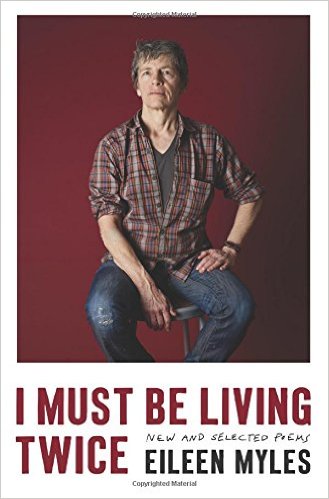


EILEEN MYLES Performer, memoirist and ‘Rock Star of Poetry’ in her only New Zealand appearance

51QYE64Zp5L._SX327_BO1,204,203,200_

I am so sad to miss this. Would some one like to do a wee write-up for Poetry Shelf please? If so email me: paulajoygreen@gmail.com


EILEEN MYLES

Performer, memoirist and ‘Rock Star of Poetry’
in her only New Zealand appearance

Reading / Q&A
Free and open to the public

Thursday 19th May 2016
5-6 PM
Owen G Glenn Building Case Room 2/057

Sponsored by the School of Humanities
University of Auckland

All Welcome

Poetry winner, David Eggleton’s seven best things to make a poem memorable

35.jpg

David Eggleton won the Ockham Book Award’s  Poetry category this year. Here are his Seven Things That Make A Poem Memorable. Gems.

1. The first thing is the poetic license, the dispensation, a poem grants allowing the poet to take liberties with language, with literary form, to yoke together like with unlike, the probable with the improbable, in a tiny space, and create a kind of explosion — sometimes thermonuclear, as in T.S.Eliot’s Modernism-defining 1922 poem ‘The Waste Land’. Virginia Woolf wrote shortly after this was published: ‘I sun myself upon the ravishing beauty of one of his lines, and reflect that I must make a dizzy and dangerous leap to the next. . .line.’

2. The second thing is the wonderfully mesmeric power of a poem’s metre, the entrancement of its heartbeat, its rhythm, its breathing, as these two lines from a Samuel Beckett poem indicate: ‘the churn of stale words in the heart again/ love love love thud of the old plunger. . .’ Allen Ginsberg shows another way the metre can memorably become stirring, march-like, uplifting, as well as amusingly sardonic, in his poem ‘Howl’: ‘buried alive in their innocent flannel suits on Madison Avenue amid/ blasts of leaden verse & the tanked-up clatter of the iron regiments of fashion/ & the nitroglycerine shrieks of the fairies of advertising/ & the mustard gas of sinister intelligent editors. . .’


for the rest of the list on The Ockham Book Award site see here

The Stories of Bill Manhire – a wee review and a wee interview – ‘I think that by and large I’ve written against rules’

bill_front_jacket__25142.1439156427.220.220.jpg  bill_front_jacket__25142.1439156427.220.220.jpg  bill_front_jacket__25142.1439156427.220.220.jpg

Bill Manhire occupies a significant position in our literary landscape — as both a poet and as founder of the International Institute of Modern Letters. As poet he is lauded on an international stage and at home was recognised  as our inaugural Te Mata Poet Laureate. As teacher and mentor at Victoria University, his outstanding contribution to our writing communities was honoured by the naming of the Bill Manhire House at IIML (April 2016). I have read Bill when he is not writing poems and have admired his clarity and elasticity of thought, but I had not read the early fiction in his recently released The Stories of Bill Manhire (VUP). Things escape us for all kinds of reason. In the 1990s, I focused on all things Italian as I wrote my doctoral thesis and missed too many local things. What a loss!

Amongst so many books I have loved, three books have really got under my reading skin in the last month: Cilla McQueen’s memoir, In Slanted Light, Tusiata Avia’s Fale Aitu, and Bill’s short stories.

Each of these books took me by surprise. Like little thunderbolts where you can feel your heart rate pick up as you read. Bill’s book didn’t cleave me apart like Kafka’s axe to the head or heart (he says the frozen sea within) but felt like the utterly satisfying thirst-quenching intake of sparkling water.  Writing that is effervescent, clear, restorative. I guess that is doing something miraculous to your parched state (a different kind of frozen sea). This is what words can do.

To celebrate this book – a short review from me and an interview with Bill.


A wee review:

The stories in this collection are gathered from The New Land: A Picture Book, South Pacific and Songs of My Life. There are previously unpublished stories, The Brain of Katherine Mansfield where you choose your own adventure, and the memoir, Under the Influence.

The writing is inventive, refreshing, surprising, on its feet skipping kicking doing little jumps.

How can I underline how good it is? As I read my way into days of reading pleasure, I squirmed cringed gasped laughed out loud sighed did wry grins wriggled on the spot leapt over the gaps laughed out loud again and felt little stabs that moved.

The stories highlight place and character, become nostalgic with detail that glints of when we were young (well for me anyway). You might move from the Queen’s visit and telling jokes to a dog named Fairburn, to a sci-fi keepsake on the tongue, to questions and answers on writing, to a dead-end job. Yes, the subjects are captivating but it is not so much what the stories pick as a starting point but how they travel. Take any story and it is a rejuvenating read. ‘Nonchalance’ for example, is like a series of postcards, travel or writing tips; or arrival tips with love and broken heart, soldiers, soldiers’ wives and the locals. You enter a realm of first things and floating elements. The readerly effects are kaleidoscopic.

To give you a taste of the book (I hope this doesn’t ruin things for you), here are some of the first and last lines. So important in a short story – these just nail it.


First lines:

Some critics write me off as just another ghost character activist, whereas I think I add up to a lot more than that.

The bishops come ashore.

Through here?

You are just an ordinary New Zealander.

The poet looks at the poet’s wife and says: You are my best poem.

He says: ‘Give me something significant.’

A slight scraggy moustache.

There are many tricks I have used repeatedly throughout my career to date, and others that I have done only really as one-offs.


Last lines:

Like a gasping in the chest.

The paddocks are left grey, stretching out to the edge of the frame.

Clouds pour across the sky and my lungs fill with air as though they might be sails.

No.

But jokes are too difficult: I’m getting someone else for that.

God bless him, and all the other poets.

That is how it is, adventure and regret, there is no getting away from it, we live in the broad Pacific, meeting and parting shake us, meeting and parting shake us, it is always touch and go.


The ‘Ghost Who talks’ made me laugh out loud with all its literary references alongside or inside the tricky business of getting ‘you’ and ‘I’ active in a story. Ha! It felt like the pronoun ghost out stalking. Then again the playful absurdities in ‘Kuki the Krazy Kea’ made me squirm with its dry wryness. Or the magician’s performance tips. Head back to the stories at the start of the book and the bits that taste a little different:  details of a nuclear winter, Ghandi’s funeral pyre, the melancholy of an empty pool, a mother colour-tinting photographs at the kitchen table. Bill enters the story to give writing tips here and there, to tilt the world a touch so you have to steady your reading feet (where next! What next!), to frame a judicious amount of missing bits, to be a little bit cheeky, to catch something provocative or lovely or poignant. This is a book I will recommend to friends.


A wee interview:


What satisfies you about writing a story?   

Pretty much what satisfies me about writing a fully-functioning poem.  There’s pleasure in the mix of surprise and inevitability, which needn’t be plot and character based. Sometimes it can just be a sense of musical completion.

I also like it if readers are given room to move and even a little work to do, and they end up feeling pleased about this, rather than grumpy. Maybe that’s explicit in The Brain of Katherine Mansfield, which is my shot at a choose-your-own-adventure story. But the best writing always invites readers to make choices as they go along. I’ve always liked Whitman’s take on the text-reader relationship: “I seek less to state or display any theme or thought, and more to bring you, reader, into the atmosphere of the theme or thought—there to pursue your own flight.”


Were there any rules you wanted your stories to obey? Or disregard? I love the way some of the stories sneak in instructions for start-out writers.

I think that by and large I’ve written against rules and tried to avoid what’s sometimes called the beige short story, of which the great exemplar is probably Joyce’s ‘The Dead’.  Glorious stuff, but . . . well, Joyce didn’t want to go on doing it, did he? Mark Haddon was writing about beige stories in the Guardian recently: ‘modest, melancholic stories, not arcs with beginnings, middles and ends, so much as moments and turning points.’  I’m a big fan of melancholy, but you read too many stories like that in a row, quiet epiphany after quiet epiphany, and the whole world starts to feel a bit insipid.

I suppose those instructions for beginning writers represent a complaint against the formulaic. What I mean is this sort of advice, which comes from a New Zealand book called How to Write and Sell Short Stories published back in the 1958:


PLOTS TO AVOID

(a)  Plots with a sex motif.

(b)  Where religion plays a dominating role.

(c)  Plots where sadism or brutality appear.

(d)  Plots with a basis of divorce.

(e)  Plots where illness or disease must be emphasised.

(f)  Plots dealing with harrowing experiences of children.

(g)  Plots dealing with politics.


And so on. Remove plots like those, and it’s hard to see what’s left.  I’m generally quite troubled by short story writing manuals, and by creative writing workshops that behave like short story manuals.


I also love the detail that catapults the reader to specific times and places  — how much did that sort of thing matter to you?

Getting the voice right in each case felt like the most important thing, and of course details are a crucial part of that.  Quite a few of the stories are really dramatic monologues, opportunities to try out some other voice or personality. That’s most obvious when they’re written in first person, but also in a strange way it’s also there in close third person.  The story called “Highlights” is third-person but it comes across in a flat, somewhat affectless voice – because it’s about a rather passive person. Anyway, the voice thing mattered to me, and I found myself trying on a range of idioms. I don’t think in general it’s a good idea to read a lot of short stories in a row, especially if they’re by the same writer, but I hope there’s quite a variety of narrating voices in the book.


Can you recommend some short-story writers?

There’s so much I haven’t read, but I’d go for Grace Paley every time.  Also Donald Barthelme and Lydia Davis. Gogol is my greatest favourite, especially “The Nose”, which I was once able to read in Russian. Early Sargeson.  Some of Ashleigh Young’s personal essays feel to me like beautifully told short stories – they just happen to be true, or true-ish. And the best of Barbara Anderson’s stories go on being brilliant – full of such sudden things. William Brandt’s collection, Alpha Male, has rather dropped out of sight, but it’s pretty fantastic – he does these wonderfully indignant, damaged narrators.


Do you have a favourite in the collection?

Probably “The Days of Sail”, though that may be because I know the back-story – it’s prompted by a covered-up assassination attempt on the Queen in Dunedin during the 1981 Royal tour.  A 17-year-old took a potshot at her from the top of a Med School building in Great King Street. Imagine if it had been successful! Dunedin would be totally on the map! Anyway, I built a rather cranky story around that fact.  There’s a nice radio adaptation that used be in the RNZ archive that I’d quite like to hear again.  It ends with a children’s choir singing “God Defend New Zealand”.


Do you find endings difficult (I have to say I loved the endings!)?    

Yes, they’re the hardest things.  I think I manage to get them right most of the time – except maybe for “The Death of Robert Louis Stevenson”, which of course is obliged to end with his death.  Not exactly a twist in the tail. Maybe the best ending is in “The Brain of Katherine Mansfield”.  Or, I should say, endings. I’ve met people who feel quite put out by the apparently brutal instruction, “Close the Book”, which comes at the close of several of the plot strands.

But “The Brain” is also about white middle-class complacency and its right-wing tendencies – so there is a “real” ending, too.  I won’t quote it, but anyone who wants to see what I mean can try to get to section 50 online, courtesy of Richard Easther and Jolisa Gracewood:   I’d also advise readers to pause on Greg O’Brien’s illustrated section headings.  There are lots of good visual arts jokes, along with a couple of depictions of C K Stead as a mad Nazi brain surgeon.


Victoria University Press page

Tusiata Avia’s book launch gave me the goose bumps

0b1eb042-a027-4f9f-bae5-5ca96dfd4ed5.jpg       IMG_3432

Fale Aitu / Spirit House Tusiata Avia, Victoria University Press, 2016

Last night I drove into the city into some kind of warm, semi-tropical wetness —like a season that no longer knew what it ought or wanted to be — to go to the launch of Tusiata Avia’s new poetry collection. Tautai, the Pacific Art Gallery, was a perfect space, and filled to the brim with friends, family, writers and strong publisher support. I loved the warmth and writerly connections in the room. I have been reading Tusiata’s book on planes as poetry now seems to be my activity of choice in the air. I adore this book and have so much to say about it but want to save that for another occasion. I was an early reader so have had a long-term relationship with it.


the launch

The room went dark and an MIT student, bedecked in swishes of red, performed a piece from a previous collection, Blood Clot. Mesmerising.

Tusiata’s cousin and current Burns Fellow, Victor Rodger, gave a terrific speech that included a potted biography. I loved the way he applauded Tusiata not just as a tremendous poet, but as a teacher and solo mother. Her names means artist in Samoan and he saw artist in the numerous roles Tusiata embodies. Writing comes out of so much. He identified her new poems as brave, startling, moving and political. Spiky. I totally agree.

Having dedicated her book to her parents, Tusiata said that it was hard to be the parent of a poet who wrote about family. When she told her mother what she was writing, her mother embraced it. She opened her arms wide. She said the skeletons need to come out. The atua. Tusiata’s speech underlined how important this book is. It is not simply an exercise in how you can play with language, it goes to the roots of that it means to be daughter, mother, poet.  It goes further than family into what it means to exist, to co-exist, in a global family. When a poet knows how to write what matters so much to her, when her words bring that alive with a such animation, poise and melody, it matters to you.

Four poems read. Lyrical, song-like, chant-like, that place feet on ground, that open the windows to let atua in and out, that cannot turn a blind eye, that hold tight to the love of a daughter, that come back to the body that is pulsing with life.

Yes I had goose bumps. You could hear a pin drop.

Fergus Barrowman, VUP publisher, made the important point that these poems face the dark but they also face an insistent life force.

Congratulations, this was a goosebump launch for a goosebump book.


Poetry Shelf congratulates the winner of the poetry category at the Ockham NZ Book Awards

OLYMPUS DIGITAL CAMERA   35

Photo credit:  F. J. Neuman


‘Stone clacks on stone

so creek lizards slither,

runnels slip through claws,

each cloud’s a silver feather.’

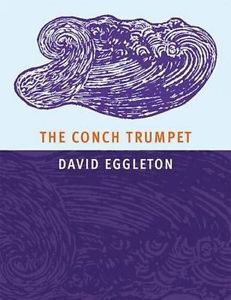
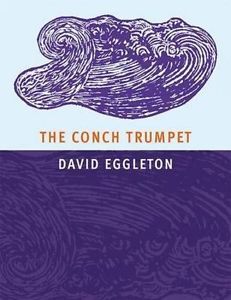
from ‘Raukura’ in The Conch Trumpet (OUP)


I was chuffed to see David Eggleton win the Poetry category for his terrific collection, The Conch Shell.

David did a wonderful interview to coincide with the publication of this book last year. He is a very fine poet who has contributed much to our writing communities.

My hearty congratulations.


from the interview:

These new poems offer shifting tones, preoccupations, rhythms. What discoveries did you make about poetry as you wrote? The world? Interior or external?

My poems like to dwell on the silver wake of a container ship, or the wet sand beneath the upturned hull of a dinghy, or the half-seen, the overheard. Poets re-arrange, but they have duties of care. X.J. Kennedy has pointed out that: ‘The world is full of poets with languid wrenches who don’t bother to take the last six turns on their bolts.’

It’s been five years since my last poetry collection Time of the Icebergs appeared, and one reason my collections have been regularly spaced that far apart is the need for more elbow-grease and line-tightening to get the burnish just so.

The poet’s mind, like anyone else’s is made up of reptilian substrate, limbic empathy and neo-cortical rationality. These shape your reveries and hopefully together lift them out of banality. Our ideas are dreams, styles, superstitions. We rationalise our temperaments, draw curtains over our windows, but poems carry an anarchic charge that reveals the force that through the green fuse drives the flower.

A poet is in the business of the unsayable being said, showing you fear in a handful of dust. A poet is amanuensis to the subconscious ceaselessly murmuring, and indeed to the planetary hum, the gravitational pull of the earth, the wobble of placental jellyfish in the womb — anything alive, mindless and gooey.

the rest of the interview here

Best first poetry book at the Ocklam NZ BNook Awards is


1411440756602.jpg  1411440756602.jpg


big congratulations go to …. Chris Tse for his very fabulous book .


Here is my review:


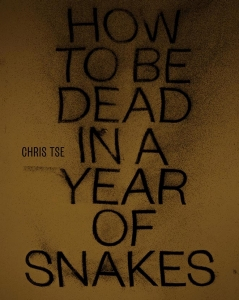
How to Be Dead in a Year of Snakes Chris Tse, Auckland University Press

Chris Tse is a writer, musician and actor whose poetry first appeared in AUP New Posts 4 (Auckland University Press, 2011). He resides in Wellington, his home town.

Chris’s debut collection, How to Be Dead in a Year of Snakes, responds to a moment in history not so much by narrating that history but by installing a chorus of voices. He takes an event from 1905 when Lionel Terry went hunting for a Chinaman in Haining Street, Wellington and ended up murdering Joe Kum Yung. Within the opening pages, the chilling event is situated in a wider context where laws proscribe the alienness that situates  Chinese as outsiders. This is what gets under your skin as you read.

The poems draw upon and draw in notions of distance, defeat, guilt and forgiveness. There are the unsettled imaginings of what it is to be home, to be at home and to be out of home to the extent that home becomes difficult and different. Mostly it is a matter of death (and casting back into life) whereby phantoms stalk and cry about what might have been and what is: ‘You spend your thoughts drowning in your family-/ missing from this vista- and contemplate a return with nothing to show/ for your absence.’

The collection harvests shifting forms, voices and tones that promote poetry as mood, state of mind, emotional residue. Yes, there is detailed evidence of history but this is not a realist account, a story told in such a way. Instead the poetic spareness, the drifting phantom voices give stronger presence to things that are much harder to put into words. How to be dead, for example. How to find the co-ordinates of estrangement, of that which is unbearably lost and is hard to tally (family, home, what matters in life). On page four you move from a matter-of-fact representation of the law to page five and the wife in Canton (‘you carry her bones in your body’). Two disparate but equally potent aches.

At times the poems are syncopated, with words stretched over little bridges of silence or white space. It adds an accumulating breathlessness. At times it feels like the intake of breath associated with the silence you grant the dead. When you stop and remember. Thus (as it appears in one poem), it also becomes static: ‘Listen: there’s a hunger in the air. It’s reciting prophecies./ It’s doubled up.’

Many lines sing out and stick as they haunt:

‘to kill a man is to marry a shadow’

‘We must divide the world around us into safety sets or else it splinters/ of its own accord into anarchy.’

‘The world is full of murder and words are usually the first to go’

‘Peace is a loose ideal for the abandoned/ left to sing their songs/ to themselves’

‘there will be voices to say your name/ to clear the way. The rest is up to you.’

There are many vessels of emptiness (the body, the head, the memory, the thing) and in a way each poem is a version of a vessel that becomes provisionally and movingly full. Just for a moment: ‘Now your onus is to surround/ yourself in objects    of your former permanence// a bone flute that stores folk songs and lullabies within,/ chopsticks that remember the taste of every meal.’

This collection shows so beautifully, so movingly, the power of poetry to give renewed presence to history; so that the silent bridges billow with a new awareness of how we get to this point.


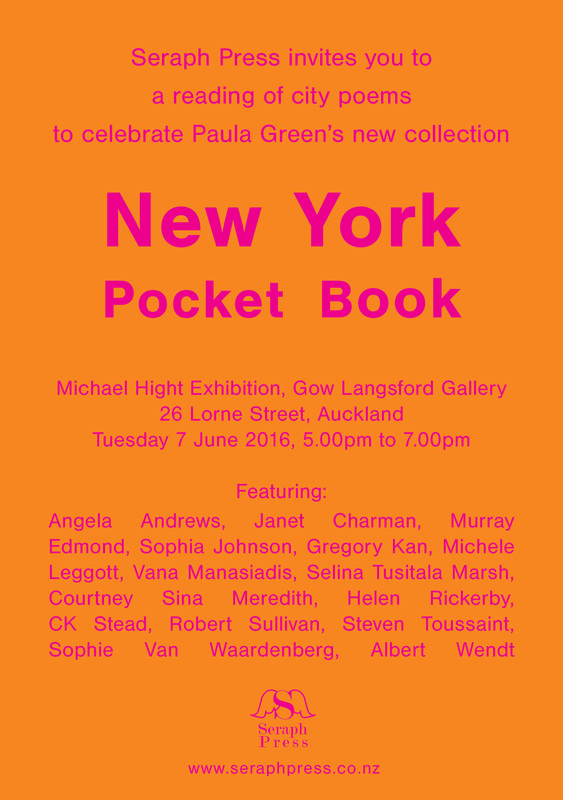
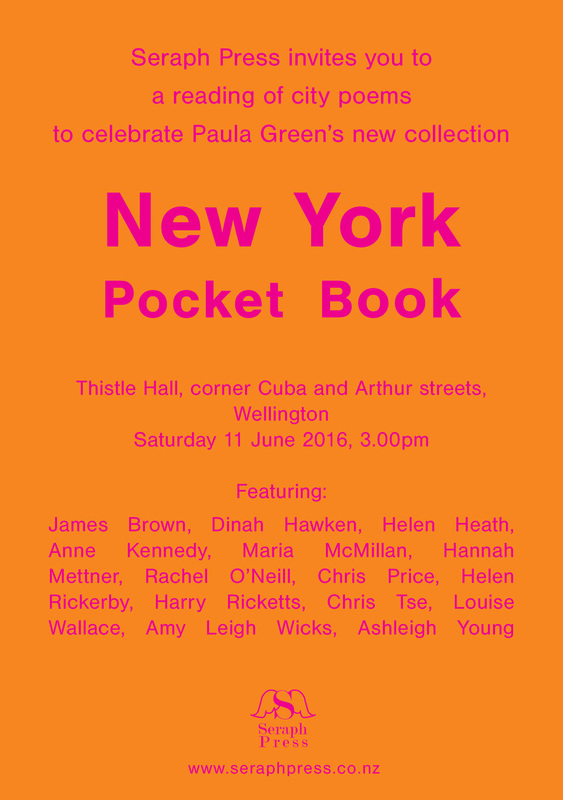
My two poetry readings to launch my new book feature some of my favourite poets

Like so many poets, I loathe people making speeches about me or my work. Much better to stage a poetry reading and celebrate the pull of cities.

My new poetry collection comes out of ten exceptional days I spent in New York with my family awhile ago. So I have invited a bunch of poets I love to read city poems by themselves and others. Big line-ups but it will free flow and leave time for wine and nibbles.

Once I got to fifteen I realised what poetry wealth we have in these places. I could have hosted another 15  in each place easily. That was so reassuring.

If I had time and money, I would have staged similar events in Christchurch and Dunedin where there bundles of poets I love too.

Please share if you have the inclination.

And you are ALL warmly invited!

Auckland:


7601147_orig.jpg


Wellington:


Auckland:2434463_orig.jpg

Tusiata Avia’s book launch on Wenesday

Invitation to Tusiata Avia’s book launch, Wednesday 11 May, 5.30pm–7.00pm, Tautai, Auckland.


0b1eb042-a027-4f9f-bae5-5ca96dfd4ed5

You are warmly invited to the launch of

Fale Aitu | Spirit House

by Tusiata Avia

on Wednesday 11 May, 5.30pm–7.00pm
at
Tautai: Contemporary Pacific Arts Trust
Level 1, 300 Karangahape Road
(Next to Artspace)

Tusiata will read some new poems and sign copies of the book.
Refreshments will be served.

About Fale Aitu | Spirit House
Tusiata Avia is an essential voice in New Zealand and Pasifika literature. In her fearless new collection, she weaves together the voices of the living and dead, the past and the present in poems that are confessional and confrontational, gentle and funny. Speaking from Samoa, Christchurch, Gaza and New York, she combines stories from myth and the everyday, never shying away from pain or wonder.

Sarah Broom Poetry Award Finalists

What a terrific list! My warm congratulations go these three women. If I can get a seat (this is a popular free AWF event!), I can’t wait to hear from your selected poems.


FINALISTS FOR THE SARAH BROOM POETRY PRIZE 2016


We are delighted to announce the shortlist for this year’s Sarah Broom Poetry Prize.

Now in its third year, the prize attracted over 200 entries from New Zealanders across the country and living overseas. This year the judge was Paul Muldoon, one of the world’s leading contemporary poets, secured in partnership between the Sarah Broom Poetry Trust and the Auckland Writers Festival.


The finalists are:

Airini Beautrais: a Whanganui-based poet, teacher, and mother of two young children, the author of three collections, including Dear Neil Roberts (Victoria University Press, 2014).

Amanda Hunt: a poet and ecologist living in Rotorua, whose work has appeared in anthologies of the New Zealand Poetry Society, online, and in newspapers.

Elizabeth Smither: a poet and novelist from New Plymouth, the author of 18 poetry collections, most recently The Blue Coat (Auckland University Press, 2013) and Ruby Duby Du (Cold Hub Press, 2014).


The Sarah Broom Poetry Prize is New Zealand’s most valuable poetry prize and aims to recognise and support financially new work from an emerging or established New Zealand poet through a $12,000 award.

Sarah Broom 1972-2013

The three finalists will each read in a free session at the Auckland Writers Festival on Saturday 14 May from 3 – 4pm in the Upper NZI Room, Aotea Centre, Auckland where Paul Muldoon will announce the winner.

ENDS


Enquiries should be emailed to: enquiries@sarahbroom.co.nz

For more information about Sarah Broom or the Poetry Prize visit www.sarahbroom.co.nz

FINALISTS FOR THE SARAH BROOM POETRY PRIZE 2016


We are delighted to announce the shortlist for this year’s Sarah Broom Poetry Prize.

Now in its third year, the prize attracted over 200 entries from New Zealanders across the country and living overseas. This year the judge was Paul Muldoon, one of the world’s leading contemporary poets, secured in partnership between the Sarah Broom Poetry Trust and the Auckland Writers Festival.


The finalists are:

Airini Beautrais: a Whanganui-based poet, teacher, and mother of two young children, the author of three collections, including Dear Neil Roberts (Victoria University Press, 2014).

Amanda Hunt: a poet and ecologist living in Rotorua, whose work has appeared in anthologies of the New Zealand Poetry Society, online, and in newspapers.

Elizabeth Smither: a poet and novelist from New Plymouth, the author of 18 poetry collections, most recently The Blue Coat (Auckland University Press, 2013) and Ruby Duby Du (Cold Hub Press, 2014).


The Sarah Broom Poetry Prize is New Zealand’s most valuable poetry prize and aims to recognise and support financially new work from an emerging or established New Zealand poet through a $12,000 award.

Sarah Broom 1972-2013

The three finalists will each read in a free session at the Auckland Writers Festival on Saturday 14 May from 3 – 4pm in the Upper NZI Room, Aotea Centre, Auckland where Paul Muldoon will announce the winner.

ENDS


Enquiries should be emailed to: enquiries@sarahbroom.co.nz

For more information about Sarah Broom or the Poetry Prize visit www.sarahbroom.co.nz