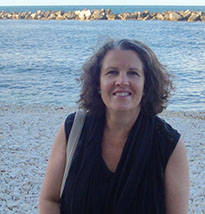
Diana Bridge received the Lauris Edmond Memorial Award in 2010 for her outstanding contribution to New Zealand poetry. She has a PhD in Chinese classical poetry from the Australian National University, received the 2015 Sarah Broom Poetry Prize and has published numerous collections of poetry. Elizabeth Smither writes: Diana’s ‘range is both local and international, delicate and down to earth, and at the same time, probing and intensely rewarding.’ Vona Groarke wrote in her judge’s report that Diana’s work ‘is possibly amongst the best being written anywhere right now– for the arresting composure of the poems, for their reach and depth, for their carefully wrought thought and language, for the beauty of their phrasing, for how they are both intellectually astute and also sensual and accessible, for the way they catch you up short and make you wonder.’ Cold Hub Press has recently published an edition of selected and new poems with an introduction by Janet Hughes. To celebrate the arrival of this astutely complied edition (selected by Robert McLean), Diana agreed to a Poetry-Shelf interview.
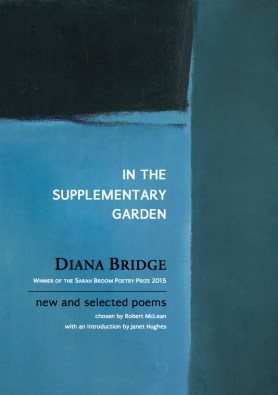
In the Supplementary Garden: New and Selected Poems Diana Bridge, Cold Hub Press, 2016
Did your childhood shape you as a poet? What did you like to read? Did you write as a child? What else did you like to do?
Well if it did, and of course it must have, then there was an awfully long incubation period. I didn’t start writing poems in any serious way until I was fifty.
By then I’d lived abroad intermittently, mainly in Asia, for over twenty-five years and had just completed an intensive study of a period of classical Chinese poetry. I’d learned to speak Mandarin and to write and read the language. I’d also begun to relish living and travelling in India. Chinese and Indian cultures had taken a bit of a grip.
So my poetry has been shaped by more than a fortunate New Zealand childhood crammed with books. But that reading certainly fed and developed my imagination and a love of fiction first, I suppose, but any writing with exciting language. I read avidly, all the usual suspects, the classic children’s books from Beatrix Potter on, anything that I came across really. I loved historical novels, especially anything by Geoffrey Trease or Rosemary Sutcliff. If I was sick a book would appear like a rabbit from a hat; an early memory is of Charlotte Yonge’s The Little Duke, which had been one of my mother’s own favourites. I ranged into fantasy, beginning with George MacDonald’s The Princess and the Goblin. Tolkein and CS Lewis must have followed soon after. My sister and I would make up, and often enact, stories of our own taken from the plots and plates of these books.
Books produced an eddy of ideas and narrative in my head, and a wonderful strangeness that ran alongside the happenings of my child’s day. This was much like the swirl of thoughts, images and language that these days prompt a poem. And in those days resulted in stories, told or written down, and sometimes composed in verse.
My Wellington childhood was filled with endless, imaginative, unsupervised play. I roamed with my sister and a gang of friends around the neighborhood – Hobson Street and the Thorndon School grounds – and, when we were older, ventured into the Tinakori Hills. There were family picnics to local beaches, Waikenae and what used to be the bush and swift running river of the Moonshine Valley. This post-war New Zealand upbringing was not a cocoon. It was protected but freeing in ways that matter. And it gave me, as it gave so many others, a secure enough basis to grab at uncommon opportunities when they came up later in life.
When you started writing poems as a young adult, were there any poets in particular that you were drawn to (poems/poets as surrogate mentors)?
I was twelve when a gifted English teacher had us begin reading excerpts from Shakespeare. I had earlier read Lambs Tales from Shakespeare, reading for the story. But now language of another dimension entered. We were asked to learn some of the famous speeches by heart. The first lines of these speeches went into a hat and we were to deliver, if we could, the speech from which it came. It was a gambit intended to fix rhythms, images, what language could be, in our twelve year old heads. I drew ‘Friends, Romans, countrymen’ but in my enthusiasm stumbled over it. This true teacher understood that I knew the lines and wasn’t about to undermine enthusiasm when she met it. She gave me a 10.
I went to University when I was just seventeen, having missed much of my sixth form year through illness and lacking a seventh form at all. I was too young but I loved it, especially the reading for English I. I met John Donne and Henry James and, with no context for either, I responded giddily to the language alone. King Lear seemed a breeze beside The Ambassadors. In my second year the incomparable Don McKenzie led us into The Winter’s Tale.
I am drawn to the way your poems make quiet demands upon the reader. There is a quiet, contemplative vein, exquisite detail and satisfying melody. What are key things for you when you write a poem?
One is not to forget that, in Emily Dickinson’s words, ‘Much Madness is divinest Sense’. I begin a poem in a state of white hot energy, which, as I get further in, generates angles and aspects I hadn’t thought of when I started. These insights impel the poem along tracks I would never have imagined and frequently drive it off course. They influence the shape a poem takes.
The entry point might be odd enough in itself. A recent poem called ‘J H Prynne in China’ ties the syntactical disruption and experimentation of one of the U.K’s most elusive poets, described on the back of his recent Poems, as ‘Britain’s leading late Modernist poet’, to a cluster of observations drawn from my own China background. I knew from the title of one of Prynne’s collections, and the accompanying Chinese poem, which I thought was written by someone else, that he possessed China background but I imagined that I was pretty much fabricating the connection. I had completed the piece before I realised that the Chinese poet’s name, Pu Lingen, was a transliteration of Prynne, and that my subject had indeed a deep knowledge of Chinese literature and the language. I believe in following your nose and probably could write in no other way. But to have what you thought you’d invented given at least some basis in fact gives a twist to the idea of ‘poetic truth’.
This account seems rather a way from quiet and contemplative. Poetry is obviously a meditational activity in itself. It requires attentiveness of a fairly high order. Without it neither insight nor language that is fresh and accurate will come up. The fact that certain of my poems start with a devotional icon, such as the Buddha, throws up the idea of a contemplative vein in my work. But part of what impels me to write any poem is having looked intently enough to generate at least a jot or two of understanding.
That said, I hanker, as most of us do, after insight, including into ‘life’ and the great abstracts. That search runs, underground or on the surface, through many of my poems.
Where, I might have asked
a few days or a few hours back, is the human face of it?
Where is the face of longing, source of sorrow?
(from’Gupta sculpture’)
But many poems are, in the words of Janet Hughes, who wrote a fine introduction to my new & selected poems, ‘mined with explosive feeling’.
As to formal demands, I was taken with something I read years ago in The Guardian’s ‘Notes & Queries’ column: ‘Stripped of set metre and rhyme, free verse still rests on the bedrock of a concentrated, structured, rhythmic expression at the heart of which is metaphor’.
With each new poem I listen hard to the rhythm that attaches itself to that particular piece. Quite often there is a fight between metre and the words I have come up with, in which case I will often look for new ways of expressing a thought. The inflection, the pacing of each individual line, are important to me. I also pay a lot of attention to how the words look on the page.
Your New and Selected Poems demonstrates the gift and range of your poetry. Looking back are there two or three poems that stand out for you? Why?
I am always interested in finding a point of connection between disparate items. In Forster’s ‘only connect’ lies a reservoir of meaning. And an ideal that, if we followed it, might help retrieve and repeal some of the situations in which human beings have placed themselves and others, to say nothing of the physical faultlines that threaten our existence. Less somberly, I’ll single out a poem that has conjunction as its deep theme. Here, it is between the sensual and the spiritual and the singular way in which they are combined in Indian culture. But it brings in, through the persona of the narrator, East and West. I hope that the poem reaches out beyond its particular circumstances, those of looking at the erotic sculptures on a Hindu temple.
The juncture wall
None of our poets knew it, this strip conjoining
the great squares of vestibule and sanctum,
this plank across to god. That was its deep grammar.
To disclose it, priest-architects devised a scheme.
They faced the wall with a cascade of figures.
On horizontal bands, in nooks, on pediments,
they spoke a ‘twilight’ language, paean and pointer
to what lies beyond; a language that the here-
and-now imagination is stood up against
and – easy to say because it’s saying it itself,
any way you read it – along, diagonally or down –
even the camera is fucked senseless.
We’re human; we go first to the faces – males
delicate as antelopes, the St Teresa look leached out,
ecstasy not so much flowered and flown as endless.
And I’d say endless, rather than repeated,
of the sinuous inventive bodies: the onlookers,
the couple at the core, the flanking figures,
straddled, spread-eagled, effortlessly yoked –
each panel branching out to make a vision
you cannot find the words for, though tradition,
like traditions everywhere, upholds ‘divine’.
We’re tourists here, lacking our priests and poets.
None of them saw it – though we wondered
about one who stocked the triple layers
of his world with story, one who dealt in passage.
The full day that we stood there, our eyes
drawn up as though to paradise, our minds
enfolded in the simple, various, blissful act
of joining, we wondered about Dante.
A line of poems that responds to the developing life of my family, with its attritions and additions, weaves its way through my work. The following poem is the latest of these. A chapter in my Ph. D. dissertation was called ‘The game element’. It discussed allusion, riddles, game contexts and codes in early Chinese poetry and traced the impact of these features on later poems. Something in the way the following poem unfolds tells me that I have kept that background alive.
A passionate possession
When I see it, I discard synapses, and the language of ignition,
in favour of a salty, dark, free-flowing liquid.
I lie, but it’s not really Plato’s sort of lie when I pursue
from that first momentary likeness a lateral kind of truth, swapping
the fizz of Catherine wheel, the vision of an asterisk, for seaways
in the brain; and then seek further watery connections
and say he is entranced and will as surely as Odysseus,
in a ship we don’t yet know the name of,
start out on enchanted forays.
Here’s the trigger: the child’s forehead billows like a sail.
Travel is a significant part of your life and many of the poems have their origins in elsewhere. What are the difficulties and rewards when you write from and to another place?
I would say that the writing, together with the understanding that process brings, has been all reward. Reception is another thing. What difficulties I have encountered cluster in one way or another around the idea of distance.
I wrote about some of the difficulties and rewards living away has entailed in an essay called ‘O to be a dragon’. To quote from a section called ‘Bridging the distance’:
‘The acquisition of distance is an essential component of the creative process and distance is, literally, what is handed to you when you leave your own country. You can look back through its lens at the home you have left behind or you can use it to examine the new place in which you have found yourself. I shone the light forward on the ground in front of my feet. I am not sure that choice was involved but I am conscious of taking a path that differs from most New Zealand writers.
I have always believed that my use of Asian repertoires was just that – a repertoire employed to pursue common human questions…But I also realised that my work held a dilemma, the dilemma of how to make the strangeness of the poems’ particulars accessible. I began to think about issues of representation and to think more urgently of the audience for whom my poems were intended. It was perhaps not enough to articulate the thought that my poems reflected a national identity and a literary community that were acquiring an increasingly sophisticated and diverse character as different cultures came forward to take their place in New Zealand society.’
Supplying notes is one obvious way to help a reader. I did that but, in a step more integrally connected to writing, felt the urge to use a less compressed and more conversational idiom. A new persona, that of traveller, entered some of the poems. Although this persona came up spontaneously, I knew it offered a way of providing information that some readers would lack, and I hoped that it might bridge a gap between my non-Asian reader and the poem.
I am not sure it has been enough. When I began to write it was from the India in which I was living; under my belt I had a Ph.D. in Chinese literature. But I was not Indian or Chinese. It was a tricky identity to accommodate and I might not have survived as a writer in New Zealand if it had not been for the support of the former Director of AUP and two of our most established poets. I was also published in several excellent overseas journals, which made me feel that I was meeting someone’s standards.
Are the poems a way of anchoring home?
I don’t think the poems were a way of anchoring home. It seemed to work the other way. Unlike those who choose to leave NZ, Nick and I were sent to various places, he to work in our offices abroad, I to be with him. Officially, we functioned as representative New Zealanders. We had regular leave in New Zealand and returned at the end of our postings. For me, each change required a re-making of my identity on the ground; but there was no conflict about choosing where to live my life. Rather I was involved in trying to comprehend, and relate to my own experience, the places in which I would live for three or four years. You could say that it was China or India I wanted to anchor in my mind. New Zealand was in no danger of slipping away.
Has one particular place resonated with you? Is there a poem that represents that?
I think people might expect me to say China, but in so far as I started writing seriously in India I would put India up there too. ‘Temple (A Sequence)’ comprises four poems in which the narrator scans the face of a colossal structure covered with carvings in the hope of learning something not just about the temple architecture of South India, or aspects of the Hindu religion and Indian culture; these are poems about being lifted into understanding more generally. Here’s the first of them:
You’re for ever looking above your head.
This time it’s a bone-white tower, a gateway,
one of six, struck like a pyramid off its base,
flung into contrast by a companion tower
still swathed in the shadow gauze of morning,
the shade where we linger, glued to its hold-
your-breath outline: the world mountain, lifted,
like your face, to the unerring blue of sky.
(‘gateway’)
Through those poems, and many like them, runs a counter-current which is the inability, no matter how much effort you put in, truly to know another culture. Images can become a bridge.
The temple’s a giant hen, small cities crowded
under her wings, people crossing her ribs, crossing
to the beat of a heart far down in the sanctum;
myth – an undertow flooding her organs.
(‘temple, close up’)
China is pervasive in my work. I began with fragments that traced the fate of friends and representative Chinese people after the Cultural Revolution, which was when I lived there. I went on to write about figures in history, poets, painters, art objects, gardens. My later work reveals a web of brief and more assimilated references. For example:
Two or more
islands were cranes, fishing companionably close.
No special pattern to cranes. But feed in, not setting
but space, as the Chinese know space, and one day
the islands rise in a spray of swallows, godwits headed
for the far rim of the earth. Readable after a fashion.
(‘J H Prynne in China’)
Things also play a significant role in your poems—as the gateway to feelings, anecdote, memory or ideas. Sometimes they simply sit centre stage in their own beautiful right. What attracts you to things? Name a thing that has particularly fascinated you and made its way into a poem.
Yes, things grab me not only for their own striking quality or beauty but as a way into a situation, a predicament, a culture. As an example, may I cite a poem set here, at my desk?
A pounamu paperweight
1
From the knotted driftwood of the carpet, where it has fallen,
it looks up, shiny as a grey-green frog half in,
half out of water. On the three-inch circle of its back,
like bruises healing, are streaks of yellowy agate. And it is true
that sometimes you can free a headache by pressing
to the places where it lurks the greenstone’s solid cooling balm.
Wisps of charcoal, brush strokes in a landscape that will never
break the surface, are sorrow’s sunken remnants.
2
In the distance, washed in silver, one of a band of children,
she plays on the flecked iridescent sand.
She is mature for six, and sensible, kind as a six-year old
is kind, artistic in her way.
In the first months of her life she howled for hours on end,
as if for hurts just shown her, and in her eyes the bleak
blank trauma of existence. Oh but she was honest with us.
The infant sadness she once harboured lies forgotten,
buried deep as veins in youthful arms.
And I no longer need, on her account, to probe dark seams
in the jade of talismans and charms.
Do you think your poetry has changed over time?
From the spare twigs of an image-dominated approach, I have become progressively more attached to syntax. I miss the spareness, though, and that lack might be what leads to a more compressed and heightened, a less than orthodox, syntax in some recent poems.
What New Zealand poets have you been drawn to over time?
I am drawn to the work of Vincent O’Sullivan and Elizabeth Smither. Along with sparkling scenarios and a wealth of lovely, thoughtful and moving lines, Vincent’s poems offer a potent model for the witty, resourceful use of personae. The freshness of Elizabeth’s vision, her altogether metaphorical way of looking at the world, constantly surprises. Then there is the course her poems take, rising into something which hits, or is very like, the sublime. Her work is replete with a humanity that draws the reader in, moves us and stays with us, achieving what the Chinese call ‘the meaning beyond the words’.
What international poets?
At university I was exposed to a mix of metaphysical and Modernist poetry. I read and still read these poets with pleasure. In the eighties I read a lot of Chinese classical poetry and wrote a Ph. D. thesis on it. I am currently combing the work of some of these poets for a collaborative translation in which I am engaged. Like millions, I adore Du Fu and could not keep him out of an essay I wrote called ‘An attachment to China’. I relish Ezra Pound’s Cathay and patches of the Cantos. There is much in him I do not relish. In the last few years I have read Geoffrey Hill. Even half-understood, Hill’s poems are immensely satisfying – far beyond what most contemporary poetry offers – and this year, following his death, I have returned to read him. I am also re-reading Seamus Heaney’s Human Chain in tandem with his beautiful posthumously published translation of the Aeneid Book VI.
What irks you in poetry?
Sloppiness and sentimentality. Obviousness, I suppose.
What delights you?
A beautiful and arresting image.
What kind of poems are you drawn to?
I like to have my mind stretched as well as to be caught by those beautiful and arresting lines or the miraculous turn a poem takes. Hence Hill. I delight in witty, even outrageous, expression, à la Vincent O’Sullivan in wicked vein.
The constant mantra to be a better writer is to write, write, write and read read read. You also need to live! What activities enrich your writing life?
We get far too many journals and in the evening I read well outside the poetry and literary commentary with which I tend to start my day. I am interested in international affairs and in the last weeks have ripped into the mountain of articles on Brexit. Early in the day I do simple yoga; I try and make time for tai ch’i and I walk in the afternoon. For the rest, it’s what everyone does: see friends, see films, go to concerts, read as many novels as I can. My two daughters live overseas and we try and combine seeing them with an excursion to somewhere else. Asia is closest and takes me back into the world of wandering among ruins devastated by time and old, occasionally recent, wars, and relishing a culture different to my own. Sometimes writing will result from the newness and stimulus of the encounter.
Finally if you were to be trapped for hours (in a waiting room, on a mountain, inside on a rainy day) what poetry book would you read?
Right at the moment I’d probably bring a beautifully produced small book called Les Dix-neuf Poems Anciens, which gives both the Chinese text and an annotated French translation of the Nineteen Old Poems, poems which date from the first and second century CE and have had an enormous influence on the Chinese poetic tradition. I had forgotten what a beguiling mix of the lyrical, the sad and the allusive they are. French scholar Jean-Pierre Dièny has reminded me. Having to concentrate on both the Chinese and French, and being rewarded with many beautiful hauntingly allusive lines – from Dièny’s commentary as well – would help keep my mind off my predicament.






 NZ Poetry Shelf