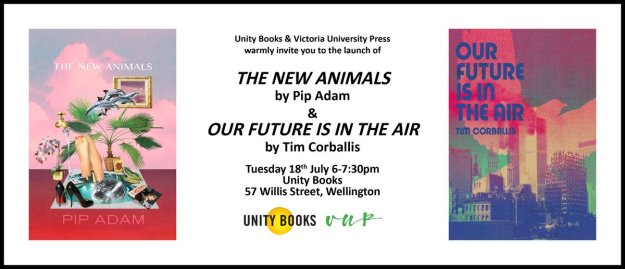
Pip Adam’s book launch at Unity Books
Leave a reply

Calling all New Zealand writers! Apply now for the writers residency at the Surrey Hotel in Auckland.
New Zealand literature’s coolest writing residency is up and running again. The fabulous Surrey Hotel – named the Best Hotel in Auckland by a well-known writer in the New Zealand Herald – has once again agreed to offer a writers residency award in association with The Spinoff.
The winner of the second annual Surrey Hotel Steve Braunias Memorial Writers Residency In Association With The Spinoff Award will be given a week’s free accommodation at the Surrey in Grey Lynn, along with free breakfast and free wifi. They will also pocket a cool $500 from The Spinoff.
There is also be a second and third prize with less nights and less money but the same thrill.
Full details and photos here
 Auckland poet Kathleen Grattan, a journalist and former editor of the New Zealand Woman’s Weekly, died in 1990. A member of the Titirangi Poets, her work was published in Landfall and other volumes including Premier Poets, a collection from the World Poetry Society. Her daughter Jocelyn Grattan, who also worked for the New Zealand Woman’s Weekly, shared her mother’s love of literature. She has generously left Landfall a bequest with which to establish an award in memory of Kathleen Grattan.
This biennial award is for an original collection of poems, or one long poem, by a New Zealand or Pacific permanent resident or citizen. Individual poems in the collection can have been previously published, but the collection as a whole should be unpublished. Entries are accepted until 31 July of the award year and must be either received or postmarked by this date. The result will be announced in the November issue of Landfall, and the winner will receive $10,000 and a year’s subscription to Landfall.
Entries to the 2017 Kathleen Grattan Poetry Award are now open and close on 31 July 2017.
The winner will be announced in Landfall 234, published November 2017.
The judge of the 2017 award is prize-winning New Zealand poet and fiction writer Bill Manhire. Manhire has won several New Zealand Book Awards, a number of significant fellowships, and he was the 1997/1998 New Zealand Te Mata Estate Poet Laureate. He was also honoured with the Prime Minister’s Award for Literary Achievement in 2007.
The award will next be granted in 2019.
The Kathleen Grattan Award
Otago University Press
PO Box 56
Dunedin 9054
New Zealand
Otago University Press
Level 1
398 Cumberland St
Dunedin 9054
New Zealand
Tel 64 3 479 4155
Email landfall@otago.ac.nz
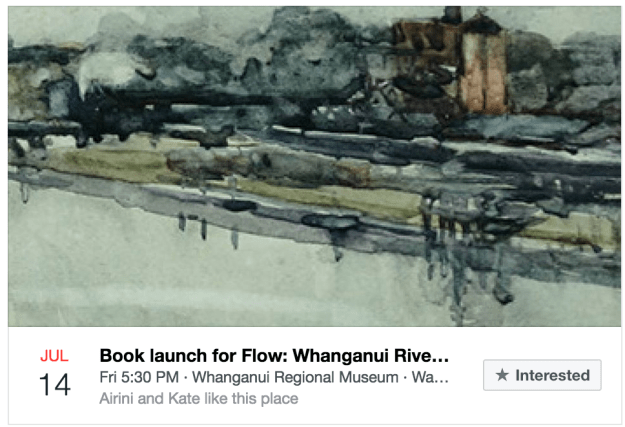
Nau mai, haere mai. Come and help celebrate the launch of Airini Beautrais’s new collection, Flow: Whanganui River Poems.
Featuring stories from the catchment, river and town.
Shipwrecks, floods, soldier-settlers, surveyors, missionaries, protests, poets, petrolheads, deviants, sly-groggers, environmentalists, heroes, anti-heroes and complicated characters.
With readings by Airini, Maria McMillan, and special guests.
All welcome. Drinks and nibbles will be served (in adjacent space as food and drink can’t be consumed in the museum. Please do not bring these items).
Accomplished poet, editor, art critic and journalist David Eggleton has been awarded the Fulbright-Creative New Zealand Pacific Writers’ Residency.
He will use the $30,000 award to complete a collection of poems exploring his Pasifika heritage. These will include poems inspired by the myths and legends of Te Moana Nui a Kiwa and will incorporate work about Mana Moana, the power of the ocean and ancient Pasifika connections.
“I hope to research and begin a prose memoir about my mother’s extended family, my cousins, scattered across the Pacific,” said Eggleton.
David Eggleton is of Rotuman, Tongan and Palagi descent. He grew up in Fiji and South Auckland, and now lives in Dunedin. Formerly a factory labourer and city council gardener, he is now a full-time editor, poet, art critic, reviewer and freelance journalist whose reviews, articles, essays and short stories have appeared in a large number of publications since the mid-1980s. These include the Listener, Art New Zealand, New Zealand Books, Art News, Architecture New Zealand, Urbis, Metro, Landfall.
“My Pasifika heritage runs all through my writing from the beginning as part of my personal context and background and I have always drawn from this heritage and history, but not necessarily overtly: instead it is there as a presence or part of a dialogue with ideas about cultural crossover,” said Eggleton.
As the recipient of this year’s award, David will be based at the Center for Pacific Islands Studies at the University of Hawai‘i at Mānoa in Honolulu for the Spring (February-May) semester of the US academic year.
Hawai‘i has been identified as a strategic location for artists and is considered the hub of Pacific writing with its numerous universities, library resources, networks, writers’ forums and publishers. It is also an important link to the mainland US and has a strong indigenous culture.
“I heard about the Fulbright residency through conversations with a number of Pasifika writers and have been aware of it since its inception, but this is now the time I feel ready to take it up and use it to allow me to develop a particular Pasifika-based project, namely to complete a collection of poems exploring my Pasifika heritage.”
The Fulbright-Creative New Zealand Pacific Writers’ Residency is for a mid-career or senior New Zealand writer of Pacific heritage to carry out work on a creative writing project exploring Pacific identity, culture or history at the University of Hawai‘i for three months. One award valued at NZ$30,000 is granted each year, to be put towards the costs of three months of writing.
Previous recipients have included poets Tusiata Avia, Karlo Mila and Daren Kamali, filmmakers Sima Urale and Toa Fraser, and playwrights Victor Rodger and Miria George.
When I was eight my parents packed me off to Little Sir Echo Camp for Girls on Lake Armington in the foothills of New Hampshire cofounded and owned by Mary Hoisington and Margaret Conoboy ten years earlier. Apparently the women chose the name because of an echo that bounces off the surrounding White Mountains. An actual child may or may not fit parental fantasies. I hated the place. Most of all I dreaded riding classes and spent many nights praying I would be assigned the tired elderly horse with a creaking stomach for the next day’s obligatory ride around the ring. On the one visiting day allowed per summer we rowed across the lake and picnicked on a secluded beach at the edge of a pine forest. I begged them to ransom me. But no. Around four P.M. they left for Boston, leaving me alone with my dread of being lost in the past; absent.
Full extract here

This terrific series edited by Guy Somerset also includes Bill Manhire and Catherine Chidgey.
To celebrate Ian Wedde’s Selected Poems, we are invited to share a smidgeon of Ian’s reading life:
‘The first book to capture my imagination was … A toss up between May Gibbs’ Snugglepot and Cuddlepie (I was scared of the Banksia Men) and Rudyard Kipling’s Jungle Books (I was Mowgli!).’
Ian’s full book shelf here
Sadly this was Guy’s last edition, but he left a terrific Glastonbury link as an adieu.

A TransPacific Poetics, Litmus Press, 2017
Edited by Lisa Samuels & Sawako Nakayasu
Thursday 27 July 530-7 PM, Gus Fisher Gallery, 74 Shortland Street, Auckland
With Murray Edmond, Ya-Wen Ho, Melanie Rands, & Lisa Samuels
Join us as we launch A TransPacific Poetics, a new collection of poetry, essays, and poetics committed to transcultural experimental witness in both hemispheres of the Pacific and Oceania. The works in ATPP re-map identity and locale in their modes of argument, resituated genres, and textual innovations. A TransPacific Poetics includes Lisa Samuels, Don Mee Choi, Melanie Rands, Jai Arun Ravine, Ya-Wen Ho, Murray Edmond, Susan M. Schultz, Eileen Tabios, Craig Santos Perez, Corey Wakeling, Lehua Taitano, Stuart Cooke, Sean Labrador y Manzano, Barbara Jane Reyes, Myung Mi Kim, and Sawako Nakayasu, with cover art by Dagmar Vaikalafi Dyck, who will also be present for this launch event.
Free & all welcome. Book copies available for a celebratory reduced price of $30 (cash only).

