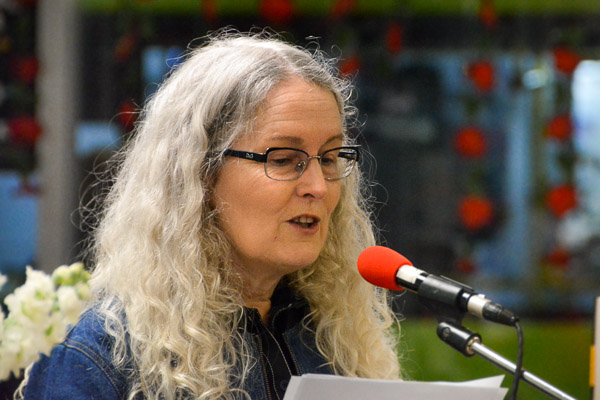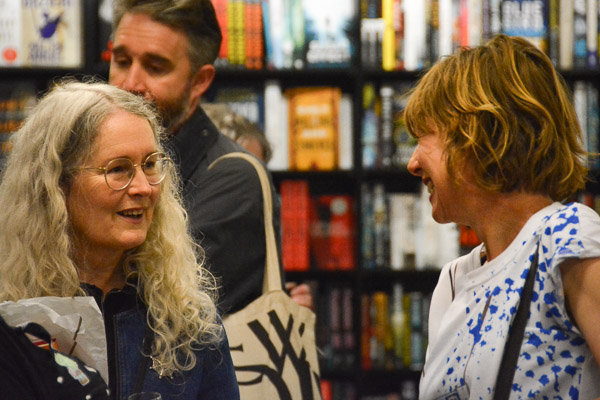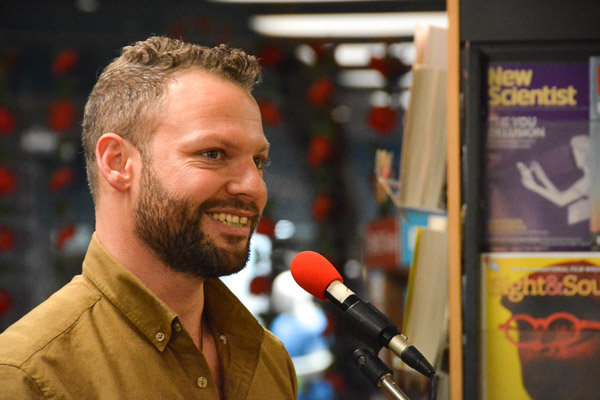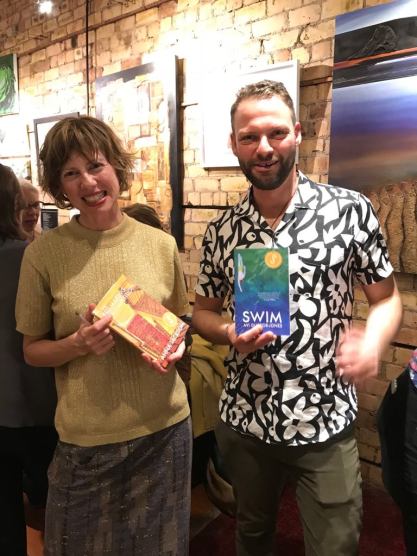
Anna Jackson with co-winner Avi Duckor-Jones at Time Out Bookstore
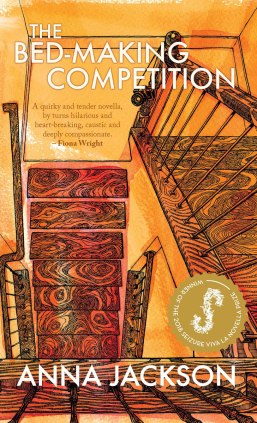
Anna Jackson recently won the 2018 Viva La Novella Prize with The Bed-Making Competition. The competition is open to Australasian writers but this is the first year a New Zealander has won – in fact two did. Avi Duckor-Jones also won with Swim. Both books were published by Australia’s Seizure Press and were recently launched in Wellington (by Elizabeth Knox) and in Auckland (by me).
I adore this book so it gives me great pleasure to share our launch speeches.
from Elizabeth Knox at Unity Books, Wellington:
Tena Kotou katoa
I am delighted to be launching Anna’s prize-winning novella The Bed Making Competition. I’m a fan of novellas, a lovely, free, slippery form, partly because no one has yet decided what a well-made novella is supposed to look like, whereas there are plenty of confident and confidently expressed opinions about novels and short stories. Like novels, a novella tells a sustained story, but in a way that somehow makes it more permissible to leave things out. The Bed Making Competition gives us five chapters in the lives of two sisters, Brigid and Hillary. Each chapter is a point of shared or solitary personal crises—solitary in the case of Hillary’s Goldilocks episode at a flat in Christchurch. The longest chapter is the duration of a pregnancy, the shortest a single day and a little run of events that consolidates a character, a relationship, a world view. Years intervene between each of the episodes—for instance Brigid is pregnant with a first child in the central one, then has two growing children in the next. Over and over I had the pleasure of surprise in coming back to the small configuration of sister, friends, parents, partner, children and seeing the changed circumstances, and changed selves, and the work of an almost Elizabethan sense of fortune in their lives—fickle fortune, an artist of whimsy and unease. I kept wanting to know more, and having to intuit much, and being rewarded by the book’s feeling for the mysteriousness of what happens to people over the course of a lifetime. These characters make their beds and have to lie in them; they move their beds around to make room for more beds; they climb into bed with a beloved sister and are as happy as a puppy in a basket; or they find themselves in the wrong bed in the wrong house, or bedless at bedtime and sitting on a suitcase.
This is a book about a sibling relationship. All sibling relationships entail some degree of competition. Hillary and Brigid for the most part aren’t competing for anyone else’s attention—maybe a little for Brigid’s best friend Julia, and Brigid is ever ready to cede even a best friend for a sister’s needs—but never for their parent’s attention—and always for each other’s. I could say that the novella charts a power relationship between sisters, except “power relationship” doesn’t quite describe the oscillations in their orbits of each other as the gravity of one becomes greater than the gravity of the other, and then swaps back again—back and forth over half a lifetime. The Bed-Making Competition is essentially about this dance, Hillary and Brigid circling each other, taking turns at being the heavier gravitational body. The younger sister waits for the older to come out of her bedroom and listen to her story, waits to have mysterious things explained to her, or for a lead in how behave with their parents, how to feel about being left by mother and father, and with father’s credit card. Later each waits for the return of remembered moment of glorious closeness. The novella gets that sense of loving too much, or of not being loved enough, that rises and falls in relationships between sisters. It gets the necessity of wooing a sister. Of all other relationships changing at the sudden presence of sister who has been absent too long. It gets being asked to be responsible, to manage a sister’s crisis for the happiness of helpless and aging parents, to manage it as if there’s some managerial magic in just being a sister. What the book doesn’t do is resentment, or disavowal—”I am not my brother’s keeper.”—only the helplessness of being able to do only so much.
This is a book very much about the changing nature of strong relationships. And it’s serious about those things, but serious with lightness, and an appreciation of mess, mayhem, oddity. The characters in this book never complain, they’re observant, rueful, they have notions about how to improve their lot – often peculiar and experimental notions.
The story is book-ended by abandonment and death—a mother runs away, followed by a father trying to retrieve her—and then then, in time, that mother is on her deathbed. The meaningful deathbed exchange the mother and daughter have isn’t about the past, but a conversation conducted as if both of them have a present and future. The scene is so true to the book’s understanding of people, and true to life, I found it really moving. This book is moving, and also productive of anxiety. I really worried about the characters at various points. Books that make me worry about their characters are my favourite kind of books. The Bed Making Competition is a fine example one of those, a book that mostly caresses its readers and smooths their fur and sometimes startles them into electrified wakefulness by brushing their fur up the wrong way. So, welcome everyone to this caressing and startling book. And thank you Anna.
Elizabeth Knox
from Paula Green at Time Out Bookstore, Auckland:
Kia ora koutou katoa
Last night I had a poet anxiety dream about launching this book. I am extremely glad I am not standing on this stepladder in a crumpled cotton dress and muddy gumboots. And I have a little speech written on this piece of paper that I haven’t left it at home.
Auckland University Press launched Anna’s terrific Pasture and Flock: New and Selected Poems earlier this year – a book that reveals a poetic curiosity in the world, lilting lines that absorb sumptuous detail, intimate attachments to people, places and ideas, an enviable ability to make words and thus poems move and surprise. I loved it.
What a treat to share Anna’s award-winning novella with you this evening when it delivers such similar joys. This is a book of two sisters, Hillary and Bridgid, two shifting voices that we follow through chronological and geographical jumps. The narrative exposes fragility, envy, attachment, yearnings, detachment along with various internal aches and hungers when life throws you off kilter or keeps you on some kind of vital track of living. As teenagers for example the two sisters get inebriated, drink champagne on swings, thrash the credit card, when the father goes in pursuit of the mother who has walked out. They get to eat pizza without salad.
There is so much to love about this book, this small package that is rich in effect.
I adore the way voice pulls you through Anna’s textured writing: it builds character, scene incident, development, and most importantly sister relations.
The details are both sensual and sumptuous: whether of food clothes people or setting. They establish an architecture of the domestic, of family, that is both intimate and revealing.
Little scenes stand out: such as in the art gallery where the prices and titles of Bridgid’s work get mixed up in her small corner of the gallery. Her partner gets most space.
Larger scenes stand out such as when Hillary goes to stay with Bridgid in London. Or the Goldilocks scene in the flat in Christchurch. But you have to read these for yourself!
I was hungry for this book as I read it. I am reminded of reading the honeyed fluency of Katherine Mansfield or Virginia Woolf. The way the novella resembles stream of consciousness but it is ever so beautifully and distinctively crafted. You get caught up in the writing currents and you don’t want to stop reading. It gives me great pleasure to declare this gorgeous book launched and to invite you to read it yourself. Congratulations on the award Anna and on this immensely satisfying read that startles and surprises as much as it draws you into points of recognition.
Paula Green
Some photos from the Unity Book launch