for Felix (1981)
a black shawl over a chair
& the corner
composed itself.
the light came from outside
& delayed/on the
delphinium
& behind the oak trees
1 2 3
a grey stripe
is a tennis court
& men have
white shirts only
& sometimes
arms
while the ball
flying/occasionally
thru trees
keeps the moon
in motion.
Joanna Margaret Paul
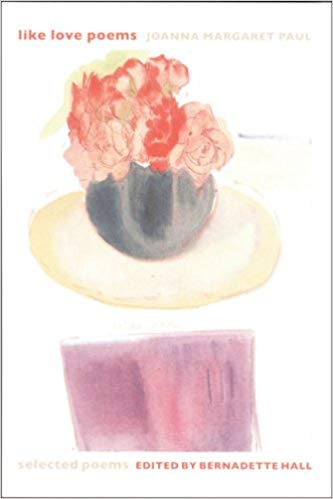
from like love poems: selected poems (Victoria University Press, 2006)
Posted with kind permission from JM Paul estate
Robyn Maree Pickens:
Recently I had the opportunity to write a review of Louise Menzies’ exhibition In an orange my mother was eating at Hocken Collections, Dunedin for The Pantograph Punch. Menzies, the 2018 Frances Hodgkins Fellow, produced an exhibition that foregrounded overlooked works by three artists, Frances Hodgkins, M.C Richards, and Joanna Margaret Paul. Of the three artists Paul seems to have been the most influential. This is evident in the enigmatic exhibition title In an orange my mother was eating, which is itself the title of a poem by artist and poet Joanna Margaret Paul (1945-2003). Published in 1981 on the occasion of the exhibition Mothers at the Women’s Gallery in Wellington, the poem records a dialogue between Paul’s daughter Maggie, and her friend Charles when they were five years old. In this poem Maggie and Charles spark off each other all the possible places they could have been born, including: “in a mirror / in a hot fire / in my gym / in my brain / in your hat.”[i] As engaging as this poem is—showing Paul’s attunement to and valorisation of her children’s world—I want to discuss another poem by Paul, one that invokes her interdisciplinary practice that included poetry, drawing, painting, photography, and film. The poem I have chosen is called for Felix and is published in like love poems edited by Bernadette Hall (Wellington: VUP. 2006, 99).
I chose for Felix because this poem has an extraordinary poetic breadth. While it is decidedly and primarily a poem, for Felix could also be a cinematic vignette, a black and white photograph, a series of graphite drawings, and a loosely gestural painting.
The corner is agentive; it has composed itself with a black shawl over a chair. In contrast to the black shawl, daylight is introduced and delayed on the slender stems of blue flowers and oak trees. From inside, the poem looks out to a tennis court in the distance (a grey stripe). The sport evokes male tennis players who again are viewed from a distance (& sometimes / arms). This distance, and the object and arc of the tennis ball lend their likeness to the moon, which Paul figures as batted between spheres, or tennis players. Paul charts this course from corner to cosmos with incredible lightness, a few sure brushstrokes, a gently panning shot. This lightness is accented formally with the short lines, lower caps throughout, ampersand symbol, forward slash, numbers, and a casually abbreviated word, “thru.”
I chose this poem partly in sympathetic response to a comment by arts writer Eleanor Woodhouse, who in a recent article primarily on Paul’s experimental film wrote, “yet the effect of dispersed critical attention—a little within the field of literature, a little within art, a little within film—isn’t additive; perversely, the effect is even subtractive.”[ii] Woodhouse’s observation—that writing done in silos on an interdisciplinary artist can be diminishing—has stayed with me. And I am conscious that writing about Paul’s poetry in a poetry forum could also be problematic. That is why I chose for Felix for its potentially “interdisciplinary” qualities, and gestured towards other possible resonances of this poem in other mediums. But it is only a gesture.
Paul was an interdisciplinary artist from the early 1970s to her premature death in 2003. In the early decades of her career she was “interdisciplinary,” or postmodern, before such a position was recognised and understood in New Zealand. This is partly why her presence is under-recognised in all the disciplines she worked in and across. Also she was a woman. In her introduction to Paul’s poems (to return to this particular discipline), editor Bernadette Hall writes:
The academic and literary worlds of the 70s were dominated by brilliant young men for
whom women might well be the Other, the Lover, the Muse. But not the Poet. Attempts
to express real womanly experience or the domestic were most likely to be sidelined as
trivial, hysterical or hormonal.[iii]
Paul was triply marginalised, as a woman, a boundary-crosser, and for her predominately everyday subject matter. This short piece introduces one of her poems and makes an attempt to validate a multi-disciplinary artist who has been neglected from several canons because she didn’t fit the circumscribed model. Call it another (small) effort towards feminist retrieval and recirculation.
[i] From In an orange my mother was eating, a digital video work by Louise Menzies in an exhibition of the same name. Hocken Collections, 16 February – 30 March 2019.
[ii] Eleanor Woodhouse. “The Transcendent and Domestic in Joanna Margaret Paul’s Films.” Contemporary Hum 19.04.18. https://www.contemporaryhum.com/joanna-margaret-paul-film-programme
[iii] Bernadette Hall. like love poems. Wellington: VUP (2006): 10.
Robyn Maree Pickens is a PhD candidate in ecological aesthetics at the University of Otago. Her poetry is forthcoming in Peach Magazine and has appeared in SAND, Cordite, Plumwood Mountain, Matador Review, Jacket 2, and at ARTSPACE. Her poetry criticism is forthcoming in The Adroit Journal and has appeared in Rain Taxi and Jacket 2. She was a finalist of the 2018 Sarah Broom Poetry Prize judged by Eileen Myles, and winner of the takahē Monica Taylor Poetry Prize 2018.
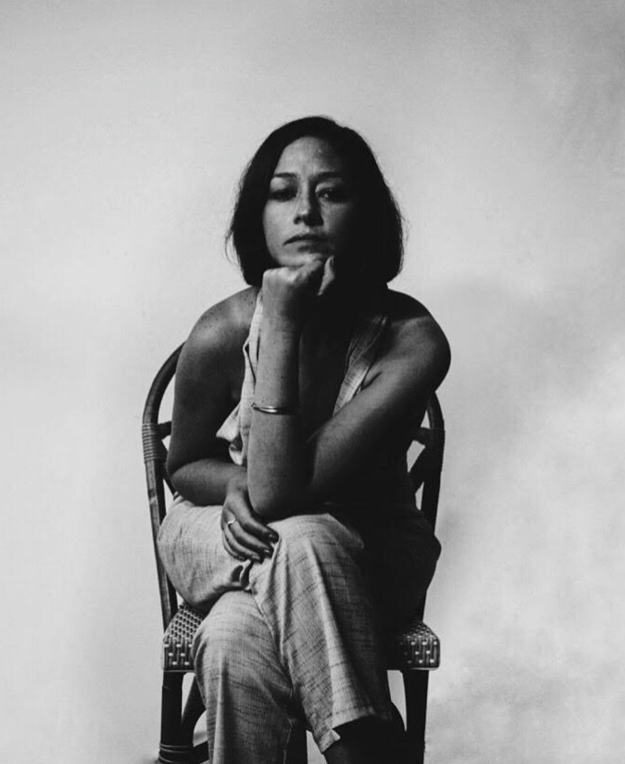
Joanna Margaret Paul (1945-2003), poet, painter and experimental filmmaker, was born in Hamilton. She graduated from the University of Auckland with a BA in Philosophy and English, and Elam School of Fine Arts. She was awarded the Frances Hodgkins Fellowship (1983) and the Rita Angus Residency (1993). During her lifetime she published several poetry collections while a range of her poems were showcased in the posthumous like love poems, edited by Bernadette Hall. Her debut collection Imogen was awarded the PEN Best First Book Award for Poetry. (1978). After her death the Wellington City Gallery exhibited her artwork in Beauty, even 1945-2003 with an accompanying book of poems.
Victoria University Press author page