
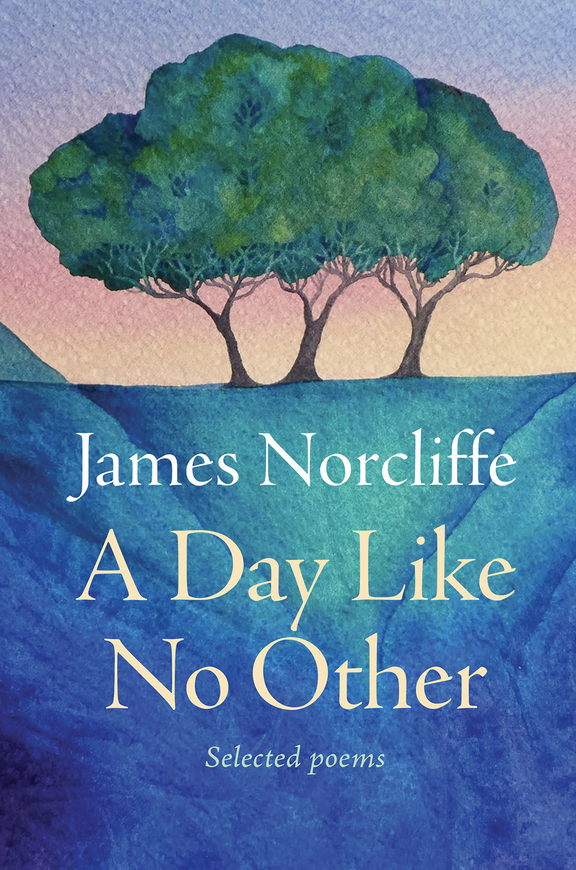
A Day Like No Other: Selected Poems, James Norcliffe
Otago University Press, 2026
Treatment
for Ted Pearson
the clouds are moving
with surprising speed
in the window that is a lake
leaves are floating
the acupuncturist
so lightly holds my wrist
I am a centre of stillness
my wrist is a trout
the clouds like days
race across the leafy lake
somewhere a fin flickers
as regularly as a pulse
I float in the still shadows
soon I will tell him everything
James Norcliffe
from A Day Like No Other: Selected Poems
originally published in Letters to Dr Dee (Hazard Press, 1993)
Otago University Press has celebrated the poetry of James Norcliffe in A Day Like No Other, a lovingly designed, hardback edition of his selected poems. This is a gorgeous book to hold in the hand, with its feel-good paper stock, the beauty of the internal design and the choice of font. The poetry has room to breathe on the page and this makes such a difference.
Reading this collection, slowly over the course of weeks, is to savour myriad fascinations, reflections, observations. Things move in and out of view, stillness and silence as resonant as darkness and light, the strange and the ordinary. Humour. Wit. Especially humour and wit. I kept jotting down things to quote you, similes that hold my attention, the lyricism of a particular line, the allure of a gap. Imagine stars set like teeth in a rat poem. Or what a cow is to believe’. Or a willow tree that ‘was a prayer in the still air’.
To have a publisher pay such loving homage to a much loved poet, is a very fine thing indeed. this is a book to treasure.
Paula: I loved reading the selection of your poetry gathered from across the decades. I was drawn to the ongoing lyricism, the connecting fascinations, the wit, the humour, the acute observations. This could be the focus of a whole book on my part, but can you share any highlights, epiphanies, discoveries, challenges?
James: When Sue Wootton of Otago University Press suggested the possibility of doing a selected to me, I was delighted with the idea, especially as it offered the opportunity to revisit earlier work and bring to the light poems from books long out of print.
I was even more delighted when Sue explained that she envisioned a book with beautiful production standards, in hardback and with a ribbon. And, of course, she delivered in spades. I think it is a beautiful book.
One difficulty soon presented itself: there were an awful lot of poems to consider from eleven or so books.
When Joan (my wife Joan Melvyn co-selected with me) and I gathered together the poems we especially liked, there were, of course, far too many! My eyes far too big for my stomach. Sue was patient and explained the difference between ‘selected’ and ‘collected’. We needed to cull, but that became a very useful if sometimes painful exercise, forcing us to crystallise the criteria for selection. Among these were personal favourites, poems with specific resonance, poems that best demonstrated what was a James Norcliffe poem, poems that had been especially well received by audiences and readers, and poems that represented the whole range and breadth of the work, the aspects you list so kindly in your second sentence. Thus the selection with Sue’s assistance, became more of a distillation. I’m very happy with the result.
One problem we couldn’t overcome was that I have written a number of lengthy sequences over the years. I’m rather with Edgar Allan Poe that a long poem is a contradiction in terms, but I square that circle by writing shorter poems and stitching them together. I like the sequences but it would have been too extravagant to include them.
Perhaps the most cheerful discovery was how well so many of the early poems still stacked up given my more critical elderly eye.
Paula: We will have to go back to your books and hunt out the sequences. Spend time with the rewards of the long extended poetry breath. A different but equally satisfying pleasure for poetry fans.
Do you think anything has changed as you hold your writing pen? What or how or where or why you write poetry?
James: Not really. Poems usually come as fleeting visitations and I’ll try to catch a line as they flit past and write it down. I’ll then work at it and sometimes something develops. Sometimes – wonderfully – a whole poem will come at once, but this is rare. I don’t ever sit before a blank page to try to write a poem. It has to develop from a prompt of some sort: an image, a word or combination of words, a memory, something I’ve seen. This hasn’t changed really. I often quote the surrealist artist, Joan Miro, who once described drawing as ‘taking a line for a walk’. In many ways, for me, poetry is taking an idea for a walk. I love it when that walk takes me to strange or quirky places.
Why do I write? I’ve always wanted to. Now while it’s something that gives me great pleasure, it’s also something I feel compelled to do do, and I get such a buzz when I read a new poem and know that it works.
Paula: Walking has been such a aide for writers. It was for Blanche Blaughan. I get a sense of it in Michele leggott’s work.
I love how, from your early poems onwards, there are philosophical undercurrents. Whether it is the philosophy of soap or what a cow is to believe or, as fossils are scraped from the beach rocks, “to teach our children / the difficult meaning / of togetherness” is paramount. These over-and-undercurrents of ideas are gold. I particular love ‘The Visit of the Dalai Lama’ where the battered man (“life / has battered him / as a fish is battered”) is also doing the bright-side not-bad response: “papering himself / around with a warmth // that could steam windows”. Ah, I held this precious poem close.
What matters when you are writing a poem? Or to rephrase, what do you want your poetry to do? Can you choose an early poem you especially love and then a newer one to share with readers here.
James: The Bob that ‘The Visit of the Dalai Lama’ is dedicated to was an uncle of mine whose life was a succession of misfortunes and tribulations – rather a Job-like figure, but who through it all who maintained a sense of grace and warm humanity. The fish and chip analogy seemed to work on so many levels. I’m so pleased it spoke to you.
If I understand what you’re implying, it’s my hope that the poems express themselves without telling something or finger wagging. The poetry I most enjoy is layered, subtle, and often with playful ambiguity. I really hope that my poems often do the same.
I love finding odd juxtapositions that shouldn’t work, but do.
A couple of poems, early and late, that may demonstrate this would be ‘Treatment’ as you mention below and begin our conversation with, and secondly, ‘Four travellers in an Austin Maxi’, a poem dealing with memory and misapprehension.
Four travellers in an Austin Maxi
They sang it in the navy-blue (or brown?) Austin as it climbed over
the mountain.
They sang it on the white road through the gloom of the beech forest.
The white dust – or perhaps it was brown – billowed behind.
Sometimes I joined in: O Veederzane! Sweetheart!
A strange and haunting name, the promise of an impossible love, like
Marlene, like Mercedes under a lamplight in European mist.
One traveller remembers a road littered with handbags, another
antlered creatures in the trees, the third recalls the pink hot-water
bottle growing cold, the fourth remembers an idea.
A girl named Goodbye.How many times did I dream of her before I
said hello to you?
The sky would know. The blue sky – or perhaps the brown – the lost
sky somewhere high above the dust.
James Norcliffe
from A Day Like No Other: Selected Poems
originally published in Letters to ‘Oumuamua (Otago University Press, 2023)
Paula: So many poems to enthuse over. I love ‘treatment’ – so lyrical, so spare. It reminds me of the power of silence in a poem, the resonance of the gap, the unspoken. There is a sweet sway between movement and stillness, almost yin and yan veering in mind the scene is an acupuncturists. For me, it’s a poem rich in ideas and in feeling.
I float in the still shadows
soon I will tell him everything
Do you feel you signal and signpost rather than confess and expand upon the deeply personal.
James: I like ‘treatment’ very much as well, especially the unexpectedness (I hope) of the final couplet and the pulling together of images prompted by the somnolent state induced by lying silently on a clinic bed on a warm afternoon with a picture window to look out of.
I do of course have strong feelings but I prefer in my poetry to express these slant. To hint and suggest rather than shout – or whine. Deadpan, again, I guess. Images and figures can do much of the work and ambiguity. I do like poems that are layered this way.
Paula: I also love the recurring motifs. Especially frogs! Especially sky hills wind water. Do you find comfort in certain things finding their way into your poems?
James:Things do recur, sometimes too often. Joan often culls the white moons! But, yes, certain images and motifs become part of your idiolect, your personal language, and they’re worth embracing. We live in a part of the world surrounded by hills and water, wind from all directions and often astonishing skies. It’s one of the delights of Aotearoa and one shared by so many New Zealanders. I should add trees and birds as well – I’m a tree buff – and trees and birds regularly find their way into the poems, often as the main feature.
Paula: Two poems struck me deeply in these heartbreaking days: ‘The attack on Baghdad’ (where black peaches fell from the tree staining the sand with peach blood), and ‘How to dress for peace’. How do we write in these war-hungry times? Are you writing poetry as protest or solace or both?
James: These two poems were ones where my heart was more openly on my sleeve and they do resonate with people. ‘The attack of Baghdad’ has especial salience right now given the lunacy of the assault in Iran and it didn’t surprise me that Steve Braunias chose it to represent the book in Newsroom.
Several years ago, I read ‘How to Dress for Peace in Medellin, Colombia’ at the Twentieth International Poetry Festival which was dedicated to peace – unsurprisingly after the Pablo Escobar years. The poem was very well received.
Interestingly, my first published poetry was very politically involved. I wrote satirical pieces for an alternative little magazine called Kobald which had set up as a slightly subversive response to Canta, the official student magazine, at the University of Canterbury. They were little squibs, really, and also with the NZ Monthly Review, a left wing journal I subscribed to. A fellow contributor was David Eggleton. This was at the time of Vietnam so there was a lot to be political about. These days I don’t write such politically engaged work. Perhaps I ought to. I don’t hold with poets being unacknowledged legislators, but I do think we should bear witness. These are, as you say, war hungry times and also full of shouting and finger wagging. Poetry is better equipped to be more subtle, reflective, I feel.
Paula: Yes to bearing witness. I think Poetry Shelf hosts political nunces alongside protest placards. Are there particular poets that have sustained you, as you navigate poetry as both reader and writer?
James: I do read a lot of poetry. There are a number of poets, both classic and modern, I return to, probably because of the way they use language and because they have written poems I would love to be able to write – among the moderns and among dozens of others I might mention Derek Walcott, James Tate and Charles Simic, but honestly I could fill pages with names.
Paula: If you were able to curate a poetry reading inviting poets from any time or place who would you line up?
James: Oh, goodness. It would be a disparate bunch! I’d have to cut it down to half a dozen or so or it would go on all night.
How about John Donne, William Blake, Emily Dickinson, Sylvia Plath, W.H. Auden, Wallace Stevens, and Pablo Neruda. I’d like to squeeze in Yeats and a couple of hundred others.
Paula: I’m justr picturing the event. Wow! I find our poetry communities are thriving, despite the scant visibility in media or at festivals (Featherston is a notable exception). I love The Canterbury Poets Collective, the way it celebrates poets and poetry, both locally and from elsewhere. Exciting. Any thoughts on life as a poet in 2026?
James: The CPC is still going strong after more than thirty years and as popular as ever and locally, too, Catalyst and Common Ground have regular poetry events. Sudden Valley Press and Cold Hub Press maintain an extensive poetry list and local mags range from the venerable Takahē to Quick Brown Dog from the Hagley Writer Writers’ Institute. And for younger writers there is the Write-On School for Young Writers and of course the ReDraft series for young writers – national but based in Christchurch – has just published its twenty-fifth annual collection. To add icing, there is the wonderful Scorpio Bookshop with regular poetry launches. So, all in all, poetry is in good shape down here. As part of this environment, I find it hugely stimulating. Poets here are very supportive of one another and of their work and also keen to help up and coming writers find their feet.
Paula: Poetry has been such an important activity for many of us, whether as readers or writers or both. What else gives you comfort, stimulation, mind and heart boosts?
James: Family first, of course. We have a wonderful family, some alas overseas which is bittersweet, especially in these current times. Then there’s our garden: it’s large but still manageable, just, and so good for the soul. We enjoy travelling and discovering new places and connecting with new people and reconnecting with old friends. And images and ideas still flit past from time to time and I’m still adroit enough to grab some of them. It’s all rather lovely.
Paula: Thanks James. I raise my glass to your terrific selection of poems, so lovingly produced, so lovingly written over decades. It is poetry book I treasure.
James Norcliffe is a poet, children’s writer, novelist and editor. He was awarded the 2022 Prime Minister’s Award for Literary Achievement in Poetry and has published 11 poetry collections, most recently Letter to ’Oumuamua (Otago University Press, 2023). He is also the author of 14 novels for young readers, notably the award-winning Loblolly Boy series, and his first adult novel, The Frog Prince (RHNZ Vintage), was published in 2022. Norcliffe has a long association with the Canterbury Poets’ Collective, takahē, the ReDraft anthologies and Flash Frontier.
Otago University Press page

