
from ‘The mountain-daughter’s last years’ in Over There a Mountain, Hoopla Series, Mākaro Press, 2018
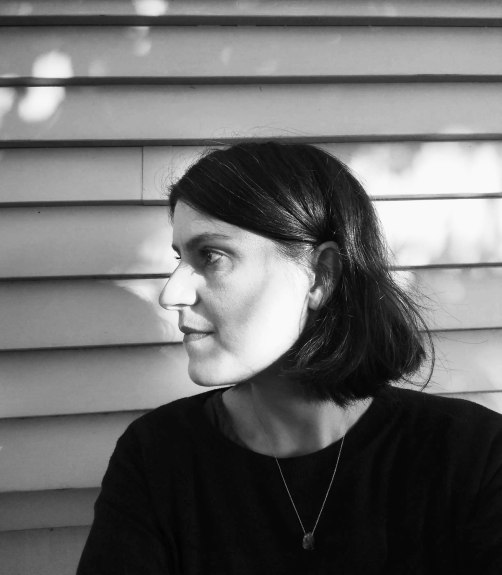
Elizabeth Welsh is an academic editor, poet and short fiction writer. Over There a Mountain, her debut poetry collection, was published by Mākaro Press in 2018 as part of the Hoopla series. Her poetry and short fiction have been published in journals and anthologies in both New Zealand and the United Kingdom. In 2012, she won the Auckland University Press – Divine Muses emerging poet prize. She lives in Titirangi with her husband and daughter.
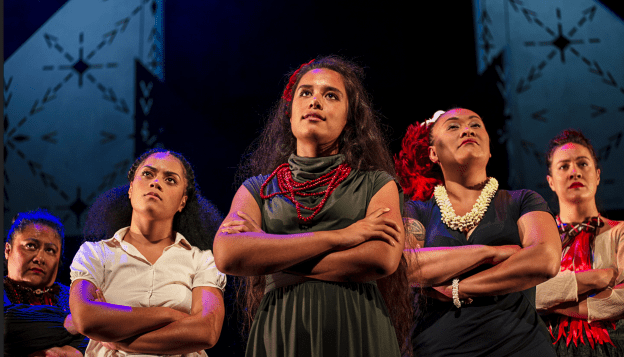
Photo credit: Raymond Sagapolutele
Last night I went to the opening night of Wild Dogs Under My Skirt (a Silo Theatre production) after a collision of a day (no not trucks and cars like last year) and was feeling like a wet dish rag. I had a lively poetry conversation with Vana Manasiadis as I ate tasty falafels in the Q theatre café before the show. And that felt good. My Wild Heart page proofs were back home looking amazing but demanding every inch of me for the next ten days. I was wondering where my next foot would go.
I am sitting in the dark when five women appear on stage; they sing and move and welcome us into the space and connections of their performance: the full cast (one is unable to make this season) is Vaimaila Urale Baker, Saane Green, Petmal Lam, Stacey Leilua, Joanna Mika-Toloa, Anapela Polata‘ivao. I have goosebumps. Their voices instil the room with exquisite musical harmony – a singing threshold that transports us into an hour or so of discomfort, pain, warmth and much laughter.
Tusiata Avia’s debut poetry collection, Wild Dogs Under My Skirt, has been with poetry fans since 2004; it has inspired young Pasifika women to tell their stories in poetry vessels, it has inspired poets to perform from the heart, to allow darkness and risk and edge. It has inspired us to write poetry that makes us laugh and weep at the same time. It is an Aotearoa classic and it is much loved.
The Wild Dog performance, steered by experienced and much lauded director and actor, Anapela Polata‘ivao, is simply astonishing. You are taken into the pages of a poetry book and then carried beyond, you are whisked on the lyrical echoes and gestures of a Tusiata performance and then born into the theatrical space and the wider world.
There are gods and wild dogs and the talk of sex and aunty’s advice on how to be a good Samoan girl and corned beef and chop suey and the tied up hair and the image of Jesus and always Jesus and the size of feet and a personalised alphabet and still Jesus and the palangi man and the dancing women and the dusky maidens and more sex and the women – always the women, how I love these women – poking fun and being deadly serious and strong.
We are taken into the raw and exposed and cutting and loved and beloved lives of Samoan women and for many in the audience it is a searing hit of recognition.
For me in white skin – my dish rag skin – it is a hit of pain – the influenza, the intolerable shootings, the shoddy treatment by NZ, the shame and but and and
it is also an utter uplift through the joy of words –it’s what Tusiata and the actors can do with words that transform your skin and heart and gut because they dance and they bite and they etch indelible stories on your legs and arms as though we are poetry tattooed.
Six chairs, props to a table or a church or a desiring man, become part of the poetry – for there is always poetry, intricate and moving. The live drums enlivening (Leki Jackson-Bourke), the soundtrack enlivening, the dancing bodies prompting rollercoaster emotions.
And the final piece, the fierce wild dog ending, the women growling teeth bared, cutting opening the issues that have shaped them, the love and the violence and place to call home, offering the bloodied past, the familiar home ground, the love that binds, the love that binds women, the love that stands proud on this stage and sings out. Fiercely.
The song ‘Telesa’, composed and sung by Aivale Cole, is the end note – haunting, reverberating. Our bodies become echo chambers for every word, every gesture we have just absorbed. I feel like I have had a blood transfusion. I feel like I can take the next step.
Thank you, thank you, thank you.
You wan da Ode?
OK, I give you
Here my Ode to da life
Ia, da life is happy an perfek
Everybodys smile, everybodys laugh
Lot of food like Pisupo, Macdonal an Sapasui
Even da dog dey fat
You hear me, suga? Even da dog!
from ‘Ode to da life’
Wild Dogs under My Skirt Victoria University Press, 2004

Photo credit: Raymond Sagapolutele
Cutty Sark
In company with Cutty Sark at sea
only once, on Himalaya off Brazil.
They sailed into the doldrums.
Day after day another sail came into sight,
would lose the wind, then idle.
Forty-two ships counted from the masthead.
Sent up with a glass at daybreak
to mark if anything stirred, reported
a clipper coming from the south carrying
canvas, the mate observing from the poop
later was first to say ’That’s Cutty Sark.’
They watched her through the day.
At last she was hull down, northing,
had sailed right through the might as well
have been derelict fleet, forty-plus of them,
some getting on for four weeks there.
That’s what poetry may be about, the impossible
part of it which achieves insubstantial
fact, as little material as Sybil Sanderson’s
G in alt or Fonteyn’s unpredicted change
(‘if you didn’t see why I did it when I did
it then it didn’t work’) not to be described;
when seen, if seen, in a kind of dumbshow
to strike dumbstruck any who looked out
hearing something beyond likely hearing,
seeing something not likely seen, gone
without leaving words for.
©Kendrick Smithyman from Imperial Vistas Family Fictions (AUP, 2002)
On the poem
If you’ve ever been aboard Cutty Sark at Greenwich your head will be full of
legends. The figurehead of Nannie, the witch, clutching the tail of a horse in
her fist; The fabulous races with its rival tea clipper, Thermopylae; the romance
of sail before the advent of steam. Kendrick Smithyman has captured all this
and more in his wonderful poem. It begins with the facts: location, doldrums,
number of ships becalmed. Then the manifestation, like an opera star, a
ballerina assoluta. Cutty Sark appears and those lovely nautical terms: ‘carrying
canvas’, ‘hull down, northing’; the other ships might as well be derelict; Cutty
Sark cuts right through them. The last stanza, the longest, turns to the mystery
of poetry, the sighting which not everyone sees, the thing ‘not to be described’
that strikes dumb anyone who is looking or hearing, something that is moving
away as fast as Cutty Sark.
Elizabeth Smither
Elizabeth Smither, an award-wi9nning poet and fiction writer, has published eighteen collections of poetry, six novels and five short-story collections, as well as journals, essays, criticism. She was the Te Mata Poet Laureate (2001–03), was awarded an Hon D Litt from the University of Auckland and made a Member of the New Zealand Order of Merit in 2004, and was awarded the Prime Minister’s Award for Literary Achievement in Poetry in 2008. She was also awarded the 2014 Janet Frame Memorial Award for Literature and the 2016 Sarah Broom Poetry Prize. Her most recent collection of poems, Night Horse (Auckland University Press, 2017), won the Ockham New Zealand Book Award for Poetry in 2018.
The Mary and Peter Biggs Award for Poetry
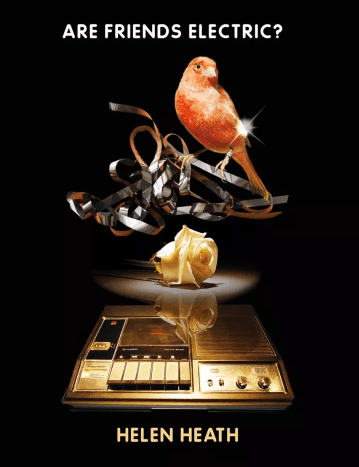
Are Friends Electric? by Helen Heath (Victoria University Press)
There’s No Place Like the Internet in Springtime by Erik Kennedy (Victoria University Press)
The Facts by Therese Lloyd (Victoria University Press)
Poūkahangatus by Tayi Tibble (Victoria University Press)
Great to see we have new sponsors, Mary and Peter Biggs, for the Poetry Category at the Book Awards.
I have featured all four finalists on my blog because I have found much to love about these books – this therefore is a moment of celebration. Of course there are books not here that I loved immensely. Poetry Shelf is whole-heatedly devoted to celebrating local books and the fact that I don’t have time to feature all my poetry loves is testimony to the excellent poetry we publish – through both big and small presses. Victoria University Press is becoming a flagship for NZ poetry – publishing at least 9 books a year of high quality and diverse scope. I applaud them for that. And all the other publishers issuing standout poetry (there are many) and the booksellers who put local poetry books on their shelves.
Thank you!
Congratulations to the four finalists! And to VUP.
Listen to Helen read two poems here
Helen’s book is a complex, satisfying read with enticing layers and provocative subject matter. It is a book of seeing, strolling, collecting; as though this poet is a bricoleur and the book is a cabinet of curious things. What I love in the poems is the shifting voice, the conversational tones. The poems that link grief with the effect of technology upon our bodies get under my skin. Most importantly there is a carousel of voices that may or may not be invented or borrowed but that make you feel something.
I ask if you would like a body.
You say, ‘No I’m beyond bodies now,
I’m ready to be fluid, spilling out all over.
I’m ready to spread myself so thin that I’m
a membrane over the world.’ I’m not ready.
I take off my socks and shoes and walk
over a patch of grass very slowly.
from ‘Spilling out all over’
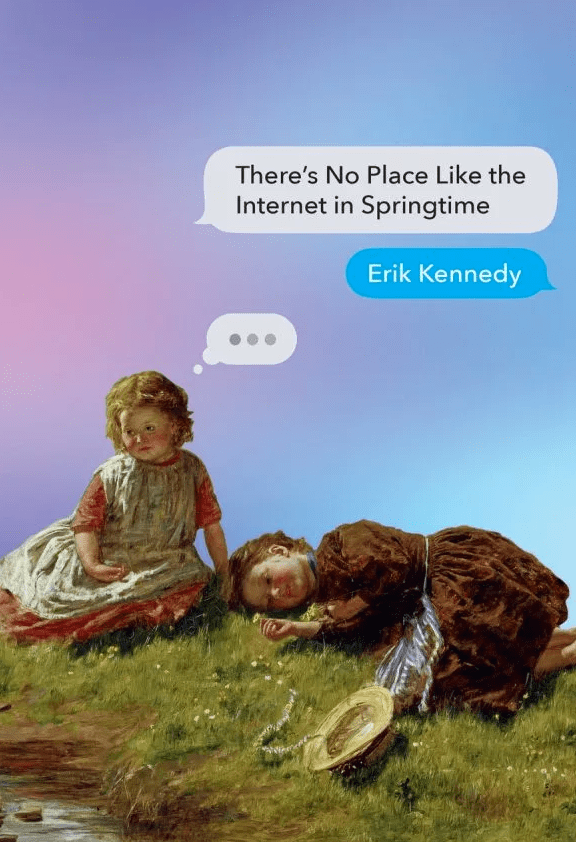
Erik’s first-full length collection sparks with multiple fascinations, experience, thought, wit, politics, optical delights and aural treats. It is a book of harmonics and elastic thinking, and is a pleasure to read. The collection navigates eclectic subject matter but I was initially drawn to the interplay between a virtual world and a classical world. I began to muse on how poetry fits into movement between the arrival of the internet and a legacy of classical knowledge. I also love the idea of poetry reacting to collisions, intersections, juxtapositions. Interestingly when I was jotting down notes I wrote the words ‘detail’, ‘things’ and ‘juxtaposition’ but not just for the embedded ideas. Yes, the detail in the poems is striking in itself, but I was drawn to the ‘static’ or the ‘conversation’ or ‘kinetic energy’ between things as I read.
Two feet of snow at my parents’ place, in another season.
Here, the cicadas sing like Christian women’s choirs
in a disused cotton mill. Belief is a kind of weather.
I haven’t seen proper snow for three years.
from ‘Letter from the Estuary’
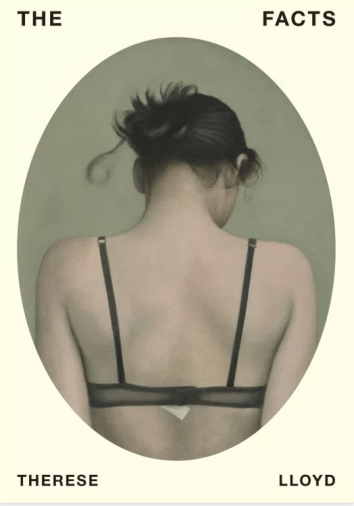
Therese’s new collection resides in a captivating interplay of chords. You could say that any poetry book delivers chords whether aural, visual or thematic, and in the light of ideas and feelings. This book does it to a stunning degree. Once you start hunting for them – whether in harmony or not, between poems or within a single example – the rewards are myriad. At the core of the book the title poem, the standout-lift-you-off-your-feet poem, achieves a blinding intensity: raw, surprising, probing, accumulative, fearless. I particularly love the surprising turns of ‘Mr Anne Carson’. Therese’s collection takes you deep into personal experience that gets hooked up in the poetry of another (Anne Carson), in matted ideas and the need to write as a form of survival. It makes you feel as much as it makes you think. It is a riveting read.
For three months I tried
to make sense of something.
I applied various methods:
logic, illogic, meditation, physical exertion,
starvation, gluttony. Other things too
that are not necessarily the opposite of one another,
writing and reading for example.
from ‘The Facts’
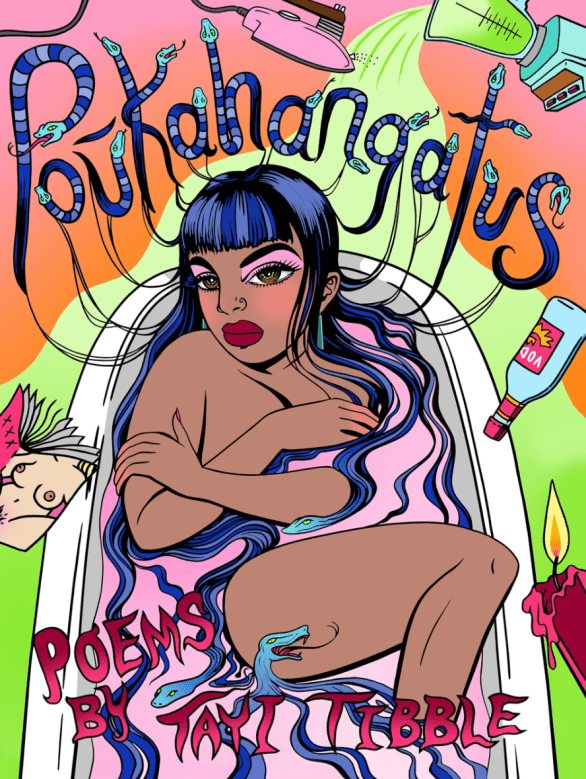
Tayi’s debut collection, Poūkahangatus, has already and understandably attracted widespread media attention. The poetry is utterly agile on the beam of its making; and take ‘beam’ as you will. There is brightness, daring and sure-footedness. The poems move in distinctive directions: drawing whanau close, respecting a matrilineal bloodline (I adore this!), delving into the dark and reaping the light, cultural time-travelling, with baroque detail and sinewy gaps. The collection charts the engagement of a young, strong woman with her worlds and words – and the poetic interplay, the sheer joy and magnetism of the writing, is addictive. I treasure this book for its kaleidoscopic female relations and views of women; and the way women are the vital overcurrents and undercurrents of the collection. Above all I loved the kaleidoscopic effect of the book; the way it is edgy and dark and full of light. The way it catches living within popular culture and within family relations, the way it carries sharp ideas and equally sharp feelings.
Poūkahangatus
in 1995 I was born and Walt Disney’s Animated Classic Pocahontas was
released. Have you ever heard a wolf cry to the blue corn moon? Mum has.
I howled when my mother told me Pocahontas was real but went with John
Smith to England and got a disease and died. Representation is important.
from ‘Poūkahangatus’
I am not a journalist punting on a winner – I am a poetry fan and have read all these books several times – any one of these books deserves to win. A toast from me x.
Find out more about book school and hang with some amazing bibliophiles: Hannah Mettner, Charlotte Darling and Helen Rickerby!
Book School is an 8 week programme hosted by The Old Shebang and taught by local talent. It takes you through design, writing, editing and production to the book launch. The workshops are a series – come to all to create your own book. Or you can treat them as one-offs, we’re commitment-phobes too.
The launch is a chance to find out more, ask questions and take part in an informal discussion on all things book with Hannah, Charlotte and Helen.
Hannah Mettner is an award winning poet.
Charlotte Darling is a co-founder of The Old Shebang and has her Master’s in NZ print history
Helen Rickerby is a stalwart in the Wellington lit scene. She is a poet and publisher at Seraph Press.
Drinks and nibbles provided. All welcome.
The launch:


Secondary students are required to respond to or interpret an image from the collections of the Alexander Turnbull Library and produce either:
Entries can be in English or te reo Māori.
This year’s theme is Tuia Encounters 250, which acknowledges 250 years since the beginning of sustained onshore meetings between Māori and Europeans in Aotearoa New Zealand. The commemoration is also about telling the stories and histories of the Māori communities who had been established in Aotearoa for hundreds of years and had voyaging traditions of their own.
details here
see here
This prestigious biennial poetry award from Landfall and the Kathleen Grattan Trust is for an original book-length collection of poems, by a New Zealand or Pacific permanent resident or citizen.
Individual poems in the collection can have been previously published, but the collection as a whole should be unpublished.
Entries are accepted until 31 July 2019.
The result will be announced in Landfall 238 (November 2019), and the winner receives $10,000 and a year’s subscription to Landfall. Otago University Press has the right to publish the winning collection.
For full entry details, and to learn more about Kathleen Grattan and the history of the award, go to here
The judge for the 2019 award is Jenny Bornholdt, who has published ten books of poems, the most recent of which is Selected Poems (VUP, 2016). She also edited the 2018 anthology Short Poems of New Zealand (VUP).
Her collection The Rocky Shore was a made up of six long poems and won the Montana New Zealand Book Award for Poetry in 2009. She is the co-editor of My Heart Goes Swimming: New Zealand Love Poems and the Oxford Anthology of New Zealand Poetry in English. Jenny’s poems have appeared on ceramics, on a house, on paintings, in the foyer of a building and in letterpress books alongside drawings and photographs. She has also written two children’s books.


 NZ Poetry Shelf