Poetry Shelf noticeboard: Nelson’s Volume Bookshop on National Poetry Day

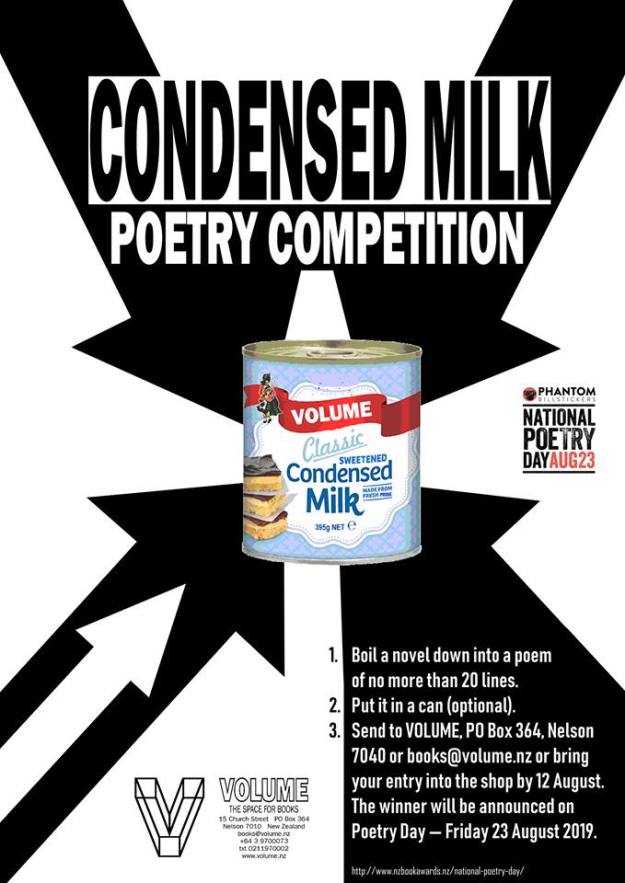
Do subscribe to the newsletter from Nelson’s very cool bookshop – Volume. I love these National Poetry Day ideas. Go here for Condensed Milk. Go here for Nelson Poetry map.


Screen Shot 2019-07-06 at 9.29.35 PM.png   Screen Shot 2019-07-06 at 9.32.27 PM.png


Screen Shot 2019-07-06 at 9.29.18 PM.png


Poetry Shelf Friday piece: essa may ranapiri picks 3 poetry books


R.S Thomas Selected Poems: having been raised nominally Christian these poems really spoke to me. God present in an impoverished Welsh countryside. The hollowed-out chest of faith really comforted me in my own struggle with the giant white Christ and his expectations. There is still one poem that I go back to often called ‘January’ with a line that sticks to me like a stain when referring to blood; ‘Soft as excrement, bold as roses.’


Beast Feast by Cody-Rose Clevidence: the first time I ever read another nonbinary poet. This book is a mess of tangled syntax and language-poop. It made me feel seen in form and message in a way I hadn’t felt before. ‘Queerness necessitates a radicalised language’ – this line still guides the poetry I write.


The Silences Between by Keri Hulme: I think I read most of this in a local bookstore and it was my introduction to Keri Hulme’s work. The use of conversation in the poems, and the movement between stanzas as their own call and response, is magic. I love how she uses setting in her poetry; we are dipped in the sea and pushed along the sandbars. A question that sticks with me is one Rowley Habib asks in the book ‘Where are your bones’ and this is driving the work I’m doing now, both the sentiment of the question and the act of making connections with other Māori poets/work.  This book plays with connection and alienation, and lives inside the strange, which is a place I live in and want to live in with my work.


essa may ranapiri: (Ngāti Raukawa | they/them/theirs) if they die before the end of the settler colonial nation state of NZ you owe them a revolution [their first book of poetry ransack out from VUP in 2019.

Victoria University Press page

Screen Shot 2019-07-05 at 8.40.55 AM.png


Poetry Shelf noticeboard: Show Ponies: A National Poetry Day Extravaganza


66116863_2409703259118480_5685248136700755968_n.jpg


Screen Shot 2019-07-05 at 8.32.51 AM.png


Poetry is popular now. To celebrate, several of Wellington’s coolest poets will pretend to be actual popstars in a lux, daring late night event for Phantom Billstickers National Poetry Day.

~~Featuring~~
Chris Tse
Sam Duckor-Jones
Rebecca Hawkes
Joy Holley
Jackson Nieuwland
Freya Daly Sadgrove
~~with Hans Pucket~~


Poetry Shelf audio spot: Charles Olsen reads ‘Inland’ – ‘Tierra adentro’


nzpoetryshelf-DSCF3056.jpg


Charles Olsen reads ‘Inland’ – ‘Tierra adentro’ in Spanish – from his bilingual collection Antípodas published in Spain by Huerga & Fierro, 2016.


Charles Olsen moved to Spain drawn by his interest in Spanish artists such as Velázquez and Goya and to study flamenco guitar. Artist, filmmaker and poet, his paintings have been exhibited in the UK, France, New Zealand and Spain, and he has two bilingual collections of poetry published in Spain, Sr Citizen (Amargord, 2011) and Antípodas (Huerga & Fierro, 2016). His short film The dance of the brushes was awarded second prize in the I Flamenco Short Film Festival in Spain and his poetry films have been shown at international festivals and featured online in Moving Poems, Poetry Film Live and Atticus Review. In 2018 he was awarded the III Antonio Machado Poetry Residency in Segovia and Soria and he has received the XIII distinction Poetas de Otros Mundos.


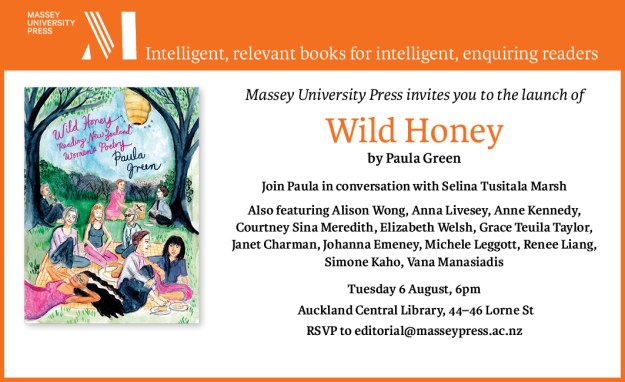
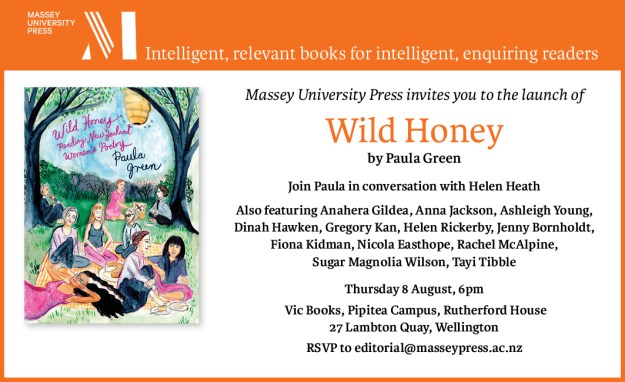
Poetry Shelf noticeboard: Two Wild Honey events

ooooooooooooh!

I am very excited about these readings to celebrate Wild Honey!

Busy times indeed as my book is about to sail into the world.

Thank-you time will be in August but thank you everyone who has made this book possible. I mean thank you!


X Paula


MUP_Wild Honey_AKL.jpg

MUP_Wild Honey_WGTN.jpg


Poetry Shelf noticeboard: an epic group of women authors will celebrate the Women’s Bookshop 30th birthday

This will be a wonderful celebration of women’s writing – and of everything Carole Beu and her shop have done for readers over the past 30 years.

Do join us!  On Monday 5th August at the Waterfront Theatre.


Screen Shot 2019-07-03 at 10.48.24 AM.png


Screen Shot 2019-07-03 at 10.48.35 AM.png


Screen Shot 2019-07-03 at 10.48.48 AM.png

Tickets here

large_30th_bday_concert_ticket_single.jpg


Poetry Shelf classic poem: Siobhan Harvey picks Bob Orr’s ‘Remembering Akhmatova’


Remembering Akhmatova


Of course they are not

spacecraft. The seed packet

described them as ‘Giant Russians’.

Nevertheless they are looking down

as if to find a place to land.

They are not Van Gogh’s sick hospital flowers

neither are they William Blake’s eternal time machines

nor even Allen Ginsberg’s gold Harlem recognition of self.

These are the sunflowers

that looked over my shoulder

at Frankton Railway Station

as I sat in brown shadows

awaiting a train out of Hamilton.

In the heat the tracks trembled like mercury.

In the pages of a book of poems

I was abducted by a Russian –

her black and yellow words

her giant symmetry.


Bob Orr   from Valparaiso Auckland University Press 2002


From Siobhan Harvey:

I’ve always admired Bob Orr’s poetry for his rare ability to entwine narrative, atmosphere and intimation. So much in ‘Remembering Akhmatova’ is said, and so much inferred. Of the spoken, Orr manages to use few words for maximum activity. Within six early lines, for instance, we are transported from a humble seed packet of sunflowers to a stretch of iconic artistic representations of the Helianthus. Van Gogh, Blake, Ginsberg – the diaspora of their artistry, history, geography, inspiration and output is collected and counterpoised seamlessly. There’s weight there too, of course: the burden inferred by the work and legacy of these great artists which carries through the remaining lines of the poem, as the narrator – located in humble Hamilton – waits to leave; but for what? For a life of writing, assuredly, as Akhmatova – directly referred to in the title, but not in the poem – anchors the end of Orr’s work and its story. It’s her poetry which has stolen the narrator’s imagination, something tellingly revealed to us only at the point of his escape. Yet, in its covert concluding reference, it speaks to – and connects – everything which has gone before.

This is said without mention of form or lyric in this poem, both of which deserve discussion of course. Where Orr’s verse stretches to include mention and inference of the work of significant creatives (painters, poets), it also extends its lines; and the musicality of the work expands too. So the first eight lines steadily lengthen, guiding the eye and ear into the rhythmically exquisite, “nor even Allen Ginsberg’s gold Harlem recognition of self.” Cleverly, such extension occurs at the point when the narrative is built upon dissent and negation, ergo “they are not spacecraft” and “are not Van Gogh’s sick hospital flowers”. Then the poem – its tale, form and lyric – tips into ten short lines, all of which are affirmative in tone (“They are the sunflowers …”), tight in form and symphony sharp.

So much is packed into these eighteen lines. As a reader and an artist, I return to this poem so often, listening to it, looking and deconstructing it, searching to make sense of its deep craft.


Siobhan Harvey is an emigre author of five books, including the poetry collection, Cloudboy (Otago University Press, 2014), which won the Landfall Kathleen Grattan Award. She’s also co-editor of the New Zealand bestseller, Essential New Zealand Poems (Penguin Random House, 2014). Her work has appeared in multiple journals both in New Zealand and Internationally. She was long-listed for 2019 Australian Book Review Peter Porter Poetry Prize (Aus) and won 2016 Write Well Award (Fiction, US). The Poetry Archive (UK) holds a ‘Poet’s Page’ devoted to her work. She lectures in Creative Writing at The Centre for Creative Writing, Auckland University of Technology where she’s completing a PhD in Creative Writing.

Bob Orr grew up in the Waikato, and has subsequently lived most of his adult life in Auckland. He has published nine collections of poetry and won the Lauris Edmond Memorial Award for Poetry in 2016. His writing has appeared in a number of collections, journals and anthologies and he has recently published the new collection One Hundred Poems and a Year (Steele Roberts, 2018).


51HoExGnmsL._SX342_BO1,204,203,200_.jpg          9780947493837.jpg Continue reading

Poetry Shelf review: Ashleigh Young’s How I Get Ready

How I Get Ready.jpg


Ashleigh Young, How I Get Ready, Victoria University Press, 2019


A woman smiles out of a plastic coat

its yellow turning rain to torches.


Light rests on a man waiting to cross,

coats his dog.


Light crosses a man

waiting to rest.


The hills pull fog around themselves

and trudge to the sea,

carrying all our houses.


from ‘Lifted’


I like the shape of this book – this matters with poetry – because when a poetry book is good to hold it makes you want to linger even more, to stall upon a page. The book looks good, the paper feels good, and the cover drawing by Sam Duckor-Jones is a perfect fit. His idiosyncratic artwork moves in and out of reality, a person tilted by anxiety, the wind, both exposed and screened. A little like the poems inside the book. This is a collection of waiting, breathing, of curious things, anxieties, anecdotes, lists, found things, recycled words; little starts in your head as you read. It is extremely satisfying.

The Notes acknowledge the jump-off points of a number of poems – a line in a letter from Andrew Johnston turns into ‘Turn Out to Be Something’. Poems spring from epigraphs, a contents page, Margery Kempe, psychiatric cases, other poems. Where the poems shift to is perhaps a blend of the fictional and the personal. The speaker is always on the move.

One of the joys of reading these poems is the way connective tissue or an invisible thread holds the poems together; it might be the way you stay with one character or situation or mood. Yet the doubled reading joy is in the glorious little leaps: from an idea, admission, description or trope to another idea, admission, description or trope. Surprising, startling, fascinating and always feeding the invisible thread. Take ‘Ghost Bear’ for example. Eliot pulls me through the poem. He is the mystery and the guide. You will move from a ritual where someone tests themselves against a ghost bear with a skull head to a boy who gets electrocuted but survives then scores a try (‘He’s just showing off  / because he got electrocuted’)  to an inappropriate kiss. Before the strange, goosebump ending, I got stuck on this verse which feels like an intrusion from the poet herself:


When there are two frail old women together, there is always one

who is visibly stronger.

I have an old friend and I think about whether we will be old together

and which of us will be stronger, holding up the other

which of us the wind will push over first

for a good joke


The opening poem, ‘Spring’, begins with an eye-catching image : ‘I saw a horse lying on the street / and people were trying to help it up.’  It is a poem of little fascinations (forgive me if I keep using that word!) but it is also a poem of breath, of holding and releasing breath, of waiting. The words form little exhalations on the page. I am standing with the person (the ‘I’) standing in the street thinking random things as they wait to see that the horse will stand. I am fascinated by the little admissions (they have waited so long it is too late to go to work). I am fascinated by the personal truisms (‘When I am satisfied with one thing / I want something else’).  I am fascinated by the biography of the speaker.


My mother   assured me

that when I feel     that I am not wel-

come at home and everybody has

hatred towards me that it is       only

my imagination. This statement

made me feel very good;

I went to bed    and

slept sound


The poem arrives in surprising increments – in bursts of unsettling strangeness. Who is this speaker who must keep revealing things? I look at the Notes, only after musing on the poem awhile, and discover it is a found poem, with the words borrowed from the study of a young man with compulsion neurosis who transforms his life into bizarre distortions. (published in 1918).

‘Turn Out to Be Something’ is also a poem that involves waiting;  the speaker waits for things and then modifies the admissions; waiting is fine as long as waiting is not in vain and something is at the end, although not necessarily what is first expected.


I can wait for a layer of sandstone to form over me

and freeze and thaw and freeze and be shattered

and be piped into the sea            as long

as that turns out to be something.


Many of the poems play with lists, repeating the beginnings of stanzas before swerving or drifting in myriad directions. Take ‘Guide’ for example. A poem written for an exhibition of Colin McCahon’s Walk (Series C) at Te Papa. I love this poem; I love the way it builds upon ‘what if’ and gathers heart,  wisdom and downright surprise. Ashleigh steps off from Colin’s ‘walk’ along Muriwai Beach and walks through meditations on water (the sea, fresh water, a river mouth, waterfalls). Her poem walks us into the physical and then catapults us elsewhere. It makes my heart ache.


If a girl is lost, someone will walk a long way to get her.

If her hand is held all the way back, it will be a short walk.


I have to share the ending with you because it gets right to the heart of what makes an Ashleigh Young poem so darn good.


If a waterfall no longer has water, it is a groove

that suggests a falling motion, just as this trail

suggests a walking motion


but if a person keeps walking until there is no more walk to take

they will no longer look forward to it, so will turn back.


Pretty much every poem is a poem I want to talk about. I want to talk about ‘Driving’ because it feels like a miniature autobiography that goes deep into experience. It gets personal but it’s prismatic in image and ideas. Somehow in this mix of riding a bicycle, learning to drive and imaginative leaps, the poem feels acutely human. Like it is breathing life back into me. When I stop on this double page I am thinking you could swap ‘driving’ and ‘riding’ for any number of things. The way the things we do conjure anxious thinking and random thoughts. I read the poem and replace all the driving/ riding words for ‘writing’. For example:  I write along the street outside your house / with my heart floating loose and getting chain grease on it.

Yes this poem is a gem – it builds and ducks and freewheels. Here is the start:


They tell me any idiot can do it and I tell them

I’m not just any idiot, I’m specific. Even when my lungs

are bursting – properly bursting

like things dragged up by a deep-sea fisherman

I keep riding.                  I get tired.                      I just keep riding!


I have written about this book in Wild Honey so have tried not to repeat myself or even refer to the poems I picked to talk about in the book! But Ashleigh became one of my sky poets for all kinds of reasons.

Every poem catches me! Some books you pick up, scan a few pages and then put down because you just can’t traverse the bridge into the poems. Not this one. It is as exhilarating as riding a bicycle into terrain that is both intensely familiar and breathtaking not. The speaker is both screened and exposed. The writing feels like it comes out of slow gestation and astutely measured craft. I say this because I have read this andante, at a snail’s pace. Glorious!


What song will they play if I don’t come home tonight?

I wished  someone would write a song for me, then someone did

but it was a song berating me; it was called ‘Actually, Ashleigh’


and I think of the cruelty of songwriters as I get ready

how their music makes their words sound better than they really are

how our feelings make music seem better than it really is


and how the difficulty of getting ready is a pure, bitter difficulty

like calculus. In the back row a once-promising student cries.

What will my face become? Strings of demi-semi quavers.


from ‘How I Get Ready’


Victoria University Press page

Read ‘If So How’ from How I Get Ready


Ashleigh Young is the author of the poetry collection Magnificent Moon (VUP, 2012), and the essay collection Can You Tolerate This? (VUP, 2016) which won a Windham-Campbell Prize from Yale University and the Royal Society Te Apārangi Award for General Non-Fiction in 2017. She works as an editor and lives in Wellington.