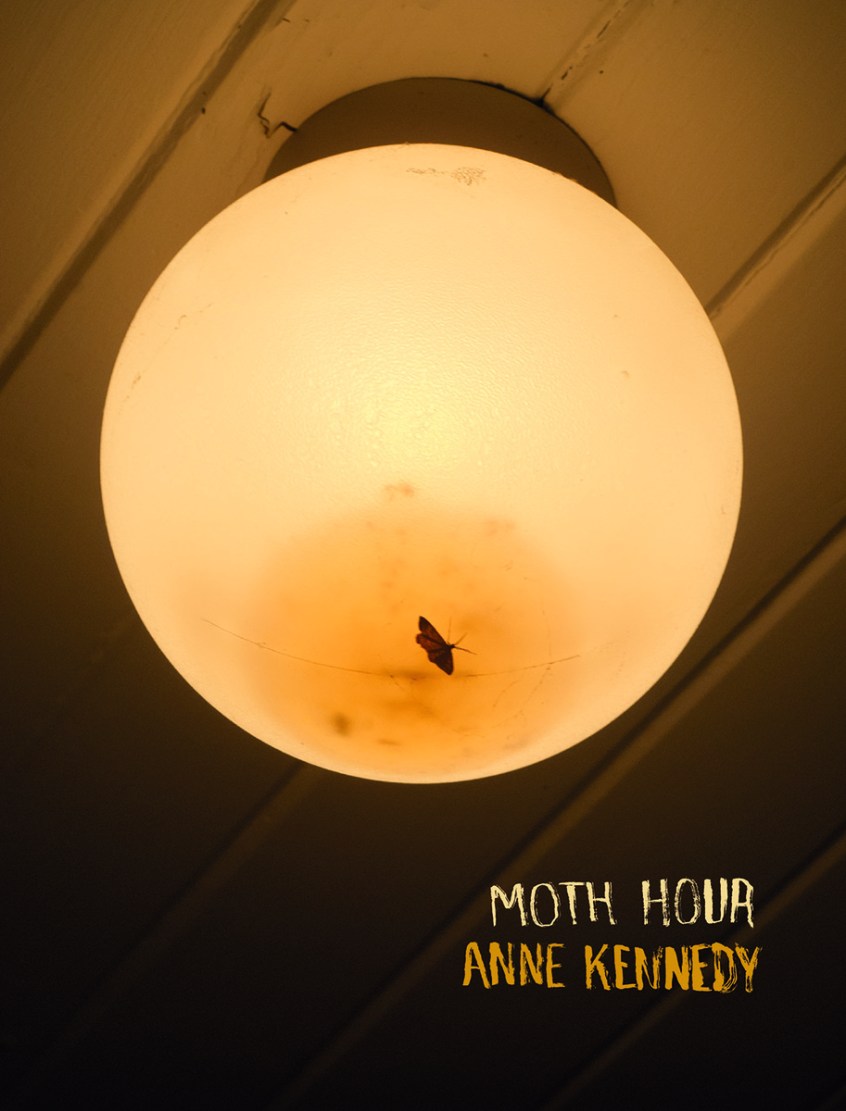
Anne Kennedy, Moth Hour, Auckland University Press, 2019
1.
The thing in the jar
always dies!
The rice cooker steams
so the sun goes down
Deep in the house
sepia gathers
The pencil has eaten
the fragile book
from ‘Thirty-Three Transformations on a Theme of Philip’
I first read Anne Kennedy’s new collection Moth Hour as a piece of music that traces the contours of grief. Words form little melodies, solo instruments sound out, there is echo, overlap, loop and patterning. Above all there is a syncopated beat that leaves room for breath, an intake of pain, an out-sigh of grief, an intake of observation, an out-breath of recognition. There is the fragile word-dance to the light.
Moth Hour responds to a family tragedy; in 1973, at the age of twenty-two, Anne’s brother, Philip, accidentally fell to his death. Anne, her seven siblings (she was the youngest and aged fourteen) and parents now lived with unbearable grief and loss, separately, diversely, as a family.
The book is in three parts: the long sequence ‘Thirty-Three Transformations on a Theme of Philip’, a coda poem ‘The Thé’ and an essay (‘Pattern/Chaos: Afterword’).
Over time Anne had read Philip’s book collection (think a 1970s gathering of books ) along with his poetry. She begins Moth Hour with one of his poems, an affecting piece that forms both the bony skeleton of her book and a fragile yet insistent pattern of echos. A voice calling out over the crevice, a voice that keeps returning. In Philip’s poem a speaker imagines being caught by a child and placed in a jar on a windowsill along with edible leaves, The Book of Tea, paper and a pen. The power of imagination is evoked.
These elements keep returning and if there is syncopation, a form of stutter, a difficulty of transmission, of speaking and retrieving, there is also fluency. The way both music and poetry can pull you into an utterly absorbing connective movement.
The second time I read Moth Hour I listened to Ludwig van Beethoven’s Thirty-Three Variations on a Waltz by Anton Diabelli because Anne had listened to this as she wrote the book. She had first listened to it over and over after Philip’s death.
Catch me little child and put me in a jar.
Ajar is small and a view of everything.
Hopefully we will always want and want for nothing.
Shall I seize you? Yes, I mean no. Please seizure.
We will live in a jar.
I will live in a jar. And the jar is a house.
Place inside a place inside.
That is how we will look out. Look out.
I am being very straight with you.
Look no hands.
In the language.
from ’19’ Thirty-Three Transformations on a theme of Philip’
The poetic fluency of Moth Hour carries so much in its momentum. There are detailed locations: a Wellington family home, the contemporary Auckland of the poet. Signs of the times (the 1970s). Surreal intrusions. Politics (again think the 1970s). There are contrasts: new / dead / breath; some / any. There are the rebounding questions. Ideas, feelings, words waver as though nothing can be fixed and certain. Such movement evokes a sense of linguistic play but it also performs the difficulty of the subject matter. Death is impossible to pin down. Grief equally so.
Such a symphonic effect means the reader participates in dis-equilibrium – the unease of unknowing along with the whoosh of connection.
If there are no air holes in the jar we cannot breathe but this book is all about breath. Breath is life sustaining and freedom. And yet this breath, this sustained breath of writing and recall, comes in gasps and puffs.
The second poem, ‘The thé’, reflects the concerns of the first – the reverberating motifs appear in a present tense of grief and observation – but now the short lines float apart on the page. A pattern of drift; the white space fractured like hicccupy breaths. Yet each line (melody) offers a moment of certainty. I am back to the music pooling inside me.
The poem burns off an hour.
We walk along the street many times.
The street is practice for death.
The chairs are aching in and out.
He staggers to his feet.
The the is ready to go through.
Ritual finally occupies the body.
Thoughts burst the shelter of the room.
The people swarm into the streets.
from ‘The Thé’
Like a mesmerising, lung-like piece of music, Moth Hour is a book of return-listening. Every time you place the poetry on the turntable of your reading you will hear something different. It blisters your skin. It touches you. But above all Moth Hour fills you with the variation and joy of what a lithe poet can do.
Anne Kennedy is a writer of fiction, film scripts and poetry. Her debut poetry collection Sing-song was named Poetry Book of the Year at the 2004 Montana New Zealand Book Awards. The Time of the Giants was shortlisted for the same award in 2006, and The Darling North won the 2013 NZ Post Book Award for Poetry. Her novles include The Last Days of the National Costume, shortlisted for the NZ Post Book Award for Fiction in 2014, and The ice Shelf was longlisted in the 2019 Ockham NZ Book Awards. She lives in Auckland.
Auckland University Press author page