Poetry Shelf Monday poem: Sudha Rao’s ‘Manuhiri’

check layout 22/ 7


Manuhiri

(Visitor)

1

Her grandmother told her she was a child of Manu,

manushi, daughter of humanity, blessed

to be a visitor when she crossed the sea.


The wooden gate is a threshold with arms outstretched

in protection, the slow wash of green waters rhythm.

Rising notes of another tongue is the wailing of her mother tongue.


Her back, a billowing canvas is taking shape –

her grandmother’s tapping, tapping the geo-graphy of her

in colours of the monsoon rain.


She is dusk, light with all the distance around her.

She crosses the threshold and offers her grandmother’s verses,

a garland of old earth sounds for the new.


2

Blissful waters surround pain washed up over and over again.

She sits among silent voices, bodies twitching to utter

shame for carrying skin, coloured by others.

What’s a brown skinned woman to do

at the gates of a marae? The solidarity of colour

bears differentiation.

He opened to a stance defying rule, he said I am

connected to islands by water, I am connected to you

by colonisation.

The gates opened enough for her to raise her head.


3

Nga Mihi

Korihi Te manu, takiri mai i Te ata 

Ka ao, ka ao, ka awatea

Tihei Mauri ora

Kua tau tenei manu hei manu, hei manuhiri, hei manu hari 

Ko te takahanga waewae, ko te rere o te kupu

Ka tangi te ngakau, he roimata aroha

Ki te manawhenua, no koutou tonu te whenua nei.

He awe ko toku mama, he awe ko toku papa 

Ma te huruhuru te manu ka rere 

Ka rere i te ao, ka rere i te po, ka rere ki toku whenua ake 

Ma Te ahi ka te manu ka ora. 

Tena koutou katoa.


4

When the kuia holds her hand, a sacred place ignites.

You are a seed of the old banyan tree swept

from your grandmother’s lap.

Transplanted here, I see birds’ nests, singing insects and shoots bearing the weight

of you. I see strong branches making light of your path –

see how they are dropping roots –

she feels the earth quiver under her feet.


5

Across the table, she hears raging clouds roving

to make wave upon wave to become sea overhead. White peaks roughed up on waters

below are screeching

gulls. How can she say that she is a visitor

on a  warm beach with sand beads

sketching a canvas stretched in her head?


6

She is a mirror of herself.

She is not a mirror of herself.

She is a scooped grain of memory,

of a love-song for a life lived

between her worlds.


1  The mihi for Manuhiri was prepared for me by Matt Gifford. It is made of two parts – the first is Māori proverb, the second part of the speech is an introduction of me to the hosts at the marae. The translation is as follows:


Nga Mihi (speech)

Part One – Maori proverb

Korihi Te manu, takiri mai i Te ata

Ka ao, Ka ao, ka awatea

Tihei Mauri ora

The bird sings, the morning has dawned

The day has broken

Ah! There is life.

Part Two – my speech introducing myself Matt references me as bird

Kua tau tenei manu hei manu, hei manuhiri, hei manu hari

Ko te takahanga waewae, ko te rere o te kupu

Ka tangi te ngakau, he roimata aroha

Ki te manawhenua, no koutou tonu te whenua nei.

This manu (bird) has descended as a manu (bird), as a visitor, as a dancing visitor

Through its dancing feet and its flowing words

Its heart cries, the tears of love

For you the home people, this is your land.

He awe ko toku mama, He awe ko toku papa

Ma te huruhuru te manu ka rere

Ka rere i te ao, ka rere i te po, Ka rere ki toku whenua ake

Ma Te ahi ka te manu ka ora.

My mother is a feather, my father is a feather

And it’s by their feathers this manu (bird) takes flight

Taking flight to the day, and flight to the night, From its own home land

Where the home fire burns, and gives this manu (bird) life.


Originally from South India, Sudha Rao lives in Wellington and has had a long standing involvement with the arts, primarily as a dancer. In 2017, Sudha graduated with a Masters in Creative Writing from the International Institute of Modern Letters, Victoria University, Wellington. Since 2012, Sudha’s poems have appeared in various journals and anthologies. These include two editions of Blackmail Press (2012 and 2014); an anthology of New Zealand writing, Sunset at the Estuary (2015) and in the UK anthology Poets’ quest for God (2016);  Landfall, Otago University, Dunedin (2018),and an anthology of migrant voices called More of us published in March 2019. In 2014, one Sudha’s poems was on the Bridport Poetry Competition’s shortlist. Excerpts of her prose work, has appeared in Turbine (2018) which comprised part of her MA thesis Margam and other excerpts were read in two sessions on national radio RNZ (2018). Sudha is part of a collective of Wellington women poets called Meow Gurrrls, who regularly post poems on YouTube


.
Poetry Shelf noticeboard: Lounge #69

LOUNGE #69 Wednesday 14 August

Old Government House Lounge, UoA City Campus, Princes St and Waterloo Quadrant, 5.30-7 pm

Free entry. Food and drinks for sale in the Buttery.   ALL WELCOME


MC Michele Leggott

Owen Connors
Irene Corbett
Cian Dennan
Murray Edmond
Tim Heath
Simone Kaho
Anne Kennedy
Anna Livesey
Alys Longley
Erena Shingade


Poetry Shelf review: Gail Ingram’s Contents Under Pressure

cv_contents_under_pressure

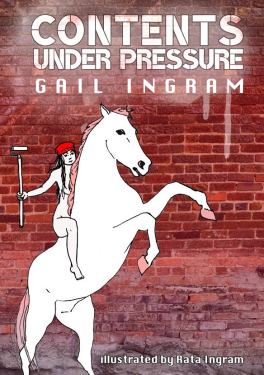
Gail Ingram, Contents Under Pressure, Pūkeko Publications, 2019


Gail Ingram has published poetry and flash fiction both in New Zealand and internationally. She lives in Christchurch where she is part of a writing/ critiquing group of poets. Contents Under Pressure is her debut poetry collection and includes illustrations by her daughter, Rata Ingram.

Contents Under Pressure is in debt to a city; the poems navigate post-earthquake Christchurch. When I first held the book and flicked through the pages, I was reminded of flicking through a book to watch the drawings on the bottom corners move. Flick the pages of this book and it is poetry in disrupted movement: you get spiky angles, walls of text, bold against light, steps against missing bits, changing fonts.

The title is perfect: everything is under pressure – the fractured city and the contents of the book. This is the story of a city filtered through that of a mother / graffiti artist and her son, and both have different ways of coping with a city in pieces.

The opening poem ‘Definition: mother / graffiti / artist’ introduces just that: a mother who goes tagging in the city that continues to break. At times the pages of the book stand in for the tagged walls:


she sprays

airport walls in zen

tangles so strangers

trace poke-leaves

in sesquipedalian mazes


from ‘From below, the graffiti artist is’


I love this book because it shakes up what poetry can do while simultaneously bringing us in close, so searingly close, to human trauma.

An early poem returns us to solid ground: the mother and her sons are looking at a photo of the family tobogganing at Round Hill. It is a white hot shard in the collection that makes the rest of the poetry even more poignant:


Mum took the photo. I’ve got this picture of Dad resting his

arm across her shoulders —

Yeah, like a security blanket.

Yeah.

But now when I look at it, I don’t see us. I don’t know who

that family is, but …

I know the mountains —

The mountains are capable of moving.


from ‘She overhears the boys talking about the photo in the hall’


The portrait of the woman feels like a woman behaving out of character in order to relocate herself (her new character) in the new and shattered terrain. She leaves her familiar/unfamiliar daylight routines. She becomes someone other in the pitch dark night. At times the writing is in shards and spiky while at times it is lyrical:


She hasn’t gone out into the ink

of the night street yet. Here,

she exists, safe as a thief

in the stoma of their sheets

before she will slink through the open window,

creep along the dark passages of local streets,

and tap her own tune

on the city’s leaping drum.


from ‘The graffiti artist waits for the world to sleep’


The graffiti artist shows us the power of art to make both public and personal both ideas and feelings. And we can engage with this. We can be moved and we can be challenged. In ‘The graffiti artist as a teenager’, her art teacher had showed the class the ‘Cubist strokes of “Guernica””. She is learning what art can do:


At fourteen she learned the power of dots. That a

cluster could create a river pebble’s shadow, a

crease in a smile or the trail of cupped hooves on

farm soil. Forty pencils pattering in the class, and

the hexagon-window left free, high in the streaked

pupil, made the picture come alive as if it was her

paper skin under the shrapnel of sharp lead. (…)


There are many threads to track through the book. Equally captivating is the thread of the son thrown off kilter, with drugs, anxiety, physic textbooks. In ‘Expedition to the New World’ the mother and son are traipsing through the vegetable aisles where the poem’s punning supermarket title confirms everything is made strange and off-centre:


(…)  She can’t find what they need. He

brushes past tins of spaghetti. Root-like tendrils on the

labels seem to take an interest in his passing, as though to

grasp for arm or ankle. He half-stumbles into the bags of

stalky cereal and utters a guttural sound, an earthquake

rumble that shudders up through his body to settle there.


On the back of the book Sue Wootton, Bernadette Hall and Bryan Walpert underline what a gift this book is. I agree. The poetry represents the way the shattering of familiar terrain shakes up everything: family, body, heart, faith, everyday routines, solid attachments. It shakes you as you read. It is intimate and it is wide reaching. It also shows the way art, language and a deep love of family carry you as you discover ways to resettle. A gift of a book.


Pūkeko Publications page


Poetry Shelf noticeboard: The Public History Talks – Fiona Kidman on This Mortal Boy

Screen Shot 2019-08-02 at 8.54.18 AM.png


The Public History Talks are hosted by the Ministry for Culture & Heritage History Group at the National Library of New Zealand. They are usually held on the first Wednesday of the month from March to November.

Talks in this series are usually recorded and available online

  • Date: Wednesday, 7 August, 2019
  • Time: 12:10pm to 1:00pm
  • Cost: Free. You don’t need to book.
  • Location: Taiwhanaga Kahau — Auditorium (lower ground floor), Corner Molesworth and Aitken Streets, Wellington. Entrance on Aitken Street.
  • Contact Details: ATLOutreach@dia.govt.nz

Please join us to hear Dame Fiona Kidman discuss the writing of her award-winning book ‘This Mortal Boy’.

Albert Black, born in Belfast, was eighteen when he arrived in New Zealand as an assisted work immigrant, in 1953. Although his life in New Zealand started well, he was found guilty of murder after an altercation in an Auckland cafe, two years later. He was hanged in December 1955.

In writing the novel ‘This Mortal Boy’ (Vintage, 2018), Fiona Kidman explores the story behind the headlines and asks whether Black might have been found guilty of manslaughter rather than murder.

The 1950s were a time of social upheaval in New Zealand, and form a background to the events she describes. Central to this talk will be the methods of research employed and the boundaries between fact and fiction.

These free public history talks are a collaboration between the National Library of New Zealand and Manatū Taonga Ministry for Culture and Heritage. They are usually held on the first Wednesday of the month March to November.

Most talks are recorded. You can listen to them at New Zealand History

About the speaker

Dame Fiona is a Wellington writer. Over the years she has been a librarian, radio producer and screenwriter.

She has written more than thirty books, including novels, short fiction, memoir and poetry. Her latest novel ‘This Mortal Boy’ was awarded the Acorn Foundation’s Prize for Fiction at the Ockham Book Awards 2019. She has a DNZM, OBE and two French honours, including the French Legion of Honour.


Poetry Shelf noticeboard: Oxford Brookes International Poetry Competition open for entries


Screen Shot 2019-08-02 at 8.48.58 AM.png

The Oxford Brookes Poetry Centre is excited to launch its 2019 International Poetry Competition to celebrate the power of poetry across the world!

Categories: Open and English as an Additional Language. Deadline: 2 September 2019 (23:00 BST/22:00 GMT). £1000 to winners.

The competition is open to both new and established poets aged 18 and over from across the globe and has two categories:

  • Open category (open to all poets aged 18 years and over)
  • English as an Additional Language (EAL) category (open to all poets aged 18 and over who write in English as an Additional Language)

The winners of each category will receive £1000 and both runners up £200.

We are absolutely delighted that this year’s judge is the internationally-acclaimed and award-winning author Jackie Kay.

Jackie Kay was born and brought up in Scotland. The Adoption Papers (Bloodaxe) won the Forward Prize, a Saltire prize and a Scottish Arts Council Prize. Fiere was shortlisted for the Costa award and her novel Trumpet won the Guardian Fiction Award and was shortlisted for the IMPAC award. Red Dust Road (Picador) won the Scottish Book of the Year Award, and the London Book Award, and was shortlisted for the JR Ackerley Prize. Her third collection of short stories, Reality, Reality, was praised by The Guardian as ‘rank[ing] among the best of the genre’. She was awarded an MBE in 2006, and made a fellow of the Royal Society of Literature in 2002. Her book of stories Wish I Was Here won the Decibel British Book Award. Jackie Kay also writes for children and her book Red Cherry Red (Bloomsbury) won the CLYPE award. She has written extensively for stage and television. Her plays, Manchester Lines (produced by Manchester Library Theatre) and The New Maw Broon Monologues (produced by Glasgay), were a great success. Her most recent collection, Bantam, was published in 2017 to critical acclaim. She is Chancellor of the University of Salford and Professor of Creative Writing at Newcastle University. Jackie Kay was named Scots Makar—the National Poet for Scotland—in March 2016.

The competition deadline is 11pm BST/10pm GMT on Monday 2 September 2019. It costs £5 to submit one poem or £4 per poem for more than three entries. Each poet can enter a maximum of ten poems. Please follow the instructions in the Oxford Brookes Shop. All entries must be unpublished work. Please read the full competition criteria and terms and conditions before entering.

There are two steps to entering the competition:

  1. Please visit the Brookes Shop and click on ‘Book Event’. Then you can register as a new customer and pay for your entry/entries.
  2. Once you have paid, please e-mail your poems to poetrycomp@brookes.ac.uk

Please note that entries must comprise one poem per document and be submitted as a Microsoft Word file (.doc or .docx), Rich Text Format file (.rtf) or as a PDF file (.pdf). Poems by EAL poets can be entered for consideration either in the EAL or the Open category. All entrants need to include either EAL or OPEN in the top right hand corner of each entry. For more guidance on submission, please visit our terms and conditions page.

You will receive an automatic e-mail in response, confirming that we have received your poem/s. Please note that there is no entry form for this competition. The Poetry Centre will match the details you submit via the Shop with your e-mailed poems.

If you have questions about the competition, please consult our FAQs page. If your question isn’t answered there, contact us at: poetrycomp@brookes.ac.uk

You can find out about last year’s competition and the winning poems of 2018 here.


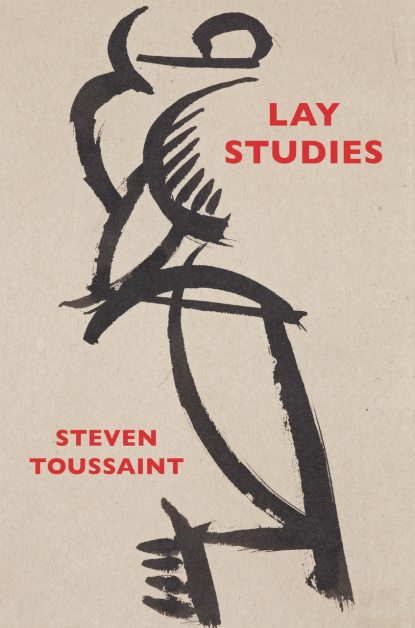
Poetry Shelf audio spot: Steven Toussaint reads ‘Aevum Measures’

Lay_Studies__35136.1555373954.jpg


Steven Toussaint reads ‘Aevum Measures’

from Lay Studies, Victoria University Press, 2019


Steven Toussaint was born in Chicago in 1986. He immigrated to New Zealand in 2011. He is the author of the poetry collections, Lay Studies (2019) and The Bellfounder (2015), and a chapbook, Fiddlehead. His writing has also recently appeared in Poetry, Commonweal, The Spinoff, Sport, and The Winter Anthology. He has been recognised in the past few years by residencies at The University of Waikato and the Michael King Writers’ Centre and with a Grimshaw Sargeson Fellowship. He is currently pursuing graduate study in philosophical theology at Emmanuel College, Cambridge.


Victoria University Press page

Steven Toussaint in conversation with Karyn Hay RNZ Lately


Poetry Shelf noticeboard: Phantom Billstickers National Poetry Day events unveiled

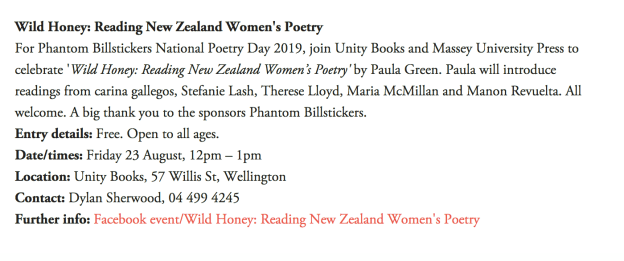
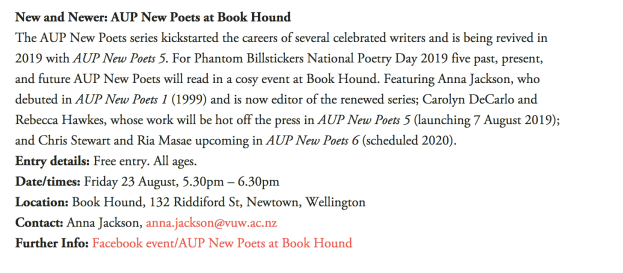
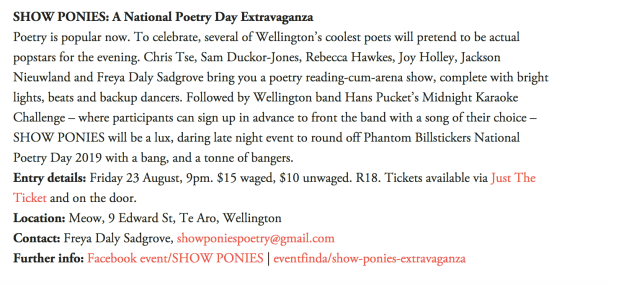
I have just mapped in my mind all the places I would like to be on Phantom Billstickers National Poetry Day – I always love what Nelson comes up with, Featherston, Napier, Central Otago … and of course all the big cities. But this year I will be in Wellington hosting a lunchtime event at Unity Books (getting to hear some women read I have never heard before yeah!), then hearing some AUP New Poets hosted by Anna Jackson at Book Hound  (also hearing poets I have mostly never heard read before) and finally going to Show Ponies (R18) (wow! what a line up!) at Meow.

I love the way bookshops, cafes, bars, universities, marae, schools and libraries are increasingly inventive every year in designing events and competitions – and poets appear all over the country.  You could for example have brunch with Chris Tse in Hamilton!

Check out your route by clicking on the link and see below for mine!


Screen Shot 2019-07-06 at 9.32.27 PM.png


Climate change and the plight of refugees are the focus of some of the 150+ events in this year’s Phantom Billstickers National Poetry Day, taking place on Friday August 23.

Our annual celebration of writing and reading poetry embraces both the personal and political in a dynamic programme of events and competitions nationwide – from parks,
beaches, pavements and public transport to cafés, bars, bookshops, schools, university campuses, libraries, RSAs, community centres, marae and more.

The record number of events include:

Auckland’s ‘I Feel at Home, Away from Home – Blackout Poetry Workshop’ – that gives voice to our migrants and refugees; and the Theoradical Hobohemians hosting
‘An Interview with Charles Bukowski’.
Wellington’s ‘Show Ponies: A National Poetry Day Extravaganza’ – a late-night gig, featuring award-winner Chris Tse and other poets posing as popstars for the evening.

Wairarapa’s ‘Climate Positive’ – poetry, song and stories of positive action against the climate crisis with performance poets Extinction Rebellion.
Christchurch’s ‘Poets in Our Tūranga’ – a six-hour poetry marathon at the new Tūranga Central Library, featuring more than 40 local poets and writers, and 2019 Ockham
New Zealand Book Awards poetry category finalist Erik Kennedy.
Dunedin’s ‘Changing Minds: Memories Lost and Found’ – a poetry competition for adults inspired by their experience of dementia or Alzheimer’s Disease.

Phantom Billstickers National Poetry Day includes appearances by the winner of the Mary and Peter Biggs Award for Poetry in the 2019 Ockham New Zealand Book Awards, Helen Heath, who will deliver a workshop at Hagley Writers’ Institute in Christchurch on Saturday, August 24.

Poetry category finalist, Therese Lloyd, will take part in a celebration of Paula Green’s magnum opus, Wild Honey: Reading New Zealand Women’s Poetry at Unity Books in Wellington.

In the lead up to August 23, Phantom Billstickers will bring poetry to our communities with an epic street poster campaign. All four 2019 Ockham poetry category finalists, including Tayi Tibble, will feature in Phantom Billstickers’ national super-size Poetry on Posters campaign.

Nicola Legat, Chair, The New Zealand Book Awards Trust, says ‘One of the themes of this year’s events is a focus on social issues. Events focused on climate change and the issues facing refugees are among them, and this shows how relevant and useful poetry is as a way of confronting and addressing some of our wicked problems.’

Held annually on the fourth Friday in August, #NZPoetryDay sees poetry royalty join forces with poetry fans from all over Aotearoa in an action-packed programme of slams and rap, open mic and spoken word performances, pop-up events, book launches and readings. There are 24 poetry contests to enter. Many of the programmed events will be open to the public and free to enjoy.

Established in 1997, National Poetry Day is a popular fixture on the nation’s cultural calendar and one that celebrates discovery, diversity and community. For the past four years, Phantom Billstickers has supported National Poetry Day through its naming rights sponsorship.

For full details about all the events taking place on Phantom Billstickers National Poetry Day, including places, venues, times, tickets and more, go here.


Screen Shot 2019-08-01 at 8.00.41 AM.png

Screen Shot 2019-08-01 at 8.00.53 AM.png

Screen Shot 2019-08-01 at 8.00.20 AM.png


Poetry Shelf Classic Poem: Fiona Farrell picks Paula Green’s ‘Glenburn’


Glenburn


Even in the face of an icy wind, the stillness

dazzles us, and we journey south to the dulcet honey.

He falls silent, the din left destitute, far

from the hive. The sound of his laugh, it rises

and becomes music, a vein of sun that is in him


like a mountain. Appearances remain objects of barter.

All the calm. All that fury. We cross a threshold

to witness the unbidden cloud. Our chamber of words

sweetened as if made of honey or beeswax,

for we arrive at last, the smell now in him of hive.


We will eat bread and cheese, forgetting the northern

city, the pull of the ocean. He moves with his sight

fixed on stillness, finding a fickle appearance

like a star behind slow speech. All that fury. All that calm.

Where will we find the scale of love? The journey south


undoes the mountain of cloud. His own incubus

the riddle that is land. We are certain that buildings

will appear in the stillness, kept alive by our eyes.


Paula Green

from Crosswind, Auckland University Press, 2004. Also published in Dear Heart: 150 NZ Love Poems, Random House, 2012.


Note from Fiona Farrell

My favourite poem? I had enough trouble selecting 25 recently for the IIML annual anthology.

So, a single poem? Should it be one that has repeatedly popped into my head at odd intervals over many years, a single line, a phrase, one of those little handgrips that keeps me from falling? Should it be a poem that belongs so strongly to a time I like going back to in my mind, that it arrives fully packed and tagged to memory? Or the one that touched me so much because it was a gift from a friend and unexpected and it said something I loved hearing? Or the one that was very old and strange? Or the one that made something I knew well gleam with newness so I noticed it again as if it was for the first time? Or the one I read this morning that has left the day feeling just great?

I’ll go with that: Paula Green’s ‘Glenburn’ because it speaks to the strangeness I feel moving to Otago again after many years absence. And to the feeling of discovering it – and it might as well be for the first time – in the company of someone I love who has other eyes to bring to the journey south. And to my knowledge of Michael Hight’s paintings of beehives, so there is an illustration – not any one painting, but many – lurking beside the words.

And it speaks too to a feeling that’s been growing steadily since I came here, that it’s all so fragile, this beautiful golden south. Last night I talked to a woman fighting subdivisions in Arrowtown. ‘It’s going,’ she said. ‘Queenstown, and Wanaka and Arrowtown and the lakes.’ Pockmarked with 400 house subdivisions, an airport proposal which could go anywhere, hotels and resorts and dairy conversions.

This poem of Paula’s makes me think about love: for people and for a landscape.


Fiona Farrell publishes fiction, non-fiction, poetry and drama. She lived for many years at Otanerito on Banks Peninsula but has moved recently to Dunedin.

Paula Green has just published two new poetry collections (Groovy Fish, The Cuba Press) and (The Track, Seraph Press) with Wild Honey: Reading NZ Women’s Poetry (Massey University Press) out early August.


Poetry Shelf noticeboard: Carcanet Press launches audio book series

Would love to see a version of this happening in Aotearoa. Let’s start with Bill Manhire’s Lifted (VUP, 2005)! I am posting Steven Toussaint reading a breathtakingly good long poem this week – Imagine if we could listen to his whole Lay Studies (VUP, 2019).

Go here for details of Carcanet’s series.


Screen Shot 2019-07-31 at 7.40.16 AM.png

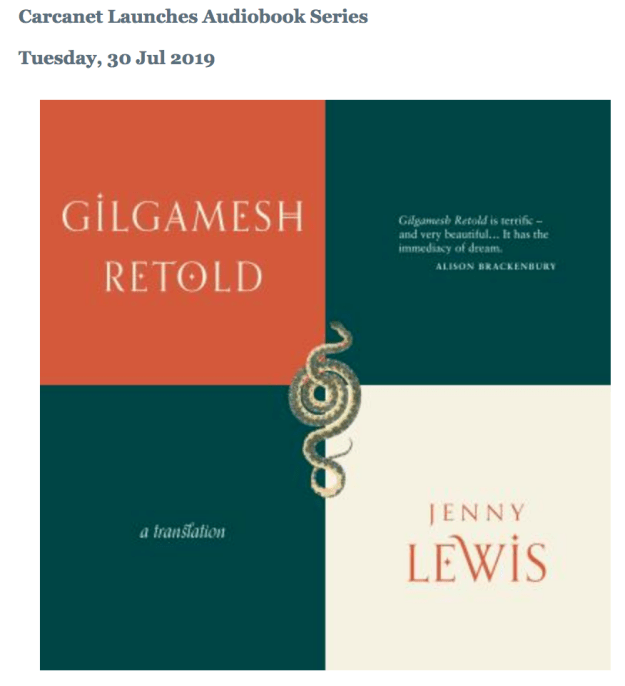
We’re pleased to share the news that we have teamed up with Colin Still of Optic Nerve to produce the first in an exciting new series of audiobooks, featuring unabridged recordings of collections read by the poets themselves.

The first title to be released is Jenny Lewis’s feminist recreation, Gilgamesh Retold, originally published as a Carcanet Classic in October 2018 and is now available as an audiobook on all major platforms, including Audible and Deezer. Forthcoming titles include Jane Draycott’s award-winning translation of the Middle English narrative poem, Pearl, and Martina Evans’ much-acclaimed poem for two voices, Now We Can Talk Openly About Men.

Michael Schmidt, our founder and editorial director, said, ‘We’re lucky to have poets who are also wonderful readers and who bring so much formal understanding to their work. The readings enhance and extend the print text. We are going to go to audio with books which are wholes and where the poet reader adds value and scale to the work. We are also very lucky to have a long historyof working with Colin Still, whose Optic Nerve audio publications of poets reveal how brilliantly he can produce poets and help them bring their work alive on the ear.’

Gilgamesh Retoldis a versatile and inventive recreation of Gilgamesh – fast-paced, capturing the powerful allure of the world’s oldest poem.

The Poetry Book Society said of the book:‘These innovative tales are full of cosmic creation, dramatic battles, gods andgrief. Lewis’ evocative and exhilarating poems bring Gilgamesh to life for a wholenew generation, discovering the resonance of ancient Mesopotamian myths inrecent Middle Eastern conflicts and its enduring relevance today.’

You can read Jenny’s account of recording the poem over on the Carcanet Blog – ‘I had no idea it was so difficult’, she writes, but ‘Colin was the perfect coach, gently encouraging me and helping me to find the right tonal qualities for various passages’. Read it here.

You can pick up a copy of Gilgamesh Retold on all major audiobook platforms, including Audible, iTunes, Scribd, Google Play and Kobo.