Tamaki Mākaurau is a mix of freezing and blue sky and thumping rain, and here I am wondering if my second batch of seeds will survive (the first got blasted by a gale all over the show), and I am falling into little black holes, and then scaling the sides by diversion writing for the love of writing, and cooking meals for the love of cooking, and reading books with the the tūī outside pitching in, and avoiding news reports, and then feeling bad because I need to know what’s happening, and to keep up with numbers and strategies, and then I am slumping back down the black hole with the constant reminder of how unkind we can be to each other, and yes, miraculously I am scaling back up the slippery sides with Jon McGregor’s luminous fiction, and turning the daily batch of sour dough,
and yes, replying to a hundred children who have sent me lockdown poems, and then there it is, the thumping rain and the politicians who need to be muted, and me worrying that Ashley and Jacinda might not get enough sleep, and then heck, here I am reading the introduction Emma Espiner has written for her Poem Picks this Friday, and I am back in the light, back in the comfort zone, remembering the hottie poem Frankie McMillan sent me, me the eternal hottie lover, me with my snake hottie wrapped about me, as our icy house waits for the fire to be lit, and the sun starts to shard through the black clouds, and Odetta sings the blues, like her voice is part saxophone, part honey, part feet travelling over the corrugated tracks
Five ways of looking at a hot water bottle
i
Dearest rubber hottie you can be as wicked as I, you spring holes in your back, drench the bed you smell of the sulphur fields of the Ukraine
ii
I carry you round the cold house wrapped in your woollen cover slip my hands under, just for the thrill of your boiled rubber bite
iii
I have to say the braille of your ribbed back speaks to my fingers more than your gobbly mouth that tends to splutter and steam and scald and though we both get over it, I suspect resentment might corrode in there
iv
We always wreck the things we love— like trees. like dirt. like certain birds not to mention the slow perish of various plantations
v
Dearest rubber hottie please know if the bed is ever drenched again it’s not the worst thing in the world just one of them
Frankie McMillan
Frankie McMillan is a poet and short story writer who spends her time between Ōtautahi/ Christchurch and Golden Bay. Her poetry collection, There are no horses in heaven, was published by Canterbury University Press. Recent work appears in Best Microfictions 2021 (Pelekinesis) Best Small Fictions 2021 (Sonder Press), the New Zealand Year Book of Poetry ( Massey University), New World Writing and Atticus Review.
Now in its seventh year, the New Zealand Young Writers is itching to get started, with a four-day packed programme delving into poetry, playwriting, performance and more.
The free to attend festival opens with a bang on Thursday 28 October at our cool new Writers Block venue at 53 Castle Street, Dunedin, hosted by the incomparable Marea Colombo (Improsaurus). We’ll be celebrating the launch of the festival with live music, tasty refreshments and even tastier performances. The event will also showcase the work of St Hilda’s students from their Creative in Schools programme, exploring poetry through sculpture, dance, drama, painting, and collage.
On Saturday, lit-enthusiasts can sharpen up their own poetry skills with How to Speak Words and Influence People, a spoken word workshop led by National Slam Champion, poet, and toast enthusiast Jordan Hamel. No experience is required for this fun and friendly spoken word how-to that explores different ways of performing your words.
Breaking boundaries is a mission statement for the festival and this year is no different with a programme full of workshops that explore the limitations society places on our bodies and how to overcome them through literature.
Playwright Dan Goodwin will deconstruct what it means to weave accessibility into narrative and ground our stories in the communities they emerge in with their workshop and writing mental health and disability theatre; and will join Jackson Nieuwland, Whina Pomana and Hana Pera Aoake, in Playing with the Trouble: Writing Gender and the Body, a conversation/performance about fluidity, gender, the body and how to write about it.
The programme continues to blur the lines between genres with events that celebrate artistic expression in all forms. In Put Your Body Into It: Somatic Writing Rituals, poet Rushi Vyas will lead participants on a short walk where they will enact a somatic ritual before writing a response to the experience; researcher Zoë Heine will be joined by Hana Pera Aoake, Jordan Hamel, Robyn Maree Pickens and Lily Holloway for a hybrid conversation/workshop on writing about climate change in Getting Our Feet Wet: Storytelling for Sea-Level Rise; and Dunedin’s celebrated Ōtepoti Writers Lab will be celebrating its second birthday with a showcase of writing in all forms. PaulaPaula
Taking creativity out of traditional spaces, two yet to be announced writers will be taking up micro-residencies in the Dunedin Botanic Garden for the duration of the festival, sponsored by online literary magazine Starling. Join the two writers, Starling editor Louise Wallace, Starling writer Lily Holloway and Jackson Nieuwland and Carolyn DeCarlo (Starling interview subjects) in a conversation/performance at the Writers Block on Saturday for a micro-residency wrap-up and celebration of the newest issue of Starling.
Festival Director Gareth McMillan said the festival was excited to inspire young writers and to encourage them to see the power in their words, whatever form they take, and to experiment with style.
“We’re really passionate about removing the boxes from the creative arts and this programme aims to show young people that it’s not about format, it’s about authenticity,” McMillan said.
“Whether you see yourself as a poet or a novelist, or neither, or a mix, it is about using your words to express what is important to you and we hope our events and workshops will provide people with the tools to do just that.”
Brand new for 2021, test your literary knowledge at the taskmaster-style Wordmaster: Festival Smackdown. Come along with a team, or make new mates on the night, to take on every literary challenge comedy legend Reuben Crisp can throw at you, from a spelling bee to charades and more.
And not forgetting our festival favourites, the Otago Poetry Slam returns this year MCd by Jordan Hamel with calibration poet Emer Lyons. Open to all ages, this fast-paced war of words will select a champion to represent Otago at this year’s nationals.
The last day of the festival will once again host Dunedin Zinefest offering a cornucopia of DIY wares from the city’s best poets, illustrators, artists, designers, and zinesters. With live entertainment, the event offers the opportunity to browse and buy – and be inspired to make your own zines at the Wake ‘n’ Make from 12pm-2pm.
A few of the people involved include:
Dan Goodwin (they/them), a Scottish-Pākeha performance poet, actor and writer, and winner of the Harold and Jean Brooks award. Dan is hosting an event called Accessible and Authentic. Having written about experiencing psychosis and in a world full of lockdowns, they want to help people work through their unexamined mental health in a safe way.
Hana Aoake (they/them), is an artist and writer who will be speaking at Playing with the Trouble: Writing Gender and the Body, where they bring their perspective on our flawed perspectives of gender. Their Māori ancestors talk about community living in pre-colonial times but today a pregnant Aoake faces daily reminders of society’s binary views when people ask the gender of their baby. They will also be part of Getting Our Feet Wet: Storytelling for Sea-Level Rise, talking about the human impact of climate change from an indigenous perspective (such as the returning of damaged resources to Māori) and a global perspective (climate change refugees).
Rushi Vyas (he/him) is the author and two-time finalist for the National Poetry Series (US). He will lead a workshop on somatic writing rituals, based on his research into how behavioural patterns set us up for certain activities, especially the creative. His work explores ritual in relation to colonialism and how to use it to decolonise arts.
Jordan Hamel (he/him) is a writer, poet and performer. He was the 2018 New Zealand Poetry Slam champion and represented NZ at the World Poetry Slam Champs in the US in 2019. He will be using his expertise to lead a workshop on spoken word and host festival favourite the Otago Poetry Slam. He is also coeditor of an upcoming poetry anthology on climate change will talk about the power of poetry in activism in Getting Our Feet Wet.
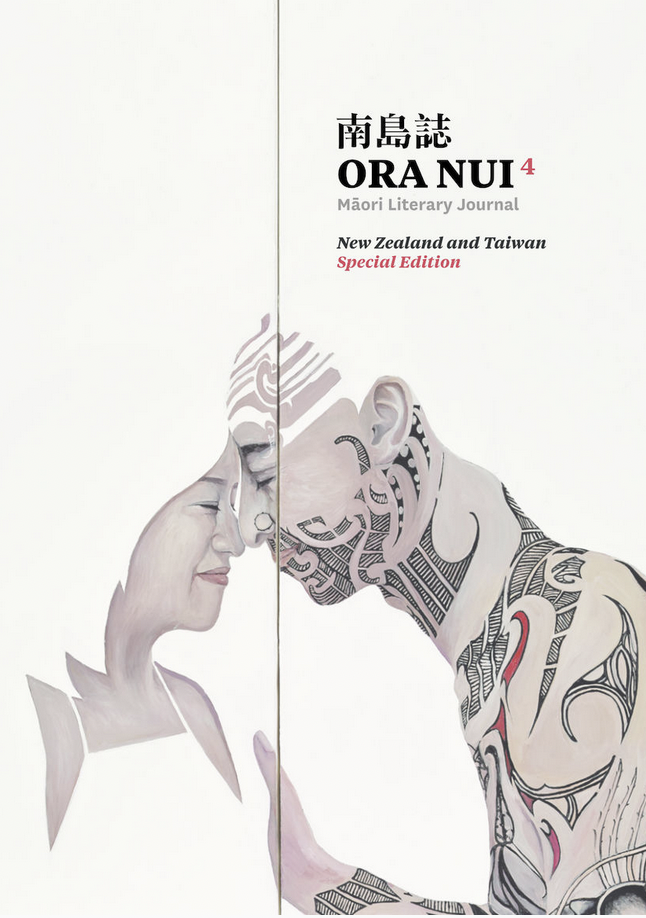
Ora Nui 4: Māori Literary Journal (New Zealand and Taiwan Special Edition), published by Anton Blank, edited by Kiri Piahana-Wong and Shin Su. Cover image: Hongi 2012, Idas Losin, oil on canvas, Kaohsiung Museum of Fine Arts Collection.
How to construct a piupiu for your Waitangi day celebrations
First the karakia to gather the family; the strength of your fibre depends on them. Next, measure the pattern and score with clear, even cuts— if you don’t do this yourself, your enemy will do it for you with year after year after year of protest. Expose the muka, the soft threads that will be so pale, so raw, that they will take on any colour they mix with. Pliability and adaptability are a gift. Don’t let them use it against you. Instead brace yourself, if your thighs can take it, and roll towards the knee. Boil these family strands until buttery smooth right down to the vein; the skin of nature. Sit close to that pain. It can sing. Then, by the threads of these taonga tuku iho, hang them where they are visible, until dry. They will curl in on themselves, shiny side hidden and become hollow chambers in a flaxen silencer. Finally, cold plunge them into dye. Constant interaction may result in uneven colouring, ignore this—do not cry for them here— their warpaint will be revealed, their pattern set. Those hardened tubes will have become whistle darts capable of long distance warning ki te ao whānui. Let their percussion begin. Let them whisper in the ears of your children.
Anahera Gildea
Anton Blank begins his introduction: ‘This issue of Ora Nui is a jewel; light dances across the words and images sparking joy and wonder. It is filled with contributions from my favourite Māori and Taiwanese writers and artists.’
Ora Nui 4 is indeed a vital gathering of poetry, fiction, creative nonfiction, essays and artwork, lovingly assembled by editors Kiri Piahana-Wong and Shin Su. When you bring together a range of voices in a literary journal – with distinctive melodies, admissions, experience, challenges, silences – conversations ensue. Electric and eclectic connections spark and inspire, both within the individual written and visual contributions, and across the volume as a whole. How much more heightened the connective tissues become when contributions are also drawn from Taiwan.
We are in a time when to slow down and listen, to linger and absorb, is the most satisfying advantage. This is, as Anton says, joy. Reading and viewing Ora Nui is to move between here and there, between love and longing, amidst myriad ideas, feelings, melodies. As Kiri underlines, Ora Nui is ‘all the richer for creative pieces spanning an incredible range of topics’. Shin astutely suggests that ‘when finished with this edition of Ora Nui, you the reader will be in possession of an empathetic understanding of the lives and histories of a great many people’.
Familiar names leap out at me: Aziembry Aolani, Marino Blank, Jacqueline Carter, Gina Cole, Amber Esau, Anahera Gildea, Arihia Latham, Kiri Piahana-Wong, Vaughan Rapatahana, Reihana Robinson, Apirana Taylor, Anne-Marie Te Whiu, Iona Winter, Briar Wood. And then – one of the reasons I am attracted to literary journals – the unfamiliar Aotearoa poets become the gold nuggets of my reading: Gerry Te Kapa Coates, Kirsty Dunn, Teoti Jardine, Hinemoana Jones, Michelle Rahurahu Scott, Jean Riki, kani te manukura. Add in the Taiwan voices, the fiction and the nonfiction, and this is a sumptuous reading experience. I am especially drawn to the mesmerising movement and harmonies in Etan Pavavalung’s artworks and poetry, that are internal as much as they are physical.
I travel from the spare and haunting heart of Jacqueline Carter’s ‘Picton to Wellington’ to the aural and visual richness of Amber Esau’s ‘Manaakitanga’. I want to hear them both read aloud, to be in a room with the voices of these poets, in fact all the poets, filling the air with spike and soothe and light. Anahera Gildea’s poems reach me in a ripple effect of sound and song, contemplation, challenge and sublime heart. Reading the collection, I draw in phrases, images and chords that boost a need to write and read and converse. To connect.
For example, this extract from Stacey Teague’s exquisite grandmother poem:
Every Christmas She would knit me dolls with yellow dresses, bright like egg yolks.
She had budgies, chickens, a cat called Mopsy.
She liked the TV show, Pingu.
On her headstone, it says: ‘Ko tōna reo waiata tōna tohū whakamaharatanga’.
My Narn sang waiata with her guitar until her voice stopped. Traded her guitar for a dialysis machine.
from ‘Kewpie’
The artwork is stunning. Take time out from daily routine and challenges, and sink into a double-page spread of art. I keep greturning to Nigel Borell’s Pirirakau: bush beautiful (2006) series. The artworks are an alluring and intricate mix of acrylic, beading and cotton in bush greens on canvas. Or his Hawaiki Hue (2010), an equally glorious mix of acrylic, dye and silk on paper.
A few years ago I bought Ben Lerner’s The Hatred of Poetry because of the title and because there is, indeed, an awful lot of awful poetry that I have felt hatred towards. However, despite the title, the book, is ultimately a celebration of poetry and these are six poems I certainly find worth celebrating.
Tusiata Avia’s ‘How to be in a room full of white people’: I guarantee any person of colour who reads this poem will nod – if not cackle – with recognition at line after eviscerating line. One of my favourite grenade lobs: “ Listen to what funding white people have applied for again, now they have whakapapa.”
Hone Tuwhare’s ‘Rain’: When one of my oldest friends asked me to do a reading at her wedding, I chose Rain because it’s such a beautiful piece. The groom came up to me afterwards and was like: What the hell does that mean? (FYI: they are still married).
Tayi Tibble’s ‘Homewreckers’: The poem begins, amusingly, with a young Maori woman’s lament: “When I was a girl/God tested me with stepbrothers.” Samoan step-brothers, to be exact, who break shit and generally torment the narrator. But as the poem unfolds it gets more melancholic as the narrator reflects on truths about her own life.
Chris Tse’s ‘What’s Fun Until it Gets Weird‘: This had me at “bukkake.” Actually, it had me way before that as it recounts an excruciatingly awkward game of Crimes Against Humanity where the writer has to explain various sexual terms to his insatiably curious mother and aunties.
Talia Marshall’s ‘KIng of the Dive’: Talia’s essays always take me somewhere surprising, utilising language in a way that never fails to fill me with a mixture of jealousy and awe. Her poems are no different.
Aziembry Aolani’s ‘Parking Warden’: Aziembry wrote this when he was a student at the Maori and Pasifika creative writing workshop I convene at the International Institute of Modern Letters. He actually works as a parking warden and I love that he represents his specific point of view here, throwing shit right back at the people who throw shit at him.
Victor Rodger, September 2021
The poems
How to be in a room full of white people
See the huge room Count the brown and black people in the room again Count to one or two or maybe three again Count to only you again Breathe in onetwothreefourfivesixseveneightnine / hold / Breathe out onetwothreefourfivesixseveneightnine
<>
Listen to white people talk about_____________and___________ and________________________________ Listen to white people talk about writing Listen to white people who are writing as black men and black women Hush for prize-winning white people talking Listen to white people who are painting dead, black bodies with bullet holes Listen to white people say they don’t know why they are painting dead, black bodies with bullet holes, but their art-school tutors are encouraging them to keep going
<>
Hear white people pause before they miss the word they used to use Hear the tiny-tiny pause Hear white people say diversity again Wonder if you could unscrew that word like a lid, what might be inside the jar
<>
Listen to white people call you the name of the other brown woman writer again Repeat your name for white people who ask you to repeat your name again Listen to white people say: That’s such a beautiful name, what does it mean? again
<>
Listen to white people say: I went to Some-oh-wa on my holiday, I didn’t stay in Up-peer, I stayed on Siv-vie- ee, it’s traditional, they haven’t lost their culture like the Mour-rees, I stayed in the village, everyone was so authentic Listen to white people say: What do your tattoos mean? But do they have meaning? But were they done in the traditional way? We saw the proper ones – you have to be a chief to have them Hear white people say: My daughter has a tribal tattoo, it looks really similar. Celtic. again
<>
Hear white people say: I own a diary, the Hori kids steal the blue lighters and the red lighters Listen to white people say: Crips and Bloods Listen to white people say Hori again and look at you again Listen to white people say: Well, you’ll know what I mean? Listen to this in your head for weeks Listen to this in your head for weeks
<>
See white people clasp a brown hand Hear white people mispronounce te reo again Listen to white people talk about their roots and their discovery Listen to white people talk about their research and their discovery and the discovery of their great-great-great- great Listen to what funding white people have applied for again, now they have whakapapa
<>
Watch white people watch you as you enter Wonder if you’ll have to empty your bag again again again Breathe in / onetwothreefourfivesixseveneightnine / hold / Breathe out / onetwothreefourfivesixseveneightnine Breathe when you leave and then feel so angry that you walk back in and walk around again Pretend to white people that you’re not watching them watch you again Watch white people’s eyes follow you when you leave again Watch white people startle when you use the words white people together Listen to white people tell you they don’t like being lumped together like that Watch white people when black and brown people are killed again because they are black and brown people Hear white people say: It’s hard to be white too Listen to white people say: I feel culturally unsafe Listen to white people say: I’m a woman of colour, white’s a colour Listen to white people say: I don’t see colour Listen to white people say something about the human race and something about we’re all the same and that all lives matter again again again
<>
Try to reframe it again Try not to sound so negative again Try to stick your fingers down your throat and vomit up the poison pellet again again again Try to say something positive at the end of this poem, so you don’t come across as the angry brown woman again writing about the things that white people don’t want to be true.
Tusiata Avia
from The Savage ColoniserBook, Victoria University Press, 2020
Rain
I hear you making small holes in the silence rain
If I were deaf the pores of my skin would open to you and shut
And I should know you by the lick of you if I were blind
the something special smell of you when the sun cakes the ground
the steady drum-roll sound you make when the wind drops
But if I should not hear smell or feel or see you
you would still define me disperse me wash over me rain
Hone Tuwhare
from Come Rain Hail, Bibliography Room, University of Otago Library, 1970. The poem also appears in Small Holes in the Silence: Collected Works, Hone Tuwhare, Godwit, Random House, 2011.
Homewrecker
When I was a girl God tested me with stepbrothers. I was eight years old. I was thirteen.
They were mean. I began to nurse a few feminist embers that they were happy to fan
with their grandmother’s leaf-shaped ili slapped on the back of my head or the whip of wet tea towels exposing the white in my legs. I wondered if it was true that you can grow too used to the feeling of pink pain spraying?
On a good day you might have called them spirited the same way Satan is spirited, all cigarette butts and stink bombs. I was offended by the audacity bleaching their bright Samoan smiles. Well,
I was soulful. Only used to baby-soft sisters and playing the piano and it physically hurt me.
Every wince seemed to shuck my ribs from my spine as I witnessed them pulling electronics apart like a carcass, searching for the static in the back of the stereo.
Then one Christmas an uncle whose actual relationship to anyone we couldn’t quite place gave the younger one a mechanical Beavis or Butthead I dunno which one but you’d press the button on his plasticated stomach and he would say something rude and crass and gross but ultimately forgettable.
He unwrapped it, studied it. It seemed like for once in his little brutal life he was actually considering his words, choosing tenderly until finally he gave his reply and his reply was Should I break it?
And we all sighed and rolled our eyes with the distinct feeling that life was suspiciously too predictable and already we knew everything that we would ever be doing. Well, I didn’t grow up wrecking things but very often the world wrecked itself around me.
Even if I was light on the kitchen floorboards the geraniums curtseyed, fish threw themselves from their fishbowls, punks crumpled on their skateboards and I always won Jenga.
Even my mother said I had a talent for extracting things from people and so had to be careful. No one was going to light up violently and tell me that I was taking something from them. Life’s not a game of Operation. Stop playing with people. But I’m a lonely Mum. I’m a Libra I’m a Libra just like you.
As a teenager, a man whose opinion I truly trusted said I was a dangerous girl and this made me so afraid of myself. I avoided being alone with her. I never left her unattended.
I made sure she had someone with her at all times. Even if they belonged to someone else, they were mine.
And pink pain became desirable. As an adult, the sensation found a home in my chest. It reminded me of tea towels and hidings and how fresh to death and nervous but alert, and alive I was then.
I can’t remember the last time I ever saw my brothers but recall
Playing Jenga and how long it would take to stack the blocks perfectly only to take turns trying to take without destroying. Which is where I learnt to understand the risk and do it anyway. I just hold me breath. Wait.
Tayi Tibble
from Rangikura, Victoria University Press, 2021
Chris Tse
Chris Tse reads ‘What’s Fun Until It Gets Weird’. Originally published in Aotearotica #4. Recorded at The Sex and Death Salon, WORD Christchurch, 1 September 2018. Thank you to Rachael King and WORD Christchurch.
King of the Dive
Lately, I have been feeling a little like the reaper but I’m drinking again and this guy from Auckland tries to tell me that when he walked into The Crown it felt like he was home and there’s not much of a moon but I still have to slay him, and I remind him that Friday was mob night and Jones is a good cunt and boy is there but I still tell the table he was conceived at The Crown Hotel well not literally but his father was playing pool and the other boys were noodles who fucked liked planks and he had excellent posture and loved Johnny Marr and Tuhoe Joe would jam up the jukebox with $2 coins to stop me because I was the gold heron that was not there for the band I wanted Prince, Dragon and George McCrae and Tuhoe Joe would put pies in the warmer because I was the only bitch who ever asked for one at 2am
Talia Marshall
Parking Warden
My colleague says my skin colour shows that I like rugby. I tell him, ‘I don’t follow rugby …’ He says, ‘Your skin tells me though …’ My skin has never spoken to anyone.
A man yells from a moving vehicle, ‘Get a fucking real job!’ He extends one of his fingers towards me. That. Is. Talent.
A woman says the job I do is ridiculous. Despite paying for the wrong space, she continues to question my presence. ‘Like why do you even?’ Is that even a question? ‘I’m actually quite odd,’ I reply— awkward and triumphant silence.
I am called a fat shit. The driver isn’t in the best shape himself. ‘Why don’t you go for a run, ya fat shit!’ He snatches the fresh white print. I try to catch laughter in the middle of my throat. I walk almost 30 kilometres a day, and I’m Polynesian.
At a pedestrian crossing, I overhear a woman tell her child, ‘You see, son. If you work hard at school, you won’t have to do a job like that.’ She points to me. I turn to the child, ‘And I have a walkie-talkie!’ The child smiles. To his mother’s evil eye, I pull a thumbs up.
Two elderly ladies ask for directions. One lady says, ‘Darling, you don’t speak the way you look …’ The other: ‘You’re a very polite young man … Good for you …’ I pity them.
I see taxis on broken yellow lines double-parked on a one-way street. A driver spots me and alerts his companions. ‘Go, go! The brown one is here! The brown one is there!’ I see panic spilling out of their ears and exhaust pipes.
‘Does anyone give you shit, bro?’ asks a man gripping a can of beer. ‘Why would they? Look at you …’ I attach a printed headache to a vehicle. ‘You’re a big dark-skinned brother. No one will give you shit, my kill!’ I have a sudden vision of myself, as fresh kill, on the roof of a parked vehicle.
A mechanic spots me checking resident and coupon zones. He screams, ‘Warden! Warden!’
Just another white jaw rattling to remind me of what I am.
Aziembry Aolani
from Turbine 2020
Victor Rodger is an award-winning writer and producer of Samoan (Iva) and Scottish (Dundee) descent. Best known for his internationally acclaimed play BLACK FAGGOT and for spear heading the revival of Tusiata Avia’s WILD DOGS UNDER MY SKIRT, his works of fiction have been included in the Maori/Pasifika anthology BLACK MARKS ON THE WHITE PAGE as well as the upcoming LGBTQIA+ anthology OUT HERE. His first published poem, SOLE TO SOLE, is also part of the upcoming Annual Ink poetry anthology, SKINNY DIP. Victor leads the Maori and Pasifika creative writing workshop at the International Institute of Modern Letters and was this year named an Officer of the New Zealand Order of Merit for services to theatre and Pacific Arts.
Tusiata Avia was born in Christchurch in 1966, of Samoan descent. She is an acclaimed poet, performer and children’s book writer. Her poetry collections are Wild Dogs Under My Skirt (2004; also staged as a one-woman theatre show around the world from 2002–2008), Bloodclot (2009), Fale Aitu | Spirit House (2016), shortlisted at the 2017 Ockham New Zealand Book Awards, and The Savage Coloniser Book (2020), winner of the Mary and Peter Biggs Award for Poetry. Tusiata has held the Fulbright Pacific Writer’s Fellowship at the University of Hawai’i in 2005 and the Ursula Bethell Writer in Residence at University of Canterbury in 2010. She was also the 2013 recipient of the Janet Frame Literary Trust Award. In the 2020 Queen’s Birthday Honours, Tusiata was appointed a Member of the New Zealand Order of Merit for services to poetry and the arts.
Hone Tuwhare, of Ngāpuhi descent, (1922 – 2008), was born in Kaikohe and moved to Dunedin in 1969 as the Robert Burns fellow. He spent the last years of his life at Kākā Point on the South Otago coast where his small crib has been renovated for an upcoming creative residency. He was a boiler maker, husband, father, and as one of Aotearoa’s most beloved poets received numerous awards and honours. His poetry has been gathered together in Small Holes in the Silence, a big anthology that contains many poems translated to Te Reo Maori (Random House).
Tayi Tibble (Te Whānau ā Apanui/Ngāti Porou) was born in 1995 and lives in Wellington. In 2017 she completed a Masters in Creative Writing from the International Institute of Modern Letters, Victoria University of Wellington, where she was the recipient of the Adam Foundation Prize. Her first book, Poūkahangatus (VUP, 2018), won the Jessie Mackay Best First Book of Poetry Award. Her second collection, Rangikura, is published in 2021.
Chris Tse is the author of two poetry collections published by Auckland University Press – How to be Dead in a Year of Snakes (winner of Best First Book of Poetry at the 2016 Ockham New Zealand Book Awards) and HE’S SO MASC – and is co-editor of the forthcoming Out Here: An Anthology of Takatāpui and LGBTQIA+ Writers From Aotearoa.
Talia Marshall (Ngāti Kuia, Ngāti Rārua, Rangitāne ō Wairau, Ngāti Takihiku) is currently working on a creative non-fiction book which ranges from Ans Westra, the taniwha Kaikaiawaro to the musket wars. This project is an extension of her 2020 Emerging Māori Writers Residency at the IIML. Her poems from Sport and Landfall can be found on the Best New Zealand Poems website.
Aziembry Aolani (Ngāpuhi / Kanaka Maoli) is a poet with a sweet tooth and a love of animals, and he is a mad gamer. He has been studying at the International Institute of Modern Letters at Victoria University of Wellington, and his work was recently published in Anton Blank’s Ora Nui Journal.
COVID has again meant that New Zealand has gone into lockdown.
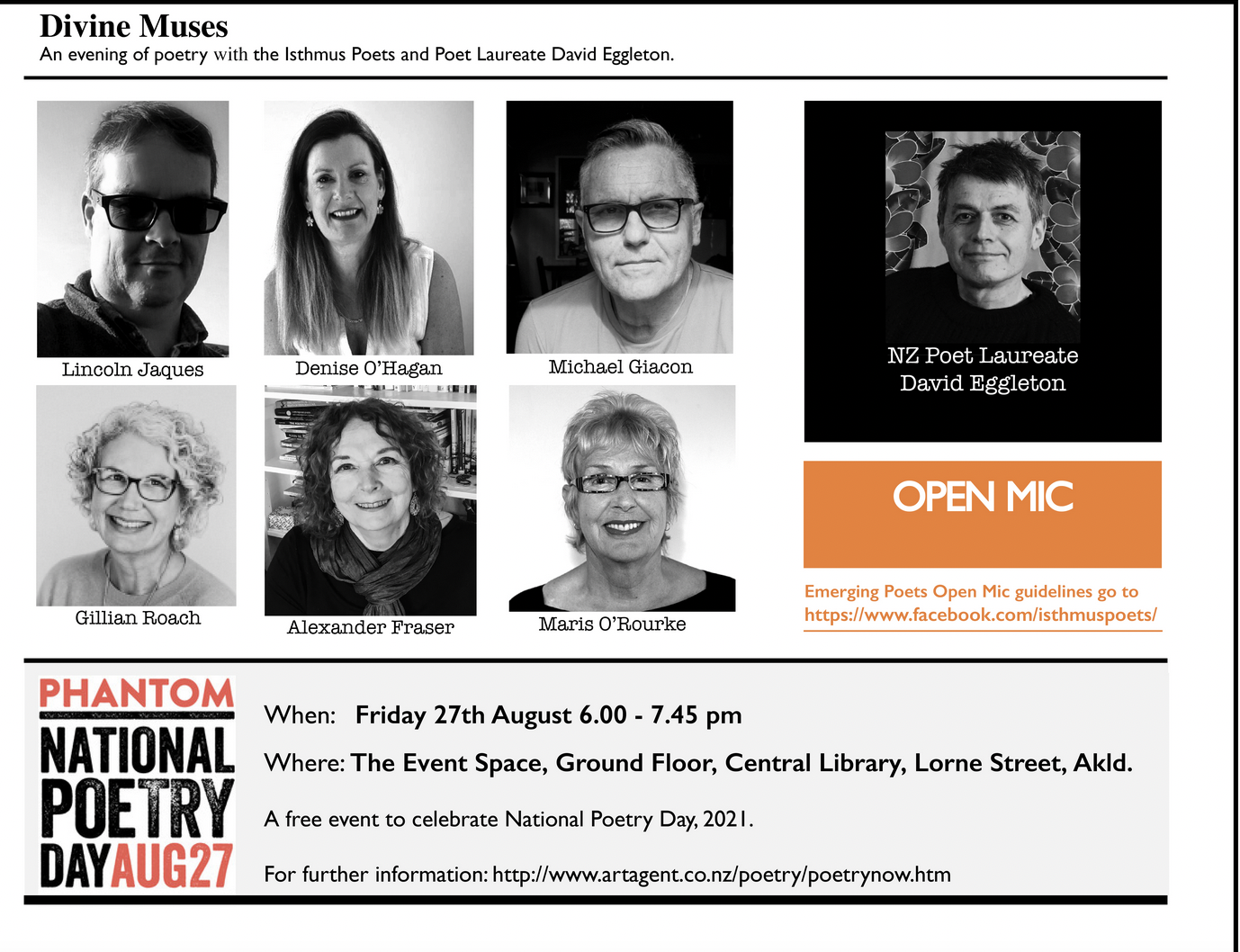
Divine Muses would like to thank the Central Library for enabling this year’s reading to go online and thanks the poets for their time in taking part in the reading.
Writers, our online journal TURBINE | KAPOHAU – A NEW ZEALAND JOURNAL OF NEW WRITING is now accepting your submissions – poetry, creative nonfiction and fiction all welcome, but please read our submission guidelines first!
Poetry Shelf is launching a new season, Readers Pick Poems, that will appear every Friday over the next few months. I have invited a group of readers to choose some Aotearoa poems they love. First up cartoonist Tara Black. She has chosen poems by Karlo Mila, Anna Jackson, Jackson Nieuwland, Hera Lindsay Bird and Rebecca Hawkes.
The poems
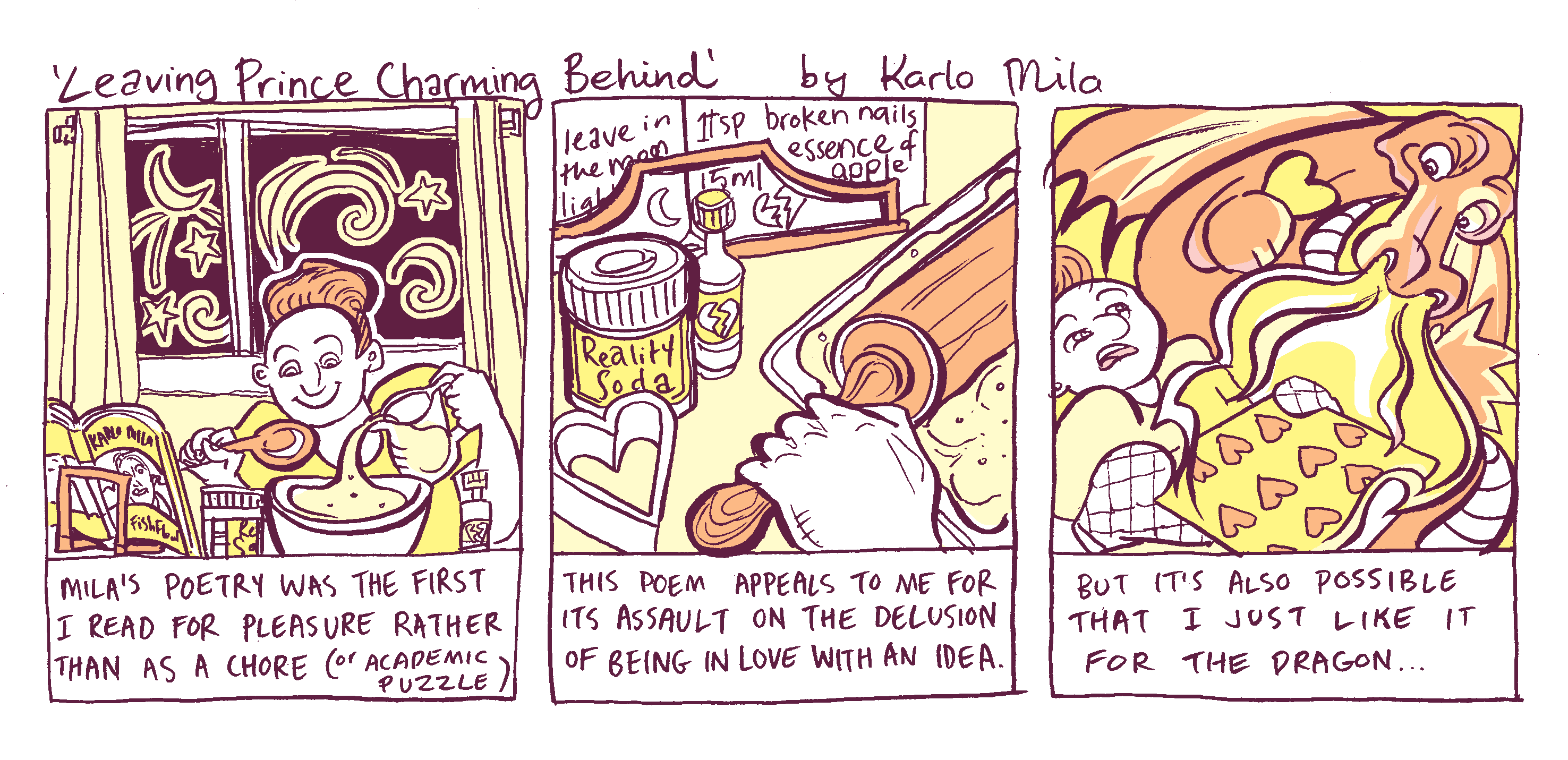
Leaving Prince Charming Behind
For a while I thought we were living the fairytale but sadly I realised that this was the myth and you were so busy believing that we were living the happy ever after I don’t think you noticed for a while I’d rejected the role of princess in your production.
I am Rapunzel with her dreadlocks shorn trying to pull down the tower with broken nails cursing your name.
I believed you the architect of my isolation and it didn’t matter what you tried to do the poison apple was lodged firmly in my throat and not believing in glass slipper redemption I worked my own midnight magic for all it was worth re blood, white cloth mirrors on the wall.
My poor dark prince on your gallant white horse the shoe didn’t fit your kiss couldn’t wake me up to your way of thinking.
I transformed myself into a beautiful dragon you felt honour bound to slay.
Karlo Mila
from Dream Fish Floating, Huia Publishers, 2005
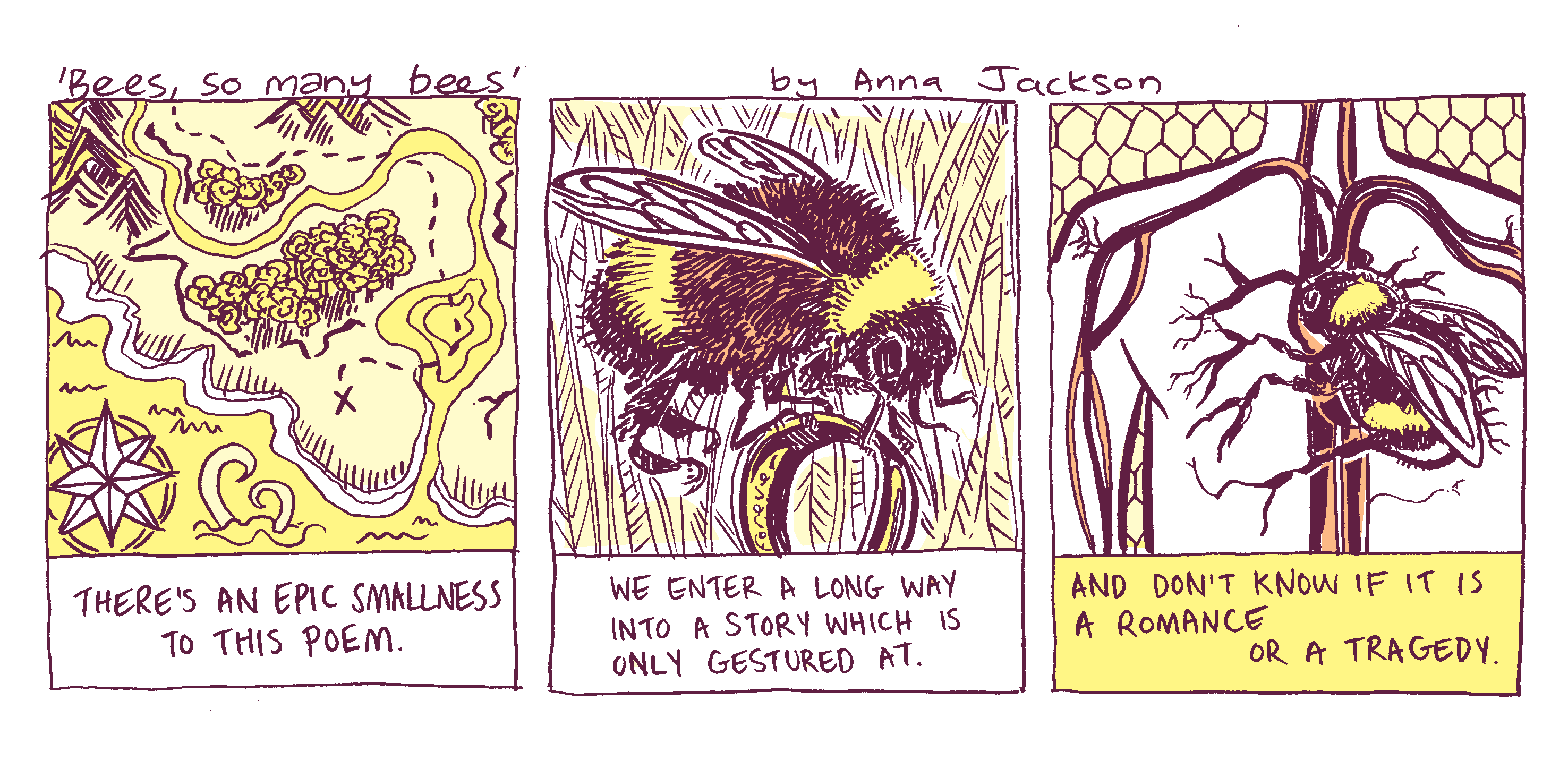
Bees, so many bees
After twenty years of marriage, we walked out of the bush and on to a rough dirt road we followed till we saw a pond we might be able to get to. The ground was boggy and buzzing. The pond was thick with weed and slime. It was not the sort of pond anyone would swim in, but we did – picking and sliding in to the water over the bog and bees, bees we suddenly noticed were everywhere, settling on our hair as we swam, ducks turning surprised eyes our way. After twenty years of marriage what is surprising isn’t really so much the person you are with but to find yourselves so out of place in this scene, cold but not able to get out without stepping over bees, so many bees.
Anna Jackson
from Pasture and Flock: New & Selected Poems, Auckland University Press, 2018
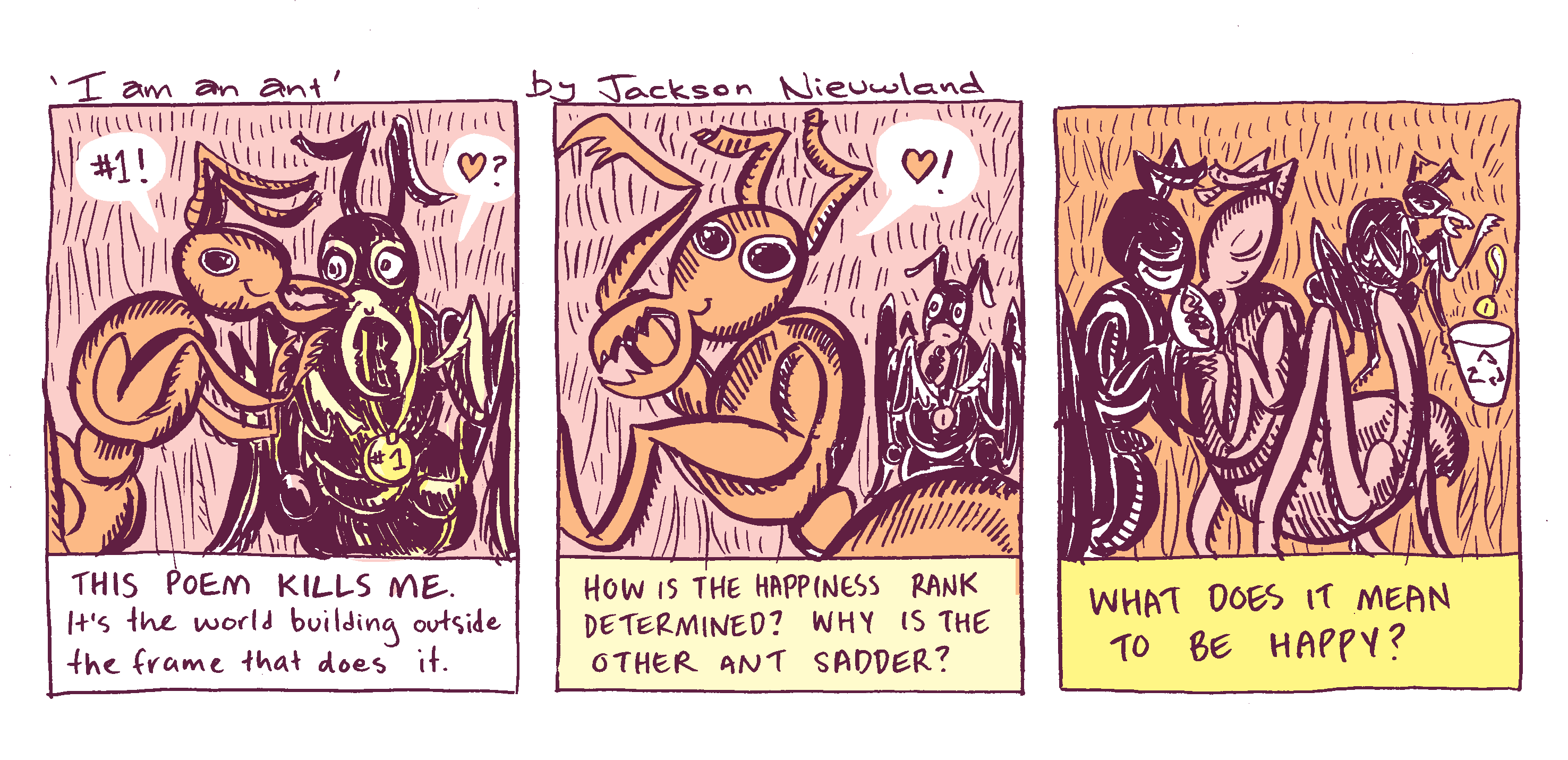
I am an ant.
In fact, I am the happiest ant in the world.
I wasn’t always the happiest ant in the world, and I didn’t become the happiest ant in the world by getting any happier
Another ant got sadder.
Jackson Nieuwland
from I Am a Human Being, Compound Press, 2020
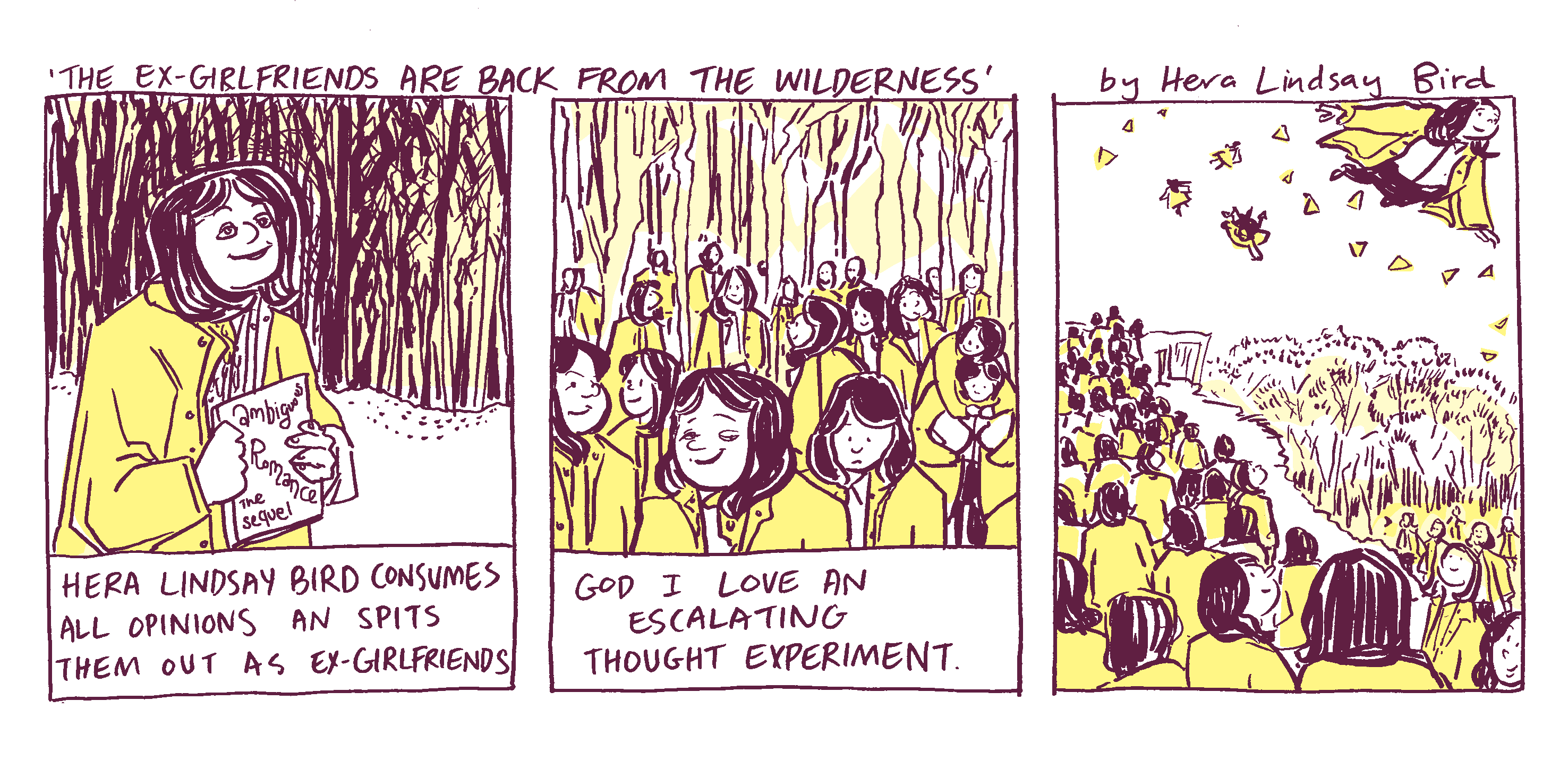
THE EX-GIRLFRIENDS ARE BACK FROM THE WILDERNESS
The ex-girlfriends are back… emerging once again from the tree shadows… into the primordial burlesque of autumn with their low-cut… reminiscences… and soft, double ironies… trembling once again into their opulent… seasonal migration patterns a corsage of wilting apologies tethered to the bust…
The ex-girlfriends are back…with their hand-beaded consistencies… & various unhappy motives… dragging their heart like a soft broom through leaves… and they go on hurting… like the lit windows of a dollhouse in winter… with a too-big house outside…
The ex-girlfriends are back but in a romantically ambiguous way…
The ex-girlfriends are back and have transcended the patriarchal limitations of romance… unlike the new girlfriends… still handcuffed to monogamy… slowly writhing… with their naughty…post-hetereosexual fatalism
The ex-girlfriends are back with their unfounded Soviet aspirations… and anti-hegemonic arts initiatives… draped over a piano on the edge of the thicket playing the lonely upper hand of chopsticks… in their vague tropical displeasure…
The ex-girlfriends are back and the post-girlfriends… and the ‘let’s not put a label on this’ girlfriends… all of them at the same time, walking through a beaded curtain of water… like too much Persephone and not enough underworld… wearing nothing but an Arts degree… and the soft blowtorch of their eyes…
You can feel their judgements come down upon you like too-heavy butterflies… but there’s nothing you can do about it! and worst of all they don’t even want anything… they’re just standing there…performing many
enigmatic life blinks re-mentioning Deleuze and Guattari in loneliness and natural lighting The ex-girlfriends are back with their sanity pangs and various life fatigues… like a stuffed-crocodile exhibit still begging for death relevance in the glass case of your heart But you are the museum director now! Walking talent on a gold leash & there’s nothing anyone can do about it!
The ex-girlfriends are back like the liquidation sale of an imported rug megastore that’s been liquidating for centuries… getting rich off all that…tasselled goodbye money as they grind your face yet again into the hand-knotted… semi-Persian wool blend…of their hearts begging once more for closure.
The ex girlfriends are back with their pre-distressed sadnesses and their…talent unlike yourself who is both undistressed and talent-free!
Yet somehow still above them all like the grand arbiter of happiness laughing in your ermine neck ruff as you push them one by one down the waxed fuck-ff chute of their bad erotic failures
Hera Lindsay Bird
from HERA LINDSAY BIRD, Victoria University Press, 2016
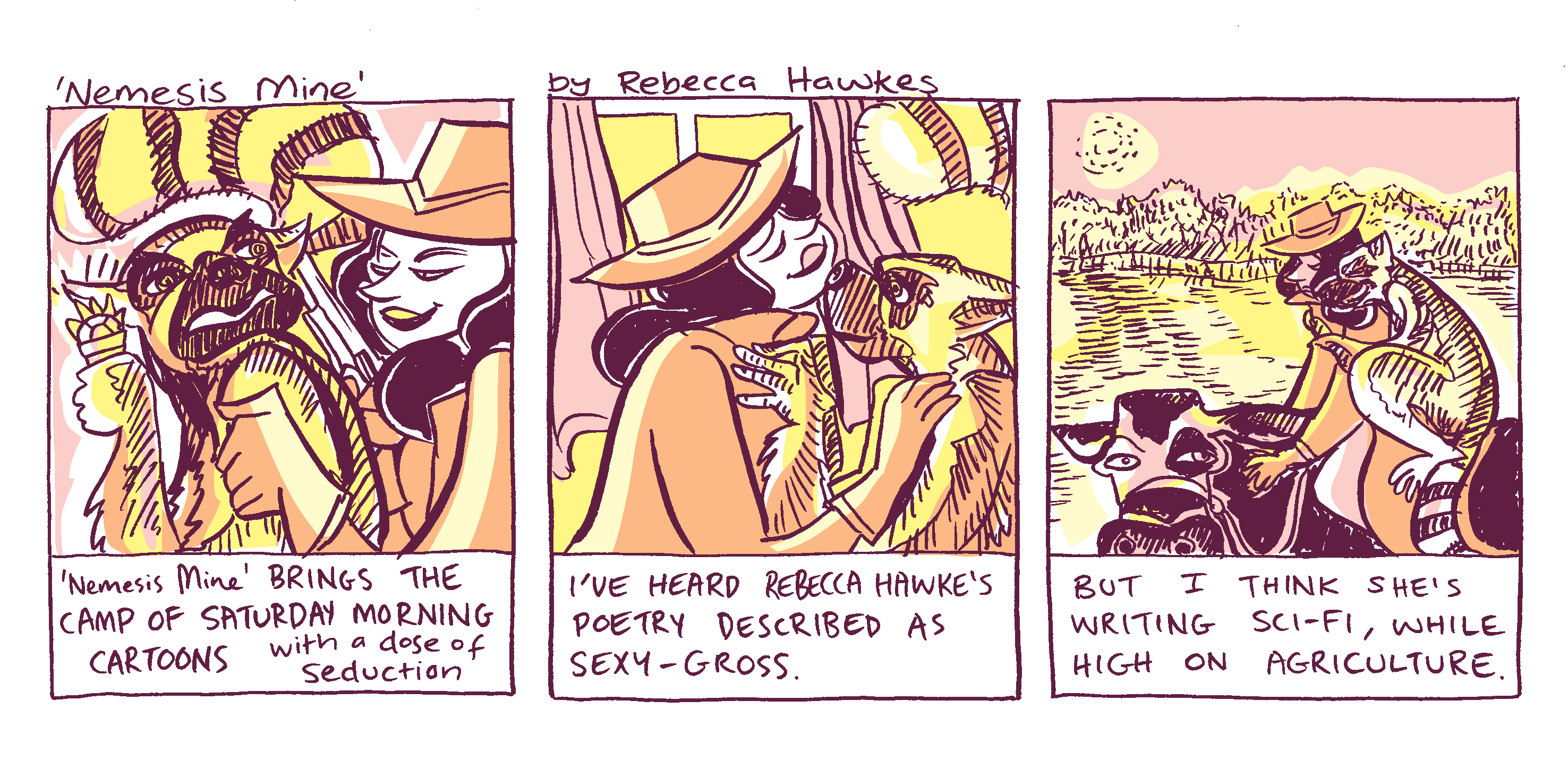
Nemesis Mine
yours is the name I hate most of all which I know because I have been repeating it between my teeth instructing my minions to conduct increasingly elaborate heists that will lure you at last to your doom which is destined to be me obviously
I burglarize a priceless artwork which you had acquired at significant personal cost I cut out the gently smiling face in the painting and replace it with a selfie so when you steal it back the painting is worthless on the black market but you do not get rid of it my spies report that you keep it under your pillow gilded edges jutting out
you construct a laser superweapon to etch a gigantic tag of your name across the moon on my birthday ruining my luxury moon themed full moon party to which I specifically did not invite you though I did arrange a data leak of the coordinates when you arrive in your warship cannons booming my heart leaps in my throat whilst I dive for cover
how many times have you sailed recklessly over continents and ocean trenches in hot pursuit launching torpedoes as I careen in your spyglass sights cackling away on my gold plated jet ski O nefarious O dastardly I live to hurl bullion back at you from a slingshot while my space squad of highly educated dolphins breaks into the hull of your craft they purloin small items of enormous sentimental value and release the conspiracy of lemurs you have trafficked and trained to paint flawless reproductions of frankly dated masterworks
loose at last the bandit-faced primates graffiti your clandestine labyrinth with the same tasteless repetitive sunflowers but you have already arranged for special forces to capture me at the border loathsome busybody I hate you I hate you I wouldn’t have it any other way
and yet my last several escapades went off without a hitch and I can no longer intercept your vile machinations on any channel even the encryptions only you and I use mortal enemy the world is boring without your meddling I lie awake awaiting intel
apparently you are spending your days in a state of deranged reasonableness you have been waking early to jog without your bespoke catsuit or balaclava your throwing stars rusting in their cabinet you have taken to hand crocheting hanging baskets for your carnivorous plants you have filed tax returns on a number of offshore accounts thereby defeating their very purpose and you have quibbled on consumer review sites for home appliances under your real name
I cannot abide all this ruin by prudence come for me you coward get! in! your! pirate! ship! you say you have been taking “therapy” you are “working on yourself” your psychoanalyst has some “reservations” about our “relationship”
ahoy there mouthbreathing brigand thinking yourself too damaged for a final duel I see it I do who knows you better than I sniveling craven stand and fight yes your shame is coiled up inside you and ready to play yes your shame is a slinky delightful in rainbows as it loops over itself going down and down and down the spiral stairwell in the frivolous castle you built for your dreams this is not an invitation to tell me the unfinished business of your childhood
but do you really think you can outdo me in abjection never fear I will draw my own shame out of my throat like a sparkling feather boa I will drape it over my shoulders I will perform a sensual dance using my shame as a prop I will helicopter my shame wildly in front of my crotch oi enemy oi nemesis look at moi through all our capers and larceny did you think I couldn’t anticipate this twist our ultimate boss battle a public redemption arc
I always expected we would grow old together spending our ill gotten gains to purchase adjacent volcanic island lairs like two humongous tits jutting up from the ocean we would spit at each other across the archipelago and in the evenings with our weakening arms we would row halfway out in our canoes and wrestle
Rebecca Hawkes
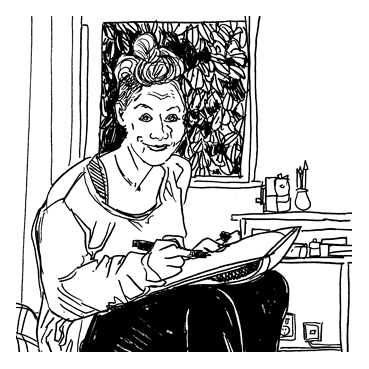
Tara Black is an Aotearoa cartoonist with a deep abiding love for fried potato. She can often be found in the front row of book events, illustrating authors and their ideas. You can find her work in places which almost exclusively start with the letter ‘s’: The Sapling, Stasis Journal, The Spinoff, The Suburban Review, and her website, taracomics.com. Her first graphic novel, This Is Not a Pipe, was published by Victoria University Press in 2020.
Hera Lindsay Bird was a poet from Wellington. She hasn’t written a poem in a long time, and no longer lives in Wellington.
Rebecca Hawkes is a queer pākehā poet, painter, and PowerPoint slide ghostwriter living in Te-Whanganui-a-Tara. Her chapbook ‘Softcore coldsores’ can be found in AUP New Poets 5. She is co-editor of the journal Sweet Mammalian and an upcoming anthology of climate change poetry, and is a founding member of popstar performance posse Show Ponies. More of Rebecca’s writing and paintings can be found in journals like Starling, Sport, Scum, and Stasis, or online at her vanity mirror.
Anna Jackson lectures at Te Herenga Waka/Victoria University of Wellington, lives in Island Bay, edits AUP New Poets and has published seven collections of poetry, most recently Pasture and Flock: New and Selected Poems (AUP 2018).
Karlo Mila is a mother, writer, poet and indigenous knowledge geek. She lives in Tāmaki Makaurau with her three sons. Karlo is especially over-active on Facebook. She works in the area of leadership for her day job, trying to understand and explore what that means when drawing on the ancestral knowledge of those who have lived in this region for over three thousand years. Of Tongan, Pākehā and Samoan descent, figuring out and living what this means in this contemporary context is often centred in her work.
Jackson Nieuwland is a human being, duh. They are a genderqueer writer, editor, librarian, and woo-girl, born and based in Te Whanganui-a-Tara. They co-founded the reading/zine series Food Court. This isn’t even their final form. Their debut collection, I Am a Human Being, won Best First Poetry Book at the Ockham NZ Book Awards 2021.
Tomorrow I am launching a new season on Poetry Shelf. I have invited a number of readers to pick a handful of Aotearoa poems they love. No easy task! I have trouble reducing all the poems I love to an anthology, so I know assembling a tiny gathering is a challenge. Over the coming months you will see the choices of Tara Black, Victor Rodger, Emma Espiner, Peter Ireland, Claire Mabey, Foodcourt, a crew from AWF, Sally Blundell, Rebecca K Reilly and Francis Cooke, among others. I am both excited and moved by this season – especially because these readers have put in their own time and enthusiasms to share a connective love of poetry.
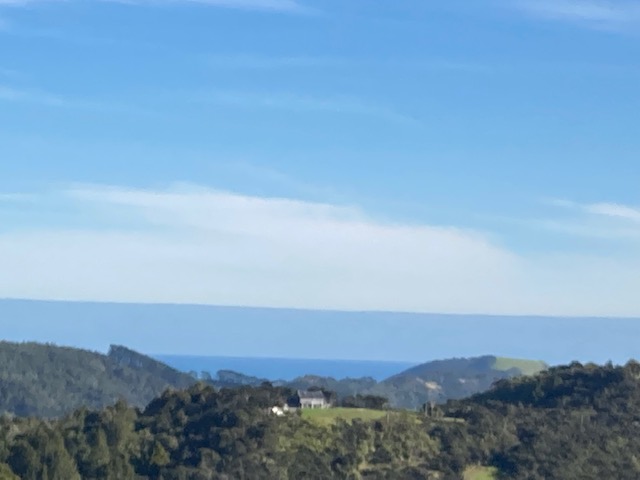
This photograph is as close as I get to the ocean at the moment. The blurry photo is standing in for my blurry mind. Me walking up and down the road to gaze out to the Tasman Sea. For so many of us in Tāmaki Makaurau, we get to the ocean at the moment by reading, by dreaming and finding new and old ways to be and stay at home. Music helps. Cooking comfort food definitely helps. Poetry too can be such a connecting delight, reaching across the divides to fingertap warmth, ideas, feelings, music, whether soothing or spiky.
I am grateful to the readers, poets and publishers who have contributed so generously with writings, cartoons, permissions and choices.


 NZ Poetry Shelf