This will be a wonderful celebration of women’s writing – and of everything Carole Beu and her shop have done for readers over the past 30 years.
Do join us! On Monday 5th August at the Waterfront Theatre.


Tickets here


This will be a wonderful celebration of women’s writing – and of everything Carole Beu and her shop have done for readers over the past 30 years.
Do join us! On Monday 5th August at the Waterfront Theatre.
Tickets here
Remembering Akhmatova
Of course they are not
spacecraft. The seed packet
described them as ‘Giant Russians’.
Nevertheless they are looking down
as if to find a place to land.
They are not Van Gogh’s sick hospital flowers
neither are they William Blake’s eternal time machines
nor even Allen Ginsberg’s gold Harlem recognition of self.
These are the sunflowers
that looked over my shoulder
at Frankton Railway Station
as I sat in brown shadows
awaiting a train out of Hamilton.
In the heat the tracks trembled like mercury.
In the pages of a book of poems
I was abducted by a Russian –
her black and yellow words
her giant symmetry.
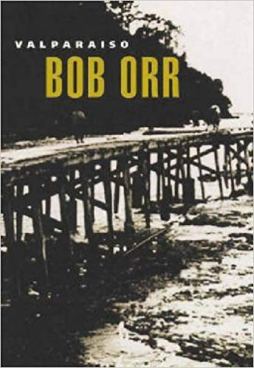
Bob Orr from Valparaiso Auckland University Press 2002
From Siobhan Harvey:
I’ve always admired Bob Orr’s poetry for his rare ability to entwine narrative, atmosphere and intimation. So much in ‘Remembering Akhmatova’ is said, and so much inferred. Of the spoken, Orr manages to use few words for maximum activity. Within six early lines, for instance, we are transported from a humble seed packet of sunflowers to a stretch of iconic artistic representations of the Helianthus. Van Gogh, Blake, Ginsberg – the diaspora of their artistry, history, geography, inspiration and output is collected and counterpoised seamlessly. There’s weight there too, of course: the burden inferred by the work and legacy of these great artists which carries through the remaining lines of the poem, as the narrator – located in humble Hamilton – waits to leave; but for what? For a life of writing, assuredly, as Akhmatova – directly referred to in the title, but not in the poem – anchors the end of Orr’s work and its story. It’s her poetry which has stolen the narrator’s imagination, something tellingly revealed to us only at the point of his escape. Yet, in its covert concluding reference, it speaks to – and connects – everything which has gone before.
This is said without mention of form or lyric in this poem, both of which deserve discussion of course. Where Orr’s verse stretches to include mention and inference of the work of significant creatives (painters, poets), it also extends its lines; and the musicality of the work expands too. So the first eight lines steadily lengthen, guiding the eye and ear into the rhythmically exquisite, “nor even Allen Ginsberg’s gold Harlem recognition of self.” Cleverly, such extension occurs at the point when the narrative is built upon dissent and negation, ergo “they are not spacecraft” and “are not Van Gogh’s sick hospital flowers”. Then the poem – its tale, form and lyric – tips into ten short lines, all of which are affirmative in tone (“They are the sunflowers …”), tight in form and symphony sharp.
So much is packed into these eighteen lines. As a reader and an artist, I return to this poem so often, listening to it, looking and deconstructing it, searching to make sense of its deep craft.
Siobhan Harvey is an emigre author of five books, including the poetry collection, Cloudboy (Otago University Press, 2014), which won the Landfall Kathleen Grattan Award. She’s also co-editor of the New Zealand bestseller, Essential New Zealand Poems (Penguin Random House, 2014). Her work has appeared in multiple journals both in New Zealand and Internationally. She was long-listed for 2019 Australian Book Review Peter Porter Poetry Prize (Aus) and won 2016 Write Well Award (Fiction, US). The Poetry Archive (UK) holds a ‘Poet’s Page’ devoted to her work. She lectures in Creative Writing at The Centre for Creative Writing, Auckland University of Technology where she’s completing a PhD in Creative Writing.
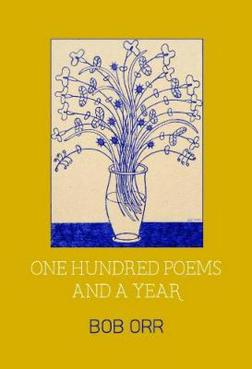
Bob Orr grew up in the Waikato, and has subsequently lived most of his adult life in Auckland. He has published nine collections of poetry and won the Lauris Edmond Memorial Award for Poetry in 2016. His writing has appeared in a number of collections, journals and anthologies and he has recently published the new collection One Hundred Poems and a Year (Steele Roberts, 2018).

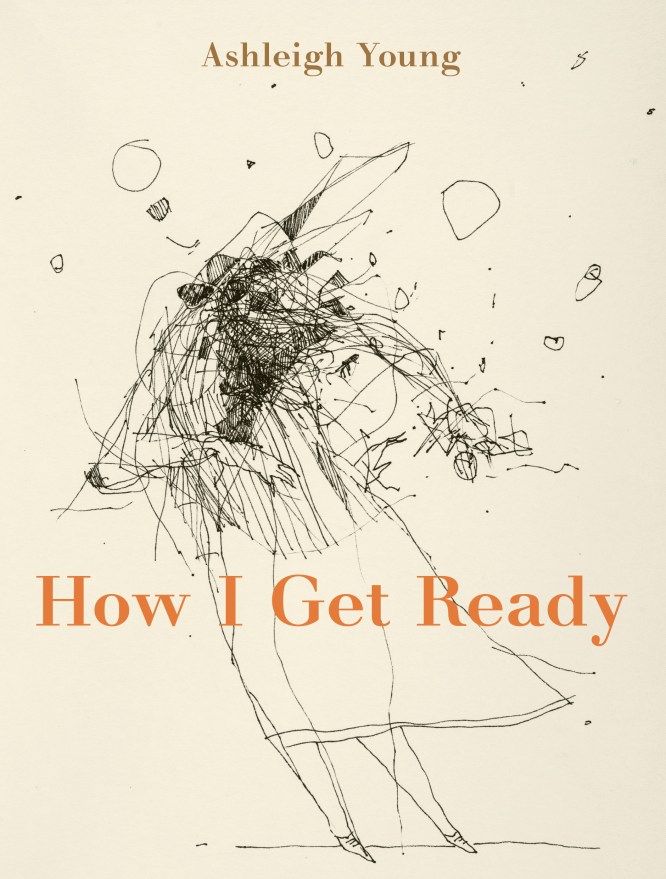
Ashleigh Young, How I Get Ready, Victoria University Press, 2019
A woman smiles out of a plastic coat
its yellow turning rain to torches.
Light rests on a man waiting to cross,
coats his dog.
Light crosses a man
waiting to rest.
The hills pull fog around themselves
and trudge to the sea,
carrying all our houses.
from ‘Lifted’
I like the shape of this book – this matters with poetry – because when a poetry book is good to hold it makes you want to linger even more, to stall upon a page. The book looks good, the paper feels good, and the cover drawing by Sam Duckor-Jones is a perfect fit. His idiosyncratic artwork moves in and out of reality, a person tilted by anxiety, the wind, both exposed and screened. A little like the poems inside the book. This is a collection of waiting, breathing, of curious things, anxieties, anecdotes, lists, found things, recycled words; little starts in your head as you read. It is extremely satisfying.
The Notes acknowledge the jump-off points of a number of poems – a line in a letter from Andrew Johnston turns into ‘Turn Out to Be Something’. Poems spring from epigraphs, a contents page, Margery Kempe, psychiatric cases, other poems. Where the poems shift to is perhaps a blend of the fictional and the personal. The speaker is always on the move.
One of the joys of reading these poems is the way connective tissue or an invisible thread holds the poems together; it might be the way you stay with one character or situation or mood. Yet the doubled reading joy is in the glorious little leaps: from an idea, admission, description or trope to another idea, admission, description or trope. Surprising, startling, fascinating and always feeding the invisible thread. Take ‘Ghost Bear’ for example. Eliot pulls me through the poem. He is the mystery and the guide. You will move from a ritual where someone tests themselves against a ghost bear with a skull head to a boy who gets electrocuted but survives then scores a try (‘He’s just showing off / because he got electrocuted’) to an inappropriate kiss. Before the strange, goosebump ending, I got stuck on this verse which feels like an intrusion from the poet herself:
When there are two frail old women together, there is always one
who is visibly stronger.
I have an old friend and I think about whether we will be old together
and which of us will be stronger, holding up the other
which of us the wind will push over first
for a good joke
The opening poem, ‘Spring’, begins with an eye-catching image : ‘I saw a horse lying on the street / and people were trying to help it up.’ It is a poem of little fascinations (forgive me if I keep using that word!) but it is also a poem of breath, of holding and releasing breath, of waiting. The words form little exhalations on the page. I am standing with the person (the ‘I’) standing in the street thinking random things as they wait to see that the horse will stand. I am fascinated by the little admissions (they have waited so long it is too late to go to work). I am fascinated by the personal truisms (‘When I am satisfied with one thing / I want something else’). I am fascinated by the biography of the speaker.
My mother assured me
that when I feel that I am not wel-
come at home and everybody has
hatred towards me that it is only
my imagination. This statement
made me feel very good;
I went to bed and
slept sound
The poem arrives in surprising increments – in bursts of unsettling strangeness. Who is this speaker who must keep revealing things? I look at the Notes, only after musing on the poem awhile, and discover it is a found poem, with the words borrowed from the study of a young man with compulsion neurosis who transforms his life into bizarre distortions. (published in 1918).
‘Turn Out to Be Something’ is also a poem that involves waiting; the speaker waits for things and then modifies the admissions; waiting is fine as long as waiting is not in vain and something is at the end, although not necessarily what is first expected.
I can wait for a layer of sandstone to form over me
and freeze and thaw and freeze and be shattered
and be piped into the sea as long
as that turns out to be something.
Many of the poems play with lists, repeating the beginnings of stanzas before swerving or drifting in myriad directions. Take ‘Guide’ for example. A poem written for an exhibition of Colin McCahon’s Walk (Series C) at Te Papa. I love this poem; I love the way it builds upon ‘what if’ and gathers heart, wisdom and downright surprise. Ashleigh steps off from Colin’s ‘walk’ along Muriwai Beach and walks through meditations on water (the sea, fresh water, a river mouth, waterfalls). Her poem walks us into the physical and then catapults us elsewhere. It makes my heart ache.
If a girl is lost, someone will walk a long way to get her.
If her hand is held all the way back, it will be a short walk.
I have to share the ending with you because it gets right to the heart of what makes an Ashleigh Young poem so darn good.
If a waterfall no longer has water, it is a groove
that suggests a falling motion, just as this trail
suggests a walking motion
but if a person keeps walking until there is no more walk to take
they will no longer look forward to it, so will turn back.
Pretty much every poem is a poem I want to talk about. I want to talk about ‘Driving’ because it feels like a miniature autobiography that goes deep into experience. It gets personal but it’s prismatic in image and ideas. Somehow in this mix of riding a bicycle, learning to drive and imaginative leaps, the poem feels acutely human. Like it is breathing life back into me. When I stop on this double page I am thinking you could swap ‘driving’ and ‘riding’ for any number of things. The way the things we do conjure anxious thinking and random thoughts. I read the poem and replace all the driving/ riding words for ‘writing’. For example: I write along the street outside your house / with my heart floating loose and getting chain grease on it.
Yes this poem is a gem – it builds and ducks and freewheels. Here is the start:
They tell me any idiot can do it and I tell them
I’m not just any idiot, I’m specific. Even when my lungs
are bursting – properly bursting
like things dragged up by a deep-sea fisherman
I keep riding. I get tired. I just keep riding!
I have written about this book in Wild Honey so have tried not to repeat myself or even refer to the poems I picked to talk about in the book! But Ashleigh became one of my sky poets for all kinds of reasons.
Every poem catches me! Some books you pick up, scan a few pages and then put down because you just can’t traverse the bridge into the poems. Not this one. It is as exhilarating as riding a bicycle into terrain that is both intensely familiar and breathtaking not. The speaker is both screened and exposed. The writing feels like it comes out of slow gestation and astutely measured craft. I say this because I have read this andante, at a snail’s pace. Glorious!
What song will they play if I don’t come home tonight?
I wished someone would write a song for me, then someone did
but it was a song berating me; it was called ‘Actually, Ashleigh’
and I think of the cruelty of songwriters as I get ready
how their music makes their words sound better than they really are
how our feelings make music seem better than it really is
and how the difficulty of getting ready is a pure, bitter difficulty
like calculus. In the back row a once-promising student cries.
What will my face become? Strings of demi-semi quavers.
from ‘How I Get Ready’
Victoria University Press page
Read ‘If So How’ from How I Get Ready
Ashleigh Young is the author of the poetry collection Magnificent Moon (VUP, 2012), and the essay collection Can You Tolerate This? (VUP, 2016) which won a Windham-Campbell Prize from Yale University and the Royal Society Te Apārangi Award for General Non-Fiction in 2017. She works as an editor and lives in Wellington.
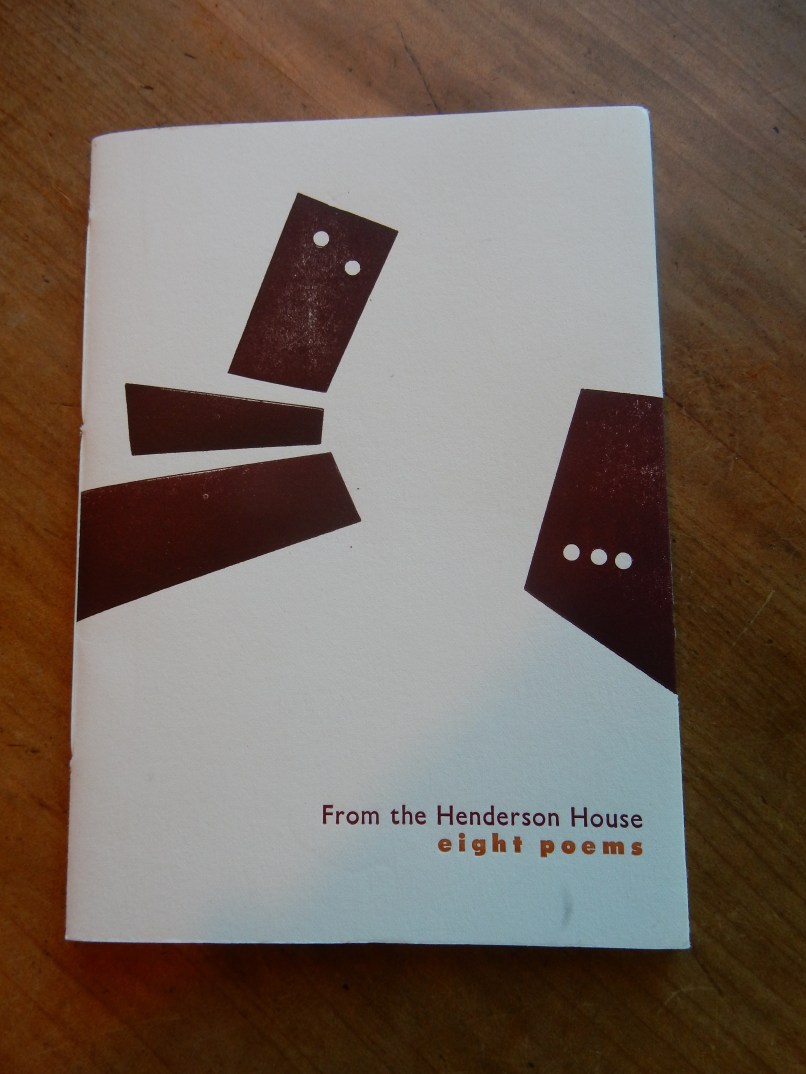
From the Henderson House: eight poems is an exquisite chapbook penned by Jenny Bornholdt and Gregory O’Brien. The first 18 copies feature a cover design lovingly handprinted by Brendan O’Brien on an Merlarue etching press at the Henderson House in Alexandria. The remaining 40 copies feature covers designed and printed by Brendan at Fernbank Studios in Wellington.
The eight poems were written while Jenny and Gregory enjoyed a year-long artists’ residency thanks to the Henderson House Trust. Each double page is like a set of open palms – with Jenny’s poem on one side and Gregory’s poem on the other. A loving couple. Here are the titles:
Old Prayer
On drinking water
About
Autumn, Alexandria
Fog
Styx Crossing, Upper Taieri
En plein air
Two burning cars, one afternoon
The poems rise from contemplation, from lengthy time in a place of beauty, from the small but fascinating detail. To read the poems is to absorb place; to delight in the ability of poetry to transport you physically to the uplift of elsewhere. Yet the poems also transport you along rebounding ideas, particularly along the verb ‘to be’. These are poems that speak of existence.
As I read I am thinking of a slow poetry movement (in keeping with the slow food movement) and that slowness extends to reader as well as writer. I travel from hawk to water to trees to autumn to fog to river to horse to burning car. I am taking my time and it is so very nourishing.
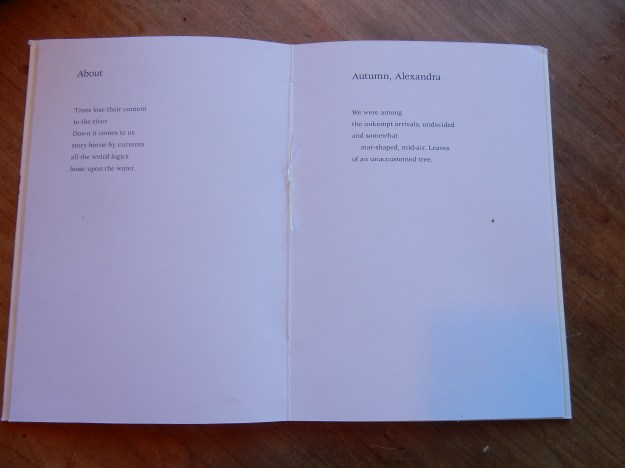
About
Trees lose their content
to the river.
Down it comes to us
story borne by currents
all the weird logics
loose upon the water.
Jenny Bornholdt
Autumn, Alexandria
We were among
the unkempt arrivals, undecided
and somewhat
star-shaped, mid-air. Leaves
of an unaccustomed tree.
Gregory O’Brien

A stellar line up of authors taking master classes include Harry Ricketts, Catherine Chidgey and Kate De Goldi,
Registrations are now open for this year’s NorthWrite conference, Expanding Horizons, which features masterclasses and a keynote presentation by top New Zealand writers.
Multiple award-winning novelist Catherine Chidgey will present a masterclass on long fiction, poet, biographer and essayist, Harry Ricketts, will offer a masterclass on poetry and Simon Minto, editor and Whitireia Polytechnic publishing course tutor, will lead one on editing. The conference’s keynote address will be given by award-winning fiction writer Kate De Goldi.
NorthWrite event coordinator Kathy Derrick said the organising committee was thrilled with the calibre of presenters they had secured for this year’s events.
“We have an outstanding line-up of very experienced and well-regarded New Zealand authors, poets and an editor, as well as an international guest and local publishing industry experts offering their expertise to the writing community at this year’s event,” she said.
As well as offering masterclasses, Catherine Chidgey, Harry Rickets and Simon Minto will lead workshops on technical aspects of their crafts, and Kate De Goldi will present sessions on writing for children. Leeanna Morgan, author of 34 contemporary romance novels, will lead a workshop on plot as well as one on the publication steps for ebooks. Smashbooks marketing director Jim Azevedo will provide a webinar from the United States on ebook publishing and Huia Publishing executive director Eboni Waitere will focus on traditional publishing.
Derrick said that NorthWrite 2019 has been organised into parallel streams, designed to reflect the interests of the writing community. The masterclasses have been planned to give experienced writers, poets and editors opportunities to engage in in-depth discussions about their craft. They are restricted to a limited number of participants to ensure a high level of engagement.
In addition to the masterclasses, the streams are as follows:
Participants may choose to attend sessions within or across streams when they book for the conference.
NorthWrite 2019 will be held at Barge Showgrounds Events Centre, Whangarei. It will open with a mihi and meet-and-greet event on Friday 30 August. The conference will take place on Saturday 31 August and Sunday 1 September.
Early bird prices are available until 31 July. Reduced prices are available for students. Catering is provided by Soda Creek Kitchen (ex Food at Wharepuke).
To find out more about the conference and to register go to northwrite.co.nz.
Aotea Square
Finally just us two
reclining on the shores of Aotea square
The absolute epicentre
of any bonafide
Auckland urban romance
I’m convincing you the pavers
could almost be sand
If you squint hard enough anyway
But I’ll say any old guff
just to make you smile
The sun’s evaluating the skyline
It’s making me drowsy
or you’ve doped me with the pretzels
I swear the odd gradient of these steps
is identical to a beach on the tip of the Coromandel
I can’t quite remember the name of
or perhaps I never knew to begin with
Your polygamy story soon jolts me out of my reverie
En masse the city dwellers
are lying around sun-drunk
sprawled all over my fake foreshore
in their suitably fake sunglasses
half watching the Chinese cultural festival
cryptically splash at our feet
We’ve got gigs across town from one another
so we’re play-acting
sulky besotted teenagers being torn asunder
by unspecified forces
much larger than our-tragic-selves
The IMAX sign looks down frowning, unconvinced
and for heaven’s sake, it would know!
Marcus Sellwood
Marcus Sellwood is a musician and occasional poet. He was born in central Auckland and has lived his whole life there. He likes to write about his experiences of the fast-changing city.
Le poetry
Quelle joie! Our monthly cultural extravaganza is on Bastille Day. Let us hope some poems include French words.
Our monthly cultural extravaganza is on Bastille Day. Let us hope some poems include French words.
Les readings by:
* Steven Toussaint, poet
* Chris Holdaway, poet
* Anna Livesey, poet
Plus snacks and a glass of vin. Truly, our lives are blessed.
…
Sunday, July 14, 2019 at 3 PM
The Open Book
201 Ponsonby Rd, Auckland

Image credit: Mākaro Press. Dementia Wellington Chief Executive Anne Schumacher receives the $1030 cheque from poet Rob King in Wellington today.
Poet with Alzheimer’s donates $1030 in royalties to Dementia Wellington
Lyall Bay poet Rob King lives with Alzheimer’s but it hasn’t stopped him publishing his fifth poetry book, Waiting for Birds, which launched in March and has already netted him over a thousand dollars in royalties – money he donated today to Dementia Wellington.
King’s collection gathers together new and previously published poems written over 50 years in England, where he was born, Scotland, and New Zealand, where he moved 12 years ago. He decided to donate his poetry royalties to Dementia Wellington to show his appreciation of their support through workshops and community outreach. He also donates the proceeds he receives from his watercolours.
The Chief Executive of Dementia Wellington Anne Schumacher, who received the cheque from Rob King in Wellington this morning, is delighted. She says the poet, with the support of his partner, Ali Laing, is an inspiration to others living with dementia.
‘Waiting for Birds is a true testament of Rob’s determination to keep doing the things he loves,’ she says. ‘Rob is a brilliant example of someone truly living well with dementia, staying active and engaged in his community and continuing to pursue his passions. I am delighted that his book is proving to be so popular and we are very grateful for his generosity. The money will go towards helping more people live well with dementia.’
Presenters at this year’s Dementia Wellington symposium received a copy of King’s book as a thank-you gift, and King and Laing sold a number of copies to people attending the conference. It’s also been selling in bookshops, including the poet’s local – The Children’s Bookshop in Kilbirnie – where the book was launched.
Rob King worked with Mary McCallum and Paul Stewart of Wellington’s Mākaro Press to bring Waiting for Birds together. Many of the poems are about people Rob had met over his life – from neighbours in Yorkshire, where he grew up, to the homeless he worked with in Scotland, to locals waiting for the train in Ngaio.
‘Rob’s eye often falls, and his ear tunes, to eccentrics and people who are a little different and often on the fringes of society,’ McCallum says. ‘He has a humorous and compassionate take on the world and a poet’s eye for detail. His poems are never maudlin or self-pitying but instead celebrate life as a “dishful of stars”.’
‘As we worked with Rob on the book, his memory loss became more pronounced,’ says McCallum, ‘but working with the poems kept some of his memories in front of him. When Rob was sent the final proofs of the book to read and sign-off, he was unable to read for himself, so his partner, Ali, sat with him one afternoon and read the whole collection out loud. She said she was anxious about this, but as she went on she warmed to the task and enjoyed the way the poems brought back memories of times past for them both. Ali said there were many laughs and a few tears (all hers).’
Mary McCallum says Rob is a great ambassador for people living with Alzheimer’s, showing what’s possible, and how to live with humour, hope and optimism despite a dementia diagnosis.

Mākaro Press
Our books speak for themselves
The sea is calm tonight.
The tide is full, the moon lies fair
Upon the straits; on the French coast the light
Gleams and is gone; the cliffs of England stand,
Glimmering and vast, out in the tranquil bay.
from ‘Dover Beach’
‘Dover Beach’ by Matthew Arnold
I only discovered this poem in the early 2000s, not sure how I missed it as it so central in the canon. Mum is a poetry fanatic, and has loads of poems committed to memory. She had been the victim of a violent crime around that time, and as she reeled from the impact on her life, she found this was the poem that was going round in her head. You can see why – it’s strangely comforting even in its offering of a final bleak vision. We decided we would both learn it off by heart, and we did, over the course of a few weeks. We sat in the car and recited it to each other outside the pub, before going in to watch an All Blacks game.
Fast forward to about five years ago, we visited Dover Beach along with my husband. We were all supposed to have remembered the poem to recite together on the beach. Staggering a bit on the pebbles (which the waves draw back and fling at their return up the high strand…) we mostly achieved it, although I have to say I was the only one of us who had it word perfect.
As we walked back up the dark beach, Paul was in front, then me, then Mum. I turned around to see her, knowing I would want to remember this moment. Over her head, out in the tranquil bay, fell a shooting star.
Kate Camp
Kate Camp is a Wellington-born essayist and poet, with six collections of poetry published by Victoria University Press. She has also written essays and memoir. Unfamiliar Legends of the Stars won the NZSA Jessie Mackay Best First Book of Poetry Award (1999), and The Mirror of Simple Annihilated Souls won the New Zealand Post Book Award for Poetry (2011). Snow White’s Coffin was shortlisted for the award in 2013, and The internet of things was longlisted in 2018. She has received the Creative New Zealand Berlin Writer’s Residency (2011) and the Katherine Mansfield Menton Fellowship (2017). Her essay ‘I wet my pants’ was a finalist in the Landfall essay competition in 2018.
Dover Beach
The sea is calm tonight.
The tide is full, the moon lies fair
Upon the straits; on the French coast the light
Gleams and is gone; the cliffs of England stand,
Glimmering and vast, out in the tranquil bay.
Come to the window, sweet is the night-air!
Only, from the long line of spray
Where the sea meets the moon-blanched land,
Listen! you hear the grating roar
Of pebbles which the waves draw back, and fling,
At their return, up the high strand,
Begin, and cease, and then again begin,
With tremulous cadence slow, and bring
The eternal note of sadness in.
Sophocles long ago
Heard it on the Ægean, and it brought
Into his mind the turbid ebb and flow
Of human misery; we
Find also in the sound a thought,
Hearing it by this distant northern sea.
The Sea of Faith
Was once, too, at the full, and round earth’s shore
Lay like the folds of a bright girdle furled.
But now I only hear
Its melancholy, long, withdrawing roar,
Retreating, to the breath
Of the night-wind, down the vast edges drear
And naked shingles of the world.
Ah, love, let us be true
To one another! for the world, which seems
To lie before us like a land of dreams,
So various, so beautiful, so new,
Hath really neither joy, nor love, nor light,
Nor certitude, nor peace, nor help for pain;
And we are here as on a darkling plain
Swept with confused alarms of struggle and flight,
Where ignorant armies clash by night.
Matthew Arnold
 NZ Poetry Shelf