
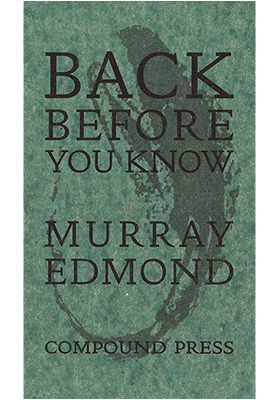
Murray Edmond, Back Before You Know, Compound Press, 2019
Jonas Bones, Jonas Bones esquire,
whale-stabber, seal-clubber,
great hands held like tongs in the fire,
road-digger, gold-grubber—
JONAS: Never did have no blasted luck,
every plan came unstuck—
Always up to his ears in muck
couldn’t make two ends meet.
So one last chance to call a stop
one last throw on a crumbling life,
on the King Country line he set up shop,
with one lone child and one sharp wife.
from ‘The Ballad of Jonas Bones’
Murray Edmond is a playwright, poet and fiction writer; he has worked as an editor, critic and dramaturge. Several of his poetry collections have been finalists in the New Zealand Book Awards: Letters and Paragraphs, Fool Moon and Shaggy Magpie Songs. He has worked extensively in theatre including twenty years with Indian Ink on the creation of all the company’s scripts.
Murray’s new collection comprises two long poems that play with other sources; with fable, allegory, history, theatre, poetics, the ballad form. The first poem, ‘The Ballad of Jonas Bones’ steps off from Robert Penn Warren’s ‘The Ballad of Billie Potts’ (1943), from Kentucky to the Waikato / King Country. Murray claims his version as a palimpsest or adaptation, leaving traces of the original version, ghost-like and haunting. We may find vestiges of place, the story that gets passed down the line from ear to mouth, the innkeepers who rob their well-off guests, a character’s return to origins, the cutting shards of history, the kaleidoscopic turns of humanity. I haven’t read Warren’s poem but I sense its eerie presence.
Murray’s fluctuating rhythm and rhymes are like shifting river currents, his poem a river poem carrying the debris of story, hand-me-down anecdote. There’s gold and there’s mud, there’s error and there’s incident, there’s greed and there’s survival. Dialogue gives it life as a theatre piece, staged to the point I invent the presence of audience and a live version runs through my head. I am watching as the past is made present and the future present is gestured at in the revised story along with the original skelton. A wider context is superimposed and hides in the seams: ‘frontier’ stories that mutate in the telling, the more significant misrepresentations that shaped our histories, the way individual stories are muffled within the dominant narratives.
Ah but alongside these fertile underground veins is the fact this is a cracking good story with its blinding twists and wounding heart. For some reason I kept thinking of Blanche Baughan’s affecting long ballad, ‘Shingle Short’.
The second poem, ‘The Fancier Pigeon’, is equally arresting with Murray characteristically playful. I am reading with a wry smile, every sense provoked, my reading momentum both fluid and addictive. We meet the fancier pigeon and the pigeon fancier (she with her hair aglint) when they meet perched on stools at a bar:
She had hair the colour of apricot
she smelt like a cake just taken
from the oven and her father played
drums in a band in the only night club
in town
I am always reluctant to spoil the unfolding of a poem, long or short, in ways that ruin the reading experience, that spotlight the darkened nooks and crannies, the poem’s pauses or digressions. That dampens the joy of reading. But I will say when the two characters kiss a pigeon drops a ring at their feet – they decide they will each keep the ring for a week and then only met when they exchange the ring. Such an emblematic hook.
The poem feels cinematic (visually sharp, moody hued), theatrical (with both dialogue and action body gripping) and fable-like (overlaying universal themes of love, betrayal, mishap and destiny). The poem also feels cinematic with its smudged lighting as though we can’t quite be sure what happens between this scene and the next, with the cue to fable never far off, the characters, a quartet, shifting and sliding in and out of view.
and it was there
the girl had stopped her
as she walked
“Has he come asking for me”
of course he had so she said “No”
and as if she were granting wishes
she asked
“You wanna come out on the lake
with me in the canoe?”
and she had lead her down
among the bulrushes
What I love about the poem – beyond the supple language play and the sensual images, the addictive and offbeat characters, and the narrative tug – is the way the world adheres. As reader you can’t just stick to the poet’s diverting fable – because the real world intrudes, the hurt and broken world if you hold the bigger picture, and the miniature daily stories if you hold the way humanity is formed by individuals. Both things matter at the level of the humane.
The book’s punning title, like a cypher, a tease, is also a ‘dropped ring’. It is re-sited as the last line: ‘BACK AGAIN BEFORE YOU KNOW’. And I am looping back on the unknown and the achingly familiar, the beginning that is ending that is beginning and so on, the switch back roads and the clifftop vantage points, the downright miraculous and the daily mundane. Ah setting sail on this poetic loop, with its blurs and its epiphanies, is sheer bliss. Poetry bliss.
Compound Press author page
2019 NFFD ADULT SHORT LIST
Breadcrumbs by Tom Adams, Wellington
Moving To Town by Tim Saunders, Palmerston North
Not a Vegetarian by Elena de Roo, Auckland
Over the Fields from Ballyturin House, 1921 by Rose Collins, Canterbury
Separated from That Which Cannot Be Separated by Craig Foltz, Auckland
T Is For Tiger by Tim Saunders, Palmerston North
The Beautiful Thing by Anna Granger, Whanganui
The Boat People by Jeff Taylor, Hamilton
The Museum of Curiosities and Natural History by Heather McQuillan, Christchurch
The sound a horse makes when it comes to drink at night by Wanda Barker, Hamilton
The Visitors by Anna Granger, Whanganui
Washing-up by Leeanne O’Brien, Auckland
2019 NFFD YOUTH SHORT LIST
Art is Dead by Lily Deuchars, Hagley College, Christchurch
Cleaning Clouds by Zoe Congalton, Year 9, Havelock North High School, Hawkes Bay
Five rules for liking girls when you are young and prone to heartbreak by Cybella Maffitt, Year 13, St. Cuthbert’s College, Auckland
Funeral hymn for a lost toy by Cybella Maffitt, by Cybella Maffitt, Year 13, St. Cuthbert’s College, Auckland
Gummy Bears by Hannah Daniell, Year 11, Cashmere High School, Christchurch
I Hope the Others Sang by Derrin Smith, Year 11, Ao Tawhiti Unlimited Discovery, Christchurch
Il faut laisser aller le monde comme il va by Cybella Maffitt, Year 13, St. Cuthbert’s College, Auckland
No Need by Hannah Daniell, Year 11, Cashmere High School, Christchurch
Noisy Silence by Maia Ingoe, Gisborne, Year 13, Gisborne Girls’ High School, Gisborne
Psycho Steve by Simon Brown, Victoria University, Wellington
Taking Shape by Alice Hoerara-Hunt, St Peter Paul School, Lower Hutt
The Last Voyage by Sarah-Kate Simons, Year 10, home school, Southbridge, Canterbury,
Youth by Phoebe Robertson, Whangarei Girls’ High, Whangarei
Winning stories will be announced June 22 at the NFFD events around the country (find an event near you, here!), and the winners will be listed on this page.
getting away from it all with the feminists
she is self sufficient, thank you very much
she has packed tea bags, brandy, chocolate, honey, wine, scroggin, olives, crackers, cheese, 30 second oats, a jar of ready espresso-ed coffee, double-wrapped, a home-made mix of potato mash, French onion soup power, salt, pepper, hand-chopped spring onion and bacon flakes, toilet paper, sanitiser, matches, candles, firelighter, New Yorker, cook pot, gas canister, three-prong burner, spork, mug, a whole, firm salami and
she is carrying a sleeping bag for all seasons, a midweight puffer jacket, a water-resistant shell. she wouldn’t be conned into buying something tagged waterproof for twice the price. very few things are truly impermeable, this she knows. she has her beanie, her sunnies, her sun hat, her thermals, the nagging start of a blister and a throb in the nub of her back. a deep breath. keeping it light. they are on a ridge, just emerged from the bush, and he turns back and offers his hand and
she is distracted by a twitch in his southwest forearm and a hint of tannin sweat and the glint of the sun refracting on his teeth and that little chinlip tuft he hasn’t quite shaved and
she hasn’t even stumbled when he says if you feel yourself falling remember there’s time to decide which way you’re going to jump
Liz Breslin writes plays, poems, stories and a fortnightly column, ‘Thinking Allowed’, for the Otago Daily Times. Her poetry collection, Alzheimer’s and a spoon (OUP), was listed as one of The Listener’s Top 100 Books of 2017. At home on the page and on the stage, Liz’s recent performances include ‘Love in a time of netball’ at the sold-out Wanaka season of Tall Tales and True, and a stint as the back end of Jill the Cow for her 2018 pantomime, Jac and the Beansprouts. In 2019 she’s heading to Dunedin, Vancouver and Krakow to read, write and perform. Her website

The competition LONG LISTS for adults and youth are here!
Please feel free to share – and congratulations to those writers who are on the Long List; please share the news that your work has made it to this stage. However, we ask that you please refrain from sharing your specific story title, as the judges are still deliberating to arrive at the winners. Thank you.
National Flash Fiction Day takes place June 22,
with events in Auckland, Christchurch, Dunedin, Northland, Wellington and Waikato.
See the events page for more information as it is updated in the coming weeks.
*
Micro Madness
The 2019 Micro Madness Long List is here! Thank you to everyone who entered — we had a record number of entries this year.
The Short List will be announced on a daily basis, as new micros are posted to the Micro Madness page each day, with the top three winners shared June 20, 21 and 22.
Watch that space and enjoy these 22 days of micros as we head towards National Flash Fiction Day!

At the moment it feels like pretty much every bright future I’d hoped for is at stake. On a grand scale the triple threats of economic precarity, bigoted populist political bullshit, and environmental degradation aren’t, uhhhh, great. And given human carelessness with our pollution, poisons, and climate apocalypse, basking in the glory of nature isn’t really cutting it anymore as a source of solace. Even David Attenborough is freaking out.
And still, to not be helpless, I turn to poetry. How else to process a planet-sized grief?
Ecopoetry as political activism and/or aesthetic impulse isn’t a new idea. But right now I’m interested in how others write about the effects humans have on nature, and how that affects us.
A poem that floats to the surface of my mind regularly, naming the current epoch, is ‘The Anthropocene‘ from Helen Heath’s Ockham winning (!!!!!!!!!) Are Friends Electric? The poem stars a tui and lyrebird mimicking the technological music of the species that destroys their native forests – cellphone trill, car alarm, camera shutter, chainsaw. Chainsaws in birdsong! I think of this too often.
Speaking of mimics, the new issue of Mimicry I just received contains two back-to-back poems on the drift of plastics through the furthest reaches of the ‘natural’ environment. Rhys Feeney’s ‘current mood’ and Erik Kennedy’s ‘Microplastics in Antarctica’ work to process the sheer scale of human junk, and model ways to respond to the guilt and arrogance of that phenomenon.
From Feeney:
“you thought you
were a god / but this sushi container
will outlive you /”
From Kennedy:
“Scratch the scalp of civilisation
and bits of it go all over the place.
Concerned about those embarrassing flakes?
You should be.”
Feeney’s poem is inspired by Pip Adam’s The New Animals which is great because I’d wanted to shoehorn that novel (with its hypnotic trajectory towards a widening gyre of sea-garbage) into this discussion somehow. Having dipped a toe in prose, it’s worth noting that my own poetry on nature (and the work of local poets like Gregory Kan and essa may ranapiri) has been influenced by Jeff Vandermeer’s novels too – testing out new ways to live in a changed world.
Poems about what people do to the environment, and what that means for us, help me work out how to rage and cope as well. When I’m overwhelmed, picking up a poem can help. Poems can help us look at the impact we have on our planet – but in a container compact as a snowglobe, enough to hold in two hands. A poem asks you to sit mesmerised by something and turn it over to see how it shifts. Shake the poem and watch what happens to the tiny landscape in the swirling glitter.
Showing off the capacity of a poem to be both moving and scientifically informative is a knack shared by Heath and Kennedy – their poems often incorporate research, like the press release that kicks off ‘Microplastics in Antarctica’. And ecopoetry is not always straightforwardly scientific – take Lucie Brock-Broido’s dreamy elegy ‘For a Snow Leopard in October‘. But each poem is also a way to pick up something about what’s happening to our world and ourselves. To write like this is a way to stake out what’s real and important. What vision of the world we should hold on to, what kind of mark we want to leave – from the Great Pacific Garbage Patch to the snow leopard vanishing.
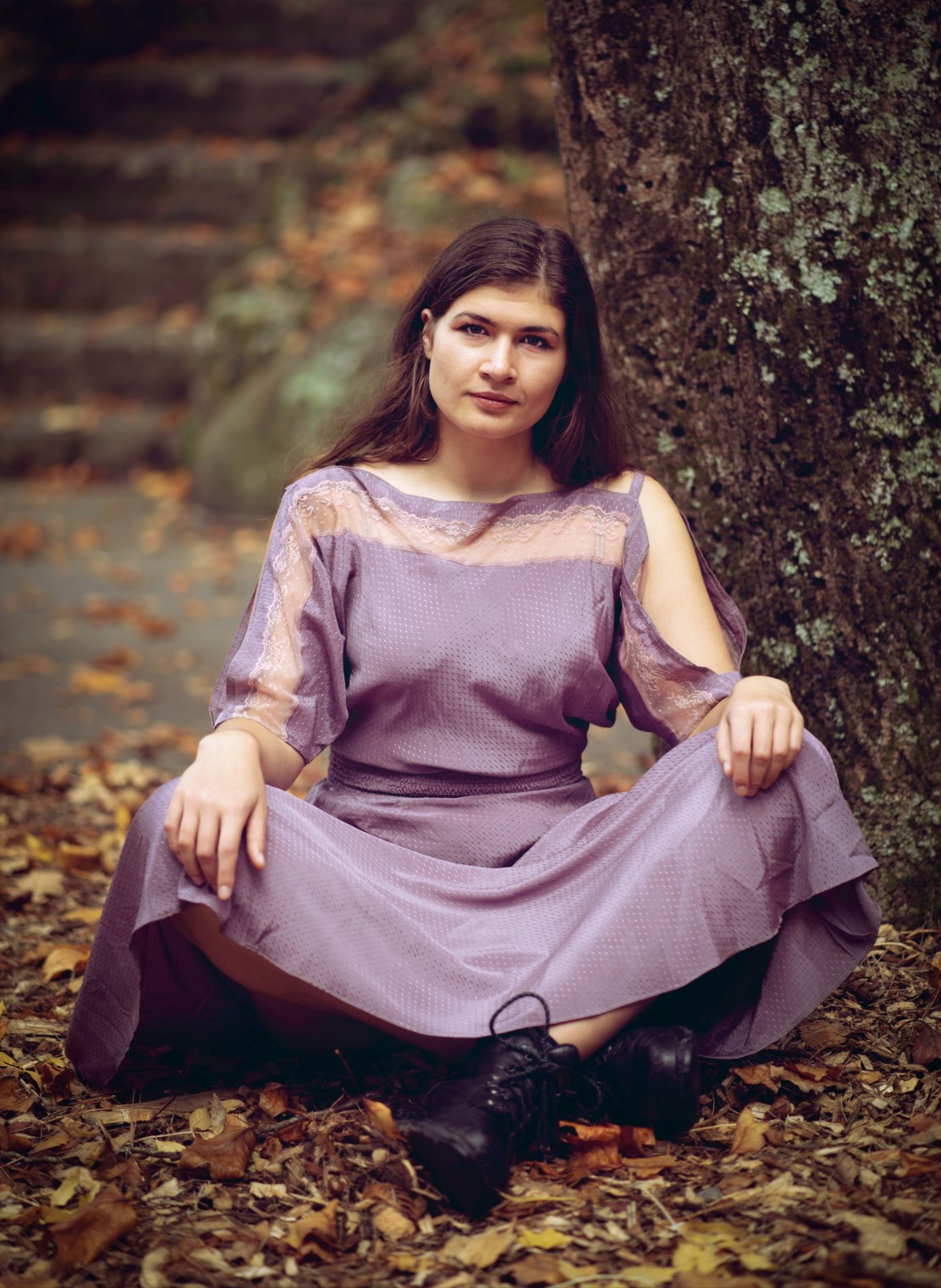
Rebecca Hawkes is a poet, painter, and reluctant corporate ladder ascender. She’s from a high country farm near Methven and is now making it biggish in the small-medium city of Wellington. Find Rebecca’s poems scattered through journals like Starling, Sport, and Sweet Mammalian – or on her website. A collection of her writing will be published in August 2019 in the revival issue of the AUP New Poets series, alongside the work of Carolyn DeCarlo and Sophie van Waardenberg.
Here you go: catch up on some 2019 AWF sessions via podcasts and videos – I can’t wait!
Thanks AWF for sharing the book love.
Here are some now on offer (there are more) and they will keep adding more!

 NZ Poetry Shelf