Category Archives: Uncategorized

Poetry Shelf noticeboard: The new online ANNEXE at Minarets


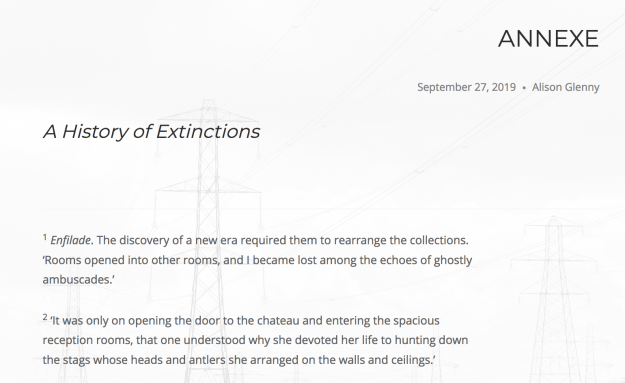
The new online segment ANNEXE @ Minarets journal for EXPANSIVE long poems, sequences, poetic research projects, dossiers, investigations, autopsies, polemics, manifestos, ars poeticæ. First specimen ‘A History of Exitions’ by Alison Glenny.


Screen Shot 2019-10-07 at 8.49.28 AM.png


Full piece here


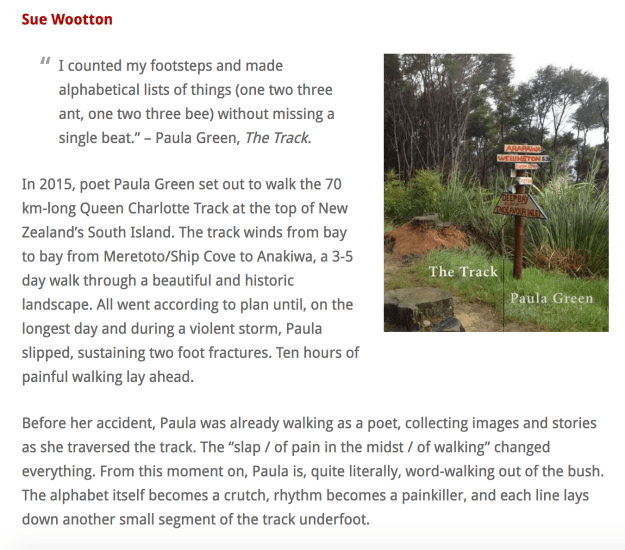
Poetry Shelf Friday talk: Victoria Broome picks 3 books


41yoStXSUcL._SX335_BO1,204,203,200_-1   https---images.genius.com-c80ccfe642fb97f74f81f3c709f86de2.300x457x1.jpg


Three books that made an impact on me at different points in my life. At the time of writing this, it is not long since my Dad died with end stage dementia and I miss him deeply and find myself reflecting on when I was much younger and the books that impacted on my life then.

When I was 14 as a family we shifted from Christchurch to Lower Hutt and I had received a book voucher for Christmas. I walked along the stopbank into the Hutt’s High Street and Whitcoulls and picked How Green Was My Valley. I remember being enveloped in the world of the village. I still have the book although I never read it again as I didn’t want to break the spell of that summer. From then until my mid 20’s I devoured books set in England, Ireland, Wales and Scotland in the 19th century. I was discovering I think the creation of other worlds in which I recognised myself, I romanticised, and was nostalgic for, a time I never lived in.

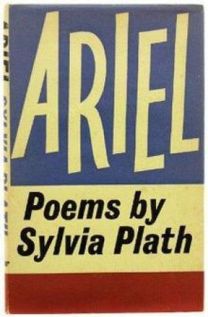
When I was 16 and at Nae Nae College a classmate Ross said “You should read Slyvia Plath”. I started with Ariel which I bought from the Horizon Bookshop in Lower Hutt where I would be working in 3 years time. In my teens I was struggling to find my way in difficult circumstances and wrote lots of sad introspective poetry. When I read Sylvia Plath I was shocked I think by the powerful way words could be used, how they encapsulated the domestic and the mysterious although I couldn’t have told you that then.

In 1973 I had left school and was working at the National Library on The Terrace, and I lived in Thorndon. After work I would haunt Roy Parsons bookshop on Lambton Quay and for Christmas that year I requested my parents buy me Katharine Mansfield, the Memories of LM. I read it lying on the bunk at the bach at Waikuku where we went for 2 weeks every Christmas. I dreamed of being a writer in London. I still have this book and have read it many times, it takes me back to that summer, to being young and to my strong dream and desire to be a published writer. It would be 46 years before I had the courage to produce a book. I was able to share it with my Dad before he died and read his poem to him.


Victoria Broome works as a mental health clinician in Primary Care mental health in Christchurch, she has been writing for many years and been published in various journals and anthologies and had her first chapbook How We Talk To Each Other published in March this year with Cold Hub Press.


cover 2.jpg


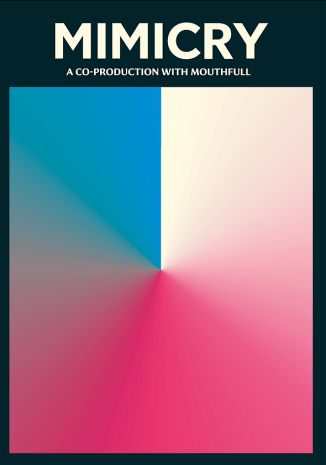
Poetry Shelf fascinations: MIMICRY 5

Screen Shot 2019-10-03 at 11.47.52 AM.png


I have been musing on the variety of journals we have, both in print and on line, that are publishing poetry, various fictions, essays, images. Each issue feels like a one-off gathering that provokes, surprises, consoles and delights. I sometimes feel I have wandered into someone’s front lounge and am eavesdropping on the conversation currents of a mix of house guests. Sometimes it feels like family – kindred poets – other times it is altogether different. Nobody is afraid to say what they feel. Or get political. I like that.

MIMICRY 5 is edited by Holly Hunter and Ollie Hutton (Mouthfull Productions); the contributors epitomise a cool new wave of writers – some barely published, some gaining recognition in the performance / slam / spoken word scenes. The images are excellent plus you get a Mimicry mixtape.

Eliana Gray‘s terrific debut collection Eager to Break is recently published – so how very fitting to have their poem ‘Sometimes I wonder if my salt water mouth / should be allowed to speak at all’ open the gathering. The first line sets up the poem: Sometimes I wonder if my poems should have been tweets’. Each line shimmies as both poetry and as potential tweet and the effect is glorious – I am swung and I slide and the effect is mood and it is dark and it is burning.

Alisdair Armstrong is studying at Victoria University and loves rock climbing which makes sense when you read ‘Sitting in a blast crater’. This is his first published piece of writing and it is wry and deft and I am loving the image of the speaker sitting ‘at the bottom of a blast crater in a puddle’. This is the line I love: ‘I introspect for awhile.’  The scene would be enough to delight but other people turn up and then it is just exquisitely funny.

We’re lying down in this crater, we tell him.

He asks why we haven’t got out.

We tell him we’re introspecting.


Molly Robson‘s three photographs are eye-popping (‘Tongariro’ is B & W but the others use a palette of surreal orange-reds with distancing and estranging grey /blacks. The empty rooftop chair is unbearably uncanny. I want to sit in it. I want to sit in it and read a novel until the sun comes up. The tilts will be numerous.

Rhys Feeney‘s ‘current mood’ is genius in the way it catches the overwhelming anxiety we feel as we face climate change and the loathsome mountain of products that will outlast us.


there’s a feeling in your chest

& it’s not going anywhere

it has the permanence

of a pile of used plastic

floating around

on the oil-slick surface


Erik Kennedy follows suit with ‘Microplastics in Antarctica’. This is poetry at its most vital – making connections with a groundswell of global protest; poetry is linking ideas and anxious voices and I applaud it.


The snow contains a finer snow.

That’s how it gets there, this plastic

that maybe one kept a lettuce green

or packaged another plastic package.


Scratch the scalp of civilisation

and bits of it go all over the place.

Concerned about those embarrassing flakes?

You should be.


Enter this lounge and you will find the miniature scenes of Rebecca Hawkes, rich in physical detail, feeling and sonic surprises along with Jordan Hamel‘s genius found mash-up that evokes a ‘Regular Kiwi Bloke’.

What I love about these literary lounge gatherings is meeting new voices. Sometimes it is like an electric shock upon skin – like how good can poetry get? Michaela Keeble is an Australian writer living with her family just north of Wellington. She writes climate-change press releases and has published fiction and poetry in various places. Her poem ‘Bob Marley was a poet’ had me listening hard because it feels so fresh and surprising and full of invigorating movement. The poem sets your attention in myriad directions, leaves gaps for you to traverse, gathering together politics, intimate thoughts, the beauty of the moon and the river, the joy of contemplation.


a few days after Waitangi Day

Bob Marley’s birthday

a Thursday


I sit down at the side of the river


the river is an estuary

is homemade paper


Rose Peoples brings an equally satisfying moment of attentiveness to ‘Hoots’. But here the poet/storyteller pivots and leaps off from the hooting ruru; and poetry becomes a form of storytelling that is to be savoured. Slowly. Sweetly. You need to read the whole poem but here is the opening stanza:


The ruru hoots each night

with a regularity which rivals the

tinny beeps of the digital watch.

The sound is directionless

it simply sits in the air,

surrounding us.

In this version of the story,

it s the glow of the streetlights

that makes its way through

the gaps in the blinds.


The final charismatic poem, Jane Arthur’s ‘Snowglobe’, showcases the addictive mix of verve and imagination that you find in her poetry. Watch this space for my musings on her new collection Craven.


I have just realised

I have just now realised


I am in a snowglobe! and that is why

leaves blow around and around but never away


and that is why I feel shook up

amazingly shook up so often.


MIMICRY probably features more artwork than any other local literary journal – and again features excellent lounge guests. For me MIMICRY 5 was like a well-needed retreat from routine and requests. I loved it. Such invigoration. I look forward to the next one!


MIMICRY page


Poetry Shelf noticeboard: Sue Wootton announced as 2020 Katherine Mansfield Menton Fellow


sue_wootton-300dpibw-546x600.jpg


Dunedin author Sue Wootton has been selected as the next Katherine Mansfield Menton Fellow and plans to use her time in Menton to write new poetry.

“I still remember reading Katherine Mansfield’s Bliss when I was a teenager, and being knocked sideways by what she could do with a sentence. Forty years on, and I am deeply honoured to have the opportunity to live and write for three months in Menton, France, as the 2020 Katherine Mansfield Menton Fellow. My main project while I’m there will be writing poetry towards a new collection whose working title is Systems of Light. I have the wonderful feeling that the chance to immerse myself in a completely different place and language will generate, to use Katherine Mansfield’s phrase, a whole new “shower of sparks”, says Sue Wootton.

Sue Wootton’s most recent publications are her novel, Strip, which was longlisted in the 2017 Ockham NZ Book Awards, and her fifth poetry collection, The Yield, which was a finalist in these awards in 2018. Sue grew up in Whanganui and Wellington and now lives in Dunedin. A physiotherapist-turned-writer, she is a PhD candidate at the University of Otago, researching the importance of imagination and language in recovery and wellbeing. She co-edits Corpus: Conversations about Medicine and Life, found at https://corpus.nz/ and teaches creative writing in schools, universities and community settings. She is currently writing a novel about a group of friends caught up in the 1948 polio epidemic.

Sue was the successful recipient of the Katherine Mansfield Fellowship in a very strong field of New Zealand writers spanning all genres of literary endeavour. The selection panel was impressed by the breadth of her work to date and the well-developed project put forward for her time in Menton, when she will be working on her sixth poetry collection. This body of work will continue her substantial and acclaimed body of work which includes 5 poetry collections, a children’s book and a novel. In recent years she has shown her eminence in her chosen literary fields thorough winning several international and national poetry competitions, as well as receiving awards for her short stories.


Previous recipients include Paula Morris (2019 fellow), Carl Nixon, Kate Camp, Anna Jackson, Mandy Hager, Greg McGee, Justin Paton, Chris Price, Ken Duncum, Damien Wilkins, Jenny Pattrick, Stuart Hoar, Dame Fiona Kidman, Ian Wedde and other prestigious writers such as Bill Manhire, Janet Frame, Witi Ihimaera, Elizabeth Knox, Lloyd Jones, Roger Hall, Marilyn Duckworth, Michael King and Allen Curnow.


Warm congratulations from Poetry Shelf!

Poetry Shelf noticeboard: Te Rito o te Harakeke – A collection of writing for Ihumātao


Screen Shot 2019-10-02 at 9.16.14 AM.png


Cover art: ‘Pono’ by Maioha Kara (Waikato, Ngāti Kahungunu, Te Arawa and Ngāti Porou)


The contributors: Hana Pera Aoake, Hinemoana Baker, Cassandra Barnett, Tyson Campbell, Jacqueline Carter, Anahera Gildea, K-t Harrison, Rangimarie Jolley, Maioha Kara, Johanna Knox, Rāhiri Mākuini Edwards-Hammond, Anna McCallister, Donna McLeod, Kōtuku Titihuia Nuttall, Sinead Overbye, Tru Paraha, Michelle Rahurahu Scott and Lyssa Rogers-Rahurahu, essa may ranapiri, Serena Ngaio Simmons, Carin Smeaton, Stacey Teague, Ruby Mae Hinepunui Solly, Alice Te Punga Somerville, Tayi Tibble and George Watson


Note from the organisers (Rangatahi o te Pene, Hana Pera Aoake, Sinead Overbye, Michelle Rahurahu Scott and essa may ranapiri):


The book was produced in five weeks, and almost all of these pieces were written within a two week period.

Our aim was to bring together a wide range of Māori authors to respond to the events at Ihumātao, to show that Māori all have different voices and different perspectives, even though there are commonalities among us (i.e. ancestral trauma, the pain of which still runs through the core of the book). We brought together more established Māori authors to sit beside newer Māori voices, including poets who have never been published before.
The title Te Rito o te Harakeke comes from a well known whakatauki ‘Hutia te rito o te harakeke, kei whea te kōmako e kō? Kī mai ki ahau; He aha te mea nui o te Ao? Māku e kī atu, he tāngata, he tāngata, he tāngata’. This translates as ‘If the heart of the harakeke was removed, where would the bellbird sing? If I was asked; What is the most important thing in the world? I would reply, it is people, it is people, it is people.’
At the core of the book is people. At the core of the movement at Ihumātao is people. We need to come together in times of struggle, in order to support each other to go on. That is what this book was about. The ‘rito’ of the harakeke refers not only to the ‘heart’ or ‘core’ of the harakeke, but also metaphorically to the younger generations in a whānau. The whakatauki, and the title of the book, therefore also implies that if we do not foster and support the younger generations, we will not progress as a people.
The organisers of this project- Hana Pera Aoake, Sinead Overbye, Michelle Rahurahu Scott and essa may ranapiri- did not edit or alter any of the kupu in the book. Each piece is published exactly as the artist intended. Each piece is perfect just as it is. As you read the physical copy, you will notice the hand-stitching, experimental formatting, and even a fold-out poem in the centre (as one of our poets desired the book to fold out from the book like a map). We wanted to maintain the integrity and mana of each piece of work. We wanted to create a space where every artist could express themselves exactly as they wanted.
There is grief at the heart of this book, and there is pain, but there is also hope. Out of this project, new friendships and connections have flourished. We are creating a space for ourselves, and we are creating new communities and opportunities. We hope that the book continues to be shared amongst friends and whānau. We hope that it sparks kōrero about our history, and that it helps to guide Māori who might otherwise feel alone.

No reira, we are very proud to have this book out in the world. He taonga ia.
Ehara taku toa i te toa takitahi, ēngari he toa takimano e – My strength is not mine alone, but the strength of many.


You may find more information about the pukapuka and how to get a copy here

essa may ranapiri’s poem here


IMG_5122.JPG


Poetry Shelf noticeboard: Landfall essay competition joint winners

Landfall essay competition joint winners profound and persuasive

Wellington writer Tobias Buck and London based New Zealand writer Nina Mingya Powles are the joint winners of the 2019 Landfall Essay Prize.

Tobias Buck’s winning entry, ‘Exit. Stage Left.’, deals with issues of prejudice and bias from the perspective of a man who ‘is the colour of cotton candy or pink marshmallows’, whose hair is ‘definitely platinum’.

His essay is full of persuasive visual detail, and an ear for the unpleasant reverberations of everyday speech, says competition judge and Landfall editor Emma Neale. Ms Neale says she admires the way the essay effortlessly displays touches of history, pop culture and general knowledge in its discussion of identity.

Nina Mingya Powles’ essay, ‘Tender Gardens’, combines both profound, even urgent subject matter with an agility of style, says Ms Neale. The essay allows for pleasure and beauty, yet also tightens the screws on recognition of various humanitarian or philosophical issues such as racial prejudice, cultural identity and how to make a home in a foreign land.

In third place is Sarah Harpur’s essay ‘Dead Dads Club’. Placed fourth equal are Joan Fleming’s ‘Write First, Apologise Later’ and ‘The Art and Adventure of Subsistence’ by Jillian Sullivan.

Highly Commended essayists are Ingrid Horrocks (‘Where We Swim’); Himali McInnes (‘The Place’) and Derek Schulz (‘Kiwi Made’). Commended essayists are Justine Jungersen-Smith (‘Half Sugar Half Sand’) and Amy Brown (‘To Hold in the Palm of the Hand’).

Tobias Buck and Nina Powles each receive $1500 and a year’s subscription to Landfall. The winning entries will be published in Landfall 238, available in November. Landfall is published by Otago University Press. Some 64 anonymous entries were received in this year’s competition, down on last year’s 91.

For more information about the Landfall Essay Prize and past winners

The winners

Born in 1978 and currently living in Hawke’s Bay, Tobias Buck studied art history and creative writing, under Gregory O’Brien, and completed post-graduate degrees in the US and in Scotland at the University of Edinburgh.
He worked in digital media and publishing in London and, alongside owner Tilly Lloyd recently helped project-manage the redesign of Unity Books in Wellington. He was the last recipient of the BNZ Katherine Mansfield Award for his story ‘Islands in the Stream’ and in 2018 was Highly Commended for his essay ‘Aquae Populus’.

Nina Mingya Powles is a poet and writer of mixed Malaysian-Chinese heritage, born in Wellington and currently living in London. Her recent publications include Luminescent (Seraph Press, 2017) and field notes on a downpour (If A Leaf Falls, 2018). She is a co-editor of Tupuranga journal, poetry editor of The Shanghai Literary Review, and founder of Bitter Melon

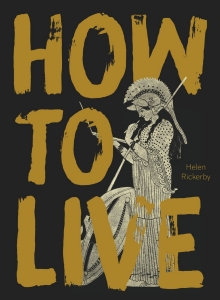
Poetry Shelf fascinations: Helen Rickerby’s How to Live

1565824292476.jpg

How to Live, Helen Rickerby, Auckland University Press, 2019


When that philosopher said life must be lived forwards

but can only be understood backwards

he was not thinking of me

I have lived all kinds of lives


from ‘A pillow book’


Helen Rickerby’s latest poetry collection How to Live is a joy to read. She brings her title question to the lives of women, in shifting forms and across diverse lengths, with both wit and acumen. Like many contemporary poets she is cracking open poetic forms – widening what a poem can do – as though taking a cue from art and its ability both to make art from anything and in any way imaginable.

Reading this book invigorates me. Two longer poems are particularly magnetic: ‘Notes on the unsilent woman’ and ‘George Eliot: a life’. Both function as fascination assemblages. They allow the reader to absorb lyrical phrases, humour, biography, autobiography, insistent questions. Biography is enlivened by such an approach, as is poetry.


6.   It seems to me that poetry usually begins with the self

and works its way outwards; and the essay, perhaps, starts

outwards and works its way in towards the self.


from ‘Notes on the unsilent woman’


Thinking of the silent woman I am reminded of Aristotle’s crown of silence that he placed upon she. I then move across centuries to Leilani Tamu’s poem ‘Mouths Wide Shut’ where she sits on a bus with her mouth taped shut silent. The skin-spiking poem (and the protest) considers silence in the face of racism. Even now, even after the women’s movements of the 1970s and the explosion of feminism and feminisms over ensuing decades, men still talk over women, still dismiss the women speaking (take women in power for example, or a young woman at the UN challenging climate-change inertia).

What Helen does is remind us is that silence is like snow – it is multi-hued and deserves multiple names and nuances: ‘Silence isn’t always not speaking. Silence is sometimes / an erasure.’

Ah the stab in my skin when I read these lines. In ‘Notes on the unsilent woman’ Helen draws me in close, closer and then even closer to Hipparchia of Maroneia (c 350 – c 280 BC).


5.    But I do have something to say. I want to say that she

lived. I want to say that she lived, and she spoke and she

was not silent.


Helen gathers 58 distinctive points in this poem to shatter the silence. Sometimes we arrive at a list of women who have been both audible and visible in history, but who may have equally  been misheard, misread and dampened down. At other times the poet steps into view so we are aware of her writing presence as she records and edits and makes audible. In one breath the poet is philosopher: ‘Silence might not be speaking. It might be / listening. It can be hard to tell the difference.’ In another breath she apologies for taking so long to bring Hipparchia into the picture.

Elsewhere there is an ancient warning: ‘”If a woman speaks out of turn her teeth will be / smashed with a burnt brick.” Sumerian law, c. 2400 BC.’

A single line resonates with possibilities and the ‘we’ is a fertile gape/gap/breathing space: a collective of women, the poet and her friends, the women from the past, the poet and I: ‘There are things we didn’t think we could tell.’ Yes there are things we didn’t think we could tell but then, but then, we changed the pattern and the how was as important as the what.

Another single line again resonates with possibilities for me; it could be personal, it could equally be found poetry: ‘I would like to be able to say that  it was patriarchy that stopped me talking on social media, but it wasn’t, not / directly.’

I read ‘Notes on the unsilent woman’ as a poem. I read this as an essay. I am tempted to carry on with my own set of bullet points as though Helen has issued an open invitation for the ‘we’ to speak. Me. You. They. She quotes Susan Sontag: ‘The most potent elements in a work of art are, often, its silences.’


The other poem I dearly love, ‘George Eliot: a life’, is also long form. Like the previous poem this appears as a sequence of numbered sections that are in turn numbered in smaller pieces. It is like I am reading a poem and then an essay and then a set of footnotes. An assemblage of fascinations. Biography as fascination allows room for anything to arrive, in which gaps are curious hooks, reflective breathing spaces and in which the personal is as compelling as the archives. Helen names her poem ‘A deconstructed biography’ and I am reminded of  fine-dining plates that offer deconstructed classics. You get a platter of tastes that your tongue then collates on the tongue.

To taste ‘George Eliot: a life’ in pieces is to allow room for reading taste buds to pop and salivate and move. This is the kind of poem you linger over because the morsels are as piquant as the breathing spaces. It delivers a prismatic portrait of George Eliot but it also refreshes how we assemble a biography and how we shape a poem. Helen brings her acerbic wit into play.


10.7.1.  But the fact is, and I don’t want to give you spoilers, that for such an

extraordinary woman she sure did create some disappointing female

characters. Even the heroines don’t strike out – they give up, they stop,

they enclose themselves in family, they stand behind, they cease, they  die.

They found nothing.


10.7.2.   Did she think she was too exceptional to be used as a model for her

characters? Did she think that while she was good enough to be involved

in intellectual life, and she could probably even be trusted to vote, the same

could not be said for her inferior sisters?


A number of smaller poems sit alongside the two longer ones including the moving ‘How to live though this’, a poem that reacts to an unstated ‘this’. ‘This’ could be anything but for me the poem reads like a morning mantra that you might whisper in the thick of tough times or alongside illness or the possibility of death.

‘How to live’ is a question equally open to interpretation as it ripples through the poems; and it makes poetry a significant part of the myriad answers. I haven’t read a book quite like this and I love that. The writing is lucid, uplifting, provocative, revealing, acidic, groundbreaking. The subject matter offers breadth and depth, illuminations, little anchors, liberations, shadows. I am all the better for having read this book. I just love it.


I slept my way into silence

through the afternoon, after days

of too many words and not enough words

to make the map she needs

to find her way from here

I wake, too late, with a headache

and she, in the garden wakes up shivering


from ‘Navigating by the stars’


Auckland University Press author page

Helen reads ‘How to live through this’

Helen on Standing Room Only

Poetry Shelf Monday Poem: Claire Orchard’s ‘Vacancy’

Vacancy


The chair – beige linen, wingback,

a little light wear where the head rests

and along the arms – sits next to the unmade

bed – rumpled white sheets, cream wool

blanket with a charcoal double stripe.


The lamp – switched on, small, round, bright

orange glass shade – glows on the desk

in the corner where there is another chair – oak,

straight-backed, ladder-backed, pushed in.


The morning sunlight slanting through

the open French windows is touching

all of this but especially highlighting

the filmy white curtains, the thin layer

of dust on the polished floorboards.


Outside, the climber scaling the balcony railings

is mostly thin, leggy stalks now, having lost

almost all its leaves. The open door,

barely visible to one side, is in fact

just the suggestion of an exit.


Claire Orchard


Claire Orchard was born in Wainuiomata, grew up in the Hutt Valley and now lives in Wellington where she completed an MA in Creative Writing at the IIML in 2013. Her first book of poems, Cold Water Cure, was published by VUP in 2016.