Category Archives: NZ Poets

Morgan Bach’s Some of Us Eat the Seeds — sets every part of your readerly self on high alert

684a89cf-1c7b-4ee7-a686-f3e03271a543           image1


Morgan Bach Some of Us Eat the Seeds Victoria University Press, 2015

I agree with Bernadette Hall. Morgan Bach’s debut poetry collection is ‘both ordinary and extraordinary.’ Morgan is a graduate of the MA in Creative Writing at IIML where she was awarded the Biggs Family Prize in Poetry.

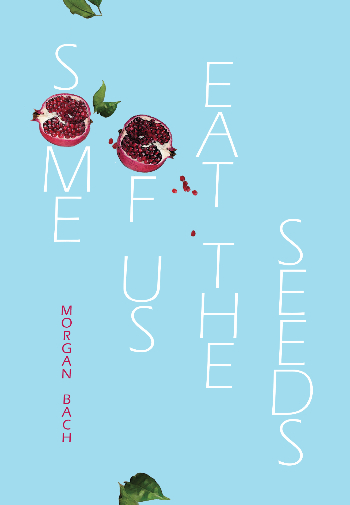
First up a stunning cover (cover design Rowan Heap) and a title that hooks. An allure of blue, the words a cascade downwards in white, the lush red pomegranates spilling their seeds. Gorgeous. The title resonant, already establishing a set of relations (‘us’).

What I especially love about this book is the way it plants anchors in the ground through an attachment to the real yet is unafraid to step into the smudged edges of the worlds that a mind both inhabits and produces. This is a book of collecting fruit, doing the high jump, cooking shows and vampire movies, but it is also a book of dread, heartache, anxiety, love, dreams, foreignness. The three sections are distinctive clusters (family, travel, adulthood), yet there is a satisfying drift of motifs and themes throughout the collection.

The opening poem, ‘What they made,’ is secured in self as it walks into physical detail (these feet, these eyes) and beyond that into a roving  ignition of ideas (by way of a trope: ‘A person// is a weak rope’). The opening question (‘What do I inherit?/ A split face// the eyes of one/ the sighs of another’) is particular apt in a book that faces memory, and in doing so represents myriad versions of self. The resulting poems are both invigorating and effervescent.

Take the title poem for example. The poem houses a jiggety mind at work, a mind walking (walking is a reoccurring device) into the fuzzy, elusive and utterly fascinating pull of memory, with its shifting and established myths, where ‘our country’ is not entirely accessible let alone knowable.

(..) The past is a tether

you don’t need to wear. Time has

its own ways of making people disappear.


Poems become frames for disappearances, for a vanishing (after terrific citations from Mary Ruefle and Adrienne Rich). You can link these unsettling and uncanny departures to memory, to the way things can not remain present reachable fathomable. The way in recuperation things change. Reading through the collection with this fertile knot is provocative yet nourishing. In anther poem, ‘His binding land,’ the disappearance is like a plot cog. A father walks away and off to ‘the paddock/ he called the back of beyond’ to lie ‘in the dew, unblinking/ as the morning changed/ with the cambered spring sun/ into full day.’ This little paternal disappearance resonates so beautifully and is a perfect example of how Morgan leaves a trail of physical traces to spark miniature narratives connections possibilities. Delicious. And then the end of the poem that is poignant, the language sweet in its simplicity: ‘When evening/ slid up and over, his wife/ walked out to find him.’

I posted ‘In pictures’ on Poetry Shelf awhile ago with a note from Morgan and a note from myself, and was surprised to learn the story of the deaths. Morgan’s father was the actor, John Bach, and the countless deaths she had witnessed were on stage. This constitutes another disappearance and is the hallmark of much poetry; what the poet chooses to reveal and conceal. and whether not  to use endnotes, can alter the navigation of a collection. Notes to the poem’s genesis can be fascinating and enlightening but I am equally happy to enter without guy ropes.

The first section, with its poems that draw upon family, family relations and childhood struck a chord with me. I stalled in this section. I got hooked and sent flying, hooked and sent flying. Here there is a richness of line, striking invention, a muscular layering. ‘The swimming pool’ evokes childhood to beautifully, through physical detail yes (Most of the day you’d lie/ on warm concrete/ beside the pool that was cold as needles’), but through so much more than this. The poem shows how childhood is also a state of mind to resist and adore.

I also loved the inventiveness of some of these poems, audacity even. In ‘Vampires,’ Morgan meshes together watching a British cooking show with family, choosing a vampire movie and walking through devastated Christchurch. The result, a sweet interplay of striking connections and overlap.


Here is a sampler of some of the lines that have stuck with me:

‘In that season life was ripe for the feast– plums and lemons, figs, apples; everything fell.’

‘We’re at the centre/ of what we know. We’re brains// and sight.’

‘I see myself alone on a swing/ and watching’

‘Forgive me then if I always// write about watching,/ it’s what a lonely child// does, even when she ventures/ over oceans.’


There is a strong sense of composition to the collection as a whole.  The middle section begins and ends with the cold, inventively, fascinatingly so. In the first poem, ‘Cold,’: ‘In that time we ate only the darkest snows/ and felled lights, brittle paintings.’ The poems travel, they take to the core people and places, otherness foreignness. This line stood out: ‘There are never the right postcards.’ And so it is as if the poems become surrogate postcards with willowy lines leading us to elsewhere. And always the roving mind, the courage to layer ideas alongside heart and acute observation: ‘Take as much time as you have, build the house in your head.’


The final section with its adult yearnings displacements recognitions  pulls uou from betrayals to desire, from love to heartache. I adore ‘This is how to write a love poem’; the way it is aware of its own making (could be old hat as self-reflexivity has been done to death, but here it is refreshed and vital. This is a cluster of love and not-love poems that burst at the seams with flavour impact  vulnerability.,

Reading Morgan’s debut is utterly rewarding as it sets every part of your readerly self on high alert, every bit paying attention to the pulse of the poem, each poem needing the grit of daily life, the surprise and flight of a daring mind, the traces of real life, the miniature stories, the lines that move in the ear so beautifully. Ordinary, extraordinary and yes, astonishing.


Within the next  week or so I will be posting an interview with Morgan.

VUP page here

‘In pictures’ on Poetry Shelf here

Posts about Morgan Bach in The Red Room



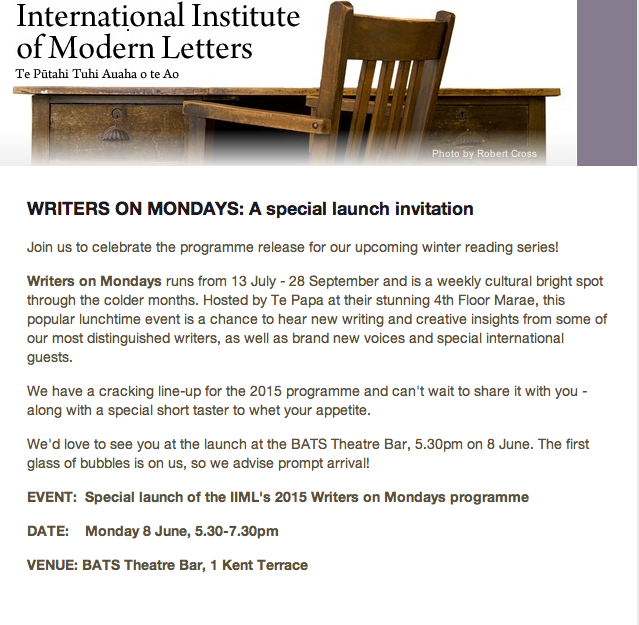
WRITERS ON MONDAYS In the company of a master: Vincent O’Sullivan

WRITERS ON MONDAYS

In the company of a master: Vincent O’Sullivan

We kick off our 2015 programme in grand style with one of New Zealand’s finest. Poet Laureate Vincent O’Sullivan’s impressive writing career includes poetry, biography, novels, plays and short stories. His recent publication Being Here is the first to survey the entire span of O’Sullivan’s poetry, from 1973’s Bearings to new poems first published in this volume. Join us as O’Sullivan and longtime publisher and friend Fergus Barrowman take a journey back through an illustrious writing career, discussing favourite themes and preoccupations, recent work, and the public role of poetry.

Writers on Mondays is presented with the Museum of New Zealand Te Papa Tongarewa with support from National Poetry Day and Circa Theatre.


DATE:  Monday 13 July

TIME:   12.15-1.15pm

VENUE: Te Papa Marae, Level 4, Te Papa
(Please note that no food may  be taken onto the Marae).

A shameless plug for poetry

My book The Letter Box Cat and other poems is a finalist — most unusual to have poetry there. So this seems like a golden opportunity to make a national show of children’s hands for poetry. Do get children to vote! (the other books are excellent too, I have to say!). So few children’s poetry books get published here. Bottom of rung in my view.

Only children can vote.

2015 New Zealand Book Awards for Children and Young Adults

Children’s Choice 

Would you like to choose the winners in the 2015 New Zealand Children and Young Adults Book Awards?


Be part of the Children’s Choice voting and have your chance to vote for the New Zealand books you think are the best.

Children and teenagers across the country have been busy reading and reviewing their favourites amongst all the New Zealand books entered in the 2015 NZ Book Awards for Children and Young Adults. Their votes created a list of 20 books they think are the best.

So get voting: we want to know what New Zealand kids think. Choose your favourite in the Top 5 in each category that’s relevant to your age group. (We have adult judges separately deciding on the overall winners, but we also want to know what kids think are the best books.)

Everyone kid who votes (you’ll need to be 18 years old or under) will be in the draw to win some books for yourself and for your school. On the second page we will ask you questions to help us contact you via your school if you win. If you are unsure about anything ask mum or dad or your teacher to help you.

Voting closes at 12 noon on Friday, 31 July.

So vote now and tell your friends to vote too. Just click here to vote!

Voting button

Morgan Bach’s launch at Wellington’s award-winning Unity Books -Would love to be there for this! Can’t wait to read it

684a89cf-1c7b-4ee7-a686-f3e03271a543

Victoria University Press warmly invites to the launch of

Some of Us Eat the Seeds
by Morgan Bach

6pm–7.30pm on Thursday 16 July
at Unity Books, 57 Willis St, Wellington.

About Some of Us Eat the Seeds:
Morgan Bach weaves a line between waking life and the unstable dreamworld beneath, disorienting and reorienting us from moment to moment. In poems of childhood, family, travel and relationships, she responds to the ache and sometimes horror of life in a voice that is restless and witty, bold and sharp-edged.

‘It’s ordinary and extraordinary. It’s the kind of arrival that delights me.’ – Bernadette Hall

Kerrin P Sharpe’s There’s a Medical Name for This — It is an astonishing book that lurked in the undergrowth of my thoughts for months

medical_4_7_1__67194.1407673215.220.220   Snapshot_20121120_8


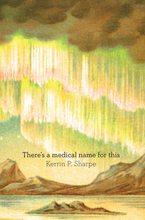
Kerrin P Sharpe There’s No Medical Name for This Victoria University Press, 2014


Last year I posted a poem from Kerrin P Sharpe’s new poetry collection, There’s a Medical Name for This. Finally, after all this time, I have picked up the book to reread and review. It is an astonishing book that lurked in the undergrowth of my thoughts for months with its sachets of strangeness, enigma, acute realness. Just casting your eye down the poem titles is poetry pleasure. Some collections house a poem or two that stand out, where the poet has transcended that which is good to become that which astonishes. In this book, I found countless examples that did that for me. Not in a flaming extravagant way but in ways that are at more of an alluring whisper. These poems are imbued with little droplets of incident, image, tension.

Near the start of the book, a miniature earthquake poem, whose perfect line breaks punctuate the modicum of detail, the deft phrasing (‘the basilica is a waltz of stone’) and the way the final stanza sings you back to the title (‘when gerry thinks of angels he hears their wings’).

Sometimes, oftentimes, the poems step into strangeness surrealness the point of becoming fable. There are no endnotes to provide author-led guy ropes into a poem so it is over to you where you step. ‘[T]here were stars behind him,’ a portrait of an elephant, shifts from an elephant in a photograph with Hemingway to ‘that year the elephant/ became a living lighthouse/ he wore a lamp/ and built a curved staircase.’ Magical. Or, in an even more captivating example (‘in the cart’), a mother, a pie cart, two hats and pastry come together in what might be a bedtime story, an heirloom anecdote, a housewifery lesson.

Rather than talk about what the poems are doing, I keep discovering snippets to share with you. The way the beginnings of the poems catch you by surprise: ‘every poem has a mother/ to feed his house/ the small bones of snow.’ Where to after such a glorious start? An equally glorious ending (I am withholding the middle!): ‘not even his mother// sews such small birds.’

Things aren’t stable in this collection. This becomes that and that becomes this as tropes shift and settle and then shift again. And so ‘a pine that is/ really the breeze/ a fish that is/ really a stone.’ Similes startle and invigorate the lines: ‘her thoughts in the thermal pools/ like fern wrapped sushi.’

These poems draw upon illness, fathers, mothers, sons, daughters, brothers, sisters, twins, snow, much snow, ponies, many ponies, birds and feathers. Whatever the subject matter, there is movement, and out of that movement vibrant, life.

Characters (pilgrims, farmers, surgeons, whistlers, gondoliers) stroll though the poems and it seems to me they wear whiffs of the poet, autobiographical traces, and yet they are more than that. Anyone can occupy these shoes that are like little shoe-stories that get handed down and then tried on for size. They are also, and so often, like fairy tales that take you out of the tedium of daily grind and familiarity and transport you to the magic and mystery of otherness and magical possibility. The poems might have a local genesis but they reach out beyond to the faraway, to Russia, rice plantations, Antarctica. Here or there, everything is in debt to place and that attachment to ‘where’ is one that makes the poems matter (‘the small farmer remains place faithful/ to the dell’). Characters become a way of circulating stories, those traces of anecdote, a forward tang to elsewhere (a turbine// turns my father’). The procession of pilgrims throughout is the poetic glue that tenders physical bearings to an uplift of wonderment. We get to be the pilgrims of the poems. We get to feel the gap, the connections, the arrival at arm’s length.

Some poems surprise in their shifting forms. ‘[S]on’ juxtaposes two definitions — the first stanza prosaic and dictionary-like, the second stanza exemplifying personal portrait as definition. The ‘half the story’ (I adore this poem!) is indeed half a story; it builds a list that builds narrative out of what you might call stream-of-conscious jump cuts.

You need a treasure box to store the adorable phrases and lines: ‘She carries him through the loom/ of fields’ ‘in the long legged darkness’ ‘the beachcomber/ keeps a button box/ a cross section/ of folded years’ ‘my father’s kitchen/ was older than eggs.’

This is a collection of exquisite variety, yet these poems are a snug fit as though for all their differences, they are meant to be together. As I read, my favourite poem was replaced by the one I was currently reading, and then again, and then again. To read these poems is to be a pilgrim – tasting the sweet and sour bite of the land, feeling the lure of travel and elsewhere, entering the space between here and there that is utterly mysterious, facing a terrific moment of epiphany.


VUP page


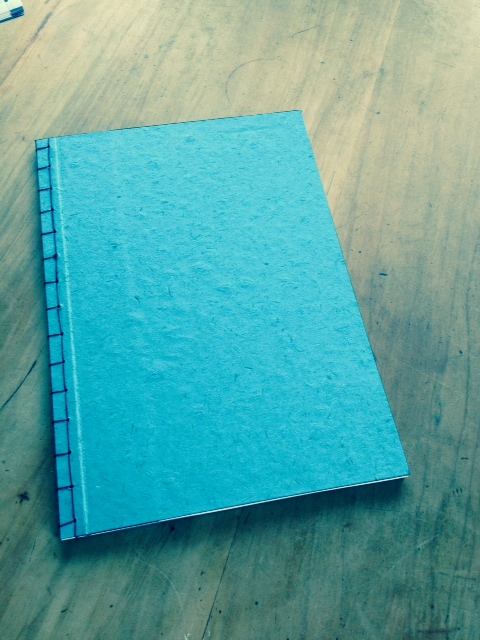
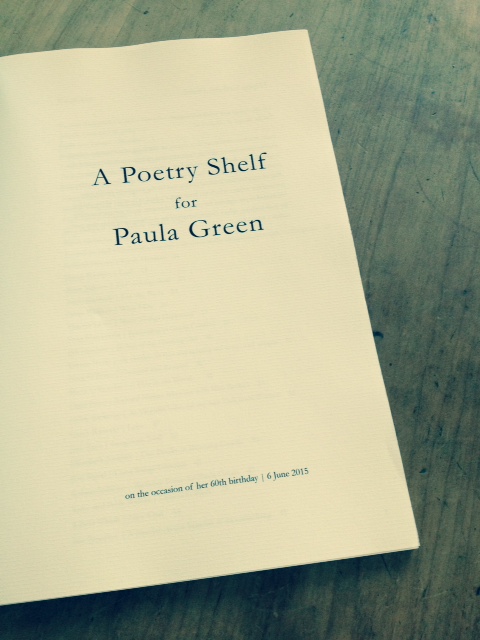
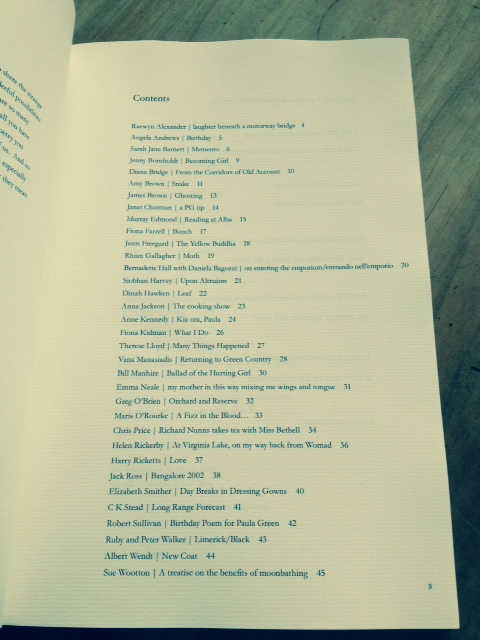
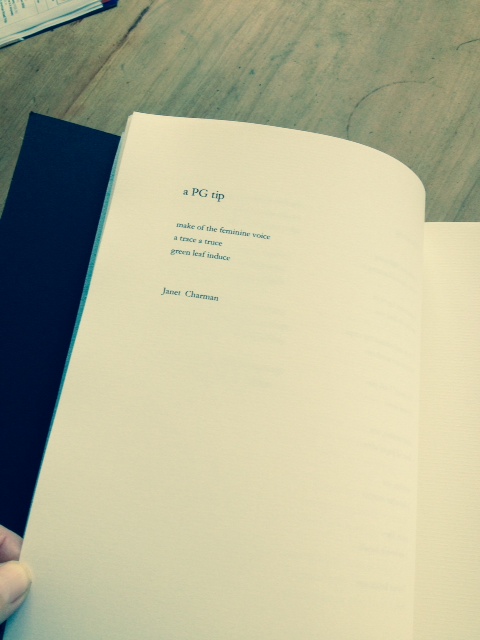
a birthday shelf made into a beautiful blue book

Anna Jackson (and Helen Rickerby) presented me with this yesterday. Utterly gorgeous.

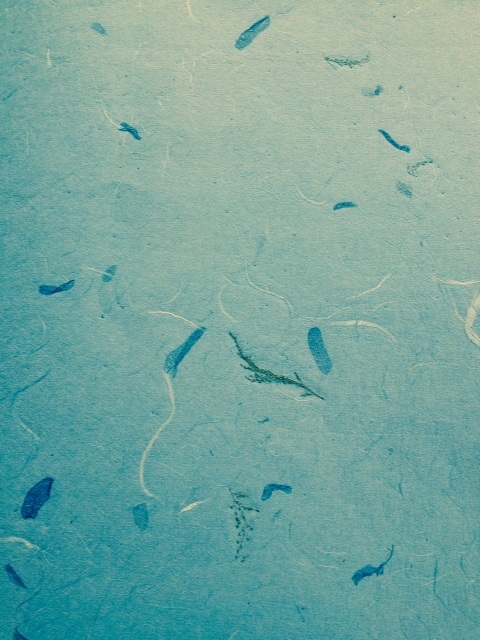
divine shade of blue, exquisitely hand stitched, heavenly end papers, internal design ever so sweet


photo 3 photo 1

photo

photo 2 photo


Bob Orr writes a poem after hearing Edwin Thumboo at AWF 2015 – marvellous!

Festival


(for Edwin Thumboo)


I sizzle to your poems –


last seen in Singapore

I duck into a hole in the wall café


only a short walk up Queen Street

where in styrofoam containers


hot and spicy prawns

have made it here


all the way from

the coconut palm coast of southern India.


Is this where poems come knocking?

As the kitchen door swings open


I glimpse an

old man


subterranean and

beat


amid his world of woks and hard working pans.


© Bob Orr  2015

A Birthday Poetry Shelf for Paula Green from NZ poets — thank you!

Saturday June 6th:

This morning, after breaking my rule of not talking about my private life on social media, I wrote about my strange and marvellous last day in my 50s on Facebook.

Then this link arrives. I burst into tears. You just do what you do. But to have this gift of poems to read on my first day in my 60s is extraordinarily moving.

For the web page go here. The driving force was my dear friend Anna Jackson. Beautifully designed by Helen Rickerby, idea for a web page conceived by Harry Ricketts. This is a beautiful birthday gift I will always treasure.

Thank you friends and fellow poets.  Thank you.

Love

Paula