Category Archives: nz poetry review

Poem Friday: Ashleigh Young’s ‘Become road’ clung to me like a poetry limpet as I left the room

Become road

When the car stops we are beginning already to become road.
A little taken apart and buried, the way birds, leaves
become road. Become road beneath
the burying of cars. All become driven over,
all become under. Even weather is taken
a little apart and buried. That we have been hit tonight
is relief; we no longer need to wonder when. Pain becomes
a story we will tell you years from now.
Sound becomes the dream you’ll nurse us from.
For now we are a passenger belted in
to the happening, looking back
at our tame furred moon. On our way home
the night had been too pleasant: rows and rows
of blue glass jars like the BFG’s jars
of dreams: the night was too pleasant
for what we had done. As we cycled uphill
the person we once were was cycling downhill
and each exhalation pushed us further apart.
Before we got hit we saw the shadows of trees
become road. Then the trees. A woman walking
a dachshund through the trees become road.
We saw the dog’s eyes glinting in the road.
The shine of his leash, caught in the road.
We heard voices in the trees become road, and the sound
of someone’s phone ringing in the trees become road.
As traffic clears, the road softens and takes us
deep in its arms, which though hard, accommodate
everyone. Early morning, as the road begins
its upward surge we hear footsteps nearing
from somewhere inside the road, as if
we have been recognised.

© Ashleigh Young


Note from Paula: This was one of the poems that Ashleigh read out at the Auckland Writers Festival in the session for the Sarah Broom Poetry Award. Ashleigh was a finalist in the award along with  Alice Miller (I was her stand in)  and Diana Bridge (winner). This poem really struck a chord with me, clung to me like a poetry limpet as I left the room. Curiously, as I listened, it was a little hallucinogenic — time slowed down, the world stretched out to a state of dissolve and all that mattered was the elongated moment of the poem. Everything inside the poem seemed bright, shining, crystal clear yet simultaneously unreal, mysterious, out of reach. Disconcerting. Strange and estranging. The words so perfectly catching the momentum of anecdote yet lilting sideways, looping back like a Zen master as everything becomes road and time laps back upon itself (‘As we cycled uphill/ the person we once were were was cycling downhill’). Really, that state I had to snap out of as I sat on stage in front of the packed audience is the state embedded in the poem — when catastrophe strikes. The world stretches like chewing gum to become so real it is unreal. This is what poetry can do; it can take those unfathomable, unspeakable moments and cast them within a poetic frame that recasts you. You get to see and feel and shift a bit. Thank you Asheigh Young, thank you.


Sarah Broom Poetry Award judge’s comments (Vona Groarke) on Ashleigh here.

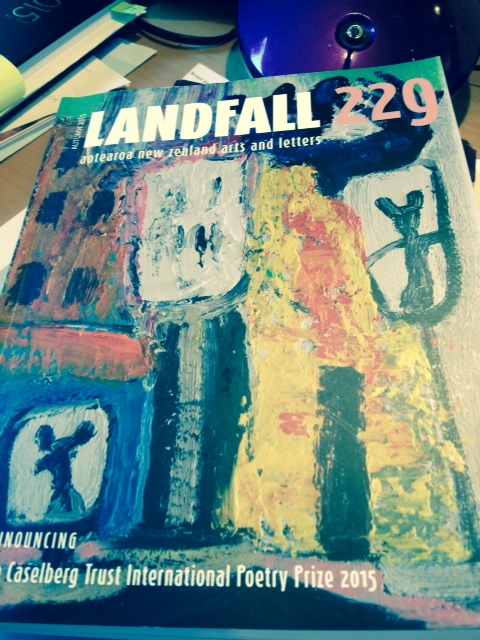
Ten things to love about Landfall 229

photo


Shortly after Sport arrives in my box, I get a bright new issue of Landfall. My little list below maps my ‘loves’ so far — like little ‘like’ ‘share’ ‘favourite’ or ‘retweet’ buttons. Editors might compile a journal with an arc of contours (aural, thematic, emotional pitch, genre, experimentation, quietness and so on) as I have always done with an anthology so you move through shifting readerly experiences from start to finish. However, I never read a journal like this.  It’s dip and delve.

1. Straight to the review section to books I have missed, and books I have reviewed. Ha! I Have missed (all meanings intended) reading Ian Wedde’s The Grass Catcher: A digression about home (Victoria University Press). Martin Edmond’s scintillating review meditates on the implications of writing the past alongside his critique of Ian’s illuminations of his own. ‘Home’ was a key notion that came under scrutiny within my doctoral thesis and within the context of Italian women writing novels in the twentieth century. It still fascinates me. This review has sent me scuttling to buy the book. In particular: ‘This is not one of those writer’s memoirs that says: here is how I became the resplendent creature I am today. It is too multi-faceted, too in love with the world, you might say, to serve such a purpose.’

2. Rata Gordon’s poem  ‘Tinkering’ is like an electric train on electric tracks. You get to the end and you want to travel that route again. Wow!

3. Discovering Michael Harlow picked  Sue Wootton’s poem, ‘Luthier,’ as the winning entry in The Caselberg Trust International Poetry Prize (2015). This poem is sumptuous in detail and that detail evokes mood, music, character, place in a transcendental kind of way. I would love to hear this poem read aloud to hear the poet lift and connect and pause, the hit of certain words on the line (flitch, slink, Sitka, bedrock). Sue demonstrates the way a poem can take a small moment/thought/action/thing and then open out intimately for the reader. A word that comes to mind and that is so overused when speaking poetry is luminous. But this poem is utterly and breathtakingly luminous.

4. Discovering Christina Conrad still writes poems.

5. Short poems can be very very good. So much happens in the white space that holds them This is the case with Louise Wallace’s ‘Mirage/Arizona.’

6. Tina Makeriti’s essay, ‘This Compulsion in Us.’ Strikes a chord because I am fascinated by museums too; enthralled by the things that stick to the objects that only you can see or hear or feel. Loved Tina’s exploration of a museum’s paradox, in that it preserves treasures yet ‘also captures and immobilises things that make sense only in motion, that should breathe and transform.’

7. Runner-up in The Caselberg Trust International Poetry Prize (2015), the opening lines in Jessica le Bas’s ‘Four Photographs from a Window’ : ‘The first is a shot in the dark/ buttoned up and black suited’

8. An Elizabeth Smither short story that underlines what an exquisite hand she has when it comes to fiction (‘The Trees’).

9. The way Sue Reidy’s poem, ‘The primitive,’ became etched on my skin.

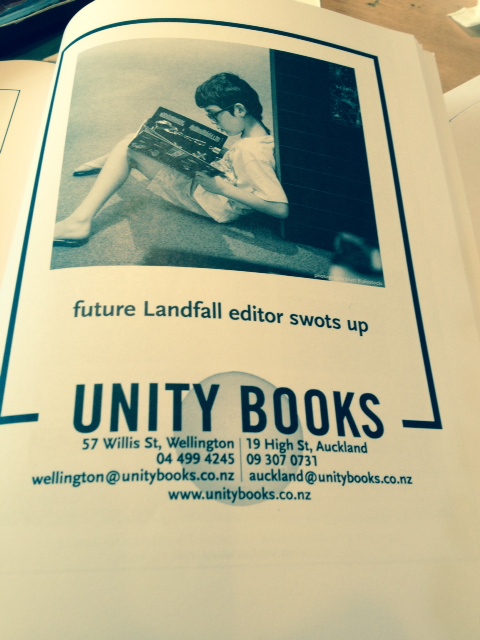
10. Lots more delights but I have to mention the Unity-Books, standout ad. A child reading a book, thank you!

photo


On reading Sport 43

Sometimes a literary journal is just the ticket for rainy-day blues, diversion, or the need to put a finger on a literary pulse. Ha! The notion of a literary pulse is where debate ensues. Each finger will be sensitive to different nuances, different implications.  I strongly believe that national anthologies that claim to represent a wide group ( New Zealand, for example) must be challenged if gender, ethnicity, age or geographic-location biases fuel significant blind spots. For decades, women were the blind spot in anthologies and journals, and now, at times it seems there is token representation of  work by Māori, Pasifika and Asian authors. Literary journals, however, are often the bloodline of a place, a niche, a literary disposition, and nearly always reveal the predilections of the editor. Sport comes out of Wellington, and it is to a great degree of Wellington (not in subject matter, but in terms of authors selected). It is a celebration of the writing by both established and emerging writers that have some connection with the city, often through Victoria University or its Press.  I have no problem with this.  I most definitely have no problem with this when the work included catches my attention and sends me in directions both familiar and unfamiliar.

The latest issue worked a treat for my rainy-day blues.

Seven essays are sprinkled through the selection of poetry and fiction, and if this is a new feature, it is a feature I applaud in this climate of idea-sharing in creative and stimulating forms. Long may it continue.

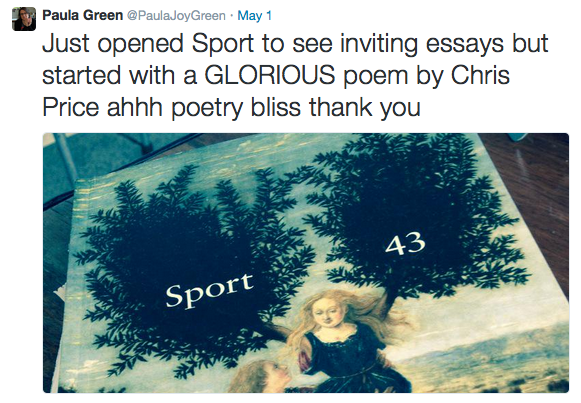
When I first picked up the book, I went straight to Chris Price (out of longing for a new collection perhaps) and immediately did a tweet review. Tucked away at the back of the book, it felt like the best had been saved for last with the playful, audacious flick and flash of words that catch your ear and send you flying to a nursery rhyme or Murphy’s Law or cheeky wit or the subtle twist and let’s-be-serious of the last word, ‘unspoken.’

Screen shot 2015-05-12 at 10.14.03 AM

This time I went to an unfamiliar name first, ‘Ruth Upperton,’ and what a discovery. Think I must have yearning for the comfort and absolute pleasure of poetic musicality (why I like the poems of Michele Leggott and Bill Manhire so much). Ruth has appeared in other journals, has just finished a law degree and lives in Palmerston North. Her five poems are different, the one from the other, but are linked by gorgeous rhyming (off, aslant, sliding), infectious repetitions, aural chords, sumptuous words. There is poetry out of sentences and there is poetry out of curiosity. You shift between comfort and strangeness.


from ‘The lonely crow’

Nothing sadder than a lonely river.

Nothing darker than a single crow.

Shiver at the strong’s surrender.

Play a tune on your June piano.


James Brown’s terrific poem, ‘Mercy,’ made me hungry for a new James Brown collection.

Anna Jackson’s three cooking-show poems suggest she is just getting better and better ( I am working my way through Catallus so I can review her new collection soon). I love the way the ingredients (excuse the pun) in these poems shift and flicker from one poem to the next, and in their new baking dishes taste a little different. The sort of poems that evoke a steady engagement at the level of sound and narrative.

Sarah Jane Barnett’s sequence of poems, Addis Ababa,’ caught me by surprise. They take me to an elsewhere, the elsewhere of  displacement, of otherness, of immigrants. The poems step up from everything Sarah has previously written, and then take another step into risk, empathy, inquiry, experience. What a combination.


Rachel Bush’s ‘Long and short,’ is a poem that moved me with its exquisite detail and revelation, a family story (true or false) that catches in the throat. The poetic glue: the baked bread.


So many things accumulate. They weigh us

off balance. We struggle to stay upright,

we lurch and are precarious. Our feet are flat

and sudden. It was easier when we had

a mum and dad. Easily we could blame them

when we were less than we desired.


Still most essays and fiction to read, but started here: Damien Wilkinson’s lecture/essay navigates a subset of the ‘ought’ and ‘ought not’ of narrative: the way it ought/ ought not represent some kind of personal change (character based). Fascinating following the thread of argument. Is this a requisite ingredient in poetry? That poems ought to navigate some kind of change? I raise this because, and I am shifting tack a little here, I am fond of poems that exhibit some kind of movement (and movement may be zen-like and hold change within its sameness and vice-versa). Poetic movement need not be on a grand, spectacular scale. It might be miniature shivers in the poem, sweet little movements that you catch out of the corner of your eye, or a flicker in your ear, or a faint tremble of your heart, or the tug of an idea that is itching to confound, challenge and pull you elsewhere. That is what I felt when I read, ‘She cannot work,’ Ashleigh Young’s foray into fiction. It is what I felt reading this issue of Sport, a catalogue of movements that displaced my state of fatigue.


Sport: miniature shivers in the writing, sweet little movements that you catch out of the corner of your eye, or a flicker in your ear, or a faint tremble of your heart, or the tug of an idea that is itching to confound, challenge and pull you elsewhere.


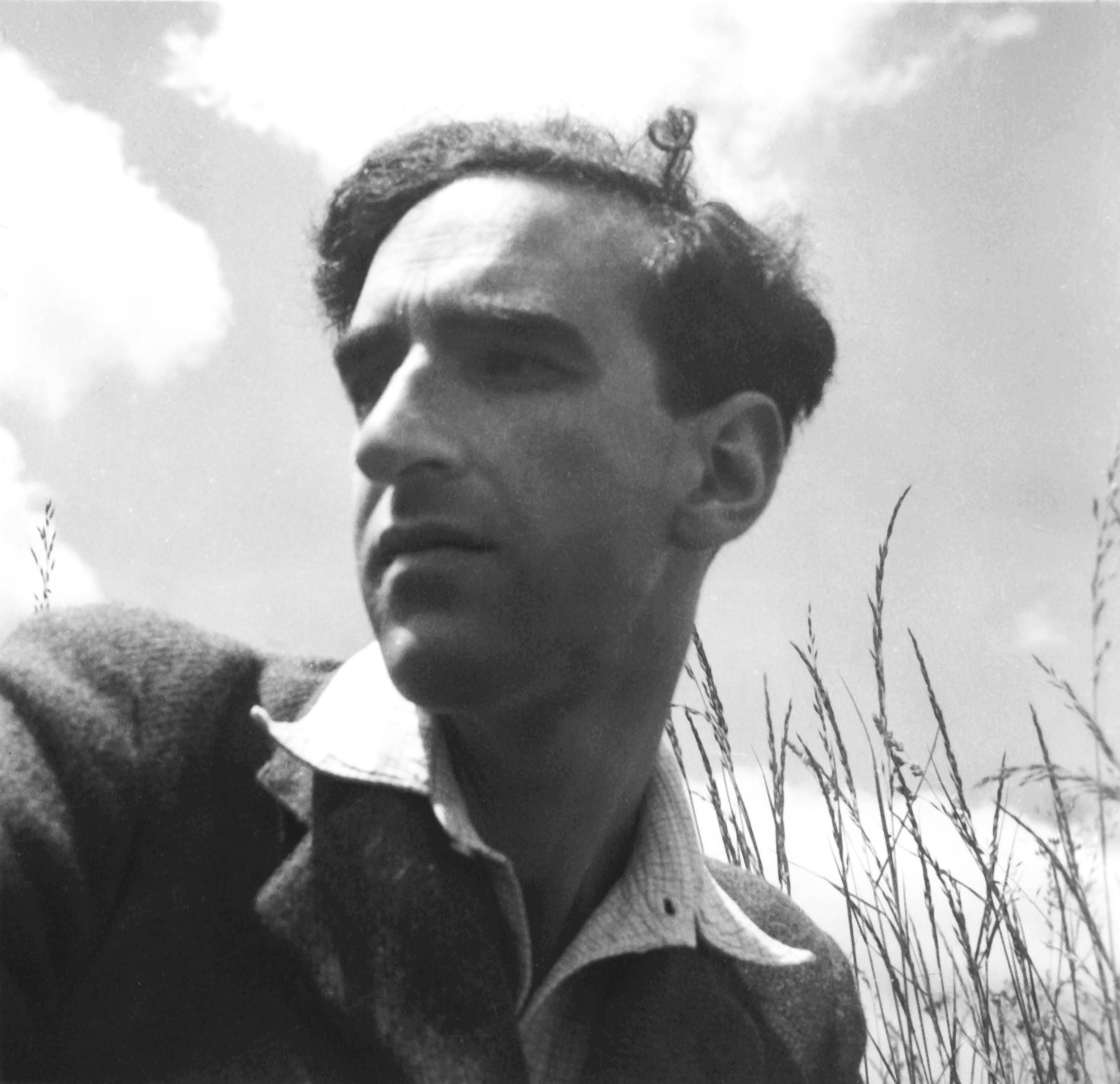
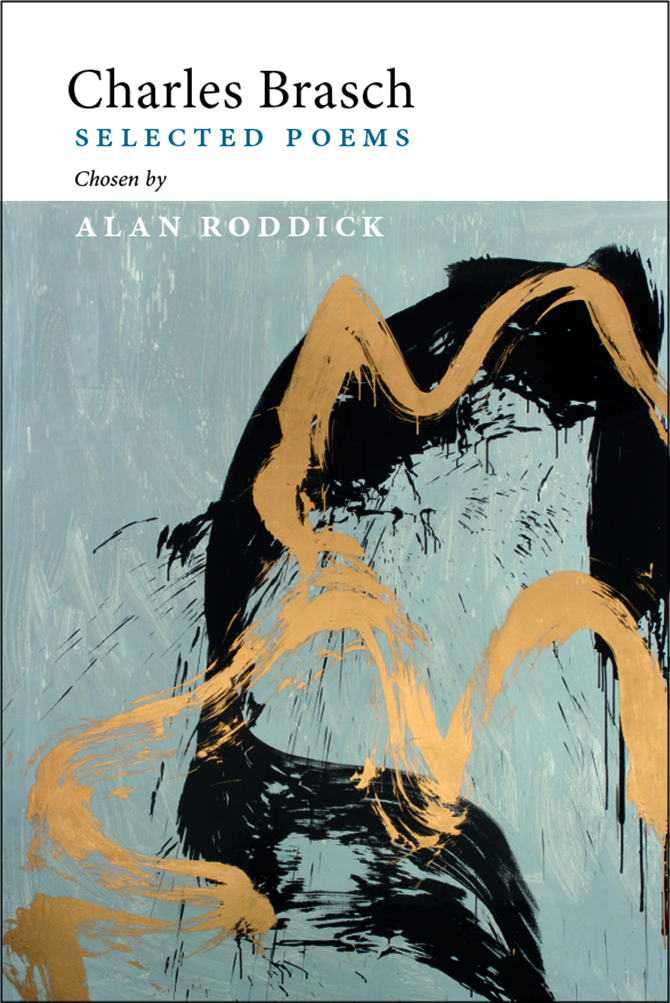
Charles Brasch: Selected Poems edited by Alan Roddick He is splitting his poems in ways that promote new revelations

3. S13-575c_CB_in_Downs   Roddick Brasch with rule

Charles Brasch: Selected Poems edited by Alan Roddick, Otago University Press, 2015


Poet and scholar, Alan Roddick previously edited Charles Brash’s posthumous collection, Home Ground (1974) and his Collected Poems (1984).  Charles published a number of collections in his lifetime, mentored younger poets and was the founder and initial editor of Landfall. With his books all out-of-print, this is a timely arrival. One of New Zealand’s most influential literary journals, Landfall has represented poetic trends over decades, and continues to endure with renewed vitality (currently edited by David Eggleton), but it is interesting to step aside from this legacy and explore Brasch’s own poetry. He was a contemporary of RK Mason and ARD Fairburn and was selected by Allen Curnow for A Book of New Zealand Verse in 1951. For many poets, this was a sign of having made it. For Brasch, it knocked back some of the self doubt and sent him traversing new poetic paths. It was indeed a turning point.

One fascination of a selected poems is the way they cover the arc of a poet’s life and, in particular, writing life; the way poems reflect interior changes, and the way a changing world rubs against the process of writing. Charles’s first collection, The Land and the People, was published in 1939 with looming threats of war and world instability. He wrote with an initial attachment to the Romantics but by the 1970s his poetry was freer. The language is less tied to loftiness, to the abstract, to tight rhythms. He writes in plainer language, everyday language, yet you still see resolute connections with the subject matter of his first book: the land and the people. In many ways, the poetic arc of Alan’s selection lays its roots in Brash’s attachment to home, and the poem becomes a frame or form for a navigation of this. A homage at times. A questioning of sorts. Charles held the war at arm’s length, he held the rumpus of the 1960s at arm’s length (you don’t see him in Big Smoke, the anthology that highlights the radical poetry of the 1960s and 1970s). In his last decade or so, he is not rupturing form and content across the page in ways that SHOUT and displace. He is splitting his poems in ways that promote new revelations, new confessions whilst always maintaining his private stance. Love is there; love is struggled with and acknowledged but it is never overt, never clear.

from ‘In Your Presence’


I practise to believe,

And work towards love.

How should I see

Until I study with your eye?


He is unafraid to bare the self portrait in ‘Cry Mercy’:


Getting older, I grow more personal,

Like more, dislike more

And more intensely than ever —

People, customs, the state,

The ghastly status quo,

And myself, black-hearted crow

In the canting off-white feathers.


I was interested to discover that he worked on one of his most famous poems, ‘The Islands’ (originally published in his second book in 1948) for twenty years until he felt like he got it right. This is the poem that contains one of the most often quoted lines in New Zealand poetry:

Everywhere in light and calm the murmuring

Shadow of departure; distance looks our way;

And none knows where he will lie down at night.


The poem that has always resonated the most strongly with me is the sequence ‘Home Ground’ (from his last book, bearing that title) and a substantial part of the sequence is reproduced here. The language is sumptuous yet affords a degree of plainness. Individual lines stall and haunt you (‘I tramp my streets into recognition’). It feels open. It feels like writing this poem mattered greatly to the poet because it draws upon what matters. And within that, as with much great poetry, there is space, silence, mystery.

Silence will not let him go

Entirely; allowed a few notes

At the edge of dusk

He will be recalled before long

And folded into rock

Reassumed by the living stream.


Otago University Press have produced a terrific anthology with care taken over internal design and the cover. There is room for the poems to breathe both in terms of font choice and white space on the page. Alan’s introduction is useful but I do think there was room for more discussion of the poetry itself despite the witty inference in Charles’s ‘Pistol Point’ that poems ought to speak for themselves (‘Poems ask their own questions’).  Selected Poems is a terrific introduction to Charles’s poetry; particularly to the way his poems shifted over time, on his own terms, and not at the behest of current poetic trends.


Endnote: I have a policy on this blog of using the first name of a poet. This is the first book I have reviewed by one of the key men poets who emerged in the mid-twentieth century in New Zealand, and it feels like I am transgressing a line by not using ‘Brasch.’ It feels like I have invited him into my kitchen to have a cup of tea informally. ‘Authority’ has sailed out the window.


Otago University Press page here

Gregory O’Brien’s terrific discussion with Kim Hill on the book here

NZ Book Council author page here


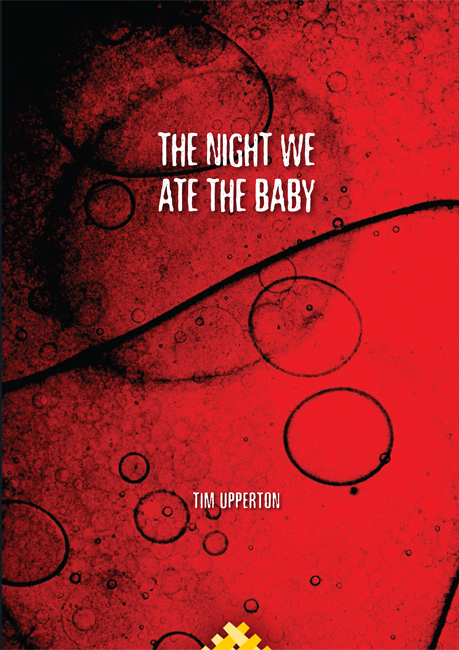
Tim Upperton’s The Night We Ate the Baby — You need to read the whole collection to get a sense of the tonal subtleties, the echoey anecdotes, the spade that digs open and the spade that buries.

Tim-FB 9780473288396-TU

Tim Upperton, The Night We Ate The Baby HauNui Press, 2014

Tim Upperton’s debut poetry collection, A House on Fire, was published by Steele Roberts in 2009. Since then, his poetry has been published in numerous journals and he has won awards for a number of them. The poems for this new collection were written with the assistance of a Doctoral Scholarship from Massey University of New Zealand, so perhaps they form/formed part of his doctoral submission. Tim will be reading as part of the Haunui Press ‘Deep Friend Poetry Reading’ series at Vic Books on 26th March. Details here.

This latest book is unlike any other collection I have seen in New Zealand; chiefly in terms of the measure of discomfort. The forms are various, scooping an edgy wit into prose blocks, villanelle, triplets, couplets and freer patterns. Yet there is connective glue at work here, and that is what makes this collection stand out. I think it comes down to voice (whether or not it is the personal voice of the poet doesn’t really matter) because the voice steering the poems is sharp, forthright, witty, edgy, grumpy. It unsettles. It keeps you on your toes. On the back of the book, Ashleigh Young suggests that ‘[t]hese willfully, calmly disagreeable poems have tenderness and courage at their heart.’ I would agree. Therein lies the pleasure of reading these poems; there is more to the brittle edginess than meets the initial eye.

The first poem, ‘Avoid,’ very clearly announces that this is a poet who loves language, that is unafraid of rhyme and rhythm working arm in arm. The poem is a miniature explosion of sound effects — with sliding assonance, bounding consonants, near rhyme and sumptuous aural connections. It brought to mind the refrain in Don McGlashan’s song,  ‘Marvellous Year,’ and Bill Manhire’s glorious ‘1950s’ in the use of rhythm and rhyme, and aural trapeze work that is ear defying. Whereas Don’s song represents a potted portrait of the world in all its warts and glory (in a marvellous year), and Bill’s poem is a nostalgic recuperation of things, Tim sets up the collection’s  negative disposition and itemises things to avoid!


New Age mystics. Wave-particle physics.

Federico Garcia Lorca, that all-night talker.

The law. The rot inside the apple core.

All dawdlers. Power walkers. Tattoo

parlours. Death metal concerts.

Poetry readings that go on for hours.


The second poem, ‘Valediction,’ is a list poem steered by straightforward rhyme, and coupled with the incantatory joy of repetition you fall upon the humour. This is a lonesome poem, yet it is unbearably funny.


Goodbye, bagel, table for one.

Coffee, cigarette. Warmth of the sun.

Goodbye, sparrow. Goodbye, speckled hen.

Goodbye, tomorrow. Goodbye, remember when.


The third poem, Spring,’ (it would be so easy to work my way through the book, poem by poem but this trend is about to stop!) is not your usual homage to the season of daffodils and lambs. It is both refreshing and refreshed as the negative bite overturns such empathetic images. You board the slippery slope of the poem and run into the self-deprecating turn of the poet as he surveys the ruins of his touch (‘I ruin the jonquils, the daffodils. I ruin the I love you.’). Beneath this surface of ruination there is a white-hot core of intimacy and loss of intimacy. Unbearably moving. The final stanza holds its most potent kick until the oxymoron in the final line. Spring becomes the vehicle to hint at so much more:


Which is to say, I am terrified.

Meanwhile the grassy goodness, the lengthening day.

It’s not as if you died.

You come closer and closer away.


I  was really drawn to ‘The trouble with poetry’ (originally published in Sport). It felt like this  poem was a sleuth on the trail of another poem that would in turn become this poem; the Private Eye Poem collected all the necessary pieces (to tell the story in the manner of ‘a poet, not a novelist’). Like many of the poems in the book, it is as much about story as it is about language effects. There are characters and problems and turning points. The poems begins like this:


In the poem

which is like a house

the poet is looking

out a window.


The poem-houses in the book do look out into the world and what they gather in through their wide open and half-open windows are little anecdotes sometimes layered the one upon the other. They house jarring relations, spiky revelations. They are not-love poems as much as they are love poems. They house broken worlds, interior and external. ‘Late Valentine’ is like an ode to what is not:


I don’t sleep with you anymore,

and this makes the rain come

in the open window


The honeyed repetition of a villanelle renders the ‘hook’ in ‘The bare hook’ more damaging. Again there is discomfort, ache, and the oxymoronic kick of a last line (‘The way in is the way out.’) Here’s a sample:


The bare hook where you hung your coat

is a question mark. The answers never.

Don’t ask what this is all about.


You need to read the whole collection to get a sense of the tonal subtleties, the echoey anecdotes, the spade that digs open and the spade that buries — the language that takes to  limitless skies, and the forms that contain. This is a risky collection. It’s like a series of negative imprints that if you tilt to the left you get exquisite glimpses of fracture and repair.


from ‘Take care’

You are precious,

so carry yourself carefully

through this day,

don’t drop yourself because

you will smash

and fly apart in every direction,

and then,

and when that happens–

who will gather you,

who will pick you all up

I’d like to know?


Tim’s Blog

HauNui Press page


Harry Ricketts’s Half Dark — These poems are like little retrievals from the shade of the past


Harry Ricketts 2011       half_dark_front_small__05477.1417645489.220.220


Harry Ricketts, Half Dark  Victoria University Press, 2015

The title of Harry Ricketts’s new poetry collection, Half Dark, is apt as many of these poems are like little retrievals from the shade of the past. Poetry as retrieval. As excavation. As reflection. The half dark underlines (as does the blurb on the back) that this collection is dedicated to the gap, and that in these spaces, there is electric life. Poetic life. One poem, ‘Gap,’ makes reference to the haunting voice of the London Underground:


‘When I grow up, I want to be

the man who says “Mind the gap”.’

Down the years how your voice,

that phrase, have haunted me.


Yet ‘mind the gap’ is also like the surrogate, underground voice of the poetry that cautions us to stall in the gap for it is there poetic rewards will multiply. If you think of the poetic gap, you are lead in myriad directions from the silent beat at the end of the line, to the white space of the page, to the tension between what the poet holds back what the poet reveals. All these things are paramount in a collection that pays diligent attention to the pause at the end of the line, the form of the poem upon the page and what is revealed by choice. Yet what animates the poems beyond this is the gap of recollection, with so many examples stretching back in time to record and review. Now the gap is the faltering stutter of history where the past is only visible in pieces and can so easily be misremembered and even diverted to suit a cause. The London-Underground echo resonates on another level when you bear in mind the punning possibilities of the word ‘mind.’ Step beyond the warning (Watch out!) to the need to tend and care for and you reach the subterranean simmer that shows these poems come from the heart. The poet loved and the poet minded.

One striking example is a triloet dedicated to Jessie. The looping lines signal the circularity of families dividing and returning, of life itself though generations of fundamental behaviour and connections. Much is not said, yet the mood that permeates is infectious and moving:


(…)

Sometimes we find ourselves quite

overcome and can’t hold back the tears,

but still we walk, talk, laugh in soft November light;

a day to set against all the lost years.


In ‘Broken Song,’ the gap is replayed on the page in the syncopated words, the white space, the withholdings paramount.


Harry has often displayed a predilection for traditional forms; they become vessels for play, for the allure and comfort of repetition, for the challenge of innovation or depth within constraint, for a contemporary licence to laud, rattle and refresh. In his endnote, Harry addresses his current preoccupation with the triolet: ‘I soon found that, like the villanelle, the restrictions and repetitions of the triolet can lead to writing poems not merely playfully or self-consciously ingenious (nothing wrong with that of course) but poems embodying confinement and the inability to break out of particular cycles of thought, feeling and behaviour.’ There are ways in which his triolets do this, as in ‘Jessie,’ yet there is often a word or phrase that acts as splinter. In this poem, for me, it is the word ‘lost’ as it becomes a universal beacon. It breaks out from the individual story (the way you can’t go back as father and son in this case) and spikes your own disconnections and connection, your own missing pieces.

Poetry also sparks on poems as startling neighbours. In some poems, it almost feels as though this intrudes on that, and that intrudes on this, to offer different insights.  in ‘The Frick  comes to Lake Rotoma,’ it is as though the tracing-paper museum is laid over the tracing-paper lake and you understand that purity of location is perhaps a pipe dream. Something always tugs at you elsewhere and something always keeps you heartily rooted here.


These postcards before you are meant

to bring back the Frick, that sumptuous


room, Fragonard’s Four Stages

of Love: meeting, pursuit, lover

crowned, love letters—all those pink roses,


that jaunty parasol, No,

you’re still here, sweat trickling over

your ribs. They knew love wasn’t that easy.


Perhaps, the feature that I found most admirable was the way in which many of the poems bear witness to an instance. The gaps heighten this effect along with the detail, musical choices and tropes. There is a sense that the poem frames a moment, an incident, a scene, a person (friend or family in many cases). ‘Pewsey’ is a terrific example of this, as is ’10 to 3.’ The latter again catches the circularity of life with a perfect balance of economy (the gap) and detail. The central image comes alive with a trope that evokes vulnerability, tenderness, stillness: ‘your hands bunched like spiders/ the purple eiderdown.’ The poem haunts as it exposes a moment so intimate, in its familiarity, it becomes universal.

Harry’s new collection takes you from Te Mata Peak to Frankfurt to Rome. It traverses weather, old friends and family. What marks the measure of book, is the fact there is so much one could say about the connections that emerge from the spaces. The poems are the heartbeat of a backward look; at times mourning, often contemplative, they revel in humour as much as intimacy, in sumptuous detail as much as the well-tended gap. This is Harry at his poetic best.


Victoria University Press page here

Poetry Shelf interview with Harry here


Truth or Beauty: Poetry and Biography — a little chapbook of poems

truth-or-beauty-cover

In 2014, Helen Rickerby and Anna Jackson organised a conference at Victoria University entitled Truth or Beauty: Poetry and Biography. It drew poets and scholars from across New Zealand and Australia. Over three days the participants shared readings, papers, panels and informal discussions.

To celebrate the event, the organisers have released a gorgeous chapbook containing poems by the participants that highlight meeting points between poetry and biography, truth and/or beauty.

In the introduction, the editors (Anna and Helen are joined by Doctoral student, Angelina Shroma) suggest that  some of the poems ‘are more straightforward retellings of a life, but most take a poetic twist — are impressionistic, episodic, mythic, abstract or undermine the very idea of being able to know factual truth.’

Seeing the line-up of poets included gives some indication of the stretch and vitality of ideas exchanged along with poetry shared: Jordie Albiston, Airini Beautrais, Amy Brown, Geraldine Burrowes, Zarah Butcher – McGunnigle, Max L Chapnick, Majella Cullinane, Toby Davidson, Joan Fleming, Janis Freegard, Maureen Gibbbons, Helen Heath, Kerry Hines, Anna Jackson, Shari Kocher, Saradha Koirala, Bella Li, Vana Manasiadis, Karlo Mila, Robynanne Milford, Vivienne Plumb, Jenny Powell, Nina Powles, Chris Price, Helen Rickerby, Harry Ricketts, Jack Ross, Erin Scudder, Anna Smaill, Marty Smith, Robert Sullivan, Leilani Tamu, Chris Tse, Jessica Wilkinson, Karen Zelas.

Some of the poems took me back to books I have already loved (Autobiography of a Marguerite, Dear Neil Roberts, I, Clodia, and Other Portraits, Crumple, Girls of the Drift, My Iron Spine, Just Then, Horse with a Hat, How to be Dead in the Year of Snakes, Captain Cook in the Underworld) while previously unpublished poems were miniature temptations of new works to come (Joan Fleming’s ‘New Margins,’ Helen Heath’s ‘Radiant,’ Chris Price’s ‘A natural history of Richard’) and some poems and poets were new to me and are now on my radar now (Shari Kocher, Robynanne Milford). I haven’t read many poems by Erin Scudder but her deliciously inventive word play in ‘Hollywood Hills Woman’ catches at story, character, language, space and life. This was a gem.

This is a beautiful hand-bound book; I got to the end and just wished I had been able to attend the conference. This makes up for it slightly.


Web page here

Copies are available for purchase for NZ$20, plus NZ$5 for overseas postage. Email Helen.Rickerby@paradise.net.nz to order and arrange payment.


About the editors

Anna Jackson, associate professor at Victoria University of Wellington, has published six collections of poetry, most recently I, Clodia, and Other Portraits (Auckland University Press, 2014). The first half of this collection is based on the life of Clodia Metelli, the ‘Lesbia’ who was the subject of the most passionate poetry written by Catullus in late Republic Rome.

Helen Rickerby has published four books of poetry, most recently Cinema (2014), which includes biographical poems about film-makers and her friends. Her 2008 collection, My Iron Spine, features biographical poems about women, many of whom have been neglected by history. She is the managing editor of Seraph Press, a boutique poetry publisher, and is co-managing editor of JAAM literary magazine.

Angelina Sbroma is a doctoral student in English literature at Victoria University of Wellington. Her thesis focuses on children’s fantasy literature.


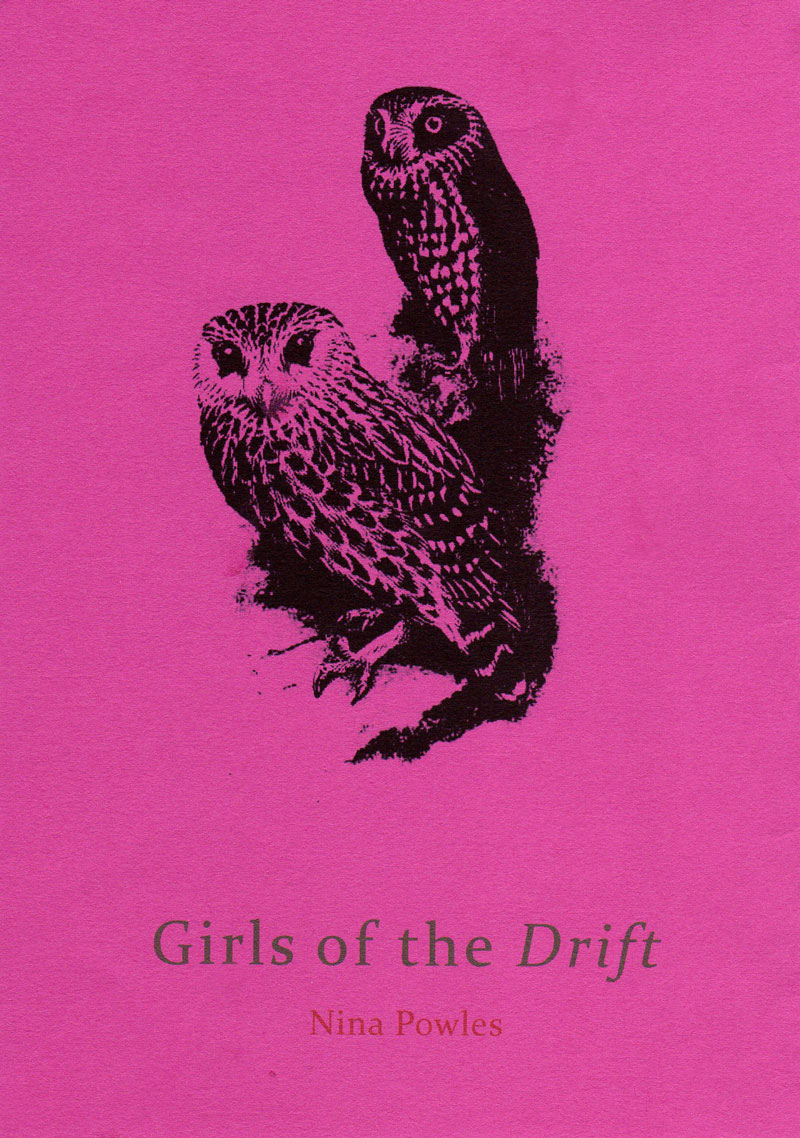
Nina Powles’ Girls of the Drift – I love the way lines turn a corner and surprise you


Girls-of-the-Drift-cover-web   Nina

Nina Powles, Girls of the Drift Seraph Press 2014

Nina Powles was the Books Editor for Salient last year, has an Hons Degree in English Literature and Chinese from Victoria University and is about to commence an MA in Creative Writing at the International Institute of Modern Letters.

Nina’s debut chapbook is handbound and in striking pink with owls peering off the cover. Eye-catching. Exquisite. Borrowed from a poem in the book, the title, too, is eye-catching. It takes its name from a pamphlet Jessie Mackay wrote and published in 1928 on the social and moral responsibilities of young women (Girl of the Drift). Nina’s endnote discusses the passion that Jesse and fellow poet Blanche Baughan felt for social justice. Nina’s poems also seem to be sparked by a passion for writing, living and navigating the world beyond the doorstep, that is paradoxically the doorstep itself.

This is a collection of poems that engages with the lives of women, fictional or otherwise. Holding this book, I am reassured we write out of the women (and men for different reasons) who paved the way for us, not just in the pioneering poems and stories they wrote, but in the lives lived that stepped out of the norm (the first female lighthouse keeper for example). Nina also acknowledges her ENGL422 Modern Poetry class of 2014 run by Anna Jackson and the Alexander Turnbull Library with its storehouse of letters and documents. While the poems feel light and refined on the page, you also get a sense of the wider world — a world of books, thinking, discussions. A bit like what Blanche and Jessie engaged in.

I love the richness of context of the poems (Katherine Mansfield and her characters, a ghost at an old school, real things and invented things, a history of the poet’s reading), but I also love the way lines turn a corner and surprise you.


from Pencarrow Lighthouse

The wind spins dead things in circles.

Collect up the wintertime, won’t you,

crack it on a rock,

drop it from a height.


The glint of detail is so mouthwatering, it is as though the poems become miniature packages  of story — of this place and that woman, of this weather and that ocean. The detail, so good at animating poetry, augments the life of the poem, visually, aurally, emotionally.


from Volcanology

[ … ] I keep

pieces of the volcano on my

windowsill, next to the honey

jars, so they don’t forget.


Nina’s collection stretches with the agility of a wordsmith who knows just where to break a line, shift a point of view or the pitch of a phrase. The poems take flight from the reading and research that a university offers, and the experience and insight you bring to that reading. I loved this collection and to celebrate its arrival I am posting a poem from it, with notes by both Nina and me, as my first Poem Friday of 2015 on February 27th.


Seraph Press page


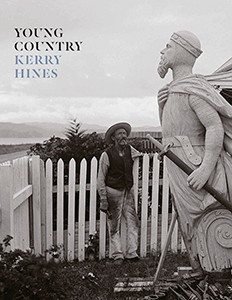
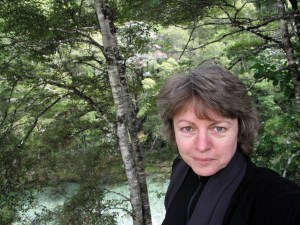
Kerry Hine’s Young Country: a sense of humour and a fearless inventiveness

1415925058226    Hines-kerry-2

Kerry Hine, Young Country, Auckland University Press, 2014

Kerry Hine’s debut poetry collection is an offspring of her doctoral thesis, ‘After the Fact: Poems, Photographs and Regenerating Histories’ (Victoria University, 2012). Her thesis considers the photographs of William Williams amongst other things and these alluring photographs act as prompts for her poems. William was a well-regarded, nineteenth-century photographer with a passion for the outdoors, and for railways in particular.  He walked and camped and canoed. He photographed both rural and urban settings. Kerry’s poetry comes out of scholarly endeavour; the research is acknowledged at the back of the book in the bibliography and the extensive notes on both image and text. The thesis title, ‘After the Fact,’ resonates with intellectual and poetic movement. The writer takes a step back into history (to view the images, read material), yet she steps off from the fact of the matter (the staged scene, the fallible anecdote) to her own territory. The photographer has framed a set of circumstances selectively with his own eye/slant, and the poet does likewise. You could say the poem, ‘after the fact,’ is a second framing where invention rubs shoulders with historical records. Reading the poems in this context raises questions. What links are made to history/histories? Can we spot the personal predilections of the poet? Do we need facts? Can poetry reframe history in a way that draws us deeper into the past. Can we track both minor and major narratives in image and poem?

Before I started reading the book, I decided I had three options. First option is to read the photographs and follow the melancholic edge of the dead scenes, the fascination of the frozen moment, without the poems. I did this a little and loved the movement that each image ignited, belying both death and the stoppage of time. Always that trace of melancholy though. Second option is to read just the poems and try and ignore the mesmerising flicker of image in the corner of my eye. That was tough as the photographs tugged me away. Yet to stop and enter the heart of the poems was rewarding. I got carried into the territory of elsewhere. Third option is to read page by page, poem and photograph, and enjoy the flavoursome link and sidesteps. This is what I did in the end.

Young Country is a beautifully produced book with its sheen of paper, white space, terrific reproductions, inviting openness of font and internal design. Auckland University Press is exemplary in its book design and this book is no exception.

Kerry’s poems do take you back in time where men are catching eels, felling trees, smoking pipes, drinking whiskey, tenting, pondering the meaning of life, being alone. What of the women? I especially loved the multifaceted portraits  of the women. There are the wives, the mothers — but then, the surprise of the butcher’s wife who darns a man’s hand. Or the rising  questions of the new wife (‘Not doubts. Little questions.’). Or the woman whose ‘bed has grown around her,/  trying to accommodate// her illness.’ An illness defined as feminine hysteria with the cure a prescription to breed, constantly breed. Or the little resistance of the widow:


The Widow

An apple is an apple

is a simple fruit.


What women are supposed to need

I can do without.


What men can do

I can do without.


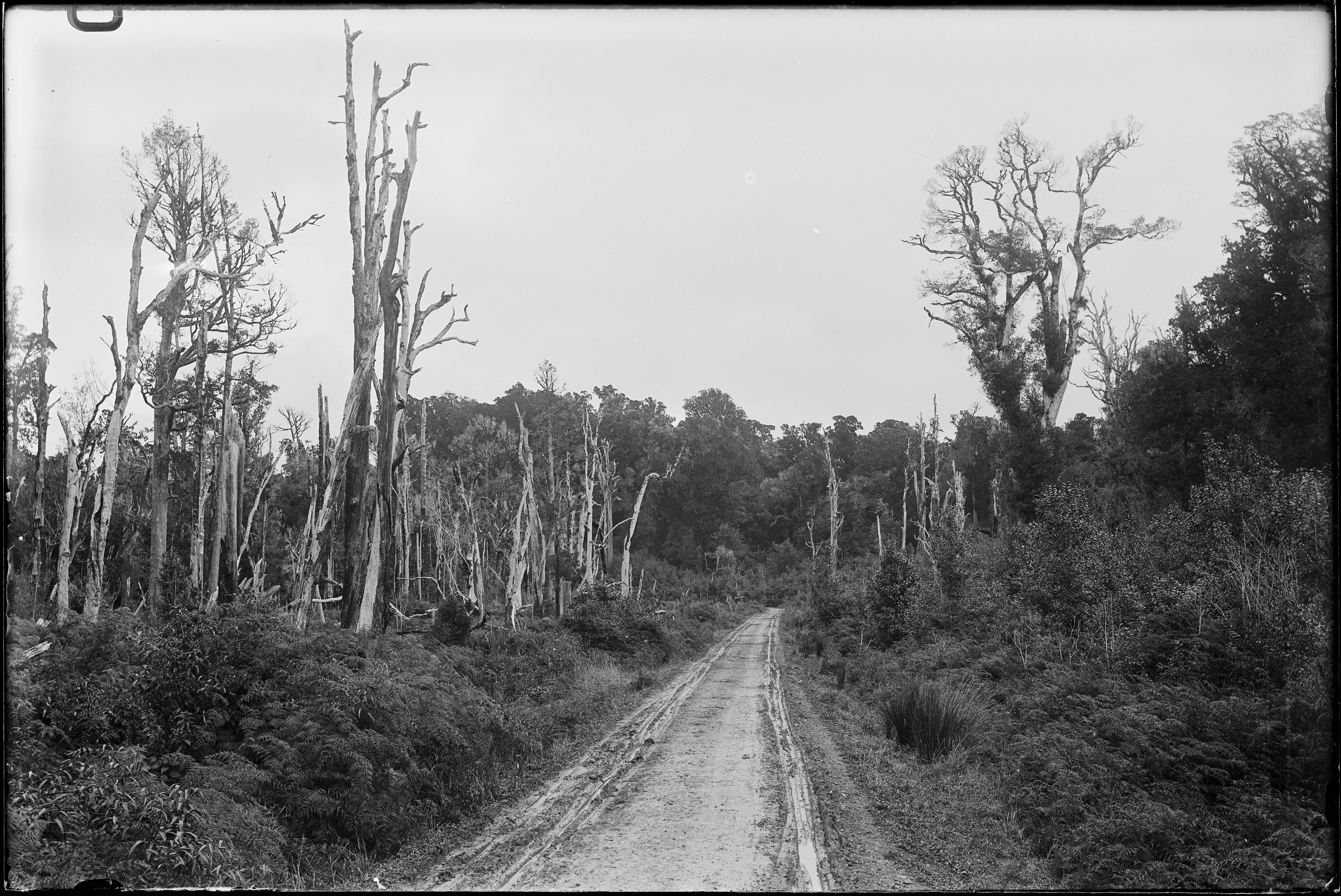
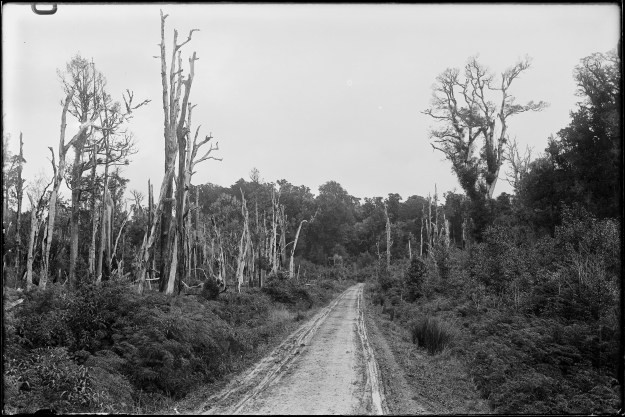
The photograph opposite this poem is an empty, gravel road heading into the bush in Masterton. A scene awaiting the pitch of the axe, the hearty yarn, the doing and the not-doing, and the needed and the not-needed.
 

26854-025950.tif

Photo credit: Forty Mile Bush, Masterton William Williams c1885 (1/1-025950-G)

There is both elegance and economy at work in the poetry; a judicious use of detail that is like the  visual snag of a photograph. Context becomes enlivened. In ‘Wellington,’ the scene is set perfectly in the opening lines: ‘Young men in bowler hats/ spring up like weeds.’ Or this in ‘After the Flood’: ‘Over our heads, debris in the trees.’ In the same poem, a scholarly observation adds historical detail: ‘Geometry gave way to geography. The settlement found its own course.’ In ‘Sarah,’ the detail of living: He writes of ‘his eel and/ spinach pie, cooking/ with gorse,’ while she answers ‘with trees/ blown down, a bee-stung/ tongue.’ The weather, too, refreshes the page with inventive detail (the best weather lines I have seen in ages!): ‘The absence of moonlight/ a kind of weather.’ ‘The river, rinsed of sunlight, is running/ clean along the bank.’ ‘[T]he scraped canvas of the sky/ the sky dropped and put back before/ anyone could notice.’ ‘Rain stings the window,/ rattles the wall.’ ‘The rain snaps at house./ The house recoils as if bitten.’

Detail animates the terrific extended sequence, ‘Settlement.’ The detail accumulates satin lining on upside down spout, grown boys  on the smell of grenadine. This is the portrait of a woman, a wife and mother that moves and astonishes. Always the achingly real detail that ties interior to exterior, man to woman, place to person. Some lines are quick to the bone as you read:


No stepping stones, but

rocks in a river.


A storm of summer insects,

lightning birds.


She says the things that

someone ought to say.


The water’s arguments run

for and against.


The cold is shocking

but she keeps her feet.


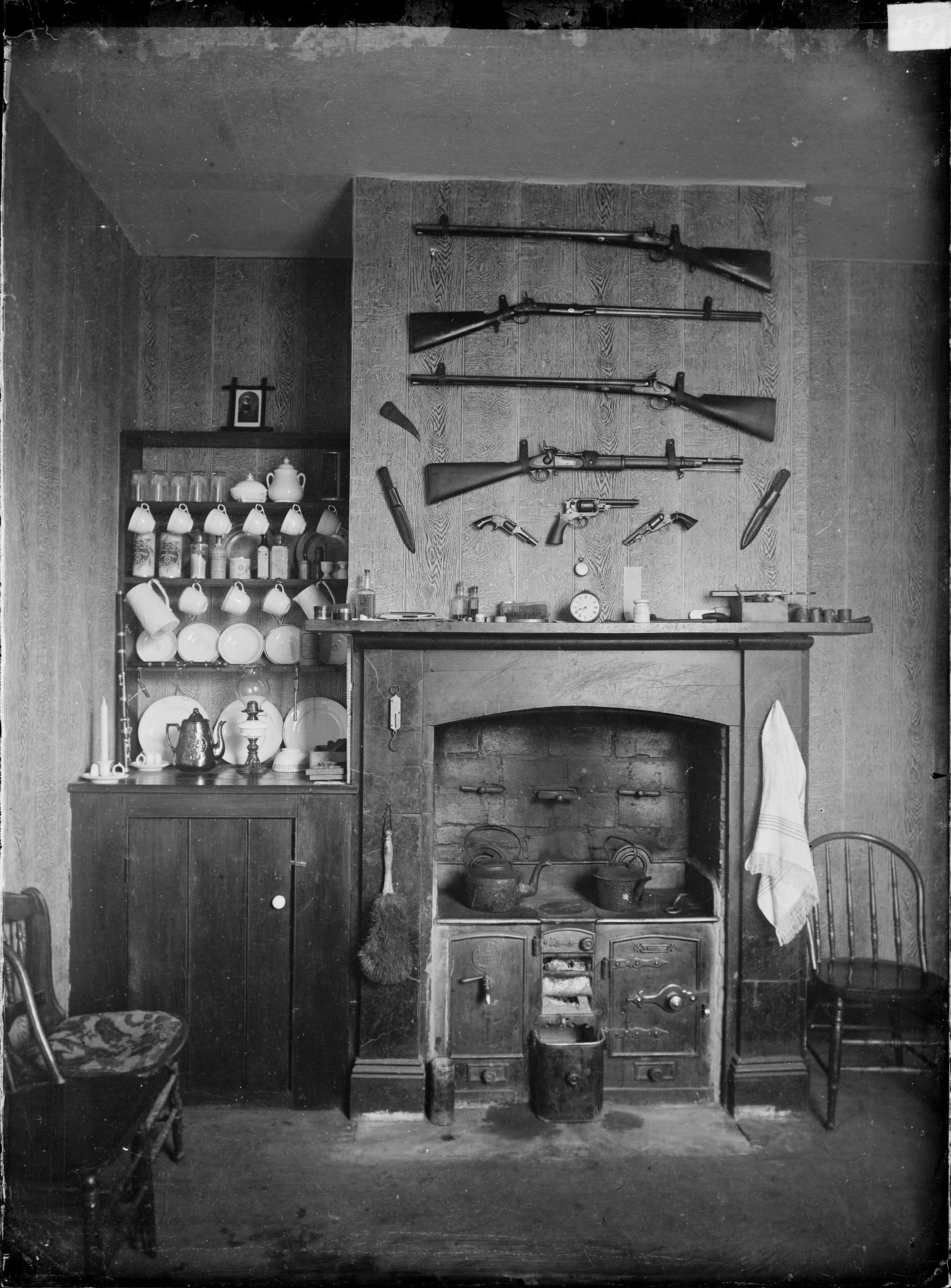
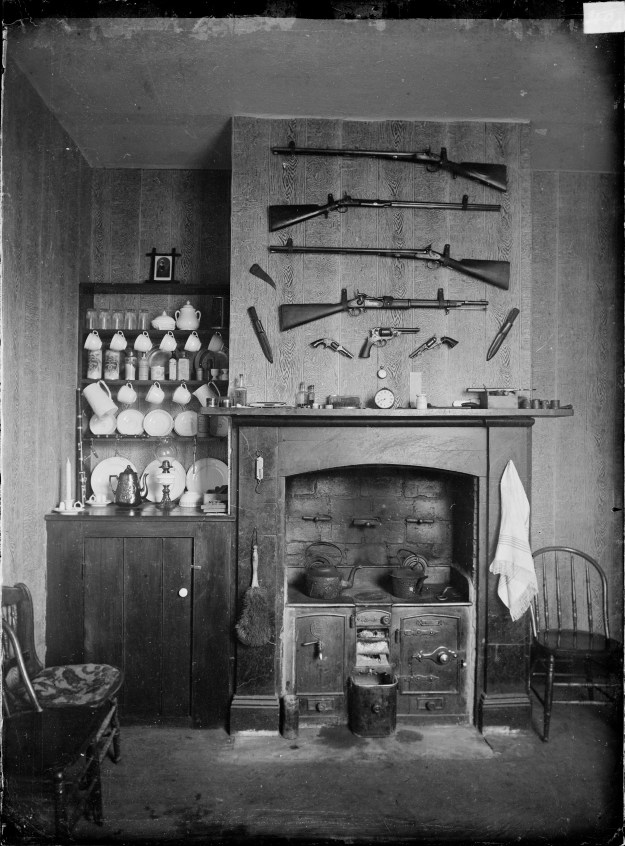
William’s photograph a few pages earlier, with the empty chairs,  the tea cups in the dresser and the guns on the wall, is also a portrait of the woman (a woman). You fall into this photograph and you fall into a thousand household stories. The chores, the time passing, the world outside, order, expectation, internal and external means of survival.
 

26750-140288.tif

Photo credit: House Interior William Willams 1888-? (1/2-140288-G)


As much as I loved the way the poems transport me back within a historical frame, to those men and women bending into the strangeness and toughness of new lives, two things stood out for me in this collection: a sense of humour and a fearless and inventive use of tropes. Many contemporary poets hold tropes at arm’s length as they seek out a plainness of line (although other complexities and delights take hold of the ear). Kerry’s tropes so often fan the visual impact of a poem. Crackling with visual impact. Deliciously fresh. Here are a few of my favourites: ‘The bush grows back/ like a balding man’s hair.’ ‘He sang like an organ making up the fire.’ ‘The breast-stroking sea/ turns at the wall.’ ‘Night surrounds her like mint cake./ She feels its grit in her teeth.’ ‘[H]is consciousness of her/ was like a trunk of empty/ clothes; he was embarrassed/ to be caught holding them/ against himself.’ Glorious.

The humour is another gold vein. Sometimes it is a mere word. In ‘Tom at Board,’ a new word is coined that wickedly catches the sameness of dinner: ‘served up with/ muttononous regularity.’ Or the irony  of the lost pipe: ‘For the others’ sake/ he tried to keep it safe// between his teeth.’ Or the way humour takes root in the familiar in this case of insomnia: ‘the ill-mannered sheep/ have forgotten how to be sociable/ except with rocks and bushes.’  Humour is one way Kerry sidesteps from the photograph. It is way of ensuring her poems are visually and emotionally active.

Yet this collection is not all humour and eye-catching tropes — in this astutely crafted collection there is balance. You fall upon a line here and a line there that shows you the poet viewing the world and our myriad ways of inhabiting it. Now the poet becomes part philosopher: ‘Home is a road/ in a glen.’ ‘We have no seasons,/ only tides.’ The oxymoron: ‘A land of opportunity, a land of/ narrow possibilities.’ ‘The photographer’s wife’s sister/ is a kind of sum.’

I loved too the epigramatic poems. Without titles they act as delightful poetry interludes in the way Bill Manhire’s billowy couplets do. Here a few favourites:


he sings the old songs,

enjoys a couple of good notes


Or:

afterwards he waited as

she sewed his buttons back on


Or:

Three in the morning. Tui,

morepork. No, but. No, but.


Kerry’s debut collection is haunting and complicated. Down to earth and resonant. One line is like an entry point to the whole collection: ‘She had been thinking something other,/ out of the photograph.’ Reading my way out of the poem, is a prismatic experience. Into history yes, but the poems are also a way back into the present. How we live now overlays how we lived then. Still labour. Still love. Still loss. Still hunger. Still narratives. The poems are held against the light. Luminous. With shifting points of view. This wife and that husband. This river bank and that shingled street. This suffering and that loneliness. This bridge and that glass in hand. I am hard pressed to recall a collection quite like it — a whiff of John Newton or David Howard or Jeffrey Paparoa Holman perhaps. Angela Andrews. Chris Price. Marty Smith. This is worth reading.


Auckland University Press page

Kerry Hine’s page

National Radio interview with photographs