Category Archives: NZ poetry event

The Sarah Broom Poetry Award finalists: an interview, some poems

Sarah-prize2.png


This world is only ever

water, rock and black air.

It cannot accommodate us;

we cannot, will not complain

when the water deafens and knocks us.

We shut our eyes

and meet its volleyed blackness.


©Sarah Broom, from ‘Caving,’  in Tigers at Awhitu (Auckland University Press, 2010)


The Sarah Broom Poetry Award supports New Zealand writers through an annual poetry competition. The finalists are invited to read their work at an Auckland Writers Festival event and the winner gets a substantial cash prize. This award matters not only because it offers a financial reprieve for a poet, but because it showcases our poetry. We are an eclectic bunch writing in diverse ways with diverse preoccupations within diverse communities. The award also returns me to Sarah’s poetry; an annual pilgrimage for which I am grateful. Her work continues to resonate on a personal level and along the fertile line, ever revealing, ever fresh and vital. I applaud Michael Gleissner and Sarah Ross for all the hard, behind-the scenes the work they undertake to make this award happen. Thank you.

This year’s judge is Carol Ann Duffy who will also appear at the Auckland Writers Festival.

The finalists: Sandi King, Cliff Fell, Hera Lindsay Bird


The Poems


Where the World Looks In


It’s true that everything’s always moving:

The way a sunbeam glances off the corner of the fridge

Or the shadows turn from violet to indigo.


Or the way your voice will slip a semi-tone

When you’re talking on the phone

And you think someone else is listening.


So I’ll wait for you under the first arch of the bridge

Where the river longs to persist,

To abide beyond its turbulence and flow

And all the other laws that words will not obey.


And I want the words to say

Something else again

Or just to be there when the river is blessed

Like a mirror where the world looks in.


© Cliff Fell


The Way Home


Flamboyant: noun

  1. The condition of being flamboyant
  2. A group of flamingos

http://www.yourdictionary.com/flamboyance


The lush wetland

of my unconscious mind is squawking

in the same way I formed thoughts

before I was old enough to know words.

Just out of sight I hear

wildlife, and the shore

bright with the colours of sunset

discarded in the morning

grass.


I reach through the wire fence

and grasp the legacy left to me,

orange/pink

and fragile. Thousands

of flamingo feathers


which I scoop secretly into a bag

and carry back to the motel

to admire the fluffy whiteness

of the tiniest feathers. I lay

the long ones in a row

to assess

their intensity of pigment,

their readiness for flight.


Sometimes I dream that my body

is wrapped in a bolt of organza.

It’s orange/pink,

a hood-to-ankle garment.

In the mirror, behind my reflection

I can see the Manawatu Estuary

coloured in with my childhood

dreams. I lift primary flight feathers

to the sky, soar

over road and cars and houses

all the way back to Nana and Grandad’s lawn.


In Nana’s flowerbed I find

two ornamental flamingos, pink

so pink. She bends as if to feed

from the shallows, he waits

fondly beside her.

They are translating the garden

into bird

of paradise.


I shelter with these two as long as I can hold

then wade on home, finally

orange/pink,

into the flamboyance of flamingos.


© Sandi King


The Questions


The Sarah Broom Poetry Award is a terrific supporter of New Zealand poets and poetry. Can you name a New Zealand poetry book that has resonated with you in the past few years. What do you love about it?


Sandi: Bill Nelson’s collection Memorandum of Understanding is stuffed with the kind of poetry I love to read. There is variety in the content that sparks my imagination. Some of the poems have an ambiguity, but of a giving nature. If the poem could talk to the reader it might say ‘I have more. Come back tomorrow and read me again.’  His clutch of poems titled ’How to do just about anything’ feature a liberal use of the second person that I enjoy.

Cliff: There are quite a few, but I particularly admired Dinah Hawken’s Ocean and Stone and recently enjoyed reading Hannah Mettner’s Fully Clothed and So Forgetful. But the book that resonated most with me in recent years is Rachel Bush’s Thought Horses, published shortly after she died in March 2016. It’s not only that she lived in Nelson and that I’d read some of the poems as they came into being, but the way the collection finds her – particularly in poems I hadn’t seen before – facing her death with such fortitude, wit and wisdom. Rachel has always had this wonderfully elastic syntax, and a giddy playfulness to the way she can shift focus in a poem. All of that is heightened in this collection. It’s a book that’s marvellously re-readable. I discover little gems I hadn’t noticed before, nuances and images, every time I enter its lost domain, its domain of loss.

Hera: I try not to talk about why I like certain books because I always end up lying by accident, but I always like reading Geoff Cochrane. Can everyone just take my word for it? It’s better this way.


What are some of the strengths or weaknesses of New Zealand poetry and its communities?


Sandi: I have found a lot of generosity. Writing groups meet together to nuture each other, and develop their work into the best it can be. We have organisers like Bill Sutton who organise events where poets can come together and hear each other. We have poetry competitions which offer hope to everyone who enters. There are still opportunities to be published thanks to the commitment of small publishers, plus a variety of journals and websites, and there are excellent educational opportunities available. New Zealand has talented mentors too – I have been extremely fortunate to be mentored by Renée.

Cliff: There’s so much going on in New Zealand poetry, you would have to be very dedicated to keep up with it all. Its strengths are its poets, of course. They’re probably its weaknesses, too. But I’d imagine that New Zealand poetry is generally thriving, gaining greater recognition overseas. Cheers to all responsible for that! As for its communities, apart from the point that individuals can create their own community, their following, these days, I’ve had a notion for a while that in the arts, in poetry in particular, in its real nose-to-the-grindstone communities, New Zealand resembles the city-states of late medieval, Renaissance Italy, with their arts flowering in different styles. There are similar alliances and rivalries and moments of cross-pollination, as there were then, and distinct local sounds or voices or concerns are beginning to develop, the way the Dunedin sound developed in music. The rivalries in poetry have been going on for generations, as we all know. All of this is, obviously, down to our demographics – relatively small population – and our geography, our topography, in that it means journeying between centres is bound to be epic, on some level. Who would the Papal State be in such an analogy? CNZ, I suppose, with the patronage it confers. Of course, this is a notion – and in some ways a ridiculous one – that I would favour, indulge in, due to my interests. Also, I’m an outsider, so that probably colours the way I see things. But I think there’s a kernel of truth to it. We may not exactly have to learn the taste of other people’s bread, but it’s not a bad trope for how things are.


Hera:


con: poor overall fighting technique, weak in physical combat department

pro: lots of wine

con: nobody to talk to at parties about Survivor

pro: except Louise Wallace and Holly Hunter

con: small population size leading to difficulty maintaining rigorous critical culture, ancient confusing unexplained feuds going back decades, lack of money, too many poems about mountains, easily hurt feelings

pro: if people hate you they have the decency to do it in private, to their friends and loved ones

con: James K Baxter

pro: oh relax, I’m only joking


Do you see your shortlisted collection as a surprising departure from your previous poetry, a continuation and deepening engagement with your poetic concerns, or something altogether different?


Sandi: To be honest, I was excited by the opportunity to have my work read by Carol Ann Duffy and looked through everything I have written for poems I thought she might like to read.

Cliff: More a continuation probably, though I’m not sure – and either way, hopefully some kind of a deepening engagement. To be honest I was amazed that my entry came together at all, as I hadn’t really been writing for a while. I wrote two new poems on the deadline day and heavily revised four others. When I looked at the collection again, on learning that I’d been shortlisted, one thing that did surprise me was to discover that three of the poems were ekphrastic in nature. How that came about, I really don’t know.

Hera: Some are following on from my first book, others are a little looser. I’m trying as hard as possible not to think about it while I write. The phrase poetic concerns is such a great one. It always makes me think of Byron having trouble with his swans.


I am putting you on the spot here, but if you were reviewing your collection, what three words would characterise its allure?  


Sandi: Sensual, adventurous, satisfying

Cliff: Yes, horribly on the spot, as I would hate to review my own collection. It would be a public self-mauling that no one would want to witness. Flawed. Flibbertigibbet. Fatal. Will they do? Oh, and Astronomy. That’s four words, but there are plenty of stones and stars, and also caves, in my poems. Too many probably.

Hera: Silly, unsettling, imagistic


When you write a poem, what talismans or cornerstones or spark plugs or jump leads or release pads do you favour? I am thinking, for example, of the way some poets are drawn to musicality, storytelling or the element of surprise.


Sandi: Many of my poems are portrait poems or persona poems. The beginning of a poem can sometimes be the sound of the character’s voice, and trying to thread that into the poem

so that maybe the reader can imagine the character speak when she reads the poem. Often a segment of story develops from the portrait as I write. Otherwise a poem will begin from a little stub – something I have seen, heard or felt. When I discover a stub, I write it down. Months later, I’ll look at that stub again, and sometimes it will be the start of a poem. It’s like taking cuttings from people’s gardens – you achieve variety without having to try too hard for it.


Cliff: Yes, I certainly believe in talismans and little rituals. I once knew a builder in Scotland who wouldn’t go up on a roof without a kilt pin in his trouser pocket. It’s easy enough to understand why, when you think about it. In my case, well, first up I consume a quantity of petrol. That’s for the spark plugs. Then I get into some kind of trance-like fire-eating routine, blowing flames around the room, hoping the poem and all my electric guitars will spontaneously combust. Or I imagine I’m being carried in a coffin into what has been billed on the invitation as an ‘outrageous’ party. This is in fact a gate-crasher’s ploy, as the hosts have notably declined to invite me. I only learned about this exclusive mother of all parties when I saw an invitation a so-called friend taunted me with. So when the night-watchmen I’ve hired as coffin-bearers carry me through the door, we thump into the hubbub, noise of glasses being smashed, voices, music, people banging on the lid and so on. I think they must have set me down in the middle of the dance floor, because when I emerge, naked as the day I was born, there she is, Topsie-Terpsichore, spinning and pirouetting and doing the scorpion in my arms. And we dance all night. Maybe it’s West Coast swing, on the track to begin with, but then it gets crazy, circle dancing around the coffin, big bass lines pumping out of the PA and deep into your rib-cage, and a frenzy of many arms and legs. Later, there will be sweaty, abandoned sex on the grassy shores of a lake. Moonlight and embarrassment, of course.  A boat, though perhaps it’s just the coffin floating away. I seem to remember there was a high wire-mesh fence we had to clamber over. Stuff like that. It all helps.


Hera: Everything at once. I like poetry pushed to its stylistic limits. For instance, take a poem about a swan in the moonlight. That might be a good poem. But what if…… instead of one swan you had a thousand swans? And what if instead of moonlight……the moon had never existed & instead there was a giant neon exit sign, hanging in the sky? I’m just being indirect because I don’t want to write a manifesto too early. I think one of the tasks of poetry is to teach yourself to write as many different ways as possible, and then to trick yourself into never thinking about them in the moment. Like mixed martial arts, if people used mixed martial arts to express their feelings about autumn.


The Finalists


Hera Lindsay Bird is a poet from Wellington. Her debut self-titled collection Hera Lindsay Bird was published in 2016 with Victoria University Press; it has been reprinted many times, and is currently on the shortlist for the Ockham New Zealand Book Awards. She has an MA in poetry from the International Institute of Modern Letters where she won the 2011 Adam Prize in Creative Writing. She works as a bookseller at Unity Books Wellington.

Bird’s work has been featured in The Guardian and Vice Magazine. She has been published in a number of journals and publications including Best New Zealand Poems, The Spinoff, The Listener, The Hairpin, Hue & Cry and Sport. In 2016 she ran a free, ten-week creative nonfiction class called TMI. She likes watching the figure skating at the winter Olympics and murder mysteries set on trains.


Cliff Fell is the author of three books of poems, The Good Husbandwoman’s Alphabet (illustrated by Fiona Johnstone, Last Leaf Press, 2014), Beauty of the Badlands (Victoria University Press, 2008) and The Adulterer’s Bible (Victoria University Press, 2003). The Adulterer’s Bible was awarded the 2002 Adam Prize in Creative Writing and the 2004 Jessie Mackay Prize for Best First Book of Poetry. Other poems have appeared in the online anthology Best New Zealand Poems and in various New Zealand and overseas publications. He has been a regular contributor to the RNZ National Nights programme, talking about poetry.

Born in London to an English mother and New Zealand father, he has lived in New Zealand since 1997 and worked, sometimes very briefly – and tenuously – as a roadie, musician, bank clerk, bar-tender and also in farming, forestry, and film-making. He studied History and Archaeology at Exeter University, received an MA in Creative Writing from Victoria University and currently lives in the Motueka river catchment. He is a tutor of creative writing in the Arts programme at Nelson Marlborough Institute of Technology.


Sandi King (previously known as Sandi Sartorelli) is a New Zealander of English, Irish, Danish and Moravian descent. She currently lives in the Hutt Valley with her youngest son Guy. She has a degree in Creative Writing from Whitireia New Zealand. Her work has been published in a number of journals and websites including 4th Floor, Blackmail Press, JAAM, Renée’s Wednesday Busk, Snorkel and takahē.

In 2013 three of King’s poems were highly commended in the Caselberg Trust Prize, the New Zealand Poetry Society Competition and takahē Poetry Competition. In 2015 her poem ‘Timing’ took first place in the Upper Hutt Poetry Competition. The most recent publication to include her work is the book Poetical Bridges/Poduri Lirice (2017), a collection of New Zealand poetry translated into Romanian, and Romanian poetry translated into English, created by Valentina Teclici.


Hera Lindsay Bird, Cliff Fell, and Sandi King will read poems from their submissions at the Sarah Broom Poetry Prize event at the Auckland Writers Festival on Sunday 21 May 4.30-5.30pm.

This is a free event. Guest judge Carol Ann Duffy will introduce the finalists and announce the winner of this year’s prize.


The Poet Laureates are heading to Dunedin in May – from my experience it’s unmissable


poet-laureates-010_1_orig.jpg


I got to see the Wellington Writers and Readers Festival version of A Circle of Laureates – and it was a rare and special occasion. I just loved it to bits, as did everyone in the packed-out room. I can’t recommend it highly enough.  My post on the event.


At the Dunedin Writers Festival in May:

A rare treat: nine of the ten New Zealand Poet Laureates will gather to read their work, with Rob Tuwhare joining them to represent his late father, Hone Tuwhare. Twenty years ago, John Buck of Te Mata Estate Winery created the Te Mata Estate Laureate Award; in 2007 the government took over funding of a Poet Laureate and vested responsibility for the Award with the National Library. This session of New Zealand’s poetry elite features Bill Manhire, Elizabeth Smither, Brian Turner, Jenny Bornholdt, Rob Tuwhare for Hone Tuwhare, Michele Leggott, Cilla McQueen, Ian Wedde, Vincent O’Sullivan and current Laureate C.K. Stead. Fergus Barrowman (Publisher, Victoria University Press) will MC the event.
Tickets can be booked here.
In association with the National Library of New Zealand Te Puna Mātauranga o Aotearoa. 

Bravo! Poetry at the Auckland Writers Festival is an eclectic mix

can_you_tolerate_this__31811-1464841060-220-220

You will also get a chance to hear  Ashleigh Young with her fabulous essays!

AWF programme here.


Lots of these events are free entry so get there early if you want a seat. Such an innovative inclusion of poets and clear demonstration that NZ poetry is in very good shape. So many excellent books out in the past year  and only so much room to showcase them here. That surely is testimony to the dedication of local publishers and local poets. Sure there are voices I am sad not to be hearing – but this is a poetry feast! Congratulations Anne O’Brien and team.


Tuesday 16th May, 7 until 8.30pm Go see who wind the poetry section of the Ockham NZ Book Awards

Friday 19th, 2.30pm. Catch Courtney Sina Meredith in Pacific Tales.

Friday 19th, 4pm. Poets Hera Lindsay Bird and Anne Kennedy joined three other writers at Auckland War Memorial Museum to seek inspiration for a piece of writing. Hear what they came up with.

Friday 19th, 5pm. Hear the book-award winners.

Hear Carol Ann Duffy with John Sampson on 19th at 6pm or do the World’s Wife on Saturday 20th 7pm until 9.30pm.


Friday 19th 6.30 until 8pm. Walk on High looks like a poetry smorgasbord:

Walk on High is an intimate meandering journey, featuring a sampler of Festival talent on a word trail along High Street in the CBD. From 6.30pm to 8pm choose from four fifteen-minute events, repeated four times across the ninety minutes, individually crafted and each as delectable as the next. Formats take in games, Insta-essays, music, spoken word and theatre. Over 20 writers and performers take part, including: Jess Holly Bates, Anthony Byrt, Teju Cole, Glenn Colquhoun, Jonothan Cullinane, Mei-Lin Hansen, Ali Ikram, Simone Kaho, Sarah Laing, Last Tapes Theatre Company, Michelle Leggott, Lana Lopesi, Selina Tusitala Marsh, Doug Poole, Randa, Rosabel Tan, Apirana Taylor, Tourettes, Steven Toussaint, Ian Wedde, Rewa Worley and Sonja Yelich. A full schedule and event descriptions will be posted to our website early April so check it out and start planning your Walk on High: writersfestival.co.nz/walk-on-high


Check out the Old Guard New Guard with Bill Manhire and Hera Lindsay Bird 4.30 Saturday 2oth.


There is an electric group on offer at the Spoken Word Showcase Saturday 21st 7.30 until 9.30pm:

Five of the brightest spoken word artists take to the stage in an unprecedented showcase of talent from Tamaki Makaurau, including Marina Alefosio (Rising Voices, South Auckland Poets Collective), Mohamed Hassan (New Zealand Poetry Slam and Revival Sessions), Tim Heath (Poetry Idol finalist), Jennifer Rockwell (Word the Front Line) and Rewa Worley (Rising Voices). Former Poetry Idol winner and judge Zane Scarborough hosts an evening of signature pieces, improv, and a little crowd participation with international guests Paul Beatty (The Sellout), Ivan Coyote (Tomboy Survival Guide) and Rupi Kaur (Milk and Honey) punctuating the evening with performances. A special night not to be missed.


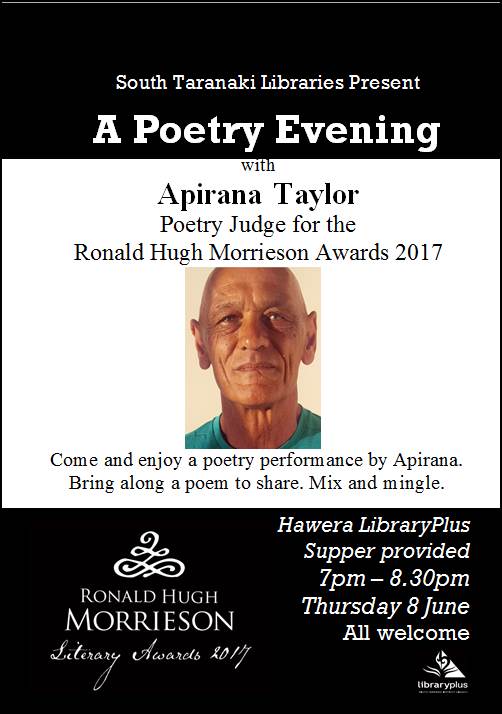
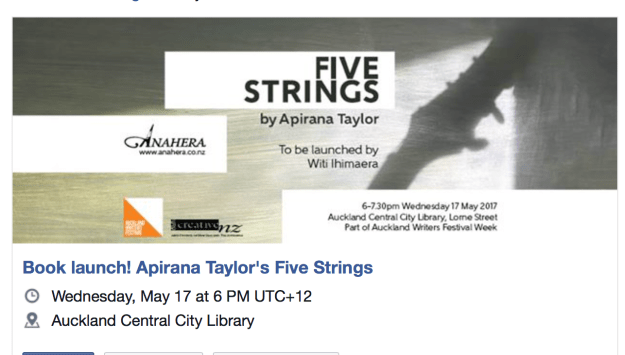
You can hear Apirana Taylor on Sunday 21st at noon.

Bill Manhire joins in Questions of Time (with the fabulous Frances Hardinge). Sunday 21st 10.30.


Ian Wedde is in Family Dynamics with his new Selected Poems. Sunday 21st at noon.

Simone Kaho and Rupui Kaur are in Those Were the Days. Sunday 21st at 3pm.


Check out the winner of the Sarah Broome Poetry Award on Sunday 21st at 4.30pm.


Fiona Kidman is the 2017 Honoured New Zealand  Writer. Sunday 21st 6pm until 7pm.


Ian Wedde is launching his Selected Poems  on Friday 19th 3.30pm until 5pm.

Plus Ian Wedde is doing this intriguing workshop you can be part of:

The poetic Bob Dylan won the 2016 Nobel Prize in Literature, and rap, poetry slams, and online publications have expanded the definitions of and audiences for poetry. In some countries – in Palestine, for example, with Mahmoud Darwish – the form has long been a vital aspect of public discourse. Bring your work to this session with Ian Wedde, for a practical investigation of the porous borders of poetry.

Limited to a maximum of 40 participants.


Finally you can see Pop Poetry in the Square each evening:

Festival week sees a corner of Aotea Square come alive each night with text projections. Every evening a
combination of curated and live writing will emanate from the mysterious Pop Poetry hut, inspired by the theme ‘Love Letters’.

A sparkling collection of intrepid writers join the fun, with one a night writing live but anonymously and only revealing themselves as they sign off… expect poems, letters, lyrics and other treats.
Pop is an annual series of public art projects made for and by Aucklanders, supported by Auckland Council and the Waitemata- Local Board. Its mission is to create unexpected experiences in Auckland’s neighbourhoods; creating surprise, making fun and forming communities. Pop Poetry is in its second year of activating urban sites around the city though large-format, typographic projections by night. Pop Poetry is designed by Alt Group.

Pop Poetry will take place each evening from 6:00pm – 9:00pm, from Tuesday 16 May until Sunday May 21.


White Night event at the Pah Homestead: a collaborative art project with Simone Kaho and Ria Masae

WHITE NIGHT at the Pah Homestead: ASSEMBLY

March 18 @ 6:00 pm9:00 pm

Assembly: Collections and Crafts at the Pah Homestead

Assembly is a White Night celebration like never before. Bringing together collections, treasures, beats, words and craft, this is a gathering of all things creative.


Throughout the evening visitors are invited to BRING | MAKE | TAKE as part of our collaborative artwork project and make connections with other local White Night venues.


Download a copy of our Neighborhood Map here


If you have an interesting item you always wanted to know more about, join expert Yvonne Sanders for our very own Antiques Roadshow.  Pre-register your prized possession and bring it on the night for a short valuation and discussion by Yvonne.

Simply send a short description and a photo to enquiries@wallaceartstrust.org.nz

We will also be joined by local fibre artists from the Handweavers and Spinners Guild, also members of the Auckland branch of Creative Fibre, who will demonstrate their skills in felting and weaving.

Artist Collective Tiger Murdoch (Kelly Pretty and Matt Dowman) will be creating a unique installation in the front entrance to the Arts Centre throughout the evening.

To complete the Assembly of local creative talent at the Pah, Simone Kaho and Ria Masae will craft beats and words into lyrical magic in a live poetry performance.


There will also be a free shuttle linking the Pah Homestead with Greenwoods Corner – hop on any time between 6pm and 9pm and see what else is happening on and around Pah Road.  Shuttle leaves from the Korma Road entrance to Monte Cecilia Park, there will be guides showing the way from Pah Homestead.


Please join us in celebrating the Auckland-wide White Night with our family-friendly evening of MAKING & CREATING at the Pah Homestead!


About our Collaborators

Yvonne Sanders Antiques is a landmark destination shop located in Epsom, Auckland.  As an International Dealer, Yvonne herself has successfully traded for over 40 years having established the business in 1971.

Creative Fibre is the New Zealand organisation for all fibre crafts. It brings together spinners, weavers, knitters, dyers, flax workers, felters, crocheters, free form fibre artists and all other people involved in the use of fibre. We have over 3000 members throughout New Zealand and around the world who share a passion for fibre.

Whitecliffe lecturers Kelly Pretty and Matt Dowman are working together as artists and grass roots activists, posing confronting questions about social welfare, gentrification, political turmoil and global injustice to the public.  Together they form the collective ‘Tiger Murdoch’ referring to the surname of media mogul Rupert Murdoch, and ‘tiger’ referring to an action or cartoon character name.

Simone Kaho joined the Literatti in 2011 as a scholarship-winning graduate of the International Institute of Modern Letters in Wellington, who count Eleanor Catton and Hera Lindsay Bird among their Alumni.  Noted for her lyricism and powerful stage presence, she’s now a performer in demand – at bars like The Thirsty Dog and theatres like Galatos, The Basement and The Mercury.

In 2015, Ria Masae won the ‘New Voices: Emerging Poets Competition’, as well as the ‘2016 Cooney Insurance Short Story Competition’. Also in 2015, Ria was thrilled to see a collection of her text come to life in a brilliant performance called, ‘MAKAI – Black Sand: Ocean Bones’. She was honoured to have her poetry translated into Spanish on the online Mexican literary website, Círculo de Poesía. Her work has been shared in several New Zealand and Australian publications including, Landfall, Blackmail Press, Snorkel, Ika, and Otoliths. Ria is a proud member of the South Auckland Poets Collective (SAPC).


Details

Date:
March 18
Time:
6:00 pm – 9:00 pm
Event Category:

Venue

The Pah Homestead, TSB Bank Wallace Arts Centre
72 Hillsborough Road, Hillsborough
Auckland, 1042 New Zealand
+ Google Map
Phone:
09 639 2010

Poetry Shelf interviews Hannah Mettner: ‘I want to be emotionally moved by a poem, and nothing less’


FullSizeRender.jpg


We believe in the steps.

We tell our children and then our

grandchildren about the cool

pond at the top where sun-

carp clean our feet and where

we can sleep. The steps are one of

the beautiful mysteries of

life, like how did we get here,

fully clothed and so forgetful?


from ‘Higher ground’


Hannah Mettner is a Wellington-based poet from Gisborne. Her poems have appeared widely in literary journals, including Sport, Turbine and Cordite. She is co-editor with Morgan Bach and Sugar Magnolia Wilson of Sweet Mammalian, an online poetry journal launched in 2014.

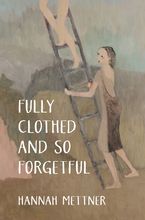
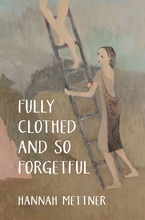
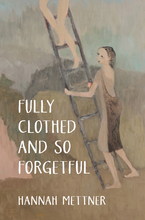
I first heard Hannah read at the Ruapehu Writers Festival last year and I was immediately hooked. To celebrate the arrival of her debut poetry collection,  Fully clothed and so forgetful (Victoria University Press), Hannah agreed to do this interview. As you will see from my comments in the interview, this collection has struck a chord with me on a number of levels. I absolutely adore it.


The book is launched tonight: 16 March 2017 from 6.00 pm – 7.30 pm

The Guest Room, Southern Cross, 39 Abel Smith St, Wellington


PG: You include two quotations at the start of the book—one by Eileen Myles and one by Adrienne Rich—that underline your status as reader, while the book itself is infused with your reading life.  Can you name three non-poetry books that have sparked you any time from zero until now? And three poetry books, from any point in your reading timeline, that have also affected you?

HM: Ah yes, I mean, it wasn’t meant as any kind of political statement, choosing two gay poets to front the book, although it definitely can be, I just love their writing, and those particular poems. And then those parts of those poems stuck out as handy things to highlight at the outset of the book. As to my reading, well, I’ve always liked reading, and I wonder if it’s partly a control thing: I find people quite hard work, they’re so fascinating and unpredictable and needy, with a book you can just shut it when you get to satiety, and come back to it when you’re ready. Then I studied English Lit at uni, and I work at the Turnbull Library now, so books are very thoroughly part of my comfort zone, and I get a bit panicked if I don’t have one nearby, to serve as a social safety blanket. I remember being completely transported by a Margaret Mahy book The Door in the Air and Other Stories, as a young person. Strange little vignettes into other possible lives: very like one of the stories in that book about a girl who meets a wizard with a house full of different windows depicting different worlds. Obviously all of Mahy’s books are fantastic, and that magical realism has definitely been a thing that has kept my interest over the years, both as a reader and a writer, she’s so good at combining the very mundane with the extraordinary. Another book I’ve come back to again and again (a big deal when you’re a bit blind and reading is a pleasure/pain situation like it is for me) is Jeanette Winterson’s Written on the Body, which is scorchingly personal and profound. Those two books are really my sun and moon, there are heaps of other books I’ve read and loved, but nothing quite like those. Poetry books are perhaps too numerable to mention? Though I distinctly remember that James Brown’s first book Go Round Power Please was the book that got me reading and eventually writing poetry. I checked it out from the public library in Gisborne not long after having my first baby, and discovered that poetry was a great way to ‘get more bang from my buck’ when I was too tired and busy to make much headway with novels. Those poems are so humble and personable, and so varied, so I could read a couple, then turn them over in my head until I could get to the next couple (which is a great way to read poetry in my opinion).


Fully_Clothed_and_So_Forgetful__32303.1486956777.220.220.jpg   Fully_Clothed_and_So_Forgetful__32303.1486956777.220.220.jpg   Fully_Clothed_and_So_Forgetful__32303.1486956777.220.220.jpg


PG: Your debut collection, Fully Clothed and So Forgetful, gave me goose bumps as I read and took me beyond words to that state where you stand somewhere wild and beautiful and just stall beyond language to absorb the world. My initial reaction is simply to tell the reader to read your book. But then I start accumulating a list of what I think your poetry is doing: the poems are inventive, unpredictable, melodic, on the move, strange, love-soaked. What key things matter when you write a poem?

HM: Thank you! That is a lovely thing to have someone say about my writing, and quite strange because these poems have become so familiar to me now that I’ve almost become disenchanted by them: you know, the feeling of old outfits you’ve worn too many times and are giving way at the knees or something. The key thing that matters to me in a poem (whether one I’m writing or reading) is that it gets me in the gut. I get very frustrated by poetry that feels empty, or emotionally disengaged or distant, or is teasing the reader or holding them at arm’s length. I just find it boring, I mean, I know that different poems and poets have all sorts of intellectual fare to offer, but I want to be emotionally moved by a poem, and nothing less.


PG: I feel the same way. Your book generated strong emotional engagement for me, which is why it mattered so much. I am particularly excited by the way you create poetic movement. Is this something organic and unconscious or deliberate and cultivated?

HM: I guess it must be unconscious, because it’s not something I’ve gone in thinking about or worked at. Maybe it’s because I’m a chronic fidgeter? Or maybe because lots of my poems come to me when I’m walking. Or maybe it’s because I have a terrible attention span?


PG: The first poem, ‘Higher ground,’ is memorable, resonant and fablesque. I fill to the brim with it and don’t want to undercut the way I absorb its magical effects—the poetic side lanes and underpasses and overbridges—by explaining what I think it is doing. But I would say, as a tiny hinge into the poem, it reminds me how we can so easily become immune to what we see and hear. How do you feel about talking about the poetry you write?

HM: Ah yes, well this poem is an example of one that came to me while walking! In Wellington, as you know, there are lots of hills, and my old house was up one of them, and then up ninety steps. This made walking home from school with my kids kind of a drag, and so this poem, with its promise of glories to come, is really just an exaggeration of the daily bribery of walking home from school up what is basically a mountain. We totally become immune to life, it’s kind of tragic eh? One of the things that was promised to me when I had kids was that “they’d make me see the world with fresh eyes” and more parental romanticisations like that, and I really don’t know if that’s been true or not. But I do spend a lot of time trying to look at things like that anyway. I used to think I was going to be an artist, so maybe it comes from that? Experiencing the world, then deconstructing it in order to be able to reconstruct it on the page?


PG: I loved the oblique appearance of Gertrude Stein and her Tender Buttons in your ‘Gender buttons.’ While your poetry does not replicate the anarchic and playful syntax of a Stein poem, your phrasing is deliciously agile and surprising (‘I wake to you nuzzling into my bed/
complaining of the quick-sand carpet in the hallway’). Do you feel Stein influenced your language in any way or your inventive links between object-self-word-love?

HM: Well actually I’m not a huge Stein fan, I find her poetry difficult to engage with, and I suspect she was kind of a horrible person. In fact, this poem came about because I told the person I was in love with at the time that I thought she looked like Stein (who she also hated), and then I felt so bad that I wrote a love poem by way of apology. But I am interested in Stein’s idea of ‘Cubist writing’, which I guess in my poems isn’t even close to the exaggerated effect she achieves, but I like the idea of multiple things going on, multiple ways to access a work, multiple planes of understanding, gaps in meaning which the mind auto-fills. And I like the idea of language constructing a world, rather than merely referencing it, you know, then I can say each of my lil poems is its own world, like one of the windows in the wizard’s house. I would love it if that’s how they were read, like objects to be picked up and transported by, either a snow-globe or a portkey.


PG: Another reason the collection affected me so much is that is deeply yet originally personal. I felt like making a caption to go over my desk: poetry is personal. Your poems demonstrate that you can dig deep into personal experience and self-scrutiny in ways that are inventive and quiet. There are some big things faced: a teenage pregnancy and not meeting expectations to marry a man.  So many of the poems, with strong personal origins, are effervescent with possibilities. I am thinking of ‘In the Forest of the night,’ inspired by William Blake’s ‘The Tyger,’ but hovers like a miniature, fully-formed autobiography (the fearful child, the maternal embrace, the maternal anxiety, the supressed feelings, the broken relationship). Did you have lines you would not cross in order to protect those close to you?

HM: Well yes, poetry is personal. Very personal. I do hope no one reads these and recognises (a part of) themself, and is upset. The relationship poems are unnamed for this exact reason, but the family ones are probably more problematic. Funnily enough the ones about my parents are pretty tidily summed up by saying they’re about miscommunication (or lack of communication), and I hope they’re grown-up enough to understand that everyone sees things differently, and that this is my version of events, so to speak. The kid-ones are the most worrying, as I don’t want them to be like some shameful or burdensome photo brought out at a 21st party. But there aren’t many of them, and I’ve tested them out on Lucia and Jethro, who seem ok with them. We talked about this a lot in Hera’s TMI course last year: what is too personal, what sorts of things make you a ‘bad person’ for disclosing about someone else in a poem, etc etc. I try to think ‘how would I feel if someone said this about me?’ and bear that in mind, and there are lots of excruciatingly personal disclosures about myself in here, so maybe that balances it out? But also, that responsibility can be a bit crippling and sometimes you think ‘well fuck it’ and just write.


PG: I love the way you place a personal revelation within intriguing and inventive contexts and layer it like an artichoke so that is exquisitely simple yet flavoursome on the tongue. I am thinking of ‘Trip with Mum,’ where you go to Disneyland and take rides with your aging mother—real or imagined—and have difficult conversations until you spin away from probing questions to a far-off planet: ‘I’d try shouting things like, What do you know about pain?! and I’m afraid! and finally, I love you! as I grew smaller and smaller and she grew older and older and everything just kept spinning.’ Is the autobiographical thread a significant part of how you write?

HM: Well I guess so, erm. I don’t know if that’s just narcissistic and unimaginative or what, but I guess I just don’t want to speak for anyone else, or tread on any toes, and other people are better qualified than me to tell their own stories. But also it’s a by-product of the way I think and experience the world: by relating information and experience directly to my personal history and developing self. I remember our MA class having a near-fight early in the year when Chris presented us with a reading which basically posited that people assume poetry is autobiographical, and that the narrator is the writer. We, mostly, railed against this on principle, wanting perhaps to protect our right to mystery, but I think we all secretly knew that the ‘I’ is the I. I’ve been emboldened by the opening poem in Hera’s book, which gives the reader permission to read it as a book about her (and the title), and Greg’s book which is openly autobiographical while looking outward at people and events to hang his history on in the complicated and beautiful way that true life does.


PG: Are you after some kind of autobiographical truth when you write, however elusive that might be? I am wondering if this is why the book has so intricately hooked me.

HM: Autobiographical truth? I guess so, in the sense that I’m prone to self-reflection. I’m quite a socially anxious person, and a major introvert, and one of those people who analyse social interactions excessively as they’re happening and potentially going on for days afterward just in the normal course of things. Looking at your actions in the world so closely is perhaps not healthy, but it is interesting, especially the way different people work in given situations and relations.


PG: Feminism is such a complicated, multifaceted, highly contested set of ideas and practices. It always has been and is especially so today. I think your collection is in debt to a feminist engagement with the world that is mobile and probing. Do you think it makes a difference to your poetry that you are a woman? Does feminism matter?

HM: Of course I’m a feminist, though I tend to think in essence feminism is very simple, actually, which is not to say women and womanhood aren’t complicated and gloriously multi-faceted, or that femininity as an identity within feminism (particular for lesbian, bi and trans women) isn’t highly contested. And yes, for sure feminism matters, and I think it needs to keep on mattering, more loudly and insistently than it has to date, for quite a while yet. I think it’s (perhaps too) clear that it matters to my writing that I’m a woman, it matters that I’m a feminist women, that I’m a mother, that I’m a teenage pregnancy statistic, that I’m bisexual, that I grew up in a working-class Christian family etc etc. Those large facts, plus all the more messy detail of just living—that’s my subject matter. I think every writer’s personal history matters to them in their writing to some extent, whether as information or bias, but not all writers are keen to share that information, or maybe they don’t think it’s interesting enough? But the feminist in me wants it to be enough! I want women to write their stories and for them to be enough! I get the sense that it’s sometimes considered not tasteful to be a bit political in poetry, that poetry should be a respite from the real world, but I want to read more poetry about the intricacies of other people’s lives.


PG: Are you a solitude poet (you keep poems to yourself) or a community poet (you exchange poems with friends for feedback)? Have you had any poetry mentors?

HM: I’m definitely not a solitary poet! If I was, I don’t think I’d get anything done. I’ve been lucky enough to be part of multiple communities of writers at different times: first my Masters class, then “poetry club” as we fondly call it, and Hera’s TMI school last year. All of those places have been so wonderful for being peopled with other humans who want to think and read and write, and I’m so grateful and in love with and in awe of all those humans! My longest-standing ‘community’ are definitely Sugar Magnolia Wilson and Morgan Bach, who are also my co-editors for Sweet Mammalian. Magnolia’s poems are like crystals, each with special powers, which you can pick up and feel humming through your skin, and which leave you altered and fumbling about on the astral plane. Morgan has this incredible gift for knitting centuries’ worth of narrative weight and detail into small and exacting visions which seep into your subconscious and trick you into thinking they’re your own memories. Those two, phoar, I’m so goddamn lucky to know them, to read their things when they’re vulnerable and new, and to have them do the same for me!


I’ve never had an official ‘mentor’, but do you think Anna would be too embarrassed if I claimed her? I think a significant portion of young writers in New Zealand, particularly women, wouldn’t be writing the way that they are if it wasn’t for her. Her writing is so smart, with such a dry sense of humour and openness to silliness too, such a unique voice, such clever observations, but they’re also unashamedly ‘womanly’ poems: they’re about friends and family, they’re domestic and comfortable and they still give you such feels. SO good!


Sometimes in your sleep I hear you roar

and it echoes in the back of my jaw, child,

in the forest of the night.


from ‘In the forest of the night’


Victoria University Press page

Radio NZ  National: Harry Ricketts reviews the book with Kathryn Ryan