
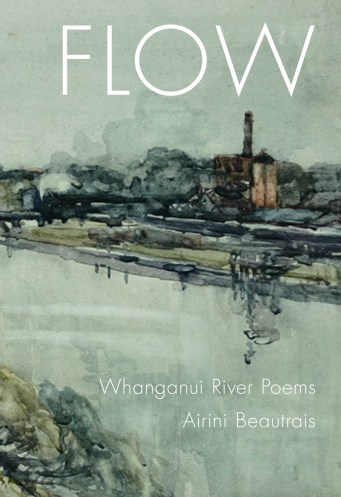
Flow: Whanganui River Poems, Airini Beautrais, Victoria University Press, 2017
Airini grew up in Auckland and Whanganui, studied both ecological science and creative writing at Victoria University and has worked as a science teacher. Her debut collection, Secret Heart, won Best First Book of Poetry at the Montana New Zealand Book Awards in 2007. She has also published North Western Line and Dear Neil Roberts.
To celebrate the arrival of Airini’s fourth poetry collection, we embarked on an email conversation over the course of a week.
Paula: After reading the first few pages of your new collection, Flow: Whanganui River Poems, I felt the kind of spark that travels like electricity through your body as you read: heart, mind, ear, eye, everything on alert. When I was doing my Masters in Italian I read the fragmented fiction of Gianni Gelati. His writing was poetic, strange, addictive. With Narratori delle pianure (Storytellers of the plains), he travelled the length of the River Po, collecting stories from people who lived there. His people, his river, yet while the river dictated the itinerary, it was less of a protagonist. Instead the people he met flourished on the page in their out-of-the-ordinary ordinariness.
I had the idea at page 24 of Flow to have an email conversation with you as I read. I wondered how my relations with the poems might change over the course of reading; the reading would act as my surrogate river with its various currents and tributaries. I wondered how I would shift in view of the poetics, the ideas, stories, characters and the river itself. The book fills me with curiosity and delight at what poems can do.
My first curiosity. How did you prepare for the river poems beyond the craft of writing? Did you travel the river, visit communities, trawl the archives or rely on memory and books?
Airini: It’s interesting to hear about Gelati’s writing. In my case, I couldn’t say ‘my people, my river’ because I’m Pākehā, and the Whanganui is definitely a Māori river. My connection with the river is different. I see it often – I drive over it at least twice a week – but it still has this sense of mystery about it. I’ve never travelled the middle reaches, although one day I hope I will.
When I began writing Flow I had two preschoolers. It was tricky to get out and about, and I was writing/ researching in short bursts while they slept, or during minimal crèche hours. I did do a little bit of travelling, which is depicted in places in the book (poems like ‘Confluence’, ‘Tributaries’ and so on). I read a lot of local histories. I read Waitangi Tribunal reports. I visited museums and galleries. I talked to a few people, but I generally feel quite uncomfortable about the prospect of interviewing someone for a poem. Also, some of the people I contacted never responded – the whole idea might have sounded too strange. There are some of my own memories in there too. When I was twelve I went on a trip with my family’s church (Quakers) and we visited a number of the marae along the river. We were guided by Morvin Simon, who passed away in 2014. That trip made a lasting impression on me. A few months later the occupation of Pākaitore happened, and we went down there to support it. There’s a villanelle in Flow called ‘Pākaitore’ about the day the police came to arrest the protestors and a group of people held hands in a circle around the park. At my book launch, local Quakers and Treaty workshop facilitators David James and Jillian Wychel told me that in fact there hadn’t been quite enough people to stretch right around, so the poem exaggerates things. I feel like that’s acceptable, in a poem. It goes for the sense of a story rather than the cold hard facts. I think all histories do this to some extent.
Paula: I was thinking about the fertile relationship between history and poetry when I read the first poem, ‘Confluence’. It seemed especially apt that the merging of two rivers also conjures the coming together of voices from the past in the poems to follow: Māori or Pākehā, a farmer, a surveyor, the surveyed.
Standing at the confluence
you can see the join in the rivers; either side
a different colour and speed.
Like standing at Cape Reinga watching two oceans
seam together.
from ‘Confluence’ (21)
Exaggeration can intensify a scene, but as I am reading, it also feels like I am reading some kind of truth. The representation of history produces multiple contesting truths, myriad confluences. Did you develop ‘how you represent history’ as you wrote? Did faithfulness or truth play a part?
Airini: I think we can only ever write an individual version of events, when it comes to history. We all come with our own interpretations. What happened happened, and there are things that are non-contestable. But how we approach these things in writing is something a little different.
I knew from the outset I couldn’t attempt anything like an authoritative history. It wasn’t my place to do that. I wanted to weave together lots of different threads, like the many tributary streams of the river. I also wanted to write something polyphonic, so I incorporated lots of different voices from different times and places. Some of these are inanimate objects talking – a fence, a shipwreck, a playground dinosaur. This is, of course, far from the ‘truth’ in the conventional sense. There are episodes I’ve narrated in the first person, from my imaginings of what it might have been like to be present. The Ongarue Rugby Club really did stage Antony and Cleopatra in the 1950s, and that just seemed so incongruous to me, but also so appropriate, that I wanted to imagine myself there. There are voices in the collection that are entirely made up, and most of them are female. The historical record is a record of privilege, and it’s largely male and largely Pākehā. Early on, another woman writer commented that most of my characters were male. I thought ‘shit, they really are,’ and the process of writing women in began. Some of them are based on real people and some of them aren’t. Some are myself and some are alter-egos.
Paula: That we enter the voices of the river, and that those voices are no longer dominated by the authoritative status of mainly white men, is exactly what makes the collection so absorbing. On the inside blurb, James Brown asks whether ‘verse is the future of history?’ For me, I got transported, as though on the river currents, by voice; not so much fact and not so much analysis but by way of immersion in time and place. I guess fictional narrative can also immerse you in an historical elsewhere, but poetry does it without plot momentum, character development.
In the first section of poems, ‘Catchment’, I got a strong sense of voice housed within poetic predilections of the past. I got an ‘air’ of Jessie Mackay and Blanche Baughan, with ballad-like rhythms and spine-like rhyme. Yet the poems are not exact replicas of early settler poetry; there is a different kind of economy, line length, degree of description and sentiment.
Did you read some of our early poets to infuse style of writing into place and voice? Particularly the women?
Airini: Yes, I did read some colonial poetry, including Australian poetry. Unfortunately for my purposes, a lot of it is also by, and about, men. Blanche Baughan’s poem ‘The old place’ was one that was floating around in my head. I knew I wanted to evoke the ballad tradition because I thought that if these pioneer ghosts talked in poetry, that would be the form they would choose, the form they’d be familiar with. I wanted there to be a sense of these ghosts in the book. Then again, there are some other four-line forms in the first section, ‘Catchment’, which aren’t traditionally associated with settler poetry – like the Sapphic stanza. I used that in a few poems with female narrators. It’s a very feminine and very emotive form. I’d read over and over that it was impossible to approximate classical quantitative metre in English, because English is a stress-timed language. But then I wrote these things and performed them and something strongly rhythmic came out and took me by surprise.
With the ballads and Tennysonian and Keatsian stanzas there’s an element of pastiche, but I also wanted to push beyond that. I think when traditional or inherited forms are mixed with more contemporary diction, points of view and so on, there’s tremendous potential for language to be stretched and to be weird, which is something I strive for in writing poetry.
Paula:
The first snow falls
like sugar, sown
breath-thin
on each blank mountain’s face.
The rock
pricked
apart by needling ice
like shattered bone
bears
down, and wears
down to fine scree.
from ‘Snow’ (80)
I think the playful pastiche of form and diction produces another hallmark of the book: its musicality. I was thinking this is history as music with various chords and keys, rhythms and aural densities. Did you listen to music as you wrote? When you perform the poems is the musicality significant?
Airini: I don’t listen to music when I write, because I find myself focusing on the music too much, and being distracted from what I’m trying to write, or having the emotion of the music trick me into thinking what I’m writing is moving or meaningful when it might not be. The ‘music’ in the poems is probably mostly due to the use of forms that derive from song lyrics. The poem you’ve quoted, ‘Snow,’ is modelled on a song by the troubadour Arnaut Daniel, called ‘L’aura amara’ (The bitter air). I owe a debt to Ezra Pound’s translation here. It’s a love song, but I felt the tone of loss and longing was suited to a poem about a damaged landscape. I’m really interested in complex and repetitive rhyming forms, and how the form shapes the material. The history of the lyric is a fascinating one – that poetry has its roots in music, but there’s been a divergence of the printed word and the song. In some ways it’s a great loss for poetry, but on the other hand there are different possibilities opened up by the page, and the lyric tradition can feed into these.
Some of the poems in Flow could probably be quite easily set to music, particularly the more rhythmic forms. There’s one in particular, ‘Surveyor’s grave,’ which I always hear in my head with a tune. But when I perform the poems, I just read them.
You couldn’t wield a pair of secateurs
to save yourself. And what use is a man
of unsure grip? But still, that soft hand-span
enters my thoughts, down where the ocean blurs
the land, repeatedly. The hot sand stirs
under our feet; we climb to where the tan
of pīngao, grey of marram holds what we can
be held. We’re silent, and the wind concurs.
from ‘Gathering the berries of Pimelea turakina’ (162)
Paula: Oh gosh I love the idea of Flow performed to music – the whole thing. I also love the idea of ghost forms hovering behind the poem as I read, and the way the musicality of form is like a set of lungs, stretching and receding, stretching and receding, with replenishing oxygen, over time.
I walk the baby to sleep along the bank,
among the disposable nappies, circles of bourbon bottles.
Tea from a thermos, talk of our grandparents.
I’ve bought Joe a kilo of frozen peas, to take a fish north.
from ‘Confluence’ (22)
At the start of the book a baby is being walked by the river, your baby perhaps. In my readings of New Zealand women’s poetry across the past century, for many women, but not all, writing poems fits into domestic spaces. Life intrudes and disrupts and nourishes writing. Do you think it makes a difference that you are a woman writing Flow, a woman with a family? You talked about gathering and inventing the voices of women as a counterpoint to the privileged men. How else might it matter? Or change things?
Airini: It makes a huge difference that I’m writing as a woman, and as a radical feminist woman. It makes a difference that my ‘domestic spaces’ during the writing of this book were not supportive or safe, and that by the time it was published I was re-negotiating life as a single parent and as a survivor of intimate partner violence. Writing was an act of resistance on a political level, on an artistic level, and on a personal level. I managed to write because I had a supportive extended family, particularly my mother, and I had a strong network of writing colleagues, many of whom were also women and mothers. It’s 2017 and amazing things have happened over the last century, but I still think there’s a battle involved in women’s creativity that men don’t experience in the same way. Children and child-rearing complicate this picture further.
Then there was the wonderful support of my two PhD supervisors, Harry Ricketts and James Brown, who nourished this collection from the first tentative drafts through to the final cut. I have immense respect for both of them. Our three-way conversations always felt friendly and collegial, and I feel lucky to have had this mentorship.
It’s hard for me to step back and look at the bigger picture when I’m working through the issues, but I feel that there’s so much work to do at every level, from global to individual. New Zealand women’s writing is flourishing, but there’s a way for us to go. It still feels to me like there’s a dominant maleness in our literature, which comes through in reviewing, in prizes, awards and grants, and in who we revere. What I would like to see are networks of supportive communities, where all the barriers of privilege are broken down. We live on islands and we have to find ways to work together.
Paula: It makes huge difference to me too. So far we have had five women out of fifteen Poet Laureates! The question, though, is why I am writing a whole book on New Zealand women’s poetry. I have just been writing a section on Robin Hyde and Joanna Margaret Paul – both produced poetry that was deemed too hysterical or too feeling-indulgent by men. I strongly disagreed. In fact I felt quite wrung out writing the piece, knowing that women’s writing still gets denigrated for domesticity or feelings or departure from a provisional (in my view) paradigm. I actually felt both women, and I am sticking my neck out here, wrote to counter the dark of their lives, not replicate the dark.
Reading Flow as I wrote about their poetry was so satisfying. The sumptuous choral effect produces so many layers, it is a book that demands multiple attentions. I love the fact I can’t leave this book yet. I need to spend longer with it.
Is there a book of New Zealand poetry that has had a profound effect upon you in the past year or so?
Airini: I’m happy you mentioned Joanna – she was a family friend and a great inspiration to me. Living in Whanganui, I often wish she was still around so I could drop in for a cup of tea. At the launch of Flow, Jenny Bornholdt read one of Joanna’s poems, ‘Blue Fleur.’ It meant a lot to me to acknowledge the work of those who’ve gone before. One of the things patriarchy does is pit younger women against older women or women of the past, like ‘You’re hip and sexy and we like you, but we don’t like her, she’s stuffy and old fashioned.’ This isn’t, of course, confined to poetry. But I think as women writers we have to find women role models as well as, or in place of, men. Joanna is someone I think of as a quiet trailblazer, an amazingly self-assured and independent woman, who lived her life, did her own thing and made the art she wanted to make, without being governed by the approval of the establishment. I think of Jenny as someone who has in part continued and extended Joanna’s poetic projects.
There have been lots of books that have affected me this year, in lots of different ways. One that stands out is Cilla McQueen’s In a Slant Light (Otago University Press). It made me laugh and cry. It’s written in a simple, often prose-like style, and the weight of it is absorbed almost subconsciously. I was moved by reading about Cilla’s journeys through motherhood, relationships, work and life, to creative success. It’s the story of a woman doing creative work against the odds. There’s a familiarity about a lot of the material, but also the differences that come with time, place and other circumstances. Reading her story gives me strength.
Paula: In my chapter on Joanna, I also said I would like to have tea with her and talk poetry! I think there is a strong community of women poets across New Zealand with different kinds of support. Michele Leggott, our first Poet Laureate under the National Library, continues to shine a light in the shadows so we may see women writing in the past. Sarah Jane Barnett, literary editor at Pantograph Punch, devotes significant attention to what women are doing. And I was delighted to see Selina Tusitala Marsh appointed as our new Poet Laureate. I see her becoming as beloved a national poetry icon as Sam Hunt and Hone Tuwhare.
I also loved Cilla’s memoir and was disappointed that a number of the reviews felt it missed the mark in terms of the life it revealed. I loved the way it showed, in poetic form, with as much white space as it desired, a woman coming into being as both poet and mother. Just as in Joanna’s poetry, the hints are there.
Were you tempted to use ‘Endnotes’ to signpost the layering of the poems? I can go go either way on this. I actually liked the fact there were none because it means the poem will linger and haunt me with possibilities for longer. On the other hand, a road map does satisfy curiosities and can send you in new and unexpected directions as reader.
Airini: I thought about notes, and I also thought about a timeline of events. In the end I decided against it because I thought it might over-explain things, or be something readers just skip. There’s a common idea that we have to explain ourselves in a notes section, or people might not know what the poems mean – I’ve done this before, I think most of us have done it. In this case, I wanted to let the poems stand alone, and retain a sense of mystery. I thought of them as being like objects washed up on a beach: some are identifiable, some not. I have included a selected bibliography of my main print sources so that anyone who happens to be interested in regional history can go and check it out for themselves.
The maps in the book give a visual indication of where things happened. These were kindly made for me by my brother Joe, who’s a geographer. While I was writing, I spent a lot of time looking at maps. I’d get an old topomap or a park map and spread it out on the floor and pinpoint the places I was writing about. I drew sketchmaps of the region and of where the poems fitted in.
I hope that each reader will bring their own interpretations to the work. I don’t think one always has to know exactly what’s going on, in order to enjoy a poem.
Paula: For me, that is one part of the pleasure in reading the collection. It is a bit like reading Bill Manhire’s glorious Tell Me My Name. I don’t know when I will ever check the answers to the riddles at the back. I love the mystery, the lure of the gap.
This collection formed part of your doctoral thesis. What did you navigate in the academic piece of writing?
Airini: I wrote about narrativity in long poems and poem sequences. By ‘narrativity’ I mean the extent to which a text is narrative, or, does it tell a story and how might that story satisfy conventions such as plot, character etc. I focused on how sequences are divided: into sections, poems, stanzas, lines, units of metre, and so on. I was looking at recent poetry by Australian and New Zealand writers, like Dorothy Porter, John Kinsella, and Tusiata Avia. I argued that the division into individual poems was the most significant in terms of narrative. This division allows the poet to make abrupt shifts in chronology, geography, between points of view, and so on. These shifts can support narrative or undermine it. There have been a lot of poem sequences written over the last century with a decidedly anti-narrative bent. Then in the last few decades we’ve seen a revival of the novel in verse, which often falls back on traditional narrative conventions (albeit juxtaposed with the departure from convention that comes from writing in verse). I think Flow falls somewhere in the middle of the spectrum: it’s not a single plot-based narrative but there are strongly narrative elements in it. I’m not trying to be wilfully incoherent, but I’m also not trying to attempt an exhaustive history with a chronological structure.
Paula: Was there an anecdote or voice that particularly surprised you – either in the finding or the invention?
Airini: There were lots of surprises. There was material I wasn’t expecting to include that I couldn’t let go of. I wanted to write a poem about my children playing in the river mud – which they do reasonably often. Then I read accounts by elders of growing up at Kaiwhaiki and learning to swim in the river almost before they could walk. And I stumbled across a story about a pregnant woman who drowned her four-year-old child in a high flood. This particularly haunted me. The three stories are quite separate but they came together in a poem called ‘Three mothers.’ I probably won’t ever read this one aloud because I can’t read it without crying. I think every parent has had moments of utter desperation and darkness, and we respond to those times differently, but it’s possible to see how things can go wrong in difficult circumstances. I put these stories together to reinforce the idea of interconnectedness in our lives – past and present, in bad times and in good.
The pang, the push, the slide,
the stretch, the yawning wide,
your supple form uncurled
into the waiting world
and water was your guide.
from ‘Children in the mud’ (122)
Paula: I love that poem! I think there is river-like coherence and momentum in the collection which is built on story. What animates the reading, is the interlocking sense of a provisional whole, and the gleam of the small pieces.
I was thinking, as a way of concluding our conversation, we could each pick a poem from the book that particularly resonates. Does this change when you pick a poem from the page and a poem you have favoured on your tour?
The book runs to almost 180 pages so there is such an array of poems to choose from. I have greedily decided to assemble a tasting plater of some of the poems I love.
In the first section, one poem, ‘Final whistle’, kept pulling me back, maybe because it doesn’t play with rhyme as the others do, so aurally it breaks the sound arc. But it is like a three-dimensional snapshot of emptiness: the landscape denuded along with the men, the weather taken over human activity. My partner spent part of his childhood at Te Wera, his father running a forest. We went back to visit and saw the the village was like a ghost village. As we walked up to the shop at noon, the owner was turning the sign to CLOSED. He said it was for the last time. Their stories then rang out across the valley. It seemed so melancholic.
(…) Well, I don’t know
why I am crying,
thinking of the bush and its eerie sadness,
rain collapsing all of the things we made here.
Still, I know they’ve sawn every dip and ridge, left
nothing of value.
from ‘Final Whistle’ (63)
I loved the rich, pungent detail in ‘Seed’, its list-like qualities and the way it also becomes song as you read.
You are in the wildness, wild with song and honey.
You are the beak and tongue and claw.
You are in the rock face, weathered by the freeze-thaw,
in the summit sulphurous and stony.
from ‘Seed’ (82)
Repetition is such a drawcard for me – it evokes the river current but also the currents of history, personal lives, stories being shared. I especially like it in the title poem, ‘Flow’, with its rippling rhyme.
To the stone, to the hill, to the heap, to the seep,
to the drip, to the weep, to the rock, to the rill,
to the fell, to the ash, to the splash, to the rush,
to the bush, to the creep, to the hush
from ‘Flow’ (84)
The river often finds its way into the poems aurally and visually. In ‘Map-making’, I love the white space that cleaves through the middle of two poems like the river.
The chain clanking, the clouds closing
we waded through wetness. Wastex is the word for it.
Feeling each footfall, scenting the foetid
slurry of shrubbery sliced with the slasher.
The fog had a freshness I felt through the flannel
cloth of my shirt: it clung to me, clammy.
from ‘Map-making’ (88)
‘Shingle beach’ is resembles a song two keys; it reminds me of the way the beach is always in a state of flux. When you visit every day you get to know those moving sands and lights. This is the second stanza:
To even out
to open space
the stone removed
its roundness cracked.
A straighter course
a blotted spill
a metalled road
a deeper hole.
‘Shingle beach’ (90)
Some poems are luminous with sensual detail; they are a bit like establishing shots for the narratives and voices the precede and follow.
Wet tang of sheep shit, mass of trees
releasing plant-scents in the angled sun,
those smells of summers been and gone,
bruised sap, ripe humus, rising to the nose.
from ‘Kauarapaoa’ (120)
If I had to pick one poem, though I would pick ‘Pour’, the penultimate poem in the collection. The poem tips out a list of similes that snap on the line; then when you get to the end there is that sweet echo, mysterious, ambiguous, gloriously fertile. Here are the last three stanzas:
like a steamer stack
like a sudden break
like an afterbirth
like the restless earth
let it all pour out.
Let it all pour out.
from ‘Pour’ (176)
Airini: The poem I’d like to pick is ‘Plotlines’, which is kind of meandering, but sums up the main preoccupations of the project. It also links to what I was thinking about in terms of narrativity. I’ll quote the last two stanzas:
My son always wants a story. Tell me a story about a T-rex
who was far away. Tell me a story about a spider
who was lonely. And if the plotline doesn’t develop:
‘That wasn’t a story! I want a proper story!’
Obstacle, obstacle, obstacle, solution.
Even a three-year-old knows the basic devices.
Obstacle, obstacle, obstacle, attempted solution, failure.
The greatest stories of all time are geological.
from ‘Plotlines’ (23 -24)
Victoria University Press page
VUP interview with Airini
Emma Shi’s review of Flow
‘Flow‘ in Overland Journal
 NZ Poetry Shelf