Category Archives: NZ poetry

Poetry Postcards: Vaughan Rapatahana’s Atonement feels good snug in your palm


photo 1 photo 2


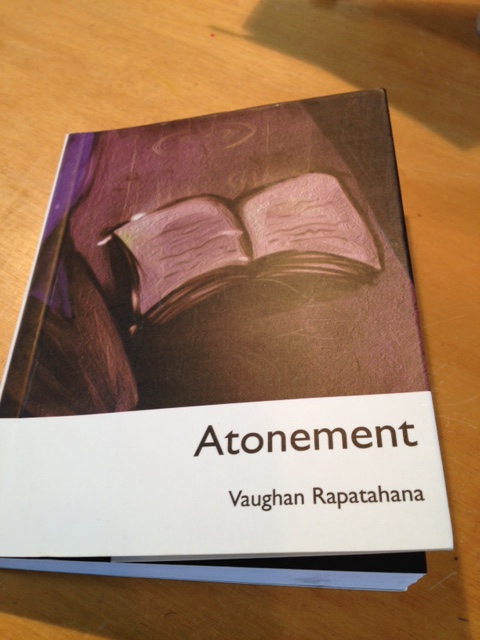
Atonement Vaughan Rapatahana, ASM/Flying Islands, Macau and MCCM Creations, Hong Kong 2015

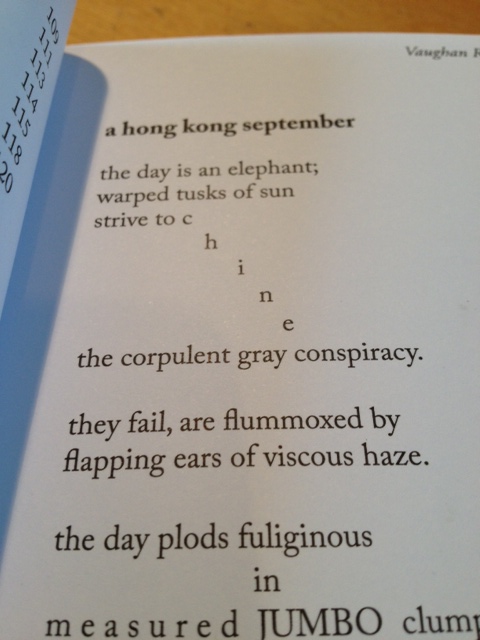
This is a gorgeous looking pocket book of poetry that feels good snug in your palm. It includes artwork by Pauline Canlas Wu and Darren Canlas Wu’s musical score of one of the poems. The poems serve disconnections and connections on people, place, politics, the weather, and love. There is a glorious marriage of lyricism, musing, image building that has anchors in numerous legacies (language poetry, myth, diverse lexicons). It is the language that prompts such evocative and delicious poetic sparks. Unlike many poets, Vaughan has not switched on the big-word filter — so the vocabulary is arcane and arching as much as it is everyday and accessible. I love that. It is like this palmful of poems is part rap, ragtime, jamming, spooling, riffs, sweet chords, minor keys, jump cuts, out-takes, in takes, double backs and so on. The playfulness is also there in the visual choices as words stutter and stretch and take diagonal turns. Whiffs of concrete poetry, language poetry abound, but you can’t simply reduce these poems to sumptuous word play. You might get led anywhere visually and aurally. An elephant trope replays Hong Kong. A Māori myth sets up shop in a Chinese context. Cantonese, Māori, and French interrupt and feed the English. You might feel like you are in the company of poetic cousins at times: Janet Charman, Jack Ross, Michele Leggott, Sam Sampson, Roger Horrocks, Leigh Davis, Steven Touissant. There are philosophical traces and political barbs. Musical hooks. Self confession. Concealment. This book is an utter delight.

Vaughan Rapatahana (Te Atiawa, Ngāti Te Whiti) lives in Hong Kong with homes in Philippines and New Zealand. This is his fourth collection of poetry. He has a Doctorate from the University of Auckland, has won several awards and has published in a variety of genres. He is the co-editor of Why English? Confronting the Hydra (Multilingual Matters, UK), a follow up to English Language as Hydra (2012).


Recordings of poems at the University of Auckland


Nina Powles on Katherine Mansfield’s newly-discovered poems

This from Nina Powles:


“Up and up beat her wings”

Lecture by Dr Gerri Kimber on her discovery of new poems by Katherine Mansfield, 5/8/15 at the City Gallery, Wellington


In 1999, a folder of papers was bequeathed to the Newberry Library in Chicago. It contained two letters to publishers sent in 1910 and 1911, typescripts of 35 poems, and a calling card embossed with a Chelsea address and the name KATHARINA MANSFIELD printed in a striking modern font.

The folder, labelled The Earth’s Child and other poems, had always been there. But no one had ever opened it; or if they had, no one realised what they’d seen.

Renowned Mansfield scholar and editor of the new Collected Works of Katherine Mansfield published by Edinburgh University Press, Dr Gerri Kimber, made this discovery in June this year. Currently in Wellington undertaking research at the Alexander Turnbull Library, she flicked through pictures of the folder’s contents at a lecture at the City Gallery.

Kimber believes Mansfield must have written the poems during or soon after Mansfield’s time in Bavaria, where she was sent by her mother, in 1909-1910. Almost all the poems are untitled except for a number, clearly intended to be read as a sequence. As a poet, this detail leaps out at me; it seems to show careful consideration for how the poems are meant to operate not just on their own but together, and the specific effect of this on the reader.

Mansfield is not best known for her poetry. The poems we knew of up until now are often more interesting from a biographical perspective, or read in relation to her fiction. Kimber doesn’t pretend otherwise: “I make no claims for the quality of her poetry.” But she does believe that throughout the published poems there are “flashes of brilliance.” However, throughout this sequence of poems all written in 1910, “these flashes of brilliance are everywhere—almost in every poem.”

The new poems aren’t yet available anywhere until next year, when they will be included in Volume 4 of the Collected Works. So we can only take Kimber’s word for it.

But as she flicks rapidly through photos of the typescripts, I read them as fast as I can. Words and phrases flare up at me, and I scribble them down at hectic speed: “the leaves smother closely” (poem 1), “trembling and burning ghosts” (poem 3), “her body was fashioned out of moonlight” (poem 7), “the foam that breaks over the world’s edge” (poem 23). The final poem Kimber shows us is strangely titled “To KM”. It describes herself in the third person—“she is a bird”—and although I could only read it once very fast, it seemed like an eerie premonition of Mansfield’s looming illness and death. It ends:


“A moment – a moment … I die.”

Up and up beat her wings.


These poems are from a period in her life from which Mansfield destroyed every scrap of written evidence that she could get her hands on. These were the years 1909-1911, when she just convinced her father Harold Beauchamp to let her return to London to try and establish herself as a writer. These years of her early twenties, the same age I am now, were her years of drugs, sex and (it seems) poetry. Her health never fully recovered.

So how and why did this folder of poems survive? Maybe it survived by accident, and if she knew we had it now, she’d be furious and burn it. Or maybe a more likely explanation is that she kept them not for their sentimental value but their literary value. Although they never got published, maybe she wasn’t disheartened. Maybe she still saw life in them.

What’s more interesting than the quality of the poems is the revelation that at this time, when she was just 22, Mansfield clearly saw herself as a poet. To some degree she always did; she continued writing poetry throughout her life. She’s not remembered as an exceptionally brilliant poet, but as I watch the typescripts flicker past on the screen in front of me, I can’t help but wonder whether maybe, if she hadn’t died so young, she might have become one.

Nina Powles, August 2015

2015 Emerging Poets Competition


Proudly supported by The Divine Muses Poetry Reading and Penguin Random House New Zealand, the Emerging Poets Competition is now in its 4th year. The competition enables writers who have to achieve that all important first publication to gain success and exposure. Our previous winners, including poet, editor and blogger, Elizabeth Welsh and poet and book reviewer, Elizabeth Morton, have gone on to achieve publication success in NZ literary journals. In 2015, our judge is poet and novelist, Rosetta Allan, a former competition runner up.

About the competition:

Closing Date: 7th August 2015

Results announced at Divine Muses Poetry Reading on National Poetry Day 2015, 28th August 2015

First Prize: $200 worth of Penguin Random House NZ books

Second Prize: $100 worth of Penguin Random House NZ books


Notice of the 2015 Emerging Poets Competition rules and entry form are available here.

About our judge:

Rosetta Allan’s books include the poetry collections, Little Rock (2007) and Over Lunch (2010), and her debut novel Purgatory (Penguin Random House NZ, 2014). Her poetry and essays have appeared in publications and anthologies in New Zealand, Australia and the USA, and in online literary journals, including most recently the essay Dear Mother, songs of the Kamikaze, released in The Griffith Review #48. She is the co-winner of the IWW Kathleen Grattan Best Sequence of Poetry 2010 and Metonomy’s Best Poem 2010, and was runner up in the 2013 Emerging Poets Competition. Rosetta is available for interviews

For further information contact:
Siobhan Harvey: siobhan.harvey@aut.ac.nz

or Jane Sanders: jane.sanders@artagent.co.nz


http://www.artagent.co.nz/poetry/newvoices.htm         http://www.penguinrandomhouse.co.nz/

The Berlin Writer’s Residency: Poetry Shelf Interviews Hinemoana Baker – I need to feel surprised by the language but not distracted by it.


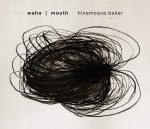
Hinemoana Baker  Album cover finished  waha_front__71664.1407673414.1280.1280

Photo credit: Robert Cross

Hinemoana Baker is an acclaimed Wellington-based poet who was recently awarded the Berlin Writer’s Residency. She descends from the South Island’s Ngāi Tahu and from the North Island’s Ngāti Raukawa, Ngāti Toa and Te Āti Awa. She also has English and Bavarian lineage. Victoria University Press has published her three poetry collections: mātuhi | needle (2004), kōiwi | kōiwi (2010) and  waha | mouth (2014). She has produced five CDs of poetry and music. Hinemoana was the Queensland Poet in Residence, has participated in the Iowa International Creative Writing Programme and was Victoria University’s Writer in Residence in 2014. She is currently convening a Poetry Workshop and with Tina Makereti co-convenes  a Māori and Pasifika Writing Workshop at IIML in Wellington.


Congratulations on receiving the 2015 Berlin residency Hinemoana. This seems like a golden opportunity to talk about poetry and writing, but first, what projects do you plan to work on while you are there?

Thank you very much Paula, I really appreciate the congratulations. It still doesn’t quite seem real yet, but I’m booking my tickets this afternoon, so it must be, right?? In Berlin I hope to finish a new collection of poetry. As is the way of writing projects, I will also be continuing work on a family memoir called ‘Dear Mother Basillise’, which is proving to be an even more gigantic undertaking than I had thought at first.


Poets often suggest writing a poem is an act of discovery as opposed to the rendition of a predetermined plan. Being in a foreign city is also an act or discovery but it may involve a bit of planning. What sorts of places and experiences attract you?

Several things. I spent a week or so there in 2012, and I was compelled by the history of the city, and fell in love with its present-day self, too. The markets, the many dogs on the streets, the public transport, the way people seem to walk so much slower than they do here.

Also, my mother’s ancestors are from Oberammergau in Bavaria, so travelling there will be much easier from Berlin. I visited once in my 20s, but I want to go again. It’s near the Black Forest, and it’s where the residents have staged the Passion Play every ten years since 1634, in return for god having spared them from the plague. The play brings many tourists to the village. The script has a history of anti-semitism, though some changes have been made to that over the years. I feel a million miles away from a place like Oberammergau, in almost every way, and yet my close ancestors sailed here from there (via Hamburg).

I am keen to experience the arts culture of Berlin, music and poetry and sonic art and burlesque and everything else. I want to join the Berlin Pop Choir and do tango. I want to eat grilled fish sandwiches at the market every weekend and drink Weiss Bier. I want to bike everywhere. Walk around in snow. Visit friends (and hopefully woo publishers) in Italy, London, Manchester. Drift through the Christmas Markets and museums and art galleries. Be anonymous.


What effect does travel have upon your writing? Can you write on the move? Or do you absorb and store and write later when it comes to poetry?

I write best when I’m on the move. Trains work best for me. I think it’s something to do with there being boundaries around the length and nature of the experience. And someone else is driving.


When you started writing poems as a young adult, were there any poets in particular that you were drawn to (poems/poets as surrogate mentors)?

I wrote poems and stories and even a few chapters of a novel as a young child. I don’t remember being really transformed by poetry until I was a teenager, though. Alistair Campbell and Fleur Adcock and Hone Tuwhare and Leonard Cohen, I memorised poems and said them aloud to myself until I cried. I had a wonderful English teacher at Waimea College who really encouraged my own writing.

I read a lot of Enid Blyton and Doctor Seuss as a kid, and I turned out ok. I was pretty much an only child, so I played a lot on my own or with my next-door-neighbour skater-boy friends. I liked skateboarding. I liked music. I became addicted to Louis Armstrong at a young age, and then Kate Bush when I turned 12.


What New Zealand poets are you drawn to now?

So many! I’m going to choose three here (refer to comment about time and boundaries above). Lynn Jenner – her latest book, Lost and Gone Away, is sustaining me at the moment. A person on Facebook whose user name isn’t, I don’t think, her real name: Hangi Pants. Heh heh. She posts poems in her feed once a month or so and I hang out for those days. It’s such good stuff. And Bill Manhire. If I had written ‘Hotel Emergencies’ I would probably just put my pen down and spend the rest of my life feeling smug. Thank god Bill hasn’t done that.


I agree on ‘Hotel Emergencies!’ Name three NZ poetry books that you have loved.

OK three different poets this time. The Bengal Engine’s Mango Afterglow by Geoff Cochrane. Star Waka by Robert Sullivan. Wild Dogs Under My Skirt by Tusiata Avia.


What about poets from elsewhere?

Sharon Olds, Joyelle McSweeney and Joy Harjo.


What poets have mattered to you over the past year? Some may have mattered as a reader and others may have sparked you as a writer.

My friend and art mentor Siân Torrington has begun writing more alongside her visual art. Her courage and determination towards freedom are things I’d like to emulate. Also her work ethic. I have been very moved by Rilke and Pablo Neruda, whose work I’ve only really started to investigate in the last couple of years.


I love the way your poetry is anchored in the real world in a way that makes physical detail luminous yet does so much more. This is what I wrote in my review of your most recent collection (waha | mouth): ‘your poetic melodies remind us that there are other layers of reality embedded here, layers that sing and tremble in the candle light — joy, pain, recognition, trust, narratives that we inherit and carry with us.’ What are some key things for you when you write a poem?

I have to feel like the poem is being co-written in a way – by me and by the poem itself. I need to feel surprised by the language but not distracted by it. I want to feel after I’ve written it that it has taught me something about the nature of life, or love, or the heart, or politics, or power, or just language.


Do you see yourself as a political poet? Overtly so or in more subtle ways?

No, not really. But I see myself as a person who is acutely aware of the dynamics of power. I am not as well-versed in local or global history and politics as I would like to be, but I’m constantly learning and reading. When that learning moves me and/or transforms me, it will no doubt make its way into my poems in some way.


In 99 Ways into NZ Poetry, I talked about the way the opening poem of your debut collection mātuhi | needle acts as a mihi. It invites us as readers across the threshold into the meeting ground that is poetry but that is also a surrogate marae. Now I see your poetry (as a whole) laying down invitations. Labels are tricky things but do you see yourself as a Māori poet? What differences does your Māori inheritance make to your writing?

I think the one thing my Māori self contributes to my writing, whether I like it or not, is a keen sense that there are feelings everywhere. People and places are alive and sensate and usually in some state of pain or longing. There’s a saying I heard once, I can’t remember where, but it was someone indigenous speaking about someone else ‘acting as if she has no relatives’. My relatives are everywhere, and not just because I have a big extended family.


The titles of your collections juxtapose English and Māori underlining these two personal lineages. Do you see this relationship as a rope (entwined, frayed, strong)? A bridge with different rhythms of traffic?

I’m not going to do it any more, this bi-lingual title thing. I’ve done what I wanted to do with it. Which is to, somehow, lock the different voices together for a moment.


You are a terrific musician and performer of your work. It shows, too, with the writing on the page. There is an exquisite cadence that draws upon silence as much as it does the shifting melodies. Do you write poetry as musician as much as you do as wordsmith?

I think in the end the thing I’m most interested in is sound. Adding meaning to the mix is a bonus, but it’s hard to keep meaning contained, and it can get a bit out of hand. I hope to make good and interesting sounds in people’s heads and in the air with what I write on the page.


Do you think your writing has changed over time?

Yes, but only in that I’ve gotten more confident.


I love the way you are unafraid of heart. Your poetry has a beating pulse that is both warm and inviting and utterly human. As a reader there are electric connections between my heart and the heart of the poem. How does heart matter to you as you write?

I try and make poems that matter, in the sense that people might care about them, because they might get that heart feeling from them. What you’ve said here is very honouring, Paula.


Is there a single poem or two in your collections that particularly resonates with you?

‘Rope’, because I didn’t even hear the ‘rape’ rhyme until a few hours after I’d written it. And ‘Magnet Bay’, because it was the last holiday I had with my ex-partner Christine, and I remember walking that beautiful land with her and playing taonga pūoro in the sun.


Your two books are beautiful to behold. How important is it to you that a poetry book is an object of beauty in view of its ‘look.’

I like a good cover image! And I like the book’s arrangement and font to be reader-friendly and readily available.


As my review attests, I loved your last collection. Did you make any discoveries as you wrote it?

You’re very kind. I discovered as I wrote it that it is very hard for me to write about things as they are happening. Sometimes I can do it – I wrote the Terrorism poem in kōiwi while that appalling crap was still going on. But mostly I have to wait. The experiences I had in the years writing waha will probably turn up in my next collection.


In the blurb for this book you wrote: ‘I’d like to think that opening this book to read is like standing at the mouth of a cave, or a river, or a grave, with a candle in your hand.’ I adore the comparison of the act of reading to holding the light of candle to a poem where something will always remain in the dim shadows, barely sighted, inaudible. How do the light and dark of poetry matter to you?

Like all the binaries – tension/release, light/dark, sad/happy – it’s the dance they do that makes art, for me. If you believe in binaries, that is.


What irks you in poetry?

Cliché.


What delights you?

Courage.


Is doubt a key part of the writing process along with an elusive horizon of where you are satisfied with a poem?

I don’t know if it’s a key part, but it seems to be an unavoidable part of my process. There’s some kind of off-balance precarious posture I manage to achieve between giving up altogether and re-working obsessively. It never feels comfortable or certain, and it never feels reproducible. After finishing a poem, I’m often certain, I’ll never be able to write another one.


The constant mantra to be a better writer is to write, write, write and read read read. You also need to live! What activities enrich your writing life?

Walking the wild coastline of Wellington, and her streets and waterfront, her Town Belt. Visiting with other artists’ work whenever I can. I teach creative writing sometimes, and that always makes me fall in love with language all over again.


Some poets argue that there are no rules in poetry and all rules are to be broken. Do you agree? Do you have cardinal rules?

Cardinal rules, no. Guidelines, yes. They’re really the same as for other kinds of writing. Show don’t tell. Concrete images. Verbs and nouns are often more powerful than adjectives. Etc. But there are some that pertain to poetry in particular I suppose – especially around line breaks and stanzas etc. That said, if I did have a cardinal rule, it would probably be ‘Don’t publish a poem your writing group hasn’t seen.’ One day I might break this rule but it’s served me well so far.


Do you find social media an entertaining and useful tool or white noise?

Yes.


Finally if you were to be trapped for hours (in a waiting room, on a mountain, inside on a rainy day) what poetry book would you read?

Something by Robert Hass – I’d have lots of time for re-reading, and Robert Hass very much rewards re-reading…


Hinemoana’s web site

Victoria University Press page

Victoria University page

NZ Book Council Author page


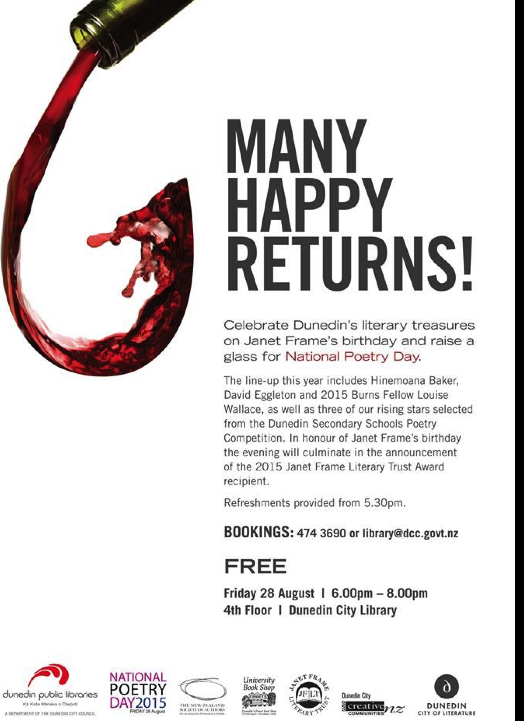
Many Happy Returns: Dunedin Celebrates NZ Poetry Day

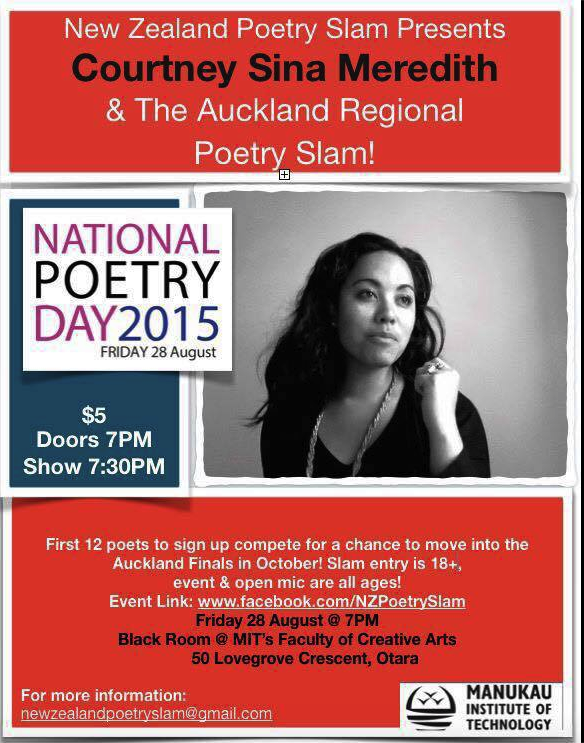
National Poetry Day is also Janet Frame’s birthday, and here in Dunedin there will be a poetry feast at the Library: the winners of the Dunedin Secondary Schools Poetry competition will perform their winning poems along with performances by Landfall editor David Eggleton, 2015 Burns Fellow Louise Wallace and special guest Hinemoana Baker. Poet Diane Brown will MC.
6 – 7.45 pm, Friday 28 August, refreshments from 5.30 pm.

Screen shot 2015-07-30 at 9.27.09 AM

this looks good! WRITERS ON MONDAYS Beach, Bach and Beyond: Three Poets

WRITERS ON MONDAYS

Beach, Bach and Beyond: Three Poets

Come and hear the latest in poetry, in a reading and discussion chaired by poet Cliff Fell. David Beach’s fourth collection, Jerusalem Sonnets, Love, Wellington Zoo, tackles, amongst other things, the inescapable presence of James K. Baxter for nay sonnet writer. Morgan Bach’s debut, Some of Us Eat the Seeds, welcomes a refreshing new voice that is in turns witty and sharp-edged. The international publication of Otherwise, John Dennison’s first collection, heralds a new, vivid and sensual voice in the New Zealand (and UK) poetry scene.

DATE:  Monday 20 July
TIME:   12.15-1.15pm
VENUE:  Te Papa Marae, Level 4, Te Papa
(please note that no food may be taken onto the Te Papa Marae)

Writers on Mondays is presented with the Museum of New Zealand Te Papa Tongarewa, National Poetry Day and Circa Theatre.

Poetry Shelf interviews Morgan Bach: ‘finding my way into a poem is not something I can force’

 684a89cf-1c7b-4ee7-a686-f3e03271a543   image1

Morgan Bach’s debut poetry collection, Some of Us Eat the Seeds, is to be launched today by Victoria University Press at Unity Books (details here). A graduate of the IIML MA in Creative Writing Programme, Morgan was awarded the Briggs Family Prize for Poetry. She currently lives in Wellington. To celebrate the arrival of this terrific new collection, Morgan agreed to be interviewed by Poetry Shelf.


Did your childhood shape you as a poet? What did you like to read? Did you write as a child? What else did you like to do?

I suppose it must have… I think being a shy child (because of living in the wops when I was very small) who kind of watched everyone set me up as both a bit of an outsider and definitely an observer. I suspect I came across as a bit of a creep! I certainly didn’t really meet any other kids I actually felt a proper kinship with until I met my friend who’s an amazing writer… That seems more significant than ever now.

I remember reading a book called Mr Rabbit and the Lovely Present (which Sendak had illustrated I believe, but I can’t remember who the author was… Charlotte someone I want to say), and finding it made me sad for a reason I couldn’t understand, and I think now it might have just been the tone of the whole thing, the miniature story that almost worked like a simple narrative poem, with an undercurrent of sadness and isolation that (now I think of it) would have resonated with me. Of course, it was a child’s picture book and I was about 3… but I suppose I found that story cathartic in a way and so I’m therefore assuming words were important to me early on. I remember singing a lot as a child, and it always being more about the words for me.

I did write, but not with any great purpose. Or rather, everything I started (outside of school) got abandoned pretty quickly. There are some hilarious bits and pieces though that have survived in family archives and prove me to have been a cynical and doomy child.

I always read a lot, all sorts, mostly fiction though in the first couple of decades of life.


When you started writing poems, were there any poets in particular that you were drawn to (poems/poets as surrogate mentors)?

Oh heck, I can’t remember now… So many over the years it all just kind of layers up as compost on the brain – turn it over and you can’t distinguish the origins of the matter anymore.


I love the way your poems have anchors in the real world (such sumptuous detail) but are unafraid to negotiate things less physical (states of mind, philosophical ideas). In other words, your poems take root in the world you inhabit and that includes inchoate worlds within the mind. They are inventive, suggestive, intelligent, at times puzzling (I like that!). What are some key things for you when you write a poem?

Thank you! I think that’s right – or at least that’s a balance I hope to strike. I wonder if that approach comes from how active my dream life can be. Sometimes it almost dominates with its use of my energy – waking up can be relaxing.

I think the key thing for me finding my way into a poem is that it’s not something I can force. It has almost never yet worked when I’ve tried to force it – I imagine most writers feel the same? I think that’s why I seem (to this point in time) to be incapable of writing to traditional form. The results are fit only for burning.

What I have realised over the process of writing this book is that I actually don’t write a lot on paper… most of it seems to happen in my head. But once it’s on paper not that much gets thrown away… the survival rate of poems is pretty high so far! I’m sure that will change over time. But yeah, currently I find it takes a phrase or idea to kind of catch in my head (like getting a song stuck) and then weaving my way out from that point. I say weaving as it’s then a process of tying the more ephemeral aspects to the concrete world. That’s my preferred space I guess.


Your debut collection, Some of Us Eat the Seeds, struck several intoxicating chords with me. I stalled in the first section, with the evocative family poems catching me at every turn. What are the pitfalls and the benefits of drawing family, familial relations, into poems?

Pitfalls – I’m already worried that some of the family will think I’m talking about them when I’m not. I’m a little worried they’ll think I’m claiming things they’ve experienced differently with too much authority. But the thing is, you can’t think about that or you’re censoring from the brain and that’s crippling. And as I’ve said to my mother – the poems they’re in aren’t actually about them, or if they are, they’re about my memory of them… they’re inevitably about me. Benefits – It’s just that they’re the people that populated my world back then… I’m not sure why I wrote about it. I didn’t set out to write poems about family or familial relations but it worked out that way anyway… I’m kind of hoping I’m done with it though. I prefer (or am more comfortable with) the poems in that section that aren’t about my family.


In a poem that took me back to games of spotlight, ‘Night in the forest,’ the power of the dark for a child with a torch, on and then off, became the power of the dark for a poet for me. Would you agree there are ways in which your poetry nudges the dark (dread, for example)?

Yeah definitely – and nudging is the right word, in that it’s both rubbing up against and gently testing. I adore this quote from Rebecca Solnit (the essayist) on Woolf (who I also love): ‘It’s the job of writers and explorers to see more, to travel light when it comes to preconception, to go into the dark with their eyes open.’ I feel like that’s a motto to live and write by.


Going back to the notion of poetic strands (physical, thematic, abstract for example), I loved the way ‘thought’ bravely makes itself visible in lines and phrases. (‘The past is a tether/ you don’t need to wear’). Do you think poems can be enhanced by ideas flickering on their hems?

Yes I feel like ideas (as visible thoughts) can often do something good in a poem. I seem to be unable to avoid doing my thinking on paper… But more than that, I feel like reading into a poem where there is active thinking presented, that you then relive in your own temporal experience of reading, can at times walk you into a space where you’re staring the writer bang in the eyes – or it can feel that way. Like getting lost in the eyes of someone in a portrait (I mean in a painting or photograph) – the static art object or defined collection of words expands somehow, and you’re in a little world of connection through that thought (which I’m equating here to a brain-stare haha – see what happens when I think as I write?!)


The final section of poems brings to life states of mind of the adult (love, desire, discovery, betrayal, heartache, recognition). What difference does it make when you write the adult as opposed to writing the child?

Unfortunately I think there’s a bit of a cynical streak across the whole lot… I suppose that’s because the adult is remembering (re-membering even) the child, and so colours experience a certain way (‘memory makes its own myths’ to quote myself). What difference does it make … Well I think I feel more comfortable writing the adult, because something about childhood makes me uneasy. I think it did at the time. I would certainly never go back. I don’t think I was ever a comfortable child, and I’m really enjoying aging. I feel like the ‘adult’ poems here are still kind of young though… I’m looking forward to seeing what I’m writing in another 10 years. The other thing is I suppose there’s more risk in writing the adult. Everyone’s inventing childhood through memory, but the adult carries an implication of self (even if it’s a fiction). I quite enjoy that risk though, so far…


Yes, a different implication of self than the smudgy thing a child navigates. Are there filters at work? A need to conceal for the sake of the poem and for the sake of self?

Heck yes. I’d say that seeming to reveal a great deal can be the best way to conceal what is most private. That said, most of my filters are for the sake of the poem. There are plenty of fictions or elaborations, which hopefully get to a more truthful truth.


What do you want readers to take away from your debut collection?

A feeling of resilience and self-reliance perhaps. It’s not a particularly cheery book but I think it’s kind of hopeful…


I can see those threads. You definitely fall upon nuggets of hope (light). You have studied Creative Writing at IIML at Victoria University. What key things did you take from this experience?

That reading and critiquing other people’s work is often the best way to work out what you need to do to your own work. That it’s a hell of a lot of work to write a book in that short span of time, but it’s so very worth giving yourself the opportunity to do it if you can. I loved the MA year at the IIML. It was the kind of experience I’d hankered after for so long and such a rare opportunity to just focus on reading and writing with a bunch of people who are as nerdy about it as you are. I wish I could do it again, really.


You acknowledge a writing group in your endnotes. How does this nourish your writing?

I’ve been in a few writing groups since doing the MA. One with my MA class… though we’re currently flagging! Come on guys!

My most productive one of late is with a bunch of damn fine and interesting Wellington poets at various career ‘stages’ or perhaps spaces is a better word, and with different kinds of poetry goals. It’s exciting to see their new work in early and sometimes quite raw form, and to be spurred on to write for our little deadlines. Also the camaraderie – I think that’s important.


What irks you in poetry?

Abstraction that isn’t tied to anything concrete, too much of a cerebral remove, or if it’s so academic as to be exclusive of almost everyone. Word play for the sake of sound alone – I understand that it has merit but I just can’t take it myself – you know what I mean, that stuff that is a bit like a toddler practicing with their tongue and vocal cords but is just essentially human white noise. I guess that’s my wanting a brain-stare again.


What delights you?

When you encounter poems that make you feel like your brain has been through a car wash. I don’t mean some ‘great revelation’ has occurred but just a combination of sense/sound/image/thought that creates that almost magic adrenalin behind the eyes feeling. I really hope I can make something like that one day…


What New Zealand poets are you drawn to now?

Oh I never know how to answer these questions, partly because there are too many and partly because ‘favourites’ lists feel too intimate/revealing to me. I know that’s weird… I’d rather tell you my full medical history or something. HA!

There are so many NZ poets that I love – I still read more NZ poetry than stuff from overseas. I’d basically just list everyone.

I will say that I am so excited about Joan Fleming’s forthcoming collection, if her recent poems are anything to go by. We have a few in Issue 2 of Sweet Mammalian and they are so good. I love how she has these little turns in some of her poems, a really interesting movement, and lines that just kind of kick you in the guts. Can’t wait.

I stand by my many previous claims that Ashleigh Young is the most interesting writer (poetry included) of our generation. I, like a lot of people, am hankering after another collection from her.

I’d like to shout out to what my Sweet Mammalian co-eds do too, Hannah Mettner and Sugar Magnolia Wilson, who are both wonderful clever and gutsy poets (though very different) and are constantly blowing me away with their delicious brains.


Any other reading areas that matter to you?

Yes, all of them… Who does not love a good essay? And nothing is more transporting than a novel that’s so good you forget to get up from your seat for hours even to eat. Also music – I mean good lyrics. I can’t listen to music unless I like the lyrics. It’s a totally different craft than poetry of course but it’s still important to me for the brain-compost.


Some poets argue that there are no rules in poetry and all rules are to be broken. Do you agree? Do you have cardinal rules?

The only rules I’ve tried to set myself so far are:

  • Don’t censor from the brain
  • Don’t try to make ‘yourself’ look good to the detriment of truth
  • Everything is layered – language, interaction, assigned meaning, just actual life – and so should a poem be.

I just made those up now, but I reckon they’ve been in there, unspoken.


Do you find social media an entertaining and useful tool or white noise?

To be honest I find it a bit overwhelming. I personally don’t feel I have time for both life and Twitter, though I see that it’s productive and enriching for other people. I’m only ever lurking or dutifully responding there. I use Facebook sometimes willingly and sometimes with a feeling of entrapment. I find it more conversational and so more useful, though I just duck in and out these days. I actually like Instagram the best, as I find it the least taxing. Perhaps when life is less busy I’ll find it all useful…


The constant mantra to be a better writer is to write, write, write and read read read. You also need to live! What activities enrich your writing life?

I think travel is the main one for me. It’s always been my default day dreaming space. I suppose it puts me into that outsider/observer role and also just bombards the senses with the new. I’ve been craving it so much… I’ve been waiting to get the book out before heading off again, for an as yet undecided ‘while’. I’m hoping somewhere along the way I’ll find my way into whatever the next project is.


Finally if you were to be trapped for hours (in a waiting room, on a mountain, inside on a rainy day) what poetry book would you read?

Just one? Too hard… I’ll stare out the window being indecisive instead.


Victoria University Press author page

My review of Some of Us Eat the Seeds.

Friday Poem on Poetry Shelf; Morgan Bach’s ‘In pictures’


Morgan Bach’s Some of Us Eat the Seeds — sets every part of your readerly self on high alert

684a89cf-1c7b-4ee7-a686-f3e03271a543           image1


Morgan Bach Some of Us Eat the Seeds Victoria University Press, 2015

I agree with Bernadette Hall. Morgan Bach’s debut poetry collection is ‘both ordinary and extraordinary.’ Morgan is a graduate of the MA in Creative Writing at IIML where she was awarded the Biggs Family Prize in Poetry.

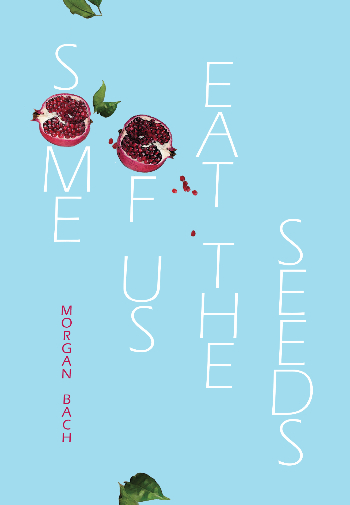
First up a stunning cover (cover design Rowan Heap) and a title that hooks. An allure of blue, the words a cascade downwards in white, the lush red pomegranates spilling their seeds. Gorgeous. The title resonant, already establishing a set of relations (‘us’).

What I especially love about this book is the way it plants anchors in the ground through an attachment to the real yet is unafraid to step into the smudged edges of the worlds that a mind both inhabits and produces. This is a book of collecting fruit, doing the high jump, cooking shows and vampire movies, but it is also a book of dread, heartache, anxiety, love, dreams, foreignness. The three sections are distinctive clusters (family, travel, adulthood), yet there is a satisfying drift of motifs and themes throughout the collection.

The opening poem, ‘What they made,’ is secured in self as it walks into physical detail (these feet, these eyes) and beyond that into a roving  ignition of ideas (by way of a trope: ‘A person// is a weak rope’). The opening question (‘What do I inherit?/ A split face// the eyes of one/ the sighs of another’) is particular apt in a book that faces memory, and in doing so represents myriad versions of self. The resulting poems are both invigorating and effervescent.

Take the title poem for example. The poem houses a jiggety mind at work, a mind walking (walking is a reoccurring device) into the fuzzy, elusive and utterly fascinating pull of memory, with its shifting and established myths, where ‘our country’ is not entirely accessible let alone knowable.

(..) The past is a tether

you don’t need to wear. Time has

its own ways of making people disappear.


Poems become frames for disappearances, for a vanishing (after terrific citations from Mary Ruefle and Adrienne Rich). You can link these unsettling and uncanny departures to memory, to the way things can not remain present reachable fathomable. The way in recuperation things change. Reading through the collection with this fertile knot is provocative yet nourishing. In anther poem, ‘His binding land,’ the disappearance is like a plot cog. A father walks away and off to ‘the paddock/ he called the back of beyond’ to lie ‘in the dew, unblinking/ as the morning changed/ with the cambered spring sun/ into full day.’ This little paternal disappearance resonates so beautifully and is a perfect example of how Morgan leaves a trail of physical traces to spark miniature narratives connections possibilities. Delicious. And then the end of the poem that is poignant, the language sweet in its simplicity: ‘When evening/ slid up and over, his wife/ walked out to find him.’

I posted ‘In pictures’ on Poetry Shelf awhile ago with a note from Morgan and a note from myself, and was surprised to learn the story of the deaths. Morgan’s father was the actor, John Bach, and the countless deaths she had witnessed were on stage. This constitutes another disappearance and is the hallmark of much poetry; what the poet chooses to reveal and conceal. and whether not  to use endnotes, can alter the navigation of a collection. Notes to the poem’s genesis can be fascinating and enlightening but I am equally happy to enter without guy ropes.

The first section, with its poems that draw upon family, family relations and childhood struck a chord with me. I stalled in this section. I got hooked and sent flying, hooked and sent flying. Here there is a richness of line, striking invention, a muscular layering. ‘The swimming pool’ evokes childhood to beautifully, through physical detail yes (Most of the day you’d lie/ on warm concrete/ beside the pool that was cold as needles’), but through so much more than this. The poem shows how childhood is also a state of mind to resist and adore.

I also loved the inventiveness of some of these poems, audacity even. In ‘Vampires,’ Morgan meshes together watching a British cooking show with family, choosing a vampire movie and walking through devastated Christchurch. The result, a sweet interplay of striking connections and overlap.


Here is a sampler of some of the lines that have stuck with me:

‘In that season life was ripe for the feast– plums and lemons, figs, apples; everything fell.’

‘We’re at the centre/ of what we know. We’re brains// and sight.’

‘I see myself alone on a swing/ and watching’

‘Forgive me then if I always// write about watching,/ it’s what a lonely child// does, even when she ventures/ over oceans.’


There is a strong sense of composition to the collection as a whole.  The middle section begins and ends with the cold, inventively, fascinatingly so. In the first poem, ‘Cold,’: ‘In that time we ate only the darkest snows/ and felled lights, brittle paintings.’ The poems travel, they take to the core people and places, otherness foreignness. This line stood out: ‘There are never the right postcards.’ And so it is as if the poems become surrogate postcards with willowy lines leading us to elsewhere. And always the roving mind, the courage to layer ideas alongside heart and acute observation: ‘Take as much time as you have, build the house in your head.’


The final section with its adult yearnings displacements recognitions  pulls uou from betrayals to desire, from love to heartache. I adore ‘This is how to write a love poem’; the way it is aware of its own making (could be old hat as self-reflexivity has been done to death, but here it is refreshed and vital. This is a cluster of love and not-love poems that burst at the seams with flavour impact  vulnerability.,

Reading Morgan’s debut is utterly rewarding as it sets every part of your readerly self on high alert, every bit paying attention to the pulse of the poem, each poem needing the grit of daily life, the surprise and flight of a daring mind, the traces of real life, the miniature stories, the lines that move in the ear so beautifully. Ordinary, extraordinary and yes, astonishing.


Within the next  week or so I will be posting an interview with Morgan.

VUP page here

‘In pictures’ on Poetry Shelf here

Posts about Morgan Bach in The Red Room