Category Archives: NZ poems

Poetry Shelf audio spot: Helen Rickerby reads ‘How to live through this’


IMG_20160820_161326.jpg


Helen Rickerby ‘How to live through this’ from How to Live (Auckland University Press, due August 2019)


Helen Rickerby has published four books of poetry, most recently Cinema (Mākaro 2014), and her next one, How to Live, will be published by Auckland University Press in August. She’s interested the elastic boundaries of what poetry can encompass, and has become especially obsessed with what happens when poetry and the essay meet and merge. She lives in Wellington, runs boutique publishing company Seraph Press, and works a day job as an editor.


Poetry Shelf Classic Poem: Bill Nelson picks Hinemoana Baker’s ‘Sound Check’


Sound Check


you sound just like that woman, what’s her name

she sings that one about the train

check one two one two check check

ka tangi te tītī tieke one two


she sings that one about the train

can I get another tui over here

ka tangi te tītī tieke one two

my secret love’s no secret any more


can I get another tui over here

at last my heart’s an open door

my secret love’s no secret any more

that sounds choice love what a voice


at last my heart’s an open door

you got a voice on you alright

that sounds choice love what a voice

you know the crowd’s gunna soak up the highs


you got a voice on you alright

had a bit of a band myself back in the day

you know the crowd’s gunna soak up the highs

i’d up the tops if I was you ay


had a bit of a band myself back in the day

check one two one two check check

i’d up the tops if I was you ay

you sound just like that woman, what’s her name


Hinemoana Baker from mātuhi / needle  (Victoria University Press, 2004)


From Bill Nelson: Sometime in 2009 I heard Hinemoana Baker read ‘Sound Check’ and it has stuck in my mind ever since. I think the reading might even have taken place on a mid-range PA system in a dingy carpeted room, some people laughing in the next room. Although I could be retrofitting that memory and it was in Unity Books or something. Anyway, at the time I noticed the outstanding music in the poem, and then wit and humour, and finally, the way the drama escalated as it continued.

Unusually, the poem is entirely in dialogue. A man is speaking to a woman who is trying to do a soundcheck and sings bits and pieces into a microphone. There’s no other description of the room, or the man, or the woman, or any other sounds. And yet through the poem’s pitch perfect choice of dialogue, the man is conjured up before us. A man we’ve probably all met. A pissed bloke in a pub, who likes to talk shit, knows a little bit about everything, probably from some other generation. He leans with his elbow propped on a tall felt-covered loudspeaker at one side of the stage, a beer in other hand, maybe a cigarette too. By contrast, the woman in the poem is a collection of song fragments and meaningless numbers, and it’s harder to picture her clearly. We know little about her, other than she seems like an incredibly professional musician, with a grasp of te reo Māori and a penchant for love songs.

You don’t have to try very hard to hear the music. It’s a pantoum, so there’s the repetition of course, but also the rhymes are particularly great and bang home like a drum, and there are bits of song lyrics that are italicized like they are meant to be sung. The complexity of the staccato sound check syllables juxtaposed with the rambley-bloke language of the man speaking is also really interesting and ramps up the conflict. Different people and different rhythms, looping in and out and over each other. It’s the kind of poem that is always going to be read out loud.

Pantoums are great at showing how context is important for language, how one line put against another can change it’s meaning entirely, or more accurately, provide two equally true meanings. The poem starts and ends on the same line said by the man, ‘you sound like that woman, what’s her name.’ And what seemed like an innocent enough question at the beginning, a bit idiotic perhaps but friendly enough, becomes patronising and infuriating by the time we get to the end. We cringe as he says it a final time, after a string of condescending comments and feeble compliments. He’s sounding more drunk, unable to remember what he already said two minutes ago, and I imagine him wandering off to the urinal, a poster of the gig that night right in front of his face. And he stands there with one hand propped against the wall, squinting his eyes, still unable to remember her name.


Bill Nelson’s first book of poetry, Memorandum of Understanding, was published by VUP. He is a co-editor at Up Country: A Journal for the NZ Outdoors and his work has appeared in journals, dance performances and on billboards. He is currently living in France. You can find more about him here at billmainlandnelson.com.


Hinemoana Baker  of Ngāti Tahu, Ngāti Raukawa, Ngāti Toa and Te Āti Awa along with English and Bavarian heritage, is a poet, musician and playwright currently living in Berlin. She was the 2009 Arts Queensland Poet in Residence, a writer in residence at the University of Iowa International Writing Programme (2010), Victoria University Writer in Residence (2014) and held the Creative New Zealand Berlin Writer’s Residency (2015–16). She has published three poetry collections and several CDs of sonic poems. Hinemoana’s website.


Poetry Shelf secondary school spot: Mo’ui Niupalavu’s ‘Camp’


Camp


Do you remember how birds

would wait until we woke up

 so they could be feed?

Do you remember

the time you saved me

from falling in the trap we built?


I wish I could carry that smell of burnt twigs

and the mixed smell of leaves and rice

with me forever.

Every night I would lay by the bright,

warm flame that accompanied

the smell of rice pudding.

I remember I would pick

the rough leaves as I daydreamed

about what would happen if we were lost.


If only life could give us another chance to go back.


Mo’ui Niupalavu


Mo’ui’s poem was inspired by Lauris Edmond’s poem ‘Camping‘, picked for the blog by Kate Camp a few weeks ago.


Hello, my name is Mo’ui. I am from St Bernard’s College in Lower Hutt and I am a proud Tongan. I have a brother who is 7 years and a father; my mother passed away when I was 13, I am now 14 years and in Year 10. I love music and English. I want to pursue music when I am older because I love to compose songs and write lyrics.


Screen Shot 2019-04-02 at 9.03.00 AM.png


Poetry Shelf Monday poem: Harry Ricketts’s ‘Ginny’s Garden’


 Ginny’s Garden

(for Ginny Sullivan, 1950-2017)


Magpies quardle-oodle in the high firs.

Down here, under the overhang, it’s hot,


looking out over the lawn Karen says she cut

two weeks ago, and already thick, clumpy,


to the paddock where Friendly, the seven-year-old ewe

that you couldn’t bear to send to the butcher,


baas by the fence for kale and attention.

The veggies you planted have gone mad:


tomatoes big as butternuts; huge, shiny aubergines;

giant marrows; cabbage whites all over the basil.


In the Pears’ Soap poster in the bathroom,

two small girls still stare at large bubbles.


Harry Ricketts


Harry Ricketts teaches English literature and creative writing at Victoria University of Wellington. His latest collection, Winter Eyes, has been longlisted for this year’s Ockham New Zealand Book Awards.


Poetry Shelf noticeboard: essa may ranapiri’s zines

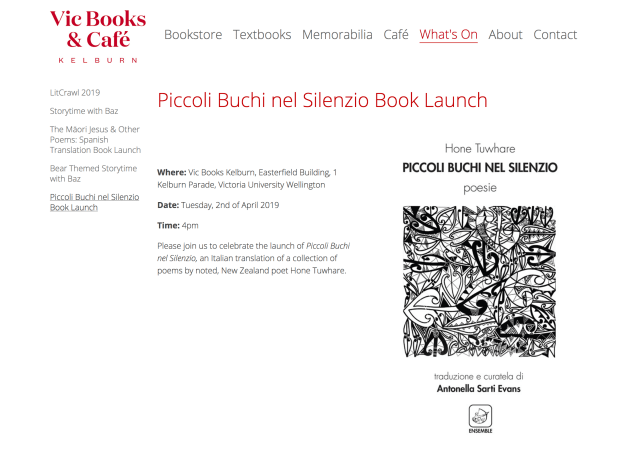
essa may ranapiri has added a zinging new zine to their collection. You can order a hard copy or read it (and others) online.


Screen Shot 2019-04-01 at 8.35.40 AM.png


Poetry Shelf noticeboard: an evening with Vivienne Plumb


Screen Shot 2019-03-31 at 2.45.15 PM.png

Award Winning Writer of Poetry, Drama and Fiction. 2018 Creative New Zealand Berlin Writing Resident.

Vivienne Plumb recently held the 2018 Creative New Zealand Berlin Writing Residency, and lived in Berlin for almost a year while researching and working on her new creative nonfiction book.

She is based in Wellington and writes poetry, drama and fiction. She has published twenty books in these three fields of writing.

She has held many writing residences, including the 2016 University of Auckland/Michael King Writing Residency and a University of Iowa residency; and has been the recipient of many awards including the Bruce Mason Playwrighting Award, the Hubert Church First Best Book Award, the Sargeson Fellowship, and an Australian post-graduate scholarship. She has acted as a judge for numerous poetry competitions and for the Ockham New Zealand Book Awards.

Her plays have been produced all over New Zealand and translated and published in Poland and Italy.

She is a member of the Academy of New Zealand Literature.

Her most recent book, a compilation of her past-published readers’ favourites, As Much Gold as an Ass Could Carry, has been translated into Italian and published in Italy.

Vivienne’s North Island reading tour is supported by the New Zealand Book Council.


Poetry Shelf audio: Marty Smith reads ‘Hat’

004_4-009540913200 copy.jpg


Marty Smith reads ‘Hat’ from Horse with a Hat, Victoria University Press, 2014


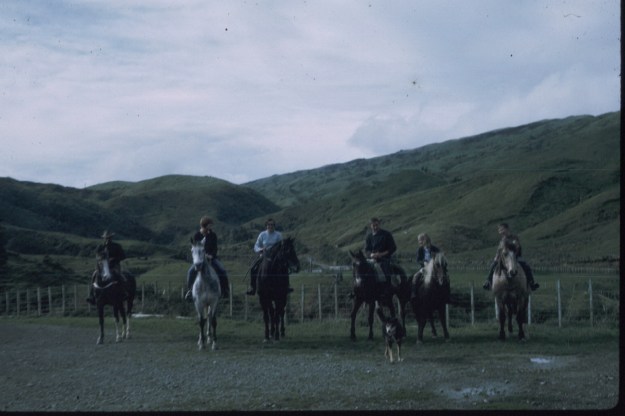
‘This is the kind of territory they were all locked together in. Here are the hills, and this is how they went to work.Left to right: Garth Smith (Dad) on Misty; Fiona Allpass on Poo: Marty Smith on Blackie: Bill Champion on Tiny: Chrissy Champion on Pet, and Paul Smith on Trixie.’ Marty on the photograph
Marty has given up teaching and administering literary events to work full time on writing a non-fiction book about what it takes to work in the racing industry and how and why people do. Her research involves regularly watching morning track work at the Hastings racecourse and betting at the TAB.


Poetry Shelf Classic Poem: Kate Camp picks Lauris Edmond’s ‘Camping’


Camping


Do you remember how we woke

to the first bird in that awkward pine

behind the ablution block, and leaned

across the knotted ground to lift

the canvas as though it was

the wall of the world

and ourselves at the heart of it

lying together

with the fresh grass against our faces

and the early air sweet beyond all telling –


do you sometimes look still

into that startled darkness

and hear the bird,

as I do?


When we drove away I looked back always

to the flattened yellow grass

to see the exact map of our imagining

our built universe

for a week

and saw that it was just earth

and faced the natural sky.


We took with us the dark pine

and the blackbird

and dew beside our foreheads

as we woke


and now we live apart

and I don’t know where they are.


Lauris Edmond  (from New & Selected Poems, Oxford University Press, 1991)

Posted with kind permission from the Lauris Edmond Estate.


From Kate Camp: It feels a bit odd that this is such a favourite poem of mine, because of the pun with my name. But the image of the flattened grass hit me with such power when I first read it, and does every time I revisit it. There is so much to love about the poem – its sensuality, its unashamed romanticism, and of course (being Lauris Edmond) its absolutely killer ending.

I remember Lauris saying to me once that she felt a poem should end like the shutting of a car door, from which I took a sense of satisfying and substantial closure, a rightness. I didn’t know Lauris well but she had a way of talking, and of reading her poems, as if she was slightly surprised by each individual word. I hear that cadence when I read the poem.

But of course the best thing about this poem is the ablution block. It’s such an ugly, unlikely thing to find in a poem, both the thing itself and the awkward “no one has ever said it” tone of the phrase. You know this is a found piece of language off some battered sign of the camp ground, and that lends the whole poem a down home, unpretentious feeling, that lets her get away with the romantic flourish of the “early air sweet beyond all telling.”

The other thing I love about this poem is how, like one of Shakespeare’s sonnets, it’s really a kind of sly testimony to the power of poetry – and of this particular poet – to capture and immortalise. It ends “I don’t know where they are” but of course we do know where they are, the bird and the pine and the dew are here in this poem. Wherever the poem’s protagonists and landscapes are, however lost to time and mortality, the poet has saved them here.

I think that’s why for me this melancholy poem is one that leaves me with a sense of exhilaration, even triumphalism – because when the car door of the poem closes, I sense the power of the poet in the driver’s seat.


Kate Camp is a Wellington-born essayist and poet, with six collections of poetry published by Victoria University Press. She has also written essays and memoir. Unfamiliar Legends of the Stars won the NZSA Jessie Mackay Best First Book of Poetry Award (1999), and The Mirror of Simple Annihilated Souls won the New Zealand Post Book Award for Poetry (2011). Snow White’s Coffin was shortlisted for the award in 2013, and The internet of things was longlisted in 2018. She has received the Creative New Zealand Berlin Writer’s Residency (2011) and the Katherine Mansfield Menton Fellowship (2017). Her essay ‘I wet my pants’ was a finalist in the Landfall essay competition in 2018.


Lauris Edmond wrote poetry, novels, short stories, stage plays, autobiography and edited several books, including ARD Fairburn letters. She published over fifteen volumes of poetry, including several anthologies, and a CD, The Poems of Lauris Edmond, was released in 2000. Her debut collection, In Middle Air, written in her early fifties, won the PEN NZ Best First Book of the Year (1975) while Selected Poems won the Commonwealth Poetry Prize (1985). She received numerous awards including the Katherine Mansfield Menton Fellowship (1981), an OBE for Services to Poetry and Literature (1986), an Honorary DLitt from Massey University (1988). Edmond was a founder of New Zealand Books. The Lauris Edmond Memorial Award was established in her name. Her daughter, Frances Edmond, and poet, Sue Fitchett, published, Night Burns with a White Fire: The Essential Lauris Edmond, a selection of her poems in 2017.


Poetry Shelf review: Poetry New Zealand Yearbook 2019


9780995102965.jpg

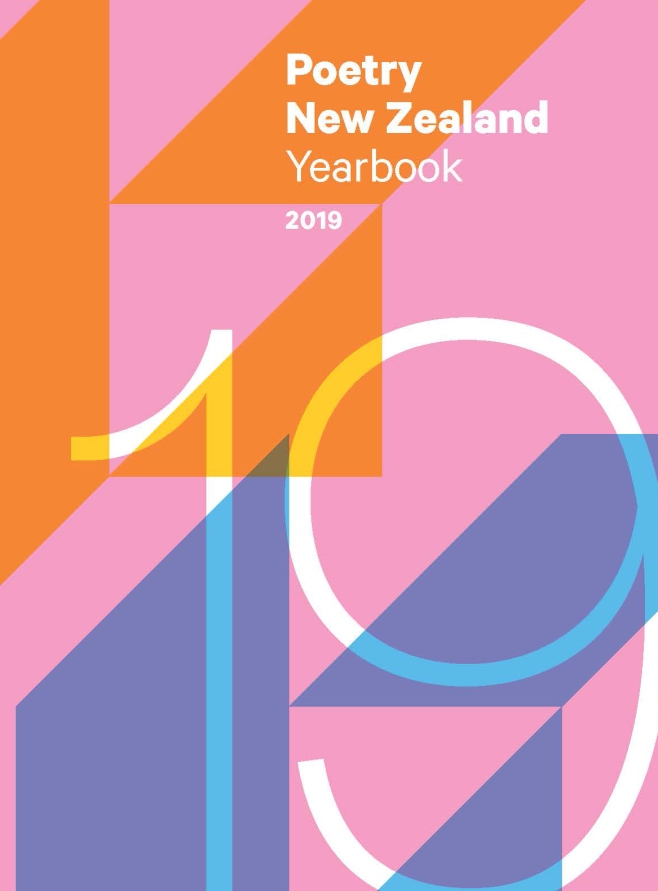
Poetry New Zealand Yearbook 2019 

editor Jack Ross, published by Massey University Press


Poetry New Zealand Yearbook always offers a substantial selection of poetry. This issue includes essays, reviews and the results of two poetry competitions, along with poems from new and established poets. I started reading the issue – I always dip and dive into literary journals – and made notes, gathering the poems that ‘spoke to me’. But then I hit the rest button and realised I was running on empty post big project. I have lain on a couch for a week and stared at the sky and after the horrendous terrorist event in Christchurch everything feels different. Because everything must be different. What happens when I pick up this journal again with a raucous bust-up of questions in my head: How to live? How to speak? How to connect? How to write a poem? How to run a blog? How to widen us and make room for past, present and future, to celebrate the good things and challenge the rest?

I picked up Poetry New Zealand again and started at the first page. No dipping and diving. Just tracking an alphabet of voices and letting poetry work its magic.

Certain poems set me musing. Marisa Cappetta‘s ‘Homeless like bones’ is both an anchor and a kite. This poem is worth the buying the book for, as a keepsake, a drifting catalyst.


My house is like a thing that flies

a warm bodied creature with wooden wings and moss

stuffed in the cracks to keep out

the draft at high altitudes.

Every night I burrow into its feathers.


Ria Masae’s magical ‘Children’s Eyes’ takes me back to a childhood looking, to stepping off from the knowable physical world to a world without limits or rules, a world bright with colour and possibilities. The poem is the thread that stitches child to adult.


In autumn

I would walk from school

under a canopy of different shades of Papatuanuku.

The flakes of her skin

drifted gently from her offspring trees

and whispered the earth’s secrets

into my childish ears

before playfully licking my cheeks

and falling to the ground

paving my golden-leaf road home.


Emma Neale’s poetry always catches hold me because its musical effects equal the craft of a silversmith – intricate, alluring, bright. However Emma’s ‘The TastiTM Taste Guarantee’ leads me in a different direction as the poem showcases her ability to write wit in all seriousness. She explains why, in the form of a letter, she has eaten the museli bar destined for her child’s lunchbox. The ending is a knockout – you get wit and seriousness with her characteristic deft musical touch.


All of which I guess

is just to say

(hey WCW, still got it!)

since you asked, I would like to know

how closed-grained and sweet-glazed

is the happiness of the future

assuming there is happiness in the future?

Because sometimes, when I do catch a glimpse

of time’s webbed, oil-black wings,

its tangerine-stained, crazed-bullet teeth,

I’m so stunned and dread-run

that even eating a candy bar

in Supergrain disguise

seems to be a legitimate opposite

to inaction.


Vaughan Rapatahana has poetry here in te reo along with a poem, ‘Rangiaowhia, 1864’, that takes us back to a massacre, an event we should become aware of in school, an event that returns us to the pronouns we and us. Again the questions compound. How to link the past to the future in order to understand the present?  How join hands and stand and listen. What to do with the breaking hearts?


who knows about the murders at Rangiaowhia?

not the majority in this country nowadays.

who remembers the burned children?

not the majority in this district.

who believes the word of the survivors?

only a minority outside that town.

alas

alas

alas.


I read Tracey Slaughter’s ‘archealogical’ and I just wanted to hear her read it aloud because it is such a sumptuous aural display of what words can do in a poem. The sound effects are as effective as the detail and the mood, and the surprising arrival of individual words; I am right back in the fumbling sexual awakenings of adolescence. I can’t wait to read Tracey’s debut collection out this year with VUP.


When the bell rings we are archealogical, cutting

through the harbour home, shins uprooting litres of slush

& levelling bubbles & barbs of creatures triggered back

into their chinks of flood. Their pinprick beds turn the sand

grid silver before your ranchslider shines up the low slope – beyond

your scalp the view’s not a bad excuse for stars. Inside we crumble

from the waded calves, the tight-knit glisten of mud scuffed

off by inches, the silhouette of grains slid of our sip.


Sue Wootton also draws me into the musicality of her writing, the luminous detail and the rendering of miniature stories and settings. ‘Anywhen’ is an electric read – taking me back to the 1960s and a foreign magazine sent to me by my French penfriend with Mary Quant products and miniskirts and velvet every way you looked.


Anywhere and anywhen

you unzip the hip-knock swing-along

to see what pops up

to hear what’s blowin’ in the wind.

You write past midnight on the blue machine

with your Mary Quant eyelashes a-droop

and the moon watches you and you watch

the moon. You’d like to land on the moon

but in colour. Page after page comes back to earth

with a crumpled thump


I have never read any poems by Sigred Yamit before and now I am keen to track down more because ‘Sweater’ blew the top off my head off (to borrow from Emily Dickinson) and really this skinny poem is sharp and sweet and utterly original and you have to read the whole thing to get the effect so I will just give you the start.


I’m supposed to write

something poignant

earth-shattering

eradicate cancer

but all I can think of

is my itchy red sweater

and how I fucking love it

and sad I get

when a boy is more

beautiful than me


I also loved Zuo You’s poem ‘I accepted His Apologies’ because it made me laugh out loud. Just two verses. Here is the second one.


The cold noodles I ordered

turned into hot ones

as if by magic.

After lunch

I posted a five-star review on the food.


Of all the finalists in the two poetry competitions I was hooked by Wes Lee‘s winning tour-de-force of a poem, The Things She Remembered #1’.   Phrases accumulate like a rollercoaster memory pulling you along in a blaze of sharpness and surprise. I was equally gripped by secondary school winner, Aigagalefili Fepulea’i-Tapua’i’s ‘275 Letters to Southside’. The poem, also sharp and rhythm rich, makes it clear that ‘Auckland is not the same place as South Auckland’.


Such is the strength of anthologies and literary journals: they can poke your skin and make you feel things – reading these poems I got sad, I laughed out loud and I got lost in trains of thought. Not everything hooked me but there is superlative poetry on offer. It was just what I needed. Now for the essays and reviews ….


Massey University Press page