Aimee-Jane Anderson-O’Connor was awarded the 2018 Charles Brasch Young Writers’ Essay Prize, and the 2017 Monash Prize for Emerging Writers. Her poem ‘Instructions’ was named by The Spinoff as the best poem of 2018. Her work has appeared in a number of literary journals, including Starling, Mayhem, Poetry New Zealand, Landfall, Mimicry, Turbine, and Min-a-rets. She writes thanks to some of the best people on this great watery rock.
Like many obsessions, my preoccupation with anagrams began by accident. I am writing my doctoral thesis at the moment, and had been struggling with my topic: alter egos in elliptical poetry. To put it bluntly: all of the alter ego poetry that I was writing for the creative section of my thesis was terrible; not so terrible that it was not even recognisable as poetry, but that uglier low level kind of terrible you get when you’re mining an area that has been all mined out and the work that results is simply boring. So I was on the lookout for inspiration, trawling for ideas that were more interesting than my thesis “starter idea”, when U.S. poet Dora Malech’s latest collection of poetry, Stet (2018), landed on our veranda in an Amazon package. My first thought on reading the poems was, “Huh?”; second thought, “What even is this?”; and then a series of thoughts that tumbled out on top of each other such as, “How does she do this?” “This is amazing!”, and “Wow, I’m so jealous, I wanna write anagram poems, too.”
Stet is a book of poetry which is composed primarily of anagrams, with a side of erasures. Malech states that she is influenced by the German artist and poet, Urnica Zurn, who wrote a series of vivid and disquieting anagram poems in the 1950s , as well as the French school of poetry Oulipo, which uses various restrictive forms to enable creativity, of which the anagram is one.
Thus began my obsession with this form–and the way that you can mine a single sentence or word or, in the case of the third section of Malech’s book, an entire poem (she writes a series of poems which are anagrams of the Sylvia Plath poem “Metaphors”)–and resulting questions (some of which Malech explores in Stet), such as: How can lyric subjectivity survive within such a tight machine? Is this kind of poetry too sterile and fragmented to really connect with a reader? I am at the beginnings of my explorations in this area, so don’t have any firm answers yet. But writing anagram poems (in which, for example, an entire poem may be made out of a single line, re-arranged) is kind of like build-your-own-nightmare. You get to choose the particular brand of nightmare, and that ambit of it, but within very tight parameters. To put it more another way, it’s like performing back flips in a very tight space; but if you pull it off, the thrill is real.
Johanna Aitchison
Johanna Aitchison is a doctoral student at Massey University, Palmerston North, examining anagrams and erasures in hybrid poetry. Her most recent volume of poems, Miss Dust (2015), was described by reviewer Sarah Quigley as “Emily Dickinson for the 21st century”. Her poetry has appeared in anthologies such as Best New Zealand Poems 2008 and 2009, and Best of Best New Zealand Poems (2011). She was a 2015 resident at the International Writing Program at the University of Iowa and the 2012 Visiting Artist at Massey University.
Chris Tse’s ‘wish list – permadeath’ was recently published in Queen Mob’s Teahouse: Teh Book (Dostoyevsky Wannabe, 2019).
Chris Tse is the author of two collections of poetry published by Auckland University Press: How to be Dead in a Year of Snakes (winner of the Jessie Mackay Award for Best First Book of Poetry) and HE’S SO MASC. His work has recently appeared or is forthcoming in Best New Zealand Poems 2018, Queen Mob’s Teahouse: Teh Book (Dostoyevsky Wannabe, 2019), The Spinoff and Peril. Chris and Emma Barnes are currently co-editing an anthology of contemporary LGBTQIA+ Aotearoa New Zealand writers.
You know, even if I hadn’t come on the plane, on a bus, in a taxi,
I’d get here at some point – cos that clever tektonos, that shifty carpenter,
poet, boat-builder in the sky, he’s been scheming all the while; been doing
a bit of backyard DIY, a bit of God-honest labouring and jack-hammering
on the boundary – right under that picket fence between the plates,
between the kanuka and manuka.
There’s a paratekstosyni afoot, a volcanic and magnanimous change,
a winching and an earthmoving: those alpine ridges, those glaciers,
plains and Hutt Valleys, they’re slap-hugging the rest of the North Island
goodbye – Ya old mudpool, ya long drawn out beach, ya tall and flashy
neighbour, I’m off to the Arctic Ocean – I hear you’re off to the Pontos –
never heard of it.
And all this in broad daylight, Yiayia – can you believe it?
This is what I know: Oceanus gave birth to Styx, the Arcadian spring into which Achilles
was dipped; from which Alexander got sick; whose water Iris drew and took to the Gods
so that it might witness oaths. Or, Styx was the river mortals crossed.
Or, the ocean is what I’m standing in – one tiptoe on the Pacific rim
and one not.
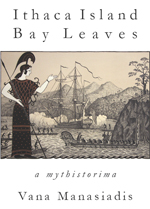
Vana Manasiadis from Ithaca Island Bay Leaves: A Mythistorima, Seraph Press, 2009
From Helen Heath:
One of the things that draws me to Vana’s work is our shared Greek heritage. I feel a deep affinity to this part of my genetic make-up; my ancestors’ homeland, the island of Ithaca in Greece, plays a big role in my debut collection, Graft.
However, I feel awkward claiming Greek heritage because I am only 1/8th Greek and my family wasn’t close to the Wellington Greek community when I was young. I barely know any Greek language and the Greek alphabet does my head in. I suffer from imposter syndrome, although I’m frequently told I look very Greek.
Vana, on the other hand, has more Greek heritage, she speaks Greek and has lived in Greece. In my mind, she far more authentically Greek than me. However, because she is pale skinned and strawberry blonde, she experienced prejudice from members of the Wellington Greek community. As Vana says. “The criteria of inclusion were missing: we didn’t look stereotypically Greek.”
Vana’s collection: Ithaca Island Bay Leaves: A Mythistorima (Seraph Press, SSS), which this poem appears in, weaves her Greek heritage with her New Zealand experience. In it, I feel her working towards a different understanding – moving between worlds and time frames, inclusion and exclusion, reinvention and fragmentation. There is uncertainty and otherness, but also, she gives me hope for a new kind of belonging.
Vana’s new collection, The Grief Almanac A Sequel, was launched in May. by Seraph Press.
μπράβο – Bravo Vana!
Helen Heath is a poet and essayist from the Kapiti Coast, Wellington. Her debut collection of poetry Graft (VUP) won the NZSA Jessie Mackay Best First Book for Poetry award in 2013 and was the first book of fiction or poetry to ever be shortlisted for the Royal Society of NZ Science Book Prize. Her latest collection of poems – Are Friends Electric? (VUP) – is about people, animals and technology, and won Best Poetry Book at the 2019 Ockham Book Awards.
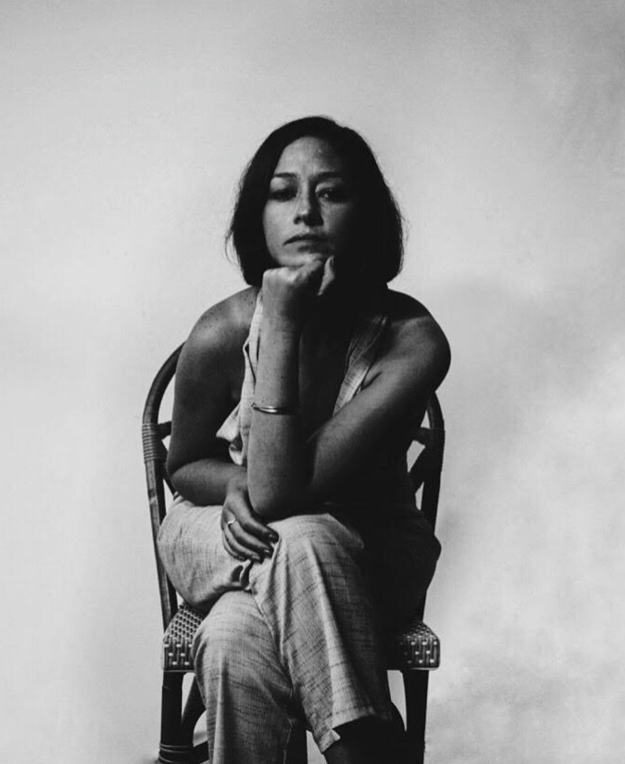
Vana Manasiadis is a New Zealand Greek writer, editor and translator who spent many years in Greece and Europe, and is now based back in Auckland Tāmaki Makaurau. She is the author of acclaimed collection and her writing has appeared in a many outlets including 99 Ways into New Zealand Poetry (Vintage, 2010) and Essential New Zealand Poems: Facing the Empty Page (Random NZ, 2014). As co-editor of the Seraph Press Translation Series, she has co-edited Tātai Whetū: Seven Māori Women Poets in Translation (2018) and edited and translated from the Greek for Ναυάγια/Καταφύγια: Shipwrecks/Shelters: Six Contemporary Greek Poets (2016). The Grief Almanac: A Sequel was published May, 2019 (Seraph Press).
Dallas Karangaroa (16) is part of a teen writing group run by Alisha Tyson at Hutt Central Library. His extraordinary poem takes you apart and then somehow, miraculously, wonderfully, puts you back together again. It’s stonishing! I hope to see more poetry from this young poet.
Rarotonga-based poet Jessica Le Bas is the winner of the Sarah Broom Poetry Prize 2019.
Sarah Broom website here with poems by the finalists and winner
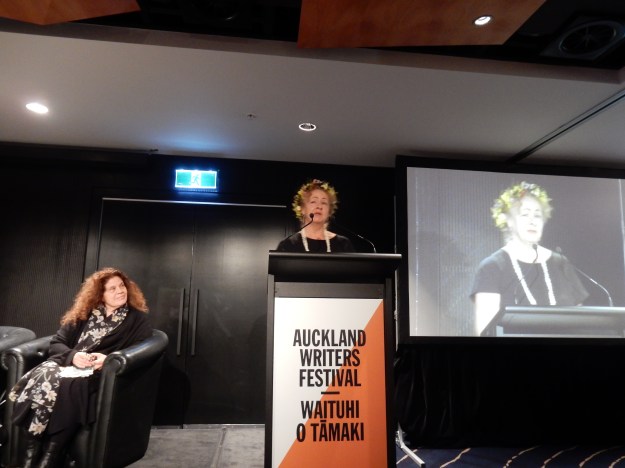
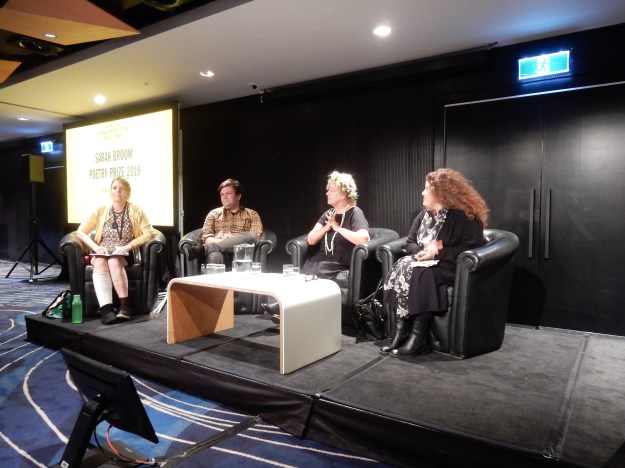
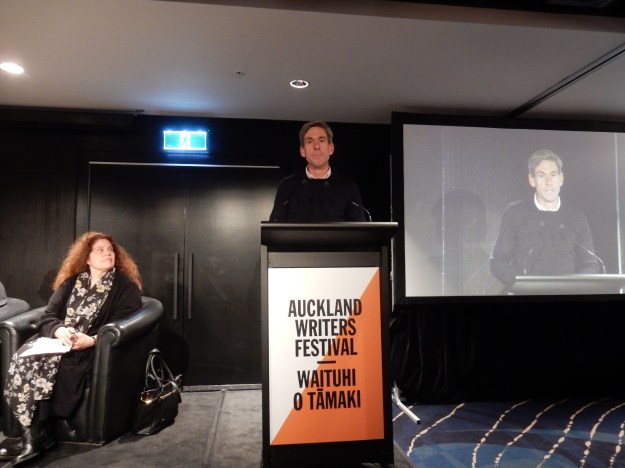
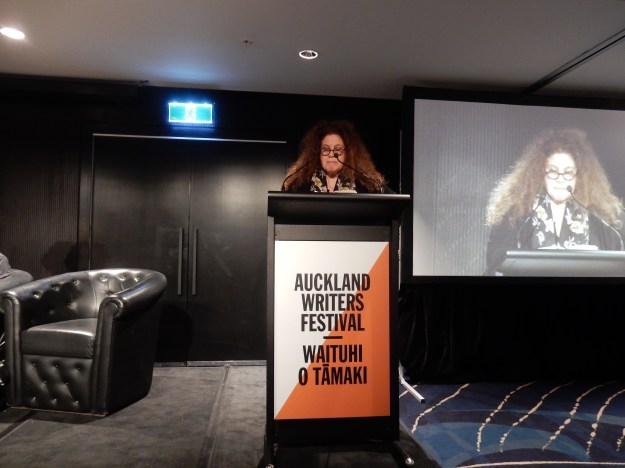
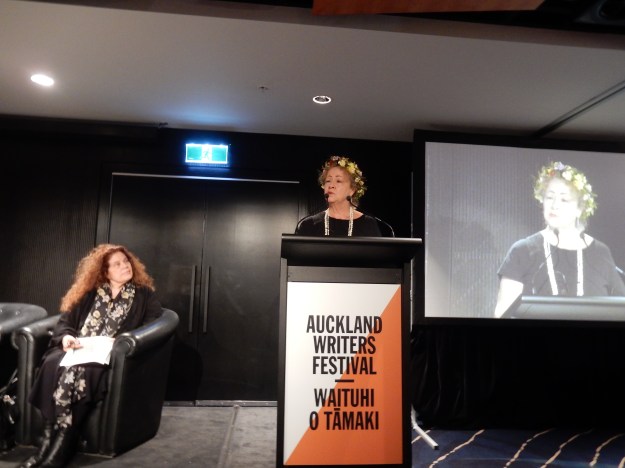
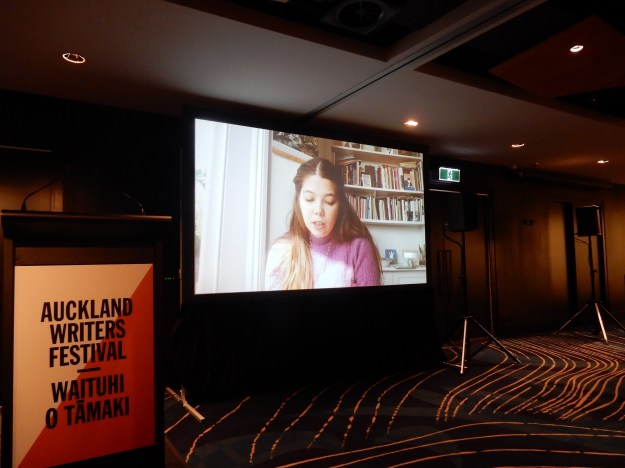
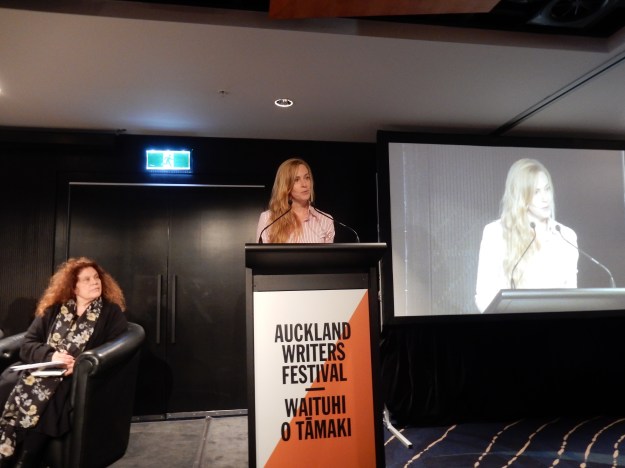
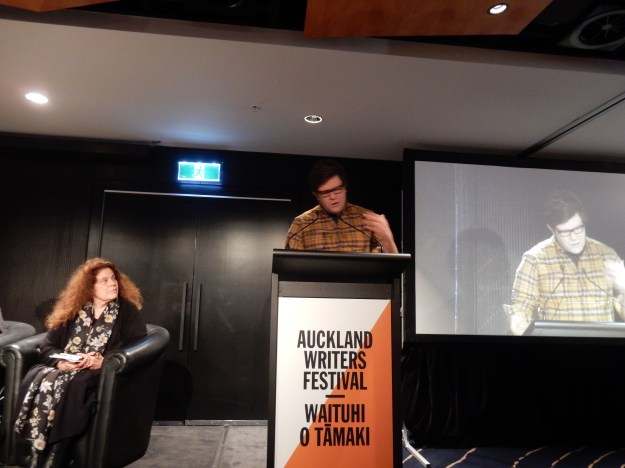
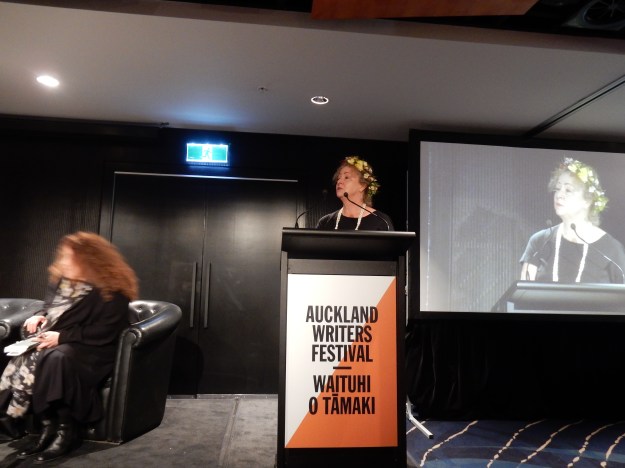
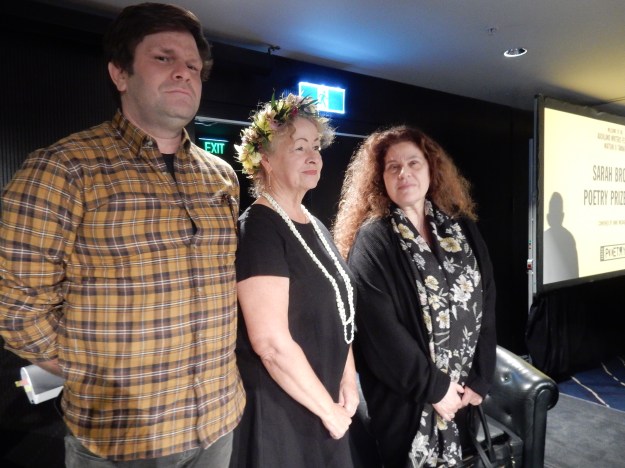
On Saturday I had the honour of mc-ing the Sarah Broom Prize session, having acted as Prize Director for the past year. I welcomed international judge, Anne Michaels, the finalists, Michael Steven, Jessica Le Bas and poet Vana Manasiadis standing in for London-based Nina Mingya Powles, the Prize founder and Sarah Broom’s husband, Michael Gleissner, and their family, and a room packed to the rafters with poetry fans.
In 2014 when Michael established the award he told me he had created a financial prize to support writing time for a poet, as his wife Sarah had enjoyed. But the Sarah Broom Prize is more than this. It allows us to shine increased light on NZ poetry, local poets get to be read by an international judge and the finalists get to read at Auckland Writers Festival. This is a gift for our poetry communities and we are immensely grateful to you, and to the hardworking Sarah Ross and Greg Fahey. The Sarah Broom Trust has launched a new website and new plans for the future. This year there were over 320 entries. For the past six years The Sarah Broom Trust has worked in partnership with the Auckland Writers Festival.
Sarah Broom (1972 -2013)
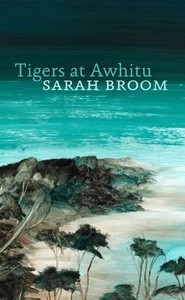
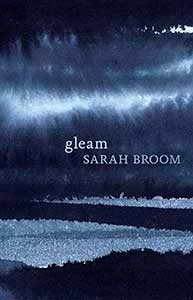
The prize also enables an annual return to Sarah’s poetry and this is a joy. Sarah’s debut, Tigers at Awhitu, appeared post her Cambridge doctorate, at a time she dedicated her life to motherhood, poetry and managing lung cancer. Her second collection, Gleam, was published posthumously. I have found her poems shine with cadence and craft, exquisite wisdom and subtle movements. She wrote poetry for the well and for the dying; the world is to be cherished. Love is always intensely present. I carry her poetry next to my heart.
I read two of her poems: ‘anchor’ and ‘river come gently’ from Gleam Auckland University Press, 2013.
The finalists
Nina Mingya Powles, of Pākehā and Malaysian-Chinese heritage is the author of field notes on a downpour (2018), two from Seraph Press Luminescent and Girls of the Drift She is the poetry editor of The Shanghai Literary Review and founding editor of Bitter Melon 苦瓜, a new poetry press. Her prose debut, a food memoir, will be published by The Emma Press in 2019. Poetry Shelf interview
Jessica Le Bas has published two collections of poetry with AUP, incognito and Walking to Africa and with Penguin, a novel for children, Staying Home. She currently lives in Rarotonga, working in schools throughout the Cook Islands to promote and support writing. Poetry Shelf interview here
Michael Steven is the author of four chapbooks and Walking to Jutland Street, a collection published by OUP, longlisted for the 2019 Ockham New Zealand Book Awards. He was recipient of the 2018 Todd New Writer’s Bursary. He lives in West Auckland. Poetry Shelf interview
The Judge, Anne Michaels
Anne Michaels, poet and fiction writer, Toronto Poet Laureate, author of the beloved Fugitive Pieces among other splendid things, has produced breath-taking poetry. Poems that take up residency in your body, that savour silence alongside revelation, that tend to musical pitch and luminosity, that take you deep into human experience, both physical and imagined. These are some of her poetry treasures. [I held up All We Saw, Poems (her first three collections) and her magnificent children’s book, The Adventures of Miss Petitfour that I urged Kate De Goldi to read if she hasn’t already]. When I was in A & E on Sunday my daughter brought me Anne’s Infinite Gradations to reread. It transported me beyond injury, beyond hospital walls to the most glorious writing on poetry and art I know, on what it feels or means to write poetry or make art. So many lines felt utterly relevant in the wake of the Christchurch mosque attacks when we collectively asked and keep asking ‘what good poetry’ and collectively seek kindness, empathy and connection.
Let me share a few favourites.
We write and we read in order to hold another person close.
Sometimes language is the rescuer.
Poetry is the lonely radical precious expression of a single life.
Poetry suspends time. Poetry is time. Poetry gives us time.
Anne Michaels spoke on poetry and the finalists entries – she has also selected two highly recommended poets – Jess Fiebig and Wen-Juenn Lee.
Anne told the audience it it was an honour to judge the prize – and that she paid absolute attention to every entry. She said the poems provided a glimpse of New Zealand one could never have in any other way, and that questions arose on home, exile, language, belonging. She saw the poems as kinds of ‘seeking voices’, and that poets are a tribe with a shared love of the word, a compulsion to write, solidarity – and that we are all in it for the enterprise of it.
Anne wanted everyone who entered a poem to understand and feel to their very soul that they are part of this enterprise. She then introduced each of the finalists (I have included her comments on highly recommended):
Jessica Le Bas (winner)
Jessica Le Bas’s poems are alive with detail acutely observed. In the poet’s disciplined language and perception is a kind of tenderness – for the natural world, and for human frailty. It is a poetic vision that understands how inextricable hope and despair, beauty and loss: of a cracked mango, Le Bas wisely advises, “eat it now”. In these poems, the world is passionately perceived.
Nina Mingya Powles (finalist)
These poems express both the power of memory and the grace of a present moment. They are a deeply felt exploration of language – how it separates us and holds us close; how it can become, sometimes, the only home we have. The best compassion is born of clear seeing, and this is the compassion that imbues Nina Mingya Powles’s poems – expressed with a generous, gentle, authority. These are poems of beautiful depth.
Michael Steven (finalist)
These poems speak of intimate encounters, often wordless, and of communions – through music, plums shared along a path, a circling hawk, a gravestone. There is a quietude in these poems that reminds us just how loud the world has become, and how valuable those moments, the “tiny benefactions” that gently restore our attention to what’s important.
Jess Fiebig (highly commended)
By not turning away from a moment, these poems insist on understanding, finding meaning where it hurts. These poems are full of compassionate detail, direct and wondering, and “finding treasures” in plain sight.
Wen-Juenn Lee (highly commended)
These are poems of witness – vivid and fierce, seeking a kind of justice. In their passion to name what it means to live in exile – from a place, from a language – these deeply felt poems assert the right to be seen and known, not forgotten. Their seeking is a kind of restoration. Wen-Juenn reads ‘Prologue’ for Poetry Shelf
In announcing the winner Anne underlined how she loved all three poets, and she urged the audience to follow their careers, to buy their books and to spread the word.
At the beginning I asked, what good poetry? I took up from Anne’s point and finished by saying, as this session so beautifully demonstrated, that we read and write to hold things close: life, love, loss, people, experience, knowledge, connections. Friends and strangers come up to me afterwards and said that this session was full of heart and soul. I agreed.
Grateful thanks to the Sarah Broom Trust and to the Auckland Writers Festival.
Grace Teuila Taylor is of Samoan, English, Japanese heritage born and raised in South Auckland. Mother, Poet, Daughter, Theatre Maker, Performer and advocate for families affected by dementia. Grace has two published works with ala press (Hawaii), Afakasi Speaks (2013), and Full Broken Bloom (2017). Writer of Auckland Theatre Company commissioned poetic theatre show My Own Darling (2015 & 2017). Director of Auckland Theatre Company shows SKIN (2014) & MOUTH: TEETH: TONGUE (2016) and Hawaiian based poetry theatre show OUR WOMEN BODIES (2016). She won the CNZ Emerging Pacific Artist Award (2014) and the Auckland Mayoral Writers Grant (2016). Grace has been part of the leadership for the spoken word poetry movement in Aotearoa: co-founder of South Auckland Poets Collective and the first youth poetry slam in Aotearoa RISING VOICES. She held the International Writer in Residence at the University of Hawaii, Manoa in Spring 2018.
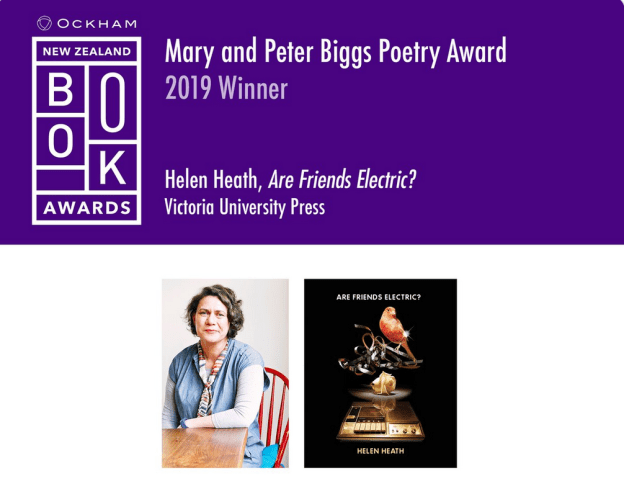
Helen Heath won the Mary and Peter Biggs Award for Poetry for her collection Are Friends Electric? (Victoria University Press).
“By turns thoughtful and moving, Are Friends Electric? asks how the material world might mediate—or replace—human relationships.
“Helen Heath’s collection impressed the judging panel with its broad thematic reach, its willingness to tackle complex issues, and its poetic risk-taking,” said the judges.
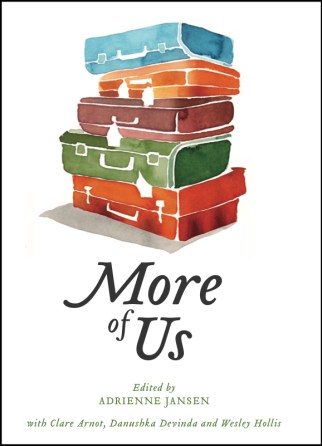
More of Us, edited by Adrienne Jansen with Clare Arnot, Danushka Devinda and Wesley Hollis, Landing Press 2019
In New Zealand, it’s the weekend.
The streets are very quiet.
Anni Pinedo Bone from ‘The weekend and the carnival’
More of Us was launched shortly after the Christchurch mosque attacks. When many of us were unable to speak – as we sought ways to come together, to listen, to show kindness, unity, solidarity, empathy – the book became even more important. The editors have assembled a terrific range of poetry that navigates loss, dislocation, home, families, food, place. It includes 46 writers from 29 countries, from award-winning poets to high school students, all now living in New Zealand. I am moved by this book. I cry at the unspeakable wounds, I rejoice at the moments of joy. I would love to see this book in every secondary school. I would love to see this book in every lounge because it is an aid to appreciating difference as much it is an aid to forging connections. It is a gift. Thank you.
I sent a list of questions to a group of the contributors and let them choose what they wanted to answer – grateful thanks to Adrienne Jansen for helping me do this.
Why do you write poetry?
Nicky Subono: I write poetry as a way to express what is in my mind and heart. It helps me process and accept things in life and also hope that my writing can inspire or help others in tough times.
Yazan El Fares: I write because writing is often the best way to express things that a person may feel or want to tell. So I chose poetry to express what I feel and share it with other people.
Sevgi Ikinci: I love all the strands of poetry, it focuses on what wanted to be said, it’s sharp and concise. It has sound which can be delivered by writing. It can be romantic or rebellious. Also, I find poetry so delightful due to its ability to deliver different meanings for different people. When my emotions came out in a form of poetry the first time, I was thrilled. It became the way how I express my deep emotions and thoughts.
Reza Zareianjahromi: For a long while now I’ve wanted to find the perfect combination of words to describe some visceral sensation deep inside – I’ve so far failed. But the closest I’ve ever gotten to it is through poetry.
My uncle switches to a music channel.
The music is fire!
My uncles stand up, and my aunties –
they’re all ready to start that dabke,
Syria’s best dance, where people stand,
shoulder to shoulder, holding hands.
Yazan El Fares from ‘My dance story’
Like music, the poems in this anthology sound good, they make me feel the world, they make me think the world, they make my senses spark, they take me into scenes outside my knowing and I am grateful. What do you like your poems to do?
Nicky Subono:I would like my poem to communicate to individuals / be relatable to those who are struggling to find their identity/ coming to terms with living in different worlds and also help them realize and appreciate the place where they can call home.
I would like my poem to highlight diversity and embrace inclusivity.
Tofig Dankalay: Change others’ views and perception of the world and prejudice of people and places that they have never met or seen.
Yazan El Fares: I like my poems to make others feel what we feel and try to think of other people and how do they live. I also want to send a message to people through my poems that each one of us has their own culture and beliefs but we all are human being.
Sevgi Ikinci: Additionally, poetry is a peacemaker. It tells people from different parts of the world, you feel so similar, you are so similar.
Also, I love that the poetry can be read so many times and it gets even tastier.
Reza Zareianjahromi: I like my poems to make you think of dreaming. I want the dimly lit visuals of a dream to come through, the half-lucid state of your mind that produces not necessarily very fantastic and wild imagery, but instead images that are strange enough to be believable and at the same time completely alien. I want readers to get a sense of that familiarity we have with the things we see in our dreams – and I want them to realise that even though they sense this familiarity, the experience is a wholly new one each time.
Was I like this?
No, I wasn’t, but I was
just a bit quieter, reserved and afraid.
I couldn’t tell anyone who I really was!
Sevgi Ikinci from ‘Was I like this back in my home country?’
Are you drawn to certain subjects or feelings when you write?
Nicky Subono: yes, personally, I tend to write more when I feel like there is a message I wanted to express and in hope to reach out to people. It is my own way of communicating my feelings and thoughts.
Tofig Dankalay: My own constantly and forever changing views of the world as part of the universe: Where New Zealand we’re at the end of the world at sometime and at the centre of it right now…
Yazan El Fares: Yes, most of my writing revolves around my mother country and the memories always drawn me.
Sevgi Ikinci: Not objects so much, I think my drive is intense emotions.
Reza Zareianjahromi: I write quite a lot about people’s suffering. I feel a lot of people are dangerously indifferent to it. I also draw quite a lot of inspiration from my dreams, as evident from my previous answer. A good amount of the poetry I write is connected to my Iranian roots.
I remember how my first experience of lettuce
prepared me to compile a recipe book for salads
Sudha Rao from ‘Making a salad’
Do you find certain motifs or symbols keep appearing in your poems?
Tofig Dankalay: The nature, the universe, the different species, objects, that abide by the same physical and universal forces and laws.The engineering species poet within me.
Sevgi Ikinci: I am not sure. Maybe not.
Reza Zareianjahromi: A lot of my poetry is quite personal. I write quite a lot of things for myself, and never intend to share it with others. So, I guess most of my poetry has a very personal motif and intention behind. I’d like to think of them as fragments of how I felt about a certain thing the exact moment I sat down to write, and that feeling can change rather quickly or take on an almost absurd form in my writing.
I became a stranger to my own identity,
an Indonesian who never felt
she belonged in her own land.
I was a blooming flower
surrounded by poison ivy.
Now I am a bird
flying towards the clouds.
Nicky Subono from ‘Overboard’
This anthology reflects diverse migrant and refugee experience. Has your migrant or refugee experience affected the way you write? Did you write poetry in your first home country in your first language?
Nicky Subono: Yes, my life experiences has played many parts of what I write, and because English has become my first language, I tend to think and write in English.
Tofig Dankalay: Of course, it’s a huge part of it. I was born in a war zone. I have no birth certificate, I was a UN refugee at age of 5 in Sudan. Then, I moved with my family to Middle East. I got my Bachelor degree in Engineering in Jordan. Moved to New Zealand in a Skilled Migrant Category Visa (SMC). I am a refugee, expat, migrant, and a resident. I am all of that.
Yazan El Fares: Unfortunately, I never had the opportunity to write in my country. All my writings are coming from my migrant background and they all talking about a child who was 10 years old when he left his own country, relatives and friends. This is because of the war which doesn’t have mercy on anyone.
Sevgi Ikinci: My migrant experience affected my writing but I don’t think it affected the way. And yes, I’ve been writing poetry for a long time. I started writing in my language and after a few years living in New Zealand, first my poetry started appearing in English.
Reza Zareianjahromi: My parents are both scientists. Because of their careers, I’ve moved around the globe a fair amount. Therefore, my migration experience is not only an experience but also a fundamental part of who I am as a person. Without it, I wouldn’t be me. So yes, the fact of my moving to new places constantly has shaped a great deal of my writing. I never wrote poetry in Persian, but I have always enjoyed reading Persian poetry.
We be pack of crow. Black bird perched upon scorched
branch. Perched upon broken building. Perched upon
snapped wire. Perched upon this doomscape.
Reza Zareianjahromi from ‘What we be?’
Was there a poet or poets that affected you in your first home country? Has a poet from Aotearoa caught your attention?
Sevgi Ikinci: Yes, possibly a few of them affected my writing from my home country.
Reza Zareianjahromi: Saadi, Hafez, Rumi, and Ferdowsi are all great Iranian poets. I can’t say any poets from Aotearoa have caught my eye (other than the really great ones is the collection!), but then that’s my own fault since I have not yet read much New Zealand Poetry. Other influences on my work are Charles Bukowski and Leonard Cohen.
I am an alien.
Call me names.
You called me all names.
Why not human?
Call me human.
Tofig Dankalay from ‘Call me human’
Which poem in the anthology really got under your skin, or moved your heart, or challenged your ideas, or gave you goosebumps? I would find it impossible to pick one so do mention others.
Nicky Subono: I loved reading ‘Call me Human’ by Tofig Dankalay because it is very raw and amazingly heartfelt… I can feel the pain within the words and it is very moving to me because I always believe that we are all belong to one race, which is humanity.
Reza Zareianjahromi: ‘The Imprisonment of Ap-Kain’ by Laurens Ikinia. Can’t quite put my finger on it, but there is something tremendous about that poem. I don’t know why. (Note from Paula: I agree!)
1.Stone
I would stand by you,
if there was no stone.
There is no sound,
that would awaken me.
I would have tasted how you felt,
if I were there.
There is only one chance
to be away from the stone.
Laurens Ikinia from ‘The Imprisonment of Ap Kain’
The interviewees
Tofig Dankalay: I was born in Eritrea in 1974, but I grew up in the Middle East. I speak Arabic and love Arabic poetry, which has influenced me. I have lived in Auckland, New Zealand since 2016. I have an engineering degree and am currently studying towards a Masters in artificial intelligence (AI) at Unitec University while working full time.
Yazan El Fares: I am Mana College in Porirua. I have been a part of the student council in 2018, and I enjoy playing football. I am interested in going to university in the future to do dentistry. I am from Syria and have been in New Zealand for two years.
My name is Sevgi Ikinci. I’m originally from Turkey and have been living in New Zealand nearly eight years now. I work as a finance professional, though writing is my passion. I’ve been writing mainly poetry and short stories. I took creative writing courses from AUT in 2018.
Nicky Subono: I am a writer and a beauty entrepreneur. I am a New Zealand permanent resident, originally from Indonesia. I first moved to New Zealand and became a kiwi at the age of ten. After being abroad for eight years, I have returned to live in Wellington. I obtained my Diploma in Creative Writing from Whitireia Polytechnic in 2009.
Reza Zareianjahromi: I was born in Iran, a country torn to shreds by a botched Islamic revolution. I am angry. I am sad. Confused. I miss my home and want it to be free from the bickering crows ripping it to pieces. I look forward to the day when I have children of my own, and they do not have to witness their country in ruins. My love for poetry stems from classical Persian poetry – especially the work of Rumi, Hafez and Saadi.
sounds like music and sometimes it sounds like confession.
At eel o’clock
the air fills with ferns and gelatinous dark . . .
I get opportunities
and release them back into the water,
their colours autocorrecting to grey . . .
Sometimes my crying feels like paperwork and
sometimes it feels like an argument
bleeding through my earplugs.
The opportunity never to do this again;
the opportunity never to be this again.
oooOOOooo
Did you meet with any people
(including festival directors)
who could have an impact
on future
opportunities for you
oooOOOooo
I was walking on the street one morning
and, yes, festival directors were winking in the snow.
One of the festival directors hid under a car
when a group of school children approached,
and I crouched down to see if he would come out,
and I saw that the festival director had lifted his body
right up into the undercarriage of the car, as if possessed.
oooOOOooo
Did the event help to increase
your long-term international
market profile
If so how
oooOOOooo
You leave the room for a moment
and when you come back, not only
has the jug come to the boil
but someone has died.
The lesser greens start to fray as
a new jag of green comes out of the soil.
I’m in over my head.
I remember praying
because I dreaded school
and the future
and I prayed to be hit in the head by a cricket ball
and to spend my last days alive hurtling
back through all of the profiles of my life. How? as if pushing
into a row of warm office shirts on the line
helplessly ensnarled
and some part of me (neck?) increasing within them,
their tiny frayed parts,
and all the workplaces they might represent.
oooOOOooo
Have you identified
any further markets
or future audience development
opportunities
as a result of this tour/event
oooOOOooo
I will go on a tour
of my future
I will identify
which of my selves
to plant in the cool damp soil
and which of my selves
to boil alive
and which of my audiences
to take down with me.
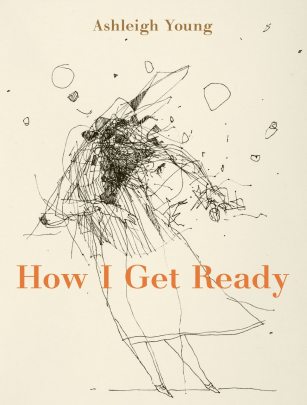
Ashleigh Young (from How I get Ready, Victoria University Press, 2019)
Ashleigh Young lives in Wellington and works as an editor at Victoria University Press. She is the author of Magnificent Moon (poems), Can You Tolerate This? (essays), and How I Get Ready (poems). She writes a fortnightly column in Canvas magazine and is the poetry editor at The Spinoff.



 NZ Poetry Shelf