Category Archives: NZ author

Poetry Shelf Winter Season: Anne Kennedy off-piste


Die die, live live
1.

A puff of air
like a lover’s
sweet speech
bubble, blue
as sky. A brown
horizon turning
fast into tomorrow
and tomorrow, etc.
Mud and leather
and a man
who runs like rubber
drawn from itself
over mud
born from
its muddy
mother field.
A kick-off
and the howl of
a moon’s dog.
They kick
the tender thing and kick and kick the tender thing
and wail and sing.
Five-nil to them.
Fuck. And fuck
the conversion
too. More
points for them.
The ball sings.
The wind
sings a hymn
down the Saint
Patrick’s Day
parade-length
of field
and the wind
blows the ball
where it shouldn’t
go. You have to
hope these idiots
grasp softness
the idea of it
its air and
innocence.
Twelve-nil to
the other side.
Conversion? No.
A rose blooms.
The fullback
there he goes
into a scrum. He’s
in the scrum
for his girlfriend
the girl he loves.
A torn ear a red rose the love-song of the fullback
a big man a
fucking giant
look at him
run. A lot of blood.
He runs for the
invisible woman.
He’s a moving tree
a flowering
tree. The Aussie
should be sin-binned.
Oh. He is.
Penalty. Twelve-
three. Tenderness
and the terrible
wind-sound
necessary for
play. They kick the tender thing and kick and kick
the tender thing
and wail and sing.
A man jumps
to his feet
throwing the hand
of his girl into
the sky. He flails
and beseeches.
Go go go go go!
It’s her envoi.
A guttural
call Moss has
never heard before
coming from
here and here
a beating on
the edge of seagull
i.e. clarinet.
There’s a rolling
maul, players
scragging faces
with sprigs. The referee
runs and blood
runs like tears.
Penalty. Twelve-six.
Go man boot
the groaning
air cradle it
as your child.
Don’t fucking
drop it idiot.
A moan goes up.
It rests in
the bodied
stadium staying
there, living on
among the people
as damage.
They kick the tender thing and kick and kick the tender thing
and wail and sing.
Rain starts. Good
for the home team
(used to it).
The visitors gnash
their teeth. Mud
sprays men
into fossils
memento mori.
They’re covered
in the game
head to foot.
Outrageous penalty
fifteen-six. Fuck.
A scrum in mud
and more rain.
The field is
ankle-glass
sometimes shattered as a dance once seen moved in water
a splish and trail
like scarves.
Half time
(FW).

2.

The land shaved
of trees made
useful by
its nakedness
and water. Men
stand as if cattle
mirrored at
a trough. A whistle
like a cast
in a roving
eye roving
over the field.
The men swarm
towards the ball
flicking earth
and sky.
The Centre’s
butchering
down the field
as a lion hunts
prey in the late
afternoon.
As a boy he
loved animals.
Off-side. Fuck.
Blood and
sweat and blood
and the crack
of bones. They kick the tender thing and kick and kick
the tender thing
and wail and sing
and wail and sing.
A man is carried
off by St John’s
Ambulance. Ah well
Fifteen-eleven
but missed the
conversion the
egg. Another
kick-off and
before long
a line-out whatever
that is. A player
hurling himself
into infinity
running and falling
and not caring
his body everything
and nothing
hovering
on the brink of
his death, death
of a small
nation. He is
a carcass
or palace. He’s carried off by St John’s Ambulance.
But there’s a penalty.
Fifteen-fourteen.
They kick
the tender thing
and kick and kick
the tender thing
and wail and sing.
Howl and a face
coated in the season
and the game
is a season
imperative
compulsory
gone again and
a girl who walks into a woman. And rain drums length
of rain
drumming.
It’s late
and the sun dips
below the cap
of cloud touching
the heads of
the crowd limning
a moment blue.
They kick
the tender thing
and kick and kick
the tender thing
and wail and sing.
On the field
blood squelches
underfoot.
Twenty-fourteen.
Paul weeps
on her shoulder.
They’ve lost.
If they’d won
there’d be
just the same
weeping like a
well a stream
or cataract. She holds his bones under her hands
his back
where wings
might once
have been.
A good man
full of tenderness
giant i.e. a lot of
tenderness.
The small mercy
of no conversion.
A minute to go.
A man runs
down the field
like a doctor
in a field hospital.
A try to us!
Forty seconds
to go. The
half-back
lines up the
wet egg
of the universe
and after some
deliberation kicks
the tender thing.
And wails.
And sings.
Converted.
The sun sinks
The whistle blows.
They won!
(i.e. We won
apparently)
Paul and his mates
leap to their feet.
Hell we won.
They leap one
by one. Fintan
leaps to his feet.
Look even
Forest is leaping
to his feet. Moss
carried away with
the win and
Paul weeping
and giants leaping
and without thinking
she stands.
She looks down
at the long body
her old favourite.
And glances up
at the great giant
there beside her
a head taller
(no matter, he will
soon go away now
the game is over
and there is just
Finnegans Wake
to read or whatever
tall tale it was).
Light from
the tall lamp casts the giant shadow of the girl over Paul.
He is bathed
in a quick new
coolness, as
dusk falls suddenly
in the Tropics
and feels it
and stares up
at the girl and
backs and backs
(the love song
of the full-back).

© Anne Kennedy from The Time of the Giants (Auckland University Press, 2005)


Author note: Writing poetry at all was a jumping of the tracks for me, and although my prose was ‘poetic’ and my poems prosey, the change still felt enormous, like doing something other than writing. (I still think of it as not really writing, more arranging.) Boiled down, the change to poetry for me was to do with noticing the cool juxtaposition between freedom of language (a poetry reader is more likely to make leaps with you), and the restraint of form that is always there on the page in front of you.

The poem here (which I call my ‘rugby poem’) is from a verse novel, The Time of the Giants. It represents for me a few realizations. The first is the power of line breaks. They are marvellous things! Always have been, but with this poem I began to regard them anew, not just aurally, but visually – as a means to isolate words like stones in a Japanese garden.

With Giants I also realized I wanted to use a quite honed three-act structure to tell the story. In this poem, I knowingly brought together the whole cast at the end of Act III.

But why use this form to tell this part of the story? (I ask myself.) Because it’s fast, and the narrative is on full-throttle at this point; and because I wanted it to be high-energy like a pre-match haka, and a bit funny, and the line-breaks are ludicrous. (When you think about too much, all line breaks are ludicrous.)


Anne Kennedy‘s last book was the novel, The Last Days of the National Costume. Among other awards she has won the NZ Post Book Award for Poetry and the Montana Book Award for Poetry. In 2016 she was writer in residence at the IIML. Anne teaches creative writing at Manukau Institute of Technology.


From Paula: For Poetry Shelf’s Winter Season, I invited 12 poets to pick one of their own poems that marks a shift in direction, that is outside the usual tracks of their poetry, that moves out of character, that nudges comfort zones of writing. It might be subject matter, style, form, approach, tone, effect, motivation, borrowings, revelation, invention, experimentation, exclusions, inclusions, melody …. anything!
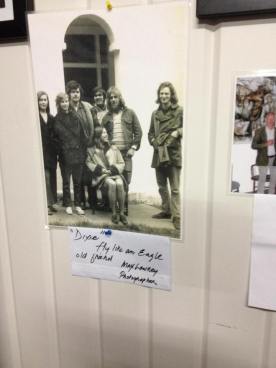
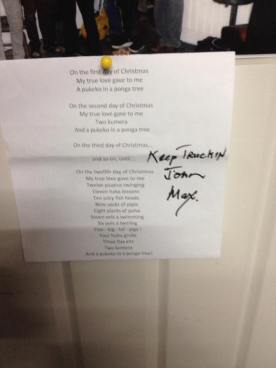


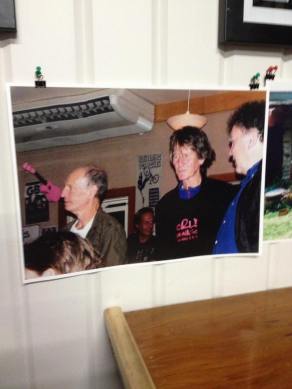
Kay McKenzie Cooke shares photos and comments on Dunedin’s farewell to poet, John Dickson


20293994_10211363283370214_8533850798113312235_n.jpg  20292864_10211363282450191_926639157787563302_n.jpg

At times last night’s memorial poetry reading for John Dickson felt like friends gathered in a room together, having a quiet drink and reminiscing about their friend Dixie.
Fitting somehow that it was held in the Crown Hotel. Is it because the beloved Crown is such a Dunedin venue – non-pretentious, down-home, verging on grungy, established, under-stated, historical, storied – as if all the people who have frequented, hosted, performed, chatted and imbibed there have left behind some invisible imprint of themselves?
At other times the night took on the air of a formal poetry reading befitting and honouring a much-revered poet.


20292969_10211363282330188_4281611238851633488_n.jpg  20375938_10211363282010180_7491810256740697715_n.jpg

Poet Richard Reeve opened proceedings by reading poems from John’s last book, Mister Hamilton.


20292838_10211363281050156_2961189889695682918_n-1.jpg


Jenny Powell read John’s famous Miles Davis poem; her delivery a tour de force and much appreciated by John Dickson aficionados present.
I read some of my own poems – poems about Dunedin and its streets and poets; poems which I hoped would reflect in some small way a poet I admired.

David Eggleton read two of his own poems, introducing his reading by saying he first met John thirty years ago and remembers, among other things, his gift as an entertaining raconteur of circular stories.
Richard spoke about how he got to know John in 1996 when he was a student and recalls their complex discussions about poetry, admitting that probably neither understood what the other was talking about. He also mentioned the value he placed on John and

Jenny’s friendship, and their visits to his Warrington home (which John dubbed as ‘bucolic’).
Richard also mentioned that in the 1980’s, John and Cilla McQueen ran poetry readings in Dunedin, which were attended by poets such as Hone Tuwhare and Bill Manhire.
John’s gift of friendship was mentioned many times – so much so that it became a feature of the night.

Max Lowery spoke about his friendship with John over many years and his regard for him both as a person (a friend, a flat-mate) and a poet. Towards the end of the evening, a quiet and reflective mood filled the room as Max talked about the photos of John that he had put up on the wall, and shared the memories that they evoked.

Alastair Reid also spoke of his close friendship with John, allowing someone like me, who didn’t know John well, insight into his individual take on life, his love of life, his curiosity about life and his love of learning, right to the end.

Alastair Galbraith also spoke about John’s dry humour, his laconic, unpretentious way of always just being himself. In particular, he spoke about John’s reading of his poetry. How amazingly deliberate and almost mesmerising it was. He recalled memories of recording

John reading his poetry and had the cds available for anyone wanting to buy them.
Richard read an excerpt from a twenty-eight page (yes, that’s right; twenty-eight page!) poem John had sent him as a response to a (much shorter) email Richard had sent him when the Irish poet Seamus Heaney died, thus treating those of us there to part of this poem’s dazzling, sweeping trains of thought.

Flatmates, poetry-reading mates, fellow poets, friends … all recalled John’s sense of humour and uniqueness.

Over and over, John Dickson’s warmth, regard, his gift of inclusion, of friendship, his intelligence and extraordinary complexity and depth as a poet, came through what people said and read.

Dixie will be greatly missed.

Kay Cooke, July 2017


20476088_10211363281890177_7940763199827956824_n.jpg  20294445_10211363281410165_5550758669763182706_n.jpg

20293078_10211363280570144_7161329800315891825_n.jpg20375909_10211363280410140_6383964667389936102_n.jpg

Winter Poetry Season: Hannah Mettner off-piste


My children are abducted by 17th-century French courtesans

In the rose garden near the big house
where somebody famous was either
born, or not, all the ladies spread their
pinks out in the sun. Pretty young ladies
with expensive, dewy faces who want
my children for their photogenic walls.
They look as though they’re picnicking
with their floral bubbles and their green
men but their stiletto fingers give them
away. And my children were just feeding
ducks, but where have they gone?! Quick
say the birds Find them Find them, gobbling
their trails of bread. The ladies strengthen
in the light and their prickles rise and my
nose is so full of their French scent that
I start to sneeze. The ladies wilt a little in
revulsion. Their corals and blushes and rouges
are falling brown, then grey; old ladies with
shallow bones and prickles blunted with
age. And where are your children they
want to know and I want to know too.
I’ve looked everywhere. There’s a low
graze of desperation in my throat, which
stings as I call their names. I uproot one
of the ladies and use her to beat back a
path through the others, until they look
almost young again in the freshness
of their bruises. When I get back to the
pond most of the spinsters have frosted
in the ground. The children are there
wearing new fur coats. One is putting logs
on a fire, while the other pulls dinner
from the snow.

©Hannah Mettner, from Fully clothed and so forgetful (Victoria University Press, 2017)


Author note: This is the poem that helped me realise that there was a way to integrate the emotional authenticity that I want my poems to convey (in this case the fear of ‘losing my children’) with something less literal. For me, this meant that rather than merely ‘stating facts’ in a pleasant or interesting way with line breaks, I was able to tease out multiple concepts and feelings simultaneously in an environment less concretely related to the real world. So, this poem deals with my fear of losing my children after the breakup of my relationship with their father, but holds with that the fear of a potential ‘stepmother’, and the fear of them doing fine without me, but because none of this takes place in a recognisable world (rosebushes don’t usually turn into young women), I felt freer to say all that.


Hannah Mettner is a Wellington writer originally from Gisborne. She runs the online poetry journal Sweet Mammalian with Sugar Magnolia Wilson and Morgan Bach. Her first book, Fully clothed and so forgetful, came out earlier this year.


From Paula: For Poetry Shelf’s Winter Season, I invited 12 poets to pick one of their own poems that marks a shift in direction, that is outside the usual tracks of their poetry, that moves out of character, that nudges comfort zones of writing. It might be subject matter, style, form, approach, tone, effect, motivation, borrowings, revelation, invention, experimentation, exclusions, inclusions, melody …. anything!
20/20 Bringing poetry to the people with free online collection -part 3 now live

Poems here

Phantom Billstickers National Poetry Day celebrate their 20th anniversary this year and, to mark the occasion, are publishing free online poetry collection 20/20. The collection includes Poet Laureates, Ockham New Zealand Book Awards winners and strong new voices from recent collections and anthologies.

The 20/20 collection features 40 poems by New Zealand poets who represent the diversity and vibrancy of our literary talent. Twenty of the poets featured in the collection are acclaimed writers, who were invited to select one of their own poems that they felt spoke to New Zealanders now. They were also asked to choose a poem by an emerging poet or writer who they considered to be essential reading in 2017.

Paula Morris (Ngati Wai, Ngati Whatua), spokesperson for the New Zealand Book Awards Trust, said that she was “excited to see the range of voices selected here, and the ethnic and geographic diversity in the poets chosen by our twenty established writers. This list speaks to a ‘new’ New Zealand literature, and reflects how much our culture is changing and growing.”

The poems are published in groups of ten between 24 May and 25 August 2017, with Group Three (see below) released today. The featured poets and their chosen poems are: Auckland-based poet C. K. Stead and his choice Johanna Emeney (North Shore, Auckland); David Eggleton (Dunedin) and Leilani Tamu (Auckland); Elizabeth Smither (Taranaki) and Rob Hack (Paekakariki); Richard Reeve (Dunedin) and Michael Steven (Auckland); Robert Sullivan (Auckland) and Ngahuia Te Awekotuku (Waikato).

C. K. Stead
‘Into extra time’
The Black River (AUP, 2007)

picks:

Johanna Emeney
‘Subtext’
Apple & Tree (Cape Catley, 2011)

—————————————————————————————–

David Eggleton
‘Rakaia’
The Conch Trumpet (OUP, 2015)

picks:
Leilani Tamu
‘Avaiki Rain’
The Art of Excavation (Anahera Press, 2014)

———————————————————————————————————

Elizabeth Smither
‘Miss Bowerman and the hot water bottles’
Night Horse (AUP, 2017)

picks:
Rob Hack
‘Almost a Buddhist’
Everything is Here (Escalator Press, 2016)

————————————————————————————————————

Richard Reeve
‘At Frankton Supermarket, Queenstown’
Manifesto Aotearoa ed. Emma Neale and Philip Temple (OUP, 2017)

picks:
Michael Steven
‘Dropped Pin: Jollie Street’
The Story of My Past Lives
(Maungatoa Press, 2017)

———————————————————————————————————————

Robert Sullivan
‘Sullivan Whānau’
Star Waka (AUP, 1999)

picks:
Ngahuia Te Awekotuku
‘Pukeroa’
Puna Wai Kōrero: An Anthology of Māori Poetry in English ed. Reina Whaitiri and Robert Sullivan (AUP, 2014).
—————————————————————————————————————————————-

The 20/20 collection is being made available to all New Zealanders as a free download. The PDF can be accessed on Phantom Billstickers National Poetry Day, Friday 25 August, via this link

Phantom Billstickers National Poetry Day has been running continuously since 1997 and is always celebrated on the last Friday in August. Poetry enthusiasts from all over New Zealand organise a host of events – from poetry slams to flash and pop-up events – in a multiplicity of venues, including schools, libraries, bars, cafes and theatres. This year, Phantom Billstickers National Poetry Day takes place on Friday 25 August 2017.

Established in 1997, National Poetry Day is about discovery, diversity, community and pushing boundaries. It is a one-day national poetry-event extravaganza held on the last Friday of August each year. This is the second year of National Poetry Day operating under the sponsorship of Phantom Billstickers.

Phantom Billstickers National Poetry Day is proudly administered by the New Zealand Book Awards Trust.

Poetry Shelf Winter Season: Cliff Fell off-piste


Cento: The Rose of Tralee


I began to investigate the world,

Tearing at something of the mystery of birds, calls,

And the blue and green of the riverbed.


Once, I read a story of killed horses.

It is copyrighted.

But when the huntsman knelt beside her,

A pistol in his hand,

The Rose of Tralee quivered like a quartertone,

Though soundless. A fountain of roses flowed from her head.


You don’t have to understand the tui’s song

To admire it. I was so much older then,

Though only a child –

It was bitter to say farewell to the earth so renewed,

Bitter to sing in chapel that week:


The body of each of us is your body, Lord.


Author note: I first wrote – or stumbled upon, really – ‘Cento: The Rose of Tralee’ in 2002, a significant year in my development as a poet. The making of the poem happened fast and involved a kind of trance-like going sideways out of my usual practice, a shift in direction or approach that certainly nudged me out of the comfort zones of my writing.

As its title indicates, the poem is a cento (of sorts), though when I was writing it, I did not yet know of the Latin form that lends its creative process an air of legitimacy. I think I was just experimenting with the possibilities of Eliot’s dictum about poets stealing and trying to make something better or ‘at least something different’ out of their thefts. So it was that one Sunday evening in that long, marvellous winter I was looking through a 1991 anthology of post WW2 eastern and central European poetry, The Poetry of Survival, edited by Daniel Weissbort. The poems are for the most part darkly moving, sometimes terrifying, born of the holocaust and the forging of the Iron Curtain. I think I was trying to find some translations of Slavko Mihalic by Charles Simic, as I was reading Simic at the time. I already knew the anthology well. It had been a bible of mine during the 1990’s, at a time when I was focused on extending my reading of 20th century poetry.

I can’t now remember exactly which line or poem set me off, but I suddenly began to wonder if I could make a poem by opening pages at random and selecting lines that caught my eye. By the time I’d come up with the key image, ‘Once I read a story of killed horses’ – a conflation of lines by Dan Pagis and Peter Huchel – I had invoked a childhood memory of a horse being shot. This was on a farm where I was working a summer job, aged 14. So, the narrative of The Rose of Tralee’s sad demise, her hoof trapped in a crevice, began to insert its voice into a solemn parade of lines that have their origins in poems by Nina Cassian, Paul Celan, Leopold Staff, Zbigniew Herbert, Czeslaw Milosz, Agnes Nemes Nagy. Others, maybe, that I cannot now trace. In a moment of light relief, ‘It is copyrighted’ was an amusing, ironic aside from the sixteenth canto of Hans Magnus Enzenberger’s ‘The Sinking of the Titanic’. As I tried to resolve the poem, as a nightingale transformed into a tui, I must have started casting my net wider. It seems clear to me now that ‘I was so much older then,’ must be a steal from Bob Dylan’s ‘My Back Pages’. How it got in there, I can’t quite remember, but it did.

Cliff Fell is working on a fourth book of poems.


From Paula: For Poetry Shelf’s Winter Season, I invited 12 poets to pick one of their own poems that marks a shift in direction, that is outside the usual tracks of their poetry, that moves out of character, that nudges comfort zones of writing. It might be subject matter, style, form, approach, tone, effect, motivation, borrowings, revelation, invention, experimentation, exclusions, inclusions, melody …. anything!


Poetry Shelf Winter Season: Johanna Emeney off-piste


Shaken Down


In the hospital corridor,

the one two of my shoes

on hard lino,

then something

sounds broken—


a thermometer—


I have left people here

in rooms

and cabinets.

They’ve gone cold

in others’ hands.


The spine of me

spills

into so many

ball bearings…


Orderlies wheel

prone passengers.

Nurses pass

with busy eyes,


until one pauses

to put on gloves,

coveralls, booties.

She sticks up a sign


[DANGER HAZARDOUS SUBSTANCE]


and calls

for a flashlight,

holds it at an angle

to find beads of me-

rcury lodged in cracks

between wall and floor.


Without a fuss

she gathers masking tape,

an eyedropper,

index cards,

and uses them to

corral what is herdable

into new glass tubing.

Her cards say:

MY MOTHER DIED

WHEN I WAS YOUNG TOO, LOVE


What miracle

to approach

naked breakage,

to chase it unafraid,

gather it up

and talk it back down

to something

resembling normal.


©Johanna Emeney,  Family History, Mākaro Press, 2017


Author note: “Shaken down” grew from two ideas rattling about—a fresh one and a memory:

1) A friend told me that one of the first jobs nurses learn is to shake down a thermometer.

2) I kept thinking of a nurse who had been exceptionally kind to me on the night my mother was killed. This nurse, probably about twenty years my senior, told me about losing her own mother, and how it had affected her.

This is the first poem I wrote that departs from naturalism, moving towards a very minor kind of magical realism. To start with, I was just trying to recapture the experience of walking alone down a hospital corridor, having lost my mother in a car accident, my father still in the ICU. The huge loneliness and disbelief still felt such that they called for more than a realist presentation. The broken thermometer, leaking its apparently irretrievable, noxious mercury, the I-speaker, her spine turning liquid and draining out of her body—together, they were what it was like.

The nurse in the poem who executes practical measures in tidying up the mess (I had to google “how to clean up a small Mercury spill”) is supposed to symbolise that beautiful truth about good nurses—their ability to balance the medical and the personal so adeptly.

Had I not ventured into territory more fantastical than my norm, I think the poem would have been sentimental and lacked emotional verisimilitude. That would have been a shame, because to express gratitude genuinely, you can’t sound mawkish or trite—in real life or in a poem.


Johanna Emeney’s two books of poetry are Apple & Tree (Cape Catley, 2011) and Family History (Mākaro Press, 2017). In 2018, Ibidem Press will publish her academic textbook The Rise of Autobiographical Medical Poetry and The Medical Humanities, based on her doctoral study, and she is currently working a chapter on poetry for Routledge’s Companion to Literature and Disability. Jo has a background in English Literature, Japanese and Education—subjects she read at Pembroke College, Cambridge. She works as a tutor at Massey University, Auckland, and co-facilitates the Michael King Young Writers Programme with Rosalind Ali.


From Paula: For Poetry Shelf’s Winter Season, I invited 12 poets to pick one of their own poems that marks a shift in direction, that is outside the usual tracks of their poetry, that moves out of character, that nudges comfort zones of writing. It might be subject matter, style, form, approach, tone, effect, motivation, borrowings, revelation, invention, experimentation, exclusions, inclusions, melody …. anything!
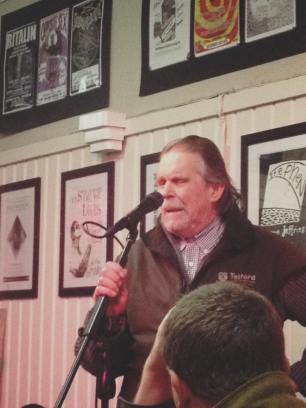
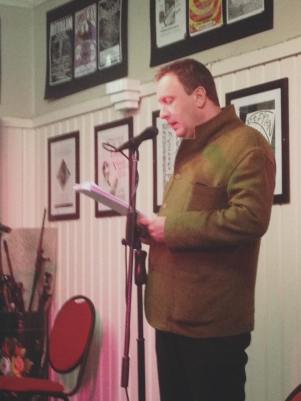
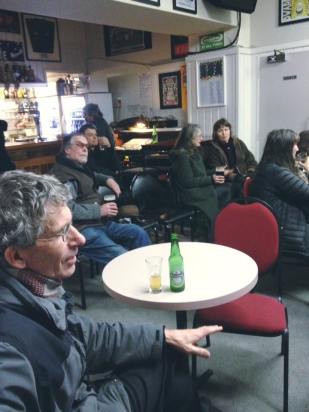
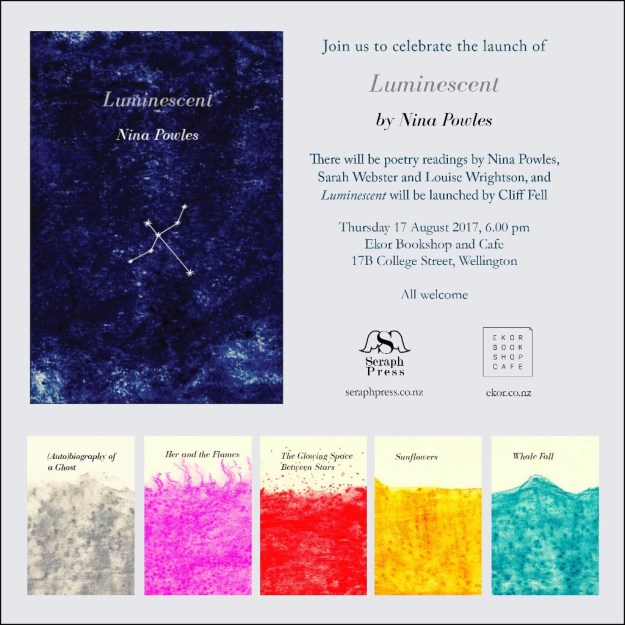
Invitation to launch of Luminescent by Nina Powles

dc10965e-f65b-4cd6-80eb-5c44f8a3eb4b.jpg06da5a13-4f07-4345-9e92-80f1401630eb.jpg

The latest Starling: fresh young voices, new poems by Chris Tse and a Bill Manhire interview


Ruby+Joy+Eade.jpg

The Starling Issue 4


Ok, I am a big fan of this.

This is an excellent issue. Featured writer, Chris Tse’s poems are rich in direction and effect.

Most importantly, the editors are adept at selecting fresh young voices that make you hungry for poetry (and short fiction ) and what words can do. I was going to single a few out – but I love them all! Eclectic, energising, electric, effervescent.


Screen Shot 2017-07-25 at 4.27.11 PM.png


Bill’s interview is a good read:

On rhyme: ‘On the other hand I think sound patterns are at the heart of poetry – they tug words away from meaning and towards music. And one bizarre thing is that the need to find a rhyming word can force you to move in directions you might not have otherwise imagined. Rhyme can make you surprise yourself.’

On needing a dose of humour: ‘The greatest danger for poets is self-importance. Some poets really do believe themselves to be wiser and more perceptive than the rest of the human race.’

On getting students to bring poems by published poets to share in class: ‘The main thing would be that no one in the class would have their minds made up beforehand; or be trying to bypass the poem in order to find out ‘what teacher thinks’. It’s much better for the students to bypass the teacher and get to know the poem directly. Paradoxically, a good teacher can help this happen.’

Poetry Shelf Winter Season: Courtney Sina Meredith off-piste


Uprising


Please be

an uprising


scissor my

black lace


indicate


be light


I’m scared of losing my faith

in people

/

I’m scared of losing my face

/

when I look into silver

your lips kiss all the shit away


I want an electric guitar

with a big circle amp


someone beautiful could sit there

& fuss over me


I like controlling the sea from my bedroom

bleeding & tearing the moon


I like howling at my octopus tits

one in every room


I’m a virgin

framed


a baby grand

next to mops and brooms


please keep calling me


so I can watch

your name flash angry blue

/

a storm

under my pillow

/

electric lines smile in the sky


with my smallest finger

in the smallest hour

I trace the maze


you were good at holding me

when the rain had nobody to fall on


you were good at knowing

souls from bodies


I still wear my organs like 80s leather

I still hear your voice in the corner              be light              be light


©Courtney Sina Meredith


Author note: I was 22 when I wrote this and in a lot of pain, I had no idea what was ahead of me, ignorance really is bliss. Months later I would undergo my first major operation and my endometriosis would be confirmed. I was channeling ancestors and trashing lovers and asking myself to keep on giving when I really felt like there was nothing left to give.

Courtney Sina Meredith is a poet, playwright, fiction writer and musician based in Auckland. She’s held a number of international writers’ residencies including the prestigious Fall Residency at the University of Iowa. In 2012 Meredith published her first book of poems, Brown Girls in Bright Red Lipstick, and in 2016 launched a collection of short stories, Tail of the Taniwha, with Beatnik Publishing.

Courtney Sina Meredith, 2017 Arts Queensland Poet in Residence, will talk to Annie Te Whiu of Queensland Poetry Festival about her poetry, and the importance of place and politics in her writing, see here.


From Paula: For Poetry Shelf’s Winter Season, I invited 12 poets to pick one of their own poems that marks a shift in direction, that is outside the usual tracks of their poetry, that moves out of character, that nudges comfort zones of writing. It might be subject matter, style, form, approach, tone, effect, motivation, borrowings, revelation, invention, experimentation, exclusions, inclusions, melody …. anything!


Poetry Shelf Winter Season: Ian Wedde off-piste


From ‘A hymn to beauty: days of a year’


Beauty

you’re the trouble I’m in

because there’s a lot of sweetness in my life

with that rude kind of magnificence

as when they hung Le Bateau upside down,

unusually animated and sparking.

Happy Birthday Montgomery Clift:

Where did I see this guy—in Red River

or in From Here to Eternity?

Accept and you become whole

bend and you straighten.


I hung around a little too long

I was good but now I’m gone,

I may find myself in a tight spot

but forge ahead

where satellite images show Yongbyon

and a mariner in the distance appears cordial.

Happy Birthday Betty Hutton

who is to be found in the lines and gradations

of unsullied snow

for your heart will always be

where your riches are.


They’re Justified and they’re Ancient

and they drive an ice-cream van

so do what will help

and don’t worry what others think

if King Kong premieres in New York.

In his eyes, beauty may be seen.

Happy Birthday Lou Reed,

as fast as a musician scatters sounds

out of an instrument.

One thing only do I want

to marvel there.


©Ian Wedde Three Regrets and a Hymn to Beauty (Auckland University Press, 2005)


Note for poetry shelf

In ‘Enjoyment’, the preface to Selected Poems (2017), I ‘confess to restlessness and the enjoyment of subverting my own practice’, which is one way of saying I got bored with myself and switched tracks regularly over the years. In a selection covering fourteen collections these swerves look more abrupt than they were. One place where they converge is in ‘A hymn to beauty: days of a year’, a sequence of fifty-seven sections that sampled lines from songs, the day’s horoscope advice to Librans, a ‘today in history’ clip from the Evening Post, the birthday of someone famous, a quote from the shambolic literature of the Sublime, and a religious homily. It took up 22 pages in its original covers (Three Regrets and a Hymn to Beauty, AUP 2005) and I only stopped when a sensible little voice told me to—I was having too much fun. It took me out of an autoethnography groove, it allowed me to mess around with a complex word, beauty, without being trapped by aestheticising lyric conventions, and it construed narrative meanings that had nothing to do with my intentions. Fergus Barrowman first published the whole thing in Sport 32 (Summer 2004) for which I thank him. Here are three sections, the opening one and two more picked at random with my eyes shut.


Ian Wedde’s first (very small) book was published by Amphedesma Press in 1971 and in May this year his (fairly chunky) Selected Poems was published by Auckland University Press, with artwork by John Reynolds. A small book about the art of Judy Millar, Refer Judy Millar, is just out from Wunderblock in Berlin. His essay ‘How Not To Be At Home’ is in the anthology Home: New Writing just out from Massey University Press.


From Paula: For Poetry Shelf’s Winter Season, I invited 12 poets to pick one of their own poems that marks a shift in direction, that is outside the usual tracks of their poetry, that moves out of character, that nudges comfort zones of writing. It might be subject matter, style, form, approach, tone, effect, motivation, borrowings, revelation, invention, experimentation, exclusions, inclusions, melody …. anything!