Category Archives: NZ author

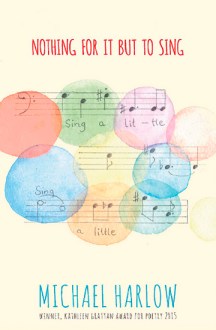
Michael Harlow’s Nothing for it but to Sing – This is poetry of the unlived as much as it is of the lived

LS3316_55_SUP_Nothing-For-It-But-To-Sing.jpg


‘Sometimes there is nothing for it but to sing;

to discover what there is in you to attain, when the light

comes stealing in’


from ‘Nothing but for it Sing’


Nothing for it but to Sing, Michael Harlow, Otago University Press, 2016


Michael Harlow has published ten poetry collections, one of which, The Tram Conductor’s Blue Hat, was a finalist in the New Zealand Book Awards. He has held numerous fellowships and residencies and his latest collection, Nothing for it but to Sing, won the Kathleen Grattan Award for an unpublished manuscript.

This shiny, ethereal collection, full of paradox and light, follows curved lines, follows song. The poems are written out of being and unbeing, out of the unconscious and the dreamed world, out of lived experience. More than anything, it almost seems like there are no things but in ideas, because this is poetry of an itinerant mind, of a heart absorbing a world that is hypothesis, abstract thought, love, attachment and continuity.

This is poetry of the unlived as much as it is of the lived.

The poetry is of strangeness to the point it delivers philosophical relations to the oxymoron: ‘What it was he saw ‘beyond’/ where his looking had gone, there’s no telling.’ ‘I’m looking for nothing/ you could put a name to right now.’ ‘[M]y mother died before she was born.’

Some of the poems are like songs for the departed:

‘And you know,

drawing the ‘short straw, you are finally

going to have a crack at the silky darkness.’


‘Until one morning when no birds sang,

emptied of all that can be said,

soul-window open—he woke up dead.’


More than anything, Michael sings his poetry into being. Song is there, steering the line, but it is also there as an echoey and insistent motif:


‘All his life

he kept looking for the one song

to sing him. A high-wire troubadour

on air, he said that writing

is the painting of the voice.

His wish that not one word be unsung.’


Elizabeth Smither writes on the blurb: ‘His poems ask the hardest questions we are capable of and answer them in fables, discourses and unquenchable curiosity.’

The book did set me thinking about my attachment to things in poetry. Is it necessary? Do I want the grit and the everyday settling along with the mind daydreaming along the course of a line? This collection overturns our contemporary insistence on locating feelings, ideas and human activity in the world of physical things. It is what I am so often pulled towards as I write. It is what I am drawn to as I read.

This is a very lovely, overturning, uplifting collection.


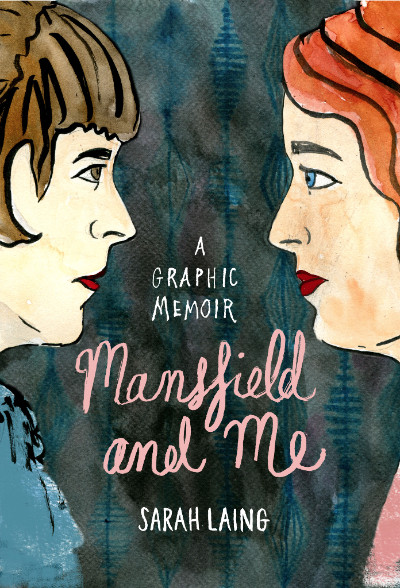
A must-go book launch: Sarah Laing’s Mansfield and Me

58259589-4613-48dd-b8db-36a95a091c62.jpg


Victoria University Press warmly invites you to the launch of
Sarah Laing’s new graphic memoir

Mansfield and Me

on Thursday 6 October, 6pm–7.30pm
at Unity Books, 57 Willis St, Wellington

All welcome!
About Mansfield and Me

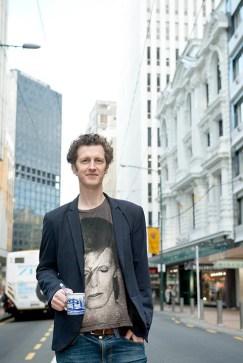
From Better Off Read – Episode 36: Nick Ascroft and Pip Adam talk about Throwback 2007

nick-ascroft024-small.jpg


From Pip Adam’s excellent podcast series:

‘Nick is an amazing poet and he has a new poetry book, Back with the Human Condition coming out on October 13 this year.

However, what 2016 is proving is that Nick can also tell you How to Win at 5-a-Side and that he is pretty awesome to talk to and read about music.

Throwback 2007 comes out later this year and is the first in series which celebrates the yearly mix tapes and play lists Nick has been making for ages.’

You can listen to the playlist for 2007 here


Here’s the podcast and more links

Announcing Ka Mate Ka Ora Issue #14

Ka Mate Ka Ora: A New Zealand Journal of Poetry and Poetics issue #14 is now live.

This issue features:

John Newton on Allen Curnow: ‘Running with the Fast Pack.’

Michele Leggott on soldier poet Matthew Fitzpatrick: ‘Touching the Taranaki Campaign: The Poems of Matthew Pitzpatrick August-November 1860.’

Makyla Curtis on bilanguaging in poetry: ‘Ngā Toikupu o Ngā Reo Taharua: e Tākiri ana te Aroā Pānui/The Poetics of Bilanguaging: an Unfurling Legacy.’

Vaughan Rapatahana discusses his theory and practice: ‘Writing Back (to the centre): practicing my theory.’

Ricci van Elburg on Second World War poets in Holland: ‘Pekelkist: some poets’ responses to war.’

Brian Pōtiki remembers Rowley Habib/Rore Hapipi: ‘The Raw Man’ and also provides an account of Rowley’s tangi.

AND PLEASE NOTE:

Issue #15 of Ka Mate Ka Ora will be devoted to work by postgraduate student writers and scholars. This is a first call for essays, discussions, theory and polemic from postgraduate students. Please send contributions to:

Murray Edmond, Editor, Ka Mate Ka Ora:  m.edmond@auckland.ac.nz

Three cheers for Going West’s 21st


IMG_3531.jpg

My Place/ View

‘Now our literature shapes how we see ourselves and our cultures – challenging stereotypes’

Albert Wendt Going West 2016


There was a lot of talk about place and where you come from at Going West this year. I live in West Auckland but seem to come from many places so don’t think of myself as a West Aucklander. I have anchors here and anchors elsewhere, but I have strong attachments to my local literary festival. I like the way it embraces a literary whanau. We share very good food and we share stories.


Like other New Zealand writers I am very grateful for the local festivals that celebrate local writing no matter the degree of international presence. Earlier this year I flew to Wellington to see The National Library’s fabulous Circle of Laureates event. It was a very special occasion but I was hard-pressed to find many other local fiction or poetry events at the festival. I see this as such a loss – not just for Wellington readers and writers but for all of us.

Auckland seems to be upping its game at their major festival. The dedication to New Zealand writing of all ilks is tremendous. It is a huge festival, overwhelming in terms of crowds and choice, but every year I come away rejuvenated as both reader and writer.


Going West is one of our key local festivals —  100 per cent devoted to New Zealand writing that crosses a range of genre, subject matter and format. This year was no exception. With new programme directors (Nicola Strawbridge and Mark Easterbrook) things were slightly different but the end result immensely satisfying. My only regret was the little poetry slots that used to pop up between longer sessions. I missed those.

The sun shone, the food was as good as ever, and I came away with a stack of books to read. Hearing Damien Wilkins read from Dad Art (two extracts) and share ideas and anecdotes with Sue Orr was so good, I raced to get the book. I loved the detail, the humour, the premise of the book, the absolute warmth and human pulse. This book deserves a wide readership.

I got to hear Emma Neale read as the Curnow Reader with her pitch-perfect melody, tender eye and acute detail of family  (among other things). Emma was also in conversation with Siobhan Harvey about her new novel, Billy Bird, and again an extract from the book and a fascinating conversation made me race to get the book. Already I am drawn to this curious boy who thinks he is a bird. Emma will also read from this at The Ladies LiteraTea in October.

Albert Wendt gave a terrific speech on Friday night that rattled our literary complacency. Where are the Pacific voices? he asked with both fire and poetry in his belly.

I missed the Poetry Slam but saw Robert Sullivan in conversation with Gregory Kan and Serie Barford. Thoughtful questions that included rocks, sediment and the thorny issue of revealing family. I came away thinking if I were a book-award judge this year I would honour This Paper Boat as it resonates so deeply with me.

Then there are the sessions you have no familiarity with. I loved a session on NZ rivers, for example, and came home with books on that topic (Dr Marama Muru-Lanning).

I ended the festival (I missed the beer session sadly) with the conversation between John Campbell and Roger Shepherd. A perfect close for me because it took me right back to listening to music in Auckland in the 1980s when I wasn’t listening to music in London (82-86). It was funny and sad and surprising and nostalgic and inspiring. How lucky we are to have John on National Radio bringing us stories that matter and ask questions that matter even more.


Thanks Going West. It was a privilege to be a small part of your festival on stage and a member of the audience over three days. I came away exhausted yet full. Festivals like this ( I am thinking of the ones in Nelson and Wanaka too) matter. Congratulations team – it was a fine occasion – like a family picnic in a way. There was warmth, prickly questions, delicious connections, challenging ideas, good stories told, a generosity of ear and mouth. Bravo!


PS I went early one morning so I could breakfast on delicious Turkish eggs at Deco, the Lopdell House cafe. Great view. Very good food and coffee! Highly recommended.


Laurence Fearnley’s new novel – a taste of my review

1472600468959-2.jpg


The Quiet Spectacular
Laurence Fearnley
Penguin, $38

‘Laurence Fearnley’s new novel is a lovely read, a moving read.

Three women are the heart of the book: Loretta, Chance and Riva. We meet them individually, but their lives overlap and begin to knot together. It is a novel of so many things — friendship, dangerous women, smothering mothers, dutiful daughters, undutiful daughters, land care, books.

It is a novel of ideas and it is a novel of empathy.’


My review is published today in the Press and The Dominion. For my complete review go here.

I love this book. I love its slowness and its penetrating heart. The title is a perfect fit.

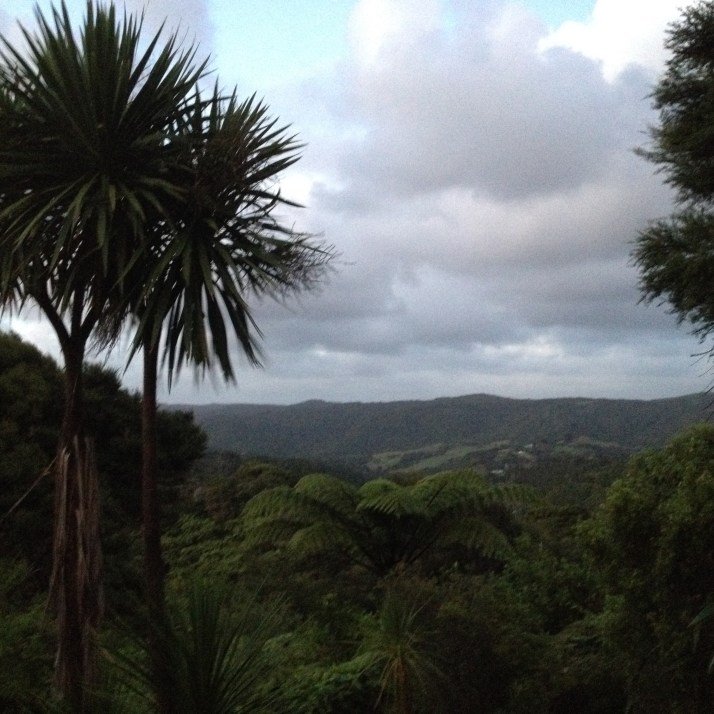
This morning when I was shedding glumness, I decided a daily dose of the quiet spectacular is a necessary balm. Just looking out at the rolling sea mist and the tail of the Waitakere ranges and the spiky nikau. That will do. Or a novel like this.

Interview on Standing Room Only.

New Voices, Emerging Poets Results 2016

mchotewinner.jpgivasm.jpg

Michelle and Iva, winning emerging poets

This event, steered by Siobhan Harvey, has become an annual event in Auckland on National Poetry Day. Check out the winning poems by following the link. Both terrific!


The 2016 Divine Muses XIII : evening of poetry was this year MC’d by Linda Tyler, Director of the Centre for Art Studies at The University of Auckland. The University’s Gus Fisher Gallery with its beautiful stainglass dome provided the wonderful venue for the readings.

Linda Tyler welcomed and invited this year’s stellar line up of poets to read from a selection of their own poems. Vivienne Plumb, current writer in residence at the Michael King centre in Devonport, read first; followed by Riemke Ensing, Maris O’Rourke, Siobhan Harvey, Jenny Bornholdt, and Gregory O’Brien.

At the close of readings the winners of the 2016 NEW VOICES – Emerging Poets Competition were announced by judge Vana Manasiadi. Michelle Chote and Iva Vemic then read their winning poems. Unity Books of High Street kindly donated the book prizes for this year’s winners.

The last event of the evening was the launch of two new letterpress broadsheets. Limited Poetry Broadsheets were introduced last year by the organisers to help raise funds to support New Voices. The two new broadsheets were printed by Wellington letterpress printer Brendan O’Brien of Fernbank Studio. They featured poems by Gregory O’Brien and Jenny Bornholdt. Click here for further details

The winner is  Michelle Chote and runner up is Iva Vemic.


New Voices, Emerging Poets Judge’s Report, 2016 (Vana Manasiadis)

I loved reading the entries for this year’s competition; it was an honour and a privilege to be entrusted with voices that took me to places as diverse as K road, Jerusalem, Santiago, Pike river, Prague and Kakamatua; and allow me presence during conversations with New Zealand poet elders, Denis Glover, Lauris Edmond; and American, Marge Piercy, Susan Howe. In all the poems I read, there was a magic and transport, and for me that is always the most important thing. I looked forward to reading the entries while I was still in Crete trying to find the threads myself, the connections in my case between words in different languages. And I thought about the words ‘language’ and ‘translation’ a lot – and certainly poetry contains a multiplicity of languages: of image, of sound, of turn, of contact. So when I finally got my hands on the entries, I looked for these different languages and their relationships to each other; and ultimately, to the translations. How was lonliness, love, loss being translated, sculpted and crafted and being offered to me, the reader, as something transformed? Water was a recurrring theme in this year’s entries, as was journey, and moving relationships with the dead and the living. So, fluidity, and arrival. I read the entries many times until I arrived myself at the shortlisted ten which succeeded particularly well in translating ideas of arrival, journey, surprise; and which showed deft use of the many languages of poetry. And I especially congratulate these poets tonight.

Highly Commended: I chose three highly commended poems this year, and the first of these is ‘Poppa’s Boat’, by Christel Jeffs, for the moving way themes of loss (of a beloved person, of childhood) and love, are evoked via turn and meticulous crafting. All five senses are alerted in this poem to memorable effect, the voice is authentic and assured, and it tells a story of presence, absence, presence in absence that is relateable, and felt true.

The second highly commended is ‘Home Thoughts, after Denis Glover’s poem’, by Annabel Wilson, a poem that insisted itself upon me. There’s a quiet confidence in the poem, a humility and ability to step back and let the images do the talking, that impressed me. The sustained image of the line drew me in and kept replenishing itself, and the implied dialogue with the poem’s inspiration, Glover’s ‘Home Thoughts’ pointed to the something bigger in poetry, to the community of voices.

The third highly commended is ‘Shoe Pads’, by Linda Lew, which was both delicate and dynamic in its treatment of the grandmother protagonist. The camera here pans wide and close in turns, as enormous historic events are checked by the grandmother’s quiet acts of love and shielding. I walked alongside her as she walked through decades of change, from Beijing to New Zealand. Always direct, never sentimental, she was kind and sturdy company.

Finalist: The second place goes to ‘A poem a day’, by Iva Vemich which, with its pace, choric repetitions, and surprising leaps of imagination made for memorable reading. I read this poem as a poem-essay, a poem that asks a question and shows its workings – in this case, ‘will poetry rescue’ (the poet, the community going about its daily business)? The responses – wry and perhaps a little ironic, but in a good way – were unexpected and evocative, and I was thrilled by many of the line breaks, and stream of consciousness connections.

Winner of the 2016 New Voices Competition:  The winning entry tonight is ‘A colonised woman speaks’ by Michelle Chote. This was one of the first poems I read, and it absolutely refused to slip away quietly. It kept calling with its layers of polemicism and consonant crash. In this poem, expression is not the means to an ends, but the thing itself – the syllables and the hollows a body allows us. So tongue, air, taste and belly establish the organic imagery, embody fury and revolt in lines like ‘dash dipthongs at the drop of a beret’. Listen for the ending which is a perfect coming together of sense and sound. Having read the poem aloud several times in an effort to absorb the sound effects, I’m particularly excited to hear this powerful poem read tonight in this beautiful space, as the winner of this year’s competition.

Vana Manasiadis

Emma Neale’s very lovely thank you speech at the launch of Billy Bird

Cover

So looking forward to this book – and to hearing Emma Neale at Going West and the Ladies Litera-Tea this year. Good to see Harriet Allen, one of our champions of New Zealand fiction, getting applauded. Here is a taste of Emma’s launch speech just posted on her blog.

…. although this is the bit about losing the launch speech – something we all blanche at the thought of …


Last night, my elbow must have hit an invisible delete button in the space-time continuum. I stapled and folded my launch speech, put it in my handbag, patted it to make sure it was in there safe and happy, and arrived at the University Book Store without my launch speech. Cue panic. Cue rushing back to the car, scrambling around to look under seats. No speech. And at home later that night: still no speech. It’s spooky. 

I had to extemporise, with my hands shaking, and I’m pretty sure I forgot something. So by way apology, I’m posting the original here. People who did attend can spot the difference! (The first one is that I forgot to say my quadra-lingual greeting.)

Tena koutou katoa, talofa lava, bonsoir, good evening, thank you so much for coming.

I’m very aware that it gets uncomfortable holding still and being quiet for a long time, especially if you are age six or under. Or maybe even if you’ve ever been six and under. My own six-year-old wrote to his headmaster recently to ask if he could incorporate exercises into assembly, because keeping still and quiet was very difficult if you have a busy mind and legs that tingle. So I wonder if, before I say all my thank yous, Zac would like to lead us all in a short game of Simon Says.


For the full speech go here

Poetry Shelf says ‘Happy National Poetry Day’ – my tips for you

Happy Phantom Billstickers National Poetry Day


There is a truckload of poetry events on today – I am going to at least three.


Check out Fiona Oliver’s post on National Library blog.


Send a poem to a friend – on a postcard, in an email, by snail mail.

Support our poetry publishers and buy a poetry book or three.

Give your favourite poetry book to someone.


Make up a poem using no more than twelve words.

Have afternoon tea with friends and talk about a poem that eludes you, or soothes you, or sparks or spikes you.

I am not brave enough but try reading a poem in a public place – on a pavement or bus or train.

Try poem busking.


w e l l i n g t o n        h e r e    I    come !


My gift is to post my IBBY presentation on line today which feels a little scary as I couldn’t sleep the night before I gave it.

(Behind every stone or refrigerator hum or cup of tea there is a poem. I feel like I have spent the night in an air-conditioning unit waiting for the silence of home.)


The Reading (for Peter Ireland)


New York City is Wellington

Wellington is Thistle Hall

and James Brown

is reading Frank O’Hara

with a slight sway, the sun

blinding like free verse halos

but still the couple

in the flat opposite smooth

the cushions, butter scones

phone  a friend, take

out the rubbish,

before Helen Rickerby

takes to the stage

and reads Rome.


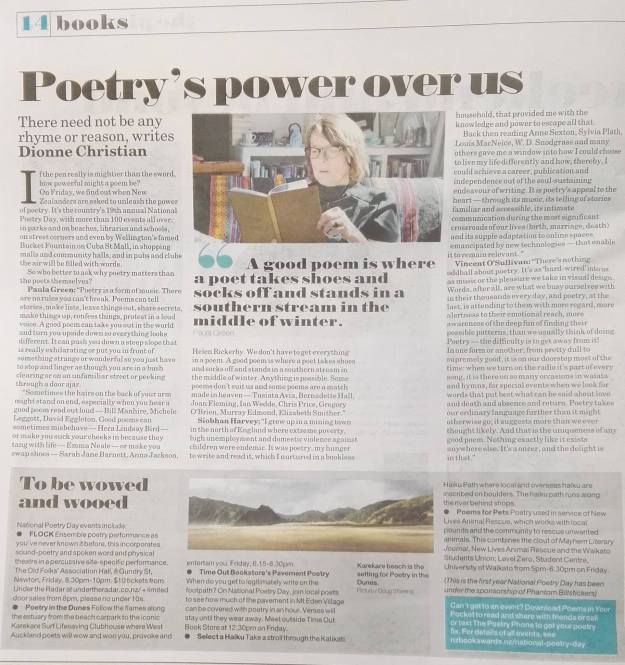
National Poetry Day in the Herald: some thoughts, a favourite poem and ten poems that have stuck to me

The NZ Herald invited to share some thoughts on poetry for National Poetry Day. Here is my contribution in full, including a favourite poem and a list of poems that have stuck to me.

DSC_0101.jpg

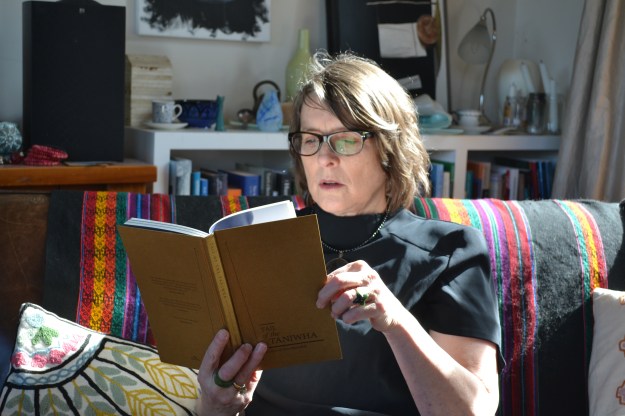
Paula with Courtney Sina Meredith’s fabulous Tail of the Taniwha


Josephine likes lyric poetry


Josephine likes the way a poet will pull in a bird or a ladder

or an old coat and the bird and the ladder and the old coat

will tremble and shiver and ebb and flow just like the sea

so you will fall upon the fullness of each and it will make

you shift on your chair and almost stop breathing.


From New York Pocket Book Seraph Press, 2016


Poetry is a form of music. There are no rules you can’t break. Poems can tell stories, make lists, leave things out, share secrets, make things up, confess things, protest in a loud voice. A good poem can take you out in the world and turn you upside down so everything looks different. It can push you down a steep slope that is really exhilarating or put you in front of something strange or wonderful so you just have to stop and linger as though you are in a bush clearing or on an unfamiliar street or peeking through a door ajar. Sometime the hairs on the back of your arm might stand on end, especially when you hear a good poem read out loud (Bill Manhire, Michele Leggott, David Eggleton). Good poems can sometimes misbehave (Hera Lindsay Bird) or make you suck your cheeks in because they tang with life (Emma Neale) or make you swop shoes (Sarah Jane Barnett, Anna Jackson, Helen Rickerby). We don’t have to get everything in a poem. A good poem is where a poet takes shoes and socks off and stands in a southern stream in the middle of winter. Anything is possible. Some poems don’t suit us and some poems are a match made in heaven (Tusiata Avia, Bernadette Hall, Joan Fleming, Ian Wedde, Chris Price, Gregory O’Brien, Murray Edmond, Elizabeth Smither, Steven Toussaint).


A favourite poem

I love Rachel Bush’s ‘Sing Them’ because she is singing out of near death, unfolding lines until they ‘float,’ and there is love and memory, even at ‘the cold leftover end/ of the rind of winter,’ and I feel sad as I read but she lets the world shine and each phrase is extraordinary.


Ten New Zealand poems that have stuck to me (sticky poems)

Jenny Bornholdt ‘The Rocky Shore’

James Brown ‘The Bicycle’

Anne Kennedy ‘Sing-Song’

Michele Leggott ‘Blue Irises’

Margaret Mahy ‘Down the Back of the Chair’

Bill Manhire ‘Hotel Emergencies’

Selina Tusitala Marsh ‘Fast Talking PI’

Cilla McQueen ‘Being Here’

CK Stead ‘Auckland’

Hone Tuwhare ‘Rain’


13988077_1154441617973440_258295689424423592_o.jpg