
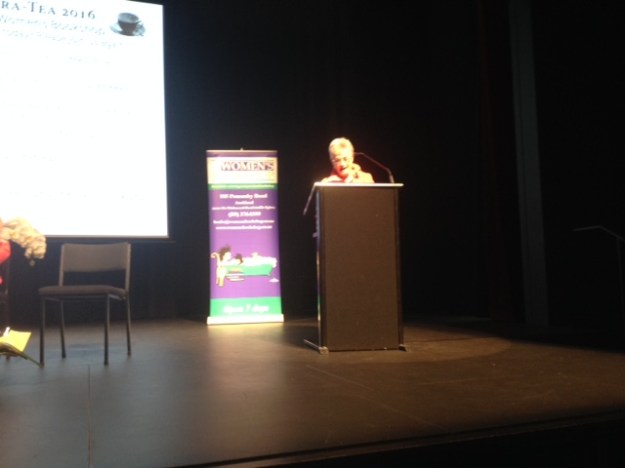
The Ladies’ Litera-Tea is an annual event organised by bookseller taonga, Carole Beu, and the Women’s Bookshop: eleven authors, a full auditorium and an excellent afternoon tea with delicious cakes and savouries. It usually lasts about five hours if you include the book signings. I always come away with a bag of new books, often unexpected choices.
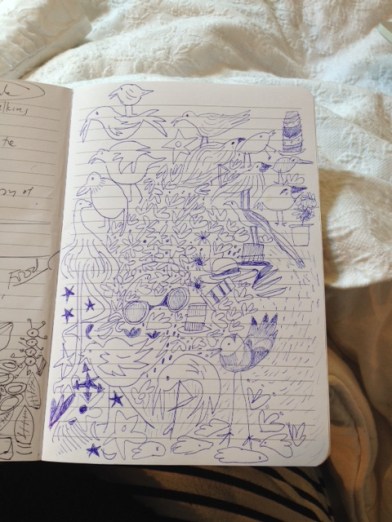
This year I felt like I was walking the fine line between voice and no-voice, with a fuzzy head and a sway that wasn’t to do with reading poems on stage. Luckily I was third up so delivered my poems and then sat back to listen. Usually I take notes to replay on my blog but all I seemed to do was doodle as a counterbeat to the feasts of words.
My head isn’t up to scholarly focus today so I am in bed blogging and reading.
Not sure why there were so many doodle birds. Birds were barely mentioned. Apart from Billy Bird. Or hats. Apart from the steampunks and their creative shed and steampunk hats.
First up was Catherine Chidgey talking with exquisite clarity about her new novel, The Wish Child. I loved the way she made something of obstacles and detours and can’t wait to read the book. Next up Helene Wong talking about: Being Chinese: A New Zealand Story. This is also on my must read list. It feels like essential reading particularly in view of the enduring racism Helene faces.
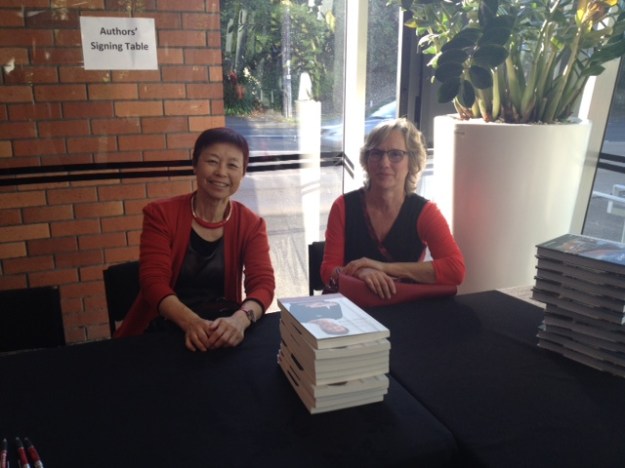
Helene Wong and Marilyn Jessen (Marilyn went on a road trip tracking creative spaces)
Helene recounted an anecdote that resonated (with a few details missing). She was at an undergraduate Chinese paper with a fairly indifferent bunch of students. The white middle-aged bloke started reading a poem in Cantonese. Helen was captivated by the undulating pitch and tones despite not understanding a word. She was struck by this ordinary white man’s pleasure in the Chinese language. His ‘gesture of respect astounded’ her. She almost ‘wept in gratitude’ that he showed so clearly Chinese culture is not to be ashamed of.
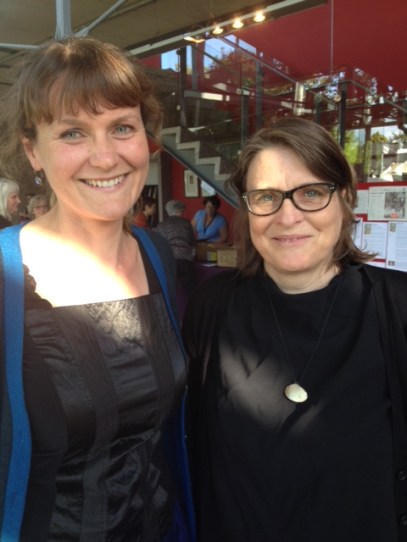
Emma Neale and Paula Green
There is no right formula for authors on stage – especially in view of what to say. I can go either way – just hearing the work or also hearing anecdotes and inroads into the writing experience can hit the spot. I loved the way Emma Neale talked about lexical exhaustion on completing a novel. She borrowed a quote from a musical composer who replayed his piece when asked to explain his work. Emma said she had decided to let the extracts do the talking. I agree with Emma on ‘the joyous creative anarchic energy’ of Billy, the central character of her new novel, Billy Bird. I have just finished this book and it is a top fiction read for 2016. So beautifully written, so moving, so funny, so gobsmackingly good.
The very lovely, very inspirational, Yael Shochat wrapped up the first half. She was celebrating the arrival of Ima Kitchen. I was hooked on the video of grandmothers in the kitchen in Israel making lunch. At half time, the queue for Ithe cookbook never stopped. Both cafe and book are terrific additions to Auckland’s eclectic food scene. We have had such a wide cultural culinary seasoning for decades and it adds so much to who we are as a city. When I arrived back from London in the 1980s my tastebuds were popping. Will be cooking out of this book tonight!
a f t e r n o o n t e a interlude was worthy of a n a f t e r n o o n t e a p o e m
sweet lamington and asparagus roll
the poem unfolds like spanikopita
spinachy peppery cream on the tongue
(thanks Yael, so delicious)
A long time fan of Kerrin P Sharpe’s poetry it was such a treat to hear her read for the first time. I adore the mother poems in her new book, Rabbit Rabbit – the audience did too as it was oohs and aahs and beautiful (just as I heard after the lyrical fiction of Emma Neale). I also loved the entry points gave into the book as it provided me with new discoveries.
Having recently (two posts back maybe!) gushed to you about Ashleigh Young’s witty debut collection of essays, Can You Tolerate This?, a highlight was hearing her read. She selected a section from ‘Big Red.’ I have quoted several times from this essay, so it felt like a favourite album was playing and I was word perfect. Wonderful!
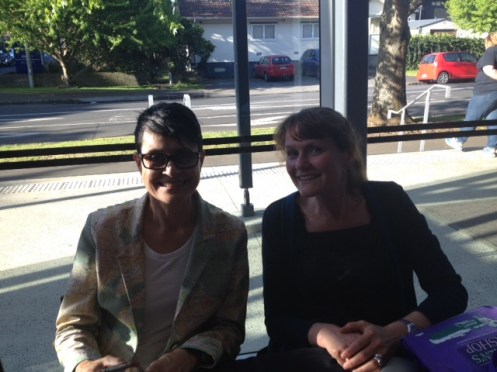
Emma Neale and Gina Cole (in the 6pm shadows!)
I was hooked on Gina Cole’s ancedotes, lucidity, warmth and story extracts all pivoting on the “L” word: lighthouses, law, literature. Her new book, Black Ice Matter, went in my shopping bag! I want to post about this soon!
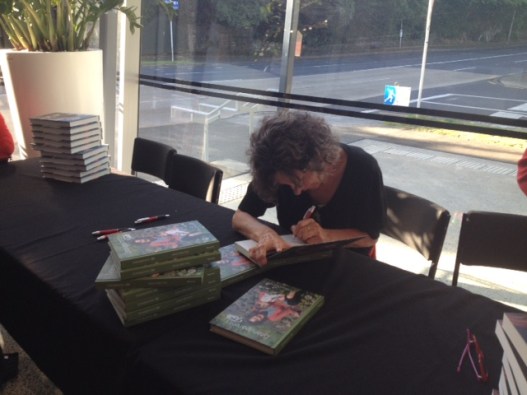
Janice Marriot’s book on Grandparents Talk also went in my shopping bag. It was good to meet a poet who has writtn some of my favourite poems in the Treasury!
Finally a dose of laughter. Urzila Carlson used her new book, Rolling with the Punchlines, to deliver a stand-up routine/reading/musing/confession that was pure gold. Like most of us she was anxious about following on from people so much wittier or funnier or more erudite. She says it best. She had been hearing all this writing that was ‘like warm honey in your mouth and too good to swallow.’ She then compared it to an effervescent something on the tongue [and then a riff on that]. ‘Holy shit,’ she says ‘What am I doing here? I should leave. I should say I’ve got to get a flight with Ashleigh.’ But then she had us in fits of laughter, tears streaming for twenty minutes, with a few piercing moments of inbreath and gasp at something sad or hard to talk about. Such a tonic.
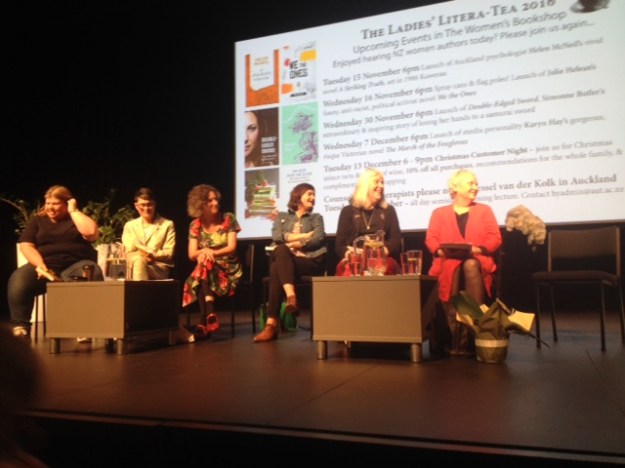
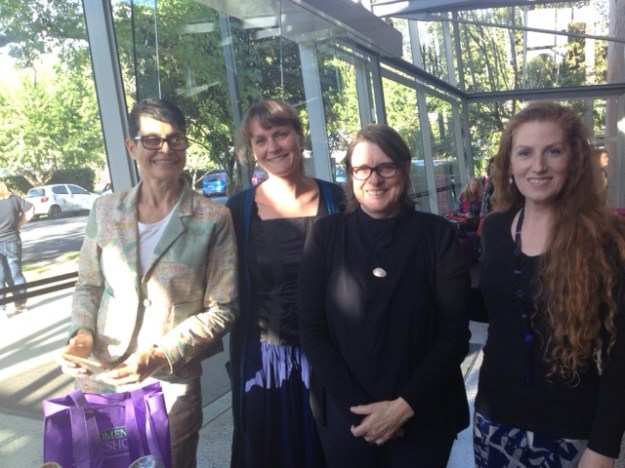
It was a rollercoaster occasion: warmth, ideas, humour, sad things, happy things, connections. I think I came home with six new books.
Thanks Carole and the Women’s Bookshop – it was a very happy audience.
My Mother and the Hungarians and other small fictions Frankie McMillan, Canterbury University Press, 2016
Frankie McMillan has published several collections of poetry along with a volume of short stories. Owen Marshall claims her as ‘our maestro of flash fiction.’ She won the New Zealand Flash Fiction Award in both 2013 and 2015. Much of her new book, My Mother and the Hungarians and other small fictions, was written when she held the Ursula Bethell Residency in 2014 at the University of Canterbury. She teaches at the Hagley Writers’ Institute.
Frankie is currently in Hungary as the guest of the Hungarian Embassy in Wellington. She was invited to attend a commemorative event of the 60th anniversary of the 1956 Hungarian Revolution. Representatives of the Embassy attended the launch of the book at the 2016 WORD Christchurch Writers and Readers Festival in August.
It was expected that Frankie would be the only guest from New Zealand at a gathering of potentially 100,000 people on the Kossuth Square in front of the Hungarian Parliament building on 23 October.
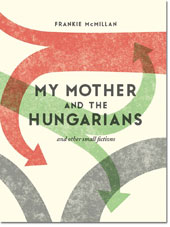
The new book is a gem. Beautifully produced by Canterbury University Press, the internal design, the cover, the shape and the feel of the paper are spot on. Most of the writing occupies the right-hand page which leaves a left-hand stream of blank space. I liked that – the empty space stands in for the unsaid, for sidetracks or pauses on the part of the reader. The writing is elegant, spare, captivating. At times there are jolts of the unexpected.
Much of the collection pivots upon location and dislocation. At the heart, are the stories of family and the Hungarian refugees that come to stay. There is an undercurrent of getting lost and finding one’s way. The parents of an old school friend of mine were Hungarian refugees and I was fascinated by their stories, mostly imagined on my part, in terms of their flight to New Zealand, and their life in a strange country. They tried to plant Hungarian roots in the soil, in the moonshine in the basement, in the language spoken, in the preserves and the cooking. So reading Frankie’s small fictions really affected me. There is a clarity in her writing, a mustering of strange and delightful detail. It feels unbearably apt to be reading behind the lines of the refugees. Disconcerting. Moving.
‘We did not have much; most of what we carried was in our heads, a smell, a snatch of song, our mother’s face, but we had our suitcases and Imre had letters and we had each other of course, though some would say let’s not gnaw that bone again. And though some of us shared a room or a bed it was our little space in the world and a place where Stefan hid when the Hungarian Welfare Officer came with his briefcase, his smell of government and questions.’
from ‘… and in a flash it seemed all the unliving we had loved were flying overhead …’
The book raises the prickly question of genre. Is it small fiction, flash fiction, short short stories or prose poetry? I don’t think it matters an iota. Call it what you will. This writing should hook anyone who sniffs at flash fiction because Frankie shows how good it can be.
I have much admired Frankie’s poetry but it seems to me with this book she is on the bicycle and hitting the right gear; the writing wheels are humming so sweetly. Brava maestra!
Canterbury University Press page
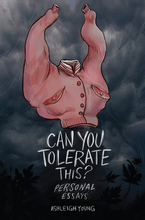
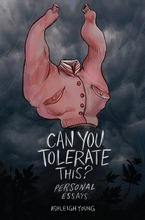
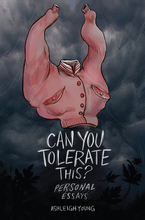
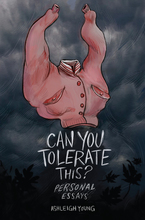
Can You Tolerate This? Personal Essays, Ashleigh Young, Victoria University Press, 2016
The other day I was on a plane about to fly to New Plymouth to go to the Ronald Hugh Morrieson Literary Award ceremony in Hawera. It was tight timing. I was going to jump off the plane into a car, drive for an hour, and walk into the function in the nick of time. But the plane’s lights kept switching on and off, the engine sounds rising and falling. It was faint-inducing heat. Babies were screaming, a high pitch of chat drowned out the safety talk. I had Ashleigh Young’s book of essays on my lap to finish on the plane. In my head I shouted, I just want to get off this place. Seconds later as though my wish made it true, we were told the plane had been cancelled and we needed to get another. I was right down the back of the plane and still not up to running in my foot-recovery regime but knew I really really wanted to do my job as judge. So I started running towards the ticket counter, foot alarmed.
I am running like an elephant or our duck-waddle cat. I can hear all these other flights that have been cancelled due to engineering problems. Everyone is running and scrambling and agonising. Three-quarters there and I hear our plane has now switched to delayed. I limp back to the regional cafe and start reading Ashleigh Young to blot out the panic. She is on an aeroplane. She is sitting next to a woman who tells her life story and her life story is extravagant. We hardly know what to trust – and that is what makes it such a gem. I can’t focus though. I can’t pick another story now with my skewy focus so hobble back to the ticket counter and hear all sorts of rumours. Our new plane was the cancelled Taupo plane. Everyone else is being bussed. I keep thinking about the woman with her extravagant stories and it reminded me of an Italian author Gianni Celati who collected the stories of others where the feather line between real and unreal is flighty. I am in the muddlewash of queues when a woman calls out asking if anyone needs special assistance. I ask for a wheelchair. I am being wheeled. I am back on the new plane next to the same young woman. She is studying physiotherapy. I could embroider my life.The fact I even tell her where I am going is like a little character warpslip as usually I don’t say a word on planes. We talk about injuries and homes. I have two of Ashleigh’s stories to go. I don’t get to read them. I walk into the ceremony 40 minutes late.
Asleigh Young’s collection of personal essays is an addictive read, but it is the kind of book I wanted to eek out (I read the last two stories on the plane home!). What would fill the gap? What would deliver the same sustaining mix of wit, revelation and aromatic detail. Ashleigh gathers in stories from her own life and replays them in sentences that flow so sweetly. Each essay is like a musical composition but it is the content that offers the reader gold. I love the shift in perception from child to adult, in reflecting back. I love the way stories harness what is intimate and personal but also venture out into the world, a world filtered through reading and the experiences of others, fascinating or strange. Perhaps it is all to do with a wry and agile mind that likes to roam and fossick.
Here’s a tasting plate of things I loved
Now and then you fall upon the way story comes into being. This one is especially good. It’s in in a terrific essay on her brother, JP:
‘My enthusiasm for the story was such that I felt it would write itself. The story was virtually already made. All I needed to do was grab hold of one end and pull the rest up behind it like an electric wire out of the ground.’ from ‘Big Red’
In the same essay this gem:
‘Just as JP was abandoning fashion, Neil and I were finding it, and fashion equipped us with new ways of being embarrassed.’
Still in the same essay, Ashleigh gets thinking about story again when she thinks about her film-making brother Neil:
‘Write your way towards an understanding, a tutor told me in a creative writing class. But what if you went backwards and wrote yourself away from the understanding?’
This strikes me as the kind of thing a Chinese philosopher might say in that going backwards is in fact your way forwards; in not knowing what you know, in knowing you don’t know.
One of the poems in New York Pocket Book picks up on Frank O’Hara’s accent. I loved reading the Frank O’Hara segue (pp70-71).
‘I returned to his lines over and over.’
Reading Frank’s lines from ‘Adieu to Norman, Bonjour to Joan and Jean-Paul,’ got Ashleigh thinking about continuity:
‘I fixated on these lines because they made me think about ways in which to continue, and what continuing meant. Getting up in the morning was one way. Getting dressed, facing the people around you–these were ways of continuing that kept your life open to possibility. But there was another way of continuing, and this was the continuing of silence. Our family had always continued to continue through events that we did not know how to speak of to one another.’
This from the plane story ‘Window Seat’:
‘I made my mind up to not decide there and then whether she was telling the truth. I wanted to stay open for as long as I could. I was wide awake when she said with resolve, ” Now, I’m going to tell you about you.”‘
I found this story moved me on so many surprising levels. The woman and her extravagant tongue. Especially the portrait of Ashleigh. I was holding the book on a plane and squirming. Squirming too at the way we reveal ourselves in shards that might embarrass. The book made me laugh out loud. Or just smile at that coiling thought. Or the deep-seated warmth of family, whatever the ups and downs. I thought the last essay, ‘Lark,’ an essay in which Ashleigh’s mother is encouraged to write, was the perfect ending. The mother rode her bike alongside them on the way to school, she used jackhammers and stripped paint off furniture. I adored the shadowy overlap between mother and daughter. Here is the gorgeous last paragraph of both book and essay:
‘A wine glass with tidal marks is on the table beside Julia’s father’s desk lamp. The lamp is doubled over like something in pain. From our desk inside the house where we are studying, we can see her through the caravan’s oblong window. Tonight she is at work on the book. She is trying to remember things. It is like practising another sort of language. It leads her to herself and it leads her away. Sometimes it unsteadies her until she finds another small friend to hold on to. A moonish light comes from her window. Her cloudy head bends over the table as she writes.’
This is a fabulous, symphonic collection. Ashleigh dares to imagine as much as she dares to admit. She has no doubt prompted us, from Cape Reinga to Rakiura, to get out pen and paper and write our way backwards, pulling electric cables, making room for extravagant tongues and familial love. I cannot recommend this collection highly enough.
Victoria University Press author page
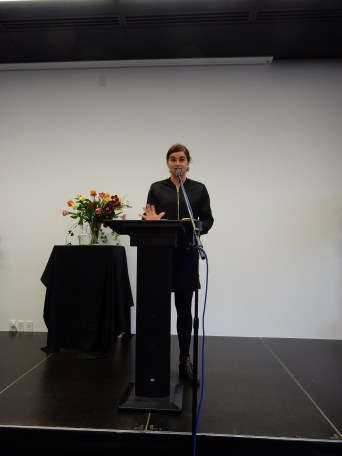
National Poetry Day event at the National Library in Wellington this year. Ashleigh is also appearing at the Ladies Litera-tea event in Auckland on October 3oth (sold out!).

‘In this episode I talk to Helen Lehndorf. Helen is a poet. Her book The Comforter is published by Seraph Press She she has just release her new book, Write to the Centre‘
Better off Read is available on iTunes where you can subscribe by clicking here
Better off Read is also available on PodBean where you can subscribe by clicking here
Or you can listen to it here
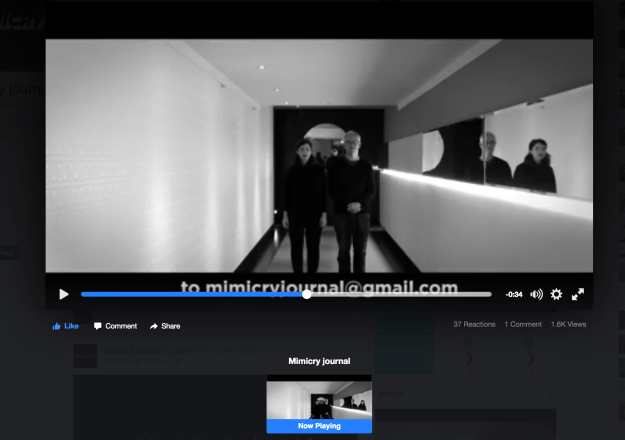
If you are from New Zealand, it’s time to submit up to three things, not just writing, to Mimicry journal (2).
poetry fiction nonfiction music comics jokes art design photography
no more than 2,000 words
by 20th November
Watch the best submission invite ever
A date for your diary Sunday 6 November 4.30pm and 6pm
POETRY CELEBRATIONS 2016
On Sunday 6 November 2016 the Caselberg Trust will present the poetry event of the year –
poetry readings, a book launch and art auction…
Following on from the successful 2015 poetry event held at the beautiful Glenfalloch Woodland Gardens the Caselberg Trust presents an afternoon of –
POETRY READINGS:
The judge’s report by former Poetry Laureate Vincent O’Sullivan and prize-winning poems from the 2016 Caselberg Trust International poetry competition will be read.
A BOOK LAUNCH:
The Trust has established their own Caselberg Press and is very excited to be launching the inaugural publication – the unexpected greenness of trees – a limited edition anthology of prize-winning poems from the Caselberg Trust International poetry competition for 2011 to 2016.
ART AUCTION
Artist Claire Beynon designed the cover for the Trust’s poetry anthology and has generously given the original artwork to the Trust to be auctioned at this event for fundraising.
Every ticket and purchase supports the Caselberg Trust, your local Arts Trust initiative
bringing Artists, Writers and the Community together.
When: 4.30pm to 6pm Sunday 6 November
Where: Glenfalloch Woodland Gardens -The Glenfalloch Chalet
430 Portobello Road Macandrew Bay Dunedin
Cost: $30 includes a glass of wine/soft drink and nibbles (door sales)
This is a Caselberg Trust fundraising event.
Please RSVP to book for catering purposes, tickets available at the door
RSVP to caselbergtrust@ihug.co.nz