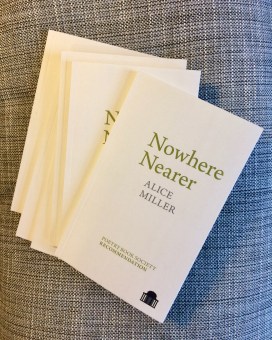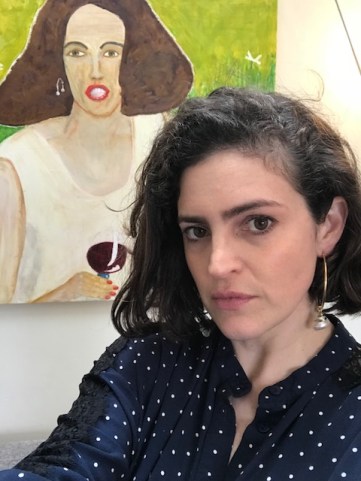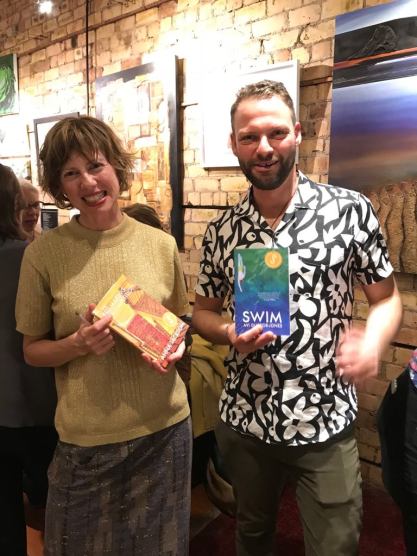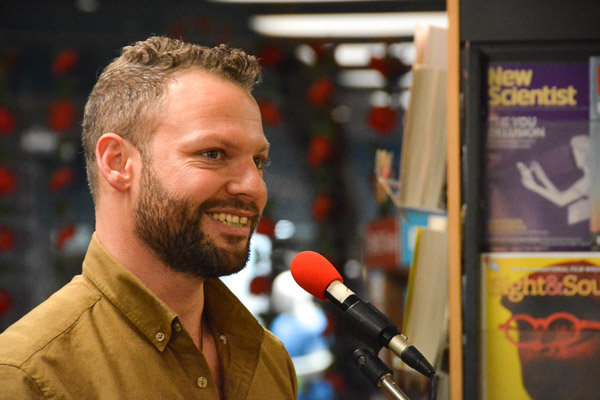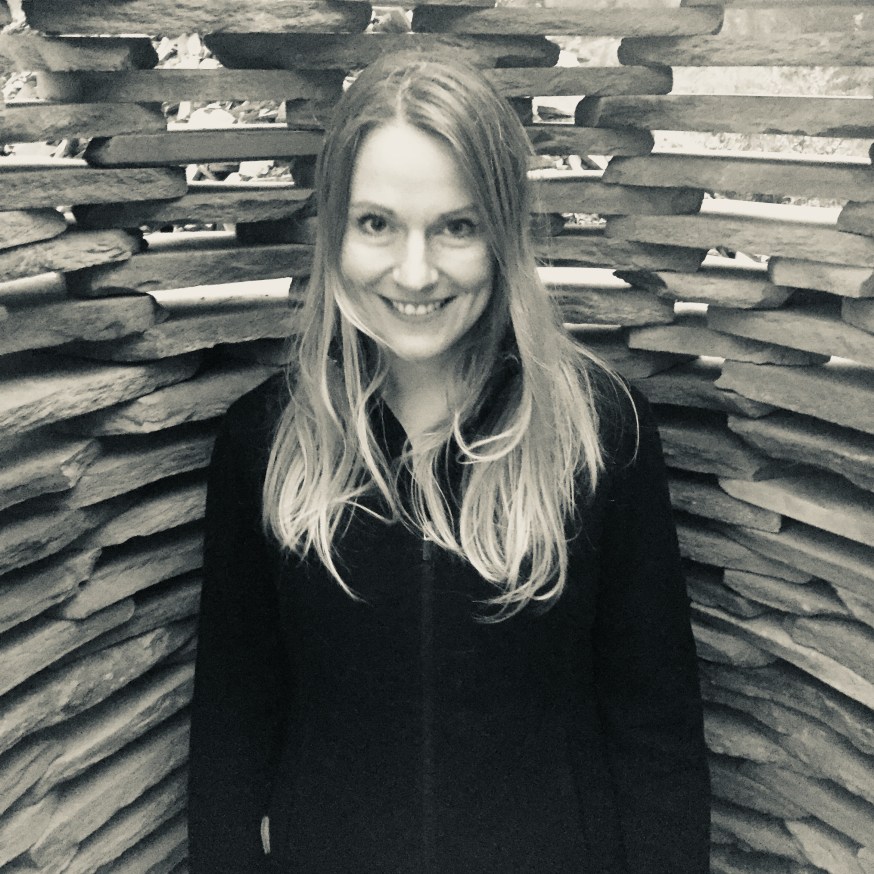
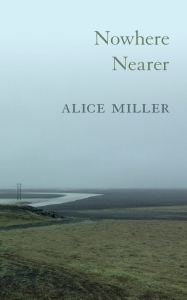
Alice Miller’s debut collection, The Limits was published in 2014. She has also published Blaue Stunde (2016), an English/German edition of poems which features letters with the Pakistani author Bilal Tanweer. A graduate of the Iowa Writers’ Workshop and the International Institute of Modern Letters, Alice was recently a fellow at the Akademie Schloss Solitude. She now lives in Berlin where she is on the faculty for the Creating Writing MFA programme at Cedar Crest College. Her latest poetry book, Nowhere Nearer, was published in 2018 by Auckland University Press and Liverpool University Press. It is a UK Poetry Book Society Recommendation.
Nowhere Nearer is kaleidoscopic in its reach for heart and mind; silence matters as much as a delight in words and linguistic connections. You move between countries, ideas, memories, hauntings, loss. The past makes way for the future and the future makes way for the past. It is a joy to read, and a joy to read again. To celebrate its arrival in the world Alice and I undertook an email conversation over the course of a month or so.
Epilogue
I’m not here to repair the world.
No one here’s here for much, except
perhaps these high windows boasting sky.
My friend says love is easier the less
you know a person. The more you know
the less you love. I say love’s
an exhausted word, used for everything.
I turn the tap on, cold, the stream smooth,
and I can’t remember why in Hell
I should turn it off.
Doesn’t language get tired?
Doesn’t it get sick of
lulling us into believing
all the **** we say? In the Prater a willow dips herself
into water and stirs her own image, and
in the lake her leaves retract, refuse to repair.
Isn’t love also the kind of cruelty
you give to someone because you can’t hold
all that cruelty in your own hands?
All I know’s I’m overflowing.
All I know’s I’m overflowing and I’m not sure
how much of me the world can hold.
©Alice Miller, from Nowhere Nearer
Paula: I have just finished reading your new book of poems, a collection that is lucid on the line and bright with ideas. The attentiveness to a peopled and physical world as well as preoccupations of the mind struck me. This is a book of musings unlike any other. The title of the book, Nowhere Nearer, and an early poem, ‘Out of this World’, underline the cerebral movements. Do you feel these titles speak of human existence but also the very process of writing poetry?
Alice: Absolutely. Poetry is a form of rescue for me. I’m terrified of death, and poetry is the closest I come to feeling comfortable about my relationship with it. I can be in dialogue with it; I can dislodge it with music. I can call it “it.” In life I have no power over death, but in poetry I have a little. I feel as though something is happening between us. So yes, for me writing occurs “nowhere” but also gives this sense that we’re getting closer.
The book’s title also leans towards other things. One is not knowing where you belong (that weird thing that happens when you live away for a few years, during which time you describe yourself as a proud citizen of Aotearoa New Zealand, but when you return to NZ the locals say “but where’re you really from?”). Another is that absurd tendency we all have of striving towards a goal, that, once it’s achieved or abandoned, is immediately replaced with a new, different goal. In a secular world, what does it mean to get nearer? And where the hell is nowhere?
Paula: I have carried a thought from the French feminist author, Julia Kristeva with me: that writing postpones death. I guess with a history of illness and accident it resonated. I wonder if death affects other writers?
(..) This morning
inside other mornings, as the city nests
inside other towns, the sun steps in
to blast the snow back
so my eyes must shut,
see only blood.
from ‘Outside Vienna’
Notions of belonging – of here and elsewhere – form such vital and various threads in the collection. I am thinking of cities (Vienna in particular) to begin with and the way you can be both inside and outside place. I was reminded of Italo Calvino’s Invisible Cities where the sequence of cities is in fact the shifting facades, interiors and intricacies of Venice. Have Vienna and Berlin changed things for you as a poet? Does a poem form a provisional self-anchor in a particular city?
Alice: The first time I read Invisible Cities, I felt like I was waking from an old world – I was filled with a vast awe and also a strange envy, that it was exactly the kind of book I’d wanted to write. What it captures is rather like that Éluard quote, There is another world but it is in this one. In this sense, perhaps everywhere I go is the hill above Mahina Bay where I used to walk around as a kid, taking myself awfully seriously, and failing to find my way out of thinking.
On the other hand, Vienna and Berlin are not just stage sets, because we live in time – in 2018 – which is exhibiting noisy echoes of another moment in the 20th century, in which Vienna and Berlin were central. My grandmother, a German Jew, had to leave Germany in the 1930s, and eventually ended up in Wellington. I spent time looking after her at the end of her life, when I was sixteen and she had lost much of her memory. All this seems connected to me in ways that can’t be approached directly. Once more Europe – and the world – feels precarious, and part of this must be tackled in prose, and part of it can’t be. Poetry’s music gets at a different slant of it, something fixed and floating and true.
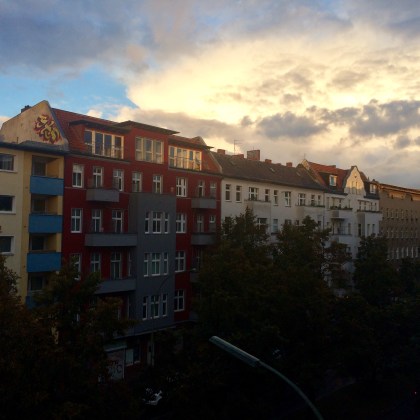
Paula: I am thinking too of the way your collection represents the lure and float of home. Home is the playful musing in ‘The Roof’:
(…) When a psychoanalyst
says adults have no notion of home, a
nomadic woman says rubbish
and in America rubbish perches on gutters
and won’t wash down. A gull has a sense of home?
A bumblebee is bumbling home?
We bumble but we do not gull, only
cull our belongings as we wait to board
our next plane out. In our bold age. In our bumble back
to riches and our gull back to rags.
In ‘Fourteen Mistakes’ the traveller cannot be admitted home until ‘we have re-mapped our own insides’. The poem, ‘Maker’, is equally powerful: ‘Home’s far and grown old.’
What are the key navigation points as you write this moving attention to home? The discoveries that surprise or unsettle or soothe?
Alice: Home! I stumbled on this question because there are so many ways to tackle it. Home is not one thing. On the most obvious level for me, Aotearoa NZ is most obviously my home; I have a strong physical reaction to the bush and the ocean, my entire family live there, I love it with a fierceness – but oddly I’m most easily at home right now, day-to-day, in Berlin, which is noisy and dirty and unfinished (and gentrifying with wild rapidity) and is also where a couple of the people I love most in the world live.
I like music as a metaphor here; in a Western tonal tradition, we are dragged towards the home key, we know what the resolution is. We yearn for it and feel it in our body when we hear it – and yet we can also distrust its perfection, its cleanness. When we did piano exams as kids they’d play a few bars on the piano and you had to say whether it was a “plagal,” “interrupted,” or “perfect” cadence. I always thought “plagal” meant related to plague; it was infected somehow, imperfect. I think home is all three of these things, perfect, plagal, interrupted. For that matter, so is poetry, making it perhaps the perfect (and plagal, and interrupted) vehicle to carry a sense of home.
Paula: I love bringing that trio to both home and poetry. Silence becomes a form of interruption in your poetry; a feature of its exquisite musicality. Occasionally there are long gaps between stanzas like pauses for thought as though the writing process is slow paced. Or the unsaid is paramount. What attracts you to the white space of poetry?
The hold I have’s not one I want to lose
though it’s caught in the flick of the clock through this blood
which knows it can’t gulp down tides, can’t tear out time,
needs a rest from the world I have wrinkled
in fingers, questions, musics. I try to teach my breath a new north,
new east
from ‘The Hold I Have’
Alice: Poetry is all about gaps, about what’s conjured, what’s beyond definition. I’ve always been fascinated (and occasionally paralysed) by the swirling counterfactual possibilities inherent in all our decisions. In a way this book could be described as an attempt to let our counterfactual existences live: to forge those counter-narratives – our seemingly false futures – into an essential strand of the story.
Paula: Oh I love that way of approaching your collection. Such an idea generates all manner of movements. There is the movement between remembering and forgetting, between the adequacy of telling and an inadequacy. Are you plagued with doubt as a writer? With forgetting? Was there a poem that was particularly difficult to write?
How today in a haunted town
the rain is patient
and windows promise
to split our faces
How today in a hunting ground
we tell our stories in the only
wayward inadequate way
anyone knows how
from ‘How to Forget’
Alice: I’m plagued with doubt as a person! I am plagued by fears of death and failure and shame. But I believe I need that doubt and fear to push through what’s easy and get to the mystery. So I’m happy to be an anxious, stubborn, stumbling person who takes a long time to finish a book. There’s also a very strange disconnect between the luminous space where you are alone playing words like an instrument, and the bit where you have a book in your hands and you’re supposed to thrust it upon people. The object of the book has such a distant relationship to the luminous space. And the luminous space is why we do what we do.
After my first book came out, I thought every time a book of mine was published I would feel a kind of shame. But it was different with the small book I published in Germany a couple of years ago, and again with Nowhere Nearer. I feel extremely lucky that I can point to this new book and say it’s mine without feeling completely mortified. I can see that people might not like the book, but that’s okay with me. At the moment it’s the best answer I have for how to live in what James Wright called “this scurvy/ And disastrous place.” And I know I write for the luminous space, and what comes after is beyond me.
Paula: Did you read any poetry books that stuck with you as you wrote this book? Any other books that stuck or affected your writing?
Alice: Elizabeth Bishop is always somewhere nearby, and she’s the best on that idea of home, too: the line “Should we have stayed at home/ wherever that may be?” appears a simple question, but while keeping this idea of staying home, it also rips away the very notion, questioning whether it exists at all. The title Nowhere Nearer is also a hat-tip to her abstract, geographical book titles: North and South, Geography III, Questions of Travel. She is so skilled at control and the lack of it: her seemingly distant tone tries to control the emotion that she also lets you glimpse.
Paula: Are there one or two poems in your collection that have really worked for you? Where the subject matters profoundly and/or the making of the poem just fell into place and it sang for you.
Alice: They’re all songs! An example follows. And I want to say thank you so much for this conversation, which has been lovely — and thank you for the extraordinary amount you do for poetry in Aotearoa. I’m definitely not the only person who is extremely grateful for everything that you’ve done, and continue to do.
Born Breathing
Because I have never quite caught the moment when you
stand and breathe on top of a mountain in a country where
you were born, and
because I have never been trapped in an underground cavern
with a single candle and no water, and
because a man I was once in love with just sent me a
photograph from Colorado of a famous man’s baby booties
and his gold death mask,
and because he was so gentle I had to push him away,
and because because means by cause of, and causes multiply as
a matter of course, and because our arguments come to us like
breath,
I am trying to keep the seconds still, in this bed overlooking a
window blasted white by mist
while I look on the dark web for a definition of the seconds
after a wisdomflash, where
you re-see each tip of tree, each gasping leaf, each scrape of
thin snow, when
your naked, foolish self can’t be argued with, and
your death mask is, for that second, wiped clean.
©Alice Miller, from Nowhere Nearer
Auckland University Press page
Liverpool University Press page
Poetry Book Society recommendation
Liverpool University Press edition: