
Gregory Kan wrote a terrific article for Verb Festival on writing his book-length poem Under Glass (longlisted for 2020 Ockham New Book Awards). It prompted me to choose ‘wonder’ for my February poem festival. I love Under Glass and picked Gregory to read at my Poetry Live Session at the Wellington Writers Festival in March. He talked about writing trauma yet resisting the need to make a spectacle of it. He also spoke of ‘an increasing drive and demand for the narratives of women, Queer and Trans people, people of colour, immigrants, refugees, etc., etc.’ but that we don’t need tokenism. Pronouns and symbols, things, the paths we follow as readers, wonder, love, empathy – these are open, mobile, able to be reformed, replenished in the form of a poem. Alienness and alienated are two different experiences:
I think everyone experiences alienness, i.e. encountering something in the world that one finds alien. To me, alienness is the experience and feeling of one’s internal models of reality being exceeded and/or disrupted. And I don’t think alienness always needs to be framed negatively. It is also a condition of the most beautiful things in the world, such as empathy, love and wonder. All these experiences that begin in the encounter of the unknown. Impossible gaps and impossible bridges. The beauty and terror and noise of being in a jungle.
But not everyone experiences being alienated. Those who are particularly privileged stand at the centre of their respective worlds, and may not often experience what it’s like to be on the other side of those borders. I wanted the text to be able to invoke, at times, the sensation of being outside, even in the places that we find most comfortable and familiar.
Gregory Kan
Poetry is wonder. So is science, dance, music, mathematics, sport, growing things, cooking things, the landscape, sky, crashing ocean, having a family, breathing clean air and watching the sun rise. These things fill me with awe, they challenge, raise questions, leave me lost for words, curious. I witness beauty and I marvel. But I also witness tragedy ignorance violence hatred greed and I wonder. I wonder at humanity. Poetry is a place of retreat when I don’t quite understand, when something puzzles, when something astonishes. Poems set me wandering, with skin pricking, with uplift. Reading and writing poems can be transcendental, like experiencing a rush of utter well being. I completely agree with Reihana Robinson that poetry can fill children with wonder – and that that carries on to adulthood!
A festival of poems: wonder
Their own mind was a kind of wunderkammer, and they kept themselves in the smallest box of all. A parrot with a bird’s keen eye for colour and flash, its memory of jungle and the blue infinite. How eloquently they decorated the tiny space, a slow but relentless process of removal. First one object disappeared and then another. But they were still there, the last to leave, curating their beautiful absence.
*A place where a collection of curiosities or rarities is exhibited
Alison Glenny
I think the beginning of anything
is always a secret.
I love myself when my mind is fucking the hinges of events.
Gregory Kan
The Houses II
On the asphalt a gas light pools: a child looks out
Swinging against the slotted fence and grey,
And eats the three nasturtium seeds: all day
She kept them in her pocket for the doubt
They might be poison, as her sisters say.
But now their delicate, dubious taste can sting
Her tongue curled: snails’ horns curl: they drop and cling
On round nasturtium leaves, green-saucered here.
Now she has evening all her own; the hot
Cream scent of cabbage palms, trying to flood out
Like man’s love, or the Blessed Sacrament:
Sunset peaks over her, a copper net,
Wind like God’s breath goes past her in a shout:
Behind this street shine houses that are not,
Playmates she loves, or loved: but then forgot.
Robin Hyde
from ‘The Houses’ in Houses by the Sea and the Later Poems of Robin Hyde, ed Gloria Rawlinson, Caxton Press 1952
Poem to my nearest galaxy
Yes, I had forsaken curiosity, let it
dull. Now, a most delicate bell,
it chimes as if a monk at meditation’s
end gently tapped the brass, a call
to wake. Stirred. Beguiled.
Not simply interested. Agog. The stars
above (if they’re above) recede
in an ever expanding universe
and here by your side at midnight
I’m startled childish by wonder.
Galaxies? Infinite question, red-shift
reply. But you, you helped me remember.
Sue Wootton
from The Yield (Otago University Press, 2017)
Wonder
Is one
of my core values.
It sits in the twelfth
House of Soul Growth
and the Unconscious.
Wonder might end
the marriage.
Wonder is the Shotover
Moonlight mountain
marathon trail
each step pushed
on by the destiny
toe edging its way
along the barren
ridge line
and what the Bible knows:
That mountains
and marriages
are earthed scaffolding
for Atua
seeded in the lava ash
of Pouliuli
sown in the rays
of Ra
grown under
the cratered cracks
of Mahina
where thigh-splitting
Va lies supine
between us
watching the woman
coming to the end
of herself
at 2000 metres elevation
at the 41st kilometre
after the seventh and final
water station
when each step
is a leap
towards or away from
an infinite love.
Selina Tusitala Marsh
Dance of Sina
You are a tiny flutter, a marigold on water
flung out calling the dead. You are the Tūī
across four winds, an armour of feathers
bone and light soaring over mountains
climbing the day.
You are the core, spilling seeds deepest
blue, head first into soul. You are blood
woven into silk piercing night to sun. You
are a child. A child at sea anchored on your
mother’s lips.
Coral holding the shore, fingers caressing Tāmaki
river. Young girl breaking into woman unfurling
on the Waitematā. You are Sina, sung from
the bones of ancestors, always swimming
towards the sun.
Kim Meredith
What to say and how to be *
Lively eyes lively eyes lively eyes
Square as a box white hair on top
Darrin is thinking HARD about Hiroshima
His teacher has set an
Assignment. It is August 6 three days
until Fat Man dropped on Nagasaki
History is such a funny idea
The fact of men and maybe women men and
maybe women in tiny offices and laboratories
scattered in some other continent
scheme a burning up of people
A burning up of people
And so Darrin writes
All Japan is waiting for
WONDER WOMAN
in your star tights
She is craven she is the last twig
on the cliff-face the last air before
going under that final fast car of rescue
Get away get away sinking wreck
punctured lifeboat wretched sickness
Her grace betraying comic perfection
as if a child could stroke her arm
and be imbued with safety and love
Darrin is wishing for WONDER WOMAN
in her star tights
to catch the falling weapon
in her saving arms like a baby
an infant who is truly a Little Boy
To save all children from
a brief but never-ending childhood
To save schools and satchels and bentos
and laces from ashes more ashes
To save shy smiles and perfectly
folded ‘kerchiefs
Ah! The etching of dark shadows
Shadows fall on Darrin’s classroom
35 small years after Enola Gay rose up
from Tinian amid floodlights and cameras
to fly into history
this funny thing called history
counting a quiet 43 seconds
Tick tock tick tock tick tock tick tock tick tock tick tock tick tock tick tock tick tock tick tock tick tock tick tock tick tock tick tock tick tock tick tock tick tock tick tock tick tock tick tock tick tock tick
* As a teacher of 11 to 13 years olds at one period in my life I loved the way poetry exploded in the hands and hearts of children who otherwise may have been overlooked in classroom chaos.
Reihana Robinson
(First published as ‘After the fall or the power of reading’
in Cha: An Asian Literary Journal Hong Kong)
Fireflies
Last summer I sat amongst a swarm of fireflies while night fell into place around me. I wanted to know if one firefly could ever fly far enough from the rest to see the pulse of their collective light. But there was no one to ask. I raised my arm and held my fingers outstretched towards them but the movement caused them to disappear in a flickering panic—
just as I imagine she might have walked every night to a spot in the bush, not far from the house, where there is a mossy bank riddled with holes and crevices and inside those crevices there are clusters of glow worms, pinpricks of bluegreen light, brightening as her eyes adjust to the dark. She reaches out to touch them and the lights extinguish so suddenly she is not sure they were even there at all.
Nina Mingya Powles
from Whale Fall a chapbook in Luminescent (Seraph Press, 2017). This chapbook focuses on Betty Guard (1814 – 1870) who arrived in Aotearoa as a 15 year-old-bride and was the first Pākehā woman to settle in the South Island.
Cambridge Trilogy
KETTLE’S YARD
The kingdom will have its own colours,
and the unfashioned light will let itself be mastered
in a bottomless, Brancusi pool.
Metal refined by its own thinking force
retains that mercury peril,
continues
to reflect the furious pleasure
of a man being listened to, the one who explains,
art become epiphenomenon of explanation,
a nuclear residue cheaper to tame,
grace nostalgia
strident, even here
where the Gaudier-Brzeska
holds the uncomfortable end of her posture,
sinews bright in the light nursery,
and light in the pits
and mistakes.
JESUS GREEN
The kingdom will have its own spices
whose fore-scent is the privilege of a retriever
lifting her nose at last from the carcass.
When assorted corvids take her place
I will not whisper any of their names
to the tutelar of the college.
The blue
roman candle advance of liberated students,
crossing the moat, appear from this distance
to embarrass the jogger,
the avenue
of plane trees a parlour
for homeless
who paddle through bugs like playing a harp,
plucking and smoking at once,
labour given lightness by caution.
I follow the sun down the darkening aisles
as if it were criminal.
The wind is animal with cannabis.
ST. MARY THE LESS
The kingdom will have its own currency.
I cannot see any from the pew,
but I know the rivers of this country
sing with cancelled sterling.
Like silver under water
mercy
will flicker through the feeling
of the reader
infinitesimally warming the air
until all of our salvos begin with forgive me.
We pray today
in a national rope
for the brokenness of what we do
here
in memory, pray
the discordances
of an amateur choir perform that brokenness better
than harmony, pray like the nonagenarians
cough
and infants bray
from the back
the Angelus domini.
Steven Toussaint
from Lay Studies Victoria University Press, 2019
The Good Husbandwoman’s Alphabet
When people fall in love with love
they fling themselves in the abyss
– Marina Tsvetaeva (translated by. Elaine Feinstein)
(Animals)
Languages we never learn to speak,
although in books they taught us how to read:
tiger, tapir, timber wolf—T was all of these—
each a name in which I find myself again,
I, who see him coming from the hill.
Now I turn the barbecue to ‘full’.
(Bridle)
These words: throat-lash, brow-band, bit—
how a horse gets broken in.
Each night I am unbridled.
Never try to understand a marriage.
It’s beyond the wonder of all but the finest
gentlemen: how the bridle’s said to fit the bride.
(Cattle)
Heedless ones who never knew
their names, the oxen were unyoked in
Happy Valley, where the years will pass
easy as eels in a creek. I was of the alphabet they made,
slipping across the wet grass at night—
eel among the cattle, gone in a scribble of water.
(Dog)
No one knows but the dog—
dog-sense, dog’s-chance, dog’s life.
So why should I care if he has changed
His name—for if he reads, he must read backwards.
I is what I am. No more or less. So, go on,
say what you will—but go and spread the word.
(Earth)
Consider the earth he works up rich beneath the plough,
or a tilth of crumbly soil—
didn’t Virgil say these were best for corn?
‘Earth yields to us its bread, each cartload
drawn into the barn by slow-
moving oxen.’
(Fires)
Even when the fire was lit, I knew that
sex would never be the thing.
Say that this is true—
an alphabet of husbandry might burn in other ways.
G would be for glimpses of this,
even as he flared beneath my skin.
(Glimpse)
I will make myself absolutely clear—
whatever glimpses you gain of me,
as string of letters, or random word, it was
nothing would ever be easy. Believe me when I say,
to be the good husbandwoman, I tried at every turn
to turn myself into any other thing.
(Husbandry)
Only when he’d love and
care for all the animals on this, my farm;
only when he could name and
number all the cravings of my body—only in such
fidelity would he learn to play their song, though
even then, I’d keep an eye on him.
(Information)
Something’s trying to tell me that
something’s going on. Oh yes.
This morning at sunrise he woke me with his
‘old ways’—then laid them on the floor.
He placed them where the sun’s first beams would alight
on them and opened the blue window.
(Jump-cut)
Whenever he wanted anything,
I recited this, my alphabet to him.
Fevers of words fastened in the needy
evening of his brow, a projection of
letters that flicker in this jump-cut to his eyes,
lifting his eyelids silent as a rose.
(Knowing)
In the first glimmer of knowing that
nothing will come of nothing,
life was all we could make
of those swiftly passing days: I was the golden
violin that he would touch into
echoes, as the echoes gathered us in.
(Lovers)
Whisper it once more in my ear. Oh, that
I would have you hold me still,
tenderly touching me into my skin:
how is it that we render our souls to
love’s fine place, in the rivery light of this:
oh, the pillow and the kiss.
(Money)
Vouchsafe for me these days of
eminence, though in my bag lies nothing but
a worn-out empty purse. Oh,
nothing will come of the nothing that
declines with each transaction. Oh,
I stared back at the checkout girl. And oh I
(Nothing)
waited for the earth to take me in,
as though this were the
nub of it all, the rub of the nothing
that plies between the echo and its
testament to what I pledge to you,
out of the hills, and echoing over again.
(Over)
My name is this: the day that passeth over.
Ancient in the making, now it will be broken over.
Keepsake, my heart, oh will you ever make it over?
Easeful now, I wake when the night is over.
Ashes in the wind: and then its fragrances blew over.
Carry me, sir, carry me on, into the going over.
(Providence)
Apple-blossom drifting down the creek.
Still the rooster wants to crow, though
evening’s almost here.
Forgo these things, though fate or commonplace
ordain us with this dream—our conveyance into
rapture, or the idea that provides.
(Quotidian)
As though this were the remedy for everything—
delight indeed will arise
unto these indigo-tinted skies;
latitude will restore us to the brightness of
the sun, to the spindle of this dreaming
earth that turns for everyone.
(Release)
Release me into the somewhere of the dream—
you will remember where, when you were
brother to me.
Unhook me from the steely world of
tractors, sheep-shit, shearing shed—
I am the one who has already gone into the giddy now.
(Sky)
Cherish the way you held me in your arms—you, he . . .
as usual I confuse the one with the other,
nattering my way through the rain, seeking out
the tarradiddle, the silver-tongue that touched
me once with truth: my good husband was
a pillar whose love could hold earth and sky apart.
(Tarantella)
Knowledge is this, with the heart in mind:
everything you ever did can always be undone.
Absolution never is never quite complete.
Cast yourself in the spider’s web:
a day would come and then the dust would settle.
Some days we would dance the wildest dance.
(Underworld)
Easier by far to see where the stars let out.
Friday. And then he said he really came from
Orion’s belt, the buckle star: Epsilon Orionis.
Riding in the hills that afternoon, he declared another name—
Alnilam . . . O you of the three Maries, I said. And then,
declare that name again . . .
(Vespers)
Usually at around this time it comes to this:
leaves in the poplars start to rustle,
the Empyrean gives forth its heron to the roost.
Except for this, the evenings are ordinary.
Round here they say the poplars are a kind of a people, too.
You’ll believe it when you hear the heron speak.
(Whisper)
It was thus that I came to quietude.
Came into the silence
and the redress of the mind. For
no one thinks to ask
of me what the horses say,
nor guide them on the way, although . . .
(Exhale)
Let me take you back to when
you first could take this in, this breath that is
my husbandman and this my
alphabet—and I, oh I whose breathing
knew of each his suck and sigh of life, each eddy in the
ebb and flow, wherein I now exhale.
(Yet)
a day would come when he would be gone.
Commend to me to these last things: a rustic table,
a bowl of fruit, the music-box that sang
‘Sally is my sweetest heart’. As though the mountains might
exalt his name, even as he flees through
falling shadows and the warbler’s plaintive voice.
(Zero)
Oh and only when the last of words is
ruled and underlined, only when you see the
love that learns itself again,
only when you find the text that declines into the
vertical, will you read in its acrostic that
everything is this: the sweetest of the nothings that are love.
Cliff Fell (Last Leaf Press, 2014)
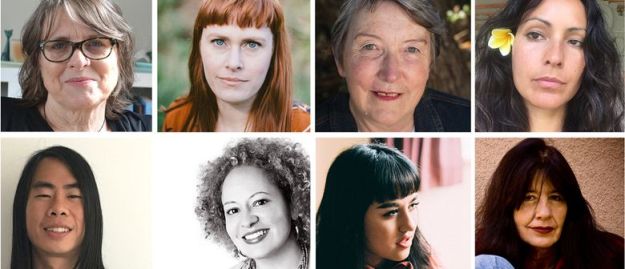
The contributors
Cliff Fell is the author of three books of poetry. The Good Husbandwoman’s Alphabet came out in 2014, published as a chapbook by Last Leaf Press, with illustrations by Fiona Johnstone and photographs by Ivan Rogers.
Alison Glenny‘s Antarctic-themed collection of prose poems and fragments, The Farewell Tourist, was published by Otago University Press in 2018. In 2019 she was, with Lawrence Patchett, a recipient of an Ursula Bethell writing residency at the University of Canterbury. She currently lives in Kāpiti.
Robin Hyde (Iris Guiver Wilkinson) (1906–1939) was born in Cape Town, South Africa, and moved to Wellington with her family in 1907. She was a poet, novelist and journalist. She worked for the Dominion before becoming Lady Editor at the Wanganui Chronicle, and subsequently the New Zealand Observer. She published three poetry collections (and one posthumously), along with two anthologies of her work (edited by Lydia Wevers and subsequently Michele Leggott).
Gregory Kan’s latest collection Under Glass was longlisted for the Ockham NZ Book Awards 2020.
Selina Tusitala Marsh (ONZM, FNZRS), former NZ Poet Laureate, is a Pasifika Poet-Scholar and graphic mini-memoirist. She is an Associate Professor at the University of Auckland and lives on Waiheke Island.
Kim Meredith (Samoan, Tokelauan, and Portuguese descent). Her poetry and short stories are founded on reclaiming space for the female narrative and have been published in Aotearoa, Hawaii and Mexico. She has collaborated extensively with partner Kingsley Spargo performing to audiences in New Zealand and China. She is co-producing an upcoming album on spoken word and soundscapes ‘Swimming Toward the Sun’ due for release later this year.
‘Dance of Sina’ was written for her daughter Courtney Sina. Courtney was named after her maternal grandmother Rita Sina. Rita Sina was named after her paternal grandmother Sina le pua (Sina the flower). There was a sense of awe and wonder about Sina, continuing her journey down the family line. This beautiful and incredible creature daring to push boundaries and seeking out her own path.
Reihana Robinson: 2019 highlights included poetry readings for Mākaro Press with Jo Thorpe and Elizabeth Welsh (including Poetry Live in Auckland and the Fringe in Wellington), as well as reading at Lounge Poetry at Auckland University and with the remarkable Bob Orr at Carson’s in Thames. Reihana is working on her next collection tentatively titled ‘Grassfire’ but may end up with the title ‘NO’.
Steven Toussaint is a graduate of the Iowa Writers’ Workshop and the IIML and is currently studying philosophical theology at Cambridge. He has been a Grimshaw Sargeson Fellow and is the author of poetry collection The Bellfounder and the chapbook Fiddlehead. His new collection, Lay Studies, is longlisted for the 2020 Ockham New Zealand Book Awards.
Sue Wootton lives in Dunedin. Her most recent publications are her novel, Strip, which was longlisted in the 2017 Ockham NZ Book Awards, and her poetry collection, The Yield, which was a finalist in these awards in 2018. She will travel to Menton, France, later this year as the 2020 Katherine Mansfield Menton Fellow.





 NZ Poetry Shelf