Foxstruck and Other Collisions, Shari Kocher, Puncher & Wattman, 2020
The cover of Foxstruck and Other Collisions reminded me of an astral vista (my partner said a Rothko painting not knowing there’s a Rothko poem inside!), but the image is in fact Kate van der Drift’s artwork, a camera-less photograph. She buried large format sheet film in the Piako river between the ebb and flow of low and high tides. What looks like a stellar view is the alchemy of pollution and nutrient by-products of intensive farming. Enter a poetry book and already nothing can be taken for granted. The title Foxstruck and other Collisions is equally fascinating. Enigmatic but rich in possibility.
Shari Kocher’s collection is a sumptuous read. It is structured in seven sections moving from the weight of lead, through the practicality of tin and iron, and the preciousness of gold, copper and silver, to the liquid toxicity of mercury. I am no alchemist but each element feels prismatic with poetic connections, shifting perceptions, uses, misuses. What bridges will form between one element and the other? Would I gain more from reading, if I were an elemental whizz? How will the elements interact with the properties of a poem? The properties of an element with a poem’s movement? All this musing and I am on full alert.
Here I am entering an alchemy maze and all I can think about is fabric as I read. I am always suspicious of academic criticism that stretches a poem to fit a premise or theory, but I am (no way an academic critic) falling upon words, phrases, ideas, details, motifs that give my approach zing. Let me be clear: a poetry book will always offer myriad pathways, frames, devices that refract, reflect, dissolve, connect. I guess I always want to put my finger upon a poem and discover its pulse.
Why fabric? Shari’s poems resemble brocade (full of sheen and intricacy), the rustling texture of silk, hard-wearing everyday denim and the coolness of cotton against skin. Glorious! There are weaves and tucks and fasteners and stitching. I am thinking of the loom behind the line, the handwork and the handiwork, and never forgetting the heartwork. I am thinking of threads and buttons and agile sewing needles. Because this poetry is rich in craft and artistry. The visual matters as much as the aural. Motifs glint. Story is intricate thread.
The collection has been slow in the making, composed over five years, and walked into being as much as written. In her endnote, Shari shares the question that might well have been there from the start: ‘In light of this task set before me, which I take as the task to love, how am I to live?’ Each poem came to life on foot, a rule set by the poet, with the walking rhythms nurturing first seeds through the many drafts.
Take any poem and the rewards are numerous. I particularly love ‘Fritter the Fat Then Fry It’. The fabric of the poem is intricate with sound and image. The poem brings to mind a feminist folktale that will bite your ankles as you walk. Corpse, Narrator and Belovèd speak, with overlapping voices, sharp stitching. Here is the opening of the poem, the Narrator speaks:
Once upon a time a house
all the modcons, etcetera but she flits
vagrant as a dandelion’s flimsy puff
blowing about in a yard
empty of air and light a hole
shucked to the floor like a skin
all that space shut-up
the chimney sealed
against birds
smoke and one
homeless soul
chewing her finger
nail outside the door slipped
sideways into maternity
ward of the state where she once laboured
abandoned to her fate under the weight
of sixteen generations of women
who lived to be fed to the dogs
day after day without complaint.
The soundtrack of the collection is sublime: words loop and repeat, with rhyme, with connecting vowels and consonants heightening the music. Such rich delight in the ear. This from ‘Girl in the Mirror’, a poem dedicated to poet Joan Fleming:
sound of her gentling
mind on me each plate
washed as if to placate
the place I’d become (from)
the shower wiped free
just sketch she said just
sketch what you see
the grain of the wood
on the windy deck the scab
on the knob of your knee
Expect restraint and exuberance. Expect rawness and polish. Expect lutes and ladders, saltspray and violins. Expect rose oil and valleys, kitchens and throats. Cosmic glitter. Questions. Breath. An alphabet unskinned. A grounding in land. The natural world with all its challenges and beauty. As Joan Flemming says on the back of the book, ‘This is dazzling poetry.’
I am just hoping my little piece will connect with readers who want to track the book down and read it for themselves, because yes this book dazzles in its love of language, its love of life, its joy in discovery.
Shari Kocher is a poet, creative writer, thinker and therapist. Foxstruck and Other Collisions (Puncher & Wattmann, 2021) is her second poetry collection, following The Non-Sequitur of Snow (Puncher & Wattmann 2015), which was shortlisted for the Anne Elder Award. Recent accolades include The Peter Steele Poetry Prize (2020), The Venie Holmgren Environmental Poetry Award (2018), and The University of Canberra Health Poetry Prize (2016). Shari holds MA and Doctorate degrees from Melbourne University, and works in a supervisory and remedial capacity.
Their feelings are like a mosquito sliding its proboscis into a freckle. Their feelings are like light through blinds in an 80s music video. Their feelings are like techno under aurora in Norway. Their feelings are like swimming in sunlit sea and seeing a shadow. Their feelings are like when they’ve taken bath salts that turn out to be bath salts, and they end up in A&E and their mothers have flown in from Hamilton and are holding their hands and crying, but all they can think about is how their lives have become a TV hospital soap which they could have been written out of or out of which they could have been written. Their feelings are like a Mindful Self Compassion course when someone asks where the hyphen goes in the title and the convenor says ‘Anywhere’ and the person says ‘I don’t think this is what I am looking for.’
James Brown
James Brown’sSelected Poems was published by VUP in 2020. He is working on a new book.
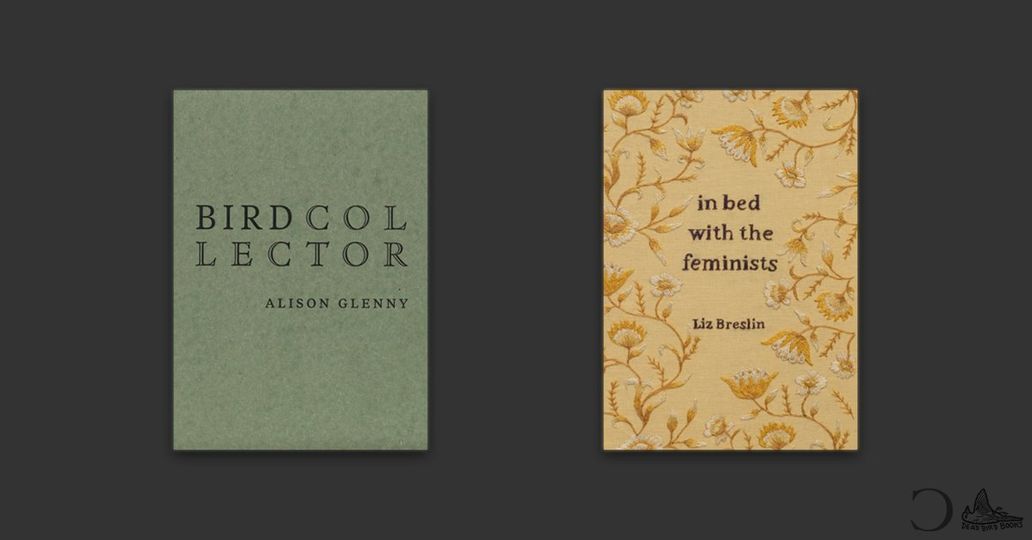
Compound Press and Dead Bird Books present: Alison Glenny – Bird Collector Liz Breslin – In Bed with the Feminists. A double book launch for two very different works by comrades in writing. Please join us for some refreshing words and wordy refreshments.
So many poets have written walking poems. So many poets have commented on the relationship between walking and a poem gathering momentum in the pedestrian’s head. Just for a start, I am thinking of Jenny Bornholdt’s magnificent poem ‘Confessional’, Michele Leggott’s walking blind, a vital thread, with different insight and senses on alert in her poems, and of course Blanche Baughan’s love of hill walking. A poem itself is a form of walking with its various rhythms and absorptions. The poet becomes walker, bricoleur, observer, mind-drifter.
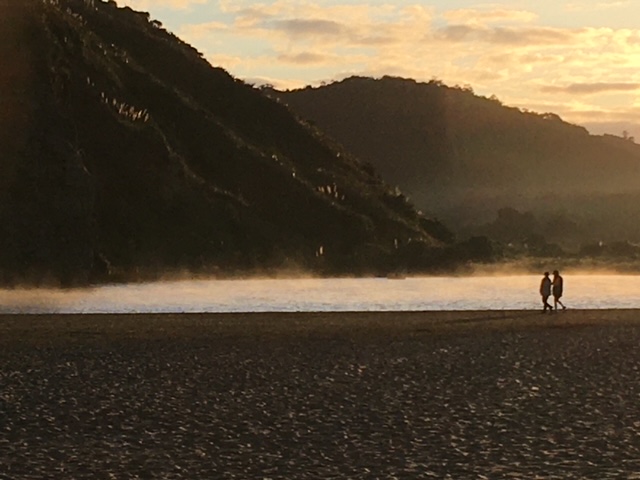
My most recent collection The Track (Seraph Press) was written as I walked the third day of the Queen Charlotte Track with a broken foot in a wild storm. To keep walking I used the alphabet to compose poems and returned home with a book-length sequence. Whenever I have read from it, I am right back in the storm diverting pain with words. A strange feeling indeed. But I also have the early mornings at Te Henga Bethells. Walking on the near empty beach in the early morning light is an opening for poetry. Glorious.
I am currently reading Foxtrot and Other Collisons, Shari Kocher’s sublime second collection. In her endnote she says the poems were written over a five-year period. She wrote:
No poem in this collection was written before it was walked: arbitrary or otherwise, the rule I applied to the book’s organic growth was that each poem was to be ‘discovered’ on foot, and many continued to be composed peripatetically across many drafts while out walking in ways dedicated to that terrain.
The poems I have selected are not so much about walking but have a walking presence that leads in multiple directions. Many of the poems are longer rather shorter and take you on glorious excursions. Once again I am grateful to publishers and poets who are supporting my season of themes.
The Poems
Travelling light
She is walking at the edge of the sea
on the wet shining sand.
The bright sky is behind her.
She is travelling
on a sheet of grey light.
We pass, and I wave.
She laughs. Of course.
A woman who walks at the edge,
on light, would laugh.
Adrienne Jansen
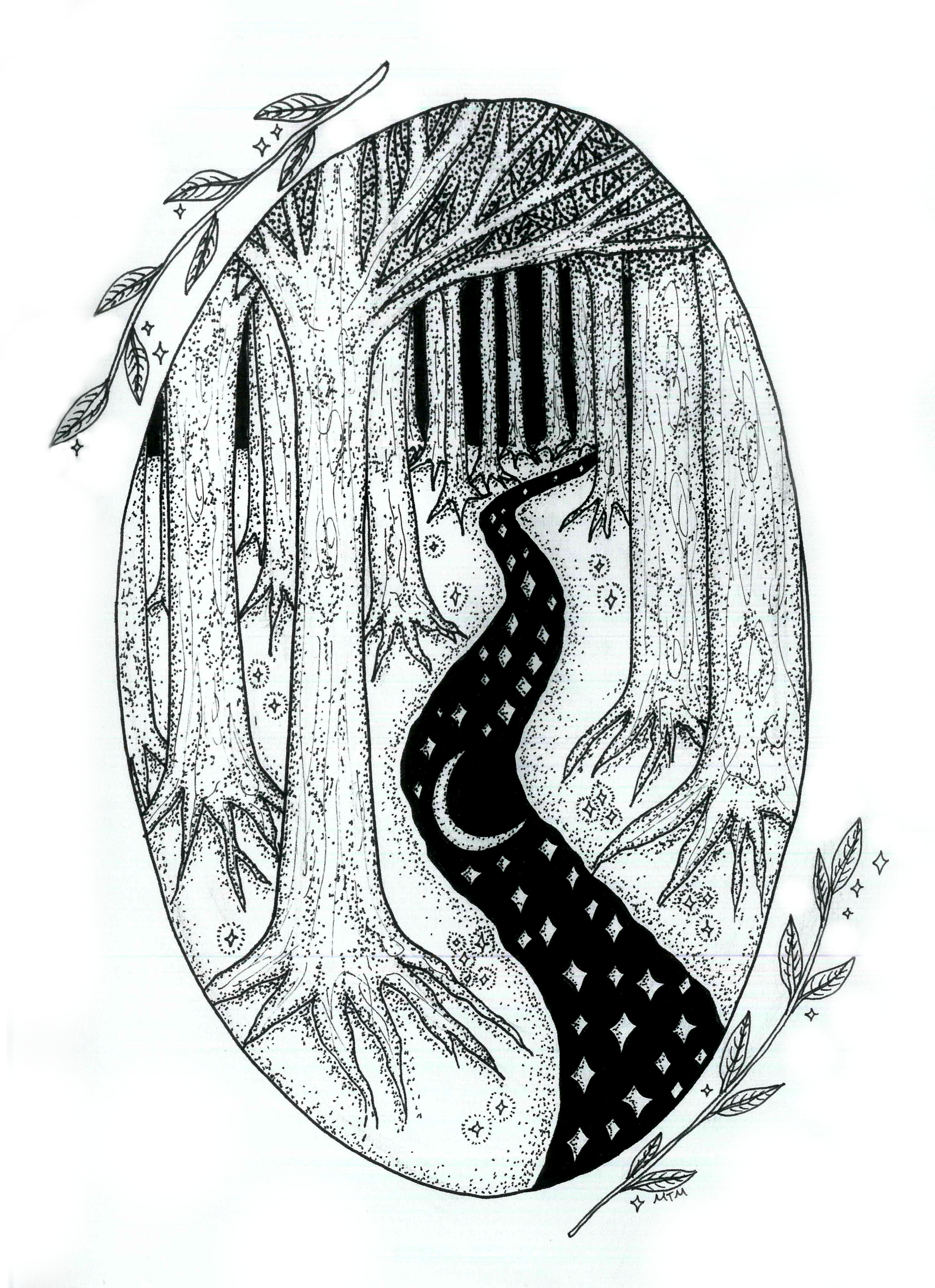
Madeline McGovern’s ‘Enchanted forest’, source of Rose People’s poem
A path of stars
There are many things
I would like to tell you,
my darling
My darling,
I would like to tell you
in this life
everything will be okay
I would like to tell you
that you will walk upon a path of stars
that you will travel through the forest
and never lose your way
I would like to tell you
to look only at the stars
and not the gaps between them
to look at the sun
and not the clouds.
My darling, I would like to tell you all these things
for the same reason we read fairy stories to children
and weave their years with mythologies
because there is comfort is such lies
because I want the world you live in
to carry more magic
and less sharp edges.
But, on this dark night
I have run out of comforting lies.
My darling,
I cannot promise you a path of stars.
some days you will walk upon
unforgiving concrete or sharp-edged gravel
some days you will wade through quicksand.
Tonight, I cannot conjure stars
without the black between them.
My darling, I can only wish
when you walk through the dark and tangled forest
and lose your way a thousand times
that one day
you come across a clearing
where you can sit
and where the sun will find you
and warm your face
and where you can rest.
My darling
you can rest.
Rose Peoples
My Maunga
we’re monitoring pests at the Maungatautari reserve
gluing bait to ink slick cardboard with peanut butter
extracted from a single hole in the finger of a latex
glove bulging with the breakfast spread
our hands were all sticky fingers and dirt
made it to the first true slope
gorse brushing our knees the angle necessitating
a fuck-this what-are we doing crawl upwards
the trees move back and forth
poles caught in a tide
swinging long ways
between sickly white clouds
and glare-blue sky
a miromiro sitting plump on a ponga
squeaking like a mouse
then fluttering caught blurry on a camera
there are no edgerleyi in sight
Māhinaarangi’s perfume a ghost in the clouds
replaced by sweat-stink
the trip back down is a chorus of snaps
and low groans from wood and soil
giving way under our weight grown careless
with exhaustion
then we’re back through the mechanical gate
one shuts and locks for the other to unlock and open
pull it back on its squealing hinge
to leave the reserve behind
it’s a short trek down the hill back to the car
the air made pungent by cowpats
essa may ranapiri
from Ngā Kupu Waikato: an anthology of Waikato poetry, ed Vaughan Rapatahana, Waikato Press, 2019, selected by Aimee-Jane Anderson-O’Connor
A Walk with Your Father
Before you do anything else, check your lungs.
Are they the right size for you, are you the right size for them?
Are they nice and snug against your ribs and spine?
Don’t worry if they’re a bit big for you, you’ll grow into them.
They must be full, however; you don’t want them empty.
You have a long way to go.
Put your hand inside your mouth and make sure
everything’s in it’s place, check that all the pipes and hoses
leading from your lungs into your mouth are in position and in good nick.
You don’t want any leaks or sudden explosions
this is your air we’re talking about.
Close your mouth securely around this apparatus.
Next check your weight. If you are too heavy
or too light you won’t get anywhere. By the way
there’s no need to take a whole lot of extras with you.
Some people strap expensive knives to their legs and wear protective gloves.
There’s no real need for any of this – an ordinary old sharp knife
from the kitchen drawer will do. And just your bare hands.
You may need to signal to each other.
Now pay some attention to your skin.
It should feel secure and warm
but also allow plenty of room to move freely.
There are any number of colours available nowadays –
they all do pretty much the same job.
Your feet, are they the right size?
If they’re too large you will tire quickly,
too small and you’ll be left behind.
You’re probably looking at feet
about the same size as his.
Your eyes – spit in them.
It keeps everything clear.
That step you’re about to take
will have to be wider than you’re used to.
Don’t forget to move forwards, not backwards.
Keep your hand on your mouth so everything stays in place
when you break the surface.
Mihi to Tangaroa. Mihi to Hinemoana.
Now get yourself in under there,
immerse yourself.
Do it now, go.
He’ll be right behind you.
Hinemoana Baker
from mātuhi / needle, Victoria University Press, 2004
When I Head Home I Like To Be On The Left Side Of The Road SoAs To Be Closer ToWhere I Am Heading
I walk home with a bouquet of flowers held up
like an explorer holding up a torch,
in the early days of these days.
The flowers do not emanate
light, but they do catch the eyes of the people
I might like. The flowers will sit by my bed
waiting for when I open my nose from sleep.
Maeve Hughes
from horse power, printed by Fernbank Studio, 2019
The verb ‘to be’
It is foggy.
There is a mountain.
I am climbing the mountain.
She is climbing the mountain.
The path is slippery.
She says, ‘It is all right.
It will all be all right.’
She is right.
There are people behind us.
They are climbing the mountain.
They are in the fog.
Their voices are broken.
There is a shout.
There is laughter.
We are all climbing the mountain.
She is climbing ahead of me.
There is fog in her hair.
Her hair is glittering.
The wind is cold.
There is a man with a walking stick.
There are names scratched on the stick.
He carries the names as if they were eggs.
They could fall and smash.
We are carrying names too.
They are carved on bone.
They are scratched on skin.
We are all carrying names up the mountain.
There is a chapel at the top.
It is locked.
Its walls are damp.
There is broken timber.
There are fallen stones.
It is cold here.
Now we are turning.
We are going down.
She is running.
She is sliding down the mountain.
I am following her.
She is running ahead in the fog.
That is how it is now.
That is how it will be.
That is how it will be
till she is and I am not.
She will be.
I will not be.
The verbs slip under our boots,
like small changeable stones.
Fiona Farrell
from The Pop-Up Book of Invasions, Auckland University Press, 2007
A note about ‘The verb ‘to be’’
This poem was written when I had a writing fellowship in Ireland. My younger daughter took leave from her job working with kakapo recovery on Codfish Island and came to stay for a month. We climbed the high hills.
We climbed Croagh Patrick, up the slippery path from the enormous carpark and visitor centre to the crest where the fog was thick and the chapel was closed and a chill wind tore at the flimsy remnants of shelters built to give some protection to the thousands who come here each year. Toward the top we met a man who was climbing using a camán (the stick used in hurling or the women’s version of the game, camogie) as a support on the stony ground. He showed us some names written on the flat head of the camán. ‘You’ll recognise these’ he said. We didn’t, and felt awkward for not knowing. It was an All-Irish champion camogie team he had coached, his daughter’s name among them. Some time after their victory she had become ill and was now in hospital, and he had made a vow to climb Croagh Patrick 30 times, if only she could be made well. He carried the camán each time. This was his 29th pilgrimage.
We climbed Errigal, a steep-sided hill in Donegal. Irish is still spoken around here and the man who ran the hostel was passionate for the language. It is subtle, he said. There are, for instance, two verbs meaning ‘to be’: one suggests permanence (‘this is the floor’). The other suggests transience and is used, for example, when speaking of the weather (‘it is sunny’).
I walked up the tracks behind my daughter with her strong legs, her dreadlocked hair. Not that long ago, I led her. I can still feel the weight of her in my arms, carrying her when she didn’t want to walk any more between banks of tussocks and flowering hebes on the track at Tongariro, or through the bearded bush at Dawson Falls, or on some sunny Sunday walk near Pohangina. The feel of her little duffel coat and her red tights and her feathery hair, usually chopped into a jagged fringe by herself using the toenail scissors. Now she takes the lead and I’m following, and behind us, there’s that long queue of people, living and dead, stretching back down into the fog.
Fiona Farrell
Pacing Poem
Past the green flowers
past the red stool
past the drying towels
past the letter from school
past the newspapers
past the glass fruit bowl
past the decanter
past the ‘Hoptimist’ doll
and into the kitchen.
Past the oven
past the breadbin
past the broken dishwasher
past the empty tomato tin
and towards the table.
Around the red chair
over the floorboards
past the stairs
and onto the rug.
Past the lamp
past the outside world
past the radio
past the Argentinian print
and around the bassinet.
Past the novels
past the poetry
past the proteas
past the pottery
and into the sun.
Past the breeze
past the ottoman
past the unwrapped cheese
past the pestle
past the wine rack
and nestled
under my armpit:
two deep eyes
still shining wide,
so we keep circling
until sleep arrives.
Amy Brown
from neon daze, Victoria University Press, 2019
Travelling
How normal it feels to get around new places— how basely, physically normal it is for our feet to touch the ground and propel us forward, step after step exactly as they do anywhere.
And if these roads home one day become the rivers they once were— though we might have to pedal the currents or steady our soles on pebbles— we’ll soon get used to it.
A flavour’s only new at first taste; and common sights become invisible; and love dulls into something necessary; and in grief we think this new lack is impossible to live with but we do.
Jane Arthur
from Craven, Victoria University Press, 2019
By the Bosphorous Strait I sat down and wept
Breathe in
when Istanbulites woke to find the water a bright turquois they thought
the worst, a curse had taken over the city or toxins seeped from textile
factories but scientists agreed it was just an explosion of plankton migrating
from the Black Sea, a milky blessing heralding the summer calm, I am told
it’s serene.
breathe out
I did not find out I was colour blind until they tested our class at the library
in Form 2, it explained so much, why I always coloured grass in brown and
tree bark green, why I’d clash my outfits and no one is impolite enough
to tell me, my parents must have thought I was stupid or acting out, the
scientists agreed it was neither
breathe in
my manager told me that things can be difficult here, but when you walk
along the Bosphorous it makes it all worth it, sometimes I think this
city is magical, other times I’m sure it is cursed, a dark pact signed in its
catacombs centuries ago threatening to explode, most of the time it is sad,
mourning a lover lost or a friend it couldn’t save
breathe out
everyday at 12.30pm I walk out of the office and stand at its mouth waiting
for a sign, for the air to return, the explosions in my lungs to subside, the
panic attacks are a daily occurrence, a striking in the middle of a meeting, a
hungry mall, a dolmus packed with strangers and I tense my abdomen and
squeeze my shirt with my hands and try not to remember
for the life of me all I can see is blue, even the scientists are at a loss on this
one, they tell me to relax my shoulders and focus on my breathing, not
worry about time I can’t unwind
it’s amazing how something can be right in front of you and you just can’t see it
Mohamed Hassan
from National Anthem, Dead Bird Books, 2020, selected by Alison Wong
Locus
as you walk you become the vanishing
as you walk you lose the point
as you walk you snow
though autumn
the ranges hold the storm
the ranges bite the neck
and night and day unfix
and night and day turn stone
snow monkeys sit with ice on lashes
coast monkeys pick snails from pools
shop monkeys flip fish in milk and flour
as you walk through autumn, the ranges
unfix snow, and pool you lose
ice-pick, milk-lash, snail-bite—
turn your neck to the day—
Nicola Easthope
from Working the tang (The Cuba Press, 2018).
Duet
I became an old woman
age eleven
Doctor and physio
circling my fingers
around a stick
bone on wood
Swinging my legs
to a new rhythm
wood on bone
bone on wood
Instructing me
in the art
of walking a duet
heel toe
bone wood
stick stick
Trish Harris
published NZ Listener, 1999
Crunch
(i)
She collected broken things: fragments of a delicate speckled eggshell she found on the gravel driveway, a starfish arm from the beach. She kept them in a leadlight box, along with her imaginings.
(ii)
He was the one who knew the way back: just to the left of the forked piece of driftwood standing upright on the shore. Over the bed of African daisies and ice plants. Past the clump of marram and close to the flat patch of sand where they’d lain together that time. That time he hardly thought about any more.
(iii)
She walked briskly, in a way that made you think the act of walking was the purpose of the walk. Not the view of the island, nor the chirrup of pipits camouflaged in the dunes. Not the way a shoe sinks into the sand, nor the sight of a collie hurtling after a stick. No, her walk was for the sake of walking and she’d dressed accordingly: the sneakers, the sun visor, the sensible orange windbreaker.
(iv)
The sheets were so bright against the dull sky, he almost couldn’t bear it. He wanted to take a pot of red paint and throw it against them. He wanted to tell her, you bring out the red in me.
(v)
She lay on top of the duvet being a starfish, each of her hands touching an edge of the bed. She thought how nice it would be, not to have to share.
(vi)
He found himself walking up and down the gravel driveway, just to hear it crunch underfoot as the stones scraped against each other. When he noticed her watching him from the bedroom window, he just kept crunching.
(vii)
She lifted the speckled egg from its cotton wool cradle in the leadlight box and fitted the pieces together to make it whole again. There was one piece missing. She turned the shell so she couldn’t see the gap.
(viii)
Pounding the driveway. Grinding the stones. He supposed he could do it all day. His heavy tread. His trample. He didn’t see her leave the house.
(ix)
The beach was a beacon, making her way clear. She could feel the island’s solid presence, even when she couldn’t quite see it.
(x)
He recognised her footsteps, getting louder. There she was at his shoulder, joining her crunching pace to his. His foot, her foot. Stamping together on a firm earth. Her foot, his foot. Two in step. A two-step. She smelt like biscuits. He reached for her hand.
Janis Freegard
from Kingdom Animalia: the Escapades of Linnaeus Auckland University Press, 2011
Hill walk
We often wonder what moves us in a day – was it words in a sequence that surprised us
or notes played by someone who kept their mouth closed & let the sound leave their broken body
or maybe after years it was the sight of your brother nursing his leg down the hill catching up with you
so you could walk on together to discuss what bird that was in the bush making the sound
neither of you were certain of.
Richard Langston
from Five O’Clock Shadows The Cuba Press, 2020
walking with Dorothy
a dog bothers the scraps
of food around the compost bin
it howls at the murmur of the village stream
ignoring the voice calling from the hill
the trees gleam with overnight rain
each tree, taken singly, was beautiful
the bees emerging
from their wooden house
mistake me for
a flower and for
a moment I am one
hopelessly lacking in pollen
swaying in the breeze
and taking up space
standing still in the mud
unmaking myself amid
leaves I’ve seen a thousand times
and never wondered the names of
some trees putting out red shoots
query: what trees are they?
a fantail flits from branch to branch
something bigger than language
in its movements
which lose
their sheen when captured
and later the sky between
apartments and streetlamps
empties but for the full moon
and Venus striving to be seen
as brightly
all the heavens seemed in one perpetual motion
grit on the footpath like glitter
the roads very dirty
a morepork somewhere in the dark
oblivious to me and better for it
Ash Davida Jane
from How to Live with Mammals, Victoria University Press, 2021
The Poets
Jane Arthur lives in Wellington, where she is the co-owner and manager of a small independent bookshop. Her debut poetry collection, Craven, won the Jessie Mackay Award (Best First Book) at the 2020 Ockham NZ Book Awards.
Hinemoana Baker is a poet, musician and creative writing teacher. She traces her ancestry from Ngāti Raukawa, Ngāti Toa Rangatira, Te Āti Awa and Ngāi Tahu, as well as from England and Germany (Oberammergau in Bayern). Hinemoana’s latest poetry collection Funkhaus (VUP, 2020), was shortlisted for The Ockham NZ Book Awards 2021. She has edited several online and print anthologies and released several albums of original music and more experimental sound art. She works in English, Māori and more recently German, the latter in collaboration with German poet and sound performer Ulrike Almut Sandig. She is currently living in Berlin, where she was 2016 Creative New Zealand Berlin Writer in Residence, and is completing a PhD at Potsdam University. Hinemoana’s website
Amy Brown is a writer and teacher from Hawkes Bay. She has taught Creative Writing at the University of Melbourne (where she gained her PhD), and Literature and Philosophy at the Mac.Robertson Girls’ High School. She has also published a series of four children’s novels, and three poetry collections. Her latest book, Neon Daze, a verse journal of early motherhood, was included in The Saturday Paper‘s Best Books of 2019. She is currently taking leave from teaching to write a novel.
Nicola Easthope (Pākehā, with roots in Orkney, Scotland, England and Wales) is a high school English and psychology teacher, and mentor of young activists and writers. Her two books of poetry are: leaving my arms free to fly around you (Steele Roberts, 2011) and Working the tang (The Cuba Press, 2018). She has appeared at the Queensland, Tasmanian and Manawatū poetry festivals, as well as LitCrawl in Pōneke. Nicola’s very occasional blog is gannet ink.
Fiona Farrell publishes poetry, fiction, drama and non-fiction. In 2007 she received the Prime Minister’s Award for Fiction, and in 2012 she was appointed an Officer of the New Zealand Order of Merit for Services to Literature. Her most recent publication, Nouns, verbs, etc.Selected Poems (OUP 2020) has been warmly reviewed as ‘a Poetry Treasure House…a glorious book’ (Paula Green, Poetry Shelf), and ‘an excellent retrospective… remarkable for drawing small personal realities together with the broad sweep of history.” (Nicholas Reid, The Listener). After many years in remote Otanerito bay on Banks Peninsula, she now lives in Dunedin.
Wellington-based Janis Freegard is the author of several poetry collections, most recently Reading the Signs (The Cuba Press), as well a novel, The Year of Falling (Mākaro Press). She was the inaugural Ema Saikō Poetry Fellow at New Zealand Pacific Studio and has previously won the Katherine Mansfield Short Story Prize and the Geometry/Open Book Poetry Prize. She grew up in the UK, South Africa and Australia before her family settled in Aotearoa when she was twelve. ‘Crunch’ was placed third in the Manawatu Festival of New Arts Poetry for Performance competition and performed in Palmerston North.
Trish Harris has written two books – a poetry collection (My wide white bed) and a memoir (The Walking Stick Tree). She teaches non-fiction on the Whitireia Creative Writing Programme, is co-founder of Crip the Lit and edited their 2019 pocketbook, ‘Here we are, read us: Women, disability and writing’. She says she’s a part-time crane operator…but maybe she’s dreaming?
Mohamed Hassan is an award-winning journalist and writer who has lived in Egypt, Aotearoa and Turkey. He was the winner of the 2015 NZ National Poetry Slam, a TEDx fellow and recipient of the Gold Trophy at the 2017 New York Radio Awards. His poetry has been watched and shared widely online and taught in schools internationally. His collection, National Anthem, was shortlisted for the Ockham New Zealand Book Awards, poetry category.
Maeve Hughes is a recent graduate of English literature with a minor in creative writing. She lives in Wellington where she loves to walk home.
Ash Davida Jane’s poetry has appeared in Mimicry, Sweet Mammalian, Starling, The Spinoff and elsewhere. Her second book, How to Live with Mammals, was published by Victoria University Press in April 2021. She lives and works in Wellington.
Adrienne Jansen writes fiction and non-fiction for both adults and children, but for her, poetry is where the magic is. Her fourth collection of poetry, All of Us, published in 2018, is a series of poems, with carina gallegos, around the themes of migration and refugees. She is the co-founder of Landing Press, a small Wellington poetry publisher. She lives at Titahi Bay, north of Wellington. Website
Richard Langston is a poet, television director, and writer. Five O’Clock Shadows is his sixth book of poems. His previous books are Things Lay in Pieces (2012), The Trouble Lamp (2009), The Newspaper Poems (2007), Henry, Come See the Blue (2005), and Boy (2003). He also writes about NZ music and posts interviews with musicians on the Phantom Billstickers website.
Rose Peoples is from Te Awakairangi/Lower Hutt. She is a student at Victoria University and, having finished her law degree last year, decided that the logical next step was to embark upon a Masters in Literature. She is a bookseller at Good Books. Her work has previously appeared in Cordite, Mimicry and Starling.
essa may ranapiri (Na Guinnich, Ngaati Wehi Wehi, Highgate, Ngaati Raukawa) is a Tainui poet from Kirikiriroa living on Ngaati Wairere land / they want everyone to know that the Echidna they write about isn’t a spikey mammal but a lady with two long snake tails instead of legs / go figure / tino takatāpuitanga 4eva
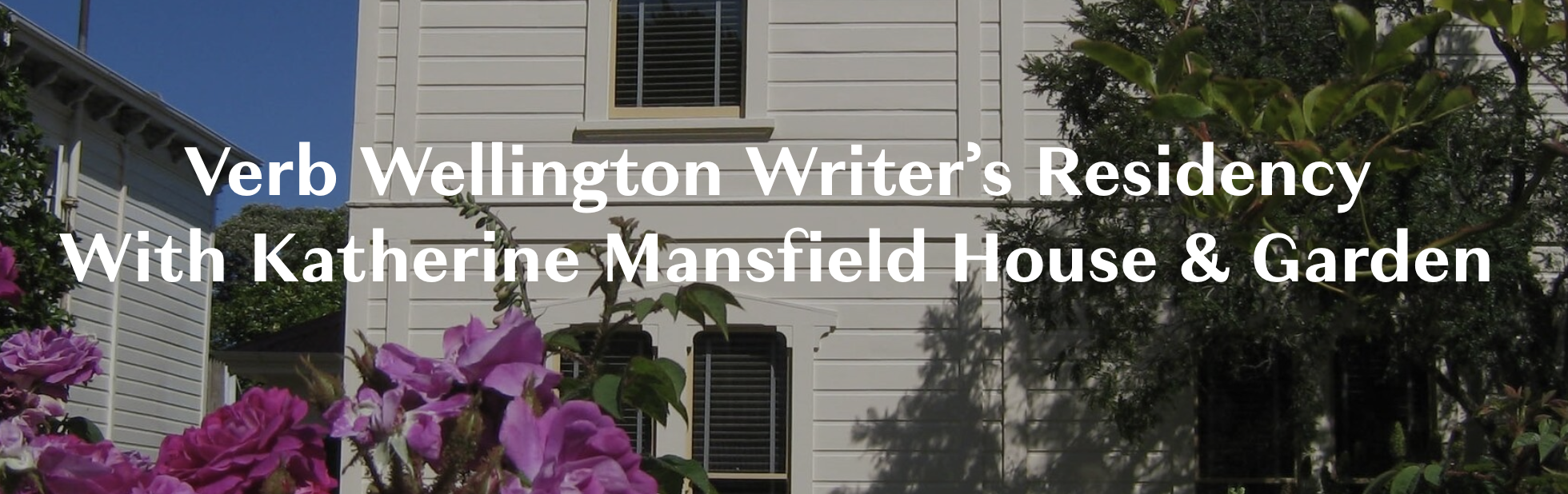
When: The residency period is Sunday 17 October (arrive this day to settle in) until Monday 8 November (check out of accommodation).
What: You will receive a $3,000NZD stipend to cover food and other incidental expenses over your three-week stay. From Monday to Friday during each of the three weeks, you will have use of a small, private office space with access to Wifi and basic kitchen facilities at Katherine Mansfield House & Garden. You will have warm, sunny, self-catering Airbnb accommodation located close to the Botanic Gardens and within walking distance to Katherine Mansfield House & Garden and the CBD.
Required: You will be required to do up to two public events while in Wellington for the residency (one event may be within the Verb Writers Festival which is 3 – 7 November) and to attend one welcome dinner and farewell event.
Travel: Aotearoa authors will need to cover the cost of domestic travel to Wellington.
Application requirements: Before you begin, please be aware that to complete the registration you will need to attach a 10-page sample of work with 1.5 line spaces and in 12-point font. You will also need to attach a maximum 2-page CV.
Application fee: We charge $10NZD per application. We are a Charitable Trust and this amount means we cover the costs of administration for the residency.
Deadlines: applications open on Friday 11 June and close Friday 9 July. The successful applicant will be notified by Monday 26 July.
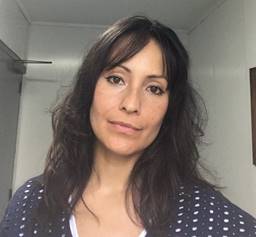
Te Herenga Waka—Victoria University of Wellington’s International Institute of Modern Letters (IIML) is delighted to announce Simone Kaho as the 2022 Emerging Pasifika Writer in Residence.
Simone will receive a stipend of $15,000 from Creative New Zealand to work on a collection of essays about identity and colonisation in Aotearoa New Zealand, with a special focus on the Pacific diaspora. She will also be supported by a mentor, funded by the University.
Born in Tāmaki Makaurau Auckland, Simone is well known as a performance poet and creative non-fiction writer. Her 2016 poetry collection Lucky Punch was called “brave and beguiling” in the New Zealand Herald, while the Pantograph Punch noted the book’s “affirming joy”. She has a Master of Arts in Creative Writing from the IIML, which she received in 2010.
Simone directed the E-Tangata documentary series Conversations, which features six Māori and Pasifika women telling their stories. She also wrote the editorial and stories for WAKA, about the battle to continue cultural practices around waka building and way-finding. She now works as a reporter for Tagata Pasifika.
Simone is looking forward to working on a collection of creative non-fiction essays during the residency. “I’m so happy to be awarded this residency. I’d put the idea on the shelf as work that’s too creative to be saleable to magazines, so work I’d end up doing in ‘hobby time’. It needs more time and space than that.
“The project follows lines of cultural inquiry I see emerging around me in Aotearoa—about who ‘we’ are and who gets to define ‘us’—from my viewpoint as a Tongan and Pākehā person for whom being ‘other’ is normal. I’m grateful for the time and space to work on it, and for the vote of confidence from the IIML, which means a lot to me.”
Professor Damien Wilkins, director of the IIML, says, “We’re very excited to host Simone later in the year. The residency recognises a new stage in her development as a writer whose work for E-Tangata has allowed her to build an impressive body of feature pieces. This work sits alongside her terrific poetry, with the residency allowing Simone to go deeper into these urgent topics.”
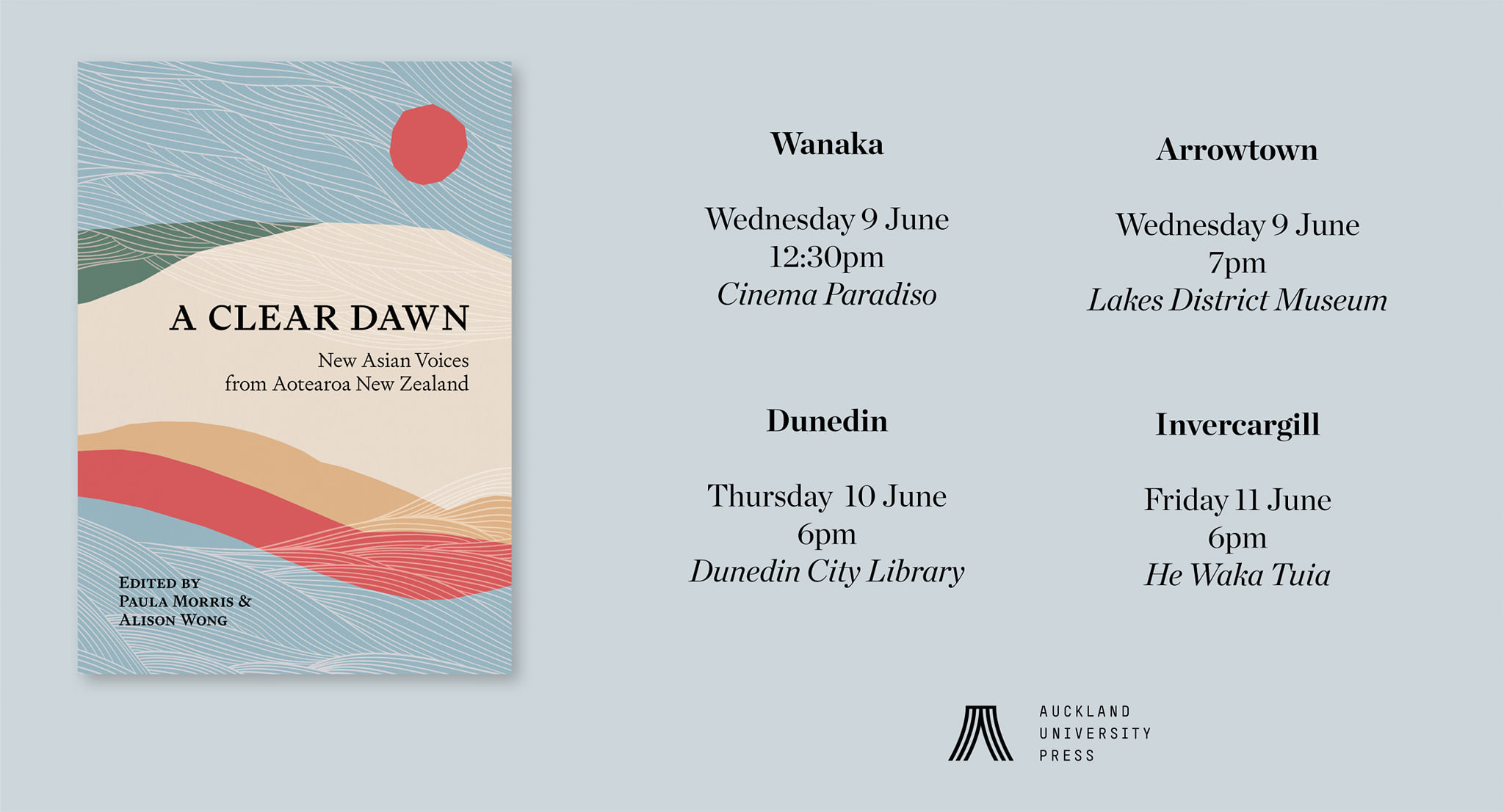
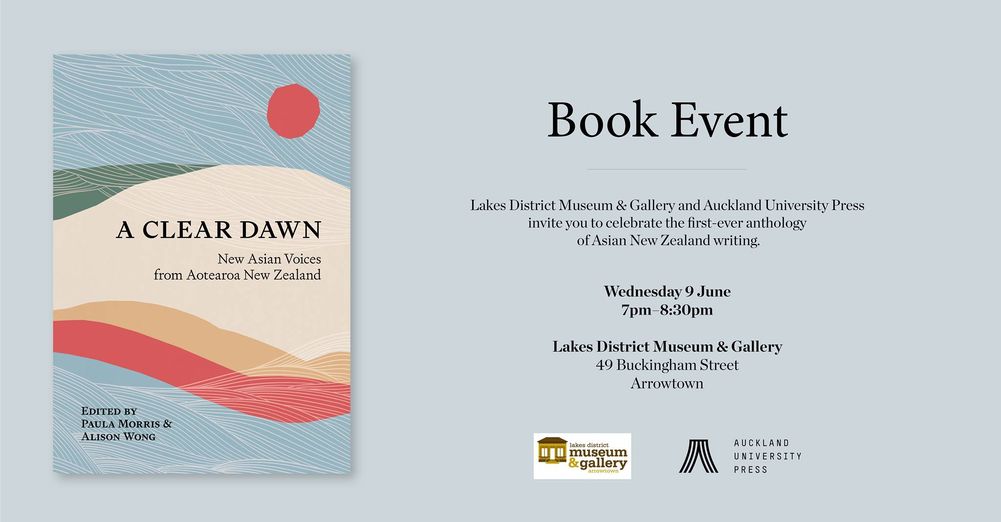
This week Alison Wong and Paula Morris are taking A Clear Dawn on a tour of the South Island! If you’re in Wanaka, Arrowtown, Dunedin or Invercargill, we’d love you to join us in celebrating this landmark anthology. Everyone is welcome and more event details can be found here