
Love Affair
(a given poem from Katherine Mansfield
with thanks to Helen McNeish)
You wrote the table
was laid
for two
but nobody came
so you dined opposite
a white napkin.
It’s called giving yourself
to life.
Through the window
a quiet branch
has the evening
to itself
also.
Riemke Ensing (24 May 1939 -10 August 2026)
from The K. M. File and Other Poems with Katherine Mansfield, Hazard Press, 1993
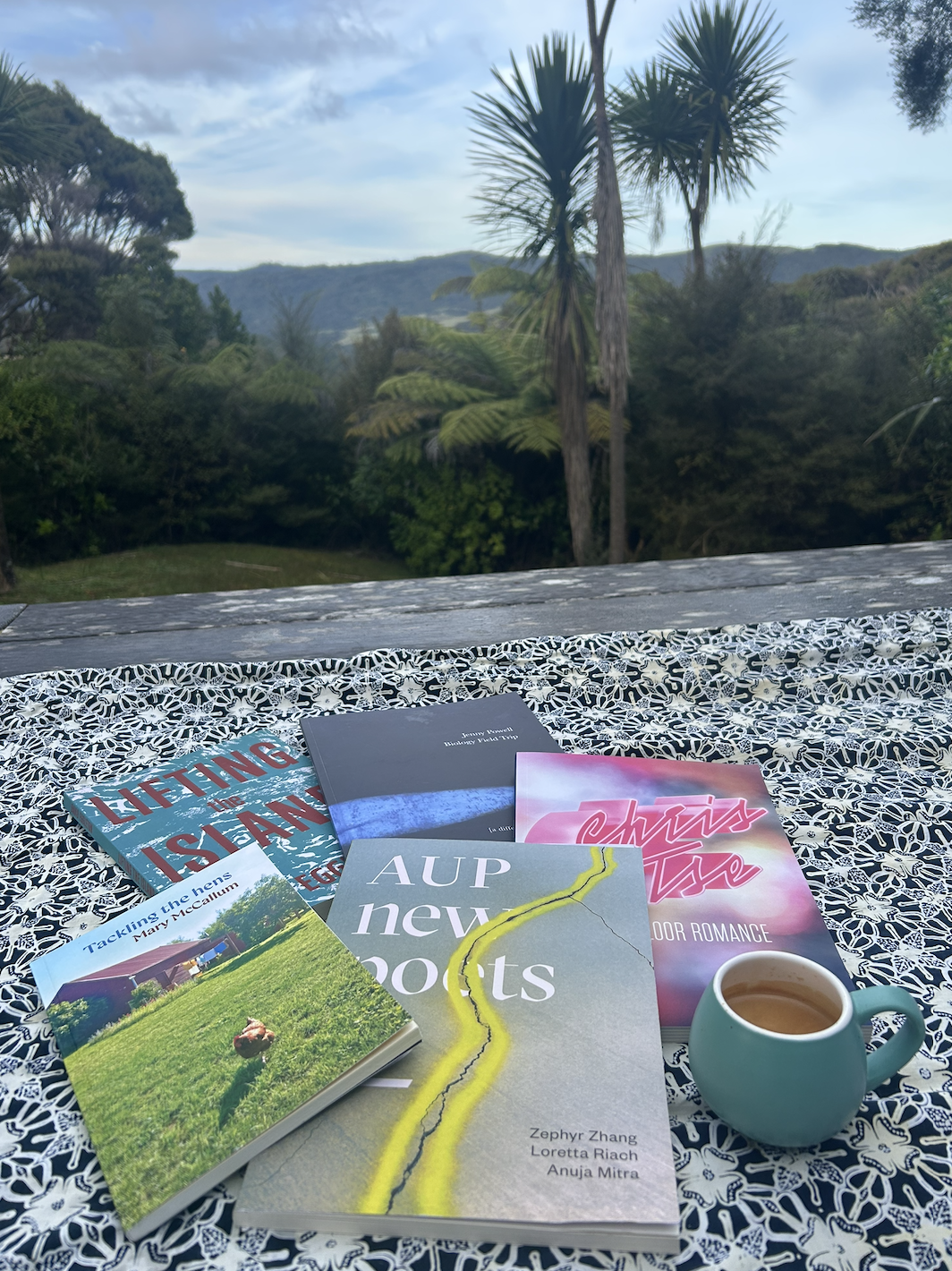
top of my reading pile, a short black and a good poetry book
perfect weeks ahead
Poetry Shelf celebrates NZ Poetry Day 2026 with contributions from poets who have participated at three events across the country.
First up Helen Rickerby, Jackson McCarthy and Anna Jackson were part of a Panel of Poets, a Wellington event chaired by Chris Tse. As the poets were invited to talk about poetry and books, I invited the panelists to write a paragraph on poetry.
Secondly Tūmanako: Words of Hope is an evening of poetry and music that will be held at the Athaeneum Library, In Dunedin’s Octagon tonight with a number of poets and musicians performing. Fiona Farrell, David Eggleton, Emma Neale Sue Wootton and Louise Wallace have contributed a paragraph and a poem on Poetry and Hope.
Finally I invited poets and the MC from the Canterbury Poets’ Collective annual event Lambing Season in Christchurch to record a few poems and answer a few questions. A bouquet of grateful thanks to Poet Gail Zing who gathered the material from the participating poets: Jordan Irvine, Naomi Roberts, Indigo Tomlinson and Jor Dansaren.
Today, and over the weekend, Poetry Shelf invites you to listen and read, to choose a new poetry book to stall on, then to pull an old favourite from your shelves, on this special day when poetry is visibly and audibly sizzling and simmering across the motu. I am reading all Reimke Ensing‘s books on my shelf as we come together in shared sadness at her death. Next Thursday and Friday Poetry Shelf will be posting two tributes.
Thank you for your continued support of Poetry Shelf. My new Post Box (but do you use my private address if you have it): PO Box 58, Waitākere, 0660
Go well, go gently and, as Anna Jackson says, “The more the world darkens around us, the brighter poetry seems to shine.”
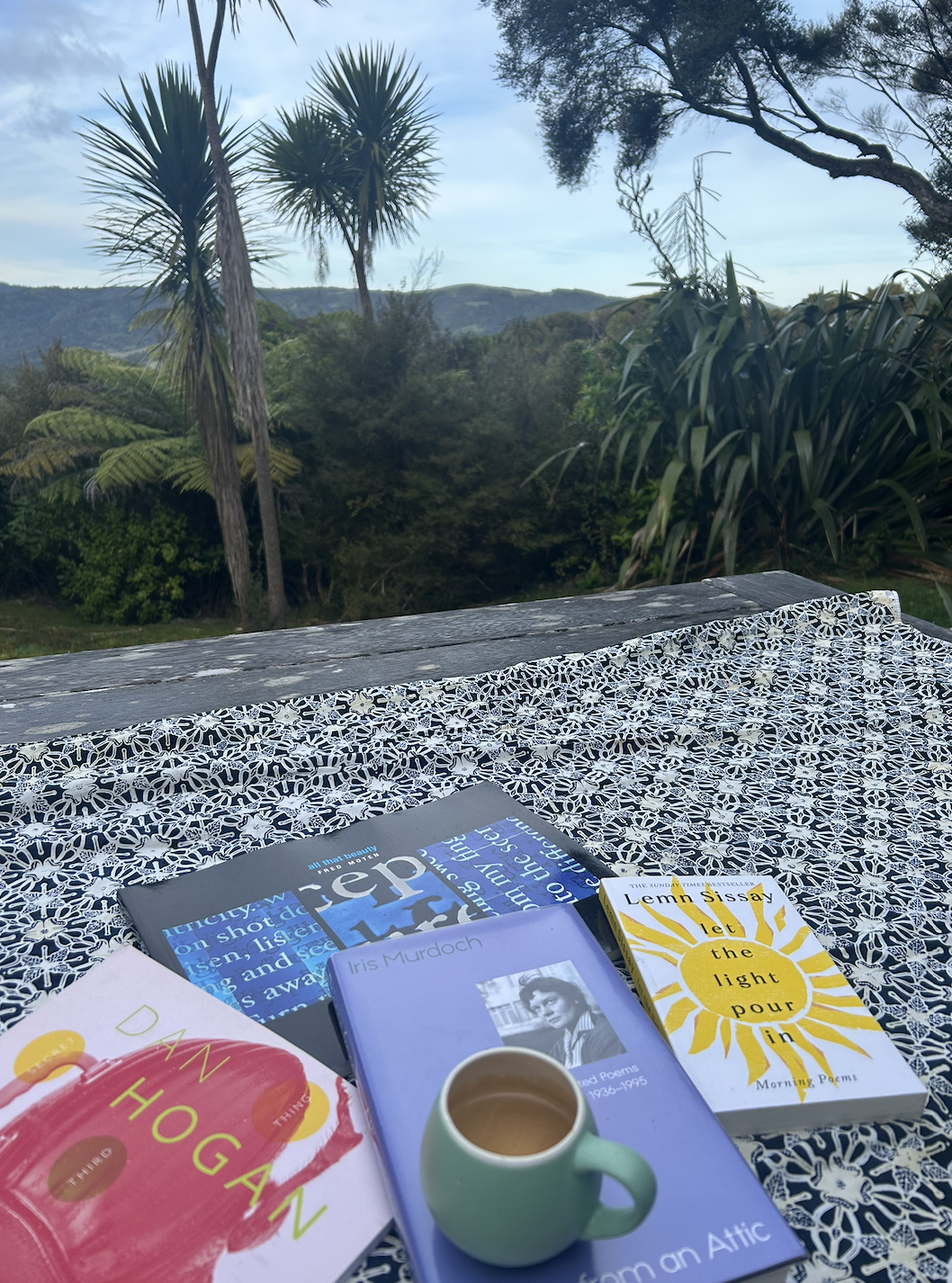
ordered these from Time Out Bookstore as I won’t make their event tonight
they offer a gold star poetry book selection
Panel of Poets
Helen Rickerby
I assume I think more than the average person about what poetry is, and the frequency of this musing has increased the more I move away from what (my) poetry was towards what (my) poetry will be. I do not think poetry is a puzzle to be solved, but it can be puzzling. I do not think poetry is a code to be cracked, but you do have to learn how to read it. Sometimes reading is feeling. It is possible the poet I am most influenced by is David Lynch, who was not a poet, and I am not a film maker and I do not like horror. But I think he showed me to read through feeling. To understand without knowing, to know without understanding. Though, on reflection, he probably learned that from us, us poets. Poetry can be beautiful without being beautiful. Poetry is not always poetic. Telling it slant isn’t only poetry, but it’s poetry. I think I can recognise it when I see it, hear it, but I think we will all disagree on where the boundaries are. And I think I like that.
Jackson McCarthy
I love poems, and I accept that some people don’t love poems. But I do think they’re wrong. It’s nice to have a few drinks and make a few texts that you probably shouldn’t. Beauty is overwhelming sometimes — you have to readjust your life to accommodate beauty. Beauty turns heads, makes people fall, ruins days. Every now and then I encounter a poet who totally revives my interest and my life. Recently, that has been Kate Camp. I love the sudden drops and escalations… “Walking up the path one time / I thought you’d hung a blue sheet on the line // it was the sky”. It was the sky! Well, that’s one way to feel about poetry: it was the sky and I’m living under it and it’s good to say true things. Some people want to talk about all that travels under the sign of love, but I want to talk about love itself. If you don’t love today, you have no concept of tomorrow. I once tried dating a boy who had no concept of tomorrow, and it was tortuous. Because I love today, I hope on tomorrow; I believe I will be alive tomorrow, even though tomorrow is unknowable and is not guaranteed. But if I really believed tomorrow wasn’t guaranteed, I’d act very differently today. In this sense fantasy is the foundational structure, and it’s nice to date somebody instead who promises things that they have no business promising, such as forever. Meanwhile, poetry is something I really like and maybe even love, and I think about the poets often. The other day while shelving books (I work at a bookshop) I thought of Auden’s Limestone, and Tse’s Last poem, and I walked almost to tears. My hands were occupied with banal tasks which I had sold to a company for money; my mind wandered and felt for you. To think of these poems… was it redemption or medication? Was it a fissure in capital or a way in which I was numbed to its degradation? Both — and that’s why I go dancing.
Anna Jackson
The more the world darkens around us, the brighter poetry seems to shine. I do think reading and writing poetry is an act of resistance. What matters in poetry is everything a tech-driven late capitalist economy has no time for – beauty, confession, interiority, emotion, love, surprise.
Tūmanako: Words of Hope
Emma Neale
Recently an old university friend sent me a photo of his teenage daughter, curled up in her room with a pen and a paper notebook. She was writing poetry, the friend said. There was a touch of irony or bewilderment when, after a beat, he added, cos it’s beautiful weather outside. I was silently barracking for her, of course, but he probably guessed that, given he’s known me since I was 18, when I, too, showed him my early foal-staggers into poetry. I asked him who his daughter’s favourite poets were: he said that it was a good question, and he should know the answer, but didn’t. I sent him Ada Limón’s ‘How to Triumph like a Girl’, for him to show his daughter, some time. He liked the choice and that was the sum of our exchange. Yet this small glimpse of a new generation in cocooned absorption left me buoyed. There it was again, like a flower that insists through frosts: this urge to catch experience, ideas, emotions, translate them into language, and perhaps arrive at something transformed that might also have the power to shift perspective in the mind of the reader. I took that candid photo of a young girl determined to stay inside with her notebook as evidence of how stubbornly and robustly poetry persists, as a conduit of ideas, feeling, rebellion, history, personality, from generation to generation. It does so despite everything at large, outside the window — and that very much includes the Gradgrindians and dust-skulled politicians who try to suppress and deplete the creative impulse. Poetry and optimism might even be synonyms.
I’ve chosen a poem that I’ve loved ever since I was around eighteen, too: it was first published in the 1980s. It seems to join hands with the photo my old friend sent.
Girl Reading
She overhears the sound of things in hiding.
She bites an apple and imagines orchard starlight.
Every time she licks her thumb, its tip,
she tastes the icy branches,
she hears a sigh migrate from page to page.
Bill Manhire
From Sheet Music: Poems 1967—1982, Wellington, VUP, 1996
David Eggleton
Relaying Hope
Hope, as Emily Dickinson describes it, is a thing with feathers, a kind of comfort eiderdown to help get us through the darkest hour before dawn. The pitch-dark night of the soul gives way to light. And hope, as Lawrence Ferlinghetti well knew, is of the essence for poets: ‘the state of the world calls out for poetry to save it’; while Marianne Moore mused on hope, thusly: ‘tired but hopeful /hope not being hope, /until all ground for hope has/ vanished …’.
Hope, then, is something irreducible. For Rebecca West: ‘Poetry should be burned to the bone by austere fires and washed white with the rains of affliction’, before any declaration of hope. In West’s formulation, the poetic is an unparaphrasable communion with the void, expressive of our basic humanity – one defined by ‘worlds that were and will be, by death and day’, to steal a quote from Wallace Stevens, writing in a poem about Walt Whitman. Poets at their best, Wallace Stevens went on to declare, are philosophers and ponderers, and their evocations are the speech of clouds. Resonance is all in poetry; we are part of the chaos and the chaos is part of us.
Poetry has something of the character of Mr Micawber in Charles Dickens’ novel David Copperfield, ever hopeful of something turning up, to be spun like straw into gold. Poets live in hope because they are able to work something up from the most humble or insignificant of materials, the most evanescent or intangible of moods, and make something lasting, using no more than pen and paper. If poets are the unacknowledged legislators of the world, as P. B. Shelley affirmed, it is because they speak in purest form to human conscience and its values; they articulate, lighter than air, the ethics that govern or should govern human behaviour. Poetry is a tradition, an aspiration, an illumination, that ‘beacons from the abode where the Eternal are’, or else it offers ‘a warm moment that rings with song’, to borrow from Ruth Dallas.
‘In dreams begin responsibilities’, intoned Delmore Schwarz, hopefully; while William Butler Yeats chanted, ‘I have spread my dreams under your feet, tread softly because you tread on my dreams’ – proof positive of the power of hope and wilful self-belief, which poets certainly need. In the end, poetry is the effort of wresting words not from silence but from the noise of other words; and for poets, the nowness of everything is absolutely wonderous, while paying poetic attention is always a declaration of hope.
Tomorrow
Tomorrow, every now and then, the world might end,
but we will be carrying on.
Tomorrow, the whistle blows for the start of the week,
and that’s where you come in.
Tomorrow is poetry in the hully-gully of its making.
Tomorrow is the spice paladin’s heated aromas.
Tomorrow is the green, waved flag of farm hills.
Tomorrow is petals, proud and bright on magnolias.
Tomorrow, everything goes in the rumpus room:
the spillage, the abandoned card game, the unemptied ashtray,
the sticky whisky glass.
Tomorrow is golden chimes, lighting up the lemon tree.
Tomorrow is wild mountain hail, and snow to sea-level.
Tomorrow, in all the iridescence and bewitching beauty of it.
Tomorrow, I got your back, and I wanna hold your hand.
Tomorrow, we go as inseparable comrades, arm in arm, through the advancing years.
Tomorrow, geology is pressing you to coal, and then to rough diamond.
Tomorrow, the world’s as blue as an orange.
Tomorrow, the world’s going micro.
Tomorrow, each of us is moving backwards,
sweeping the trail clean with a branch.
Tomorrow, see you on the flipside, sistah.
Tomorrow, in drist, rain will dringle and drumble
to form evanescences, vapours, balms and rinsings.
Tomorrow, more bafflegarb, gobbledegook, bumpf,
officialese, taradiddles and blatteration.
Tomorrow, never give in, never give in, never, never, never —
in nothing ever give in, except to accede to good sense
and deeds of honour, for the sake of others.
Tomorrow, out of the black: ka awatea, daybreak, an ocean gleam,
a faint stain, ripples, eels crossing vast waters;
and above them, a mollymawk’s glide
tomorrow.
David Eggleton
from Respirator: a Laureate Collection, Otago University Press, 2023
Louise Wallace
Poetry is my way of navigating difficult things, so writing is often a hopeful act in itself. This poem was about unpacking the twin events of the birth of my son and my father’s experience with dementia, and later, his passing. Through that grief and through the poem, I found a way to carry on.
from VESSEL
Try to picture me.
Try to imagine my face.
I wonder if you will think of me
when I no longer know
I’m here.
In sailing,
you must learn how to demast:
how to cut away
the mess.
*
There are many different scales of pain.
Some are songs.
Some linen
with white lace trim.
How small they seem, you’ll say,
when you hold the clothes
I once thought hard about for you.
In an instant,
we transform.
*
Birth is the body’s intuitive process.
And people walk tightropes all the time.
There is now a whole fleet
of waiting vessels.
An envoy
at the edges of my eyes.
*
Try to picture me.
Sunlight beams
through the window
but I do not yet feel myself.
It shines
on blue pathways that run under
your skin,
passages filled
with life.
You smile and I feel
your forehead on mine.
As well as pain,
there is joy.
*
We knew who you were as soon as we saw you.
The second they pulled you from my body.
The name means firm or strong, and you are beautiful.
Other names mean
courageous.
Voyager.
*
In some other place, you finish building
the boat my father no longer can.
Some lines can’t be cut.
I know
how to move now, I know
how to breathe.
*
Swaddle the hull’s ribcage in wooden sheets.
I am ready to sail with you.
Louise Wallace
from This is a story about your mother, THWUP, 2023
Sue Wootton
Hope, like light, is energy required for life. It may flicker or grow fierce; it may flare, or dwindle – but heaven forbid it turn completely to cold ash. Then, despair descends to fill the void: smothering, oppressive, breeding apathy, making you believe there’s no point in even imagining a turn for the good.
Poets are in the business of paying attention to the world. Given our species’ longstanding predilection for making such a mess of things, you might therefore expect poetry to trade only in despair. Yet what poets in their close-noticing often uncover – even if they’re down in the ruins dismally stirring those stone cold ashes – are glimpses of beauty and love. Stubborn sparks! Glimmers of possibility, glimmers of joy, glimmers of freedom. Poets are hope-finders. They just can’t help it; it’s in the job description: Notice, imagine, create.
Poem in June 2020
A narrow aperture of light today, a squint
in the year’s dark walls, and I, as if in anchorite
seclusion, am pressed to it. Truly the light is sweet,
flowing like a gently falling stream between
bare branches, spreading out along the path
as if to say, behold the sun, perhaps the earth
abideth and may flourish yet. There is, from cell
to cell, a season’s purpose quickening, voices
rising, carried on the birds of air across the lands,
insisting time and chance might turn on all
with equal favour, and all will breathe and none
shall labour for the wind in endless days of darkness.
The monumental marble men are falling on the cracked
foundations. An aperture, an opening. Press to it.
Sue Wootton
(First published as ‘Poem on the Shortest Day’ in takahē 101)
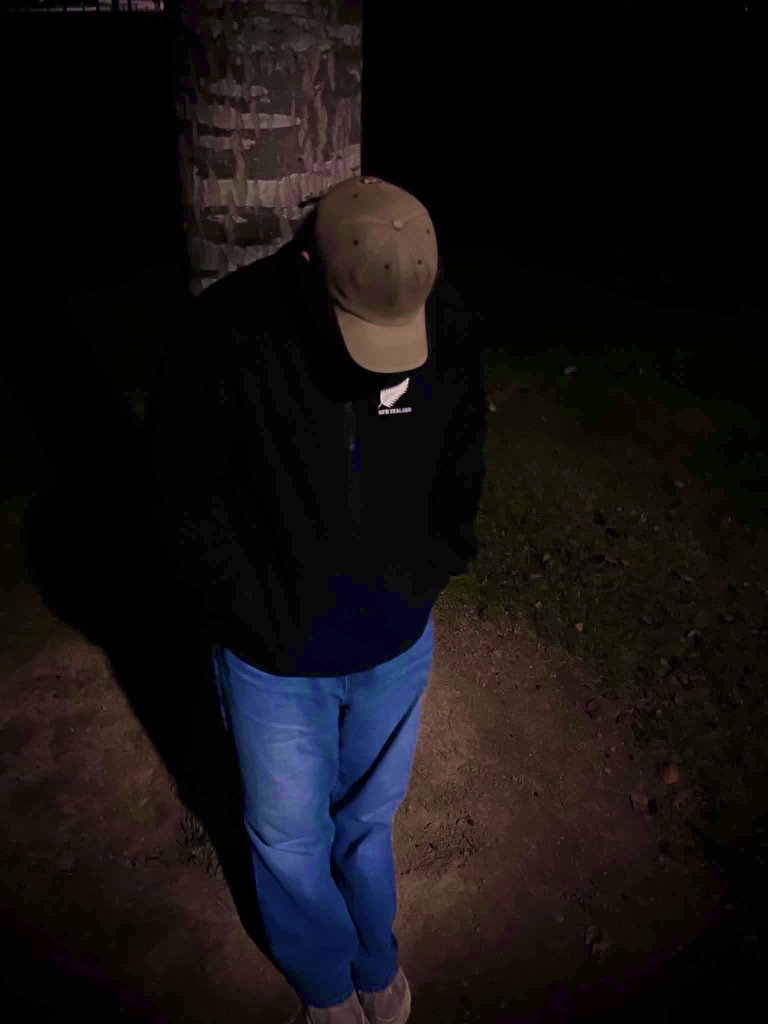
Jordan Irvine
‘thickets’
‘not even a mouse’
‘sydenham’
Name three words that matter to you when you are writing a poem.
Purpose, perspective and rhythm
Can you share a few poets whose poetry boosts you as a writer?
Dominic Hoey, Ruby Macomber, Josiah Morgan
Why poetry? Why poetry in this tumultuous world?
There’s this Armand Hammer song, “Dogeared” and in the second verse, billy woods is posed this question and says he doesn’t answer but thinks about it over the week and throughout the verse he just describes what happened in that week and when he is asked again he replies “I’m still grappling”. That’s the extent of it I suppose.
Jordan Irvine (they/them) is an Ōtepoti born and Ōtautahi based poet. Their work details the absurdness of both the mundane and extra-ordinary through their own absurd nature. Their work has been featured in The Spinoff, The Art Lens, Symposia, bad apple and more.
Naomi Roberts
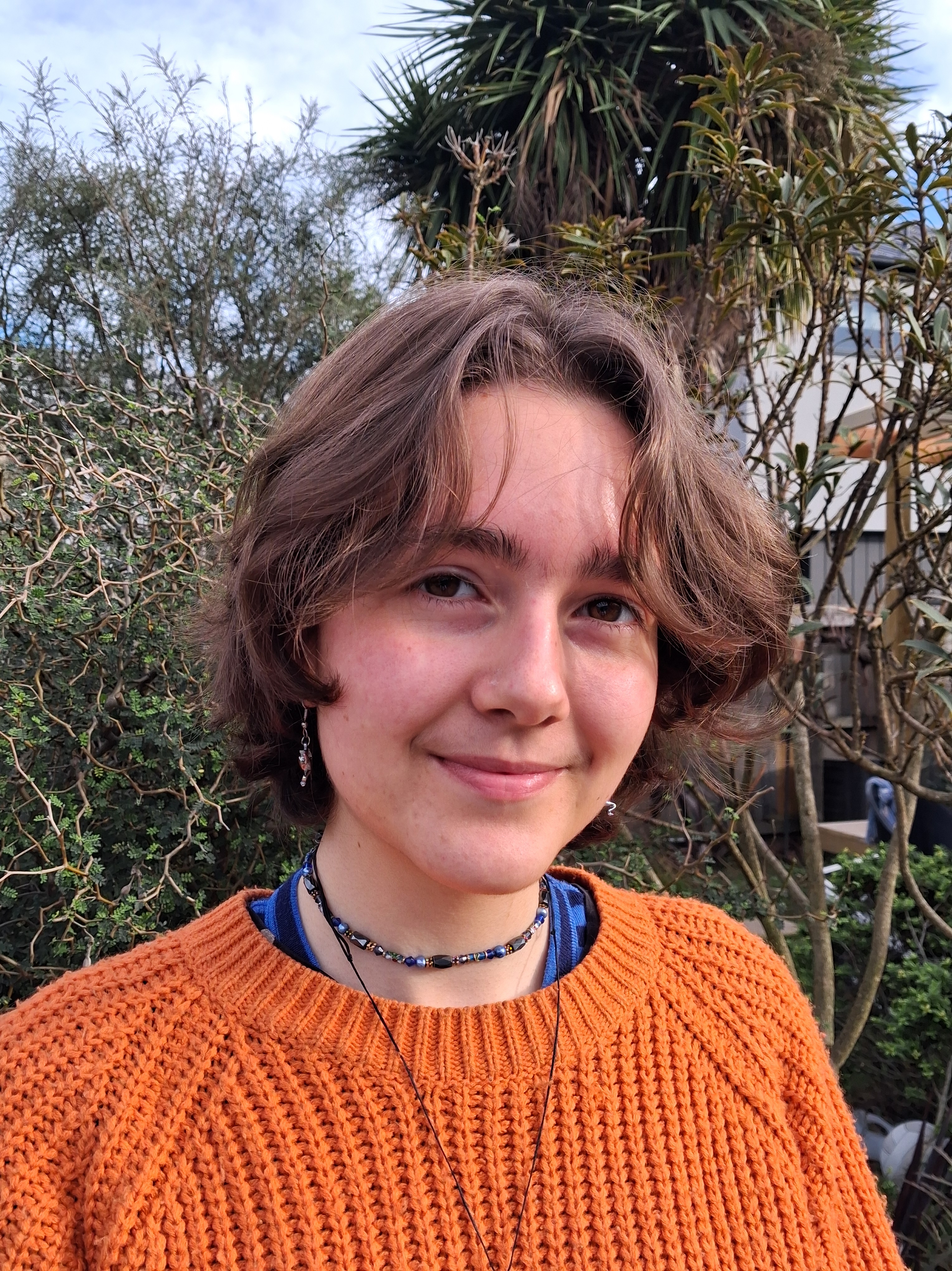
‘Coup de Grace’
‘Palindromic’
‘Don’t Bother Reading The Poem’
Name three words that matter to you when you are writing a poem.
Precision, reality, exploration
Can you share a few poets whose poetry boosts you as a writer?
Since I first discovered his works as a child, I’ve enjoyed E E Cummings’ poetry. The enrapturing rhythm of his words and frequent use of parentheses and enjambment to change the way lines are read commands me to pay attention to the form of poetry rather than solely the poem’s content. Bill Manhire’s succinct writing captures vast imagery and concepts within a few words, leading me to draw more out of a poem each time it is re-read. His work leads me to consider the same in my own poetry — how can I say what I mean sharply on paper, but leave larger implications in a line’s wake?
Why poetry? Why poetry in this tumultuous world?
There’s not really another option for me. Poetry is language in (simultaneously) its most naked and put-together form, showing almost viscerally the workings of the writer’s mind. There’s a punchiness to it that is undeniably attention-grabbing. Our perceptions of the world can be shaped by the words we use to view it. Reading and writing came hand-in-hand for me: as I discovered how poets have been speaking their minds for generations I soon learnt I had plenty to say as well.
Naomi Roberts is a long-suffering word tamer who has been wrangling stray sentences since 2009. Born and raised in Ōtautahi and tutored at Write-On School For Young Writers, the young poet/songwriter enjoys meddling with forms she knows little about and asking more questions than she answers. Her work has been published in NZPS’s anthology There Are Rabbits Here.
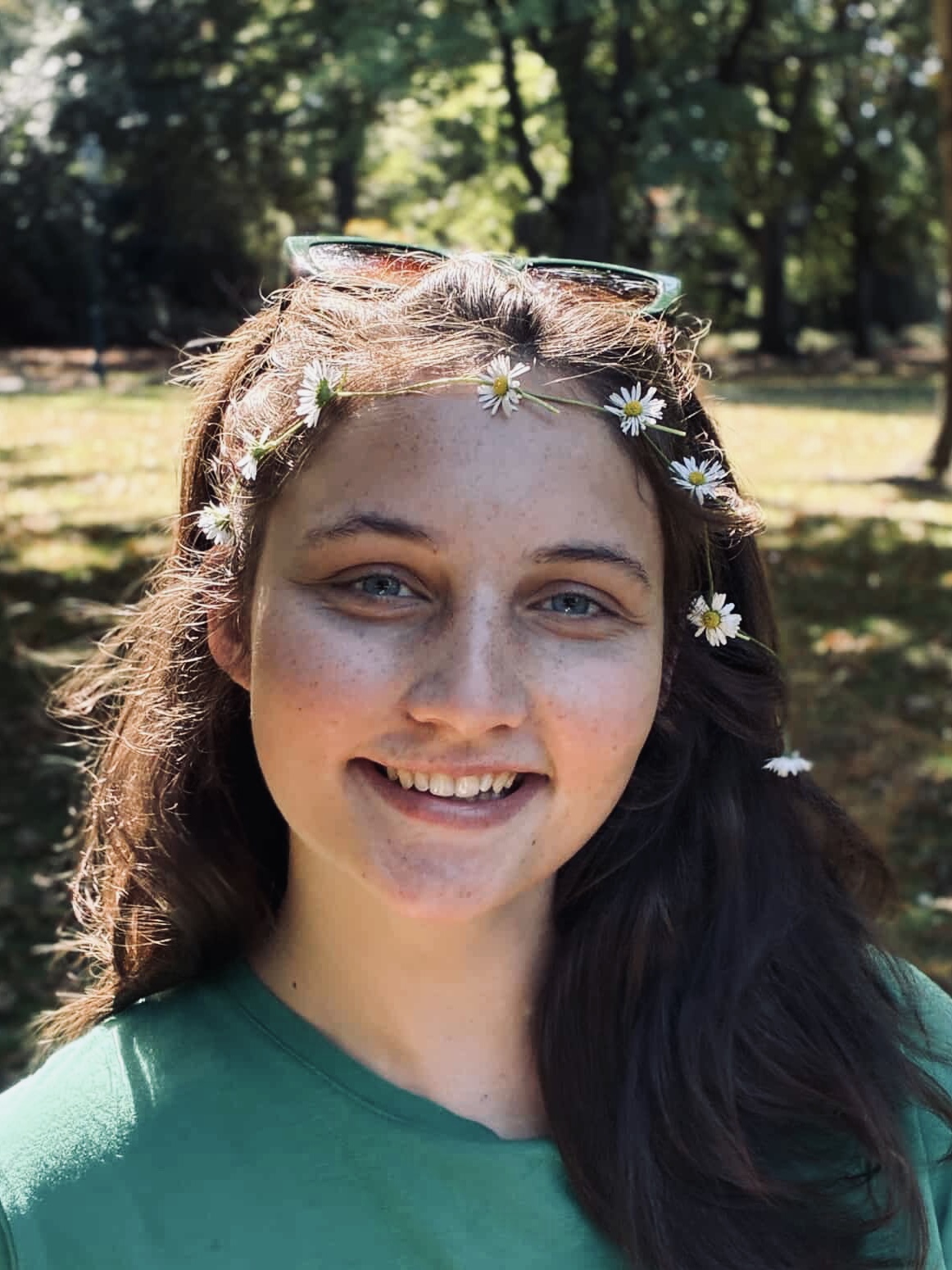
Indigo Tomlinson
Name three words that matter to you when you are writing a poem.
Emotional honesty, empathy, excision.
Can you share a few poets whose poetry boosts you as a writer?
Embarassing as this is to admit, I actually read relatively little poetry in my free time! As an English Lit major however there are a number of poets whose work I have read and enjoyed from a more analytical perspective, in particular Louise Glück and Sylvia Plath. I studied The Wild Iris quite extensively last year and I adored how structured the collection was and how effortlessly Glück moved between different voices. I think that her fluidity of voice is really inspiring, and she also uses a lot of rich nature imagery which I appreciate. Thematically I appreciate anything which feels intersectional or like it straddles a boundary and I think she does that very well. Although I don’t read much poetry, I do listen to a lot of music, and I think that songwriting can function as a poetic form when its done well. With that idea in mind, some of the artists whom I love are Maisie Peters, Taylor Swift and Lana del Rey. I’m definitely not very niche or original when it comes to the musical media I consume but I do like to think that popular things are popular for a reason and its interesting to consider what is it about these songs which cause them to evoke such strong emotional responses in so many different people.
Why poetry? Why poetry in this tumultuous world?
Well, why not poetry?
I think I like poetry it requires a creative exchange between the writer and the reader. To me, the meanings of my writing always feel very obvious, but I know that to other people my poems could read as weird or confusing, and that friction is interesting to me. You get as much out of a poem as you put into it, both as a reader and as a writer. I like that poetry is a liminal and ambigous form of expression, because, as you say, our world is a tumultuous place. Poetry can reflect that but it can also provide a respite from it.
Indigo’s poems
Deposition II
this is a painting made psychedelically violent by conflicting color, a corrosive pressure against my eyeballs. the lecturer muses that it is modern art, shorthand for this can mean anything you want. I look at the title
Deposition II
and wonder where Deposition I is. Such grand roman numerals – I and II, lined up like multi-coloured dominoes, the father knocking over down into the son, king passing on to king. I am the first of my name in an un-illustrious line, called indigo for eye color and not for legacy, unoriginal i know, but primogeniture reigns supreme, and if i was a boy i would have the letters G R T printed on my birth certificate – in untidy newborn parent handwriting, pushing me backwards into my father and his father before him.
G R T – for grit and gravel and grazes, for my psychedelically violet childhood, a flailing fist, seven-year-old gives her father a black eye. And my grandfather is G R T too, G R T and also blind on his right side. These patterns are clearer to me than the sporadic smears of color which comprise Deposition II.
Grayson, they might have termed me, had some chromosomes aligned differently. A son made gray, no paint palette explosion of color, nothing like this childish picture projected on the wall of a lecture theatre, just like how I am weakly projecting myself onto my forebears. Art imitates life imitates art, and imitation is the sincerest form of flattery, so I suppose it is a good thing I have never been capable of detecting sarcasm.
As Grayson, my form would be like a graphite pencil, like clouds. As Grayson, perhaps, other things would be different too.
But as it is, I was born with a vagina and the letter G on my birth certificate is not a signifier of name but of sex, standing for Girl, standing solely for this iteration of life and not some contrived parallel. Thus, the weight of G R T shall never be mine to bear, and I do not mind, although I feel it would not be very heavy; no heavier than a 3500g baby whom my father caught with two hands, and whose eyes he looked in when they first opened, and then whose eyes he told my mother were the color – indigo blue.
on The Yellow Wallpaper and the duality of a teenage girl
She doesn’t want me to tell you her name. This is because she thinks being nameless will lend her the universality of classic literature. She cited The Yellow Wallpaper like it made her intelligent and I told her Charlotte Perkins Gilman was a eugenicist.
She went for a walk in the park yesterday and fancied that she looked tragically esoteric. I told her no-one can be esoteric in two thousand twenty six, that all the esotericism died with the rise of the Internet, or, if not then, when mankind built an AI and called it Claude. Claude does not require namelessness to be universal; he is everywhere, and also pigeons are spies for the government.
She looks for signs of her importance in the shafts of sun, the way it lances like light off a knife smudged with butter. Silhouetted on screen she is radiating “main-character-energy.” The sun is yellow, but there is no wallpaper, except over all the cracks.
If she crawls, it is not madly nor in circles, but only ever in the clubs, sometime after 11pm, amid a mass of writhing bodies, twisting like lines, limbs knotting into an indecipherable pattern. She does not suffer from postnatal depression because she is eighteen and also a virgin, although I doubt she wanted that disclosed.
She thinks if I make her nameless then the audience (who the fuck are the audience?) will project themselves onto her, and through that process – grainy film rippling over a white sheet, hung in the backyard like so much laundry – she might at last be understood.
Her laundry is like teeth, dirtied yellow, and her name is the one on my birth certificate.
hand me down your blue genes size XS
seven true ribs each one visible
count the valleys between, like on knuckles
find what months have thirty days always
waning always wasting, waxing of legs
Eve was torn out from Adam’s rib cage
was part of me not once held within yours?
if my mother grew her bones inside you,
half of me must’ve formed in those moments as well
let us walk on splinters: crack the egg shell,
the little mermaid lost her voice for such a privilege
bury beige shards in the compost, still nothing grows
yolk me bleeding to this wagon of waiting rooms
doctors like to ask when i got my first period i say fifteen which is late although i am never.
do you know anything about this
?
Indigo Tomlinson (she/her) is a first year student at the University of Canterbury studying Law and English literature. She grew up in the small town of Whakatane in the Bay of Plenty before moving to Whangarei as a teenager. Her poems have been published several times in the NZPS yearly anthologies. When not writing she enjoys spending time outdoors, volunteering, practicing aerial silks and spending time with her family.
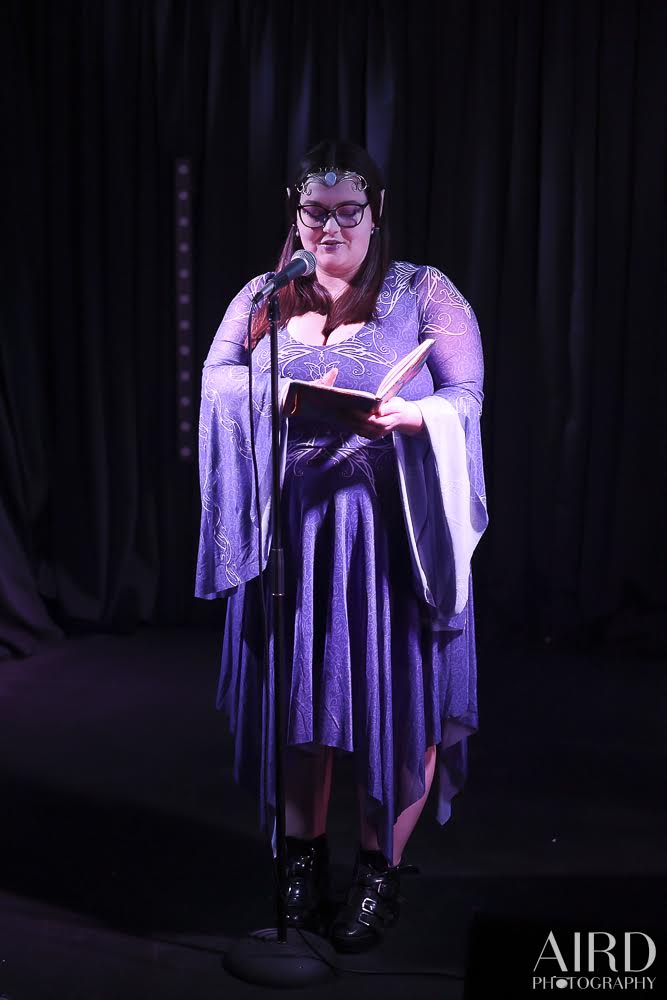
Jo Dansaren
‘ŌhinetahI Tales’
‘Lost Ent-Wife Finding Oneself’
‘Hearth, Harvest
Name three words that matter to you when you are writing a poem.
Flow, rhythm, feeling.
Can you share a few poets whose poetry boosts you as a writer?
Desireé Dallagiacomo, Melanie McKerchar, Neil Hilborn
Q. Why poetry? Why poetry in this tumultuous world?
Poetry is a powerful combination of voice and written word, allowing authenticity, intuition and emotion to connect people, especially in difficult times. As humans we love to relate to each other, poetry is a beautiful bridge between individuals.
Jor Dansaren (she/they) is an MC, producer, poet and performance artist based in Ōtautahi. Heavily influenced by the delights of the natural world, Old Norse skaldic storytelling, and spiritual process, Jor finds wonder in life and the broad spectrum of human experience. They are a regular poetry slammer and their written work has been published in Catalyst and Fuego journals.


Pingback: Poetry Shelf best ever celebration of NZ Poetry Day – Fiona Farrell responds to Tūmanako: Words of Hope event | NZ Poetry Shelf