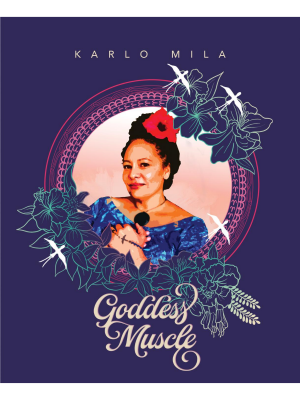
Karlo Mila, Goddess Muscle, Huia Publishers, 2020
Paintbrushes in our hands
drafting our dreams,
remembering the chants,
writing the poems,
relearning the language
composing the chants,
cooking the dinners,
carrying the children,
paying the bills,
fighting the fight,
with our tax-paying,
car-driving hands.
A collective of artists
narrating a story
we can bear to live in.
Creating an image
of ourselves
we can love
to look at:
from ‘Our Generation : ‘Āina Aloha’
Karlo Mila’s new poetry book is the most gorgeously produced collection I have held in ages. It feels good. It looks good. It is a pleasing shape. It has abandoned the reigning tradition of black ink upon white page in favour of a wider colour palette for both font and background. Sometimes I have to peer in close to read as though the physical act of reading is as important as cerebral connections and heart boosts. It continues to matter to me as addicted poetry reader at the moment: the effects a poetry collection has upon you as you read and as you move away. How satisfying when poetry uplifts heart and stimulates brain, soothes tired bodies and sets us swaying.
Several artists contributed work for the book and, as the acknowledgement page underlines, these vibrant works are personal: Delicia Samero’s portraits of Karlo, a collaborative mural Aloha ‘Āina and Naomi Maraea’s depiction of Hikule‘o.
I adored the 2021 poetry longlist for the Ockham New Zealand Book Awards having been so affected by the eight books I had read and reviewed. And now I can add a ninth sublime read: Karlo’s Goddess Muscle. The collection ignites every reading muscle: from heart to mind to breathing to memory to pulse. Karlo engages with light and dark, fragility and strength, relationships, family, sisterhoods, writing mentors, life mentors, political issues. Her words meet the line, create the lines like a movement of water, lap lapping in your ear, across your skin, with ebb and tide, the words in debt to water fluency as they flow gentle and honeyed, or hit sands, rocks, obstacles. Such sweet flowing lyrical currents. Always audible, always mesmerising. This is poetic craft at its most agile.
Dark, lovely cowrie-shell eyes,
who’d expect the lies,
unless you flipped that fragile shell over
to the serrated crack
of the backside,
where the sea slugs reside,
that weak pink flesh on the inside.
Everyone’s got a living surprise,
the part that they hide.
from ‘The Tale of Hine and Sinilau’
The book begins with a gathering, a gathering of lineage, ancestors, relations. This becomes place, somewhere to write from and to and because of. The gathering involves balance, re-orientation. The gathering (both noun and verb) becomes writing and this is what writing can do.
It is their
soft singing,
cellular love songs,
the chanting lyric of bloodlines,
accompanying you
all the way
through the lonely.
from ‘Your People Will Gather Around You: Love After Love’
The ocean is paramount, not just in the water fluency of the lines, but in the recurring motifs and the personal attachment. “Oceania’ is an ocean homage, image, self-defining: ‘I call on the memory of water’.
Karlo acknowledges writers and loved ones who have sustained her, who are the essential oils of writing. She lights a candle for Teresia Teaiwa in ‘For Teresia Teaiwa’. I am moved to tears as I read this loving tribute to poet who affected and inspired so many others.
I will light this candle.
The spendy kind,
cradled in glass,
that burns for days
smelling of coconut and vanilla
and I will say prayers for you
even though my prayers
are like bad poems
and are often wordless.
I hope,
at the least,
you will feel the
long-burning
flame of my intent,
warming the space
between us.
The tribute poem to JC Sturm cuts to the bone of reading, sidestepping Baxter and his sickening offences, Karlo taking a road trip to Jerusalem with her own broken heart and her mother, moving under his over-present lines to Jacquie. How I love this poem, this mihi: ‘But moving under all that surface skimming / was you.’ The poem to Hone Tuwhare is pure delight. The sonic torque (can I say that, think sounds spinning on word axes) is sensational.
You boilermaker,
fabricating lyrical weld
from blast furnace
of sun,
slowed,
stopped and
set
on white horizon
of page.
from ‘A Conversation with Hone Tuwhare’
Karlo’s love poems have always gripped me and I favoured them in Wild Honey’s ‘Love’ section. This collection faces broken love, longings, touch, loneliness, attachment with shifting intensities, hues, admissions. There is someone at the end of the poem, an addressee, a beloved, a lover lost, a lover found, and Karlo never forgets that. The poems are layered, intimate, deeply personal. I am still held in their grip.
Goddess Muscle is crafted like a symphony, an experience of shifting life seasons and subject matter, so as you read the effects are wide reaching. Karlo faces significant political issues: climate change, the Commonwealth, colonialism, racism, Ihumātao, ‘the daily politics of being a woman, partner and mother’. She faces these global and individual challenges without flinching. The resulting poems are essential reading, never losing touch with song and heart, always insisting in poetic form how we can do better. How we can be a better world, recharge humanity. I would like to see these poems read in secondary school. You can read ‘Moemoeā: (composed for poets for Ihumātao)’ here.
Goddess Muscle is a gift. I can barely account for how it will stretch your reading muscles, your beating heart, your enquiring mind, your compassion, your music cravings, your empathy. Karlo has extended her own poetic muscle and offered poetry that is wisdom, strength, refreshed humaneness. Thank you. Thank you.
If we were truly to reorient
to life as relatives,
commonwealth
would mean more
than what we might cling to
in the face of a dangerous
and uncertain future.
Let us not
use the word ‘commonwealth’
to try and insulate fate
with the soft fur of fine-feathered friends.
No,
let us spread our wings
to a much wider vision than that.
It may be the end of the world as we know it
but let us not fear
the remaking of another one.
To the young people I say,
there may be no jobs
but there is plenty of work to be done.
So let us harness our collective wisdoms:
divers, different and divergent.
Let us create an atmosphere
of kindness and love
for even the air we breathe,
fresh water, trees, people, ocean.
Let us create a dream house,
a great place to raise a family.
For therein lies the fate
of an extraordinary family of relatives.
Where what we have in common
is all of us.
from ‘Poem for the Commonwealth, 2018’
Dr Karlo Mila is a New Zealand-born poet of Tongan and Pākehā descent with ancestral connections to Samoa. She is currently Programme Director of Mana Moana, Leadership New Zealand. This leadership programme is based on her postdoctoral research on harnessing indigenous language and ancestral knowledge from the Pacific to use in contemporary leadership contexts. Karlo received an MNZM in 2019 for services to the Pacific community and as a poet, received a Creative New Zealand Contemporary Pacific Artist Award in 2016, and was selected for a Creative New Zealand Fulbright Pacific Writer’s Residency in Hawaii in 2015.
Goddess Muscle is Karlo’s third book of poetry and has been longlisted for the Ockham New Zealand Book Awards 2021. Her first, Dream Fish Floating, won NZSA Jessie Mackay Best First Book of Poetry Award at the Montana New Zealand Book Awards in 2006. In 2008, Karlo collaborated with German-born artist Delicia Sampero to produce A Well Written Body.
Huia Publishers author page
Poetry Shelf – poets on their own poems: Karlo Mila reads ‘For Tamir Rice with Love from Aotearoa’




 NZ Poetry Shelf