Monthly Archives: March 2020

Poetry Shelf noticeboard: Ockham NZ Book Awards – General non-fiction shortlist picks poetry!

Screen Shot 2020-03-04 at 6.41.06 AM.png

Wow! I am so chuffed Wild Honey is on this list! I am still reeling Elizabeth Knox’s The Absolute Book is not on the fiction list because that book just blew my socks off it is so astonishing. After a bite of sleep I am a weird mix of sad glad reader writer. But crikey I am feeling very moved. And very soon I will do a happy dance (and it rained last night so our water tank will join in).

Full Ockham NZ Book Award list here

I am posting a feature on the Poetry shortlist this morning.

Screen Shot 2020-03-04 at 6.39.34 AM.png

Screen Shot 2020-03-04 at 6.39.59 AM.png

Screen Shot 2020-03-04 at 6.36.21 AM.png

Screen Shot 2020-03-04 at 6.40.24 AM.png

THE JANN MEDLICOTT ACORN PRIZE FOR FICTION

Auē, by Becky Manawatu (Mākaro Press)

Pearly Gates, by Owen Marshall (Vintage, Penguin Random House)

A Mistake, by Carl Shuker (Victoria University Press)

Halibut on the Moon, by David Vann (Text Publishing)


ILLUSTRATED NON-FICTION

Crafting Aotearoa: A Cultural History of Making in New Zealand and the Wider Moana Oceania, edited by Karl Chitham, Kolokesa U Māhina-Tuai, Damian Skinner (Te Papa Press)

Protest Tautohetohe: Objects of Resistance, Persistence and Defiance, edited by Stephanie Gibson, Matariki Williams, Puawai Cairns (Te Papa Press)

We Are Here: An Atlas of Aotearoa, by Chris McDowall and Tim Denee (Massey University Press)

McCahon Country, by Justin Paton (Penguin Random House)


GENERAL NON-FICTION

Dead People I Have Known, by Shayne Carter (Victoria University Press)

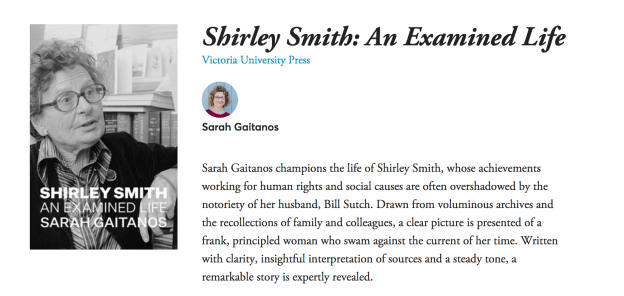
Shirley Smith: An Examined Life, by Sarah Gaitanos (Victoria University Press)

Wild Honey: Reading New Zealand Women’s Poetry, by Paula Green (Massey University Press)

Towards the Mountain: A Story of Grief and Hope Forty Years on from Erebus, by Sarah Myles (Allen & Unwin)


THE MARY AND PETER BIGGS AWARD FOR POETRY

Moth Hour, by Anne Kennedy (Auckland University Press)

How to Live, by Helen Rickerby (Auckland University Press)

Lay Studies, by Steven Toussaint (Victoria University Press)

How I Get Ready, by Ashleigh Young (Victoria University Press)


Some questions for poets reading at Paula Green’s Poetry Shelf Live (Wellington)


1389048-612125-34-1.jpg

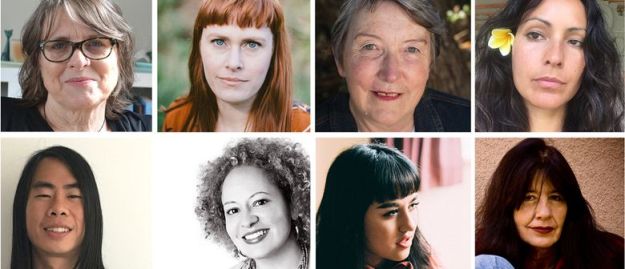
Paula Green with Jane Arthur, Lynn Jenner, Simone Kaho, Gregory Kan, Karlo Mila, Tayi Tibble and and special guest, US Poet Laureate Joy Harjo.


Prompted by the arrival of Wild Honey, Claire Mabey (Verb Wellington) invited me to curate a session for NZ Festival of the Arts Writers programme. It morphed into a Poetry Shelf Live session at Claire’s suggestion. I have always wanted to do this and would love to curate seasons of Poetry Shelf Live in other places, even my hometown Auckland! But I am a big fan of the poetry verve in our capital city, and have multiple Wellington attachments, having lived there twice in my life (I started school at Petone Central way back when).

So am delighted to be hosting this session!

Picking just a handful of poets was hard as there are so many recent poetry collections that I have adored, along with poets whose work has inspired me for a long time. And it’s something special to have American Poet Laureate Joy Harjo read with us.

As a prelude to the reading, a few of the poets answered some poetry questions.


Why write poetry?

Gregory Kan: Poetry is a way for me to process the world and also to build new worlds.

Simone Kaho: My mother used to read me and my brothers and sister bedtime stories, and we all loved reading growing up. When I first came across poetry at school, I saw how much energy there was in it. It seemed to me, to be a wild and condensed version of stories in books. I was drawn to the way a poem could tell a story, or create powerful emotion with very few words. I liked how much the writer collaborates with the reader to create meaning. It looked like magic to me and I had to try and see if I had some in me.

Jane Arthur: I think it’s because my brain suits short, intense bursts of thoughts and words, thinking about poem-sized ideas and doing poetry-shaped crafting. Which is why it’s bizarre and terrifying that I am working on a children’s novel right now.

Lynn Jenner: 

Because poetry is an arrow.

Because it can also be  as wide as a sea.


What  attracts you in a poem as a reader?

Gregory Kan: Leaps of the mind, eye and imagination.

Simone Kaho: I like poetry that is dark and funny, but in any poetry I’m looking for the moments where you have to stop and look away from the page, to savour what the poem has said or done. I find in many poems, times where there’s a feeling of spiritual connection. What the poem is saying becomes so true for you it’s like you are experiencing it yourself, you suddenly blend with the poet and understand, deeply, something they are saying or feeling. This can happen in any type of poetry, but for me, it’s probably more likely to happen in poetry that is slightly narrative, or grounded in the real world.

Lynn Jenner: I like the poet to tell me about what they know and what they have learned in their life. I like politics in poems. Other than that, I probably like what everyone likes; surprising language, some building up of themes and some swing and lurch in the rhythm and cadence.


What matters to you in a poem as a writer?

Gregory Kan: Movement beyond what I know.

Lynn Jenner:It is important to feel that the poem has done enough, that it has brought something into the light and examined it quite a bit. Because of this, I tend to write long-ish poems! I also aspire to write poems that have an emotional punch to them.

Jane Arthur: Authenticity, voice, surprise.

Simone Kaho: When a poem works, to me, it’s like it holds it’s own energy. You can read it back and see things you didn’t necessarily intend at the time of writing, and it communicates new things back to you. It feels a bit distant – like a memory of being in that moment.


I just hosted a festival of tree poems on Poetry Shelf – do you have recurring things in your poems?

Lynn Jenner: Trees, actually, and people dying. Also people talking.

Gregory Kan: Funny you should mention the tree poems – trees!

Jane Arthur: There’s a constant oscillation between rage and apathy. At least, those were the two states I found myself in while writing Craven, and I can still sense them when I read it now.

Simone Kaho: Yes, trees is a recurring them in my poems. Also family, the natural environment generally, and how it feels to be human. Lately, I’ve been writing poetry that is perhaps more overtly political – it’s talking about gender dynamics and trauma.


Name 3 to 5 books that you have loved at different points in your life.

Lynn Jenner: Seamus Deane,  Reading in the Dark;  Amos Oz, Tales of Love and Darkness; Leo Tolstoy, Hadji Murad; H.G. Sebald, The Emmigrants

Gregory Kan: Nox by Anne Carson, Sonny by Mary Burger, Dreams for Kurosawa by Raul Zurita, Penury by Myung Mi Kim. Just off the top of my head. But really there are so many.

Simone Kaho:  Huckleberry Finn – Mark Twain, In the line of Beauty – Alan Hollinghurst, Bunny – Selima Hill, All of Tusiata Avia’s books, The Book of the Black Star – Albert Wendt


If you were to host a festival poetry session with poets from any time and any place who would you include?

Lynn Jenner: Adrienne Rich, Bill Manhire, Yevgeny Yevtushenko, Leonard Cohen, Paul Muldoon, Seamus Heaney, Rumi

Gregory Kan: I don’t know!

Simone Kaho: The poets in this reading definitely. Selima Hill, Tusiata Avia, Albert Wendt, essa may ranapiri, Hone Tuwhare, Jacquie Sturm, Maya Angelou, Staceyann Chin. I could go on to include 100’s but these would be my first picks.



Screen Shot 2020-02-28 at 11.18.48 AM.png


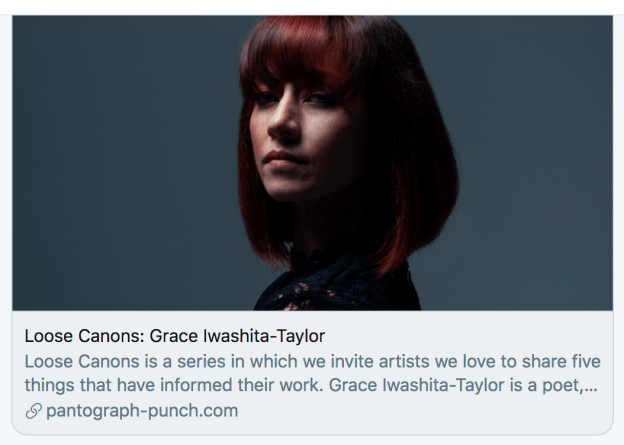
Poetry Shelf noticeboard: Grace Taylor and Loose Canons

Screen Shot 2020-03-02 at 9.33.21 AM.png

Read the full piece at Pantograph Punch

Loose Canons is a series in which we invite artists we love to share five things that have informed their work. Meet the rest of our Loose Canons here.

Grace Iwashita-Taylor is a poet, performer and curator of Silo Theatre’s UPU.

When I first met poetry, it was through the lyrics of my favourite songwriters. Meticulously playing and rewinding and replaying their songs on cassettes just so I could write the lyrics down in a notebook. As a teenager I would buy albums and open up the sleeve to read the lyrics before I would even play the music.

The other way I met poetry was through Shakespeare, by way of Baz Luhrmann’s Romeo + Juliet. Or to be more specific it was Leonardo smoking a cigarette, writing sonnets in his notebook with the Venice sun setting behind him. The alluring cliche of the tragic romantic to a teenager! That then led to me stealing The Complete Works of Shakespeare from my Year 11 English class, the only time I have ever stolen anything. It wasn’t long before I started to write my own words, but I dared not call it poetry for a couple of years. Poetry did become the language that makes the most sense to me, in my world of many languages. When I read poetry that thrills me, resonates with me, it is the same as making slow glorious love. It is orgasmic.

Poetry my greatest lover, forever constant, never stumbling.

Poetry Shelf Monday poem: Murray Edmond’s ‘The Chocolate for the Ants’


THE CHOCOLATE FOR THE ANTS


It was the ants who taught you pathos.

Your oldest aunt the only one not living

in Australia stern Methodist that she was

loved you best of all her many nephews

so when you had eaten all your dinner up

gave you a piece of chocolate which you

with your grasp of the Methodist ethic of

delayed gratification placed on the bedside

table when you had been tucked up in

your narrow bed so that the pleasure

to be taken on awaking in the morning

would be all the greater than had that

chocolate been eaten when it was received

except those ants had their own wayward

thoughts and there they were exercising

their own ideas when you woke. So thickly

did they coat that chocolate piece the pathos

was you could not see the chocolate for the ants.


Murray Edmond


Murray Edmond’s recent books include Back Before You Know (2019, Longlisted for the Ockham NZ Book Awards) and Shaggy Magpie Songs (2015), two poetry volumes; Then It Was Now Again: Selected Critical Writing (2014); and Strait Men and Other Tales (2015), fictions. He is the editor of Ka Mate Ka Ora: A New Zealand Journal of Poetry and Poetics; and works as a dramaturge – Jacob Rajan and Justin Lewis’s Mrs Krishnan’s Party (2017) and Welcome to the Murder House (2018) and Naomi Bartley’s Te Waka Huia (2017/ 2018). Also directed Len Lye: the Opera (2012).


Poetry Shelf noticeboard: Sweet Mammalian calls for submissions

Screen Shot 2020-03-01 at 2.00.20 PM.png


SUBMISSIONS

SUBMISSIONS ARE OPEN SWEETIES

It’s a leap year babieeeees and we want YOUR leaps of faith in this year of our lady 2020 for the Sweet Mammalian spicy election special.

Get het up about it – everything you love is political and we want to hear what and who you care for. Not party politicians but your sisters and brothers, your babes, your brutes, your ride or dies, your bois, your bus drivers, your worshippers, your nan, your neighbours kicked out of the damp flat down the road…

Send us your best poems.  Send us your experiences of well-being and hell-being. Mould manifestos; hope-fooled love letters; climate doomsdays; down with the single use plastic bag & up with tino flags at Ihumātao; anxiety med prescriptions; close encounters with generation greed; rental mental ills… or anything you please.

This year we’re interested in poems that touch on politics cos that’s the time in the place we live in, but don’t feel obliged to contort your work to the theme if you have something potent to share with us.

Send up to five poems of any length to , ideally in an editable format (eg Word or Google docs).

Submissions will be open from now until 31 May 2020, towards a pre-election launch in August.

_________________________________________________________________________

Send us your writing, be it a roar, purr, or pip-squeak.

Sweet Mammalian aims for diversity and inclusiveness—we want all different kinds of poetry, from all different kinds of writers. In order to make this possible we need your submissions, so send us your thrilling writing!

Check back here for updates, or find us on Facebook or Twitter.

Send all submissions to swetmammalian@gmail.com