
Claire Orchard reads ‘Long Haul’. It was originally published in Verge
Claire Orchard lives in Wellington. Her first poetry collection, Cold Water Cure, was published by Victoria University Press in 2016. Links to more of her work can be found here.

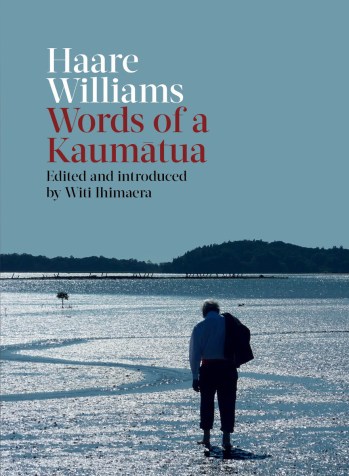
Haare Williams: Words of a Kaumātua, edited and introduced by Witi Ihimaera (AUP 2019) is reason for celebration in anyone’s language. Characteristic of the work and its contents is this kaumātua’s persistent acknowledgement of his elders as the source of his considerable wisdom. A modest and honest gentleman, Haare Williams might have required some coaxing, so full credit (as the footie captains say) to Witi Ihimaera as well.
My object here is neither a critique nor a review but to draw attention to the book and to rejoice in one of the most accurate and excellent metaphors in our poetry in Aotearoa. From the sequence ‘Bird songs’:
He Kuaka
(for Hone Tuwhare)
At Pārengarenga
a lone godwit
lifts
others rise to take wing
and follow
to circle and once in flight
to soar
others rise
to follow
This is a beautiful poet to poet tribute. That there are so many young kuaka now in the air, which would delight him, is evidence of how much Hone Tuwhare’s precedent achieved both for Māori and for world poetry.
— Tony Beyer
Tony Beyer now writes full time in Taranaki. His recent titles are Anchor Stone (2017) and Friday Prayers (2019), both from Cold Hub Press. New work appears here
Haare Williams grew up with his Tūhoe grandparents on the shores of Ōhiwa Harbour in a te reo world of Tāne and Tangaroa, Te Kooti and the old testament, of Nani Wai and curried cockle stew – a world that Haare left behind when he learnt English at school and moved to Auckland.
Over the last half-century, through the Māori arts movement, waves of protest and the rise of Māori broadcasting, Haare Williams has witnessed and played a part in the changing shape of Māoridom. And in his poetry and prose, in te reo Māori and English, Haare has a unique ability to capture both the wisdom of te ao Māori and the transformation of that world.
Recipient of an MNZM for services to Māori, Haare has been dean of Māori education and Māori adviser to the chief executive at Unitec. He was general manager of Aotearoa Radio and set up a joint venture with South Seas Film and Television to train te reo speakers as producers and operators in film and television. He has worked closely with iwi claimant communities and was responsible for waka construction and assembly at Waitangi for the 1990 commemorations as executive director of the 1990 Commission. He has published poetry, exhibited paintings, and written for film and television. He was cultural advisor for mayors of Auckland, a senior vice president of the Labour Party, and is amorangi at the Auckland War Memorial Museum.
Auckland University Press page
This is a treasure on my shelf – so good to see it out again. I adore the poetry and I adore the object. Would be at the launch in a flash if flashes worked like that!
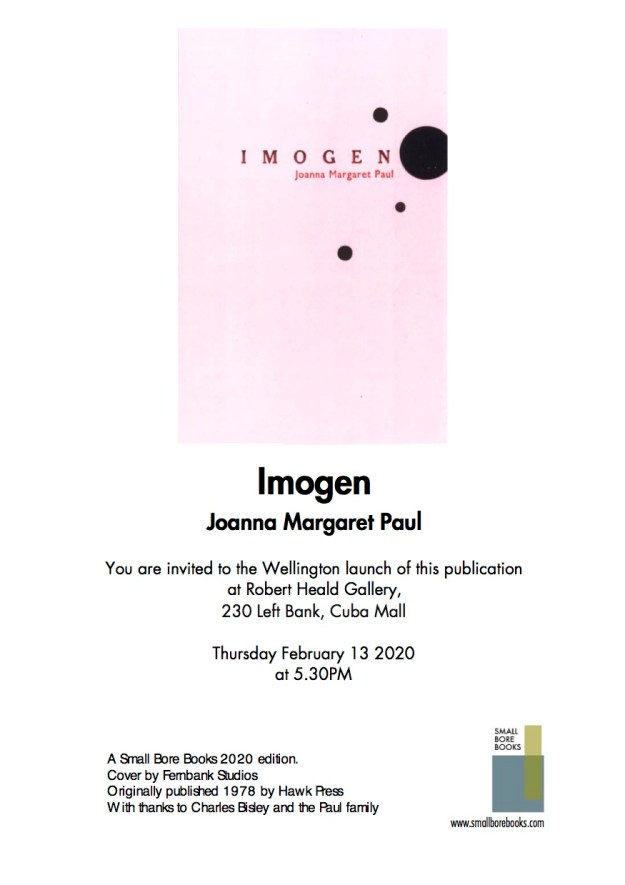
Hi everyone,
Just to let you know that this Thursday a new edition of Joanna Margaret Paul’s classic book IMOGEN is being launched at the Robert Heald Gallery (Left Bank, Wellington). Emma and Frank (of Small Bore Books) have done a magnificent job producing the new book, with Brendan O’Brien furnishing a hand-printed cover.
The launching is at 5.30 so please do come along and join us for a celebratory drink. (We realise there are other events on the same evening–come here first, then trundle on your way if necessary.)
Things will be underway well before start-up time, so hope to see you all there, earlier the better. And please pass this along to any interested persons.
Cheers and all,
Gregory O’brien
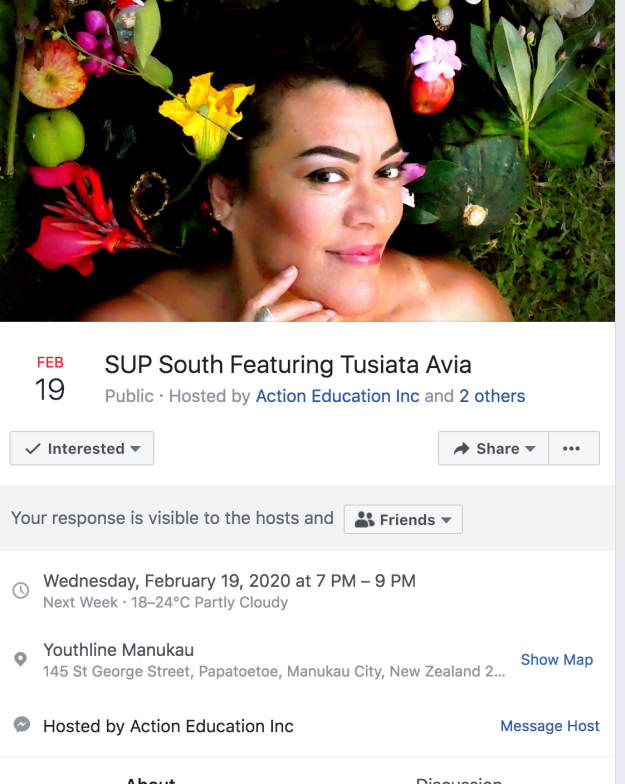
Yeah! Tusiata Avia has an Auckland poetry performance on February 19th!
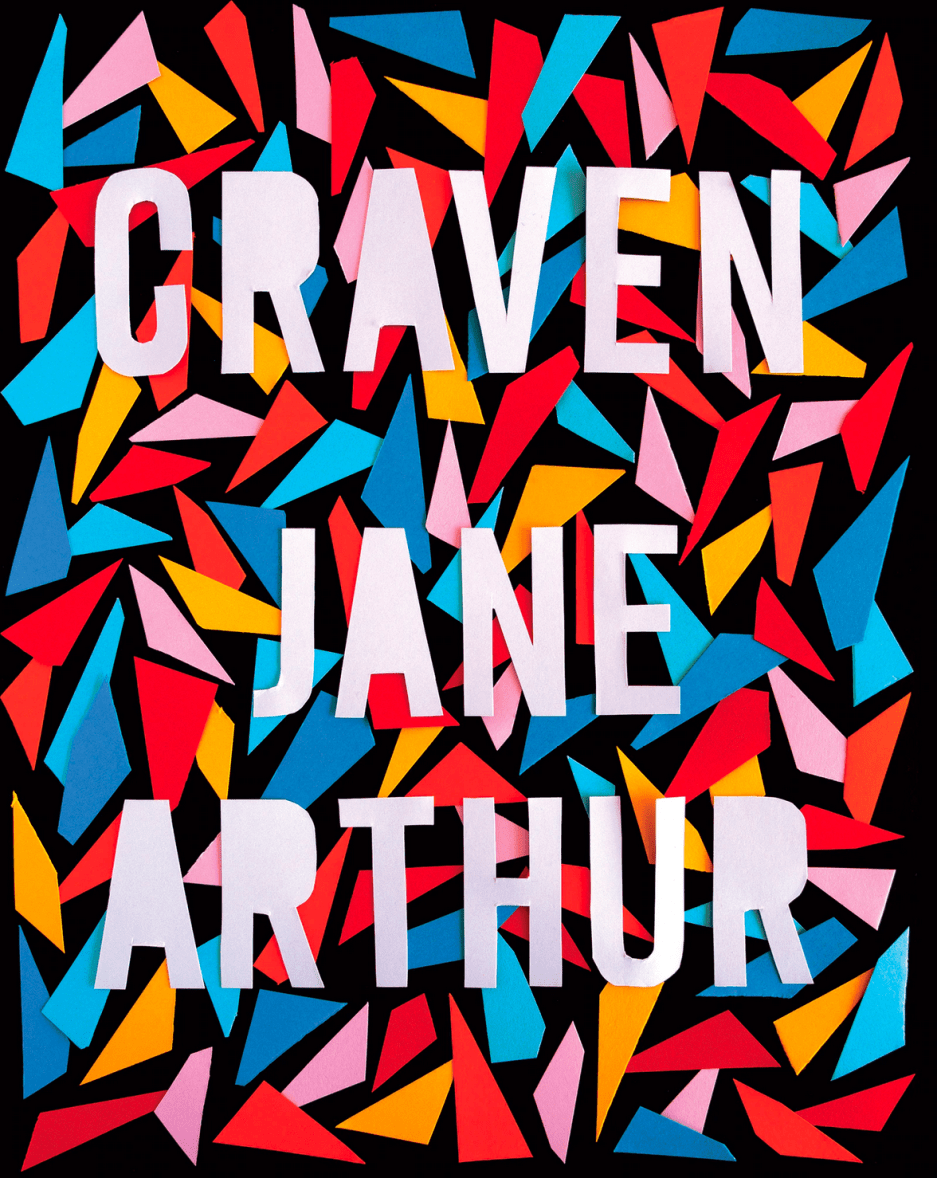
Craven, Jane Arthur, Victoria University Press, 2019
I have a broth at a simmer on the stove.
Salty water like I’ve scooped up some ocean
and am cooking it in my home. Here,
gulp it back like a whale sieving plankton.
Anything can be a weapon if you
swallow hard enough:
nail scissors, a butter knife, dental floss,
a kindergarten guillotine, hot soup,
waves, whales.
from ‘Circles of Lassitude’
Jane Arthur’s debut collection Craven inhabits moments until they shine – brilliantly, surprisingly, refractingly, bitingly. Present-tense poetry is somewhat addictive. With her free floating pronouns (I, you, we) poetry becomes a way of being, of inhabiting the moment, as you either reader or poet, from shifting points of view.
It is not surprising it has been longlisted for the Ockham New Zealand Book Awards.
The collection title references lack of courage, but it is as though Jane’s debut collection steps across a line into poetic forms of grit. This is a book of unabashed feeling; of showing the underseam, the awkward stitching, the rips and tears. Of daring to expose. The poems are always travelling and I delight in every surprising step. You move from taxidermy to piano lessons to heart checks and heart beats, but there is always a core of exposed self. And that moves me. You shift from a thing such as a plastic rose to Brad Pitt to parental quarrels. One poem speaks from the point of view of a ship’s figurehead, another from that of Constance. There is anxiety – there are dilemmas and epiphanies. The poetic movement is honeyed, fluid, divinely crafted – no matter where the subject travels, no matter the anxious veins, the tough knots.
An early poem, ‘Idiots’, is like an ode to life, to ways of being. I keep crossing between the title and the poem, the spare arrival of words punctuated by ample white space, elongated silent beats that fill with the links between brokenness, strength and pressing on.
Idiots
I’ve known people who decided
to carry their brokenness like strength
idiots
I’m a tree
I mean I’m tall, I sway
I don’t say, treat me gently
No¾I say, cool cool cool cool
I say, that really sucks but I guess I’ll survive it
or, that wind’s really strong
but so are my roots, so are my thighs
my branches my lungs my leaves my capacity to wait things out
I can get up in the morning
I do things
I heard Jane read for the first time at the Sarah Broom Poetry Prize session at the Auckland Writers Festival in 2018. Her reading blew my socks off, just as her poems had delighted American judge, Eileen Myles, and it was with great pleasure I announced her as the winner. Eileen described Jane’s poetry: ‘poetry’s a connection to everything which I felt in all these [shortlisted] poets but in this final winning one the most. There’s an unperturbed confident “real” here.’ In her report, Eileen wrote:
The poet shocked me. I was thrust into their work right away and it evoked the very situation of the poem and the cold suddenness of the clinical encounter, the matter of fact weirdness of being female though so many in the world are us. And still we are a ‘peculiarity’ here and this poet manages to instantly say that in poetry. They more than caught me. I like exactly how they do this – shifting from body to macro, celestial, clinical, and maybe even speaking a little out of an official history. She seems to me a poet of scale and embodiment. Her moves are clean and well-choreographed & delivers each poem’s end & abruptly and deeply I think. There’s a from the hip authority that inhabits each and all of these poems.
I am revisiting these words in view of Craven’s multiple poetry thrills. So often we talk about the way a poem steps off from the ordinary and blasts your heart and senses, if not your mind, with such a gust of freshness everything becomes out of the ordinary. This is what happens with Craven. A sense of verve and outspokenness is both intoxicating and necessary:
I’m entertaining the idea of never being silent again,
of walking into a room and shouting, You Fuckers Better Toe the Line
like a prophylactic.
from ‘Sit Down’
A sense of brittleness, vulnerability and self-testing is equally present:
I’ve been preoccupied with what others think again.
I’ve been trying not to let people down.
Nights are not long enough.
Lately there’s been more sun than I would’ve expected.
I keep the weather report open in its own tab and check it often.
From ‘Situation’
The movement between edge and smooth sailing, between light and dark, puzzle and resolution, and all shades within any dichotomy you might spot – enhances the reading experience. This is a book to treasure – its complexities and its economies, its confession and its reserve. It never fails to surprise. I am so excited she will be reading at my Poetry Shelf Live session at Wellington’s Writers Festival in March (see below). Triple yeah!
Jane Arthur was the recipient of the Sarah Broom Poetry Prize (2018). She has worked in the book industry as a bookseller and a book editor for over fifteen years. She has a master of Arts in Creative Writing from IIML at Victoria University of wellington. She was co-founder of the The Sapling, an online site for children’s literature. She lives in Wellington.
Jane will be appearing in my Poetry Shelf Live session at NZ Festival of the Arts,
Michael Fowler Centre, Sunday 8 March 2020 12:30pm – 1:30pm
Victoria University Press page
Poetry Shelf Monday poem: ‘Situation’ by Jane Arthur
Poetry Shelf audio spot: Jane Arthur reads ‘Snowglobe’
Poetry Shelf: Conversation with Sarah Broom Prize finalist, Jane Arthur
daughters depart
they are in the waves
beating for shore
as the little fish of their absence
swims in the fissures of my long grown bones
currents take hold
until
from sentiment
i fall to sediment
where the fumerole heat
escapes
in deep
dark
down
hair
a fontanelle
tells the stalker of memory
the necessity of tenderness
Janet Charman
Janet Charman’s monograph ‘SMOKING! The Homoerotic Subtext of Man Alone’ is available as a free download at Genrebooks. Her essay ‘Mary Mary Quite Contrary’ on Allen Curnow’s suppression of the poetics of Mary Stanley, appears in the current issue on-line of Pae Akoranga Wāhine, the journal of the Women’s Studies Association of NZ.
Ben Fagan is a performance poet and director of Motif Poetry.
He has a video just released in collaboration with the NZ Youth Choir. It’s the seventh video in his series Pākehā 2020, which is wrapping up this month.
‘To stiffen the sinews, to summon the blood’: Ka Mate Ka Ora: A New Zealand Journal of Poetry and Poetics
Ka Mate Ka Ora: A New Zealand Journal of Poetry and Poetics will be 15 years old in 2020. The latest issue contains a memoir of the last years of Baxter’s life, an essay about Mary Stanley’s poetry, an essay about David Merritt’s poetry and production systems, an essay about David Kaarena-Holmes’ poetry, and a reflection on the fictive lives of poets. But no poems. And no reviews of recent books of poetry. That’s what it’s like at Ka Mate Ka Ora. We don’t publish poems and we don’t run short reviews (though longer review-articles are definitely part of our kaupapa).
Ka Mate Ka Ora was designed to fill a gap – the lack of in-depth discourse about poetry and poetics within Aotearoa’s literary community. I guess you can say we are a specialist magazine, a niche product for an informed market. But this ‘informed market’ has many links to international poetries and poetics, which is where the electronic format is crucial. And this means KMKO is more than ‘just’ an academic journal. (I know that ‘just’ is not ‘just’!). If you haven’t seen the magazine before and want a look, or if you want to go back and revisit this or that issue, click here.
Throughout Ka Mate Ka Ora’s existence, we have sustained a policy of looking outward to what is going on elsewhere via reports from local roving reporters: Pam Brown on Australian poetry (issue #1), Anne Kennedy on Hawai’i poetry (#3), Anna Smaill on poetry in London (#5), Murray Edmond in China (#5), Lisa Samuels in Spain (#12) and Erena Shingade from Mumbai (#16).
The magazine is open access on-line. Its inception dates back to a time when the internet was more innocent and idealistic. We are still holding out for this ideal.
But times pass and worms turn and poets die. Over its 15 years obituaries have also become a regular feature: we have said haere ra to Dennis List, Mahmoud Darwish, Jacquie Sturm, Leigh Davis, Martyn Sanderson, Trevor Reeves. Rowley Habib (Rore Hapipi), Russell Haley, Heather McPherson, Gordon Challis and John Dickson. This list is interesting because each of these names occupied a crucial niche situation in New Zealand poetry at various times; yet none would quite qualify for that brief eternity of media attention that is shone in this age of reincarnated celebrity on certain kinds of literary names at their passing. I like to think that Ka Mate Ka Ora’s attention to such figures as those listed above will provide a valuable doorway through from the future to the past.
The majority of issues of Ka Mate Ka Ora have been composed from the careful editorial selection, aided by outside readers, of unsolicited contributions. But there have been at least four ‘special’ issues. Hone Tuwhare’s death warranted an issue-sized response, and Robert Sullivan took over the editorship for this (#6). Then there have been issues about ‘Words and Pictures’ (#7), James K.Baxter (#8) and Translation (#11).
Special issues tend to bring in a swathe of special contributors, whereas an issue that consists of four or five substantial essays errs in favour of depth rather than spread. More than 100 different writers have contributed to KMKO over the past 15 years. Contributors range from those who are poets themselves to academics, to Masters and Doctoral students who are often both poets and scholars, plus photographers, illustrators, archivists, printers, designers, songwriters et al.
The contents of KMKO have become cumulative, as the editorial in the latest issue highlights in relation to the catalogue of contributions about James Baxter:
John Newton, ‘”By Writing and Example”: The Baxter Effect,’ No.1, Dec. 2005.
Paul Millar, ‘Return to Exile: James K. Baxter’s Indian Poems’ plus the unpublished Indian poems, No. 3. March 2007.
Dougal McNeill, ‘Baxter’s Burns,’ No. 8, Sept. 2009.
Jeffrey Paparoa Holman, ‘”Reason not the Need”: John Newton and James K. Baxter’s Double Rainbow,’ No. 8, Sept. 2009.
Francis McWhannell, ‘Hunt’s Baxter,’ No. 8, Sept. 2009.
Reproduction of Baxter’s ms. Of ‘Jerusalem in Winter,’ No. 8. Sept. 2009.
John Petit’s photographs of Baxter at Hiruharama, Dec. 1970, No. 8, 2009.
Stephen Innes,’ The Baxter Papers at the University of Auckland Library,’ No. 8, 2009.
Paul Millar and Miranda Wilson, ‘”The Fire-bird Singing Loud”: James K. Baxter’s Relationship with Composer Dorothy Freed,’ No 15, July, 2017.
Keir Volkerling, ‘James K. Baxter – an Evolving Memoir,’ No.17, Oct 2019.
Threading one’s way through these disparate works of criticism and literary historiography, it is possible to trace the developing case study of Baxter criticism as it has taken shape in the 21st century up to (and with Keir Volkerling’s piece, even beyond) the recent controversy of Baxter’s ‘me/too moment’ with the publication of the Letters in 2019.
Ka Mate Ka Ora is named after the first line of what can be labeled Aotearoa’s most well-known and, at times, most controversial poem. The crass, commercial and appropriative imitations of the haka form that now get mounted world-wide with depressing regularity, do not touch upon Te Rauparaha’s words. The words of haka have always been of the most charged and sensitive kind. Robert Sullivan, in his editorial in issue #1 quotes Timoti Karetu with regard to this kind of kind of short, intense haka, he ngeri, to the effect that such a form is designed ‘to stiffen the sinews, to summon up the blood’: life or death?
I have been the editor of Ka Mate Ka Ora from the first issue until now. I have been greatly assisted in this role by Hilary Chung, Michele Leggott and Lisa Samuels. We are planning a new issue for 2020, #18, so if you wish to send a contribution, first spend a little time looking through some issues, then read about us by clicking on the red ‘about’ at the bottom right of the magazine’s home page, and email to Murray Edmond at m.edmond@auckland.ac.nz. All contributions are sent out for at least one reader’s report.
Murray Edmond
Murray Edmond’s recent books include Back Before You Know (2019) and Shaggy Magpie Songs (2015), two poetry volumes; Then It Was Now Again: Selected Critical Writing (2014); and Strait Men and Other Tales, (2015), fictions. He is the editor of Ka Mate Ka Ora: A New Zealand Journal of Poetry and Poetics (http://www.nzepc.auckland.ac.nz/kmko/ ); and works as a dramaturge (Jacob Rajan and Justin Lewis’s Mrs Krishnan’s Party (2017) and Welcome to the Murder House (2018) and Naomi Bartley’s Te Waka Huia, 2017/ 2018). Also directed Len Lye: the Opera (2012).
Back Before You Know (Compound Press, 2019) has been longlisted for the Ockham NZ Book Awards.
Waitangi Day
When I was seventeen I took to the road
alone, the Northland sun in my bones and blood
the heat in my head like vertigo
my head spinning, feet on the land that raised me
along with the sturdy kauri the salty ocean
the home-grown vegetables fed on volcanic soil
I sat on the edge of a trail a bush pool mesmerising
and heard a cacophony of voices wailing mourning
knew I should not be there
Ghosts inside me I tell the local Māori on the stone
bench outside the Kerikeri store That place is tapu
he says kindly and I feel the grief rise and fall
We can carry the grief
I carry the grief
I carry the grief that our ancestors stole
whenua te reo kai wellbeing
I carry the grief at the violence and injustice
and I can’t imagine
I can’t imagine the wounds
I am almost old and I accept the hand
that is held out from the marae
I accept the kai that is cooked for me
the stories that are whispered in my ear
the poems that are gifted, the waiata that
are sang, the warm mihi nui offered but I will always
have the wailing Northland voices I heard
at seventeen when I had no idea of how to be
how to listen to the past
how to listen to the present the future
Now I am almost old with feet planted on this
Waitākere land we care for
my kūmara and tomatoes growing
out of story and wound and resilient love
I am holding your hand to my heart
knowing so much more is to be returned
breath to breath song to song and
the ghosts tell me listen listen listen
Paula Green 6 February 2020
HAPŪ WĀNANGA
for Tawera & Sharron
From Parihaka you can see it maybe hope is a kind of haunting
the shape of women learning maybe it is a dazzling thing
how to startle the red earth the whenua like the threads of a kaitaka
that will be buried but not left behind that have been woven
how to labour in the present with something I can only describe
tense with the weight of a future as breath
and the sound of tupuna knocking the wind has an ache in it
the marae fills with the first language it sounds like a river
I recognise but do not understand whose blue end is coming
but the kuia teaches me how to harvest moonlight where the world begins
pulling the threads from harakeke is this enough to remedy the past
draped over her lap like a question the world doesn’t stop to answer
I roll the silver between my fingers rain rolls off the mountain
the strands fray into more questions but they say you don’t need an atlas
made up of tinier pieces of doubt the size of the universe
she takes them and rests them on her calf to make sense of this
handrolls the fear into a muka of light approaching moment
Maria Yeonhee Ji
This piece by Maria has everything I seek to admire in a poem. First of all, its structure is entirely emblematic and relevant. It does something different without being gimmicky and gratuitous. For me, the white space is possibility. It is an invitation to hope. It is a suggestion that I may read the poem two ways. Most importantly, it is a birth canal of sorts for “the approaching moment” upon which the poem ends—but does not end.
“Hapū Wānanga” has an easy unity of theme and imagery. Indeed, one of its themes, the solidarity of women—sensed especially in this place of ancestors—is highlighted by the motif of weaving. There is a blended spirituality and corporeality to this poem which hinges on Maria’s ability to make magic from the concrete to “harvest moonlight” like the kuia who shows the speaker part of this new world.
This poem is also special because it signifies Maria’s last year publishing work in Signals, the journal of the Young Writers Programme. Ros Ali, my colleague at the YWP, taught Maria at St Cuthbert’s College, and Ros and I have both enjoyed Maria’s company at many workshops and master classes over the years. This is a beautiful valedictory poem as Maria goes off into the world of medicine (and the world of more writing, of course). Ros and I wish her every success.
Johanna Emeney
Johanna Emeney is a senior tutor in Creative Writing at Massey University, where she has worked since 2011. She also leads community writing projects with migrant young people and older adults with her friend, Ros Ali. They have worked together on the Michael King Young Writers Programme since 2009. Jo has published two collections of poetry (Apple & Tree, Cape Catley, 2011, and Family History, Mākaro Press, 2017), as well as an academic book called The Rise of Autobiographical Medical Poetry and the Medical Humanities (ibidem Press 2018). Her latest publication is a chapter on poetry for the Routledge Companion to Literature and Disability (2020).
Maria Yeonhee Ji is a writer and junior doctor based in Tāmaki Makaurau. She holds an MBChB and a BMedSci (Hons) from the University of Auckland, and dreams of adding a Masters in Creative Writing to this list someday. Her writing has appeared in several publications, including The Pantograph Punch, takahē, Signals, and Starling.
 NZ Poetry Shelf