Monthly Archives: September 2019

Poetry Shelf noticeboard: celebrating Helen Heath

Helen Heath won the 2019 Ockham New Zealand Book Awards with her poetry collection, Are Friends Electric? National Poetry Day sat down and talked to her about ‘that moment,’ the themes that recur in her work and why poetry is so hot in Aotearoa.


Helen reads two poems for Poetry Shelf

Poetry Shelf in conversation with Helen

Victoria University Press author  page


Going West 2019: chickens and a fresh wild wind


I love the hens in the autumn.

They’re beautiful.

I couldn’t imagine my life without them.

They’re everything to me.


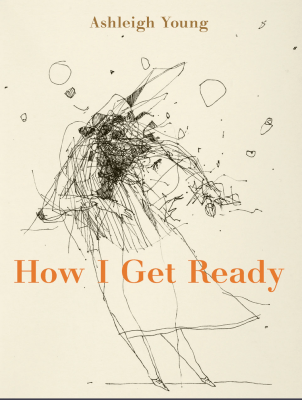
Ashleigh Young, from ‘Everything’ in How I Get Ready (VUP, 2019)


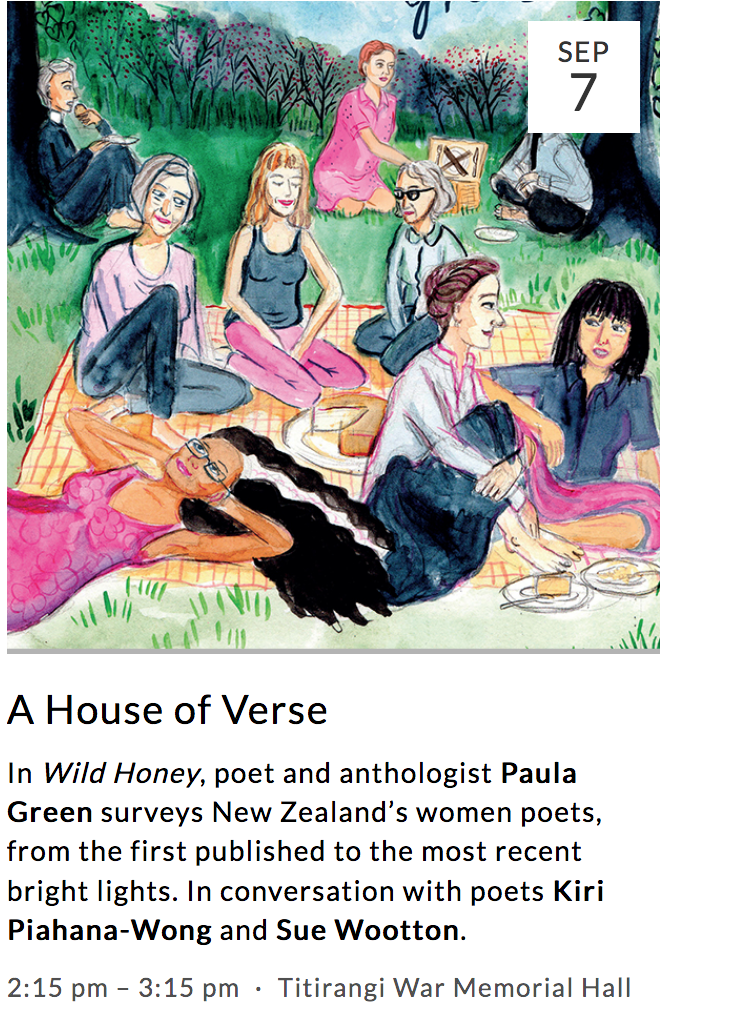
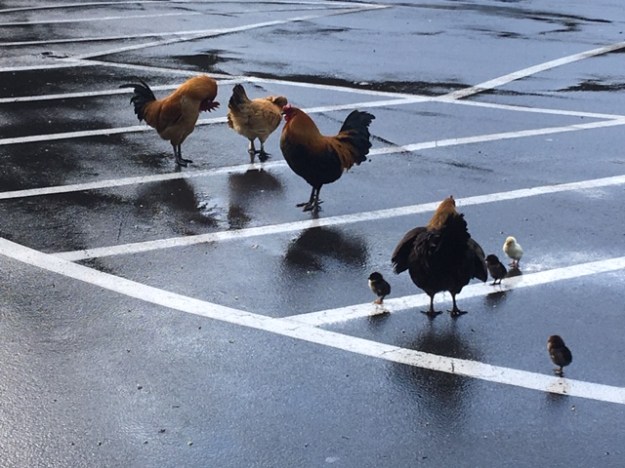
Going West 2019 is not over yet – but the weekend that brings writers and readers together in a warm bush setting is! Mark Easterbrook, the festival’s creative director, tweeted that every one was tweeting about chickens and not ideas – and here I am  wondering how many chickens will make their way into poems. Co-incidentally I finished my Wild Honey session by reading Ashleigh Young’s heavenly poem where chickens are much loved.

Actually when I arrived I switched my car off and thought it must need a new engine as my car sounded like a chicken! I panicked then saw the hen under the car. We all have our hen stories.

But yes the weekend was rich in kōrero, stories, poetry, conversations, connections. Listening to Apirana Taylor perform his poetry, Elizabeth Knox’s terrific oration on Friday night (I felt I was eavesdropping on the train!) and then talk about The Absolute Book with Dylan Horrocks the next day, (oh jumped to the top of my novel pile!) and Witi Ihimaera discussing his new memoir Native Son and seeking forgiveness from his younger self – was breathtakingly good. Restorative.

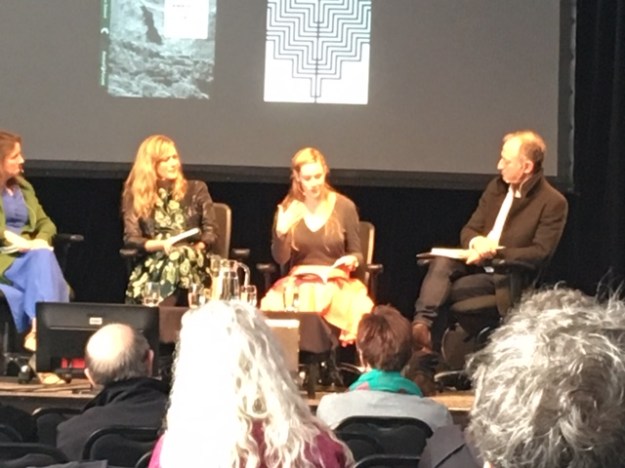
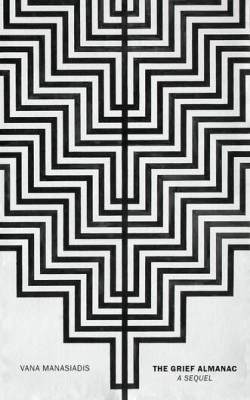
I loved hearing Vana Manasiadis read from The Grief Almanac. The writers in the museum session were a fresh wild wind blasting through my body reactivating skin and bones and I just adored them: Saraid de Silva Cameron, To’asavili Tuputala, Louise Tu’u, Lucy Zee.

And it was pretty special to sit on stage with Kiri Piahana-Wong and Anne Kennedy, talk about women’s poetry in Aoteaora and hear them read poems by other women.

I missed The Bellbirds on Friday night because I was so tired and had to drive back to Te Henga in the treacherous weather and got lost in the dark driving like an accident-prone snail and found myself driving up a narrow mountainous road ( I have never got lost coming back from GW) with nowhere to turn around and my heart beating wildly. I was on Mountain Road! I took me so long to get home I should have stayed for the Bellbirds. Fergus said they were gorgeous. Everyone was singing their praises. Ah!

This is always a family-like festival – relaxed, warm, empathetic, community building. Things were a little different this year – the seats arranged differently making audience flow easier, the food breaks were different but offered equally delicious fare, and pleasingly some sessions lasted an hour – but whatever changes were made the festival essence makes it a must-attend experience for me. Maybe with a bit more poetry! I was pleased to see many of the visiting authors listen to other sessions – I was disappointed to see so few Auckland writers in the audience. I find the support of writing communities so different in other cities. Ah – but the hall was full, and readers and writers got talking.

Thanks Going West team!

I loved this weekend. I just loved it.

IMG_5060.JPG

IMG_5064.JPG

IMG_5067.JPG


the-grief-almanac-cover-front-web.jpg   Screen Shot 2019-09-09 at 2.40.41 PM.png


Poetry Shelf Monday poem: Kate Camp’s ‘The law of expressed emotion’


The law of expressed emotion

The law is, that those who love you
will not help you get better.

Yes, they will sit next to you in a car
and take you through space

both moving forward at exactly the same speed
showing your profiles to each other

which are ageing rather more cruelly
than the fronts of you.

They will do things like park their car on the footpath for you
leaving only a card on the dashboard as a plea for clemency

and they will do explaining for you
when people do not understand your language

because you appear absolutely fluent while in fact
you are somewhat on fire.

They might take you to the monastery
with its not very important frescoes of Jesus

faintly visible and let you look down into valleys
that literally never see the sun.

They hope you will find this soothing
but perhaps it will be terrifying, the train of marvels

with its gorges and viaducts
and the medieval villages it passes though

on its way to the coast.
Maybe better to take you to the wardrobe

the armoire, where all the sheets and towels are
and where there used to be stickers of the Incredible Hulk

which glowed in the dark.
Except we gave the wardrobe away

left it out on the street with a sign saying
FREE

and when we woke up
or when we looked around

it was gone.


Kate Camp


Kate Camp is a Wellington-born essayist and poet, with six collections of poetry published by Victoria University Press. She has also written essays and memoir. Unfamiliar Legends of the Stars won the NZSA Jessie Mackay Best First Book of Poetry Award (1999), and The Mirror of Simple Annihilated Souls won the New Zealand Post Book Award for Poetry (2011). Snow White’s Coffin was shortlisted for the award in 2013, and The internet of things was longlisted in 2018. She has received the Creative New Zealand Berlin Writer’s Residency (2011) and the Katherine Mansfield Menton Fellowship (2017). Her essay ‘I wet my pants’ was a finalist in the Landfall essay competition in 2018.


Poetry Shelf Friday talk spot: Nithya Narayanan on getting into poems through Sylvia Plath


It was Sylvia Plath’s poems that really got me into poems.

I managed to get through most of high school without much contact with poetry. Not many people I knew wrote poetry, or read it. While I was fortunate enough to grow up in a home filled with books, poetry wasn’t really something that featured. The only poets I could name were the dead British ones: Keats, Byron, Coleridge, Southey. My grandmother—who was educated in freshly post-colonial India—would often bring them up, and remains shocked that I have gotten three years into an English major without encountering the canon.

In my final year of high school, I sat the Scholarship English exam and decided it would be more interesting (true) and easier (not true) to study poetry for one of the essay questions. I didn’t really have a clue who Sylvia Plath was. I knew only that she was American, and that she had written a novel called The Bell Jar. It’s funny how far you can get into a writer’s work without knowing the first thing about them. I got through about four of Plath’s poems—and meticulously annotated them—before I found out their author had gassed herself in an oven at the age of thirty.

There is a lot of commentary out there that will discuss Plath’s suicide alongside her body of work, as if her death is what makes her legendary. While I find this deeply problematic, I also think that it is difficult to read Plath’s work without an awareness of how she lived and died. She battled clinical depression for most of her life, a condition acutely worsened by the discovery that her husband (poet Ted Hughes) was in love with another woman. In 2003, a film was released on Plath’s life. Quite apart from its terrible casting (with Daniel Craig horribly miscast as Hughes), it reduced the problem of Plath’s life to a love triangle, and chose largely to skirt over the allegations of physical violence that Plath made against Hughes. Plath did not lead an easy life by any standard—a reality that is endlessly reflected in her poems.

I was initially drawn to Plath’s poetry because I thought she was God’s gift to feminism. There’s this wonderful line at the end of ‘Lady Lazarus’: “Out of the ash/I rise with my red hair/And I eat men like air”. I remember reading that at seventeen and trying to interpret the entire poem as some sort of tirade against men. In retrospect I think this was a rather reductive interpretation although, in my defence, the average seventeen-year-old girl will concoct a feminist reading out of almost anything. When I read ‘Lady Lazarus’ today, I read it more as a poem about survival. One of the things I admire most about Plath’s poetry is that it expresses the feeling of not being okay without being dramatic, sentimental, syrupy or self-indulgent. In ‘Tulips’ she contrasts—almost clinically—her body’s determination to live with her mind’s desire to leave: “I am aware of my heart: it opens and closes/Its bowl of red blooms out of sheer love of me”. The poem isn’t about moving on. It’s about endurance; about sitting with your not okay-ness until you are ready to move on.

If I had a dollar for every time someone told me they “don’t get” poetry, I wouldn’t have a crippling student loan. The way we’re taught to read in school puts an inordinate amount of emphasis on extrapolation: what something means as opposed to how it makes you feel. While this is helpful in terms of learning how to express an argument, it can be really counterintuitive when it comes to poetry. So much of what makes a poem worth reading is the sensation of it—its texture; its shape; the way it feels on the tongue. I think it’s possible to love a poem without ever really figuring out what it means. I struggled—and still do struggle—with a lot of Plath’s poems. I have never quite managed to figure out ‘Daddy’. I can’t reconcile its various parts, but I still love the way it sounds. Poetry isn’t algebra; you’ll never be able to solve it. Most of the time, the unknowability of the ‘x’ just hits you repeatedly in the face.

The last time I told someone I liked Sylvia Plath, they asked if I was into confessional poetry generally. The term “confessional” is defined as “the poetry of the personal”, and could include anyone from Plath to Anne Sexton to (arguably) Hera Lindsay Bird—yet Plath is a different animal to Sexton who is a completely different animal to Bird. My love for Plath is specific; I struggle to label, generalise, or explain it. I feel a little fraudulent even writing this because, while I love a good poem, poetry doesn’t make up the bulk of my reading material. My passion for Plath is the exception rather than the norm, the way some people claim to avoid dairy but have a special affinity for cheese.

I’m not sure why Plath isn’t taught more widely in New Zealand schools, but I really wish she was. I think we’re perhaps a little scared of poetry that addresses mental health so explicitly. I don’t really have anything to say to this, except to point out that we have the highest youth suicide rate in the OECD. Poetry isn’t a substitute for conversation or treatment—but it might well be a beginning.


Nithya Narayanan was born and bred in Auckland, and is currently studying a BA/LLB conjoint at the University of Auckland. She works on the editorial team for Interesting (the Faculty of Arts’ undergraduate journal) and her essay on Don Mee Choi’s ‘Shitty Kitty’ will be published in this year’s edition. Her poetry has previously appeared in Starling.


Poetry Shelf noticeboard: Eliana Gray’s boosted campaign for her Finland residency

Screen Shot 2019-09-06 at 7.59.10 AM.png


Kia ora e te whānau!

Eliana/ Ellie/ Eliana Gray here!

I’m going to Finland! I’ve just been selected for my first ever writer’s residency. This means that next February I get to live in a tiny town in the snow and work on my second collection of poetry!

I’m running a boosted campaign to achieve this and, if you’d like to, you can follow this link

I have been selected as the February 2020 writer in residence at Villa Sarkia in Finland and I am so excited! Villa Sarkia is a house run by Finnish Cultural Institution, Nuoren Voiman Liitto, which hosts a select number of writers every year, to work on their craft for a month. This will be my first ever residency (which for a poet is VERY exciting). I’ll be at Villa Sarkia for all of February working on my second collection of poetry.

How does it work?

I’ll be living in the tiny, snow filled town of Sysmä, Finland, at Villa Sarkia. I will be devoting some much needed time to my second collection. I will also be performing my poetry around Finland and running a writer’s workshop. I am so thrilled about the opportunity to devote myself to my writing, take my work overseas and share skills with other writers!

What I will be creating:

I will be using this time (the first time I’ve ever had to work ONLY on my writing!) to work on my second collection of poetry. My debut collection was about my experiences as a survivor of sexual abuse and living with C-PTSD. My second collection is about experiences of healing, and what happens after we are deemed “better”. So many conversations around sexual violence and mental illness contribute to harmful stigma. Nuanced conversations and art about these topics are vital. We are told not to talk about them, but we need to. To heal, not only on a personal level, but a collective one.

How can you be involved?

By donating to and sharing this campaign! I’ve come to boosted because I need your help covering costs to get me to Finland and keep me alive once I’m there! Your donation will mean I can cover the essential costs to help me complete my first ever residency and finish my second collection of poetry!

Please share with your friends and family, I truly appreciate it ❤

Arohanui and a big big thank you!

Talk soon,
Ellie xx

Learn more about Villa Sarkia here

Find out about my poetry/me here

And  here

Poetry Shelf noticeboard: change in my Going West event

1562291764827.jpg

Saturday 7th September

I am very sad to say Sue Wootton won’t be able to make my Wild Honey session at Going West – she was so looking forward to talking about Wild Honey and reading poems.

The good news is Sue will back in Auckland in December. I am going to organise a poetry reading with Sue and a handful of local poets because I do want you to hear her read!

I am also happy to say Anne Kennedy will join Kiri Piahana Wong and I – it is good timing as the audience will get a taste of Anne’s breathtaking new collection Moth Hour. Copies will be released for Going West (it launches soon in both Auckland and Wellington).


Screen Shot 2019-09-05 at 12.57.50 PM.png


Poetry Shelf audio spot: Catherine Trundle reads ‘Undergrowth’


Catherine Trundle reads ‘Undergrowth’


The poem was originally published in Plumwood Mountain: An Australian journal of ecopoetry and ecopoetics


Catherine Trundle is a writer, mother and anthropologist, based in Wellington. She writes flash fiction, poetry and ethnography, and experiments with unpicking the boundaries between academic and creative genres. Recent works have appeared in Landfall, Not Very Quiet, Plumwood Mountain and Flash Frontier.


Poetry Shelf noticeboard: Ladies LiteraTea now on sale

Screen Shot 2019-09-05 at 9.08.15 AM.png


Sunday 3 November 2019 – 1pm to 5.30pm

Raye Freedman Arts Centre, Epsom Girls’ Grammar School, Corner of Silver Road & Gillies Avenue, Epsom, Auckland.

The programme is as follows

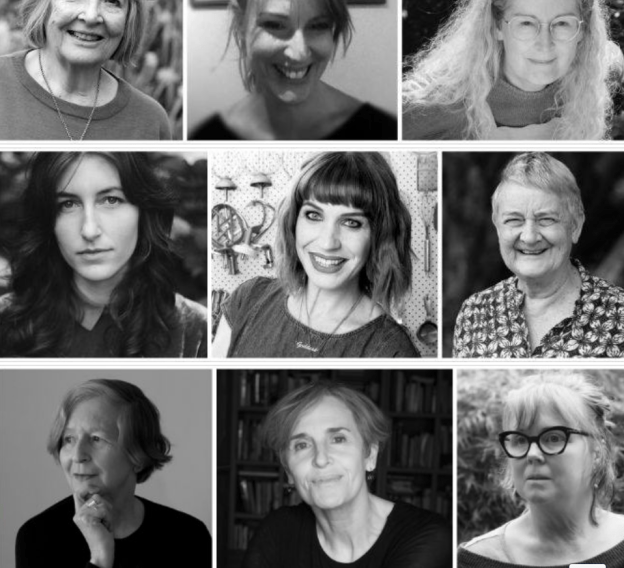
1pm Elizabeth Smither – Loving Sylvie  The relationship between 3 generations of women, particularly grandmother & granddaughter, is explored in this novel with the gentle wisdom of one of our finest poets.

1.20pm Margie Thomson – Womankind  A landmark publication, with stunning words & images, about NZ women – all ages & ethnicities, famous & unknown – who have truly ‘made a difference’.

1.40pm Laurence Fearnley – Scented  A fascinating, poignant new novel about a women’s search for identity after her university career ends – obsessed with scent, she creates unique perfumes.

1.55pm Whiti Hereaka – Winner 2019 Young Adult Fiction Award for Legacy , & editor, with Witi Ihimaera, of the spellbinding Purakau: Maori Myths Retold by Maori Writers

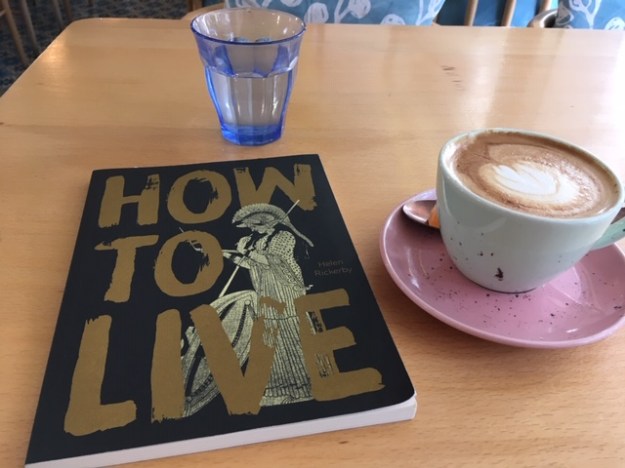
2.15pm Helen Rickerby – How to Live  Poetry publisher from Seraph Press with her own new collection – witty, philosophical, feminist poems about women’s lives, that experiment with the poetic form

2.25pm Ruby Porter – Attraction  Provocative, engaging & highly praised first novel takes 3 young women on a road trip, navigating their relationships & NZ’s colonial past.

2.40pm Bernadette (Bets) Gee – Magnolia Kitchen  She’s an Instagram sensation & her book bulges with delectable recipes (including allergy-free), clever tips & sensational decorating inspiration

3pm – 3.45pm Afternoon Tea

3.45pm Marilyn Waring – The Political Years “This frank narrative of courage & tenacity in the face of an intensely patriarchal & homophobic polity will surprise & reward readers across generations” Sue Bradford

4.10pm Rosetta Allan – The Unreliable People A whole population exiled by Stalin, a Korean folk tale, Kazakhstan, a young art student searching for identity – – a fascinating novel.

4.25pm Linda Burgess – Someone’s Wife  A delightful collection of essays, personal & universal, exploring family, teaching, living overseas, being the wife of an All Black . . . witty & moving

4.40pm Vana Manasiadis – The Grief Almanac; A Sequel  A bold combination of poetry, essays, memoir, a lost mother, melding Greek with English; unconventional & richly textured.

4.50pm Elizabeth Knox – The Absolute Book  New from the brilliantly imaginative Knox, an epic fantasy with secrets, treasures, revenge, & three people driven towards a reckoning felt in more than one world.

5.10pm Mary Kisler – Finding Frances Hodgkins  The curator of the recent magnificent exhibition at Auckland Art Gallery, travelled throughout Europe & UK, following in Hodgkins’ fascinating footsteps.

Poetry Shelf noticeboard: LitCrawl’s fabulous set of poetry events

Screen Shot 2019-09-05 at 9.01.38 AM.png


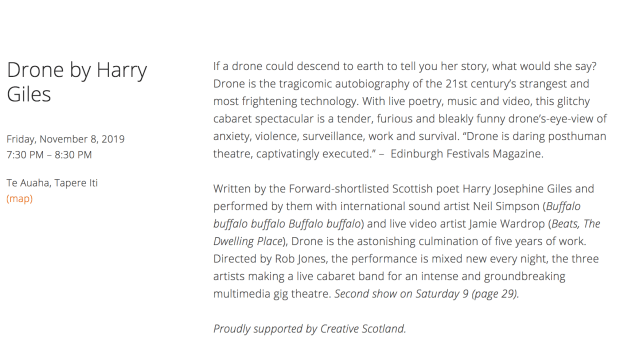
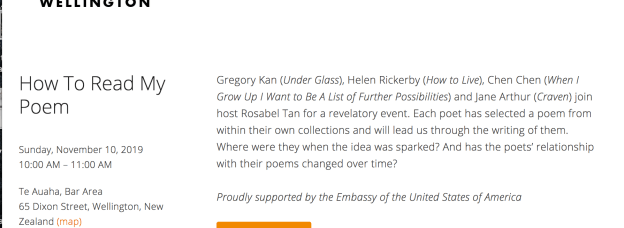
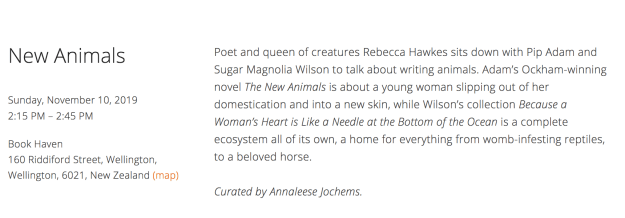
Congratulations VERB Wellington! There is a very tempting array of LitCrawl poetry events in November! Here is what I what I would go to if I could (so excited Amy Brown and Nina Mingya Powles will be here!!):


Screen Shot 2019-09-05 at 8.44.43 AM.png


Screen Shot 2019-09-05 at 8.54.12 AM.png


Screen Shot 2019-09-05 at 8.55.22 AM.png


Screen Shot 2019-09-05 at 8.56.23 AM.png


Screen Shot 2019-09-05 at 8.57.23 AM.png


Screen Shot 2019-09-05 at 8.58.21 AM.png


Screen Shot 2019-09-05 at 8.59.16 AM.png


Screen Shot 2019-09-05 at 9.00.13 AM.png


Screen Shot 2019-09-05 at 9.01.05 AM.png