I am excited right now about the collectivity of writing poetry; how poems draw from poems. In 2016, soon after arriving in Edinburgh, I was invited to join a collective of women writers who had come together at the request of the Cooper Gallery in Dundee to respond to their exhibition about a 70s collective art movement called the Feministo Postal Art Event. The Postal Art Event began with two artists – Sally Gollop and Kate Walker. When Sally moved away from South London where she and Kate were neighbours to another part of the UK, both women missed sharing their art so began posting small artworks to each other. Other women artists heard of and picked up this idea and in homes across cities, towns and villages in the UK women made, posted and received art and generated a community of artists. We echoed the Feministo Postal Art Event’s process in a 21st Century way, by writing and responding to each other’s work via a shared Google document.
Our collective is called 12. There are twelve of us, we are Edinburgh-based, and we have continued to write and respond to each other’s poems via a shared Google document for more than two years. We sometimes perform our work, and have been asked to respond to several art exhibitions, most recently to Emma Hart’s Banger at the Fruitmarket Gallery in Edinburgh. We are finding that the poems we write for 12 are a bit different to the poems we write outside of that particular circle of response. Why? I’m not sure, but there’s something about being honest about writing from community. About calling our lone selves in from the hills. The collectivity of making is front and centre; no one is pretending otherwise.
Lynn Davidson
Lynn Davidson is a New Zealand writer living in Edinburgh. Her latest poetry collection Islander is published by Shearsman Books and Victoria University Press (out this month). Lynn teaches creative writing, works in Edinburgh libraries and is a member of 12, a feminist poetry collective.
Helen Rickerby ‘How to live through this’ from How to Live (Auckland University Press, due August 2019)
Helen Rickerby has published four books of poetry, most recently Cinema (Mākaro 2014), and her next one, How to Live, will be published by Auckland University Press in August. She’s interested the elastic boundaries of what poetry can encompass, and has become especially obsessed with what happens when poetry and the essay meet and merge. She lives in Wellington, runs boutique publishing company Seraph Press, and works a day job as an editor.
Hinemoana Baker from mātuhi / needle (Victoria University Press, 2004)
From Bill Nelson: Sometime in 2009 I heard Hinemoana Baker read ‘Sound Check’ and it has stuck in my mind ever since. I think the reading might even have taken place on a mid-range PA system in a dingy carpeted room, some people laughing in the next room. Although I could be retrofitting that memory and it was in Unity Books or something. Anyway, at the time I noticed the outstanding music in the poem, and then wit and humour, and finally, the way the drama escalated as it continued.
Unusually, the poem is entirely in dialogue. A man is speaking to a woman who is trying to do a soundcheck and sings bits and pieces into a microphone. There’s no other description of the room, or the man, or the woman, or any other sounds. And yet through the poem’s pitch perfect choice of dialogue, the man is conjured up before us. A man we’ve probably all met. A pissed bloke in a pub, who likes to talk shit, knows a little bit about everything, probably from some other generation. He leans with his elbow propped on a tall felt-covered loudspeaker at one side of the stage, a beer in other hand, maybe a cigarette too. By contrast, the woman in the poem is a collection of song fragments and meaningless numbers, and it’s harder to picture her clearly. We know little about her, other than she seems like an incredibly professional musician, with a grasp of te reo Māori and a penchant for love songs.
You don’t have to try very hard to hear the music. It’s a pantoum, so there’s the repetition of course, but also the rhymes are particularly great and bang home like a drum, and there are bits of song lyrics that are italicized like they are meant to be sung. The complexity of the staccato sound check syllables juxtaposed with the rambley-bloke language of the man speaking is also really interesting and ramps up the conflict. Different people and different rhythms, looping in and out and over each other. It’s the kind of poem that is always going to be read out loud.
Pantoums are great at showing how context is important for language, how one line put against another can change it’s meaning entirely, or more accurately, provide two equally true meanings. The poem starts and ends on the same line said by the man, ‘you sound like that woman, what’s her name.’ And what seemed like an innocent enough question at the beginning, a bit idiotic perhaps but friendly enough, becomes patronising and infuriating by the time we get to the end. We cringe as he says it a final time, after a string of condescending comments and feeble compliments. He’s sounding more drunk, unable to remember what he already said two minutes ago, and I imagine him wandering off to the urinal, a poster of the gig that night right in front of his face. And he stands there with one hand propped against the wall, squinting his eyes, still unable to remember her name.
Bill Nelson’s first book of poetry, Memorandum of Understanding, was published by VUP. He is a co-editor at Up Country: A Journal for the NZ Outdoors and his work has appeared in journals, dance performances and on billboards. He is currently living in France. You can find more about him here at billmainlandnelson.com.
Hinemoana Baker of Ngāti Tahu, Ngāti Raukawa, Ngāti Toa and Te Āti Awa along with English and Bavarian heritage, is a poet, musician and playwright currently living in Berlin. She was the 2009 Arts Queensland Poet in Residence, a writer in residence at the University of Iowa International Writing Programme (2010), Victoria University Writer in Residence (2014) and held the Creative New Zealand Berlin Writer’s Residency (2015–16). She has published three poetry collections and several CDs of sonic poems. Hinemoana’s website.
As in previous years, the 2019 Featherston Booktown Festival will feature a stellar range of New Zealand writing talent. Special guest authors include novelists Lloyd Jones, Dame Fiona Kidman, Greg McGee and Catherine Robertson, children’s book writer and illustrator Gavin Bishop, blogger and writer Emily Writes, and poets Ashleigh Young, Tayi Tibble, Te Kahu Rolleston and Kate Camp.
If only life could give us another chance to go back.
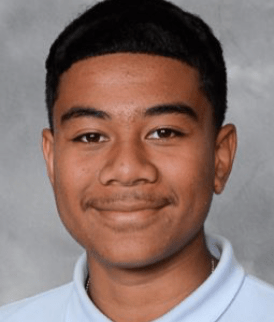
Mo’ui Niupalavu
Mo’ui’s poem was inspired by Lauris Edmond’s poem ‘Camping‘, picked for the blog by Kate Camp a few weeks ago.
Hello, my name is Mo’ui. I am from St Bernard’s College in Lower Hutt and I am a proud Tongan. I have a brother who is 7 years and a father; my mother passed away when I was 13, I am now 14 years and in Year 10. I love music and English. I want to pursue music when I am older because I love to compose songs and write lyrics.
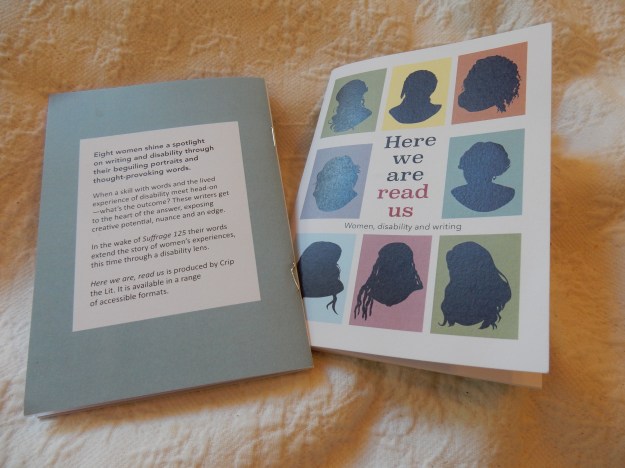
Here we are read us Women, disability and writing ed Trish Harris (Wellington: Crip the Lit, 2019)
In 2016 Robyn Hunt and Trish Harris established Crip the Lit ‘to celebrate and foster the work of Deaf and disabled writers’. Trish explained further in an email to me:
We chose ‘There is no such thing as a disabled writer. We are all just writers’ for our debate topic at LitCrawl (2018) because we wanted a moot that could be argued–in an entertaining and feisty way–either way. And that’s what we got! We want to open up those kinds of conversations but Crip the Lit also makes a stand saying there’s an important voice under represented in mainstream New Zealand writing and that is the voice of writers who have an impairment/disability–people who can write about this topic from the inside of the experience.
Crip the Lit has produced a slender pocket book, Here we are read us, that showcases eight writers who all live with disability. The writers include memoirists, novelists, poets, essayists, playwrights and bloggers from across New Zealand/ Aotearoa. Most of them seem to do poetry in some form or another!
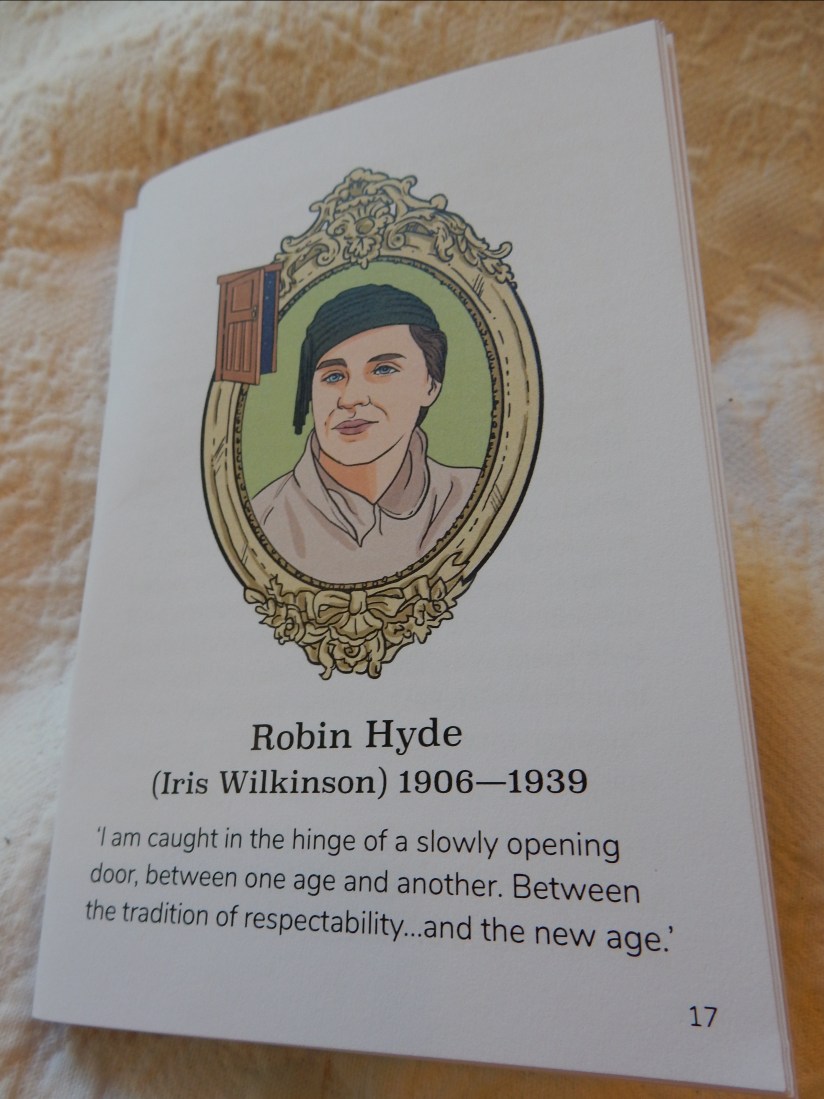
Illustrator, Adele Jackson has done a portrait of each writer housed within personalised frames that include a writer-selected symbol. The writers are: Tusiata Avia, Steff Green, Michele Leggott, Helen Vivienne Fletcher, Charlotte Simmonds, Trish Harris, Te Awhina Arahanga and Robin Hyde. The disabilities include blindness, autism and epilepsy.
Each writer has written about their chosen symbol, living with the experience of disability and their writing choices.
There is a section where each writer responds to the question: Why do you write?
This is how Tusiata answers the question:
I write because there’s an itch or a spangle and when I give it attention and space it expands to something full blown. It teaches me something. I write because sometimes the spirits are whispering and if I put pen to paper they will speak.
The pocket book is also available as large print format, an audio book, an e-book, individual social media files on each writer, in Braille and DAISY audio.
I love this pocket book because it brings disability out into the open – it took Tusiata awhile, for example, to expose her epilepsy in poetry beyond hints and traces. The pocket-book writings not only open out the daily challenges that each writer faces but confirm the notion that the ways and hows and whys of writing are utterly diverse.
Huge admiration to the editors for bringing this uplifting project to realisation. It is a gift.
to the paddock where Friendly, the seven-year-old ewe
that you couldn’t bear to send to the butcher,
baas by the fence for kale and attention.
The veggies you planted have gone mad:
tomatoes big as butternuts; huge, shiny aubergines;
giant marrows; cabbage whites all over the basil.
In the Pears’ Soap poster in the bathroom,
two small girls still stare at large bubbles.
Harry Ricketts
Harry Ricketts teaches English literature and creative writing at Victoria University of Wellington. His latest collection, Winter Eyes, has been longlisted for this year’s Ockham New Zealand Book Awards.




 NZ Poetry Shelf