Monthly Archives: March 2019

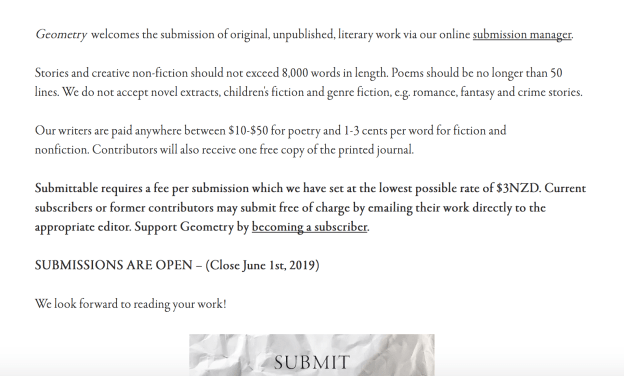
Poety Shelf newsboard: Jenny Bornholdt to judge 2019 Kathleen Grattan Award

see here

This prestigious biennial poetry award from Landfall and the Kathleen Grattan Trust is for an original book-length collection of poems, by a New Zealand or Pacific permanent resident or citizen.

Individual poems in the collection can have been previously published, but the collection as a whole should be unpublished.

Entries are accepted until 31 July 2019.

The result will be announced in Landfall 238 (November 2019), and the winner receives $10,000 and a year’s subscription to Landfall. Otago University Press has the right to publish the winning collection.

For full entry details, and to learn more about Kathleen Grattan and the history of the award, go to here

The judge for the 2019 award is Jenny Bornholdt, who has published ten books of poems, the most recent of which is Selected Poems (VUP, 2016). She also edited the 2018 anthology Short Poems of New Zealand (VUP).

Her collection The Rocky Shore was a made up of six long poems and won the Montana New Zealand Book Award for Poetry in 2009. She is the co-editor of My Heart Goes Swimming: New Zealand Love Poems and the Oxford Anthology of New Zealand Poetry in English. Jenny’s poems have appeared on ceramics, on a house, on paintings, in the foyer of a building and in letterpress books alongside drawings and photographs. She has also written two children’s books.


Screen Shot 2019-03-05 at 4.27.07 PM.png


Poetry Shelf review: Dinah Hawken’s There is no harbour

There_Is_No_Harbour__22619.1544066853.jpg

cover image by Marian Maguire


When I trained in social work

in 1968—the year we saw Earth from space—

I found the History of New Zealand

could shake me like an earthquake

and make me cry.


from ‘”All the history that did not happen'”


Dinah Hawken’s eighth poetry collection, There is no harbour (Victoria University Press, 2019), presents three entwined Taranaki strands. The first comprises her family history during the years of early Pākehā settlement, the second a brief history of the Taranaki wars and the third reveals her thoughts and feelings as she researched and wrote her long poem. Dinah always gifts her poetry with musicality, breathing room, heart and contemplation. This new book is no exception. It is an addictive mix that inspires me as both reader and writer.

In her brief frontnote Dinah writes:

The completion of the poem has not lead me to any sense of resolution. It has led to something less measurable, perhaps more valuable—greater clarity, particularly of the depth of injustice Māori have endured in Taranaki. At the same time it has strengthened my attachment and my gratitude to my great and great-great grandparents, whom I know as essentially good people. And it has led me back to Parihaka: to profound respect for Te Whiti and Tohu, the art of leadership, the art of passive resistance, and their refusal of human war.

Dinah brings together family voices, anecdotes, settings, facts and musings to re-present history in poetic form—history that was hidden, manipulated and muted in the past. She stands as a Pākehā in multiple places, searching for other points of view, other ways of seeing and feeling. I am looking through her poem view-finder and the effect is significant. I am mourning the arrogance and the atrocities, I am celebrating the courage.


Tītokowaru

fired his tūpara in the air

in front of 600 people

threw it down at his feet

and kicked it.


The evil weapon, he said,

which has caused so much mischief and ill-will

and been loaded with the blood of men,

should never hereafter

be taken up again.


from ‘1867, “The Year of the Daughters”‘


As a poet Dinah utilises economy on the line to build richness above, between and beyond. That plainness of talking makes the impact even stronger, deeper, wider.


Wherever you looked at it from,

whoever lived inside it,

a whare was a welcome shelter.

One in which a family could sleep,

in which a child could be born.


It was the kind of house

that could easily

go up in smoke. And it did.


from ‘Oswald, from his notebook’


How to imagine the past? How to imagine the cruel past? How to imagine the day and its sheen of sun on the leaves? How to imagine both sides of  an unforgivable war? How to imagine how to proceed in your Pākehā skin with your Taranaki family tree and the ancestral tree in Britain?  This is what Dinah does as she creates her chain of connections towards the present and back into the past.

Individual lines stand out and they feel like entrances into the stories I /we need to hear:


‘I am the beneficiary of injustice.’


In one poem the voices of Robin Hyde, Virginia Woolf, J. C. Sturm and Te Whiti sit side by side.


In 1940 Virginia Woolf said:


Unless we can think peace into existence

we—not this one body

but millions of bodies yet to be born—

will lie in the same darkness and hear

the same death rattle overhead


from ‘Found Poetry’


I adore this book, this contemplative, self-vulnerable exploration that faces a past that makes me feel shame, but that offers empathetic heart-lines out in the open. I can’t take it all in, in my first reading. I have read it again, and then again. There is no harbour is a vital reminder to bring our stories into the open and to keep finding ways to build peace in our homes and our villages and our cities. And our hearts. I want you to read it and find your own connections, your own lines to treasure, because this is a poetry book that matters so very very much.


‘Loss of possessions is a kind of freedom;

loss of land is exile’


This is what it comes down to:

Taranaki land was stolen.

My people—at first lost—were then

steadied by it. Pakakohe

were wrenched from it.

They were promised reserves,

instead they were jailed.


When you come down to it

everything comes back

to the vital, absorbing land.

And although a poem

can enclose you

like the rocky arms

of a Cornish cove,

justice is so much stronger than injustice

and this poem

has no solace to offer:

it is a phrase or two in a story

being written and woven together

by numerous, various,

generational hands.


©Dinah Hawken There is no harbour


Victoria University Press page


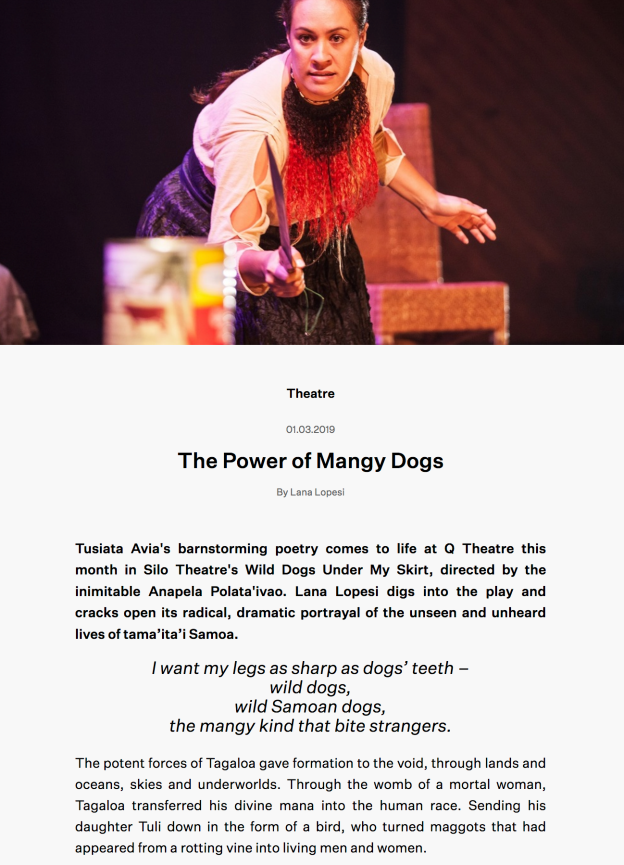
Poetry Shelf noticeboard: excellent Lana Lopesi review of Wild Dogs Under My Skirt performance

I am off to Opening Night tonight in Auckland. Read this excellent review at Pantograph Punch

Screen Shot 2019-03-04 at 1.56.33 PM.png


Poetry Shelf Monday Poem: Charlotte Simmonds’s ‘Kirsten’


Kirsten


Says she has a small dog.

You would like a small dog.

Will Kirsten let you walk her small dog?

Will she let you play with it?

But what if Kirsten’s small dog doesn’t like you.

What if it rejects you.

Rejection is so painful and hard to bear.

It feels like you are dying.

You are dying.


If you were in ‘the wild’, ostracism would mean certain death.

If you were in ‘the wild’, it would be hard for you to feed and shelter yourself adequately.

If you were in ‘the wild’, and then you got an injury, you would be really screwed.

If you were in ‘the wild’, no one would be able to help you.

If you were in ‘the wild’, you would be dead by now.

If you were in ‘the wild’, wild dogs who were in the wild would feed on you.

If you were in ‘the wild’, you could productively give back to the wild.

If you were in ‘the wild’, you could help everyone.


You could help everyone except the runt of the litter.

The runt of the litter is too small to feed on you.

His elder siblings shove him rudely out of the way.

His mother no longer loves him because she does not buy into that sunk cost fallacy.

The runt of the litter is excluded, cast out, ostracised, just like you.

He never meets another runt of the litter.

They never hump, conceive, give birth to even runtier runts.

All the small dogs of the world die out.

In the wild, all the small dogs are dead because your body was too small, there was not enough to go round, they could not feed on your body.

You’d think Kirsten’s small dog would like you, because it, too, in the wild, would know the pain of rejection, like you.

But it doesn’t. It blames you.

Kirsten’s small dog thinks this is all your fault.


©Charlotte Simmonds


Charlotte Simmonds is a (currently) “autistic” Wellington writer, translator, sometime researcher and intermittent theatre practitioner. Her fiction, non-fiction and poetry has appeared on stage at BATS Theatre in Wellington, in New Zealand podcasts, on New Zealand poetry blogs The Red Room and Poetry Shelf, in New Zealand literary journals Landfall, Hue & Cry, Sport, Turbine and JAAM, in Usonian literary journals The Iowa Review, Mid-American Review, Painted Bride and Broad Street, and in the UK journal Flash. She is the author of one published collection of poetry and lyric prose, The World’s Fastest Flower, a finalist in the Montana Book Awards in 2009, and was more recently shortlisted for an Australian short story prize.


Poetry Shelf noticeboard: at Jacket 2 – Vaughan Rapatahana on Kiwi Asian women poets


in a few months, i will fly

away from these streets, out of

skin. in a few months, i will spend

two new years in vegetable markets

and watching lazy susans

spin our chipped china plates around.


from ‘Ancestors’ by Joanna Li


This is an excellent post (part one of two) by Vaughan on a cluster of Kiwi Asian women poets: Vanesssa Crofsky, Wen-Juenn Lee, Joanna Li, Renee Liang, Aiwa Pooamorn and Nina Powles.


Here is a taste of the introduction:

I was completing a chapter in the forthcoming 2019 book, English in the South, edited by Kyria Finardi and published by Eduel, Brazil, when I thought that I really must write a commentary regarding the influx of young Asian poets, who were born in Aotearoa New Zealand, or have arrived to live here for long periods. Why? Because my chapter is entitled Confronting the English language Hydra in Aotearoa New Zealand and bemoans the lack of recognition given to Asian languages in the country because of the domination of English language exponents and their monolingual expectations, and the concomitant definite lack of deference to Asian peoples per se — despite the fact they will be the second largest cultural demographic here by 2026.

This resolve further strengthened when I read poems in a chapbook provided me by Renee Liang, and entitled Tasting Words (2017) — in which there was considerable strong emotion displayed by these younger New Zealand women poets, of Asian heritage. The excellent Poetry Shelf postings, which Paula Green so wonderfully provides, further highlighted other poets, whom I had not been aware of, or insufficiently aware of. This is no arbitrarily superimposed grouping either, because their voices and verse are distinct. They need to be heard.

More than this, my own family, which is Asian (Chinese and Filipina), was forced to learn English —  or not (!) when at school in both Hong Kong SAR and Philippines — while I have observed them somewhat caught between cultures at times. When they came to live in this, the skinny country of New Zealand, they were compelled to adjust. (Just as I tried to do when living in Brunei Darussalam, PR China, and Hong Kong SAR for so many years, in a sort of reverse diaspora. In fact, I spend considerable time in Asia nowadays and feel more comfortable there, by the way.)


Full post here

Poetry Shelf noticeboard: Sargeson Prize

Sargeson Prize

Short story competition

New in 2019, the Sargeson Prize is New Zealand’s richest short story prize, named for celebrated New Zealand writer Frank Sargeson and founded by Catherine Chidgey. Entries open on 1 April for the 2019 (and inaugural) Sargeson Prize and close at 11.59pm (NZST) on 30 June 2019. There is no entry fee, and entries are limited to one per writer, per division.

Open Division

The Open Division is open to New Zealand permanent residents writing in English. Published and unpublished writers are welcome to enter. Entries must be a single story of no more than 5000 words. It must an original, unpublished piece of work.

  • First Prize: $5000
  • Second Prize: $1000
  • Third Prize: $500

The winning story will be published in Landfall and, at least three months later, in Mayhem. The second and third placing stories will also be published in Mayhem.

Secondary Schools Division

The Secondary Schools Division is open to students enrolled at a New Zealand secondary school and aged between 16 and 18 years on the date that competition entries close. Entries must be a single story of no more than 3000 words. It must be an original, unpublished piece of work.

  • First Prize: $500
  • Second Prize: $200
  • Third Prize: $100

The winning story will be published in Mayhem.

The winner of the Secondary Schools Division will also be offered a one-week summer residency at the University of Waikato, to be taken up in January or February of the following year. The residency will include accommodation and meals at one of the University of Waikato Halls of Residence, a writing space in the School of Arts, and mentoring from postgraduate students and/or academic staff in the Writing Studies programme. If the winner is under 18 years of age, parental consent will be required.


Judging

Each year we will invite a successful New Zealand writer to judge the Sargeson Prize. This year we are delighted to announce that international award-winning author Catherine Chidgey will be Chief Judge. Catherine’s numerous achievements include being awarded the Acorn Foundation Fiction Prize at the 2017 Ockham New Zealand Book Awards for her fourth novel, The Wish Child.

Judging will be conducted “blind” – i.e. without the writer’s name attached to their submission. Entries may be subject to a pre-judging screening process by a panel overseen and moderated by the Chief Judge.


Details on how to enter here

Poetry Shelf noticeboard: Book launch – novel by Vaughan Rapatahana

                   BOOK  LAUNCH

      NOVEL       BY   VAUGHAN  RAPATAHANA


2.00 pm SUNDAY 10 MARCH, 2019 @ Nectar Lounge, Kingslander Hotel, New North Road,            

AUCKLAND


FREE ADMISSION           Live band Any Day Now     MC is Roger Horrocks

                    Performance poetry – Michael Botur

Full restaurant and bar facilities available.


NOVEL by Vaughan Rapatahana

Published by Rangitawa Publishing, 2018.

ISBN 9780995104662

320 pages trade paperback or on Kindle.


The rapidly developing action in ‘Novel’ straddles Aotearoa New Zealand, Hong Kong SAR, Philippines and beyond. In our contemporary world of increasing electronic surveillance from hegemonic national administrations, several diverse characters struggle to survive to resist in a variety of ways. At the same time the so-called established methods of writing fiction undergo deconstruction.

“With its range of exotic settings and even more exotic characters, ‘Novel’ is a switchback ride written in Rapatahana’s inimitable switchblade prose. A violent murder in a rural New Zealand meat works is the catalyst for a series of fast-moving events that ultimately have geopolitical consequences involving the struggles of dispossessed people and the shady efforts of the powers that be to thwart them.” James Norcliffe.

“A blazing tale of international politics and murder, and the people entangled in it, by design or accident, told in a style that detaches the reader from comfortable reading and a comfortable world, or even a comfortable reading of the world.” John Gallas

“Novel is an innovative and complex creation, both a thriller with fast-moving pace and a meditation on today’s and tomorrow’s world. It is an absorbing read, a journey to diverse cultures…The story weaves back and forth through a multiplicity of unfolding situations both gripping and thought provoking. Be afraid. Or not.” Alan Chamberlain

“The novel has a highly visual cinematic quality to it, cutting quickly from scene to scene while letting the action speak for itself. Its uncluttered narrative held my attention to the last page. It deserves a wide readership.” Bob Orr


“I’ll see you at the launch, eh.” Vaughan Rapatahana