

I know I find it hard to listen.
I read too much. I often need a drink.
It isn’t the world that makes us think,
it’s words that we can’t come up with.
Sure, I can work up fresh examples
and send them off to the committee.
But the poetry is in the bird. And in the pretty.
Bill Manhire, from ‘Polly’
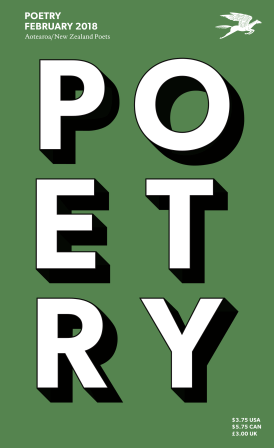
International poetry traffic is so often dependent upon fortuitous connections. The degree of familiarity with poetry from elsewhere is utterly paltry compared with the degree of familiarity I have with local writing. Yes I have studied American and British poetry but I am more aware of the luminous stars in these poetry constellations than the grassroot outings.
On the other hand, we are no longer dependent upon ocean voyages and the constraints of distance, but to what degree does our poetry travel (compared say with fiction)? Or our poetry conversations extend beyond our lapping tidelines.
I am acutely aware of my impoverished relations with contemporary Australian poetry. Perhaps Joan Fleming and Amy Brown could guest edit a local journal with an Australian focus? But then again our journals are often annual and offer vital but scant opportunities for local poets.
This is not the first time an overseas journal has showcased New Zealand poetry, but it is perhaps the example I am most excited by. The editors – Stephanie Burt (USA), Paul Millar (NZ) and Chris Price (NZ) – have worked hard to present a distinctive and diverse overview of our current poetry. The selected poets cross all manner of borders: age, geographical location, style, university affiliation, gender, ethnicity. This matters if we want to move beyond the legacy of white male predomination, urban bias and privileged poetry models. I cannot name a NZ journal that has achieved such movement.
Yes the five books Daisy Fried reviewed – from the fifteen 2017 publications she was sent – were all Victoria University Press. Her selection certainly does not reflect the contours of that year, and we can all stand on the sidelines and shout (or sing) about the books we loved, but I have no issue with reviews reflecting individual taste. However I do take issue that a short intro and five VUP books can respond to her opening question: ‘How to characterise a national poetry?’ Why would you even try! It is a personal take on five excellent books.
The rest of the journal is an altogether different joy. The effect of reading is symphonic in the different hues and chords. Every single poem lifts off the page and catches both ear and eye. Such freshness, such lightness, darkness, musicality, room to breathe, surprising arcs and links and undercurrents. I keep swaying between Anna Jackson’s glorious bee poem and the flickering titles that coalesce in Nina Powles’s offering or the infectious wit of James Brown, Ashleigh Young and Tim Upperton. I am pulled into the bite of Anahera Gildea, Chris Tse and then Tayi Tibble and stop in the tracks of reading. Travelling with Janet Charman and the revelatory suite makes me weep. Switching to Anne Kennedy and the momentum coils and overlaps and poetry transforms a starting point into elasticity on the line. Bill Manhire flips me over into the second stanza, and the lacework of reading – intricate yet full of holes – offers mystery, surprise, wit, curious things.
The time of breathing into clasped hands
hovering over a lighter to make a flame
not knowing
that an angry man threw his eyes into the night
the belly of his shattered father
weeping rain for separation of earth and sky
Jessie Puru from ‘Matariki’
The editors did not feel beholden to poetry that targets versions of New Zealand/ Aotearoa; our poetry might do this and then again it might not. The poems have the freedom to do and be anything whether they spring from spoken-word rhythms or talkiness or thinginess or anecdotal revelations or sumptuous Baroque-detail or story or slanted humour or cutting political edges.
The poets: Anna Jackson, Kate Camp, Michele Leggott, Therese Lloyd, Jessie Puru, Essa Ranapiri, Tayi Tibble, Robert Sullivan, Kerrin P. Sharpe, Hera Lindsay Bird, Dylan Horrocks, James Brown, Murray Edmond, Jenny Bornholdt, Anne Kennedy, Bill Manhire, Nina Powles, Janet Charman, Anahera Gildea, Bernadette Hall, Vincent O’Sullivan, Courtney Sina Meredith, C.K. Stead, Chris Tse, Tim Upperton, Gregory O’Brien and John Pule, Faith Wilson, Ashleigh Young, Albert Wendt, Steven Toussaint, Erik Kennedy
This issue is a cause for celebration – I absolutely love it – and my celebration will take the form of a subscription. New Zealand poetry has been well served – congratulations!
Poetry here
everything I never asked my grandmother
I can understand but I can’t speak
no one has played that piano since
New Zealand is so far away from here
let me translate for you the poem on the wall
Nina Powles from ‘Some titles for my childhood memoir’
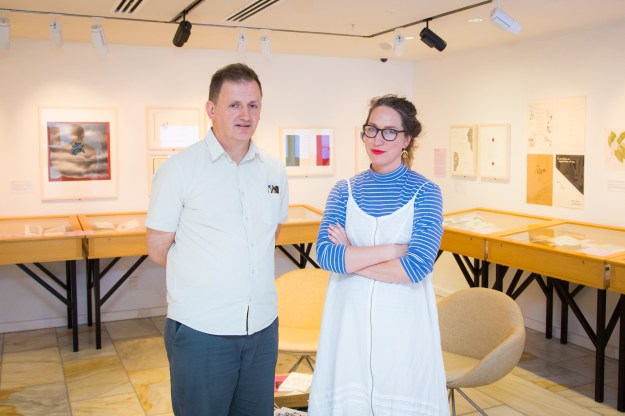
All photo credits: Imaging Services, Turnbull Library
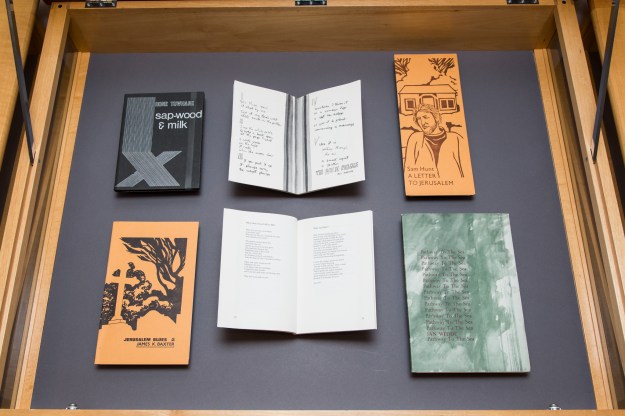
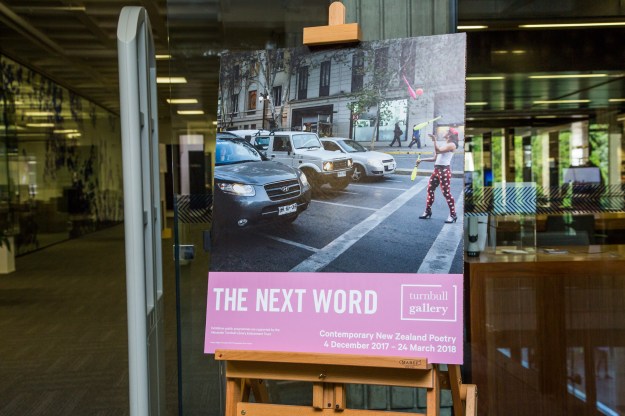
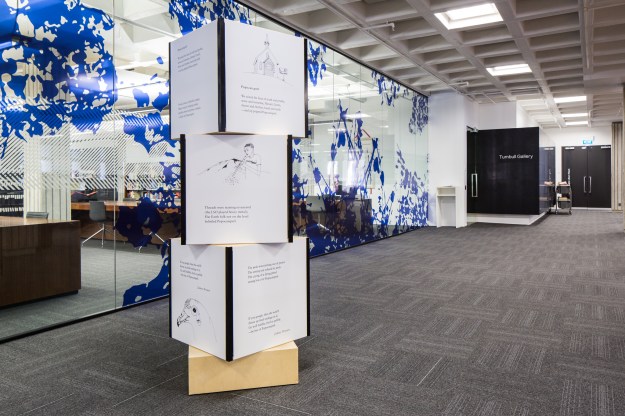
Hannah Metttner and Brendan O’Brien have curated an exhibition of contemporary poetry at the Alexander Turnbull Library. The key aim is to offer an overview of the past thirty years in various spots in the gallery. There is an art video put together by Hana Pera Aoake and and a carousel showcasing a James Brown poem on the ground floor.
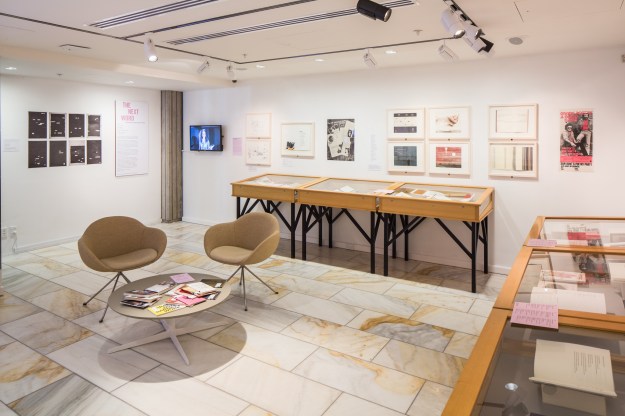
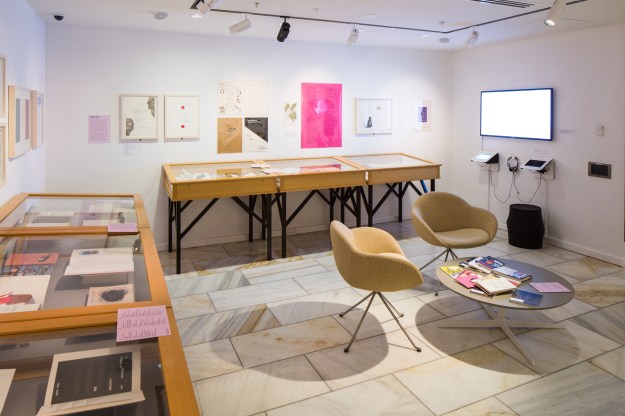
The little reading room is a poetry treat.
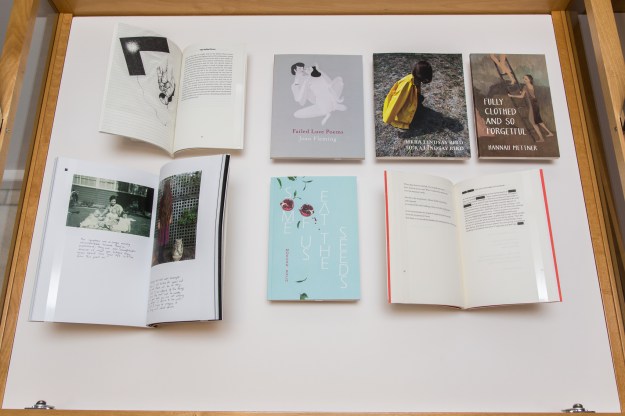
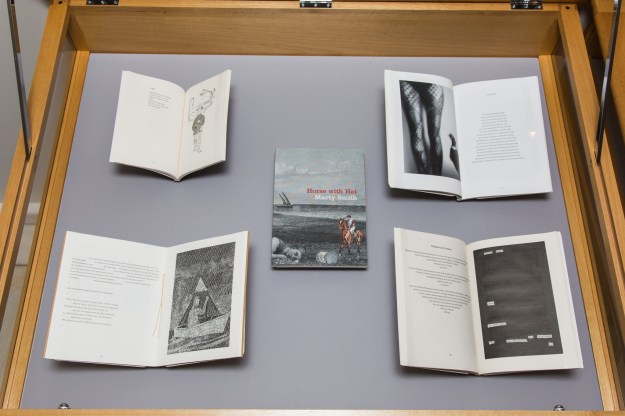
The curators have drawn from the poetry riches of the Alexander Turnbull Library to set up reading pathways between poems and poets, in the books on display, yet the eye is also drawn to poetry as visual object. You land upon a poem and alight upon an exquisite image. There are countless possibilities for travel: politics, aesthetics, music, confession, place, time, edge, rebellion, love.
Poetry is lovingly tended.
I am reminded that our poetry families are distinctive and diverse with many connections and necessary bridges. Nina Powles’s set of booklets, Luminescent, was a 2017 highlight for me; then again I am struck by the way so many of these books have glowed (Morgan Bach, Hinemoana Baker, Hera Lindsay Bird, Hannah Mettner, Chris Price, Joan Fleming, Bernadette Hall with Rachel O’Neill).
I love the way a book falls open at a poem in the glass case and we must stall on that to give a single poem devoted attention.
There are posters and prints and trips back in time (Sam Hunt, Ian Wedde, Hone Tuwhare, James k Baxter).
I went into the room after doing my final book checks at the library and it felt like an oasis, a place of retreat where the joy of poetry is the joy of stalling and savouring.
I highly recommend a visit before it closes on March 24th.
There is a lunchtime reading (12:15-1) on March 22nd with Chris Tse, Therese Lloyd, Anna Jackson, Gem Wilder and Sugar Magnolia Wilson. I am tempted to fly down!
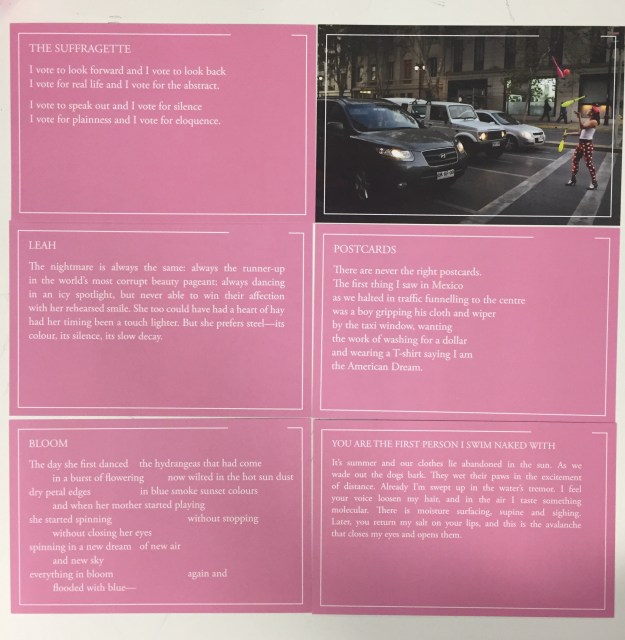
There also some postcards on offer including my Suffragette poem.
One visit is not enough! I plan to loiter there before our Call Me Royal event next week.
 NZ Poetry Shelf