Monthly Archives: May 2017

Poetry Shelf Autumn Season: Poets pick a word – Janet Charman picks open


door tender


a trek through bush

arriving at the party breathless


climb onto the verandah

two chairs

one each side of the open door

sit there

with the music

pumping from the lit living room

down the empty hall


then who should step up?

out of the dark

a sparkler

a hum

as if with this starry fingering

the sinews of the self

are vibrating

all

at once


©Janet Charman  2017 (March 19th)


‘door tender’ is one of the etymological origins of clitoris.

That said this poem is set at a borderspace of self-fragilization, so the door is open.


Janet Charman’s essay ‘A piece of why’ appears in the current issue of The Poetry New Zealand Yearbook (Jack Ross Ed., 2017, PNZ, Massey University Press). In it some of the patriarchal implications of Allen Curnow’s three post-war Caxton and Penguin poetry anthologies are discussed.  Drawing in this, on the Matrixial theories of Bracha Ettinger, in terms of the affects and effects of transmissive trauma.


Autumn Season: Poets pick a word – Vana Manasiadis picks crease


The crease of things

‘Creaste’ or ‘ridge’ or ‘fold in a length of cloth which might produce a crest’: the crease in poetry, the tuck and bend is what I read and write for.

Aren’t we all curious about each pinch and puck that pulls against the smooth; the consequence of weight and then the lifting?  The crease points to the something hidden underneath, the pitch interior below the skin that sees the light.

Line, mark, wrinkle, nick against the surface: we look for the transgressions and antidotes to flatness.  That’s why we track disruptions on the black sands, cracks in the pavements outside our schools and houses, crows-feet, stretch-marks, nasolabial folds.

Cellular realignment is another way to look at it, this crease in poetry, this specificity, this chiselled, permanent tatau.  There are inscriptions in the laugh lines: Thracian women tattooing each other in commemoration, and secreting gem-stones in their hems.

For the hunters it’s the topography that counts: its contours, troughs, and mud-flats.  Because above all, the crease calls for navigation, and like an origami crane, no poem can fly without a line of cockles in its gut —


©Vana Manasiadis 2017


Vana Manasiadis most recently edited and translated Greek poetry for the bilingual poetry collection Ναυάγια/Καταφύγια:Shipwrecks/Shelters (Seraph Press, 2016).  She lives in Auckland and teaches at AUT.


Hats off to The Ockham NZ Book Award Winners

Congratulations to the winners, commiserations to those who missed out and hats off to Victoria University Press for an extraordinary showing. VUP is a strong supporter of local writing, publishing more poetry that anyone else without compromising on quality. Three cheers VUP! Hats off to all NZ publishers, large and small, who back local writers and books. We are in debt to you. Away from the glitz and flare of an awards ceremony, there is an active terrain of writing and writers. Hats off to that too!

And hats off to the winners! Enjoy this moment of well-deserved recognition by your peers.

This year’s four category award winners will appear at a free event at the Auckland Writers Festival: The State We’re In on Friday 19 May at 5.30pm in the Heartland Festival Room, Aotea Square.


Fiction: Catherine Chidgey

Internationally renowned Ngāruawāhia resident Catherine Chidgey has won New Zealand’s richest writing award, the $50,000 Acorn Foundation Fiction Prize, for her novel The Wish Child. The award was announced this evening at the 2017 Ockham New Zealand Book Awards.

The panel of judges — Bronwyn Wylie Gibb, Peter Wells, Jill Rawnsley and inaugural international judge the Canadian writer Madeleine Thien — said  “The Wish Child exposes and celebrates the power of words – so dangerous they must be cut out or shredded, so magical they can be wondered at and conjured with – Chidgey also exposes the fragility and strength of humanity … Compelling and memorable, you’ll be caught by surprise by its plumbing of depths and sudden moments of grace, beauty and light.”

The Wish Child, Chidgey’s fourth novel, comes 13 years after her last work, The Transformation, was published to critical acclaim. Chidgey’s previous novel Golden Deeds was chosen as a Book of the Year by Time Out (London), a Best Book by the LA Times Book Review and a Notable Book of the Year by the New York Times. Her debut novel, In a Fishbone Church, won a Commonwealth Writers Prize (South East Asia and South Pacific).

Her latest novel, published by Victoria University Press, is one of four Ockham New Zealand Book Awards category winners, selected by four panels of specialist judges out of a shortlist of 16, which were in turn drawn from 40 longlisted titles from 150 entries.


Poetry: Andrew Johnston

Paris-based Andrew Johnston won the Poetry category for his collection Fits & Starts (Victoria University Press), a book described by the category’s judges’ convenor, Harry Ricketts, as a slow-burning tour de force.

“The judges’ admiration for Andrew Johnston’s remarkable collection grew with each rereading, as its rich intellectual and emotional layers continued to reveal themselves … Using a minimalist couplet-form, the collection is at once philosophical and political, witty and moving, risky and grounded, while maintaining a marvellously varied singing line.

“To reward Fits & Starts with the overall poetry prize is to reward New Zealand poetry at its most impressive and its most promising.”


Nonfiction: Ashleigh Young

Ashleigh Young (Wellington) took the Royal Society Te Apārangi Award for General Non-Fiction for her collection of personal essays Can You Tolerate This? (Victoria University Press).

The category’s judges’ convenor, Susanna Andrew, says Young’s work sets a high bar for style and originality in a form that has very little precedent in this country. “Always an acute observer, it is in Young’s commitment to writing as an art that the true miracle occurs; she tells us her story and somehow we get our own.”

Young catapulted to international recognition earlier this year when she won the Yale University US$165,000 Windham-Campbell Prize for the collection.


Illustrated Non-Fiction: Barbara Brookes

Dunedin writer and historian Barbara Brookes won the Illustrated Non-Fiction category for her meticulously documented work A History of New Zealand Women (Bridget Williams Books).

The category’s judges’ convenor, Linda Tyler, says Brookes’ work combines deep research, an immensely readable narrative, superbly well-integrated images and is distinguished by close attention to both Māori and Pakehā women.

“Putting women at the centre of our history, this sweeping survey shows exactly when, how and why gender mattered. General changes in each period are combined effortlessly with the particular, local stories of individual women, many not well-known. A wider sense of women’s experiences is beautifully conveyed by the many well-captioned artworks, photographs, texts and objects.”


Best First Books:

The Judith Binney Best First Book Award for Illustrated Non-Fiction: Ngarino Ellis for A Whakapapa of Tradition: 100 Years of Ngāti Porou Carving, 1830-1930, with new photography by Natalie Robertson (Auckland University Press).

The Jessie Mackay Best First Book Award for Poetry: Hera Lindsay Bird for Hera Lindsay Bird (Victoria University Press).

The E.H. McCormick Best First Book Award for General Non-Fiction: Adam Dudding for My Father’s Island: A Memoir (Victoria University Press).

The Hubert Church Best First Book Award for Fiction: Gina Cole for Black Ice Matter (Huia Publishers).

The Sarah Broom Poetry Award finalists: an interview, some poems

Sarah-prize2.png


This world is only ever

water, rock and black air.

It cannot accommodate us;

we cannot, will not complain

when the water deafens and knocks us.

We shut our eyes

and meet its volleyed blackness.


©Sarah Broom, from ‘Caving,’  in Tigers at Awhitu (Auckland University Press, 2010)


The Sarah Broom Poetry Award supports New Zealand writers through an annual poetry competition. The finalists are invited to read their work at an Auckland Writers Festival event and the winner gets a substantial cash prize. This award matters not only because it offers a financial reprieve for a poet, but because it showcases our poetry. We are an eclectic bunch writing in diverse ways with diverse preoccupations within diverse communities. The award also returns me to Sarah’s poetry; an annual pilgrimage for which I am grateful. Her work continues to resonate on a personal level and along the fertile line, ever revealing, ever fresh and vital. I applaud Michael Gleissner and Sarah Ross for all the hard, behind-the scenes the work they undertake to make this award happen. Thank you.

This year’s judge is Carol Ann Duffy who will also appear at the Auckland Writers Festival.

The finalists: Sandi King, Cliff Fell, Hera Lindsay Bird


The Poems


Where the World Looks In


It’s true that everything’s always moving:

The way a sunbeam glances off the corner of the fridge

Or the shadows turn from violet to indigo.


Or the way your voice will slip a semi-tone

When you’re talking on the phone

And you think someone else is listening.


So I’ll wait for you under the first arch of the bridge

Where the river longs to persist,

To abide beyond its turbulence and flow

And all the other laws that words will not obey.


And I want the words to say

Something else again

Or just to be there when the river is blessed

Like a mirror where the world looks in.


© Cliff Fell


The Way Home


Flamboyant: noun

  1. The condition of being flamboyant
  2. A group of flamingos

http://www.yourdictionary.com/flamboyance


The lush wetland

of my unconscious mind is squawking

in the same way I formed thoughts

before I was old enough to know words.

Just out of sight I hear

wildlife, and the shore

bright with the colours of sunset

discarded in the morning

grass.


I reach through the wire fence

and grasp the legacy left to me,

orange/pink

and fragile. Thousands

of flamingo feathers


which I scoop secretly into a bag

and carry back to the motel

to admire the fluffy whiteness

of the tiniest feathers. I lay

the long ones in a row

to assess

their intensity of pigment,

their readiness for flight.


Sometimes I dream that my body

is wrapped in a bolt of organza.

It’s orange/pink,

a hood-to-ankle garment.

In the mirror, behind my reflection

I can see the Manawatu Estuary

coloured in with my childhood

dreams. I lift primary flight feathers

to the sky, soar

over road and cars and houses

all the way back to Nana and Grandad’s lawn.


In Nana’s flowerbed I find

two ornamental flamingos, pink

so pink. She bends as if to feed

from the shallows, he waits

fondly beside her.

They are translating the garden

into bird

of paradise.


I shelter with these two as long as I can hold

then wade on home, finally

orange/pink,

into the flamboyance of flamingos.


© Sandi King


The Questions


The Sarah Broom Poetry Award is a terrific supporter of New Zealand poets and poetry. Can you name a New Zealand poetry book that has resonated with you in the past few years. What do you love about it?


Sandi: Bill Nelson’s collection Memorandum of Understanding is stuffed with the kind of poetry I love to read. There is variety in the content that sparks my imagination. Some of the poems have an ambiguity, but of a giving nature. If the poem could talk to the reader it might say ‘I have more. Come back tomorrow and read me again.’  His clutch of poems titled ’How to do just about anything’ feature a liberal use of the second person that I enjoy.

Cliff: There are quite a few, but I particularly admired Dinah Hawken’s Ocean and Stone and recently enjoyed reading Hannah Mettner’s Fully Clothed and So Forgetful. But the book that resonated most with me in recent years is Rachel Bush’s Thought Horses, published shortly after she died in March 2016. It’s not only that she lived in Nelson and that I’d read some of the poems as they came into being, but the way the collection finds her – particularly in poems I hadn’t seen before – facing her death with such fortitude, wit and wisdom. Rachel has always had this wonderfully elastic syntax, and a giddy playfulness to the way she can shift focus in a poem. All of that is heightened in this collection. It’s a book that’s marvellously re-readable. I discover little gems I hadn’t noticed before, nuances and images, every time I enter its lost domain, its domain of loss.

Hera: I try not to talk about why I like certain books because I always end up lying by accident, but I always like reading Geoff Cochrane. Can everyone just take my word for it? It’s better this way.


What are some of the strengths or weaknesses of New Zealand poetry and its communities?


Sandi: I have found a lot of generosity. Writing groups meet together to nuture each other, and develop their work into the best it can be. We have organisers like Bill Sutton who organise events where poets can come together and hear each other. We have poetry competitions which offer hope to everyone who enters. There are still opportunities to be published thanks to the commitment of small publishers, plus a variety of journals and websites, and there are excellent educational opportunities available. New Zealand has talented mentors too – I have been extremely fortunate to be mentored by Renée.

Cliff: There’s so much going on in New Zealand poetry, you would have to be very dedicated to keep up with it all. Its strengths are its poets, of course. They’re probably its weaknesses, too. But I’d imagine that New Zealand poetry is generally thriving, gaining greater recognition overseas. Cheers to all responsible for that! As for its communities, apart from the point that individuals can create their own community, their following, these days, I’ve had a notion for a while that in the arts, in poetry in particular, in its real nose-to-the-grindstone communities, New Zealand resembles the city-states of late medieval, Renaissance Italy, with their arts flowering in different styles. There are similar alliances and rivalries and moments of cross-pollination, as there were then, and distinct local sounds or voices or concerns are beginning to develop, the way the Dunedin sound developed in music. The rivalries in poetry have been going on for generations, as we all know. All of this is, obviously, down to our demographics – relatively small population – and our geography, our topography, in that it means journeying between centres is bound to be epic, on some level. Who would the Papal State be in such an analogy? CNZ, I suppose, with the patronage it confers. Of course, this is a notion – and in some ways a ridiculous one – that I would favour, indulge in, due to my interests. Also, I’m an outsider, so that probably colours the way I see things. But I think there’s a kernel of truth to it. We may not exactly have to learn the taste of other people’s bread, but it’s not a bad trope for how things are.


Hera:


con: poor overall fighting technique, weak in physical combat department

pro: lots of wine

con: nobody to talk to at parties about Survivor

pro: except Louise Wallace and Holly Hunter

con: small population size leading to difficulty maintaining rigorous critical culture, ancient confusing unexplained feuds going back decades, lack of money, too many poems about mountains, easily hurt feelings

pro: if people hate you they have the decency to do it in private, to their friends and loved ones

con: James K Baxter

pro: oh relax, I’m only joking


Do you see your shortlisted collection as a surprising departure from your previous poetry, a continuation and deepening engagement with your poetic concerns, or something altogether different?


Sandi: To be honest, I was excited by the opportunity to have my work read by Carol Ann Duffy and looked through everything I have written for poems I thought she might like to read.

Cliff: More a continuation probably, though I’m not sure – and either way, hopefully some kind of a deepening engagement. To be honest I was amazed that my entry came together at all, as I hadn’t really been writing for a while. I wrote two new poems on the deadline day and heavily revised four others. When I looked at the collection again, on learning that I’d been shortlisted, one thing that did surprise me was to discover that three of the poems were ekphrastic in nature. How that came about, I really don’t know.

Hera: Some are following on from my first book, others are a little looser. I’m trying as hard as possible not to think about it while I write. The phrase poetic concerns is such a great one. It always makes me think of Byron having trouble with his swans.


I am putting you on the spot here, but if you were reviewing your collection, what three words would characterise its allure?  


Sandi: Sensual, adventurous, satisfying

Cliff: Yes, horribly on the spot, as I would hate to review my own collection. It would be a public self-mauling that no one would want to witness. Flawed. Flibbertigibbet. Fatal. Will they do? Oh, and Astronomy. That’s four words, but there are plenty of stones and stars, and also caves, in my poems. Too many probably.

Hera: Silly, unsettling, imagistic


When you write a poem, what talismans or cornerstones or spark plugs or jump leads or release pads do you favour? I am thinking, for example, of the way some poets are drawn to musicality, storytelling or the element of surprise.


Sandi: Many of my poems are portrait poems or persona poems. The beginning of a poem can sometimes be the sound of the character’s voice, and trying to thread that into the poem

so that maybe the reader can imagine the character speak when she reads the poem. Often a segment of story develops from the portrait as I write. Otherwise a poem will begin from a little stub – something I have seen, heard or felt. When I discover a stub, I write it down. Months later, I’ll look at that stub again, and sometimes it will be the start of a poem. It’s like taking cuttings from people’s gardens – you achieve variety without having to try too hard for it.


Cliff: Yes, I certainly believe in talismans and little rituals. I once knew a builder in Scotland who wouldn’t go up on a roof without a kilt pin in his trouser pocket. It’s easy enough to understand why, when you think about it. In my case, well, first up I consume a quantity of petrol. That’s for the spark plugs. Then I get into some kind of trance-like fire-eating routine, blowing flames around the room, hoping the poem and all my electric guitars will spontaneously combust. Or I imagine I’m being carried in a coffin into what has been billed on the invitation as an ‘outrageous’ party. This is in fact a gate-crasher’s ploy, as the hosts have notably declined to invite me. I only learned about this exclusive mother of all parties when I saw an invitation a so-called friend taunted me with. So when the night-watchmen I’ve hired as coffin-bearers carry me through the door, we thump into the hubbub, noise of glasses being smashed, voices, music, people banging on the lid and so on. I think they must have set me down in the middle of the dance floor, because when I emerge, naked as the day I was born, there she is, Topsie-Terpsichore, spinning and pirouetting and doing the scorpion in my arms. And we dance all night. Maybe it’s West Coast swing, on the track to begin with, but then it gets crazy, circle dancing around the coffin, big bass lines pumping out of the PA and deep into your rib-cage, and a frenzy of many arms and legs. Later, there will be sweaty, abandoned sex on the grassy shores of a lake. Moonlight and embarrassment, of course.  A boat, though perhaps it’s just the coffin floating away. I seem to remember there was a high wire-mesh fence we had to clamber over. Stuff like that. It all helps.


Hera: Everything at once. I like poetry pushed to its stylistic limits. For instance, take a poem about a swan in the moonlight. That might be a good poem. But what if…… instead of one swan you had a thousand swans? And what if instead of moonlight……the moon had never existed & instead there was a giant neon exit sign, hanging in the sky? I’m just being indirect because I don’t want to write a manifesto too early. I think one of the tasks of poetry is to teach yourself to write as many different ways as possible, and then to trick yourself into never thinking about them in the moment. Like mixed martial arts, if people used mixed martial arts to express their feelings about autumn.


The Finalists


Hera Lindsay Bird is a poet from Wellington. Her debut self-titled collection Hera Lindsay Bird was published in 2016 with Victoria University Press; it has been reprinted many times, and is currently on the shortlist for the Ockham New Zealand Book Awards. She has an MA in poetry from the International Institute of Modern Letters where she won the 2011 Adam Prize in Creative Writing. She works as a bookseller at Unity Books Wellington.

Bird’s work has been featured in The Guardian and Vice Magazine. She has been published in a number of journals and publications including Best New Zealand Poems, The Spinoff, The Listener, The Hairpin, Hue & Cry and Sport. In 2016 she ran a free, ten-week creative nonfiction class called TMI. She likes watching the figure skating at the winter Olympics and murder mysteries set on trains.


Cliff Fell is the author of three books of poems, The Good Husbandwoman’s Alphabet (illustrated by Fiona Johnstone, Last Leaf Press, 2014), Beauty of the Badlands (Victoria University Press, 2008) and The Adulterer’s Bible (Victoria University Press, 2003). The Adulterer’s Bible was awarded the 2002 Adam Prize in Creative Writing and the 2004 Jessie Mackay Prize for Best First Book of Poetry. Other poems have appeared in the online anthology Best New Zealand Poems and in various New Zealand and overseas publications. He has been a regular contributor to the RNZ National Nights programme, talking about poetry.

Born in London to an English mother and New Zealand father, he has lived in New Zealand since 1997 and worked, sometimes very briefly – and tenuously – as a roadie, musician, bank clerk, bar-tender and also in farming, forestry, and film-making. He studied History and Archaeology at Exeter University, received an MA in Creative Writing from Victoria University and currently lives in the Motueka river catchment. He is a tutor of creative writing in the Arts programme at Nelson Marlborough Institute of Technology.


Sandi King (previously known as Sandi Sartorelli) is a New Zealander of English, Irish, Danish and Moravian descent. She currently lives in the Hutt Valley with her youngest son Guy. She has a degree in Creative Writing from Whitireia New Zealand. Her work has been published in a number of journals and websites including 4th Floor, Blackmail Press, JAAM, Renée’s Wednesday Busk, Snorkel and takahē.

In 2013 three of King’s poems were highly commended in the Caselberg Trust Prize, the New Zealand Poetry Society Competition and takahē Poetry Competition. In 2015 her poem ‘Timing’ took first place in the Upper Hutt Poetry Competition. The most recent publication to include her work is the book Poetical Bridges/Poduri Lirice (2017), a collection of New Zealand poetry translated into Romanian, and Romanian poetry translated into English, created by Valentina Teclici.


Hera Lindsay Bird, Cliff Fell, and Sandi King will read poems from their submissions at the Sarah Broom Poetry Prize event at the Auckland Writers Festival on Sunday 21 May 4.30-5.30pm.

This is a free event. Guest judge Carol Ann Duffy will introduce the finalists and announce the winner of this year’s prize.


Jenny Bornholdt’s choice of Best NZ Poems 2016 now live

Screen Shot 2017-05-16 at 9.18.56 AM.png


Looking forward to delving into this delectable poetry banquet (sorry AY but I love cooking and writing equally!) An impressive array of mostly Wellington published and Wellington based poets –  poetry must sizzling on the streets there just as it does in Ireland. It blew my poetry socks off. Extraordinary!


Press release:

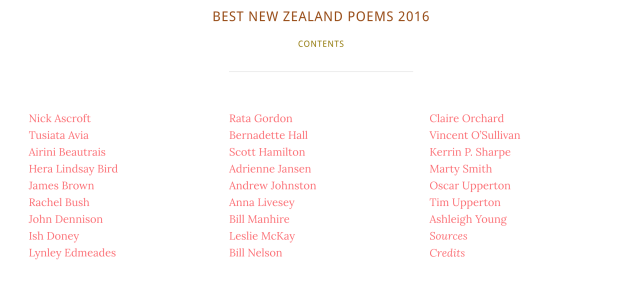
The latest online edition of Best New Zealand Poems is now available, bringing together twenty-five poems that are rich with place and vibrating with a fierce energy.

The anthology has been published annually since 2001 by the International Institute of Modern Letters (IIML) at Victoria University of Wellington with support from Creative New Zealand.

“Best New Zealand Poems 2016 comes with a brand new look that includes author photos and a search feature,” says series editor, poet and IIML senior lecturer Chris Price.

This year’s edition represents the cream of New Zealand poetry published in 2016, as selected by poet and Arts Foundation Laureate Jenny Bornholdt.

Ms Bornholdt says she picked poems that “made me pause and put a book/pile of paper down; made me want to go to the bakery and buy a cream torpedo then make coffee; or put my gumboots on and go and inspect the compost—the things I do when I need to think”.

Internationally acclaimed and Ockham New Zealand Book Award-shortlisted writers Ashleigh Young and Hera Lindsay Bird, and the father/son duo Tim and Oscar Upperton are among the poets who have made the cut. The anthology takes flight into the past with an ancient Egyptian pharaoh, soars with an orphaned falcon named Avro Vulcan, yet always manages to return to earth in a recognisably New Zealand landscape and culture.

Place is a key theme in this year’s selection, and the poets often find themselves transported—in both senses of the word. Claire Orchard’s ‘Charms’ takes a drive through her childhood neighbourhood to examine her past life, James Brown heads for the trig in a Wellington wind and 2017 Windham-Campbell Prize winner Ashleigh Young is galloped away screaming on a frightened horse. John Dennison meditates on man’s urge to fly; Andrew Johnston travels outside of time and space at the ear, nose, and throat doctor’s; and Tim Upperton visits Kansas, well, kind of.

Other poets find their way around life’s biggest emotions and events. Bill Nelson writes a memorandum of understanding to his love; Anna Livesey examines the death of her mother, the birth of her child and cabbages; Tusiata Avia looks at a photo of her house, and watches it populate with people, spirits and history.

“The poems themselves are as fresh as this morning’s milk. There’s never been a better time to encounter new New Zealand poetry,” says Chris Price.

The new site has been designed by poet Rachel O’Neill.  (looks great Rachel!! PG)

Best New Zealand Poems 2016 can be viewed online

Poetry Shelf Autumn Season: Poets pick a word – Michael Harlow picks light (and dark)


A glancing smile


On a run-down street, its sagging buildings, cracked footpaths

and stunted trees, shadows everywhere and on the move.

And passing by, here’s that someone you will never know,

with a glancing smile in her eyes that’s meant to touch yours,

for no other reason than it must—for the shortest, longest time.

That wakes someone in yourself who wants to say, despite

all the running darkness in the world, that just now, there is

out of the dark the light, inside a glancing smile.


©Michael Harlow 2017


Michael Harlow’s Nothing For It But To Sing, won the Kathleen Grattan Award for Poetry and is published by Otago University Press.  He has been awarded the Beatson Prize for poetry, and in 2014 the Lauris Edmond Memorial Award for Distinguished Contribution to Poetry in NZ.  He has published tens books of poetry, two of which have been shortlisted for the National Book Awards.  In collaboration with NZ-Suisse composer Kit Powell, as a librettist he has composed some thirteen Performance Works, many of which have been performed in Switzerland, Germany, France and New Zealand.  He lives in Central Otago (NZ) and works as a writer, editor, and Jungian therapist.


Poetry Shelf Autumn Season: Poets pick a word – James Brown unpicks


Not Writing

The longer the week drags on, the more I realise I’m not going to be able to write anything creative for Paula. I feel flat and dull. I’d finally handed a poetry manuscript to VUP the previous week and am in a post-hand-in slump.

Paula had provided a long list of words as sparks, but now I couldn’t face the decision I would have to make if I returned to them. The tyranny of choice. I recall there were a lot of poetic words – ‘lilt’ was one – and of course ‘cycling’ had caught my eye. But I don’t want to write about cycling. I’m also not even sure what I’m supposed to produce. Should I be writing a poem?

It’s like I’m struggling with one of the creative writing exercises I set my students at the IIML, and I begin to think about creative sparks – when something takes off and when it doesn’t. And, let’s be honest, mostly things don’t. If I could sit down and write a book of poems like I’m typing this, it would take about a week. My last poetry book took seven years. Not full-time, of course, but I suddenly realise how much of my writing takes place off the page. Gazing around, thinking, reading, listening to music, people, nothing … actually writing is only part of it. I recently read (some of) The Writer’s Room by Charlotte Wood – a book of interviews with writers. I didn’t recognise any poets; certainly the interviewees I read were prose writers and they presented themselves as impressively diligent, rising early to pound out word counts, often leaving off mid-flight or sentence so they could jump straight back into the action the next morning without wasteful floundering.

I wonder how different the process is for poets. The poetry writer’s room, if there’s a room at all, would, I imagine, witness much less keyboard action. For me, poetry writing is beset with guilty spaces. But like the prose writers, I too have to leave off poems and return to them – they’re rarely completed in one sitting – though it may be several days before I can get back to them. Time and space are good for those poems I kid myself are finished, but not for a poem still trying to ignite. The initial spark may go out. Poetry is a bit like lighting a fire: you often have to wander away to gather fuel, but you need to return and keep blowing on it for it to really take hold and raze everything in your suburb – or however far it’s going to travel.

Okay, most poems are more candle than bushfire, but what makes some reach ignition temperature and some not? I’ve come to the conclusion that there’s no special formula for mine (though I can think of things that don’t help), but they generally begin with an idea, phrase or word that interests me. I got a couple of poems out of the word ‘hibiscus’. And this very week, flat and dull as I feel, I tried to get a poem going using a particular kind of word. The result so far has been amusing, but pointless. I also created a small found poem using a couple of sentences from a friend’s email. I wonder if my interest in found poetry stems from being averse to poetry’s emotive and moralistic excesses.

At this point I remember Paula saying something about ‘a couple of paragraphs’. Eek. I was just getting going. Maybe there is something in triggers and deadlines.


©James Brown 2017

James Brown’s new poetry collection, probably called /Floods Another Chamber/, will be published by VUP later in 2017.

Poetry Shelf Autumn Season: Poets pick a word – Nina Powles picks salt

On Salt & Kitchen Poems

I got back into writing poetry by writing about food. I hadn’t written anything in months so I decided to start keeping a food diary of everything I love to eat in Shanghai, where I currently live. Eventually the diary became a blog. I don’t do it for any of the reasons people usually keep track of what they eat. I do it in order to remember, to record and recreate the things that bring me comfort and joy.

Silken tofu cut into the shape of a flower floating in soup, tiny dried shrimps and pickled vegetables sprinkled on top, caramelised spring onions tossed with noodles in a sweet and salty black bean sauce.

When I started writing bits and pieces that resembled poems again, I couldn’t get away from salt and sugar and teeth and skin. I keep coming back to the many food memories that map out my childhood spent partly in New Zealand, in the United States, in Malaysia and in China.

Maybe writing a poem is like preserving something in salt. Like putting a memory or a sensation in a sealed jar and letting a chemical change take place.

A few weeks ago I attended a haiku writing workshop in Shanghai run by the Japanese-American poet Miho Kinnas. I’d never written a haiku before and didn’t know much about them. Miho explained that the form was especially popular with women poets in ancient Japan. The tradition of women writing haiku has continued into contemporary Japan but some of these poems have been scornfully labelled “kitchen haiku”, devalued by literary critics because of their domestic subject matter.

So I decided to try and write some kitchen haiku.

Zongzi


I unwrap lotus leaves

with my teeth

a steamed heart inside

Garlic


spread salt into

the cracks and crush until

our skins break

Canteen


girl sits alone

peeling dragonfruit

with pink fingers

As part of my mission to read more poetry by women of colour from all over the world, I recently discovered the work of Safia Elhillo, a young Sudanese-American poet whose first book The January Children was published this year by the University of Nebraska Press. Her poems often take us deep into the minute details that make up the landscape of her origins, both real and imaginary.

Her work makes me think a lot about tracing my own history—both the things I remember and the things I’m told I should remember—through kitchens, childhood haunts, living rooms, & conversations between grandmothers, mothers, aunts, meals made by hand, spices and seasonings, words I hear passed between them at the kitchen table. Below is an excerpt from Safia Elhillo’s poem “Old Wives’ Tales”:

Screen Shot 2017-03-28 at 9.33.47 pm.png

© Nina Powles 2017

Nina Powles is a poet and writer from Wellington, currently living in China. She is the author of the chapbook Girls of the Drift (Seraph Press, 2014) and several poetry zines. Her poems and essays have recently appeared in The Sapling, Mimicry, Shabby Doll House and Sport. Check out her blog for more.

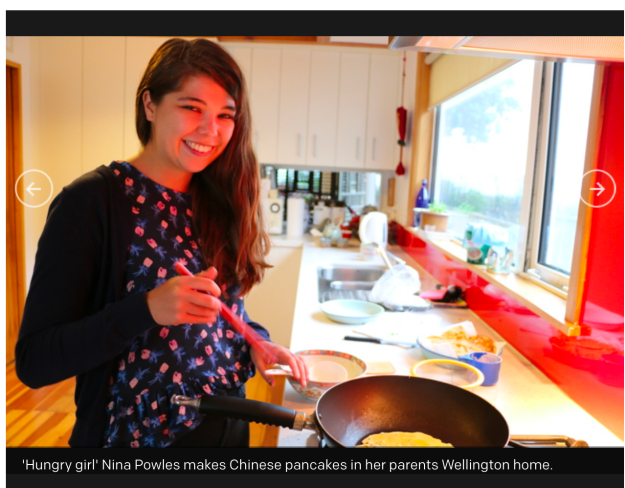
Listen to Nina in conversation with Lynda Chanwai-Earle on National Radio as she makes dumplings. It is terrific.

Nina Powles on hunger, food and poetry with @LyndaChanwaiEar on National Radio

Screen Shot 2017-05-13 at 9.27.28 AM.png


“You must be hungry girls,” he said. We were in Shanghai, 14 or 15, eating dumplings. We absolutely were hungry girls, I don’t just mean food. We were hungry for everything, in every sense of the word.”  – Nina Powles.

“Love is a bowl of noodles. Eating noodles reminds me of being at home, and also being very, very far away from home.” Nina Powles, Mooncake poetry zine, Shanghai, 2016.

“The first character of my mother’s name, Wen, is made of rain and language.  According to my dictionary, together they mean “multi-coloured clouds” or “cloud tints.” There are so many things I am trying to hold together. I write them down each day to stop them from slipping. Mouthfuls of rain, the blue undersides of clouds, her hydrangeas in the dark.”  Nina Powles, Field Notes On A Downpour, zine, Shanghai 2016.


I heard this  conversation replayed at 5 am this morning and it is terrific!

Coincidentally, I am about to post Nina’s contribution to the Autumn Season.


Screen Shot 2017-05-13 at 9.27.58 AM.png