Monthly Archives: May 2015

On reading Sport 43

Sometimes a literary journal is just the ticket for rainy-day blues, diversion, or the need to put a finger on a literary pulse. Ha! The notion of a literary pulse is where debate ensues. Each finger will be sensitive to different nuances, different implications.  I strongly believe that national anthologies that claim to represent a wide group ( New Zealand, for example) must be challenged if gender, ethnicity, age or geographic-location biases fuel significant blind spots. For decades, women were the blind spot in anthologies and journals, and now, at times it seems there is token representation of  work by Māori, Pasifika and Asian authors. Literary journals, however, are often the bloodline of a place, a niche, a literary disposition, and nearly always reveal the predilections of the editor. Sport comes out of Wellington, and it is to a great degree of Wellington (not in subject matter, but in terms of authors selected). It is a celebration of the writing by both established and emerging writers that have some connection with the city, often through Victoria University or its Press.  I have no problem with this.  I most definitely have no problem with this when the work included catches my attention and sends me in directions both familiar and unfamiliar.

The latest issue worked a treat for my rainy-day blues.

Seven essays are sprinkled through the selection of poetry and fiction, and if this is a new feature, it is a feature I applaud in this climate of idea-sharing in creative and stimulating forms. Long may it continue.

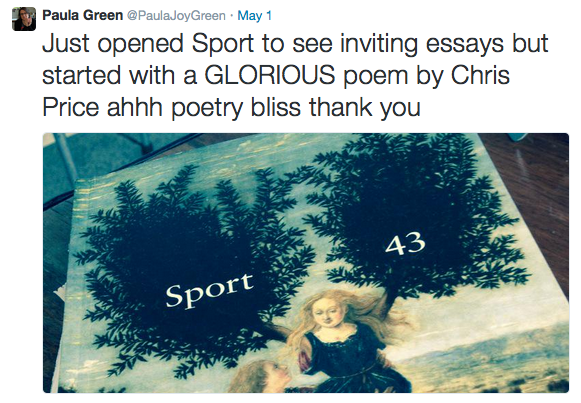
When I first picked up the book, I went straight to Chris Price (out of longing for a new collection perhaps) and immediately did a tweet review. Tucked away at the back of the book, it felt like the best had been saved for last with the playful, audacious flick and flash of words that catch your ear and send you flying to a nursery rhyme or Murphy’s Law or cheeky wit or the subtle twist and let’s-be-serious of the last word, ‘unspoken.’
Screen shot 2015-05-12 at 10.14.03 AM

This time I went to an unfamiliar name first, ‘Ruth Upperton,’ and what a discovery. Think I must have yearning for the comfort and absolute pleasure of poetic musicality (why I like the poems of Michele Leggott and Bill Manhire so much). Ruth has appeared in other journals, has just finished a law degree and lives in Palmerston North. Her five poems are different, the one from the other, but are linked by gorgeous rhyming (off, aslant, sliding), infectious repetitions, aural chords, sumptuous words. There is poetry out of sentences and there is poetry out of curiosity. You shift between comfort and strangeness.


from ‘The lonely crow’

Nothing sadder than a lonely river.

Nothing darker than a single crow.

Shiver at the strong’s surrender.

Play a tune on your June piano.


James Brown’s terrific poem, ‘Mercy,’ made me hungry for a new James Brown collection.

Anna Jackson’s three cooking-show poems suggest she is just getting better and better ( I am working my way through Catallus so I can review her new collection soon). I love the way the ingredients (excuse the pun) in these poems shift and flicker from one poem to the next, and in their new baking dishes taste a little different. The sort of poems that evoke a steady engagement at the level of sound and narrative.

Sarah Jane Barnett’s sequence of poems, Addis Ababa,’ caught me by surprise. They take me to an elsewhere, the elsewhere of  displacement, of otherness, of immigrants. The poems step up from everything Sarah has previously written, and then take another step into risk, empathy, inquiry, experience. What a combination.


Rachel Bush’s ‘Long and short,’ is a poem that moved me with its exquisite detail and revelation, a family story (true or false) that catches in the throat. The poetic glue: the baked bread.


So many things accumulate. They weigh us

off balance. We struggle to stay upright,

we lurch and are precarious. Our feet are flat

and sudden. It was easier when we had

a mum and dad. Easily we could blame them

when we were less than we desired.


Still most essays and fiction to read, but started here: Damien Wilkinson’s lecture/essay navigates a subset of the ‘ought’ and ‘ought not’ of narrative: the way it ought/ ought not represent some kind of personal change (character based). Fascinating following the thread of argument. Is this a requisite ingredient in poetry? That poems ought to navigate some kind of change? I raise this because, and I am shifting tack a little here, I am fond of poems that exhibit some kind of movement (and movement may be zen-like and hold change within its sameness and vice-versa). Poetic movement need not be on a grand, spectacular scale. It might be miniature shivers in the poem, sweet little movements that you catch out of the corner of your eye, or a flicker in your ear, or a faint tremble of your heart, or the tug of an idea that is itching to confound, challenge and pull you elsewhere. That is what I felt when I read, ‘She cannot work,’ Ashleigh Young’s foray into fiction. It is what I felt reading this issue of Sport, a catalogue of movements that displaced my state of fatigue.


Sport: miniature shivers in the writing, sweet little movements that you catch out of the corner of your eye, or a flicker in your ear, or a faint tremble of your heart, or the tug of an idea that is itching to confound, challenge and pull you elsewhere.


Abandon Normal Instruments – an editorial Kirsten McDougall has written for Horoeka Reading

Abandon Normal Instruments: A Call for Change in New Zealand Literary Arts

  • by Kirsten McDougall

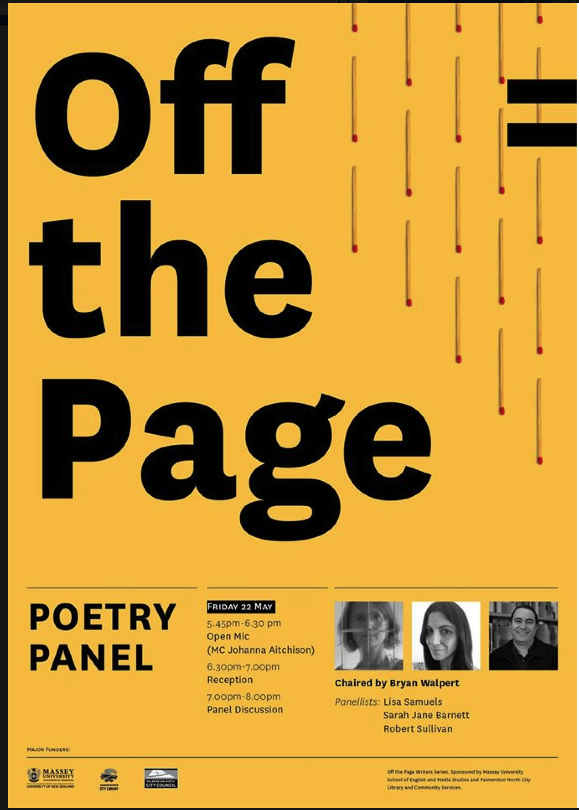
    In 2015 the public face of the literary arts in Aotearoa is in a sad state, a worn discarded toy that many people have forgotten how to play with. Publishers here and internationally have been caught like a possum in headlights by the dramatic changes to the industry and society at large. Those responsible for the guardianship of the literary arts in Aotearoa have failed to respond adequately to the pressures they are under and they are stagnating. It is time for writers and arts advocates to abandon their normal instruments, their usual ways of working. It is time to show real leadership and move the scene to a position of renewal. We need to articulate the value of literature to our society and clearly demonstrate the various ways it enriches our existence.

    For the rest of this timely piece go here. The recent losses/holds are like splinters in NZ Literary Arts. As readers and writers we exist in a state of continual erosion. Do we need a holistic approach? Do we need numerous little initiatives buzzing from the ground up? Do we need the big agencies facing our current challenges together?

    Brava Kirsten! This was sparking.

hey book lovers, we’re walking on egg shells

It seems every time I turn on the radio or pick up a paper or enter social media some other wretched thing has happened in the New Zealand book world. It all feels so fragile.

Things are sidelined and under threat (NZ Book Awards, NZ Book Month, Te Papa Press, bookshops, review pages and so on).

What we do have feels oh so brittle, as though it might snap or dissolve at any moment.

Three cheers for the NZ festivals that promote books, authors, ideas, narratives, poetry, discussions through inspired and inspiring programmes.

Three cheers for all those publishing NZ books against all odds.

Three cheers for those of us who go out and buy NZ books and then read them.

Three cheers for little initiatives such as the twitter NZ book month. The idea is to tweet a NZ book you love each day in the month idea. Bravo!

Screen shot 2015-05-05 at 3.57.11 PM


What else can we do?

My aim with this blog is to promote and celebrate NZ poetry and I am open to posting reviews and interviews that other people do.  paulagreen@gmail.com

I am open to posting short opinion pieces.

I am open to posting poetry news.

I am even open to posting fiction and non-fiction reviews of NZ books.


Arohanui,

Paula


Poetry Live’s 35th Birthday Celebration

Tuesday 5th May 8pm, Thirsty Dog, Karangahape Road, Auckland

The Poetry Live team welcomes you to a special event: our 35th birthday. All through the month of May we will be holding special readings celebrating Poetry Live and this important milestone.

To kick things off on Tuesday 5th May we will have a mihi from MC Rachael; a short speech about Poetry Live from Judith McNeil; music by Otis Mace; poetry readings by former Poetry Live MCs Miriam Barr, Piet Nieuwland, and Christian Jensen; and a Poetry Live-themed open mic.

Guest musician: Otis Mace
Otis Mace is a Auckland based singer/songwriter/musician who performs crafty, irreverent, comic takes on life in Aotearoa. Love ballads, pop noir and surreal protest songs tangential to most mainstream music. A long-time supporter of the Poetry Live nights and wholehearted ranter ,reader and raconteur, come and see his seventh show as guest artist! Vivid stories introduce provocative and punchy pop gems. He has toured extensively and opened for diverse acts: Billy Bragg, The Violent Femmes, Screaming Blue Messiahs, D.O.A. Albums are on Powertool and Jayrem and Ode, and now OMM (Otis Mace Music).

Guest poets:

Miriam Barr
Miriam Barr first came to Poetry Live in 2001 as a 19 year-old who had never read her poems to anyone but a few friends and family members. She is now the current national coordinator of NZ’s National Poetry Day and her book Bullet Hole Riddle was published by Steele Roberts last year. Poetry Live has been her home away from home for over a decade. One night at Poetry Live in 2005 she met her husband, poet Daniel Larsen, and poet Shane Hollands, a meeting that would lead to the creation of performance poetry group The Literatti. For six years she served as an MC and saw Poetry Live through its last year at Grand Central in Ponsonby, the move to the Classic Studio on Queen St, a short stint at Te Karanga and the first years at the Thirsty Dog.

Piet Nieuwland
Piet Nieuwland started reading poetry in Kaikohe and made his first appearance at Poetry Live in 1984. He soon took on the role as MC and was included in the Globe Tapes. Since then he has read poetry in a wide variety of gatherings, meetings, hui, cafes, restaurants and bars throughout New Zealand and beyond, including Pecha kucha evenings. His poems have been published in Landfall, Live Lines, Mattoid, Takahe, Snafu, Take Flight, Tongue In Your Ear, Poetry NZ and in online journals including the Blue Note Review. He is currently involved in Poets Exposed readings in Whangarei and has just co-edited a chapbook compilation of Northland poetry titled Fast Fibres Poetry. Fast Fibres 2 is in preparation.

Christian Jensen
Christian is a former creative director of The Literatti, and was one of the organisers of the Metonymy Project, a collaborative project that sends a poet and a visual artist on a 6-week blind date, culminating in an exhibition. His work has been published in such places as Snorkel, The Hay(na)ku Anthology, Otoliths and the De-Formed Paper. His book, Zin Uru (Soapbox Press) was released in 2008. Christian was an MC at Poetry Live from 2006-2012.

Open Mic: This week we have a themed open mic. We welcome you to read poetry about Poetry Live. (General open mic will also run.) 5 min max as usual.

Koha entry

MC: Kiri