Tag Archives: Te Herenga Waka University Press

Poetry Shelf Cafe: Bill Nelson reads from Root Leaf Flower Fruit

Root Leaf Flower Fruit, Bill Nelson, Te Herenga Waka University Press, 2023

Excerpt from Root Leaf Flower

Bill Nelson is the author of Root Leaf Flower Fruit (2023) and Memorandum of Understanding (2016). His poems have appeared in Best New Zealand Poems, Sport, Landfall, Hue & Cry, Shenandoah, The Spinoff, Minarets and The 4th Floor, as well as in dance performances and art galleries and on billstickers. In 2009 he won the Biggs Family Prize in Poetry from the International Institute of Modern Letters, and he is a founding editor of Up Country: A Journal for the NZ Outdoors. He lives in Te Whanganui-a-tara Wellington with his partner, two children and his dog, Callimachus Bruce.

Te Herenga Waka University Press page

Poetry Shelf review: As the trees have grown by Stephanie de Montalk


As the trees have grown, Stephanie de Montalk
Te Herenga Waka University Press, 2023

We heard neither

gasps of admiration
nor ecstatic interpretations

of radiance that afternoon—
only the sighs

of wind-blown sand
awakening our

desert thirsts
to the marvellous

from ‘Trance’

Many of the poetry collections I read, reinvigorate the idea of writing, plural rather than singular, expanding and refreshing the scope of what poems can do. Stephanie de Montalk’s new collection, As the trees have grown, is no exception. Writing becomes memory, elevation, diversion, celebration, uplift, grounding. Writing becomes heart, and all heart’s embedded words resonate within the poems: art, ear, tear, hearth, health, earth.

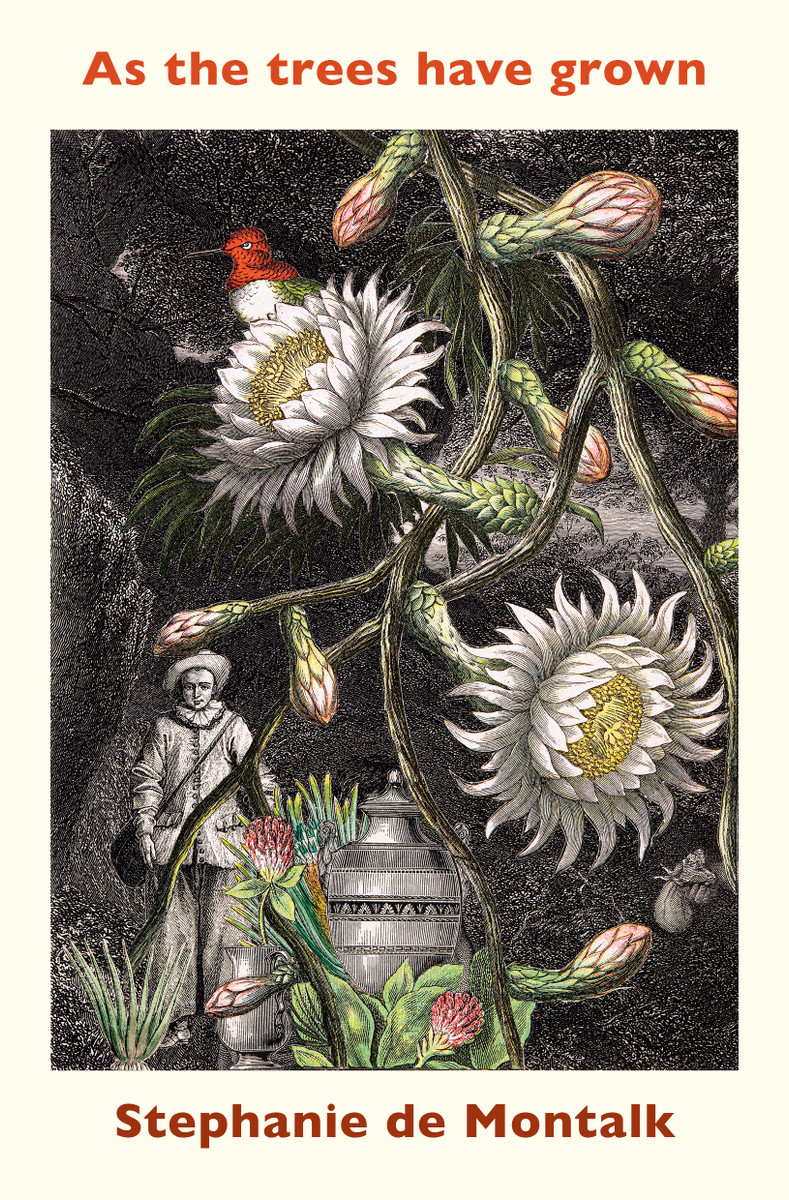
Art vibrates on the cover in the form of Brendan O’Brien’s terrific artwork, a collage made using 19th-century engravings with pencil and ink additions, with its intricate detail of bloom and mysterious dark. He created it after revisiting her poetry, having created covers for her first two collections. Inside, the art of the poet laces plants and wildlife, weather and luminosity with subterranean pain. It’s heart. It’s the allure of a physical moment that is transcendental in its physicality. In ‘Allurement’, you move from cobalt skies and bright hills to lawn sleeping cats to:

and all day there was
a deep, white light

and everything
with an edge to it.

A significant current, a vital skein, is that of health, as the poet negotiates physical challenges, ‘limitations’ as it states in the blurb, the tear and pain in daily equilibrium. Critical illness is an undercurrent, understated, there in signposts whiffs and analogies, as much as it is admitted, referenced, factored in. The opening poem, ‘Heartfelt’, lays down the threshold admission, introduces the impaired heart and its skew whiff music. Everything proceeds from this point. The writing. The absorbing. The living.

The rolling slopes and groves
of my lissom, evergreen heart,

struck by the dysfunction of left
ventricular damage—were at risk

of fatal erosion.

A poem, ‘Amor fati’, features a brown trout that allegedly accompanied a Scottish steam train driver on his daily trips between London and Edinburgh. I am musing how this found narrative stands in for the love of fate, amor fati, an embrace of the cards dealt, whether good or bad. And I am drawn back to the exquisite ‘Allurement’, and its pulsing beauty of an outdoor scene. Elsewhere an ailing lemon tree is watered to offer relief, or in ‘Events’, under the threat of flood and storm and power lost, plans are made: ‘What to do but bake bread and brew tea / before the occurrences peak’. Ah, how the doing is reinforcing the being. The imperative of trees and butterflies, sunsets and sunrises, earth in all its marvel and magnificence, is so vital.

Now I come to ear, the arrival of music, the longer lines, the shorter lines, the propensity for melody. Some poems favour length, but many accumulate short phrasings, a puff-breath syncopation, white space to savour, the measured beat, an economy that builds image, physical presence, nourishment. In ‘Imperium’, the poet bends her ear to the music of the bush, the pitch of tree, the operatic score of a physical view, and it is opening and it is open, as is the whole collection:

Massed choir

or spot-lit
solo performance?

The grace of long
gliding strides

or a glissandi
of light, rapid steps?

Stephanie de Montalk’s As the trees have grown is a rejuvenating map of bush tracks through living and breathing, seeing and sensing, where hospital ward becomes garden and garden becomes hospital ward, where each poem holds out ‘space and weight’, where the joy of words becomes the joy of unpackaging each day. The poetry so resonant. The poetry heart a marvel. The reading a gift of ‘hope and possibility’. This is a book to savour.

Stephanie de Montalk is the award-winning author of four collections of poems, including Animals Indoors, which won the 2001 Best First Book Award, the novel The Fountain of Tears, the biography Unquiet World: The Life of Count Geoffrey Potocki de Montalk, and How Does It Hurt?, a memoir and study of chronic pain. Described by Damien Wilkins as ‘groundbreaking and riveting and beautiful’, How Does It Hurt? was published to critical and medical acclaim, and received a Nigel Cox Award at the 2015 Auckland Writers’ Festival. It was published as Communicating Pain: Exploring Suffering through Language, Literature and Creative Writing by Routledge in 2018. Stephanie was the 2005 Victoria University Writer in Residence, and she lives in Wellington.

Te Herenga Waka University Press page

Poetry Shelf review: This is a story about your mother by Louise Wallace

This is a story about your mother, Louise Wallace
Te Herenga Waka University Press, 2023

Think of something you know about me.
Something you know for sure.
Step on it with both feet.
Make sure it can hold your weight in water.
Make sure it can hold you for a long time.

from ‘Vessel’

I adore poetry books that exude a love of poetry and what words can do. I also adore poetry books that get me thinking. Poetry can generate so much as you read, whether you enter roadmaps of experience, imagination, or combinations of both. For decades I have been fascinated by how the ink in our pens (or pencils or keyboards) is infused with the personal, the recalled, the scavenged, the political, writing trends, writing regulations, societal trends, societal regulations, hierarchies, biases, ideology that circulates immunity, open challenges, open hearts and roving minds.

Louise Wallace’s new collection, This is a story about your mother, gets me thinking. I am in awe of what her poems can do, the way we might delight in a poem for the sake of its poemness. I am also personally stitched into the weave of poetry that places motherhood and pregnancy, the anticipation and the actuality, centre stage. It is to be back in the thick and thrill and fatigue, the endless questions and precious epiphanies, the physicality of both becoming and being a mother.

Some critics continue to denigrate writing that favours a domestic focus, yet I continue to argue it is an enduring and rewarding subject for poetry with its multiple rhythms and rhymes, its myriad melodies and repetitions. It might be personal, political, physical, nurturing, mood or idea-generating, fortifying.

Louise’s collection begins with the poem ‘fact’, a sequence of declarations that are rich in possibilities. Already I am hooked. Read the phrase, “life is not a bed”, and hit the pause button, savour the sweet gap on the line. I want to put of roses in the gap but I make the poem’s leap to “of white paper”. Then I spin and spiral on the “bed of white paper”, the reverberating rose. Ah. I keep reading the poem’s punctuated flow, leaping over the spaces on the line to the next fact, the next rose.

I am breaking up with difficult poetry using       a comprehensive guide
to my biggest childhood crushes      then & now          thanks people

life is not a bed      of white paper         don’t forget to stop and smell
a white piece of paper    by any other name

Begin with pregnancy, the mystery and miracle of birth and new babies, the how to put into words such experience. The larger section of the book is entitled ‘like a heart’, while the second slender section, ‘vessel’ contains a single poem, an epistolary poem, like a gift addressed to the baby, whether still in the womb or out in the world.

Questions permeate. How to be a mother? How to be mother lover writer woman? How to negotiate the bombardment of images and ideas that promote an ideal woman – the ideal body image, the ideal mother, partner, writer. Louise performs a resistance through her writing – there is no singular maternal rhythm or composition or thread or place to stand or sleep.

it’s hard to be completely yourself while being beaten around the ears with
leafy greens. you can see freedom swinging further away as you try to relax
daily and  not lift heavy things, blitzing vegetables and exposing your mood,
poking out your chin and the no-good nose, your hair constantly increasing
in volume so that everything feels like it might do you harm.

from ‘cumbersome repetitions with friends’

I hold this glorious book out to you as an example of poetry as hinge. Poems offer continuity and flow but they also create invent juxtapose. The richness of the poetic hinge establishes connection, the pause, the gap. Louise uses numerous “hinges” that affect visual and aural effects as you read. A poem might be fractured and conversely connected by the use of an x, a blank space, a comma, a full stop, or slash /.

The opening poem ‘fact’ compiles a series of ands. Writing becomes a way of measuring and marking a life, the time, the day, what we must to do, what we might do. There are echoes and there are repetitions, but each arrival is nuanced. A word might be a musical note, a gesture, a thought, a feeling – it might be different keys, a chord, a swelling, a gathering, a recognition. There might be connection and there might be disruption.

Ah. The title of the collection offers us entry points. A way into the comfort of lists. A way into joy and pain. Ah yes. The way mothers might be invisible. The way self-doubt is a plague and the burnt chop is mother’s choice.

this is the sound of waves / of no preference / of low-fuss mothering / or working
and staying reputable / the sound of being undercover / this is what it sounds
like to be secretly terrified / and this is the sound of washing / drying flatly / in
heat / the sound of a booster seat / being installed / this is sound of intent /
of planning / and preparation / for something for which you can’t prepare / this
is the sound of size / the sound of a guarantee / and of hope / this is the sound
/ found / in a library / this is the sound of a screen / in the dark / the sound of 

from ‘talk you your baby’

When I reach the final poem, the long gift letter to the baby, it feels as though I am trespassing on something utterly intimate, so exquisitely private. But how this poem resonates; the way motherhood is both familiar and unfamiliar, with recognitions and misrecognitions. It is the most breathtaking sequence I have read from a mother’s point of view in ages.

There are many different scales of pain.
Some are songs.
                                                                 Some linen

                                                    with white lace trim.

As you read, you enter a realm where poetry is “like a heart” and like “vessel”. Where poetry is a sublime rendition of what poems can be, where poetry pulsates, and poetry holds. Such is the glorious terrain of This is a story about your mother.

There are some things you cannot know.
There are some places I cannot go.

from ‘Vessel’

Louise Wallace is the author of three previous collections of poems. She is the founder and editor of Starling, an online journal publishing the work of young writers from Aotearoa, and the editor of Ōrongohau | Best New Zealand Poems 2022. She completed an MA in Creative Writing at the International Institute of Modern Letters in 2008, winning the Biggs Prize for Poetry, and was the Robert Burns Fellow at the University of Otago, Dunedin in 2015. She grew up in Gisborne and now lives on the Otago Peninsula in Ōtepoti with her husband and their young son.

Te Herenga Waka University Press page
Louise reads at Poetry Shelf
Chris Tse launch speech for Louise Wallace and Jane Arthur at Good Books

Poetry Shelf review: Leah Dodd’s Past Lives

Past Lives, Leah Dodd, Te Herenga Waka University Press, 2023

last night I locked eyes               with a possum
its gaze moon-dark      and gleaming
              through the bedroom window

it trying to get in
               me trying to get out

from “soulmates”   

I am writing this review with Pink Floyd’s Ummagumma on repeat. The last time I had the album on repeat was in the 1970s. Having an album on repeat is a habit I have never discarded and it is a habit I apply to poetry collections. I highly recommend it. Leah Dodd’s Past Lives is a collection to put on repeat, and yes, it is there in a poem, the impetus for me to play Pink Floyd: “one night seventeen / got high listened to Ummagumma on repeat / then fell in a pool and floated away” (from “masterclass”).

Reading Past Lives is exhilarating, the poetry moving between the supercharged and the intimate. I have made a music playlist, a first while reading a poetry book, because the music references are so enticing: Miles Davis, Leonard Cohen, Big Thief, Joni Mitchell, Schumann, Jim Morrison, Fleetwood Mac, Nick Shoulder covering Blondie’s “Heart of Glass”, Cristina Aguilera, Shocking Blue. Throw in a youth group singing gospel songs, piano lessons, and you are in the heart of a collection steeped in music, that lifts you out of the thickness of daily routine and sets you afloat on a pool of reading bliss. Kind of like a version of high.

As I read, I am pulled between the domestic (a new baby, staying in, doing the washing, “kitchen scissor haircuts”) and the beyond: a history of reading, viewing, listening, going out, falling in love. The physicality of writing is mouthwatering, whether food or baby, whether “stale curry” or “too-bright billboards”.

in poems, babies are like snacks –
doughy loaves, apple-cheeked,
sweet as pie, sausage-toed

victim to the metaphor,
I call my peach-fuzzed baby yummy
because he is so tasty
I could just toss him in olive oil
and roll him into a kebab

from “clucky”

Here I go setting controls for the heart of the sun and I am back in the weave of the book. I am laughing out loud and I am holding back the tears. I would love to hear Leah read “the things I would do for a Pizza Hut Classic Cheese right now” because it is fast paced, a rollercoaster pitch of pang and laugh: “I would strip down to my knickers & slither around / on a backyard Warehouse waterslide coated / with cheap detergent on the coldest day of the year”. OR: “I would forgive the person / who hurt me when I was thirteen”. Ah, what you would do for a Pizza Hut classic cheese pizza!

Turn the page and fall into the sweet humour of conversing with the snails who insist on eating letters left in the letterbox before “shitting [them] out in long ribbons” (from “snails”). The poet and the snails get to talk TV, to talk Twin Peaks and Special Agent Dale Cooper, and what creamed corn stands for, and to ask if Josie is ok.

Put the collection on replay and you can hear music simmering in the bones of its making. This from “tether”:

I am a moonscape of blood and kitchen grit
ultraviolet bone & blotted sleep     one day
we will be separate creatures
I will give kitchen scissor haircuts
tether balloons on a string to a wrist
wrap birthday presents in the witching hour
and become a different animal altogether

Sometimes I feel like I’m holding on with fingertips, legs outstretched, hair streaming behind, as the poem and I move along a blistering stream-of-consciousness trail and it is so darn thrilling. Take “this night’s a write-off” for example, a poem that riffs on the notion of ideas, on writing on the passion lip of inspiration where ideas get away on you. All I know is I yearn to hear Leah read this poem out loud too!

my ideas are full bunches of marigolds
they are like a flock of Polish-Jew ghosts all set to haunt
the local supermarket, spitting OY VEY
              on single-use plastic and individually wrapped
                          organic energy bars
they are like                   if canned meat was a person
they get all dressed up in Brokeback Mountain cosplay
just to sit around the house smoking and
               thinking about Linda Cardellini
they are strong teas
and dancing to Miles Davis in the kitchen

Fresh! So very fresh! That is what Past Lives is. Every poem and every line refreshes the page of what poetry can do – of how we move between what was and what is and what might be. It is bold and eclectic and full of verve. It is a single moment on the first page that sticks with you while it is your turn to hang the washing out or put an album on replay, say Lucinda Williams or Anoushka Shankar or Bach. Because there in the first poem is the way a particular moment can flip you up and over, and become poetry, and be physical and confessional and full of heart-yearn and self-awareness. The speaker in the opening poem, “soulmates”, is eyeballing a possum at the window and it as though she’s eyeballing herself. The poem is unexpected, visceral, with the unsaid as potent as the said.

Ah, gloriously happy poetry head zone! Set your sights on this book and let go. Let yourself go into the joy of reading poetry.

Leah Dodd lives in Pōneke. Her poetry has appeared in Starling, Stasis, Mayhem, Sweet Mammalian and The Spinoff. In 2021 she won the Biggs Family Poetry Prize from the International Institute of Modern Letters at Te Herenga Waka—Victoria University of Wellington.

Te Herenga waka University Press page

Poetry Shelf review: Jake Arthur’s A Lack of Good Sons

A Lack of Good Sons, Jake Arthur, Te Herenga Waka University Press, 2023

I cavorted through the Gobi Desert
I fell in love with a camel in Saudi
I poured pints in Kraków.

If anecdotes are a life, I have lived.
Otherwise, I’ve urgently wasted my time.

from “Peregrination”

The opening poem of Jake Arthur’s debut poetry collection, A Lack of Good Sons, is wow! A young boy witnesses a bizarre and startling sight through his bedroom window: the farmer who lives next door, stands naked in his gumboots, back to the window. Even more surprising is the mother who says the boy did that when he was younger. The poem is a perfect threshold into a collection that startles and twists, that is honey fluent, detail sharp, physically grounded and metaphysically sailing.

For me this is a travel collection – poetry as a means of travel through time, space, location, voice, perhaps memory. I could say “prismatic” which would make Nick Ascroft squirm with his abhorrence of the word “luminous” in reviews. But this is the collection’s effect on me. It is poetry that glints and hues variously, from dark to edge to light to edge to dark to softness to searing colour and more light. There is a fluidity of voice and representation, epitomised in an “I” that is on the move, third person pronouns that skate and shuffle, a symposium of characters that Luigi Pirandello might fall in love with, or Italo Calvino.

This is the kind of book you need to immerse yourself in without being dampened down by the expectations and limits a review might offer. I offer you a mini tasting platter of poem extracts. Some stanzas are so sticky you keep hold of them for ages. I love the weave and startle turns. In the multilayered “Confessional”, the poem navigates both an external world and internal consumption. The last verse is sublime:

On a pew I rest my head and look up,
the colonnade a forest to a stone ceiling;
in me, too, an awful lot of rock.

The speaking voice might be man woman son or daughter, but at other times it is object. I particularly loved the shifting perspective (a trademark of the book as a whole) of the tree that becomes boat mast in “Bare choirs”. Again I loved the final stanza:

The flap and licking
thrump of the sail is a beat,
the slapping waves an uneven melody,
but it is more dirge than music
and not a tune to sing too.

I ask myself whether I will locate a connective tissue across the collection as a whole, a link beyond recurring motifs and devices. I wondered, for example, if there is “sameness” embedded in all the difference, then I read this in “1588”:

Everything was animated.
It spun on a dime. It was umami.

Now I  know better.
There is a sameness in everything.

Physicality is a lure. It is there in the earth and soil that appear and reappear. In a deft subject sidestep in the poem “Encounter”, a gardener becomes springboard to a sci-fi anecdote, and is abducted by aliens.

                                                      (…) I’m used to getting soil out
of my clothes, being green-fingered, but first I looked up
in the hope of spotting their craft and
I did see a little black shape but
probably it was just a bird
oh well, I thought,
from a distance
everything’s
unidentified.

Reading this sublime book, I am reminded of the wit and humour, the economy and richness of a James Brown collection – and heck, there is James Brown, endorsing Jake’s book on the back cover. Jake takes us on a multi-dimensional, electrifying tour that holds human to the light and then keeps twisting and turning so can we absorb human from different vantage points. So satisfying as reader. I have barely scratched the surface of Jake’s fabulously haunting poetry. Read it!

Jake Arthur’s poetry has appeared in journals including Sport, Mimicry, Food Court, Turbine, Return Flight and Sweet Mammalian. He has a PhD in Renaissance literature and translation from Oxford University.

Te Herenga Waka University Press page

Poetry Shelf Occasional Reviews: James Brown’s The Tip Shop

The Tip Shop, James Brown, Te Herenga Waka University Press, 2022

Alex Grace writes on the back of The Tip Shop: “Funny, dark, insightful and nothing close to a chore to read. Poetry, but it doesn’t suck.” Ha! Some poetry must suck, even be a chore to read, like a school assignment! James Brown’s poetry is cool – ok a lazy-tag adjective children are often forbidden to use as what does it actually mean? It means James’s poetry is hip, electric, agile on its poem toes, lithe on its heart beat, and is immensely readable.

The opening poem, ‘A Calm Day with Undulations’, places visual waves on the page and sets you up for all manner of undulations as you read the collection: wit, heart, life. In the poem, James uses an ocean metaphor to write about cycling which is a way of writing about living. Think surf / swell / naval surface / roll up and down / wave length / lull / pool.

It’s a calm day with undulations.
My tyres flow freely
across the naval surface.

The Tip Shop appraises and pays attention to scenes, moments, events, potential memory, language. The detail ranges from measured to madcap. Questions percolate. Poetry rules are invented. Words are played with. Dialogue is found. Poems stretch and poems repeat. Herein lies the pleasure of poetry in general, and a James Brown collection in particular: there is no single restrictive model when it comes to writing a poem. Within the collection as a whole, and within the frame of an individual poem, James resists stasis.

A poem that epitomises intricate delights is ‘Schrödinger’s Wife’. It delivers a miniature story laced with wit and puzzle. Here is the first stanza:

Mary didn’t walk with us Sundays. She ran.
With earbuds, she could keep reading. Her shop,
Schrödinger’s Books, was a tough mistress.
‘Are you working today?’ we’d ask. ‘Yes and no,’
she’d reply. She just needed to ‘finish the books’.
Can the books ever be finished? They wink at us
as though there are uncertain things
they think we ought to know.

I am drawn to repetition, to a concatenation of detail, especially in list poems, overtly so or nuanced. Three examples in The Tip Shop, establish A to Z lists. Another poem juxtaposes ‘I must not’ and ‘I must’. A found poem, like a form of canine play, lists dog owner dialogue. And then the delight in repetition dissolves, and time concentrates on the washing and peeling of fruit. In ‘Lesson’, a single elongated moment becomes luminous when caught in the poem’s frame. We are implicated, and are returned to an (our) apple: “When was the last time you / washed a green apple”.

Three longer poems stretch into telling a yarn, spinning a story, as the repeated indents mark the intake of a storyteller’s breath. Glorious.

‘Waiheke’ pares back to an ocean moment, and I am imagining the scene imbued with love. So much going on beneath, on and above the surface of the poem, whether in the breaststroking, in the prolonged looking.

You yearn so much
you could be a yacht.
Your mind has already
set sail. It takes a few days
to arrive

at island pace,
but soon you are barefoot
on the sand,
the slim waves testing
your feet

The Tip Shop is piquant in its fleet of arrivals and departures. It is poetry as one-hundred-percent pleasure – it makes you laugh and it makes you feel. It encourages sidetracks and lets you rollercoast on language. What a poetry treat.

James Brown’s poems have been widely published in New Zealand and overseas. His Selected Poems were published in 2020. Previous books include The Year of the Bicycle (2006), which was a finalist in the Montana New Zealand Book Awards 2007, and Go Round Power Please (1996), which won the Best First Book Award for Poetry. His poems are widely anthologised and frequently appear in the annual online anthology Best New Zealand Poems. James has been the recipient of several writing fellowships and residencies, including the 1994 Louis Johnson New Writers Bursary, a share of the 2000 Buddle Findlay Sargeson Fellowship, the Canterbury University Writer in Residence, the Victoria University of Wellington Writer in Residence. James works as an editor and teaches the Poetry Workshop at the International Institute of Modern Letters at Victoria University of Wellington. 

Te Herenga Waka University Press page

Poetry Shelf review: essa may ranapiri’s Echidna

Echidna, essa may ranapiri, Te Herenga Waka University Press, 2022

they’re sharing takeaways
next to the ocean
bony butts on a park bench
the Spider signs into the air
did you know liking hot chips makes you gay
Echidna smiles does it?
there is just the sound of waves crashing
and the newspaper rustling
the grease making things
transparent

from ‘Echidna & the Spider’

Spending extended time with essa may ranapiri’s new collection Echidna is a catalyst for contemplation, deep-seated musing, sinking into the knowable, wallowing in the unknowable, brushing against the light, scratching at the dark. All this and more. essa is writing in the present tense, that intimate prolonged precious moment when their words meet screen or page but, as their dedication indicates, are writing – for to from – their ancestors (past) and descendants (future). And past present future become weave. And writing becomes weave. And weave becomes writing.

I see the word weave is used on the book’s blurb: ‘Echidna contends with three stands of tradition; Greek mythology, Christianity and Māori pūrākau, and through weaving them together attempts to create a queerer whole.’ Storytelling is weave. Weave is storytelling. Where and how did she fit into storytelling over time? Where do they fit into story telling. Who is speaking? Who wields power according to the dominant voice? Ah the power of myth to acculturate.

For decades, we have attempted to place she centre stage, to give her necessary voice, to rescue her from shadows and misrepresentation, this complex prismatic stretching she. As a writer and once temporary academic, I wanted/want to witness and engage with her publications, performances, anthologies, critiques. And now, so long overdue, we must place they centre stage, to give them voice, the non binary, the gender fluid, to rescue them from shadows and misrepresentation, this complex prismatic stretching they. As writer and once temporary academic, I want to witness and engage with their publications, performances, anthologies, critiques.

essa draws upon so very much for this heart-startling collection. I experience it as a weave of their own self, vulnerabilities, fears, dreams, experiences. As a weaving of contemporary spaces, mythological and cultural inheritances, and above all the wounding slam of colonialism. This is the kind of book an author has given every inch of skin and blood to. I am reminded of Tusiata Avia’s Bloodclot.

Again I am also reminded that the books we write are woven out of the books that precede us, the communities we write within and beyond – as much as life, imaginings, daring. essa acknowledges this in their poem dedications and ‘Notes’ and the connective tissue of their poems. Here is part of the community they gather: Tusiata Avia, Tayi Tibble, Roman Potiki, Aimee-Jane Anderson O’Connor, Hana Pera Aoake, Tina Makereti, Sam Duckor-Jones, Ruby Solly, Stacey Teague, Whiti Hereaka, Keri Hulme, Rangi Faith, Robert Sullivan, Anne Marie Te Whiu, Ngahuia Te Awekotuku, Reihana Robinson, Elizabeth Kerekere, Hinemoana Baker, Sinead Overbye, Michelle Rahurahu, Harry Josephine Giles, Carin Smeaton.

The collection. Echidna, the she-viper, cave dweller, mother of monsters, half woman half snake: she is myth and she inhabits this world. She meets Narcissus, and she starts an instagram account, plays video games, eats takeaways. She squashes sandwiches into a tupperware container and she wraps herself in cliches. She meets Ureia. She is a night cleaner. She is the pulse and tension of this collection. She will keep you reading.

standing in the shower now she scrubs vivid from her tails      kids’ comics
and lyrics     from the radio     Black Parade and a Riot! of melodrama    when
she gets out   lifting her unruly  form over the threshold     she wraps clichés
around herself to get dry    the mirror fogged over      hides a reflection she
doesn’t see herself in

from ‘Echidna Goes through Her Emo Phase’

Māui and Prometheus also make an appearance or two in a steaming hot relationship. The poem ‘Prometheus Collects the Body of His Lover’ hugs the right-hand margin and the collection slows right down to heartbreak, to held-breath, to astonish us as the poem shifts vantage point and embodies grief.

he takes small sips
black and bitter

there was a Prometheus who would howl at this
would take up patu and strike
a Prometheus who would burn the house down
and leave with the body
and bury him in the rich soils of his kāinga
a Prometheus who would try his hand at succeeding
where Māui had failed
but that wasn’t him

not now

essa offers sensual hooks so poems become tactile, aromatic, igniting taste buds. There is the physical and there is the intangible. The form of the poems shift like the shifting voice of the storyteller, the point of view swivelling. Sometimes a poem might appear like two salt pillars, sometimes ravined with space and ache, sometimes wider gaps punctuate the line, allowing room for float and drift.

And the sound. There is the music of the storytelling voice, a voice attuned to holding a listener entranced, to composing aural connections, undulating chords. Yes, it is music for the entranced listener.

Books find you. You find books. Poetry, like storytelling, has an incredible ability to invigorate every body pore, in ways that both heal and challenge. We need poetry in these turbulent times. We need this book. This remarkable groundbreaking Echidna.

essa may ranapiri (Ngaati Raukawa, Highgate, Na Guinnich) is the author of this book. Their first book, ransack, was published in 2019. They will write until they’re dead. 

Te Herenga Waka University Press page
Poetry Shelf Monday poem: ‘Echidna & Nafanua’

Poetry Shelf review: Oscar Upperton’s The Surgeon’s Brain

The Surgeon’s Brain, Oscar Upperton, Te Herenga Waka University Press, 202B

A life needs rinsing out, once in awhile.

from ‘Code name’

Oscar Upperton has followed New Transgender Blockbusters, his terrific debut poetry collection, with a book that is equally sublime.

The Surgeon’s Brain is the story of Dr James Barry, a biography say, that is in debt to research, imagining, poetry, more imagining. According to the collection’s blurb, Dr Barry was “a pistol toting dueller, an irascible grudge holder, a vegetarian, an obsessive cleaner – and a brilliant military surgeon who served throughout the British empire, travelled the world with a small menagerie of animals, and advocated for public health reform. Barry was also a transgender man living in the Victorian era when ‘transgender’ was unknown in Western thought.”

Oscar’s new book is essential reading. Marvellous, startling, heart-jolting reading. Poetry, in my view, is a perfect process in which to take risks, to step into the shoes of another, to challenge historical misconceptions and regulations, to enable words to sing. The Surgeon’s Brain does all this and more. It strikes a mark, and then another, and lights up on so many levels. The story is divided into three sections: ‘Dura Mater | Tough Mother’, ‘Arachnoid Mother | Spider Mother’, ‘Pia Mater | Tender Mother’. A baby born, a life lived, a life goes missing. At one point, the doctor admits:

I am not a writer. I am a soldier. I am a surgeon.

Sometimes I write reports. I write in straight lines and use straight
language. I would never dream of writing a poem.

from ‘Well’

And here is the doctor speaking from the straight lines of a poem. He is infused in the ink of the excavating poet. And the straight lines of poetry are judder bars, potholes, side roads, scenic views, the unforeseen, the exhilarating downhill cycle ride. And if the doctor only ever wrote reports, would never dream of writing poems, the young girl dreamed of busting apart the straight lines of a girl’s future. She sews herself into another gender. She makes the physical garment and codpiece that renders her man, and he steps into a different set of expectations and outcomes. He studies, passes exams and practices as a surgeon. Dr Barry, for example, is the first surgeon to perform a caesarean where both mother and baby survive.

The rules are different now. I travel unchaperoned;
I enter public houses; I attend a university.
Once I hid my hair and people would talk to me differently,
but now they listen differently too. Before they didn’t listen
but now their ears are opened. I am worth teaching now.
I can be of use beyond myself. There is no question
of my right to board a ship, or take a room.
It is as though I were a ghost and I have now been give form.

from ‘The rules’

It is joy reading this as story, moving through beginnings middles and endings, but it is not pure delight. It is discomfort, corrugated musings, because the world has not yet dismantled the structures and behaviours that denigrate and deny women. That perpetrate blind ignorance of all genders as opposed to equity and openness. I carry a degree of mourning as I read, thinking of heart-numbing dichotomies: men women slave master rich poor literate illiterate hungry full. Yes Victorian times, yes 21st century.

It is joy reading The Surgeon’s Brain as poetry, moving through the lilt and economy of voice. And yes, it is voice, think speaking voice: confessing, exploring, refining. It is the musicality of conversation that is poetry. It is images and it is wisdoms. Fluidity and fluencies. Tenderness. It is the arrival along the plainness of line that forms another stitching of self. The poem as self-dress. Precious buttons and warm threads. Lines stand out and it is like you are gut-winded. Here I am falling in to a hole in the world, like we might fall into a hole in the poem, into a life. And I am imagining the floor of the poem. And it is this:

Mamma fell ill; an ill wind blasted; a will drawn up; the trapdoor
    swung down:
a rope ladder descending into darkness;
a hole in the floor of the world—

from ‘The idea’

So much to say about The Surgeon’s Brain. I wish we were in a cafe, having invented a poetry bookclub so we could share espresso and our favourite lines. Quoting this bit, and warm musing on that bit. I want to share how the doctor builds a room in his head with a bookshelf and chair, dust in the air and London light. We could talk hesitantly about the rooms we build in our own heads, for whatever reasons, that help keep us safe and on track, strengthened.

I want to tell you as you sip your coffee about a particular poem (‘Journey to the university’) that has a shadow version in the footnotes, little refinements, because we cannot take a face or an action or a statement for granted. Because behind this poem is another shadow poem, and behind that another.

Or the forest. I am thinking of the power of metaphor to get us along the straight line. Through the living of the life, the reading of the poem. How this life and this book is effervescent with metaphor.

Some things I keep secret even from myself.
I’ve never seen a forest but sometimes I walk in one
in my dreams, great black trees with twisted branches
and underfoot wet earth and spiders’ nests.
This is a forest that covers the world,

and in it live three things: the red foxes that dislike rain,
the innumerable silver spiders, and me, numerable
I think, but when I turn to regard the path behind me
I am there. Each step of me is frozen in place,
curls of earth sticking to the soles of my feet.

Some things I keep secret even from myself.
I didn’t want done to me the things that were done to me.
But the sun rises and you say, well.
Only you don’t say it. You never say it

from ‘Into the forest’

But most of all I want to share the well. The well that ends ‘Well’, the straight line poem I have already mentioned (aside from the appearance/echo in ‘Into the forest’ above). I will leave you with the well, leave this metaphor for you to become entangled in, and say as an opener, how Oscar’s quiet and extraordinary poetry collection taps into another life, and how in doing so, it also taps into your life, my life. You and me and poetry are in this upheavalled world together. And know that as you read thorough marvel and wonder, mourning and wound, poetry is the lamp we can hold high and share.

I am a well. Or there is a well in my mind, clean stones, broad
wooden bucket, rope. The water at the bottom of this well is so
clear and cold it makes men drunk. It is black, because it takes the
darkness with it when it is pulled from the well.

I would like to intoxicate. I would like to be a well-frequented well.

from ‘Well’

Oscar Upperton’s first poetry collection was New Transgender Blockbusters (VUP, 2020). In 2019 he was awarded the Creative New Zealand Louis Johnson New Writer’s Bursary. His work has been featured in Sport, The Spinoff, Metro and Best New Zealand Poems.

Te Herenga Waka University Press page

Conversation with Lynn Freeman, Standing Room Only, RNZ National

David Kert review Kete Books

‘Code name’ The Friday Poem at The Spin Off

‘The surgeon’s brain’ Poetry Shelf

Poetry Shelf review: Frances Samuel’s Museum

Museum, Frances Samuel, Te Herenga Waka University Press, 2022

Up here in the thin green air,
I’m feeling the wind on my face
with the joy of a dog on a family car trip,
head out of the window.

from ‘Exhibition (DNA)’

Frances Samuel worked in a museum writing texts for exhibitions for many years. For me, museums are an endless source of fascination and marvel. I wrote about the intoxicating thrill of museums in New York Pocketbook. Standing, for example, before a pair of child’s boots in Ellis Island’s Immigration Centre or moving with the wonders of the Natural History Museum. Or the roll call of museums that fed my Italian degrees. There are the hungry gaps of the past that you seek to fill by studying scuffed toes, wrinkled leather, the uncanny emptiness, the child that once ran or skipped or hid. In my self-imposed lockdown, picking up Frances’s new collection felt like a trip to a museum and, as happens on the threshold of any museum space, I felt a heady mix of anticipation, joy, curiosity. Where would this book take me?

I pass through the book’s opening poem, ‘Exhibition (Security)’, and then move through three exhibitions: ‘SUPER(NATURAL) WORLD’, ‘(IM)MATERIAL WORLD’ and ‘OBJECT LESSONS’. I am following the poet, the museum maker, but the museum on offer is porous. It reaches out beyond walls and still life into the air we breathe, and with each poem I track twist unfold pursue peruse fold untwist. Just like I do on Ellis Island. Or in Roma. It is discovery and it is magical.

The poem ‘Climate Change’ proposes a change in perspective. Inventive in its start:

Since we are all made up of atoms and vibrations,
let’s rearrange ourselves.
You be a bird and I’ll be a buffalo,
stand on my back and off we go, carefully
stepping over our discard clothes

And utterly moving, when you reach the final stanza. I keep bouncing back to the poem’s title, just as I might switch and flick between museum diorama, museum label and someone else’s shoes:

From above, we watch travellers on the trails
tying and retying their loads to donkeys’ backs.
They take a few steps and the load slips again.
Over and over again, agreement can only come
when the bird in me bleats
to the buffalo in you.

Frances writes lightfootedly. It’s not just a matter of weight but a matter of luminosity. If the poems were written in ink, the ink would be imbued with a wonder that slips in and out of view. You need to read each poem whole to get the effect of fitting together, but certain lines stand out and settle on you, little talismans, little points of fascinations.

‘Rain is hole-punching its way in.’ from ‘Moonhopppers’

‘My friend wears a grass jumpsuit / teeming with ants and worms.’ from ‘Fashion’

‘A poet explodes at a kitchen table / taking everything else with her.’ from ‘Pottery’

‘The words are falling from him like seeds.’ from ‘Fast Forest’

‘If one hundred thousand leaves / can make a clean break every day / then what are you waiting for?’ from ‘Seed/Leaf/Tree’

In the first section/exhibition, you enter forests, mountains, deserts, fields, physical exhibition spaces. In the second section/exhibition space, the immaterial shifts my view on existence. Ghosts and trees jangle eyes. Things leap off the page, the canvas, out of the shadows, or from the anecdote, to gain provisional flesh, and you are back in the invigorating and mysterious air of the world.

And suddenly it’s a good thing
you extinguished your shoes
because now you are walking on air.
And when you are walking on air
you can go anywhere.

from ‘Exhibition (Shoes)

And then poet becomes mother, and the maternal role, reframed time and fatigue, chores and the tendering, are made visible. The mother is still of course poet, and the third section/exhibition refuses to keep the world confined in glass cases. The domestic enters and still the writing mind roves and creates and muses. In such an airy space, the wonder and discovery expands. For both reader and writer. In ‘Coin Rubbings’, the speaker finds buried civilisations and buried self elusive, so she tries this:

(…) So maybe it’s as easy
as placing the paper over your own face
and rubbing to see what impression
you are making on the world.

In each section/exhibition space, you turn upon notions of perspective, ways of absorbing and reacting, seeing and feeling. Your place(s) in the world comes into question, or into view, or dissolves, and you turn the page and keep reading. This sublime stanza appears in ‘The Kindness of Giants’ and appears in other guises or translations throughout the book.

Your feet are shod in cruise ships, and your eyes
look though spectacles made of frozen lakes.
Trapped fish obscure your vision.

When I first visited foreign museums in my twenties, I found them dead. Nothing jumped out and poked me in the eye or heart. Yet all these decades later, both poetry and museums are alive to me. I get to carry bits of humanity, song, epiphany, storytelling, dread, mystery, roadmaps, possibility atlases, the real, the unreal. The power of words, in both locations, along with the power of objects, get to sing in heart and mind. I finished France’s new collection and, how can I explain it, I was bursting with gladness and sadness. Maybe because instead of listening to the 11 am announcement on Covid changes yesterday, I read the book. I reread the collection today, writing this on one breath, on the wire of living, on the lightning rod of uncertain times, and as I put the book on my shelf, I am busting up with joy. That is what poetry can do. Read this book.

Inside your heart, a museum
and not the free-entry kind,
not the kind with a rollercoaster
and a cafe and a shop.

from ‘Museum Without an End’

Frances Samuel‘s first book was Sleeping on Horseback (VUP, 2014). Her poems have appeared in many print and online publications, including Sport, Best New Zealand Poems, Short Poems of New Zealand, and the National Library exhibition The Next Word: Contemporary New Zealand Poetry.

Te Herenga Waka University Press page

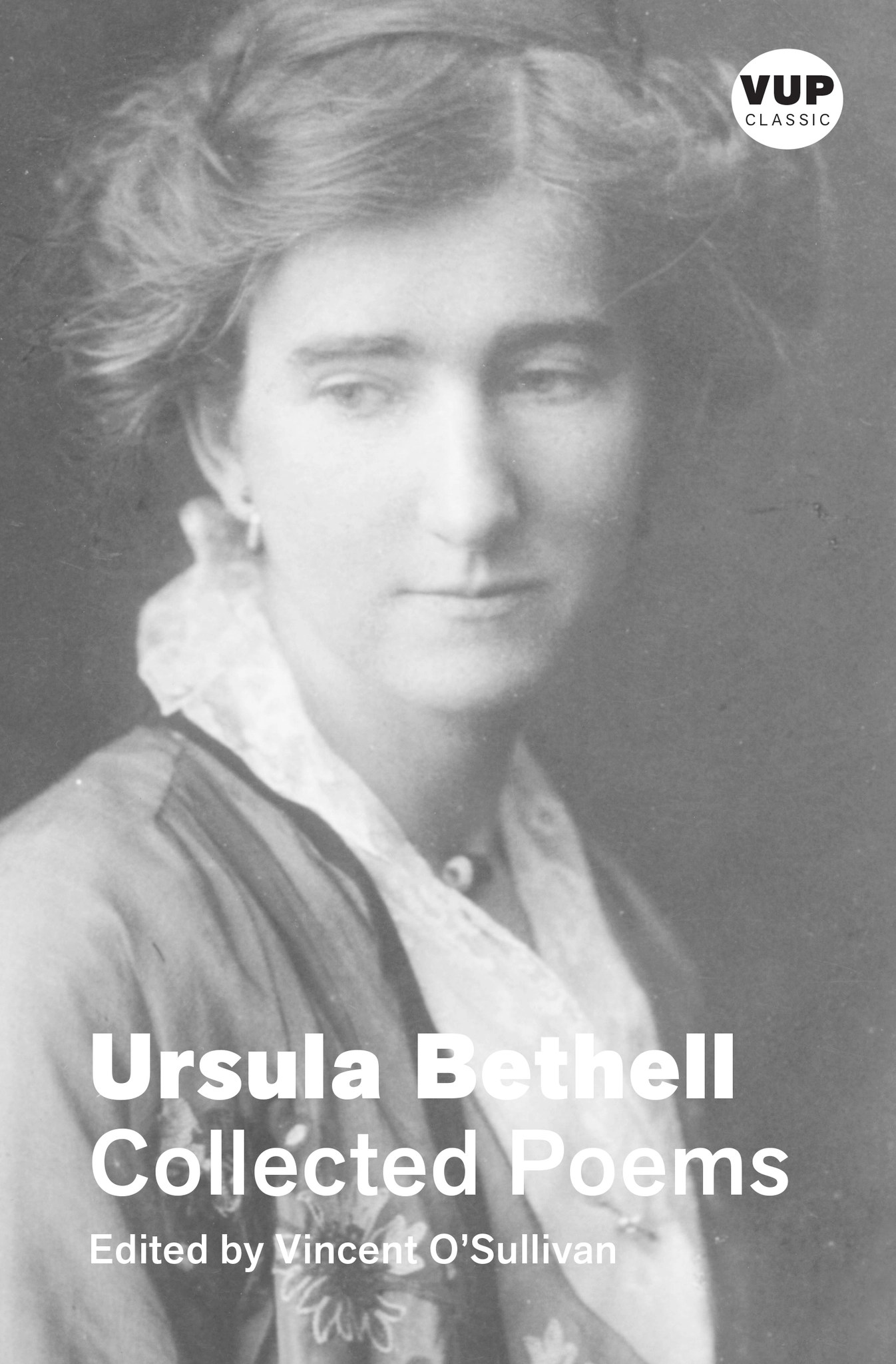
Poetry Shelf celebrates: Ursula Bethell Collected Poems

Today is International Women’s Day. At breakfast, I read NZ Supreme Court Judge Susan Glazebrook’s terrific story about her ongoing ZOOM efforts to help get women Judges out of Afghanistan last year (with the help the International Association of Women Judges). The story is in the February issue of North & South and it is unmissable. It feels like we are living and breathing under such a blanket of darkness at the moment. We know the list: the pandemic and its ripple effects, misguided protests, impending war, human suffering under despots across the globe, misguided journalism, mis-and-disinformation, poverty, greed. At times it is too much. I switch off social media, the radio, the papers to avoid toxic voices creeping in with their destructive influences influencing the vulnerable and the disenfranchised. But here I am reading a magazine presenting good journalism under Rachel Morris’s astute editorship. Rachel is stepping back now from the role, but I am grateful for the issues she has presented (not forgetting worthy attention to books in Aotearoa).

It seems an eon since Wild Honey appeared in the world, yet it was only last year I was doing the online Ockham NZ Book Award celebration for it. But it is fitting to remember this project of love – I set out to celebrate and retrieve women poets in Aotearoa. The younger generations of women poets are vibrant, inspiring, active, revealing, political, personal, edgy, lyrical, path-forging and it is a joy to read them. To write about their work on Poetry Shelf. But I don’t write out of a vacuum. I write out of the women poets who preceded me. Who also wrote with vigour, with various connections to the personal and the political. And so to celebrate International Women’s Day, to celebrate women’s poetry in Aotearoa, I draw your attention to Te Herenga Waka University Press’s reissue of Ursula Bethell’s Collected Poems.

I have several copies of Wild Honey to give away. Email or DM or leave a comment if you would like a copy.

Let’s shine lights this week on all the wonderful things women are doing – but hey, not just women, everyone. Let’s shine lights on humanity’s goodness.

Ursula Bethell Collected Poems, ed Vincent O’Sullian, VUP Classic, 2021

Detail

My garage is a structure of excessive plainness.
it springs from a dry bank in the back garden.
It is made of corrugated iron,
And painted all over with brick-red.

But beside it I have planted a green Bay-tree
— A sweet Bay, an Olive and a Turkey Fig,
— A Fig, an Olive, and a Bay.

Ursula Bethell, From a Garden in the Antipodes, 1929

Ursula Bethell is the kind of poet I turn to when I want uplift, when I crave the poetic line as transport beyond ongoing despair at this sad-sack world. Ursula Bethell’s reissued Collective Poems is now a member of the VUP Classic series. Oxford University Press originally published the collection in 1985, and it was reissued in 1997 with corrections and a new introduction by editor Vincent O’Sullivan.

I utterly loved engaging with Ursula’s poetry in Wild Honey. I considered it in three parts:

“I want to approach her poetry as three distinctive garden plots with a memorial garden to the side: From a Garden in the Antipodes (1929), Time and Place (1936) and Day and Night (1939) and ‘Six Memorials’. You could consider the debut collection as poem bouquets for friends, the second as a poetry posy handpicked for Pollen after her death, while the final collection, a late harvest from the same ground, almost like a consolation bouquet for self. The memorial poems were penned annually on the anniversary, or thereabouts, of Pollen’s death.”


I wrote in my Wild Honey notebooks:

Bethell published three collections of poetry in her lifetime, all anonymously, with the poems chiefly drawn from a decade she devoted to writing, gardening and her cherished companion, Effie Pollen. For ten years, the two women lived in Rise Cottage in the Cashmere Hills, until Pollen’s premature death, at which point Bethell’s life was ripped to unbearable shreds.  The more I read Bethell’s poetry and letters, and the more I muse beyond her characteristic reserve, I feel as though this is the woman to whom I would devote an entire book. She is a knotty collision of reticence, acute intellect, acerbic advice, crippling heartbreak and poetic dexterity. Bethell rightly counters the claim that she ‘knows no school mistress but her garden’, with the point that the garden was ‘a brief episode in a life otherwise spent’. Yet her gardening decade was the most joyous of her life, responsible for the bulk of her poetry, and a period she could not relinquish in letters and the grief that endured until her death. She moved back into the city with ‘no cottage, no garden, no car, no cat, no view of mountains’, no dearest companion and an impaired ability or desire to write poetry.


I was uplifted by individual poems and by the threads and luminosity as a whole:

“How can poetry ever match the joy and beauty a garden offers? Bethell brings us to the pleasure of words, the way words bloom and bristle. For Ruth Mayhew, a close friend to whom she dedicated a number of poems, Bethell builds her green garden symphony in ‘Verdure’: an abundant foliage of lemon, myrtle, rosemary, mimosa, macrocarpa. Without these variations, Bethell confesses she ‘should have, not a pleasaunce, not a garden/ But a heterogeneous botanical garden display’. The word, ‘pleasaunce’, is the spicy fertiliser waiting to explode the poem into new richness. Bethell favours flowers over produce, a pleasure enticement for the senses over fruit and vegetables for the kitchen (‘I find vegetables fatiguing/ And would rather buy them in a shop’. Her poetry ferments as a form of pleasaunce where the ‘plausible’, easily digested details of domestic routine, the house interior, daily conversations, intimate preferences and relations are sidestepped for words that provoke sensual and intellectual variegation in an outside setting.” from my Wild Honey notebook


To re-enter Ursula’s poetry is an act of restoration, just for a blissful moment, because it’s a way of feeling the warmth of the ground, the warmth of humanity (as opposed to its cruelty and ignorance). It is reminder that our literature offers so many rewards, on so many levels, and it is at times like these, poetry can be such necessary solace, respite, prismatic viewfinders, idea boosters. I am toasting the poetry of Ursula Bethell with thanks to Te Herenga Waka University Press.

Vincent O’Sullivan is the author of the novels Let the River Stand, Believers to the Bright Coast, and most recently All This by Chance. He has written many plays and collections of short stories and poems, was joint editor of the five-volume Letters of Katherine Mansfield, has edited a number of major anthologies, and is the author of acclaimed biographies of John Mulgan and Ralph Hotere.

Ursula (Mary) Bethell (1874-1945) was born in England, raised in New Zealand, educated in England and moved back to Christchurch in the 1920s. Bethell published three poetry collections in her lifetime (From a Garden in the Antipodes, 1929; Time and Place, 1936; Day and Night, 1939). She did not begin writing until she was fifty, and was part of Christchurch’s active art and literary scene in the 1930s. A Collected Poems appeared posthumously (1950). Her productive decade of writing was at Rise Cottage in the Cashmere Hills, but after the death of her companion, Effie Pollen, she wrote very little. Vincent O’Sullivan edited a collection of her poetry in 1977 (1985).   

Te Herenga Waka University Press page