Tag Archives: tate fountain

Poetry Shelf celebrates Starling: New Writing from Young New Zealanders

Starling is a go-to online poetry space for writers under 25: wide-ranging in form, voice, subject matter, mood. It’s vibrant, essential reading. Plus there’s the bonus of a featured writer (latest issue is Sophie van Waardenberg). To celebrate the tenth anniversary and the selection of two new editors, I invited the the co-founders, Louise Wallace and Francis Cooke, along with the two writers now at the editorial helm, Maddie Ballard and Tate Fountain, to select a poem from Starling‘s past decade and write a note to explore why the poem has stuck with them.

Poetry Shelf offers a bouquet of congratulations to the editors and participants, and looks forward to Starling‘s finger on the pulse of new writing.

Starling website

Starling was established in 2015 by us (Louise Wallace and Francis Cooke) as a literary journal for authors under 25 to publish their work and read writing by their peers. At the time we hoped could give space to a community of young writers that we knew were often not given their own platform in the broader Aotearoa literary landscape. Over the decade that’s followed we’ve been very fortunate to see how much the writers of Starling have taken up the journal and made it their own – it’s been more than we’d even hoped for, and we’ve been lucky to be a part of the start of the publishing career of so many incredible authors who’ve entrusted us with their work.
As we approached the ten-year mark, it seemed like the right time to hand over the reins, and so we were very happy to announce this September that Tate Fountain and Maddie Ballard would be taking over as Starling editors, ably assisted by the Starling editorial committee, currently made up of Joy Holley and Ruby Macomber. Tate, Maddie, Joy and Ruby are all past Starling writers who have now stepped into the role of shaping the journal for its next era, and we’re very excited to read the 21st issue, which they’re currently crafting, and all the issues to follow. We hope that Starling will be around for as long as young writers need it, and we can’t wait to see what’s to come.

Louise Wallace and Francis Cooke

four poems

Driving Directionless


It happens like that sometimes, stranded in the carpark in Mt Eden
Village, and your car battery is dead because you couldn’t sit
with the silence. The rain has been sweeping in from the horizon
all day, in and out, in and out, and you’re so much younger

than you thought you were. Nothing has been constant, lately, but
things must come to an end. I thought I knew that, I really thought
I did. And Circus Circus is so warm. The cheesecake sweet, and
we talk like we’re seventy. I went to a sushi train for lunch, plates

travelling around a circuit. The jumpsuit I bought was expensive,
but money is money. It was like trying on my own skin. There,
I say to my reflection, there you are. And as we approach the red
light, I don’t think about placing my foot gently on the brake. I

don’t think about switching lanes, or how my hands automatically
flip off the indicator after a turn. Instead, I think about tomorrow
and the colour of your eyes and the rising inside me. The words
stuck, gathering at the heart. How do you translate a feeling? How

do you wash yourself clean? I want to be wanted. I want to see where
we are all going to land at the end of all this. In the passenger seat, you
listen patiently. A reminder that you are not the enemy. I don’t know
who is. The sunset is so different every day. A cloud rears up in front

of my windscreen like a tidal wave, puffy, and peach-coloured, and
astounding. I want to remember, want to keep it all with me. Time
is unsteady. Today, is today and you finally noticed.

Brecon Dobbie

On Brecon Dobbie’s ‘Driving Directionless’ (from Issue 12) 


The first time I read this poem I was overcome with envy! Partly because of its wonderful final line and partly because of how well it does sincerity, a quality I think it’s really hard to write well. I love that it’s about being a new driver in Tāmaki. I love that it mentions the cheesecake at Circus Circus. I really love that it couches its existential moments (‘How do you translate a feeling? How / / do you wash yourself clean?’; ‘you’re so much younger / / than you thought you were’) amid sushi trains and car batteries. Isn’t that exactly how life is? All the big things squeezed up against the little ones.
I’ve returned to this poem several times over the years because I love the speaker’s voice so much: wise and sad and hopeful and observant of peach-coloured clouds. I hope to read lots more from Brecon in the future.

Maddie Ballard

loss


mum went to bed for months.
got up only for using bathroom with red toilet seat &
sitting on step outside pink back door, smoking,
saying i love you without her eyes.

moving truck got stuck
under opawa’s overbridge
& my baby brother was born
just a red mess onto a matted towel.
one of those things
no one talked about.

family came to visit.
nana picked me up from school,
aunty slept, floor of my room,
& made a sticker chart so
i could be Good.

in doorways i stood
peering around corners to see
mum’s supine form or curve
of her spine as she sat outside, puffing.

her room seemed grey
i wanted to say:
what did i do?

but more than anything
i wanted to lose my first tooth;
to have a broken grin;
to tongue empty space.

mum got better suddenly –
woke up one day
& darkness had gone away,
ran out to lawn in her underpants,
cheering & dancing.

i lost a tooth eventually
& then, oh,
so much more.

Hebe Kearney

On Hebe Kearney’s ‘loss’ (from Issue 15) 

I am a huge fan of ‘quiet poems’ and Hebe Kearney is very good at them. I think they are the hardest poems to get right, and it’s also hard for them to jostle for space in a journal selection process, up against loud, funny, bold poems. But when quiet poems work, they sing – like Hebe’s piece here.

First up, if you’re looking for an example of ‘show, don’t tell’, the line “saying i love you without her eyes” hits that mark perfectly. We understand that something is off, there’s something distant about the mother – the reason she’s gone to bed “for months” – without the poet needing to spell the specifics of the situation out. I can see the “supine form or curve of her spine” as I read – Hebe offers those shapes to me. 

Towards the end, things become brighter – the mother seems to miraculously recover and the speaker loses a tooth just as she had hoped – which makes the uppercut of the last two lines hit even harder. We remember the title, ‘Loss’, and feel that emotional impact at the end.

Louise Wallace


Any Machine Can Be a Smoke Machine If You Use
It Wrong Enough

Circe likes to live comfortably. The island,
the private jet – does putting everyone else
between Scylla & Charybdis make this
worth less? Hardly. Circe is moulding you
in her fingers like soft wax – here, amorphous

child of Morpheus, are you comfortable? Circe
takes her tax, she is a circular saw coaxing sap from a slack veiny tree
& in her menagerie the sad lion is left to starve & chew
his stately mane for comfort. She will destroy your planet
to live comfortably, but oh! she is compelling –

for instance, she claims she’s only anti-vaccination
insofar as she is against the continuation of the existence
of this human race, the world’s worst disease, abominations
bombing nations, laughing lesions of senseless flesh celebrating
their own unsubtlety, the syrupy pus of which

she collects in a glass & holds to her lips. Bemused charmer
of every snake, she has taken men to space and yet has not succeeded
in getting them to respect it. She has fought a thousand wars for you
and your right to say that war is bad, although there is a comfort in it.
Knowing who your enemy is. Circe leaves a thick slick of spit

on the panther’s taut haunch, sends him off with a resounding slap
and when his whispering ear is gone she advises you sincerely
to cultivate your loneliness, make your silence
violent, remember a woman’s first blood doesn’t come
from between her legs but from biting her tongue. Circe says

to treat comfort ephemerally, like a fleecy faery-circle
of ringworm on the skin of your inner thigh, a sick unscratchable itch
you don’t want to show. If you admit that you need something that badly
then it can be taken away from you. Circe instructs you to become blood
diamond, smoky topaz, hard-edged undesiring object of destructiveness

& self-destruction internalised by all as desire, as comfort, as Circe’s white
dandelion-floss cat who flows down the street on his way to eat
or sleep or fornicate with the mouse he doesn’t keep at home
instead silently stealing out to play with her
garnet heart among the liquorice-scented ferns.

Rebecca Hawkes

On Rebecca Hawkes’ ‘Any Machine Can Be a Smoke Machine If
You Use It Wrong Enough’ (from Issue 1)

Sometime in 2015, Ashleigh Young wrote on twitter (this was back when twitter was, mostly, good) ‘One of my students has written a poem called ANY MACHINE CAN BE A SMOKE MACHINE IF YOU USE IT WRONG ENOUGH. It’s great.’ I remember reading it and thinking that I’d love to read it someday. A few months later, going through the pieces we’d received for the first issue of Starling – I remember the day exactly, it was 14 November and I was reading submissions before heading out for the second ever LitCrawl – I picked up a set of poems by a writer named Rebecca Hawkes, and there it was.

One of the best parts of editing Starling are the moments where you get absolutely smacked in the face discovering brilliant writing by someone who, until that moment, you’ve never heard of, and realise ‘oh, wait, we’re going to get to publish this?’. Rebecca’s poem was one of the first of many moments like that – I remember reading ‘Any Machine….’ and being blown away by how expansive and luxurious it was in its language, heightened and apocalyptic while still undercutting itself at the right moments with a pitch-black humour (Circe stating that “she’s only anti-vaccination / insofar as she is against the continuation of the existence / of this human race” is a particular stand-out).

Rebecca’s poem has a lot of the themes that she’s fleshed out further in her writing since, as she’s become one of my favourite poets working in Aotearoa – a merging of classical themes and very distinctly New Zealand pastoral imagery, a very physical and sensuous love of the natural world while also being enmeshed in our modern, technology-driven present. She’s throwing it all into the pot here, and I’m sure if she looks back on this early piece now there are things she might want to change or edit out, but I hope she still recognises that at the heart of the poem is a true show-stopping line – “remember a woman’s first blood doesn’t come / from between her legs but from biting her tongue” – that still hits home a decade later. It’s been a privilege to get to follow Rebecca’s writing, and the work of so many other great authors who published some of their first writing with us, since I first read this poem, and it’ll always be a special one for me because of that.

Francis Cooke
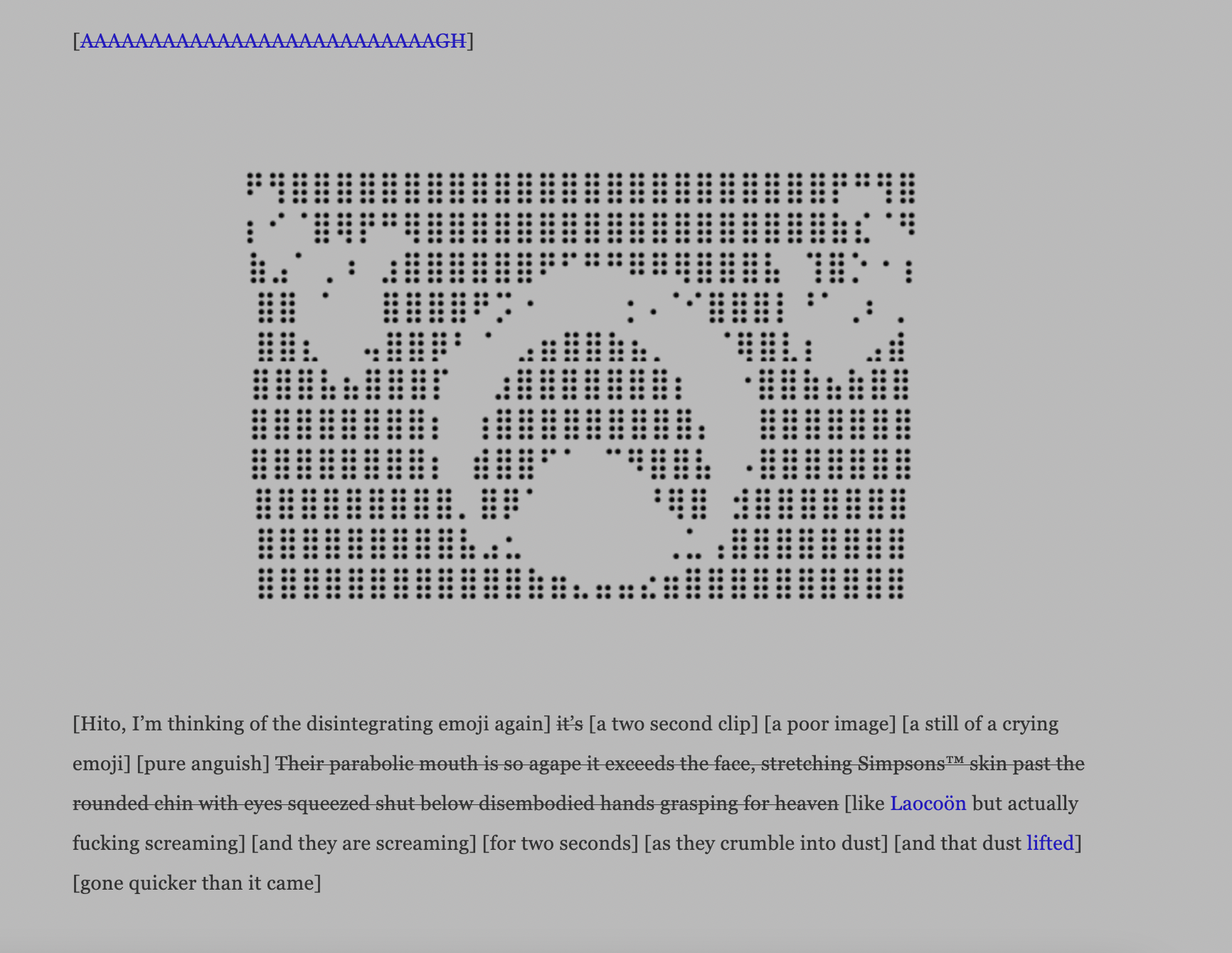
Extract from ‘UNTITLED’ by Matthew Whiteman
for complete poem, visit here

On Matthew Whiteman’s ‘UNTITLED’ (Starling, Issue 17) 

To highlight any single Starling poem from the past ten years is a daunting task. I vividly remember so many poems that struck and compelled me in my early days as a reader and contributor to the journal: Aimee-Jane Anderson-O’Connor’s ‘(Instructions)’ in Issue 6; jane tabu daphne’s ‘K–A–R–O’ and Van Mei’s ‘On Beauty’ in Issue 7; Sinead Overbye’s ‘The River’ in Issue 10 (to name only a few!). Likewise, I could list off countless poems that have made me put a hand to my heart, or pump my fist, or cheer while reading submissions during my time on the editorial committee. One of the great gifts of Starling is the range of work and of stylistic and poetic approaches that we get to read twice a year – no better job. 

On this occasion, I’d like to spotlight Matthew Whiteman’s ‘Untitled’ from Issue 17. Dedicated to German artist, filmmaker, and writer Hito Steyerl – addressed directly to, and referencing,her throughout – this is a go-for-broke, abundant, ekphrastic, pointedly intertextual poem that grabbed me immediately on the first read. Framed within an illustrated and progressively disintegrating – well – ‘disintegrating emoji’, Whiteman contextualises this ‘two second clip’, this ‘poor image’, and its silent or elongated variations, within a larger relational and arthistorical web: Steyerl’s ‘How Not to be Seen: A Fucking Didactic Educational .MOV File’ (2013), the iconic classical statue group of Laocoön and his sons; even The Simpsons, briefly, gets a look in. We are all scaffolded by our references, clear or opaque, and what I am so drawn to about this poem is that, stacked up and arranged in this form, it really could have only come from one person. 

Matthew’s ‘Untitled’ seems to bend so many poetic conventions: the fact of the title, intentionally ‘Untitled’ or else by necessity, speaks so well to the perhaps-futile search for meaning outlined in the poem itself. ‘I want to tell you what it means,’ he writes, ‘but I’m not sure I even know, Hito.’ The arrangement of the text, in square brackets and struck-through, likewise reflects this: everything is couched in erasure, something hiding even as it’s visible, or drawing from the form of emojis as textualised (as Matthew points out, ‘[‘disintegrating emoji gif’]’). The closest we get to the text outright engaging with its meaning is within the collage of this framing. It’s perhaps not an ‘easy’ read, but one that allows a few different paths for engagement, a few methods by or levels at which it might be read. (The links! The gorgeous electric blue links to give you the chance to experience the full web Matthew is pulling from!) 

I can get quite defensive of visual poetry – I never want people to think the ‘conceit’ or aesthetic identity of an effective poem nullifies or overpowers its content at line level. (In the same vein, I’m not overly interested in internet poems for internet poems’ sake; there needs to be something that grounds or further substantialises the work.) Any form can be a great act of assemblage, but the writing still has to stand out. And that’s something I love so much about this poem – that even if you stripped away all the rest of the work it’s doing, there would still be descriptions like ‘a poor image’, ‘pure anguish’, a ‘parabolic mouth is so agape it exceeds the face’, ‘disembodied hands grasping for heaven’. You would still have the immediate internal assonance of ‘Simpsons™ skin’ and ‘rounded chin’, the inbuilt, square-bracketed/struck-through pace shift of ‘[it bothers me] that lost scream [because that felt real] [wasn’t it] [someone’s scream] that then [became image] then [language]’. You would still have the closing lines to settle any of the destabilisation of what’s come before; the calm (characteristically struck-through, occasionally bracketed and linked) sentence function: ‘On Twitter [X] people just signal it like that. I want to tell you what it means but I’m not sure I even know, Hito. I think it may be a kind of speechlessness, the kind that calls you offscreen. I think you follow the scream elsewhere.’ 

I just love this poem. I’m drawn to its singularity, its stretching of form, its tone and the inherent line-toe of sincerity in a broadly comedic set-up; I’m compelled by its finding of art everywhere, its determination of meaning and its existential search, its deep thought. I feel really honoured, too, that it found its way to Starling and that we had the chance to publish it, especially as part of a longer intertextual poetic/artistic sequence within Issue 17.

Tate Fountain
Poetry Shelf Monday Poem – SIDE A: MANIFESTO and SIDE B: MANIFESTEAUX by Tate Fountain

SIDE A: MANIFESTO

  1.  I WILL NOT DWELL IN THE CAUSEWAYS OF ANGUISH.

  2.  I WILL NOT DWELL IN THE CAUSEWAYS OF ANGUISH AND CALL THEM DREAMS.

  3. WE WILL CELEBRATE THE PETALS OF THE SPIDER CHRYSANTHEMUM, EMBRACING IN THREE DIMENSIONS, EACH AS A THICK IMPASTO STROKE REACHING FURTHER INTO THE WORLD THAN ANY MORTAL PAINTER COULD MANIFEST, DUSTED WITH TRACKS OF PIGMENT ALMOST-MIXED AND OF GREATER DIVINITY FOR IT—THE VIEW STILL AND EXPLODED.

  4. EVERYTHING WILL BE ALRIGHT, ACTUALLY—IF YOU HOLD TO THIS KNOWLEDGE AND ARE TENACIOUS ABOUT YOUR LIFE.

  5. I WILL NOT DWELL IN THE CAUSEWAYS OF ANGUISH.

  6. I WILL NOT DWELL IN THE CAUSEWAYS OF ANGUISH AND CALL THEM GOD-GIVEN.

  7. YOU MUST FIND THE THING THAT SINGS TO YOU AND LET YOURSELF REJOICE IN THE MELODY.

  8. MY LIFE CAN BE REAL WITHOUT IT BEING CAPTURED. A YOUNG WOMAN WALKING DOWN KARANGAHAPE ROAD IN THE RAIN, BUNCHES OF FLOWERS FROM A PONSONBY GROCER CRADLED IN HER ARMS, IS JUST AS BEAUTIFUL WITHOUT BEING FLATTENED, FRAMED, AND HELD AT A REMOVE. SHE LIVES WITHOUT US HAVING SEEN HER.

  9. DIVE INTO THE HAVING. SEE HOW IT IMPACTS YOUR COMPULSION TO SPEAK.

  1. MY LIFE CAN BE REAL WITHOUT IT BEING CAPTURED. LET SOMEBODY BREATHE WORDS OF LOVE BEHIND A CLOSED DOOR AND RESIST THE URGE TO HAVE A LENS PHASE INTANGIBLY THROUGH THE WOOD. SET DOWN THE SCREENPLAY.

  2. MY LIFE CAN BE REAL WITHOUT IT BEING CAPTURED. ARE YOU IN LOVE OR DO YOU JUST WANT SOMEONE TO TEND TO IN THE SOFT BLUR OF A CROWD SHOT?

  3. MY LIFE CAN BE REAL WITHOUT IT BEING CAPTURED.

  4. MY LIFE IS REAL—THIS—NOW—AND IT IS HAPPENING.

  5. KEEP SOMETHING FOR YOURSELF—THE TROUBLE WITH SO EASILY DISGUISING THE EXERTION IS THAT THOSE YOU’RE SOOTHING DON’T GAUGE THE DEGREE OF YOUR EFFORTS.

  6. YOU DON’T HAVE TO LIVE WITH THIS CAVERNOUS THING INSIDE THAT YOU FEEL COMPELLED, FOR OTHERS’ SAKE, TO CRACK OPEN.

  7. WE WILL CELEBRATE THE HURTLING BEAT—THE SOARING CHORUS—THE WAILING SINGER—THE ALTO AT DUSK.

  8. YOU’RE NOT TRAPPED IN THIS. YOU’RE NOT TRAPPED AND ANYTHING CAN CHANGE AND NOTHING IS EVER WITHOUT HOPE.

  9. I WILL NOT DWELL IN THE CAUSEWAYS OF ANGUISH.

  10. MY LIFE CAN BE REAL WITHOUT IT BEING CAPTURED: SURGING ADRENALINE, A POP BEAT AND A THICK ANCHOR—THE THRUM, THE THRUM, THE THRUM, THE THRUM, THE THRUM. THE TURN AWAY. THE I’M BACK. THE HEY, BABY. THE—THE—THE—

  1. I WILL NOT DWELL ON EVERYTHING THAT COMES AFTER. I WILL FRONTLOAD THE GIFT AND THE DOING.

  2. WE WILL CELEBRATE CORIANDER AND MINT AND BASIL—CELEBRATE THE PARSLEY THAT USED TO GROW IN CLAY POTS AT THE VERGE WHERE YOUR GREAT-GRANDFATHER’S GARDEN MET THE STEPS OF THE HOUSE. YOU HAVE THE SAME HANDS NOW AS THOSE HE HELD. THE SAME IDIOSYNCRACIES AS ONCE KNOWN BY THOSE WHO HAVE CLOSEST LOVED YOU.

  3. WE WILL CELEBRATE THE REFRACTED LIGHT AS IT CASTS ITS SLANTING GLANCES.

  4. WE WILL BANISH SELF-DENIAL.

  5. I WILL DEFAULT TO COURAGE AND FAITH.

  6. I WILL EMBRACE FUN!!!!!!!!!!

  7. MY LIFE CAN BE REAL WITHOUT IT BEING CAPTURED.

  8. MY LIFE CAN BE REAL WITHOUT IT BEING CAPTURED. THE TENDER SLICING OF ANGEL TOMATOES ON THE SUMMER MORNING—THE GENTLE POOL OF OLIVE OIL—THE UNENCUMBERED ENOUGHNESS IN THE MEASURE OF MILK TO BE STEAMED.

  9. I WILL BE ACTIVE IN MY DEVOTION.

  1. WE WILL CELEBRATE THE FACT IT’S ALL AN ADVENTURE, EVERY SINGLE THING, AND ONE DAY IT WILL BE GONE.

  2. I WILL LET GO OF THE COMPULSION TO CARVE IMMEASURABLY DEEP GULFS BETWEEN MY PRESENT SITUATION AND A FORMLESS, IMAGINED SCENARIO WHEREIN MY LIFE IS SOMEHOW BETTER. I WILL LET GO OF ABANDONING MYSELF AND MY DEAREST ONES AND ALL THOSE I AM YET TO MEET. I WILL COME HOME TO MYSELF AND LOVE HER.

  3. I WILL BE GRATEFUL FOR EVERY HAND-UP AND KINDNESS.

  4. ALL OF US IN SUCH CIRCUMSTANCES WILL CELEBRATE OUR DAY-TO-DAY STABILITY AND THE SAFETY IT CAN BE SO EASY TO TAKE FOR GRANTED. WHEN WE FIND OURSELVES IN POSSESSION OF THIS INALIENABLE HUMAN RIGHT, NEEDLED PERHAPS BY DISSATISFACTION BUT NOT RAVAGED BY STATE-SANCTIONED EVIL, IT IS OUR DUTY TO STAND AS MEANINGFULLY AS WE CAN WITH THOSE WHOSE HUMANITY, HISTORY, AND FUTURE IS BEING TARGETED AND ERASED. WE MUST. HEAR ME: WE MUST.

  5. I WILL BE ACTIVE IN MY DEVOTION.

  6. I WILL RETIRE THE METHODS I TOOK UP TO SURVIVE MY ADOLESCENCE—I NEVER HAVE TO BE THAT GIRL AGAIN. INSTEAD—

  7. I WILL BE EXACTLY THE PERSON I’VE WAITED FOR, EVERY WOMAN I’VE LOOKED AT WITH ADMIRATION AND DELIGHT, WITH DEEP, DELICIOUS ASPIRATION. I HAVE THE MEANS NOW. I JUST HAVE TO RESPECT MYSELF ENOUGH TO BECOME HER.

  8. I WILL NOT DWELL IN THE CAUSEWAYS OF ANGUISH AND CALL IT BEING PREPARED.

  1. WE WILL CARVE OUR MOST FUNDAMENTAL TRUTHS INTO THE MATTER OF THIS AND ALL WORLDS, AND WE WILL NEVER LET IMPOSED DESPAIR WIN OUT.

  2. WE WILL MAKE MISTAKES AND GROW AND ALLOW THE SAME FOR OTHERS.

  3. WE WILL CELEBRATE PASSION AND RELIEF.

  4. I WILL COME HOME TO MYSELF AND LOVE HER.

  5. I WILL NOT DWELL IN THE CAUSEWAYS OF ANGUISH.

  6. I WILL COME HOME TO MYSELF AND LOVE HER.


SIDE B: MANIFESTEAUX

  1. The thing about the other side is that it fuckin’ rocks

  2. —once you take the reins of your life and throw all that other shit out.

  3. It’s a wonder what the right pair of boots will do, even if they immediately crack a sole on the edge of the footpath. Even at the end of a month that has felt cursed to you. Even as everything in your body is screaming at you that it’s time.

  4. Throw it away! Throw it away! Let it mean more by letting it go! Throw it away!

  5. Don’t luxuriate! Let the tides lap at it! It’ll stay if it’s meant to! Here’s your real life, baby!

  6. BRIGHT BLEEDING TULIPS SPRAY CHRYSANTHEMUMS THE LONG LINE FOR THE MADELEINES THE CITRUS ZEST AND THE ELDERFLOWER THE OIL CLINGING TO THE ICING SUGAR THE BUFFETTING LATE SPRING WIND

  7. THE DIP OF YOUR COLLARBONE SMOKED LAVENDER ELECTRIC BLUE

  8. Loosen your grip! Open your hand!

  9. It’s all got a bit serious, hasn’t it!

  10. THE DIP OF YOUR COLLARBONE SMOKED LAVENDER ELECTRIC BLUE THE MONT BLANC DOWN THE ALLEYWAY ON A SUNNY DAY THE SQUARE LINES THE GEOMETRIC JAVA TILING THE SWEET DEEP EUCALYPTUS THE

  11. DEEP EU— ORANGE TU— ENOUGH LOVE HERE THAT THERE’S SOMETHING TO LOSE

  12. You owe it to yourself not to hesitate. Or else you owe it to yourself to power through. You owe it to yourself to be the version of yourself you wish you could be, the one you know you are at your best. Tip your head back and meet the rain. And meet it. And meet it. And—

  13. Most of the time what you’re scared of losing isn’t the thing itself anyway, just evidence that, for a time, you had it—and you did; and you do; but the past doesn’t exist anymore, just as the future doesn’t, hasn’t reached us yet; what can you put down on the way there? What preemptive punishment are you assigning to yourself in order to beat some hypothetical judge to the punch down the line? Let it go! And—

  14. I love you in words I love you aloud I love you waiting for the bus I love you incomprehensible I love you at the perfect time I love you with jitters I love you with your hair in a bun giving notes I love you and your dog who is in many ways a lot like me and vice versa I love you through all events I love you with shared pocket tissues I love you for the others you love I love you from 1.5m away to ensure we’re in focus I love your attentive baby I love your braids I love you at the football I love you unproofread I love you undone I love you I love

  15. THE UNEXPECTED GENEROUS GIFT NEVER ASKED FOR AND YET RECEIVED NEVER ASKED FOR OUT OF THE ASSUMPTION IT WOULD NOT BE GRANTED AND YET RECEIVED AND YET GIVEN WITH THE FULLNESS OF ANOTHER’S HEART

  16. AND NOTICE THE EXCITEMENT SPILLING OVER ACROSS THE TABLETOP FLOODING THE PICKLED FENNEL AND THE STRACCIATELLA THE CRUMBLED PISTACHIO AND THE SICILIAN OLIVES THE FOCACCIA AND THE ROSEMARY ALREADY OILED AND FLAKED WITH SALT AND THE UNREMARKED-UPON SHARED DESSERT

  17. WHAT MIGHT OTHERS TAKE AS SIGNS WHEN REALLY THE LOVE IS AT THE SURFACE WHEN REALLY THE LOVE IS THERE WHEN REALLY ALL I MEAN IS EXACTLY WHAT I AM SAYING TO YOU WHEN WE CAN SINK TWO SPOONS INTO THE CUT OF A CHEESECAKE TO TASTE OUR EQUAL SHARE OF BLISS AND I’M NOT TRYING TO TELEGRAPH ANYTHING ELSE AND WHAT IT MEANS IS THAT WE’RE HERE TOGETHER WHAT IT MEANS IS THAT WE’RE HERE TOGETHER WHAT IT MEANS IS THAT WE’RE HERE TOGETHER HERE RIGHT HERE FOR NOW THANK GOD

  18. One day, sickeningly soon, it’ll all change. You’ll have to find someone new to call on the way home from work, some new supermarket corner to be disappointed by, yet another new site to which hopes can be pinned. All those things you once wrote about with such matter-of-fact self-derision—well, in many ways you were right, trying to haul yourself up as you always have, closer to that great wish, that gnawing right place, that fantasy. But that other world will be one you build, which requires grace. A different flower market. A different, likely more demanding, commute.

  19. Another gentle gaze to fall into.

  20. For the better. For the better.

  21. LET THE IMAGES CASCADE

  22. If you tallied it up—took time and took stock—it’s likely that the list of material objects you’d deem essential to the base comforts of your life and your sense of self would be vanishingly small. To be told this makes you defensive, as though you’re being reprimanded, as though they’re being taken from you by another person’s thought experiment, as though you are without agency again. Unless you’re being actively threatened, resist this urge. The odds of the ‘you’ actually being you are rare. Act in good faith. Let the rest fall through your fingers, unclaimed, to find a better home.

  23. All those months. Years. Whispered, as in prayer: Give me something to run to. Give me something that makes it hard to leave. Better yet—baby, just go. You’re ready! You’ve done all the learning you need to! All the rest will roll on from here, underfoot and overhead and in your hands. So much unknown—and how electric is that!

  24. LET THE IMAGES CASCADE AS A BROOK AS A PERFUME AS A WATERFALL YOUR BEAUTIFUL FACE YOUR BREATHLESS LAUGH YOUR SINCERITY CAUGHT OFF GUARD YOUR HAIR UNKEMPT YOUR SOFT SHIRT CORNFLOWER BLUE MY BOOTS REPLACED THE CRYSTAL DESCANT THE FINAL RASPING JAGGED STONE AGAINST THE SMOOTHNESS OF YOUR VOICE THE PAPERED FRONDS

  25. THE IRIS BOLTING—

  26. ALL THOSE YEARS AS CONCERTINA. LET YOUR HEART REACH RIGHT THROUGH.

  27. You’ve got here and you love her: you love her; you love her; you love her.

  28. Here’s your real life, baby. Here’s your real life and your leitmotif and the themes you’ll never be cured of.

  29. STAND YOUR GROUND / EXHIBIT GRACE / REARRANGE YOUR PRIORITIES FOR THE WORLD YOU LIVE IN AND THE WORLD YOU HOPE, THROUGH ACTIVE COURSE, YOU’RE HEADED TO

  30. Enjoy it, this, everything—everyone through a warm lens, half-grained and smiling.

  31. BELIEVE IN SOMETHING BETTER, FULLER-HEARTED / REFRAME ABUNDANCE / ESCHEW DEPLETION / BE STEADFAST, CLEVER, FIERCELY KIND

  32. And you love her. Keep on proving it.

  33. AND THE IMAGES CASCADE

  34. And you’re here now.

  35. AND YOU HOLD THEM

  36. And you’re gonna love it here.

  37. AND YOU’RE HERE NOW

  38. And you love her.

  39. AND I’M GONNA LOVE IT HERE.

  40. And I’m here now.

  41. AND I LOVE HER / AND

  42. I’m gonna love it here.

Tate Fountain

Tate Fountain is a writer, editor, and creative producer. She has held programming, digital marketing, and strategy roles with Te Ahurei Toi o Tāmaki Auckland Arts Festival, Whānau Mārama New Zealand International Film Festival, and theatre and film company, extracurricular. She is the author of SHORT FILMS (Tender Press, 2022) and, as of September 2025, the editor of Starling, alongside Maddie Ballard. 

Poetry Shelf review Tate Fountain’s Short Films

Short Films, Tate Fountain, We Are Babies, 2022

and I, well, I have had practice at this; I am far
better attuned to wanting things than I have ever
been to having them, and the day is clear, and the
scent of the kitchen of each nearby restaurant is
carrying. I am alive, and I am settling in, and I have 
in my hand at last something I could not bear to lose, 
some fibrous imperfect gift of a life in the place of
theoretical triumph: blistered heels and my mother’s 
old dress and a self I can face in the mirror; three 
long-stemmed lilies wrapped in cellophane, an 
unripe blushing hydra, five dust-pink tongues 
unfurled to catch the light.

from ‘SUNDAY, 7 NOVEMBER’

Love the idea of a poetry collection called Short Films, especially when it isn’t lifted from a poem title in the book. At the back is the director’s commentary, a HEX index and credits. Rhythm is a vital ingredient in the collection as a whole, the poet’s editing suite has resisted long slow panning camerawork. Instead there are jumpcuts and oblique camera angles, fascinating montage and hypnotic soundtracks. It is an opulent surprising reading experience, that depends upon the visual as much as the aural.

For some reason I made a leap from activated hazelnuts to activated language. Tate’s linguistic agility is spellbinding. Her language is alive, mobile, playful, inventive, active. The word activate is counterbalanced by bracketed space that is rich in possibility. At times it is a blank slate for the reader to scrawl upon, a foyer for musing points, a series of silent beats, a signpost to the unsayable, the unsaid, the gaps in the telling. They strike the eye and they resonate in the ear.

Colour is ubiquitous. Colour pops on the line, sparks across the wider scope of the book. There are individual colour poem clusters. You move from yellow-rayed blossoms to summer to pineapple, and housed in that yellow embrace is ‘a riverside lunch with my mother / We are learning again / / how to be around each other’ (from ‘Yellow’). It is the heightened power of metonymy where you place this shot next to that shot next to this shot. This frame next to that frame next to this frame. Feeling, experience, reaction is heightened.

A stripped back blackout poem uses a prose poem we have just read. I was reminded of how certain words pierced and stuck as I read. And there they were, isolated in the dark black shapes. Tate is taking a form, a convention and then playing with it, pushing it further.

In the inside blurb, the book is aptly compared to ‘a lush bouquet of poems’. I step from the flowers and the fruit, like brocaded still life, like kinetic life, finding mouth and heart, finding float and drift, the light and dark of chiaroscuro. The poetry is bouquet, held out to ignite the senses, but it is also mirror, looking glass for both reader and writer. Love is paramount. YES! These are love poems, heart poems, little outings with glints of self exposure. One poem, ‘LOVE POEM’, plays with ‘I want’, think light and serious, and you move to and fro, between need and desire.

Short films is, as Anna Jackson and Emma Barnes say on the back of the book, wonderful. It is a terrific cinematic experience, Maya Deren flashed in my head, where rhyme feeds motifs and subject matter, and rhythm performs the syncopation of daily life, of love life, of heart life. Utterly wonderful.

stop looking for me in my work /
I am not there /
you are in a hall of funhouse mirrors

from ‘ORANGE’

Tate Fountain is a writer, theatremaker, and DVD Special Features advocate splitting her time between Tāmaki Makaurau and Tauranga. She is a current member of the Starlingeditorial committee, and also works as the coordinator for samesame but different, Aotearoa New Zealand’s LGBTQIA+ Writers and Readers Festival. As an assistant director, actor, and stage manager, she’s worked with Auckland Theatre Company, Binge Culture, and the Pop-up Globe, as well as at Basement Theatre. Her poetry has been published in eel, Aniko Press Magazine, and Min-a-rets (Annexe), among others, and her screenwriting has been recognised by several feature development initiatives. She completed her Master of Arts (First Class Honours) at the University of Auckland, with a thesis on appropriations of the Eurydice myth by H.D., Carol Ann Duffy, and Céline Sciamma. Each month, she releases a new bouquet on Substack. She’s pretty much always thinking about films.

We Are Babies page

Poetry Shelf Theme Season: Eleven poems about breakfast

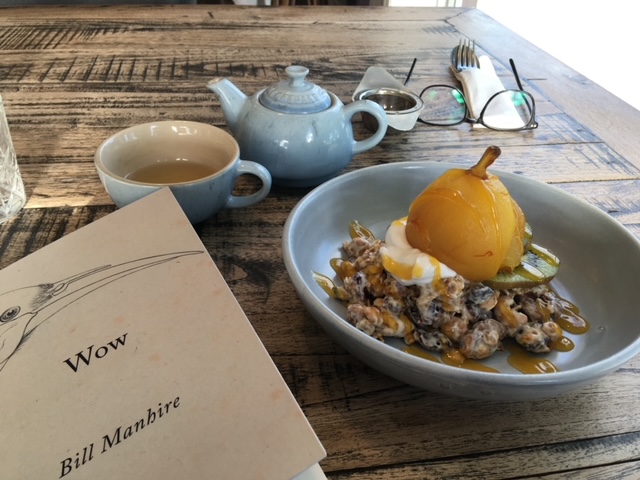
Breakfast is a lifelong ritual for me: the fruit, the cereal, the toast, the slowly-brewed tea, the short black. It is the reading, it is the silence, it is the companionship. It is finding the best breakfast when you are away at festivals or on tour, on holiday. This photograph was taken last year at Little Poms in Christchurch when I was at WORD. One of my favourite breakfast destinations. Breakfast is my gateway into the day ahead, it is food but it is more than food. It is the ideas simmering, the map unfolding, the poem making itself felt.

The poems I have selected are not so much about breakfast but have a breakfast presence that leads in multiple directions. Once again I am grateful to publishers and poets who are supporting my season of themes.

Unspoken, at breakfast

I dreamed last night that you were not you

but much younger, as young as our daughter

tuning out your instructions, her eyes not

looking at a thing around her, a fragrance

surrounding her probably from her

freshly washed hair, though

I like to think it is her dreams

still surrounding her

from her sleep. In my sleep last night

I dreamed you were much younger,

and I was younger too and had all the power –

I could say anything but needed to say

nothing, and you, lovely like our daughter,

worried you might be talking too much

about yourself. I stopped you

in my arms, pressed my face

up close to yours, whispered into

your ear, your curls

around my mouth, that you were

my favourite topic. That

was my dream, and that is still

my dream, that you were my favourite topic –

but in my dream you were

much younger, and you were not you.

Anna Jackson

from Pasture and Flock: New & Selected Poems, Auckland University Press, 2018

By Sunday

You refused the grapefruit

I carefully prepared

Serrated knife is best

less tearing, less waste

To sever the flesh from the sinew

the chambers where God grew this fruit

the home of the sun, that is

A delicate shimmer of sugar

and perfect grapefruit sized bowl

and you said, no, God, no

I deflated a little

and was surprised by that

What do we do when we serve?

Offer little things 

as stand-ins for ourselves

All of us here

women standing to attention

knives and love in our hands

Therese Lloyd

From The Facts, Victoria University Press, 2018

How time walks

I woke up and smelled the sun mummy

my son

a pattern of paradise

casting shadows before breakfast

he’s fascinated by mini beasts

how black widows transport time

a red hourglass

under their bellies

how centipedes and worms

curl at prodding fingers

he’s ice fair

almost translucent

sometimes when he sleeps

I lock the windows

to secure him in this world

Serie Barford

from Entangled islands, Anahera Press, 2015

Woman at Breakfast

June 5, 2015

This yellow orange egg
full of goodness and
instructions.

Round end of the knife
against the yolk, the joy
which can only be known

as a kind of relief
for disappointed hopes and poached eggs
go hand in hand.

Clouds puff past the window
it takes a while to realise
they’re home made

our house is powered by steam
like the ferry that waits
by the rain-soaked wharf

I think I see the young Katherine Mansfield
boarding with her grandmother
with her duck-handled umbrella.

I am surprised to find
I am someone who cares
for the bygone days of the harbour.

The very best bread
is mostly holes
networks, archways and chambers

as most of us is empty space
around which our elements move
in their microscopic orbits.

Accepting all the sacrifices of the meal
the unmade feathers and the wild yeast
I think of you. Happy birthday.

Kate Camp

from The Internet of Things, Victoria University Press, 2017

How to live through this

We will make sure we get a good night’s sleep. We will eat a decent breakfast, probably involving eggs and bacon. We will make sure we drink enough water. We will go for a walk, preferably in the sunshine. We will gently inhale lungsful of air. We will try to not gulp in the lungsful of air. We will go to the sea. We will watch the waves. We will phone our mothers. We will phone our fathers. We will phone our friends. We will sit on the couch with our friends. We will hold hands with our friends while sitting on the couch. We will cry on the couch with our friends. We will watch movies without tension – comedies or concert movies – on the couch with our friends while holding hands and crying. We will think about running away and hiding. We will think about fighting, both metaphorically and actually. We will consider bricks. We will buy a sturdy padlock. We will lock the gate with the sturdy padlock, even though the gate isn’t really high enough. We will lock our doors. We will screen our calls. We will unlist our phone numbers. We will wait. We will make appointments with our doctors. We will make sure to eat our vegetables. We will read comforting books before bedtime. We will make sure our sheets are clean. We will make sure our room is aired. We will make plans. We will talk around it and talk through it and talk it out. We will try to be grateful. We will be grateful. We will make sure we get a good night’s sleep.

Helen Rickerby

from How to Live, Auckland University Press, 2019

Morning song

Your high bed held you like royalty.

I reached up and stroked your hair, you looked at me blearily,

forgetting for a moment to be angry.

By breakfast you’d remembered how we were all cruel

and the starry jacket I brought you was wrong.

Every room is painted the spectacular colour of your yelling.

I try and think of you as a puzzle

whose fat wooden pieces are every morning changed

and you must build again the irreproachable sun,

the sky, the glittering route of your day. How tired you are

and magnanimous. You tell me yes

you’d like new curtains because the old ones make you feel glim.

And those people can’t have been joking, because they seemed very solemn.

And what if I forget to sign you up for bike club.

The ways you’d break. The dizzy worlds wheeling on without you.

Maria McMillan

from The Ski Flier, Victoria University Press, 2017

14 August 2016

The day begins
early, fast broken
with paracetamol
ibuprofen, oxycodone,
a jug of iced water
too heavy to lift.
I want the toast and tea
a friend was given, but
it doesn’t come, so resort
to Apricot Delights
intended to sustain me
during yesterday’s labour.
Naked with a wad of something
wet between my legs, a token
gown draped across my stomach
and our son on my chest,
I admire him foraging
for sustenance and share
his brilliant hunger.
Kicking strong frog legs,
snuffling, maw wide and blunt,
nose swiping from side
to side, he senses the right
place to anchor himself and drives
forward with all the power
a minutes-old neck can possess,
as if the nipple and aureole were prey
about to escape, he catches his first
meal; the trap of his mouth closes,
sucks and we are both sated.

Amy Brown  

from Neon Daze, Victoria University Press, 2019

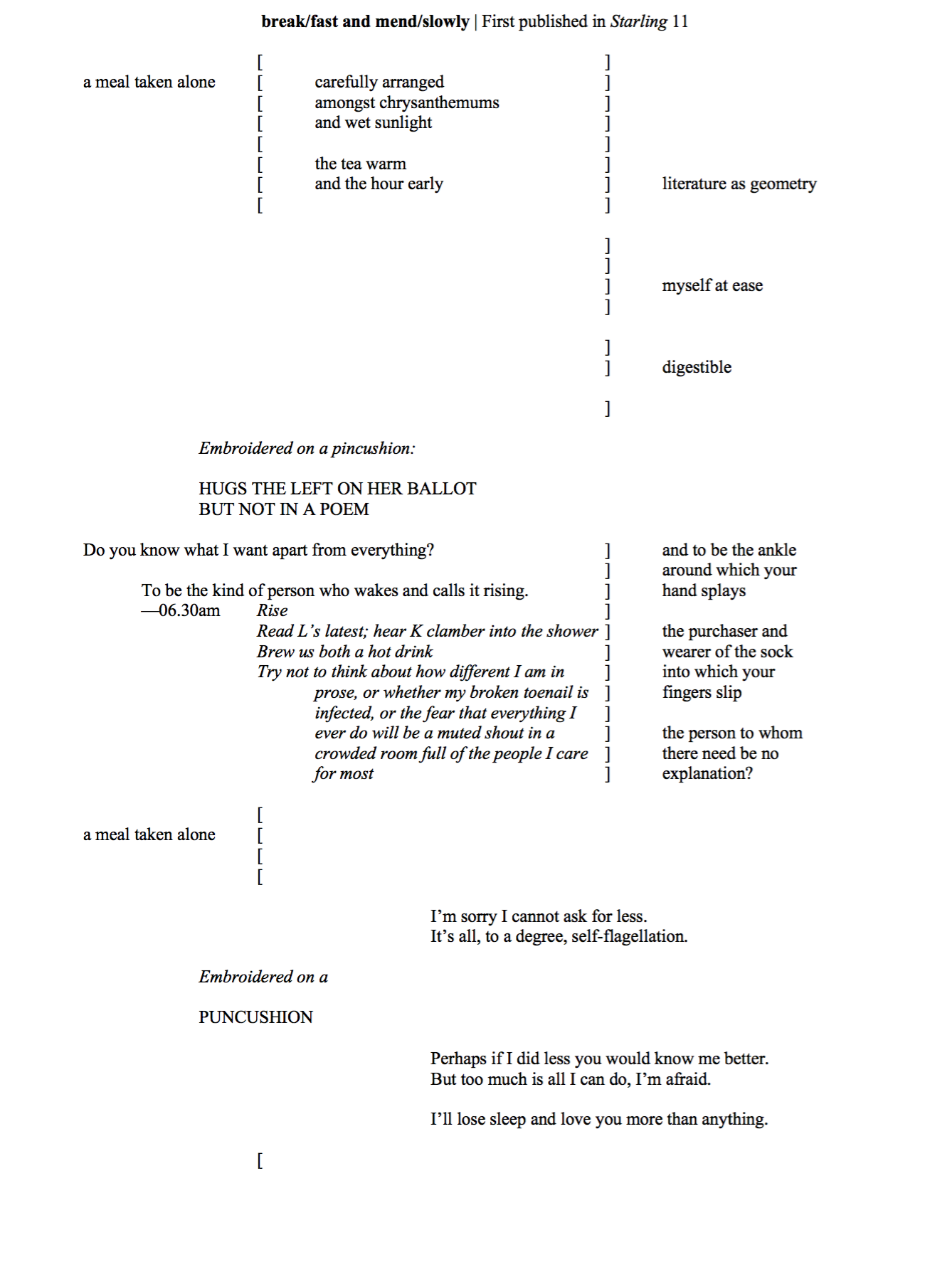
break/fast and mend/slowly


Tate Fountain

from Starling 11


Biologist abandoned

I lay in our bed all morning             

next to the half-glass of juice you brought me 

to sweeten your leaving

ochre sediments settled in the liquid

a thin dusty film formed on the meniscus

but eventually I drank it                 

siphoning pulp through my teeth 

like a baleen whale sifting krill from brine

for months after your departure I refused to look 

at the moon

where it loomed in the sky outside              

just some huge rude dinner plate you left unwashed

now ascendant                   

brilliant with bioluminescent mould

how dare you rhapsodize my loneliness into orbit

I laughed                 

enraged                       

to the thought of us   

halfway across the planet staring up

at some self-same moon & pining for each other

but now I long for a fixed point between us

because from here       

even the moon is different     

a broken bowl     

unlatched from its usual arc & butchered                

by grievous rainbows        

celestial ceramic irreparably splintered              

as though thrown there

and all you have left me with is          

this gift of white phosphorous

dissolving the body I knew you in    

beyond apology

to lunar dust     

Rebecca Hawkes

in New Poets 5, Auckland University Press, 2019, picked by Aimee-Jane Anderson-O’Connor

everything changing

I never meant to want you.

But somewhere

between

the laughter and the toast

the talking and the muffins

somewhere in our Tuesday mornings

together

I started falling for you.

Now I can’t go back

and I’m not sure if I want to.

Paula Harris

from woman, phenomenally

Breakfast in Shanghai

for a morning of coldest smog

A cup of black pǔ’ěr tea in my bedroom & two bāozi from the

lady at the bāozi shop who has red cheeks. I take off my gloves,

unpeel the square of thin paper from the bun’s round bottom.

I burn my fingers in the steam and breathe in.


for the morning after a downpour

Layers of silken tofu float in the shape of a lotus slowly

opening under swirls of soy sauce. Each mouthful of doufu

huā, literally tofu flower, slips down in one swallow. The

texture reminds me of last night’s rain: how it came down

fast and washed the city clean.


for homesickness

On the table, matching tiny blue ceramic pots of chilli oil,

vinegar and soy sauce. In front of me, the only thing that

warms: a plate of shuǐjiǎo filled with ginger, pork and cabbage.

I dip once in vinegar, twice in soy sauce and eat while the

woman rolls pieces of dough into small white moons that fit

inside her palm.


for a pink morning in late spring

I pierce skin with my knife and pull, splitting the fruit open.

I am addicted to the soft ripping sound of pink pomelo flesh

pulling away from its skin. I sit by the window and suck on the

rinds, then I cut into a fresh zongzi with scissors, opening the

lotus leaves to get at the sticky rice inside. Bright skins and leaves

sucked clean, my hands smelling tea-sweet. Something inside

me uncurling. A hunger that won’t go away.

NIna Mingya Powles

from Magnolia 木蘭, Seraph Press, 20020

Serie Barford was born in Aotearoa to a German-Samoan mother and a Palagi father. She was the recipient of a 2018 Pasifika Residency at the Michael King Writers’ Centre. Serie  promoted her collections Tapa Talk and Entangled Islands at the 2019 International Arsenal Book Festival in Kiev.  She collaborated with filmmaker Anna Marbrook to produce a short film, Te Ara Kanohi, for Going West 2021. Her latest poetry collection, Sleeping With Stones, will be launched during Matariki 2021.

Amy Brown is a writer and teacher from Hawkes Bay. She has taught Creative Writing at the University of Melbourne (where she gained her PhD), and Literature and Philosophy at the Mac.Robertson Girls’ High School. She has also published a series of four children’s novels, and three poetry collections. Her latest book, Neon Daze, a verse journal of early motherhood, was included in The Saturday Paper‘s Best Books of 2019. She is currently taking leave from teaching to write a novel.

Kate Camp’s most recent book is How to Be Happy Though Human: New and Selected Poems published by VUP in New Zealand, and House of Anansi Press in Canada.

Tate Fountain is a writer, performer, and academic based in Tāmaki Makaurau. She has recently been published in StuffStarling, and the Agenda, and her short fiction was highly commended in the Sunday Star-Times Short Story Competition (2020).

Paula Harris lives in Palmerston North, where she writes and sleeps in a lot, because that’s what depression makes you do. She won the 2018 Janet B. McCabe Poetry Prize and the 2017 Lilian Ida Smith Award. Her writing has been published in various journals, including The Sun, Hobart, Passages North, New Ohio Review and Aotearotica. She is extremely fond of dark chocolate, shoes and hoarding fabric. website: http://www.paulaharris.co.nz | Twitter: @paulaoffkilter | Instagram: @paulaharris_poet | Facebook: @paulaharrispoet

Rebecca Hawkes works, writes, and walks around in Wellington. This poem features some breakfast but mostly her wife (the moon), and was inspired by Alex Garland’s film adaptation of Jeff Vandermeer’s novel Annihilation.  You can find it, among others, in her chapbook-length collection Softcore coldsores in AUP New Poets 5. Rebecca is a co-editor for Sweet Mammalian  and a forthcoming collection of poetry on climate change, prances about with the Show Ponies, and otherwise maintains a vanity shrine at rebeccahawkesart.com

Anna Jackson lectures at Te Herenga Waka/Victoria University of Wellington, lives in Island Bay, edits AUP New Poets and has published seven collections of poetry, most recently Pasture and Flock: New and Selected Poems (AUP 2018).

Therese Lloyd is the author of two full-length poetry collections, Other Animals (VUP, 2013) and The Facts (VUP, 2018). In 2017 she completed a doctorate at Victoria University focusing on ekphrasis – poetry about or inspired by visual art. In 2018 she was the University of Waikato Writer in Residence and more recently she has been working (slowly) on an anthology of ekphrastic poetry in Aotearoa New Zealand, with funding by CNZ.

Maria McMillan is a poet who lives on the Kāpit Coast, originally from Ōtautahi, with mostly Scottish and English ancestors who settled in and around Ōtepoti and Murihiku. Her books are The Rope Walk (Seraph Press), Tree Space and The Ski Flier (both VUP) ‘Morning songtakes its title from Plath.

Nina Mingya Powles is a poet and zinemaker from Wellington, currently living in London. She is the author of Magnolia 木蘭, a finalist in the Ockham Book Awards, a food memoir, Tiny Moons: A Year of Eating in Shanghai, and several poetry chapbooks and zines. Her debut essay collection, Small Bodies of Water, will be published in September 2021.  

Helen Rickerby lives in a cliff-top tower in Aro Valley. She’s the author of four collections of poetry, most recently How to Live (Auckland University Press, 2019), which won the Mary and Peter Biggs Award for Poetry at the 2020 Ockham Book Awards. Since 2004 she has single-handedly run boutique publishing company Seraph Press, which mostly publishes poetry.

Poetry Shelf classic poem: Tate Fountain picks Emma Barnes’s ‘White Tuxedo’


White Tuxedo


I dream of you in a white tuxedo. It is a wedding. It is not our wedding.

But the face that you affix to yourself when you look into me is the face

of the man viewing the woman. Hello this is love. Your square jaw. Your

soft, capable, all knowing mouth. Hello even your bluest and greenest

eyes. Everyone is wearing white. I look down at myself and I am lace over

pearlescent white water wings and I am shaking with adrenaline. We walk

holding hands and you’re a helium balloon I tug to earth with my

unexpected weight. Your hands slip over me. You in a white fitted shirt

with your head thrown back. We lie in bed together wrapped tightly in disbelief.

Some of our best moments were sleeping. Some of our best

moments were only in our eyes. You tilt your head to turn to me and the

whole world follows behind you.


Emma Barnes


The poem was originally published in the journal, Sweet Mammalian 3


Note from Tate Fountain:

I rarely pass specific poems on to friends, despite the amount I read and my general penchant for sharing. ‘White Tuxedo’, however, was immediately dispatched to the other side of the globe: this is a very good poem, I told my best friend, the link attached in a Twitter DM. And it is, of course, precisely that. A very good poem. A bittersweet one, which accomplishes so much in something so seemingly simple.

‘White Tuxedo’ balances the delightful with the devastating, and both elements are augmented for the presence of the other. There is an ease to Barnes’ language, unadorned yet undoubtedly calculated, which lends both to fine poignancy—‘Your/ soft, capable, all knowing mouth’—and to forward propulsion—‘lace over/ pearlescent white water wings […]’. The fourth ‘sentence’, if you will—‘But the face that you affix to yourself when you look at me is the face/ of the man viewing the woman’—pierces. It verbalises a distinct discomfort, and the inescapable air of objectification, that I’ve so often found in ‘heterosexual’ experiences. (This is perhaps furthered by the wedding in the poem, and how pointedly it is not that of the narrator and the subject.) Of course, this line might just as well signal romance to someone else (‘Hello this is love’): perhaps an ode to the archetypes of affection by which they have seen themselves represented. This may be the loving look of literature, of cinema, of song—which is a valid interpretation, and a testament to the multitudes Barnes’ phrasing can contain (though it may also be the kind of feminine subjecthood that Barnes, in penning this particular poem, has explicitly reversed).

What I love most about ‘White Tuxedo’, though, is entrenched in each and every phrase: say it with me, gang—the intimacy of it all. This intimacy is a condition that I’m always looking for in poetry; in art, in life. The knowing of somebody, and an existence shared with them, that cannot be erased by the conclusion of it. The enormity of that understanding; making macro of the minute. Really, I have always had to share this poem just for its final statement, in which Barnes handles the depth of these ideas with sparing, rapturous clarity: ‘You tilt your head to turn to me and the/ whole world follows behind you.’ It’s delicious. It’s immediate, and it’s immense. It says everything it needs to. It’s very, very good.


Tate Fountain is an Auckland-based writer, actor, and academic, whose recent work can be found in Starling, Perception, Gold Hand and MIM. In 2018, she self-published the chapbook Letters, which found readers around the world, and she has just begun a literary newsletter, which she hopes might be read by five people.


Emma Barnes lives and writes Te Whanganui-ā-Tara. She’s working on an anthology of Takatāpui and LGBTQIA+ writing with co-conspirator Chris Tse. It’s to be published by AUP in 2021. In her spare time she lifts heavy things up and puts them back down again.


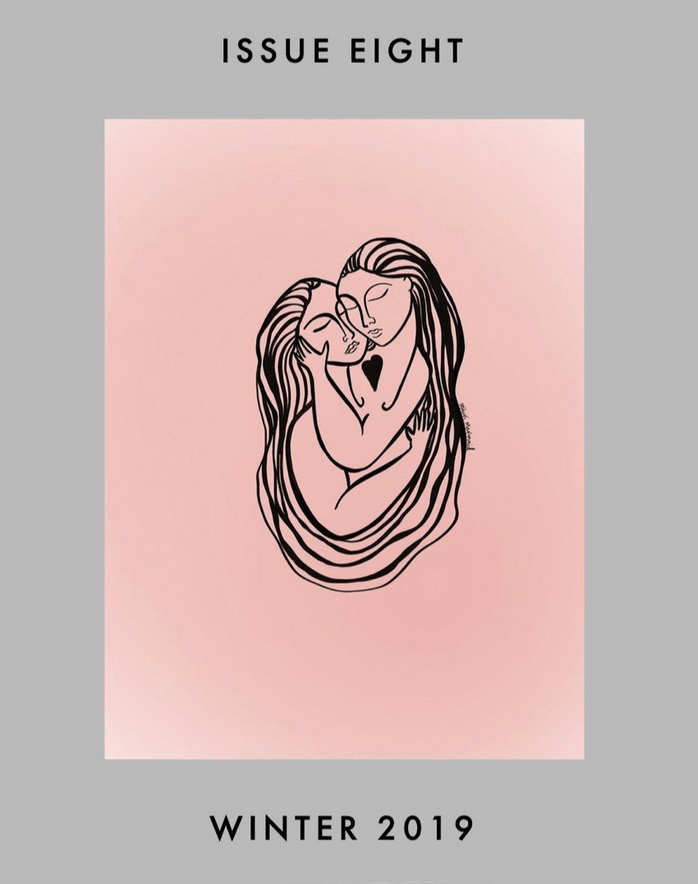
Poetry Shelf review: Starling 8 Winter 2019

Screen Shot 2019-07-23 at 9.10.16 AM.png


Read the journal here

I have poetry interviews on the go, poetry reviews on the go, a leaning tower of poetry books to read (this morning it toppled), questions for me to answer for my new books, a study that needs sorting after four years of intense work ( it needs to be like the clean sheet before I begin again), a house that needs spring cleaning, a veggie garden that needs weeding, fruit trees that need planting, novels that call to be read, doodles that need doodling ….. and after being awake for hours with the marine forecast and Jeffrey Paparoa Holman’s pilot memoir on RNZ National all I feel like doing is making a lemon honey and ginger drink and reading the brand new Starling.

Starling is edited by Starling founder Louise Wallace and Francis Cooke and publishes the work of writers under 25 which is a very good thing. Starling always exposes me to new voices that I am dead keen to read more from.

This issues includes the work of 20 writers, an eye-opening interview with Brannavan Gnanalingam and the extra cool cover art of Jessica Thompson Carr. It is women rich, there is fire and cut and lyricism. I loved every piece of writing – no dull grey spots. Just an inspired and inspiring celebration of what young writers are doing


Here are a few tastes to get you linking.

Tate Fountain is a writer, actor and student in Auckland. Her tour-de -force poem ‘Dolores’ busts up form, ‘you’,  expectation and what good is poetry. It gently kicks you in the gut with ‘ashes in the back of a car’ and shakes your heart with ‘maybe craft is love and love is attention’. The pronouns are adrift as the lines stutter and break;  F Scott Fitzgerald makes an appearance, and Kandinsky. Sheez this poem electrifies. I am now on the hunt for Tate’s Letters; she describes it ‘perhaps [..] blasphemously as an extended chapbook’.

Nithya Narayanan is currently doing a conjoint degree (BA / LLB) at the University of Auckland. Her poem ‘Hiroshima’ held me in one long gasp as the mother / daughter relationship links the title to the final ‘bomb’ stanza. This is confession at its most radioactive (excuse the pun) with a rhythm that pulls and detail that hooks.

Rose Peoples is a student at Victoria University. Her poetry has appeared in Mimicry and Cordite. Her extraordinary poem ‘The Politics of Body Heat’ begins with a woman pegging washing on a line, then moves through cold and sexism, female syndromes and disappearances. You just must read it.

Think –
Have they forgotten the fear
of a cold hand on the back of the neck?
The dread of an icy whisper?
Remember this –
It is easy to disappear in the cold.


Morgan McLaughlin is an English lit graduate and describes herself as a fierce feminist. It shows in her poem ‘1-4’, four prose-poem pieces that subvert numerical order as clearly as they lay down a challenge to patriarchy. The writing is lucid, sharp as a blade and deliciously rhythmic.  I would love to hear this read aloud. I want to read more.

Meg Doughty recently completed an Honours degree in English at Victoria University of Wellington. She says she is a reactionary writer who is fascinated by the everyday mystic. Her poem is like two heavenly long inhalations that pick up all manner of things, herbs, birds, cats, fire, and I am caught up in the idea of poetry as breath (again, see today’s Herald!!). Then I reach the end of the poem and here is the poet breathing:

I stir
hover over the steam
and breathe in
I know how to live in this world


Mel Ansell is a Wellington poet whose brocade-like poem ‘Cook, Little Pot, Cook’ (I have used this term before) shimmers and sparks with surprise arrivals as I read. Ah poetry bliss where food and love and place and home rub close together.
Rebecca Hawkes is in the recently published AUP New Poets 5 with Sophie van Waardenberg and Carolyn DeCarlo. She has a cluster of poems here that show her dazzling word play, the way images and detail build so you are swimming through the poetic layers with a sense of exhilaration (it was like that when I heard her read at the launch). Her poetry is so on my radar at the moment.

I want to read more from Danica Soich.

Joy Tong is a Year 13 student at St Cuthbert’s College. ‘Tiny Love Poem‘ is pitch perfect.

Hebe Kearney is from Christchurch but is currently studying to complete her Honours in Classics at the University of Auckland. Her poem ‘Bukit Ibam, 1968’ is so divinely spare but opens up inside me, like an origami flower that unfolds family:

a story in a cage. dad,
you recount my grandmother
through the mosquito netting baking
tiny raised cakes.


Thanks Louise and Francis. This is a terrific issue. Now I need to head back to my long list of jobs to do before I head back down to Wellington for National Poetry Day.