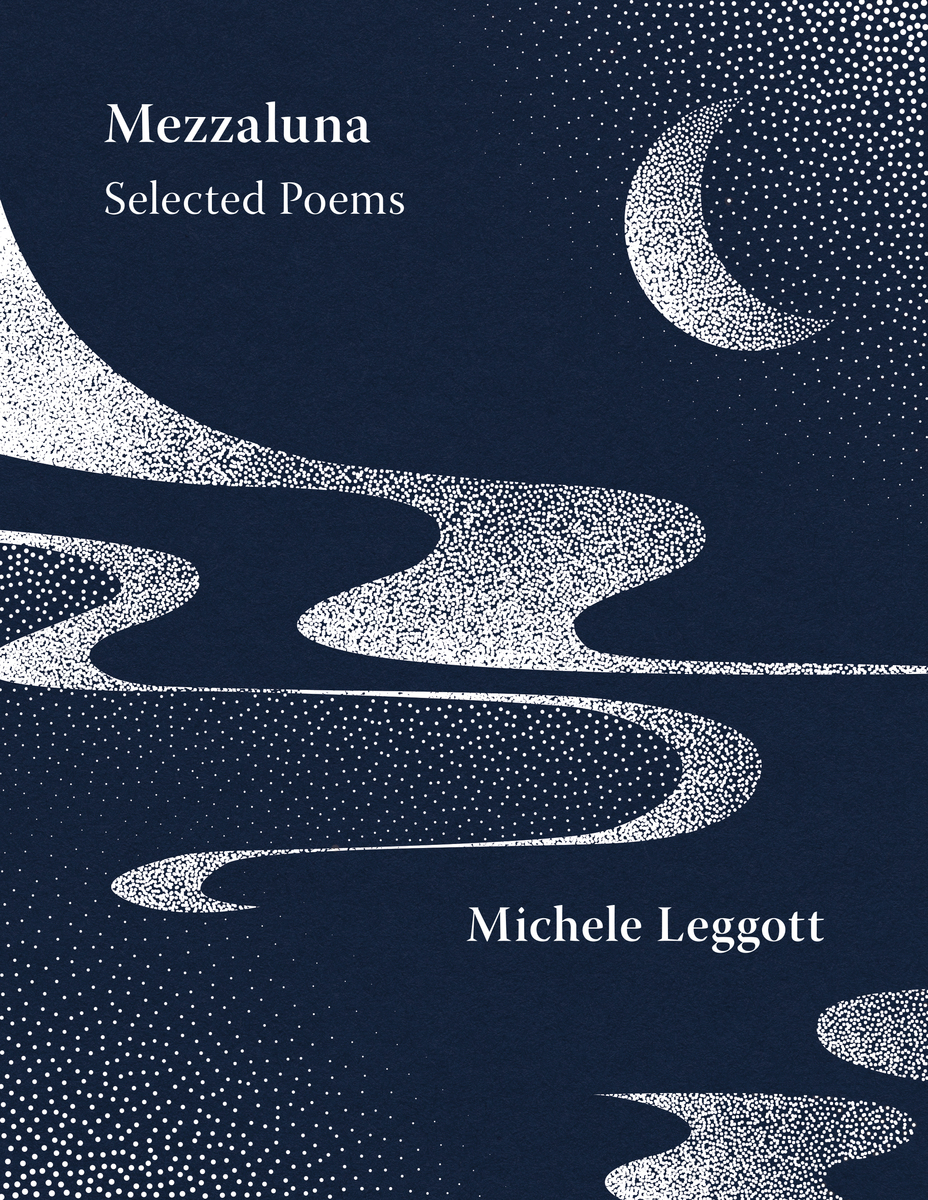
Mezzaluna: Selected Poems Michele leggott, Auckland University Press, 2020
people still go to cottages in moody seaside weather
to read for a week how will we do it now?
when I go for walks words stalk along too
I’ll be travelling mid-February and can’t guarantee a lucid mind
what about a big table in a room with windows
looking over the wild and wavy event?
from ‘Colloquy’ Swimmers and Dancers
Michele Leggott is continuing to make extraordinary contributions to poetry in Aotearoa. I rank her with Bill Manhire: two poets who have not only published astonishing poetry, but who have also been significant mentors and teachers in university programmes and introduced poetry initiatives, and edited vital anthologies. We are in debt to Bill for his vision for the IIML and offshoot projects, and the Poet Laureateship (now administered by The National Library but established with the efforts of Bill and Te Mata Estate). Michele was the first Poet Laureate under the National Library administration. She established the NZ Electronic Poetry Centre, set up the Lounge readings in Auckland, and has organised various gatherings of poets, including symposiums in Bluff, Christchurch and Auckland. Not forgetting her diverse contributions as Professor of English at the University of Auckland.
More than anything, we are in Michele’s debt for the light she has placed upon women poets from the past, especially Robin Hyde and Lola Ridge.
words come so slowly
it has been lonely
a phoenix palm
and behind it
crystalline glitter
another story, waving
plaintain paradisiaca a bird
musey with waves
Helicon a harbour cone
here
bright
Greek
over Narrowneck
from ‘Withywind’ from Like This? (1998)
I have been reading Michele’s poetry since her debut collection, Like This? (1988) and have followed the thematic and lyrical contours ever since. The first word that springs to mind is heart. Michele has written within the academy, with her prodigious intellect flaring, but she is a heart poet beholden to neither theoretical trend nor poetic fad. Her poetry has always linked hands with the writing of other women, and over time has become increasingly personal and more accessible for readers.
Michele’s Mezzaluna: Selected Poems appeared mid March, just before we moved into lockdown. Its visibility suffered as our reading, writing, publishing and reviewing lives moved into upheaval. There is an excellent interview with Lynn Freeman on Standing Room Only and a short conversation with Paula Morris as part of The Auckland Writer’s Festival online series. The highlight of the latter is hearing Michele read an extract from her poem ‘The Fascicles’ from Vanishing Points (2017) (she is the last writer in the zoom session).
Fine ground darkness pours into the vessel
beans and flowers adorn the fall—
ichor! ichor! drink to the eyes locked on yours
the mouth that smiles and will speak for itself
I have always done the talking and she
put the words in my mouth saying do melisma
like sunlight be melisma like no sunlight pressed
redness before dark print an iris on her
from ‘Blue Irises’ in DIA (1994)
Difficulty has never been an issue for me as a reader of poetry – I love venturing into poetry thickets where meaning might appear in whiffs, and where enigma, evasion and multiplicity are active ingredients. Michele’s mid-career poetry collections, perhaps from DIA through to Mirabile Dictu, delivered various shades of difficulty and I loved them for that. Her lexicon has drawn upon the arcane, the archaic, slang, borrowed words, foreign languages. There were highways and byways to other poems, a history of research and reading. Intimacy was as likely as distance. And even though her poetry has become increasingly personal, self confessional in parts, it has always been so. Family appears, sons, food, beloved places, a shaping of home along with a profound engagement with other writing, other stories, myths, conversations.
The poems underline the way poetry threads ideas, memory, motifs, experience, opinion, reading history. The how of writing is as crucial as the what of writing.
imagine the world goes dark
a bowl of granite or a stone bird
incised by tools the nature of which
is unknown just that they are metal
and therefore from otherwhere
just that the weight of the bowl
precludes light and lightness
of thought my feet take a path
I can no longer see my eyes
won’t bring me the bird only now
has my hand found the stones
I could add to the smooth interior
of my despair the world goes dark
I look into the eyes of my stone bird
hammers before memory
silence and the world that is not
from ‘mirabile dictu’ in Mirabile Dictu
Along Mezzaluna’s reading tracks you will find honeysuckle, daffodils, roses, melons, breath, the wind, stars, here, there, light, dark, heart. Always heart. Always the interplay between light and dark. Michele has dedicated Mezzaluna to those who travel light and lift darkness’. Yes reading is a fertile way of travelling, life equally so; light and dark stick to us like biddybids, but our relations with and navigation of both are unique. What do we carry with us? What do we keep placing in our personal baggage? What do we do with the dark? For Michele, with her slow movement into blindness decades back, and all the challenges that have affected every aspect of her life, blindness has understandably also seeped into her writing. She has always been attuned to the sound of words, the mobility of language, words as sound dance in the ear, in harmony and discord. But the possibilities of sound, under Michele’s deft guidance, have become a glorious anchor for everything that has mattered and will matter.
The lush terrain of the visual is also a sumptuous part of Michele’s poetry. The recurring motifs I have already mentioned range from piquant to honeyed, visual bouquets in their own physicality but players in so much more. Participants in ideas, the mythological references, the recuperation of memory, family history, personal challenges.
It is equally rewarding to listen for the other women, particularly the poets who have captured Michele’s attention and diligent rescue work: I am thinking of the way Robin Hyde, Eileen Duggan and Ursula Bethell have become a visible part of the network. More recently Lola Ridge. Michele’s latest project is Emily Harris, a New Plymouth poet who died in 1925 and whose work has been located in Sappho-like traces. Michele response to the missing poet is to recreate versions in Vanishing Traces.
I have heard Michele perform poems from most of her collections and it has always affected me deeply. To listen to poems from As Far As I Can See – the poems that expose her move into blindness – these have been audience-affecting occasions. I have sat in a line of poetry fans and we have been utterly still, barely able to take breath at the daring exposure, the heartbreaking experience, the exquisite and utterly memorable poetry.
Ah, no matter what I write, no matter what I signal, I feel like I am shortchanging this rich and elegantly constructed volume. Michele told Paula Morris she had originally sent in a longer version but had cut it back and, in doing so, focused on the DNA of each book, on what was important. As she read and replayed, she carried a key question across the books: ‘What does a poem look like?’
This is such a good question to carry with you as you read – yes Michele’s poems do change, the lines shorten, the lexicon is more familiar, but there is common ground. Perhaps it comes down to a love of a sound, and how that love of sound is amplified when you can’t see the physical world. It is a rejuvenating, heart-engaging, thought-provoking read and it feels like this Michele’s poetry deserves a whole book of response. Michele Leggott warrants a whole book that navigates what her poetry does: its connections, its liberations, its epiphanies, its testings.
Mezzaluna showcases the work of one of our most inquisitive and sensual poets who ventures into the unknown, into an inhabited world, with an open heart and free-flowing mind. Glorious.
Auckland University Press author page

 NZ Poetry Shelf