Tag Archives: Poetry Shelf review

Poetry Shelf review: 28 days by Janet Charman and Elizabeth Anderson

28 days, Janet Charman and Elizabeth Anderson
Skinship Press, 2025

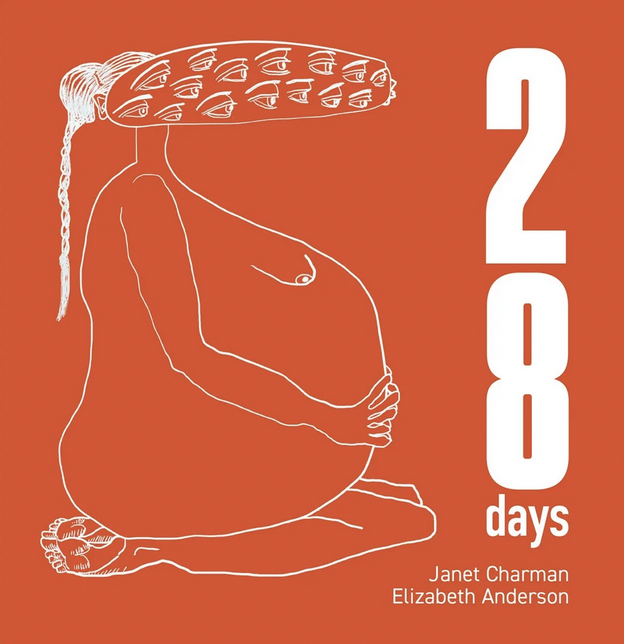
I am sitting at the kitchen table, the doors wide open, feeling the wind rustling in from the Waitākere ranges, the bird song racketing after all that rain, my flat white growing cold, and I slowly reflect upon 28 days. The book fits in the palm of my hand but expands in prismatic ways in both heart and mind. I have never experienced anything like it. It is pitched as a creative memoir. Elizabeth Anderson has produced 28 artworks, Janet Charman 28 texts. The artwork focuses on cafe scenes, drawing upon multi media, echoing Japanese ukiyo-e woodblock prints and Henri de Toulouse-Lautrec’s Parisian café paintings. The little texts – dialogue or poems or anecdotes – are like word kisses on the page.

The memoir is a collaboration, a contiguous relationship between word and image, between artist and writer, and this brushing close, this besidedness as the blurb says, is utterly fertile, utterly heart expansive in its reach. I am stretching for words, and they slip away. So I sit here on the rim of weeping, weeping at the way I’m brought cheek to cheek with the sharp edges of humanity. The shadows. My shadows. The unspoken. My unspoken. There in the cafe settings. There where dark brushes against light, where isolation and loneliness are rife. There where stories are shared, and equally stories are held back. Darkness and light.

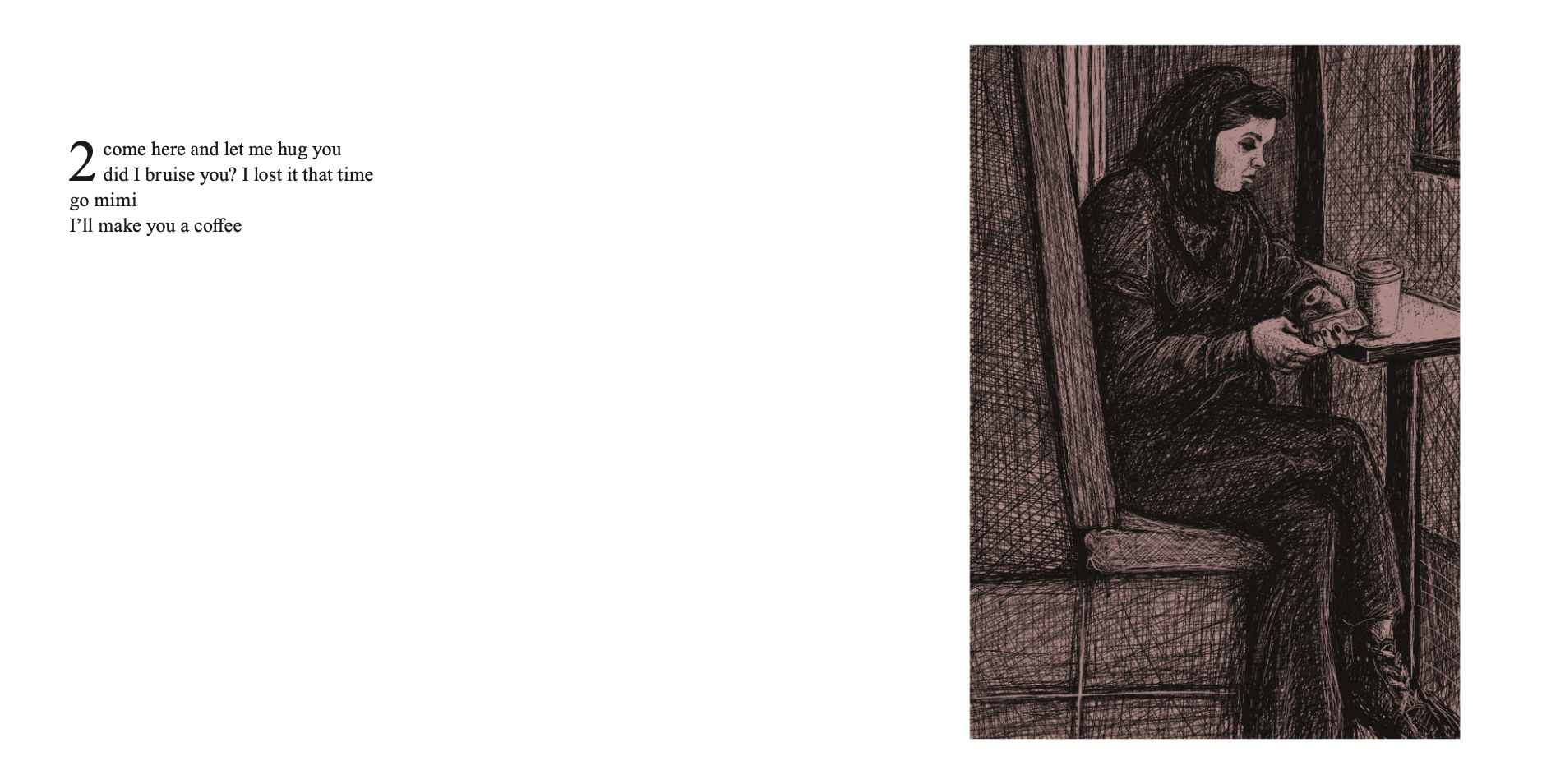
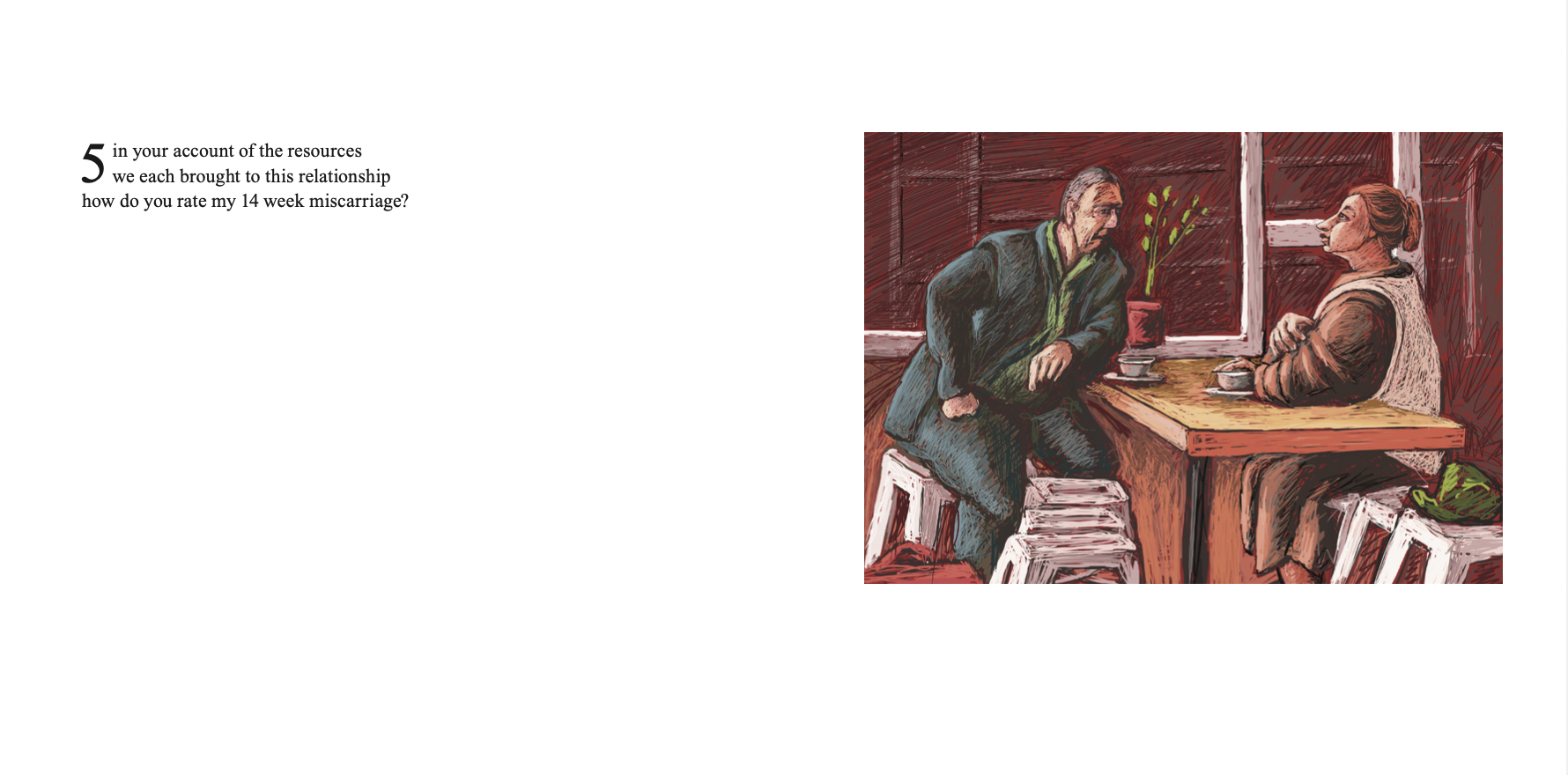
Probably against the grain of reading a sequence of images and text, I look at Elizabeth’s images first. She produces all the drawings on her iPad using the Procreate drawing app, recording her observations in cafes or buses. I am absorbing the people frozen in a cafe moment, those on phones, those alone, those in groups, those with son or daughter, and each scene amplifies an intensity of mood. I can’t think when I have last felt portraits to such a degree. I feel the gaze of the eyes, the expression on the face. I feel the unspoken, and more than anything, the way we become a catalogue of memory, experience, pain, aroha, longing, recognitions.

In these tough times that can be so overwhelming, this book, I am feeling to its raw mood edges.

Now I return to the beginning and read Janet’s texts, these little patches of dialogue or poetry or anecdote, and again I am shaken to my core. It’s dark and light, its jarring and surprising. It’s gender relations and damage and patriarchy and femen and abuse and dressing wounds and how do we become and how do we be. Interior monologues, intimate revelations. Again I am feeling this book, feeling poetry to a skin tingling degree.

I am reading through the book for a third time, text alongside image, image alongside text, and the besidedness is extraordinary. It takes me deep into grief, into how we live, how vital our stories and conversations are, how connectedness matters, how listening to the person beside us matters. How important it is to nourish our children and ourselves in multiple self-care ways. And my words are a knot. How to re-view? How to speak? How to write?

Janet and Elizabeth’s collaboration began during the Canal Road Arboretum protest in Avondale, where the two artists first met. The book is in some ways a form of protest, in another ways a memory theatre, an intimate album. I haven’t felt a book this deep in a long time. This book is a gift. And I have ordered a copy to gift to a friend. Thank you.

Janet Charman is an award-winning poet, recipient of the Best Book of Poetry at the 2008 Montana New Zealand Book Awards. Her 2022 collection The Pistils was longlisted at the 2023 NZ Book Awards, and her 11th collection The Intimacy Bus was released in 2025.

Elizabeth Anderson is an artist and educator with an MFA from Elam. She has worked across design and television in Aotearoa and the UK, and now focuses on observational drawing and community-based creative work.

Skinship Press page

Poetry Shelf review: No Good by Sophie van Waardenberg

No Good, Sophie van Waardenberg
Auckland University Press, 2025

What initially hooks us into a poem? For me, there is no singular response. Indeed if there were, it might limit what poetry can be and do. When I first started reading Sophie van Waardenberg’s new collection, No Good, I jotted down two words in my notebook: rhythm and voice. I was hooked. I was drawn into the musical cadence of a speaker speaking, drawn into the under and over currents of spiky, thistle, bloom. And as I read the collection, on a number of occasions over the past few months, crucial questions arrived. I was especially musing on the way a poem might become both self and other.

The title is the perfect welcome mat into the collection, particularly coupled with the cover illustration, where ‘good’ wavers, and I gaze at the beetle on the apple that is both good and not good. Pausing on the welcome mat, a cascade of (centuries) of good girl propaganda spins in my mind, and I am peering into the no good to see the next apple in the bowl, a portal of good in the pillowcase of no good.

And then, there on the first page, the ‘Poem in Which I am Good’, and the welcome mat widens, and still I am musing on the good girl, the no good girl, and the lyrical voice is blisteringly affecting.

Everything will be good, and the trousers I left
to blow in the wind and the rain and lemon leaves,

them too. The linen will keep its soft thatching.

Who is she? How is she? The speaking voice gently draws me into both flawed and happy, and as much as I am on the edge of weeping, I hold tight to the coat-tails of joy. These words. These lines. These poems. I read : ‘A girl is born out of comparison.’ Read the glorious poem, ‘Sticky’, and feel the possibility of girl stretch oh so wide, even in the complicated history of her making, whether personal, or across centuries, or as negotiable and contested ideas.

A girl is filth and bright. A girl is born
out of comparison. A girl can sing or can’t.
A girl is held inside a duck’s bill, weighed
against a slice of bread for softness.
What flour is a girl made of? Wheat or corn?
How can a girl get clean again?

The middle section of the book, ‘Cremation sonnets’ resembles a grief casket, where the poems lead in multiple directions, carrying us between presence and absence, letting go, and unable to let go. This lost love. This elegiac memory.

The final sequence of poems, so utterly moving, are written with the ink of love. The poems are addressed to ‘you’, written across a distance between here and there, between hunger and satisfaction, dream and reality, turning away and moving close. This is love. This loved and loving woman. This is ache and this is a yearning to love and be loved. Such gentleness, such a slow perfect unfolding of what is special, with only so much revealed and gently placed in the pockets of the poems. And if this is a love that is over, such deep sadness, it seems to me, that love finds a way to linger in residues, traces, scents.

The word I write in my notebook in my latest reading is bridge, the way poems become a bridge, establish vital bridges. Think sweet and sour crossings, fluid and awkward, here and there, good and not good. Not as a restrictive dichotomy but as a series of movements, like music, like the way personal experience resists pigeon holes. Traversing the myriad bridges in Sophie’s sublime collection makes me both think and feel the world. Yes I am thinking and feeling a version of her world, but also a version of my world. And this moves me.

Rhythm, voice, bridges. I hold this book out to you so you may find your own self-affecting crossings.

A stagger of lemons and a goneness
I can’t swallow. Hello the same feeling,

didn’t I wash you off,
you get everywhere, sog up my arms

and droop me. It’s something alien
in my gut that knows you so well.

I say it again: I am not a creature of sorrow.
But I could be proper sad if I put my mind to it,

if someone dropped me from a height.

from ‘The Getting Away’


Sophie van Waardenberg is a writer from Tāmaki Makaurau. She holds an MFA from Syracuse University where she was editor-in-chief of Salt Hill Journal. Her first chapbook, ‘does a potato have a heart?’, was published in AUP New Poets 5 (2019). Her poems about eating carbohydrates and kissing girls can be found in Cordite, Sweet Mammalian, The Spinoff and Best New Zealand Poems.

Listen to Sophie read two poems on Poetry Shelf: ‘Self-Portrait as Adolescent Covered in Flour’, ‘Hymn to the Insomniac in Fool’s Spring’

Auckland University Press page

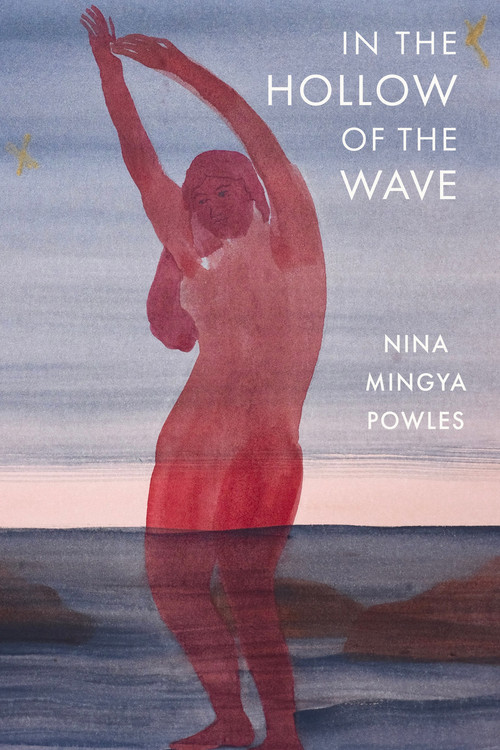
Poetry Shelf review: In the Hollow of the Wave by Nina Mingya Powles

In the Hollow of the Wave, Nina Mingya Powles
Auckland University Press, 2025
first published, Nine Arches Press, UK, 2025

handiwork


People asked me where I learned
and I said I taught myself the slow work of making.

But memory is a house with scraped white walls.
I step inside and choose what to take, what to leave behind.

My hands feel their way through
the gathering, the careful pulling apart.

The work of particular poets can strike you so deeply, so resonantly. Poets who produce collections that satisfy your hunger to read so keenly, with books that take up residency in both your mental and physical poetry rooms. Nina Mingya Powles has been that kind of poet for me, from her terrific debut collection Magnolia 木蘭, through her various other published offerings. Her new collection, In the Hollow of the Wave, is one of the most gorgeous poetry books I have held this year – a sweet combination of heavenly paper stock, generous size, lovingly-tended internal design and vital breathing room. Nina has also created textile works that add to the visual beauty and allure of the book.

Textile is a key word. I experience the book as multiple loomwork: a weaving of memory, experience, language, cottons and fabric. Weaving as a way of observing the world, feeling the world, observing the object, feeling the object, observing the past, feeling the past. It might be the sewing machine upon which her grandfather stitched quilts from garments belonging to her siblings, mother and grandmother. It might be a gown, a pleat, or a sheet of white paper or fabric.

And now, with In the Hollow of the Wave, the granddaughter is herself stitching quilts; inside the stitched poem the stitched cloth, and inside the stitched cloth the stitched poem. I experience contemplation pockets tucked with memory pleats, and inside memory pleats, I threads of slow contemplation: andante, largo, adagio.

The book title is borrowed from a line in Virginia Woolf’s To the Lighthouse. It gains its own life as Nina ponders Virginia’s use of orientalism and Kitsushika Hokusai’s woodblock print, ‘The Great Wave off Kanagawa’. The poem haunts, the hollow in the wave haunts, the recurrent pulse of existence and non-existence haunt. The poem is skin-prickling reading:

beyond the frame I saw a distant city / a place I used to know / where rain
falls in the foreground / all day and all night / I took out my sketchbook /
sharpened my pencil / drew a line across the sea / asked the mountain /
what does it mean to see and be unseen / it did not answer

So many echoes across the collection. So many threads to follow and pause on(slip stitch, ladder stitch, cross stitch). There is the scent of plants and plantings, herbal remedies, the reminder of the women in poverty who stitched the garments we wear, the reflection of self in a stirred pan on the stove, the way dreaming seeps into making, the way the language, chores, hopes and the lives of women still matter. The way poetry can be a way of asking questions.

Inside the hollow of a wave is a poem. And inside that poem is a book. A book such as this one. Stitched with aroha and luminous threads. I want you to read it for yourself and get absorbed in its beauty and craft. It has already found spots in my poetry rooms.

Nina Mingya Powles is a poet and writer from Aotearoa New Zealand, currently based in London. Her debut poetry collection, Magnolia 木蘭, was published in New Zealand, the UK and the US, and was a finalist in the Felix Dennis Prize for Best First Collection and the Ockham New Zealand Book Awards. Powles won the inaugural Women Poets’ Prize in 2018 and the inaugural Nan Shepherd Prize for under-represented nature writers in 2019. Her resulting book of essays Small Bodies of Water was published in 2021 by Canongate. She has also published a short food memoir, Tiny Moons: A Year of Eating in Shanghai (The Emma Press, 2020).]

Auckland University Press page

Poetry Shelf Occasional Poems: Dinah Hawken’s Speaking of Trees

Speaking of Trees

What does it take to break ground?
What does it take to carry yourself
with dignity through mist and rise?

You can see the fragility of trees
and the forbearance of trees.
You can see the agility of trees.

You know where you stand with a tree:
sheltered and strengthened,
beholden to the nature and network

of trees; the assembly of trees,
the farmland haunted by trees  
and the regiment of trees.

You can see the bearing of trees,
the felling and falling of trees,
the shipment of trees, the return on trees.

The return of trees.

What does it take to carry yourself into a forest
one valley over
from the one, right now, on fire?


Dinah Hawken

Dinah Hawken’s ninth collection of poems, Sea-light, was published by THWUP in 2021. ‘Speaking of Trees’ was written for Gerda Leenard’s exhibition of paintings at Pataka in Porirua : Regeneration – A Story of Trees

Poetry Shelf review: Frankie McMillan’s The Wandering Nature of Us Girls

The Wandering Nature of Us Girls, Frankie McMillan, Canterbury University Press, 2022

The feel of a book in hand matters. Holding Frankie McMillan’s new collection, The Wandering Nature of Us Girls, is immensely satisfying. The size and shape, the paper stock, the pale blue title pages, the choice of font and font size, the breathing space. A perfect alchemy of design and production.

The dedication page: “For Marvin, / who taught me how to wander. / Without you, I would never have gotten lost.” This is the keyhole entry into a book where wandering becomes wondering; we get lost in wonder and wander, whether reader or writer. The collection of small stories performs bridges between both, in so many delicious ways. Even me naming the pieces is a mental excursion through form and label; how we tag what we write from poetry to prose to essay to fiction to short story, and any number of hybrid marriages.

The book is offered as small stories so I am running with that. Think mouthfuls of narrative or let’s say fiction. Think past and present. Think stepping stones from the miniature to wider issues, issues hungry for human attention: love, death, loss, violence, curiosity. Think anchors in the real, and offshoots in the hyperreal, sidelines in the surreal.

Water is the connective tissue, and if you think of the ever-changing appearance and movement of water, it is extremely apt. Frankie often crafts long sentences, sentences an Italian novelist might favour, sentences that showcase the currency of water. Extended tidal rhythms, the water breathing in and out. It makes me think again of wander, and the flâneur comes to mind, the bricoleuer, with both reader and writer meandering, amassing detail, absorbing atmosphere.

Water is the connective tissue and like the ocean it is a meeting ground of dark and light. The grandmother goes swimming, others go swimming, but there are drownings, there are bodies missing at sea. This is a collection of mystery, of gaps in the narrative, of surprising turn of events, of tragedy. Most definitely tragedy, terrible twists in events. The aunt who loves sweeping stays home in the flood, sweeping out the water, until the point she is on the roof, still sweeping, still sweeping, until she and broom and house are swept away.

There is such power in Frankie’s imagination. A beaked mouth, an antlered head. A baby under a tree writing a thesis on “aerial domesticity”. There are the acrobatics of circuses, of putting on a show. There are the subcurrents of our planet under grave threat. The tragedy we must face. Along with violence against women, ‘us girls’, and suddenly, slowly, the meandering takes on a greater insistent force. We are wandering and wondering, and there are consequences, cause and effect.

The mood and ideas a book generates matters. The Wandering Nature of Us Girls is less concerned with geography than with movement, with action, with human connections. It is a handbook of curious and gut smacking things. It is a book you feel as well as a book you think. It is a book of catastrophe and a book of epiphany. Small story brilliance.

Frankie McMillan is the author of five books of poetry and short fiction. Her most recent collection, The Father of Octopus Wrestling, was listed by The Spinoff as one of the 10 best New Zealand fiction books of 2019 and shortlisted for the NZSA Heritage Book Awards, and her 2016 collection, My Mother and the Hungarians, was longlisted for the Ockham New Zealand Book Awards. She has twice won the New Zealand Flash Fiction Day competition and has been the recipient of numerous awards and residencies, including the NZSA Peter and Dianne Beatson Fellowship (2019), the Michael King writing residency at the University of Auckland (2017), and the Ursula Bethell residency in creative writing at the University of Canterbury (2014). McMillan spends her time between Ōtautahi Christchurch and Mohua Golden Bay.

Canterbury University Press page

Girls Raised by Swans on Poetry Shelf (‘Accounts of Girls Raised by Swans’)

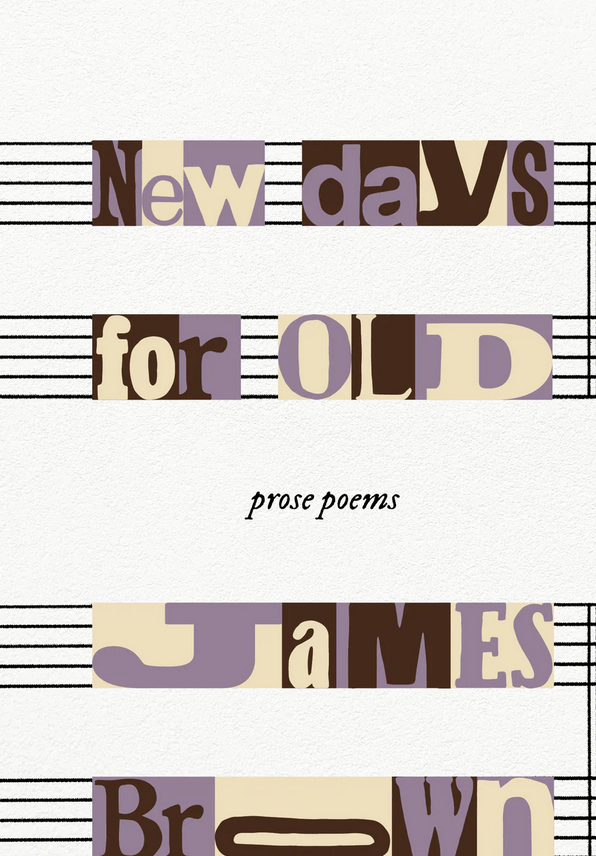
Poetry Shelf Occasional Reviews: James Brown’s The Tip Shop

The Tip Shop, James Brown, Te Herenga Waka University Press, 2022

Alex Grace writes on the back of The Tip Shop: “Funny, dark, insightful and nothing close to a chore to read. Poetry, but it doesn’t suck.” Ha! Some poetry must suck, even be a chore to read, like a school assignment! James Brown’s poetry is cool – ok a lazy-tag adjective children are often forbidden to use as what does it actually mean? It means James’s poetry is hip, electric, agile on its poem toes, lithe on its heart beat, and is immensely readable.

The opening poem, ‘A Calm Day with Undulations’, places visual waves on the page and sets you up for all manner of undulations as you read the collection: wit, heart, life. In the poem, James uses an ocean metaphor to write about cycling which is a way of writing about living. Think surf / swell / naval surface / roll up and down / wave length / lull / pool.

It’s a calm day with undulations.
My tyres flow freely
across the naval surface.

The Tip Shop appraises and pays attention to scenes, moments, events, potential memory, language. The detail ranges from measured to madcap. Questions percolate. Poetry rules are invented. Words are played with. Dialogue is found. Poems stretch and poems repeat. Herein lies the pleasure of poetry in general, and a James Brown collection in particular: there is no single restrictive model when it comes to writing a poem. Within the collection as a whole, and within the frame of an individual poem, James resists stasis.

A poem that epitomises intricate delights is ‘Schrödinger’s Wife’. It delivers a miniature story laced with wit and puzzle. Here is the first stanza:

Mary didn’t walk with us Sundays. She ran.
With earbuds, she could keep reading. Her shop,
Schrödinger’s Books, was a tough mistress.
‘Are you working today?’ we’d ask. ‘Yes and no,’
she’d reply. She just needed to ‘finish the books’.
Can the books ever be finished? They wink at us
as though there are uncertain things
they think we ought to know.

I am drawn to repetition, to a concatenation of detail, especially in list poems, overtly so or nuanced. Three examples in The Tip Shop, establish A to Z lists. Another poem juxtaposes ‘I must not’ and ‘I must’. A found poem, like a form of canine play, lists dog owner dialogue. And then the delight in repetition dissolves, and time concentrates on the washing and peeling of fruit. In ‘Lesson’, a single elongated moment becomes luminous when caught in the poem’s frame. We are implicated, and are returned to an (our) apple: “When was the last time you / washed a green apple”.

Three longer poems stretch into telling a yarn, spinning a story, as the repeated indents mark the intake of a storyteller’s breath. Glorious.

‘Waiheke’ pares back to an ocean moment, and I am imagining the scene imbued with love. So much going on beneath, on and above the surface of the poem, whether in the breaststroking, in the prolonged looking.

You yearn so much
you could be a yacht.
Your mind has already
set sail. It takes a few days
to arrive

at island pace,
but soon you are barefoot
on the sand,
the slim waves testing
your feet

The Tip Shop is piquant in its fleet of arrivals and departures. It is poetry as one-hundred-percent pleasure – it makes you laugh and it makes you feel. It encourages sidetracks and lets you rollercoast on language. What a poetry treat.

James Brown’s poems have been widely published in New Zealand and overseas. His Selected Poems were published in 2020. Previous books include The Year of the Bicycle (2006), which was a finalist in the Montana New Zealand Book Awards 2007, and Go Round Power Please (1996), which won the Best First Book Award for Poetry. His poems are widely anthologised and frequently appear in the annual online anthology Best New Zealand Poems. James has been the recipient of several writing fellowships and residencies, including the 1994 Louis Johnson New Writers Bursary, a share of the 2000 Buddle Findlay Sargeson Fellowship, the Canterbury University Writer in Residence, the Victoria University of Wellington Writer in Residence. James works as an editor and teaches the Poetry Workshop at the International Institute of Modern Letters at Victoria University of Wellington. 

Te Herenga Waka University Press page

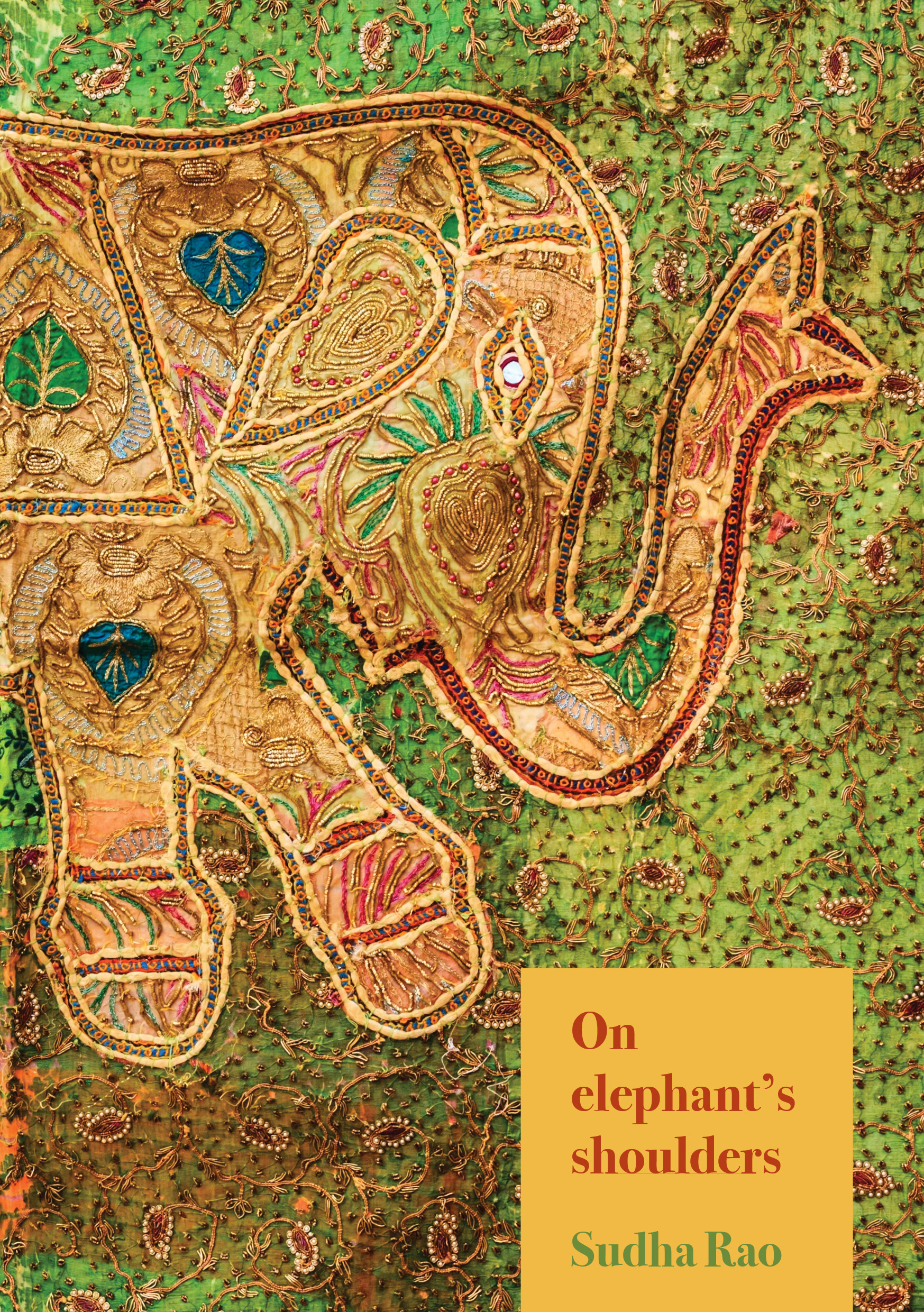
Poetry Shelf Occasional Reviews: Sudha Rao’s On elephant’s shoulders

On elephant’s shoulders, Sudha Rao, The Cuba Press, 2022

Poetry books are so often objects to treasure, physical treats to hold.

Sudha Rao’s On elephant’s shoulders is exactly this, with its exquisite, embroidered cover image (sorry no acknowledgement of source or creator). The interior design is equally appealing; a perfectly sized font with ample space for the poems to breathe and readers to sojourn. The title also captivates, and I especially love the fact there is neither definite nor indefinite article to support ‘elephant’. I am pirouetting on the title, imagining elephant as both anchor and viewing platform. Falling into the title, over and over. I am both grounded and liberated.

The opening poem, ‘Warp and weft’, establishes the collection as a book of arrivals and departures. It sets the scene for recurrent motifs, ideas, words, images – and I love that. The poem is divided into three parts: passages, shadows and braids. The three terms are an excellent guide to the book as a whole. I am particularly captivated by the recurring ‘braids: there are plaits, the father’s hands, the grandmother’s hair, the South Island rivers, a way of writing, a way of living between here and there, this home and that home.

“I am a bracelet of memories bearing the weight of your bones.”

from ‘Threads across waters’

The poetry, in keeping with braid notions, exudes both economy and perfumed richness, an evocative serving of detail. The detail enhances a scene, a series of relationships, poetry as musical score. The detail may be repeated, as in echoey ‘braid’, you might move from the scent of turmeric to a ‘sunflower flowering’.

What renders the collection poignant, especially in its poetic tracing of a migrant’s experience, is the presence/absence braid, whether we are talking geography, kin, food, gestures, memories. Everything feeds into a braided version of home that is near and far, intimate and longed for.

[…] When you crossed

old waters, did you know

how cold new waters would be?

from ‘Cradle’

I talked about stitching when I recently reviewed Elizabeth Morton’s terrific collection Naming the Beasts, and stitching seems appropriate here, especially bearing in mind the sublime cover. Stitching is a way of talking about poetic craft, about the little threads that are both visible and invisible parts of the art and craft of a work, in the edge and the tension. Sudha has stitched her poetry in threads that gleam of the everyday, the detail so alive with living, epiphany, challenge, but that also work behind the scenes as the poems flow like little exhalations. Measured. Mesmerising. Magnificent.

This is a collection to treasure.

“‘There is rhythm in the cabbage tree when it combs clouds.”

from ‘Keeping time’

Originally from South India, Sudha Rao migrated to Dunedin with her parents and trained in classical South Indian dance. She moved to Wellington to establish Dance Aotearoa New Zealand (DANZ). Sudha’s poems have appeared in literary journals and anthologies in New Zealand and overseas, including Ko Aotearoa Tātou | We Are New Zealand and Best New Zealand Poems. Sudha was a participant in the International Bengaluru Poetry Festival 2019 and performs in Wellington with Meow Gurrrls.

The Cuba Press page

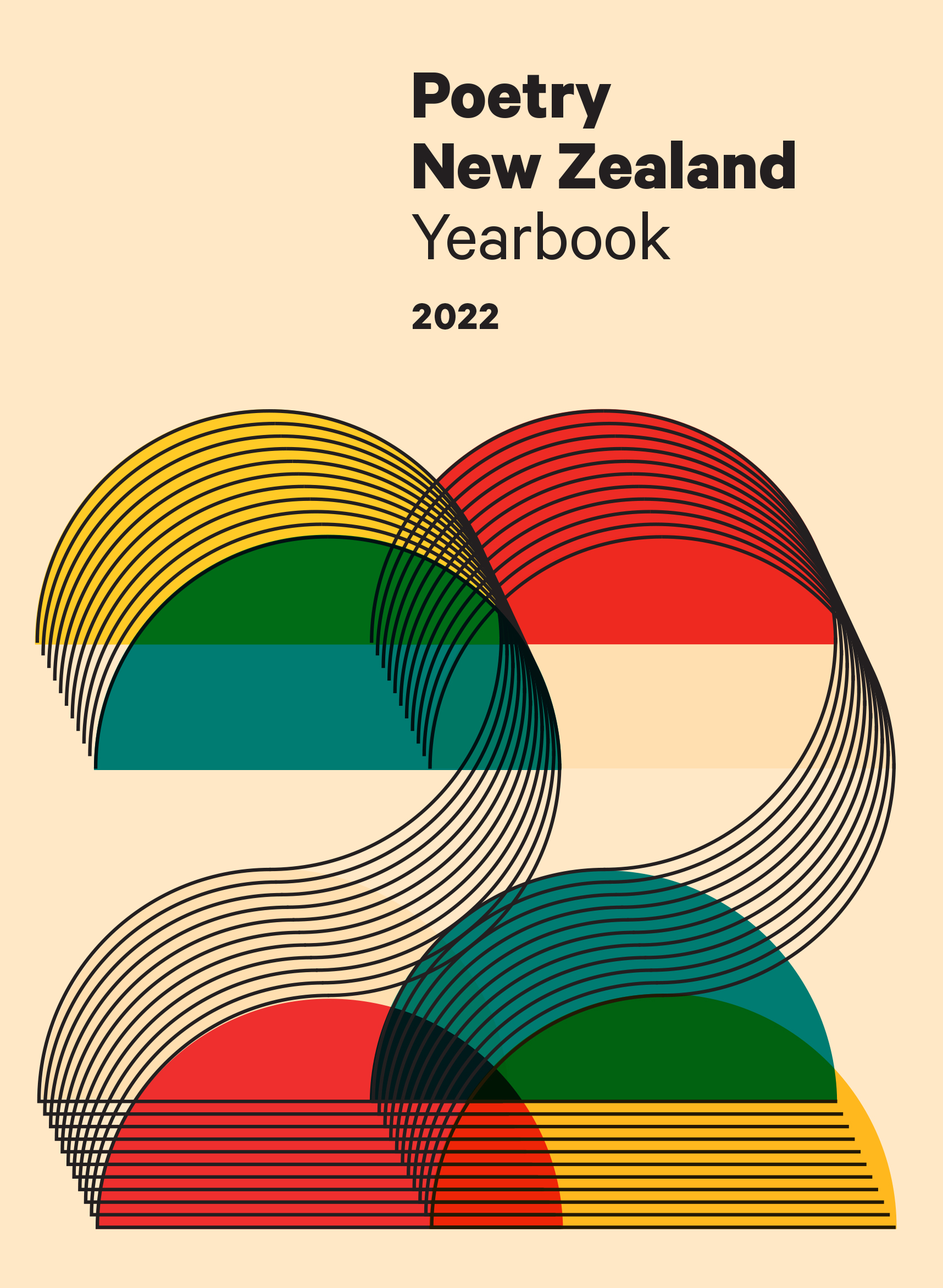
Poetry Shelf: Poetry New Zealand Yearbook 2022

Poetry New Zealand Yearbook is now edited by Tracey Slaughter, supported by the University of Waikato and published by Massey University Press. The latest issue continues to showcase poetry, essays, reviews and a feature poet. It also runs an annual poetry competition for secondary students.

Tracey Slaughter’s introduction sidesteps the traditional literary journal’s editorial ‘opening’ and riffs on the theme of breakage. I adore it! The end of a line provides infinite fascinations: either as a rest stop or an open valve, but Tracey draws us to the way the line itself may be punctured with white space. It is not just the visual hit, prolonged breath or a shift in rhythm, it’s ‘Switch your senses on’. Tracey’s editorial is an invigorating piece on reading and writing poetry. It’s a rush to the senses, and inspired me to to create my second Paragraph Room (coming up soon!).

As an electrified proposition on reading poetry, it also applies to our entry into Poetry New Zealand 2022:

‘Bring it all. Waste nothing. Use everything you are to open the poems in this book.’

Celebration time: there is a succulent and diverse wave of young poets in Aotearoa New Zealand. You meet them on Starling, on social media, in the IIML secondary school poetry competition, and through publishers such as We Are Babies. Holding an annual competition for secondary school students in Aotearoa, PNZYB adds to the increased visibility of emerging voices.

The four First Prize winners (from Y11 to Y13) are nestled in the alphabetical order of the contributors. Good to see them sit alongside the selected poets rather than as a competition adjunct. Unlike most writing competitions, there is no judge’s report. Were there common themes, styles? Leanings towards politics or the personal or both? What the four published poems underline is these new writers are an unmissable destination. You get heart, you get garden-fresh, breathtaking music, thunderbolt surprise, word nimbleness. The names to watch: Ocean Jade, Caitlin Jenkins, Sarah-Kate Simons and Jade Wilson. I am lost for words … these poets are so darn good.

get some air. the haze of summer is ripe and all i could ever want
is to rest my head into its shoulder, rendered to its shallow fever
until i can find a warmth to keep safe. for now,
my head is tilted north through your slack-jawed window
with patient wind threading into my skin

Ocean Jade from ‘Route Back Home’

when the world wants our faces to kiss the concrete
we’ll still be safe in the arms of papatūānuku
cause when things go south —
we’ll deal with them like south —
with the love our roots nourish us in …
bronze skin mona lisa

Caitlin Jenkins from ‘South’

Wes Lee is the featured poet. Her most recent collection is By the Lapels (Steele Roberts, 2019). She was a finalist for the Sarah Broom Poetry Prize (2018) and was awarded the Poetry New Zealand Prize the following year. Tracey provides two terrific paragraphs as entry points into both the poems and an interview she has with Wes. Wes’s poems leave her in awe: ‘accosted, exhilarated, struck’. Tracey writes: ‘The scenes glimpsed within a Wes Lee poem are often low-key, incidental, domestic, yet under the surreal pressure of the poet’s eye the ordinary detonates and homely details seethe and seize.’ Indeed. The poems walk on a precarious edge of living. They scratch and lash, they tilt you as read. You body surf on currents of memory, trauma, the personal.

A highlight for me is reading the essay of poet and journalist, Maryana Garcia’s ‘A Clearer Dawning”. Maryana writes of being selected for the AUP antholgy A Clear Dawn: New Asian Voices from Aotearoa New Zealand, and on standing in the wings about to read at the book launch at the Auckland Writers Festival. The essay is sorting buttons, reciting vowels and diphthongs, a moving ledger of plus and minuses in the family’s move to New Zealand several decades ago (bomb checks v Lola’s cloth cupboard, smog v the best mangoes in the world). It is self doubt as a poet. We should all have a folder marked ‘Dietritus’! It is the way memory is hooked when you least expect it (by the fabric feel of the anthology’s cover). More than anything, it is in keeping with A Clear Dawn‘s stated aim: that Asian poets, like all poets, write about anything in a thousand inspiring ways.

I stared at my poetry folder, asked myself which poems I felt at home with. The answer was: none. Tabs closed. Tabs opened. I blinked again. Then I clicked on a folder I’d called, in a fit of creative frustration, Dietritus.

Maryana Garcia from ‘A Clearer Dawning’

Derek Schulz’s essay steps off from a brilliant Alice Oswald quotation (‘poetry is the great unsettler’) to opening windows on Emily Dickinson’s poetry. I kept arguing and agreeing with the essay which is far more satisfying than skim reading and moving onto the next page.

Sometimes you fall upon a piece of writing at exactly the right time. Sue Wootton’s extraordinary ‘This Damned Helplessness’ chimes so deeply when I am currently equating 2022 to climbing Mt Everest, when I am in training for a high risk adventure and not at all sure what views I will see. Caught in the gap between so many things. Sue considers climbing a first mountain and a second mountain, each with different views, and then perhaps imaginary mountains (Dream, Day, Night, Fact, fiction, Science, Culture, Body, Soul). More importantly, she traverses (connects with) how to exist, survive, flourish in the space between disparate things. Say Science and Culture. The first mountain view and the second mountain view. What is said and what is misheard. She uses her past experience as a physiotherapist to consider storytelling, gap navigation, treating pain, broken self narratives, bridges, patient involvement, re-composition. I am barely scratching the surface of this intricate tapestry of thought. It’s a satisfying neighbourhood of quotations and responses to other writers, physicians, thinkers, patients. Beautifully written, supremely thought provoking, it’s an empathetic plea to speak from both mountains. Yes, extraordinary, humble writing.

My issue of Poetry New Zealand Yearbook 2022 is already well thumbed as I lily-pad hop the poems (one poem per poet) along with the continued solid devotion to reviewing poetry books published in Aotearoa. This is a journal I am drawing out over months not days. To savour and sidestoke in. There are unfamiliar names and recognisable favourites. Under Tracey’s inspired editorship, Poetry New Zealand Yearbook is something I look forward to. Rejuvenating. Rejuvenating. Rejuvenating.

take this night
quickly like a pill / the pull
of space cracking / ankle joints
from the stretch up
in its dark belly
gurgling acid starlight

Hebe Kearney from ‘night comes on’

she lay on the pavement
squinting at clouds
and never made out
my father roosting
in cranes and carillons
even her dress    pressed
with paintings of the domes
of Budapest  made
her giddy sun downing
giddy      this way
                               and that

Kerrin P. Sharpe from ‘the scaffolding of wings’

didn’t matter that our Chinese faces
spoke white/all of us knew the routineness
of string/mā má mǎ  mà/knotted our xīn
into snake bites/left our tongues parched/
dead nailed until the bell rang three.

Wen-Juenn Lee from ‘chinese class’

Massey University Press page
10 Questions with Tracey Slaughter

Tracey Slaughter teaches creative writing at the University of Waikato, where she edits the journals Mayhem and Poetry New Zealand Yearbook.

Poetry Shelf review: Janet Charman’s The Pistils

The Pistils Janet Charman, Otago University Press, 2022

little lapping waves
to inundate
the shoes of makers
whose texts
i’ve addressed
and assessed
in the dark inland towns
of my imagination
the large waves of the fire siren
call me out
in the middle of the night

from ‘welling’

I started reading Janet Charman’s poetry when I emerged from my poetry cocoon with Cookhouse, my debut collection, and she knocked my socks off. First up it was Janet’s musical ear: an elasticity with words, linguistic play, surprising syntax. And then, so essential when my academic research focused on women and writing, her feminist core. Not an adjunct, nor a side track, but an essential feminist core. When I walked across the university threshold onto Simmonds Street, with my PhD and carton of books, I walked out of the academy into life as a poet. And a hunger to immerse myself in an Aotearoa New Zealand context. To discover the women who had written before me, who were writing alongside me, and who would write ahead of me. Janet Charman was busting out of the men’s canon and opening up notions of ‘she’, ‘i’, ‘we’, ‘you’, ‘they’. The ink in her pen and her preferences were placed centre stage, whether in trousers or skirts, folding nappies or building houses.

Janet’s new collection The Pistils opens with a terrific sequence, ‘High days and holy days’. Twelve poems that mark holidays or significant occasions (Waitangi Day, Parihaka Day Guy Fawkes Night, Wahine Day, Matariki, Picnic Days). Each poem contributes to a life – within a sequence of panels. Bare bones. Ample white space. A miniature narrative of excavation. Remember when. Remember how. Remember why. The sequence opens scenes, moments, places – and we enter the collection grounded.

winds drain to the horizon
tides
lap below the wrought-iron railing

here
we are sheltered in the hollow of the year
the hollow of the day

blowflies
loll and bang the afternoon to a close
the windows

from ‘1. Northland Panels‘ from ‘high days and holy days’

Move into the heart of the book, and the mind leaps and bounds along the rhythm of the line. Exquisitely crafted. Scored. Composed. In ‘Mrs Valentine’s instructions’, the rhythm of revelation shapes memory. On the next page, in ‘hometime’, attention to the sound of the line is equally arresting. Memory is translated into music and image. It is a portrait of the child but it is also a portrait of the mother. In parings and traces. Surprising arrivals. It is religion and Freud, a mother lost in a novel, it is fingers worn to the bone, the news on the radio, family dinners, walking home. Life and death. It is home.

and the mother weighting at the top of the hill
her red roof tile her front windows
black blank shine
her white two-storeyed weatherboard authority of home time
—untangle the latch race the path
hunt through the house to find her where she sits
adrift in a novel
or conducting her day in some regimen of intellectual longing
with Freud and Jung in the sunroom
—on three sides light pulses in
Father Son and the Holy Ghost
summer on summer through glass the great gum nods

from ‘hometime’

Rhythm is so important. It renders Janet’s poetry fully charged, and accumulates life, detail, confession, insight, opinion, grief, reflection. It feels real, it feels personal, it feels political. The mother is a constant presence, in the shadows and in the light, a vital connection. Rhythm accommodates the feminist spotlight on life. The stamen and the pistil, the difficulty of childbirth and a baby in an incubator, a war memorial, waste management, Pakehā privilege, an aging body image, a breast removed, James K Baxter’s rape boast, literary criticism, sex, grief, having breakfast while watching John Campbell rather than listening to National Radio because your beloved has gone. It is the rhythm of mourning. Ah. So many layers.

i waited into the summer for my diagnosis
saw how a benign White Island
only became Whakaari
for the pakehā
after an eruption with deaths

from ‘bra dollars’

I speak of rhythm in such glowing terms but it is of course part of a sonic festival. Janet’s poetry strikes the ear (as Rebecca Hawke’s debut collection does). This leaning in to listen is rewarding: the leapfrogging alliteration, assonance, short lines, slightly longer lines, punctuating breath, free flowing currents. Again Janet’s agile music enhances my engagement with her roving subject matter. With the sharp edges and the necessary subterranean questions. How to live? How to live and love on planet Earth? How to speak against subjugation based on gender or skin colour? How to see your parents? How to go on when your beloved is no longer there? How to continue probing and resisting? How to be yourself? Ah. Such layerings.

Reading Pistil is exhilarating. I am loving this book because it is vulnerable and open, it is edgy and crafted, and because it shines a light on how it is for women. We still need that persistent light. We still need poetry that misbehaves as much as it makes music on the line. The poems call out and call for, stand out and stand for. It is a stunning collection.

Janet Charman is one of New Zealand’s sharpest and most subversive writers. In 2008 she won the Montana Book Award for Poetry for her sixth collection, Cold Snack. In 2009 she was a Visiting Fellow at the International Writers’ Workshop of Hong Kong Baptist University. In 2014 she appeared as a Guest Reader at the Taipei International Poetry Forum. Her collection 仁 Surrender (2017, OUP) chronicles her writing residencies in Hong Kong and Taiwan. This is her ninth collection of poetry.

Otago University Press page

Interview: Janet Charman on Standing Room Only with Lynn Freeman Listen

Review: Sophie van Waardenberg for Academy of New Zealand Literature Read

Review: Chris Tse for Nine to Noon Listen

Poetry Shelf review: Brian Flaherty’s Plague Poems

‘Chewing the nails of just one hand, the right

Silence falling back on us

With all its weight of sky and stars.’

Plague Poems, Brian Flaherty, Little island Press, 2022

10.

Fingering the page of statistics in your pocket
You are still trying to find the right words
It’s not a matter of painting a black picture
It’s a matter of taking precautions
Even to express such simple emotions
Costs an enormous effort
Most of all you like a certain bell in the neighbourhood
That rings softly around five in the evening.

Rather than knit or bake sourdough, Brian Flaherty wrote a poem a day after Aotearoa went into its first lockdown, just before midnight on 25 March 2020. The next morning, he took Albert Camus’s The Plague (La Peste). He read five pages each day, and ‘used them to sample and shape a poem’ that echoed our pandemic situation, and that he emailed to a friend. Plague Poems represents the fifty poems he wrote. It is a slender, dark-covered book that sings out of dark and life, the unknown and the recognisable.

A reshaping, a sampling, a translation, a poetic transparency laid over our pandemic time. As I read the book in one slow sitting, entranced, captivated, the poetry forms a transparency over my own lockdown experience. Here and then, the empty city, the empty streets, the hijacked and reinvented daily routines, these poems like those days, offer new and surprising sustenance.

Brian slows down in the empty city, in Camus’s novel, and in his slowness of daily pace, observation is heightened. There are posters demanding hygiene, a droning radio, a glass of warm beer, people on balconies and people walking the boulevards. In the ambulation, whether physical, emotional, cerebral, the poet’s mind is adrift, collating and collecting. The poem is thinking with new eyes. It is contemplating the strange and the estranging. I am personally returned to my own drift through the house, up the country road, without anchor and then again with a different anchor. Reading the collection it feels like the objects on the mantelpiece of the mind were taking time to settle. They still are.

14.

To make the trains run again in our imagination
The only way to escape this unbearable holiday
To speak more particularly at last of lovers
Those one sees wandering at any time of the day
Subservient to the sun and the rain
Handed over to the whims of the heavens
To go back through the story
And examine its imperfections
It must be said that people are drinking a lot
You have the impression that cars
Have started to go round in circles.

Time is elongated, meaningless, endless, meaning rich, meaning astray, meaning hungry, questions compounding.

I adored reading this elegant suite of poems, with its silence, its epiphanies, its unexpected resonance, its sweet craft. I am returned to a time that was body-displacing off-real, like a film noir set, a dystopian novel from past or future, as we grappled to reshape our days, our relationship with today. Two years later, it feels altogether noisier, edgier, more divisive, less connected and less connecting. Brian’s poetry takes me back to a time where, against all odds, life felt precious, when we worked together to make it so. We walked through the empty city, observing, collating, harvesting, recognising, celebrating, and being alive to and for what matters. I love this precious book.

33.

After eleven, plunged into darkness
Under a moonlit sky
The town is like a monument
A necropolis in which disease and stone
Have finally silenced every voice
Night crouching in our hearts
The myths that are passed around
Black shape of a tree, the howl of a dog.

Brian Flaherty is a poet librarian. He is co-founder of the New Zealand Electronic Poetry Centre  with Michele Leggott, and was co-editor of the poetry journal Trout. Poems have appeared in Turbine, Best NZ Poems, Blackmail Press, Ika, Ka Mate Ka Ora, and Trout. Recordings of some of his poetry are at Six Pack Sound.

Little Island Press Plague Poems

Little Island Press Brian Flaherty