Tag Archives: Monday poem

Monday Poem: Nina Powle’s Styrofoam Love Poem


STYROFOAM LOVE POEM


my skin gets its shine from maggi noodle seasoning packets / golden fairy dust that glows when touching water / fluorescent lines around the edge of / a girlhood seen through sheets of rainbow plastic / chemical green authentic ramen flavour / special purple packaged pho / mama’s instant hokkien mee / dollar fifty flaming hearts / hands in the shape of a bowl to carry this cup / of burning liquid salt and foam / mouthful of a yellow winter morning / you shouldn’t eat this shit it gives you cancer / melts your stomach lining / 99% of all this plastic comes from China / if we consume it all maybe we’ll never die / never break down / and I’ll never be your low-carb paleo queen / I’ll spike your drink with MSG / find me floating in a sea of dehydrated stars / on the surface of my steam shine dream / my plastic Chinese dream / lips swollen with the taste of us


©Nina Powles

Nina Powles is a poet and zinemaker from Wellington, currently living in London. Her debut poetry collection, Luminescent, was published by Seraph Press in 2017. She is poetry editor of the Shanghai Literary Review and was the 2018 winner of the Jane Martin Poetry Prize. 


Monday Poem: Albert Wendt’s ‘And so it is’


And so it is


we want so many things and much

What is real and not? What is the plan?


Our garden is an endless performance

of light and shadow  quick bird and insect palaver


The decisive wisdom of cut basil informs everything

teaches even the black rocks of the back divide to breathe


Blessed are the flowers  herbs and vegetables

Reina has planted in their healing loveliness


The hibiscus blooms want a language to describe their colour

I say the red of fresh blood or birth


A lone monarch butterfly flits from flower to flower

How temporary it all is  how fleeting the attention


The boundary palm with the gigantic Afro is a fecund nest

for the squabble of birds that wake us in the mornings


In two weeks of luscious rain and heat our lawn

is a wild scramble of green that wants no limits


Into the breathless blue sky the pohutukawa

in the corner of our back yard stretches and stretches


Invisible in its foliage a warbler weaves a delicate song

I want to capture and remember like I try to hold


all the people I’ve loved or love

as they disappear into the space before memory


Yesterday I pulled up the compost lid

to a buffet of delicious decay and fat worms feasting


Soil  earth  is our return  our last need and answer

beyond addictive reason  fear and desire


Despite all else the day will fulfil its cycle of light and dark

and I’ll continue to want much and take my chances


©Albert Wendt

March-April 2017


Albert Wendt has published many novels, collections of poetry and short stories, and edited numerous anthologies. Last week, along with four others, he was recognised as a New Zealand Icon at a medallion ceremony for his significant contribution to the Arts.


Monday Poem: Jack Ross’s ‘My Uncle Tommy’


My Uncle Tommy


‘In the end they had to put him

in a home 


Tommy had grown too heavy

for Dad to carry 


Dad worried about it

till he went to visit


tried to hug him

Tommy didn’t know him


was not aware

of where they were


it was my mother

I was sorry for


she thought she was to blame

for having him


my brother shared a room

with him


all night he’d rock

inside his cot


one winter he got sick

and never spoke


again

no-one


could visit us

because


of Tommy’


©Jack Ross 2018


Jack Ross is the managing editor of Poetry New Zealand, and works as a senior lecturer in creative writing at Massey University. His latest book, The Annotated Tree Worship, was published by Paper Table Novellas in 2017. He blogs here


Monday Poem by Bernadette Hall


from a sonnet sequence called  Fancy Dancing


vii.

Drowning is painless, or so they say, when we die

we’ll look as though we’re sleeping. How many thousands

and thousands are sleeping now in the swollen waters

of the Mediterranean? It’s enough to break your heart.

Maggie dropped in for a drink after work

the other day. Tears in the street. I’ve given her

our mother’s lovely little blue Limoges plate.

We talked about the grandfather we’d never met,

Alexander, thrown out of the family for some reason

we are left to imagine. I found him earlier this year,

lying all on his own in an unmarked grave  in Ashburton.

You can drown in loneliness, it seems, just like in water.

We’ll put up a stone with his name on it, such a small gesture.


©Bernadette Hall


Bernadette Hall lives in a renovated bach at Amberley Beach in the Hurunui, North Canterbury. She has published ten collections of poetry, the most recent being Life & Customs (VUP 2013) and Maukatere, floating mountain (Seraph Press 2016). In 2015 shereceived the Prime Minister’s Award for Literary Achievement in Poetry. In 2016 she was invested as a Member of the New Zealand Order of Merit for services to literature.  In 2017 she joined with three other Christchurch writers to inaugurate He Kōrero Pukapuka, a book club which meets weekly at the Christchurch Men’s Prison.


Monday Poem: by Gregory Kan


I wanted what happened to be something

I could know

and I wanted what I knew to be something

I could describe

something to which others could say

I know this

this happened to me also.

At the back of the room is a mirror

dreaming it’s become itself at last.

I keep walking

as if I know all the parts

and could play them.


©Gregory Kan


Gregory Kan is a writer and coder based in Wellington. His poetry has been featured or is forthcoming in literary journals such as the Atlanta Review, Landfall, The Listener, SPORT and Best New Zealand Poems. His poetry and philosophical works have also featured in exhibitions and publications for contemporary art institutions such as the Auckland Art Gallery, Artspace, the Adam Art Gallery, the Dunedin Public Art Gallery and the Physics Room. Auckland University Press published his first book, This Paper Boat, in 2016. An earlier incarnation of This Paper Boat was shortlisted for the Kathleen Grattan Poetry Prize in 2013. The book was also a finalist in the Ockham New Zealand Book Awards for Best Poetry in 2017. He was a Grimshaw-Sargeson Fellow for 2017. His second poetry collection, Under Glass, is forthcoming.


Monday Poem: Emer Lyons’s ‘Poison’


Poison

After Gwendolyn Brooks and Terrance Hayes


We

take to the drink, wanting real

life to dampen our tongues, cool

the shame we are forced to we-

ar with guilt built in, all left

to us from him. Dul ar scoil

to learn the church’s rules, we

learn to shut mouths, minds, legs, lurk

close to home, wait until late

in life to start living. We

protest against them. We strike

them down like they do us, straight


*


up get wasted. Hear our we-

ary mothers try to sing

songs that might free us from sin –

A-ma-zee-ing Grace. They we-

ep for us their kin grown thin

from not giving a shite, gin

our favourite perfume. We

think to join in, feel that jazz

of life again but them June

days are made for drinking, we

mute their sound, they turn to die-

ts of rosaries, T.V. Soon


*


we join the rest like us, we-

lcomed we are into the real

darkness of the pub, scrubbed cool

colours paint the walls, but we

don’t look at the walls, eyes left

downcast for fear that some school

friend’s dad be holding up we-

t edges of a stool, lurk-

ing for some young wan’s time. Late-

r when we’ve spent our lot, we

goes to the likes a him, strike

up some talk with tits out straight


*


under their noses, they we-

ak them eejits, we be sing-

le, we’re not patrolling sin-

‘s committed by men, we

too busy with our own thin-

clad secrets, like how the gin

at home is watered down – we-

eks of stealing dat took! Jazz

oozes from the jukebox, June

fades outside the window, we

stay until it starts to die

down, already Sunday, soon


*


Mass be starting, not that we

bother anymore, found real

religion that don’t play cool –

you’ll get what you’re given. We

grab the bottle’s neck, get left

in pools of our own sick, school-

ed to mind ourselves – coz we-

‘ve no time for all dat! Lurk-

ing Larry’s hide in the late

afternoon shadows to we-

t us between the legs – strike

all ya want girls! We walk straight


*


passed them, they keep trying. We

see some other girls get sing-

led out, get pregnant, the sin

dripping off them, we look we-

ll away when they be thin-

king to look at us. Begin

to think about things that we-

‘ve been told, listen to jazz

music in our rooms with June

next door shouting how we owe

her some peace – go way and die!

Her gob shuts as the bassoon


*


roars the devil’s music. We

develop our taste buds, real-

ise wine looks classy, the cool

kids be drinking it, so we

form fists around the stems, cleft

our insides, move like a school

of fish, joined at the hip we

be, until we go home, lurk

through our own front doors, dilate-

d pupils in heads, too we-

ak to take d’mother’s strike

against our faces, lie straight


*


down on the carpet. There we

sleep dreamless until the sing-

ing birds move our bleary sin-

ged bodies to mirrors. We-

igh ourselves (no shoes on) – thin

girls don’t hang onto virgin-

ity long. The fella’s we-

dge between us, shove their jazz-

ing hands down our skirts, the June

heat hot against our heads we-

lded to the wall, us die-

hards wanting it over soon-


*


er rather than later, we

don’t look into their eyes, real-

ly we’d rather catch the cool

stares of other girls, a we-

llspring of poker faces left

to drown outside of the school

system, taught us nothing we

could use against filthy lurk-

ers, or what to do with late

periods, or how come we-

‘d never be wealthy – strike

us down for we have strayed straight


*


off the path most chosen. We

won’t marry any man, sing

children to sleep or get sin-

gled out for promotion. We

will live backed against walls, thin-

king of dreams we had of begin-

ning again, all along we

knew we’d never see a jazz

band, another clear blue June

sky or hear our mother’s we-

ak, how sweet the sound. We die

soon.


©Emer Lyons


Emer Lyons is an Irish writer who has had poetry and fiction published in journals such as TurbineLondon GripThe New Zealand Poetry Society AnthologySouthwordThe Spinoff and Queen Mob’s Tea House. She has appeared on shortlists for the Fish Poetry Competition, the Bridport Poetry Prize, the takahé short story competition, The Collinson’s short story prize and her chapbook Throwing Shapes was long-listed for the Munster Literature Fool For Poetry competition in 2017. Last year she was the recipient of the inaugural University of Otago City of Literature scholarship and is a creative/critical PhD candidate in contemporary queer poetry.


Monday Poem: Essa May Ranapiri’s ‘To Get Out’

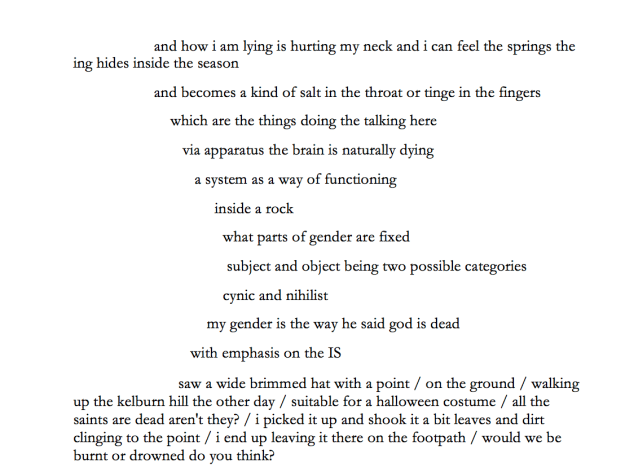
Screen Shot 2018-04-09 at 9.29.43 AM.png


TO GET OUT

Screen Shot 2018-03-24 at 3.47.34 PM.png


Screen Shot 2018-03-24 at 3.48.59 PM.png


Screen Shot 2018-03-24 at 3.49.36 PM.png


Screen Shot 2018-03-24 at 3.50.16 PM.png


©Essa May Ranapiri


essa may ranapiri | Ngāti Raukawa/Pākehā | takatāpui | they-them-theirs | has words in [Mayhem, Poetry NZ, Brief, Starling, Cadaverine, Them & POETRY Magazine] they will write until they’re dead


Monday Poem: Emma Neale’s ‘Called’


Called

(2015)


It is October in Dunedin.

Rhododendrons fan out flamenco skirts;

magnolias, magnanimous with their moon-cool glow,

light the path south so the sun stirs us early;

although the river, the creek boulders,

the city’s cinched green belt, still hold the cold

like an ice store’s packed down snow.


The days shiver with filaments

of ua kōwhai: soft rain that dampens paths,

shakes loose carpets of white stamens, yellow flowers

bruised and trodden like flimsy, foil cornets.

School holidays send out falling, silvery arcs

of children’s sky-flung laughter; our bodies drink it in

as if love’s parched ground sore needs this watering.


Yet the radio stays hunched in the kitchen corner,

hard grey clot in the light’s fine arteries

muttering its tense bulletins

and as if they sense this late spring still harbours

frost’s white wreck, or some despotic harm abroad

seeps too near, our sons more than anything want

their old games: secret codes, invisible ink, velvet cloaks;

hide ’n’ seek in public gardens’ clefts and coves—


and again, again, can we tell them again


the chapters of how they first appeared

in the long, blurred myths we are entangled in;

kingfisher-blue wells of their eyes a-gleam

as if they know how much all adults withhold.

They want us to go back deeper, to when

we both were star-spill, sea-flume, spirits,

only belatedly woman, man, climbing up from a shore

feathered in sand black and soft as ash,

driven by some gravid magnetism towards each other


in case we changed to birds, lizards, trees,

or back to sea-salt borne by wind;

an urge clear as hunger coursing the cells’ deep helix

to complete this alteration, half bury and re-germinate

the fleet molecules of self, so we could run our mortal hands

the right, kind way along the children’s plush skins,

learn, pulse on pulse, their true, human names.

Yes, we must go back and back; as if to swear

even to this dread epoch’s wild, original innocence.


©Emma Neale


Emma Neale received the inaugural NZSA/Janet Frame Memorial Award, the Kathleen Grattan Award for an unpublished poetry manuscript (The Truth Garden), the University of Otago Burns Fellowship and the NZSA/Beatson Fellowship. Her poetry has been shortlisted for the Sarah Broom Poetry Award and the Bridport Poetry Prize, and her poetry collection, Tender Machines, was long-listed in the 2016 Ockham New Zealand Book Awards. Her novel, Billy Bird, was short-listed for the Acorn Prize in the 2017 Ockham New Zealand Book Awards and long-listed for the International Dublin Literary Award. She is the current editor of Landfall.