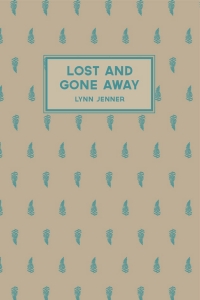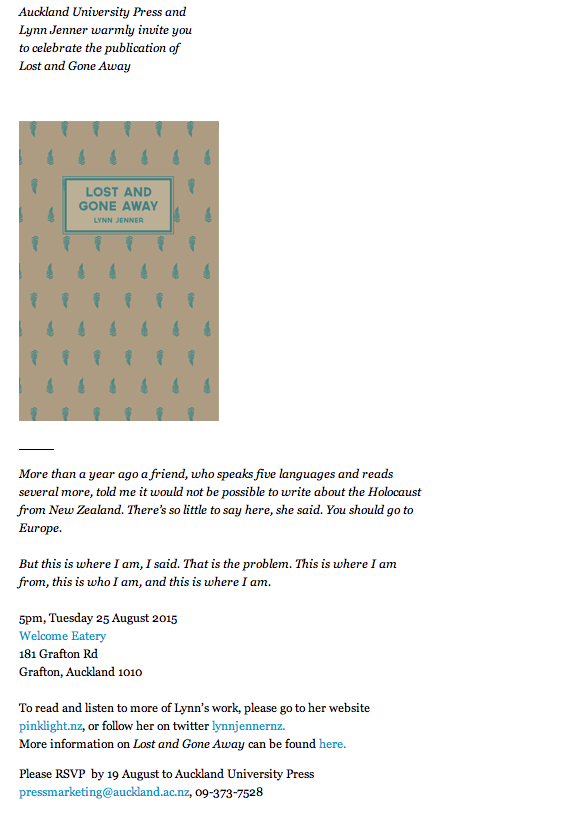
Lynn Jenner Lost and Gone Away Auckland University Press 2015
Lynn Jenner’s new book, Lost and Gone Away, is a terrific read, a challenging, thought-snapping, sidetracking, stalling read. A must read. The book, as the title suggests, navigates and stretches towards lost things. It is a hybrid work that started life as a doctoral thesis, and is in turn, poetry, prose, essay, memoir, and a smudging of genre to the point that it is unimportant where one genre begins and another ends. ‘Things’ matter but this is a work that places people at its white-hot core, and from here radiates missing memory, experience, time, place, events.
The book is in four parts. Part One, ‘The ring story,’ pursues Lynn’s mother’s ring that went missing in the Christchurch earthquake. Part Two, ‘The panorama machine,’ is like a stream-of-conscious outflow of that which is lost. Part Three, ‘Point Last Seen,’ focuses on missing people. Part Four, ‘I ring the bell anyway,’ navigates The Holocaust.’ Writing becomes a way of reaching and tethering traces of what has gone. It is, and can only ever be, subjective, elusive, fleeting, partial. The generous white space that gives the text room to waver and shift heightens the allure of fragmentation — yet as you read you identify currents that link: the stream-of-consciousness movement, the concatenation of ideas.
Lynn trawls eclectic places for material: books, anecdotes, conversations with strangers, conversations with friends, museums, personal experience, invented experience, inherited experience, dreams, white space. The thinking and writing process is guided by acute contemplation, critical thinking, doubt, self-defensiveness, thought drifts, accidents, discoveries, questions. As she searches for her way into and through knotty issues, she identifies approaches she connects with and those she does not (Michael King is a stand-out example of the latter). The pieces accumulate and build a thought mosaic as opposed to a thought fresco. Always there is a taut wire to the personal –no matter where thinking leads, no matter how distant in view of time and place, this is an intimate and utterly personal inquiry.
For me, the book is a treasure chest of curious things, fascinating things — but it is not just a novelty box. This book takes you to essential human questions and reminds you that there is no singular response and no singular way to write your response. How do you face individual loss? How do you face national loss? How do you face the Holocaust? Global crimes against humanity? How do you write what you have not experienced? How do you listen to the voice that is other? A waterfall of questions.
The questions stick but little pieces of the book adhere, indelible upon your skin. The suitcase. The empty chair. The man in the Jewish museum telling his story, over and over. Finding beautiful words in the work of a prolific but unknown poet and using them in a poem. A dream’s impact on reading and writing. The carriages. The Polish children. The way you may unwittingly leave traces at a high-pitched frequency that readers may unwittingly pick up. The way Sappho appears and reappears.
Lost and Gone is an extraordinary read because it lays a gossamer net upon missing things and allows you to catch glimpses of what has gone, whether far from your life or close at hand. At work, and intensely present, is a mind foraging, delving, struggling, daring. Lynn is unafraid to venture upon unstable ground in order to follow her trains of thought — at times uncomfortable, at times surprising, always moving and shifting your point of view. This is a special book.
Auckland University Press page