Here are a couple of poems with a location that is important and distressing to me, Palestine, where I had a connection while working in a Palestine refugee camp near Amman in Jordan in 1968/69. The catastrophic situation of Palestinians oppressed by Israel then has become genocidal, and while poems are not going to change that, I have vivid memories of men sitting with coffees in the camp and in the marketplace in Amman, reading aloud to each other from Arabic texts. I assumed these were news updates and in a sense they were, but what I learned from my colleagues and students there was that they were more than likely poems by the likes of Mahmoud Darwish and Fadwa Tuqan. So I share them here in a spirit of empathy and dismay at the plight of the persecuted Palestinian refugees and survivors in their decimated homelands. These are among the different ones in a proposed collection Being Here – Selected Poems 2020 – 2025, currently in a publication queue.
Salaam aleikum!
Ian Wedde
From Palestine Poems
1. The View from Here
Looking west from our second floor I see foregrounded the demurely venetianed ranks of identical white neighbourly units with here and there a barbeque on the first-floor patio or a sun brolly with folded chairs and sometimes a frugal pot-plantation of aromatic herbs, and directly opposite some bamboo stakes holding up an early assortment of green tomatoes – sometimes I can see the busy outline of a neighbour in their kitchen window as they prepare an evening meal (the sun is just down beyond the western range) and cars have begun to nudge into their lit garages under welcoming kitchens with sometimes an ‘I’m home’ toot – what goes on in those private neighbourly situations will only be revealed to eyes that should know better and go up to their top floor and look out west past the ranked roofs of neighbours and their modest secrets at the distant grey- green, back-lit skyline of the sinuous Waitakeres as far as the eye can see across the dim horizon with sudden shards of late light reflected from the tranquil estuary where distant miniature house-clusters leave just enough space for these flashes that ambush me with nauseating memories of 1969 and the Israeli rockets I saw striking refugee camps near Amman in Jordan – but Palestine/Lebanon is where those missiles have been directed these past months, they remind me of Mahmoud Darwish’s great Diary of a Palestinian Wound – ‘O brave-faced wound my homeland isn’t a suitcase and I’m not a traveller. I am the lover and the land is the beloved.’ – a far cry from ‘the first-floor patio’ or ‘skyline of the Waitakere hills’, or ‘sudden shards of late light’ – but then not far at all, not a far cry, but a cry to be heard over and over in the in-your-face view from here.
2: Backfire
This morning as I walk our dog Maxi through streets silenced not by apocalypse but by the indulgent early hour of the summer holiday, a car backfires making her cower, shake, and press against my sympathetic leg, so that out of my early Al Jazeera news items (forty-six thousand Palestinians killed in Gaza since that October 7, 2023) I hear myself utter the words I heard often on any day back in 1969, in Amman, Jordan, a greeting but also a kind wish for peace, As-salamu alaykum, and as if cued in by that memory, Mahmoud Darwish’s Diary of a Palestinian Wound, his Rubaiyat for Fadwa Tuqan, poet sister of my friend Fawwaz who didn’t bother to restrain his tears when reading the Arabic but quenched while translating its many verses, starting with this one that I didn’t know I recalled until keeping sympathetic pace with Maxi: We’re free not to remember because Carmel’s within us & on our eyelashes grows the grass of the Province of Galilee. Don’t say: I wish we were running to it like the river/ Don’t say this. We exist in the flesh of our country and it in us.
Ian Wedde
Ian Wedde was born in October 1946 (shortly after his twin brother David) in Blenheim, New Zealand. He and Dave spent much of their childhoods in different parts of the world with their peripatetic parents or else in boarding/education institutions without parents, and Ian continued these travelling ways when grown-up, living in several different places including Jordan. He has published quite a lot of books both fiction, essays and poetry, has been New Zealand Poet Laureate, and was awarded an ONZM for services to literature. He now lives in Auckland, a city he’s very fond of, with his wife Donna Malane and beloved dog Maxi. He has a new book of poetry, Being Here, awaiting publication.
And so Colin I cast off in my frail craft of words my craft of frail words of crafty words into the defile of Three Lamps where struck by sunshine on the florist’s striped awning and the autumn leaves outside All Saints as you did before fully waking in Waitākere to look at the elegant pole kauri in dewy light I defile my sight with closed eyes and so see better when I open them the Sky Tower pricking a pale blue heaven like Raphael’s in Madonna of the Meadows or the scumbled sky of Buttercup fields forever where there is a constant flow of light and we are born into a pure land through Ahipara’s blunt gate a swift swipe of pale blue paint on Shadbolt’s battered booze bar where bards bullshitted among the kauri.
Gaunt cranes along the city skyline avert their gazes towards the Gulf away from babblers at Bambina breakfast baskers outside Dizengoff some pretty shaky dudes outside White Cross beautiful blooms in buckets at Bhana Brothers (open for eighty years) Karen Walker’s window looking fresh and skitey across Ponsonby Road my charming deft dentist at Luminos most of South Asia jammed into one floor at the Foodcourt Western Park where wee Bella bashed her head on some half-buried neoclassical nonsense the great viewshaft to not-faux Maungawhau and then turn left into the dandy defile of K Road where you make your presence felt yet again Colin through the window of Starkwhite in building 19-G_W-13 where dear John Reynolds has mapped your sad Sydney derives and defiles across the road from Herabridal’s windows all dressed up in white broderie Anglaise like lovely frothy brushstrokes or the curdled clouds and words you dragged into the light fantastic along beaches and the blackness that was all you saw when you opened your eyes sometimes like the bleary early morning Thirsty Dogs and weary hookers a bit further along my walk.
I love the pink pathway below the K Road overbridge a liquid dawn rivulet running down towards Waitemata’s riprap but also the looking a bit smashed washing hung out on the balcony above Carmen Jones and over the road from Artspace and Michael Lett etc there’s El Sizzling Lomito, Moustache, Popped, and Love Bucket the Little Turkish Café has $5 beers it’s like a multiverse botanical garden round here you could lose yourself in the mad babble of it like the Botanical Gardens at Woolloomooloo with the clusterfucking rut-season fruit-bats screaming blue murder.
But it’s peaceful again down Myers Park the mind empties and fills like a lung breathing the happy chatter of kids swinging and my memory of you Colin sitting alone and forlorn on a bench must have been about 1966 contemplating the twitchy cigarette between your fingers as if it divined the buried waters of Waihorotiu or the thoughts that flow beneath thought in the mind’s defile at dawn when you open your eyes and see that constant flow of light among the trees.
Ian Wedde
Note on
Ode to Auckland 1. McCahon’s Defile (For John Reynolds)
This is the first of five ‘Ode to Auckland’ sections/poems, themselves the first twenty-one-page section of a sixty-one-page book BEING HERE: SELECTED POEMS 2020 – 2025looking to publish in 2026. The poems address a city I’ve loved for the many years I’ve lived in it at various times, including early on when I was a student at Auckland University in the 1960s when I lived in Wood Street, Ponsonby. It was a pretty rough neighbourhood then compared to the Ponsonby of today which is mostly upmarket and chic. Our part of it in Three Lamps is not in the wealthy space, a functionally convenient four-floor unit in a multi-unit apartment complex with office space on the top floor for my wife Donna and myself. What this elevated space provides is the view out west from my panoramic fourth-floor windows to the Waitākare hills across the luxuriantly tree’d suburbs that stretch across that view. What’s just across the road from our inner-city place is one of my favourite dog-walks, it takes Maxi and me into the steep, sensational viewshaft down to the north-east harbour where we often walk in the morning via one of the little old-tree-planted parks that have survived from the 1960s Ponsonby I remember.
Living here now in this folding-together of memory and present, I celebrate the huge old Chinaberry tree that stretches up past our office window on Donna’s northern side and is typical of the old plantings I can see stretching out west to the Waitākeres on my side, and I’m glad to have most of what I need within walking distance, but I’m annoyed by the homogenizing impacts of the suburb’s wealth and even find myself grumbling in an old-fuck way about why all the classic villas are getting painted the same white. But the frustration is really with myself. Back in the day when I was flatting in Wood Steet the scungy villas hardly mattered and Ponsonby was just a great place to live. It still is. The title of my prospective book, Being Here, should be where I stop whingeing.
The poems in the ‘Ode to Auckland’ section are mostly written to-and-fro across something like a give-or-take twelve-syllable line which I like because it gets the measuring mind in a focused but not stalled state – like walking with wide-open eyes and a sense of your foot-falls having an organic not regimented pace, mind and breath in synch, the lines reaching ahead but anticipating a transition that keeps the thing moving.
for the Heberley Family Reunion, Pipitea marae, Easter 1990
1
I remember the pohutukawa’s summer crimson and the smell of two stroke fuel and the sandflies above the Waikawa mudflats whose bites as a kid I found cruel.
At night and with gunny-sack muffled oars when the sandflies were asleep with a hissing Tilley lamp we’d go fishing above the seagrass deep
—a-netting for the guarfish there where the nodding seahorses graze and the startled flounders all take fright stirring the muddy haze.
And who cared about the hungry sandflies when a-codding we would go my blue-eyed old man Chick Wedde and me where the Whekenui tides do flow.
It’s swift they run by Arapaoa’s flanks, and they run strong and deep, and the cod-lines that cut the kauri gunwale reach down to a whaler’s sleep.
When the tide was right and the sea was clear you could see the lines go down and each line had a bend in it that told how time turns round.
The line of time bends round my friends it bends the warp we’re in and where the daylight meets the deep a whaler’s yarns begin.
I feel a weight upon my line no hapuku is here but a weight of history swimming up into the summer air.
Oil about the outboard motor bedazzles the water’s skin and through the surge of the inward tide James Heberley’s story does begin.
2
In 1830 with a bad Southerly abaft soon after April Fool’s Day on big John Guard’s Waterloo schooner through Kura-te-au I made my way.
And I was just a sad young bloke with a sad history at my back when I ran in on the tide with mad John Guard to find my life’s deep lack.
Seaspray blew over the seaward bluffs the black rocks ate the foam my father and my mother were both dead and I was looking for home.
But what could I see on those saltburned slopes but the ghosts of my career: my father a German prisoner from Wittenburg my grand-dad a privateer
my mother a Dorset woman from Weymouth, I her first-born child, and my first master was called Samuel Chilton whose hard mouth never smiled.
He gave me such a rope-end thrashing that I left him a second time, I joined the Montagu brig for Newfoundland, though desertion was reckoned a crime —
and me just a kid with my hands made thick from the North Sea’s icy net, eyes full of freezing fog off the haddock banks and the North Sea’s bitter sunset.
And master Chilton that said when your mother dies you can’t see her coffin sink you can only blink at the salt mist about the far land’s brink.
And in the fo’c’sle’s seasick haven where a lamp lit the bulkhead’s leak you’d share your yarn with the foremast crew your haven you would seek.
Where you came from the rich ate kippers or if they chose, devilled eggs. They didn’t blow on their freezing paws they favoured their gouty legs.
And if you pinched an unripe greengage from their tree they’d see you in the gallows or if you were dead lucky wading ashore through Botany Bay shallows.
But I was even luckier, as they say, those who tell my tale: they tell how my tale was spliced and bent about the right whale’s tail.
And how poor young James Heberley fresh from South Ocean’s stench and the foretop’s winching burden of blubber his great good fortune did wrench.
In autumn I came ashore at Te Awaiti on Arapaoa Island. ‘Tangata Whata’ the Maori called me— now ‘Worser’ Heberley I stand.
‘Ai! Tangata whata, haeremai, haeremai mou te kai!’ Food they gave me, and a name, in the paataka up high.
My name and my life I owe that place which soon I made my home. From that time, when Worser Heberley went forth, I didn’t go alone.
I raised a considerable family there, with Ngarewa I made my pact: from him I got my summer place at Anaho, my home from the bush I hacked.
I summered there in the mild weather and in autumn I went a-whaling from the boneyard beach we called Tarwhite where Colonel Wakefield’s Tory came sailing.
And I guessed from the moment I saw their rig that we had best take care: not the Maori, nor Worser Heberley’s mob stood to gain from this affair.
With fat Dick Barrett I went as pilot on the Tory to Taranaki. From Pukerangiora and Te Motu descended Te Atiawa’s history —
a history already made bitter once in the bloody musket wars, that might be made bitter yet again for Colonel Wakefield’s cause.
Worser Heberley was never a fool else I’d not have lived that long: I could see the Colonel meant to do business, I could hear the gist of his song.
He was singing about the clever cuckoo that lays her egg elsewhere and fosters there a monstrous chick too big for the nest to bear
so the other chicks must be all cast out for the greedy cuckoo’s sake. The Colonel sang this song I heard as he watched the Tory ‘s wake
tack up the South Taranaki Bight with Kapiti falling astern, and I, James Heberley, stayed close to see what I could learn.
And what I learned has since been written in many a history book: that you’ll find little enough of our record there however hard you look.
3
And now Worser Heberley’s story ceases, I hear his voice no more though my line still bends by the notched gunwale as it had done before
when I was just a kid gone fishing in my old man’s clinker boat and hadn’t learned that it’s history’s tide that keeps our craft afloat.
And now I see as I look about in Pipitea marae at the multitude here assembled that your line didn’t die —
and though old Worser Heberley was right to fear Colonel Wakefield’s song, he didn’t have to worry about the family which multiplies and grows strong.
I thank you for your kind attention the while my yarn has run. I wish you all prosperity and peace. Now my poem is done.
Ian Wedde from The Drummer (Auckland University Press, 1993) also appears in Ian Wedde: Selected Poems (Auckland University Press, 2017)
In 1986 my novel Symmes Hole was launched at Unity Books in Wellington. An historical character I appropriated for the book is James ‘Worser Heberley’, a whaler who came ashore in Tōtaranui Queen Charlotte Sound in 1829. He married into local iwi and at the book launch tuhanga of James Heberley introduced themselves and suggested it would be appropriate, given my borrowing of their ancestor, if I could donate some copies of the book and also write and share something for their upcoming hui at Pipitea marae in Wellington. This is that poem, a favourite of mine for diverse reasons.
Ian Wedde
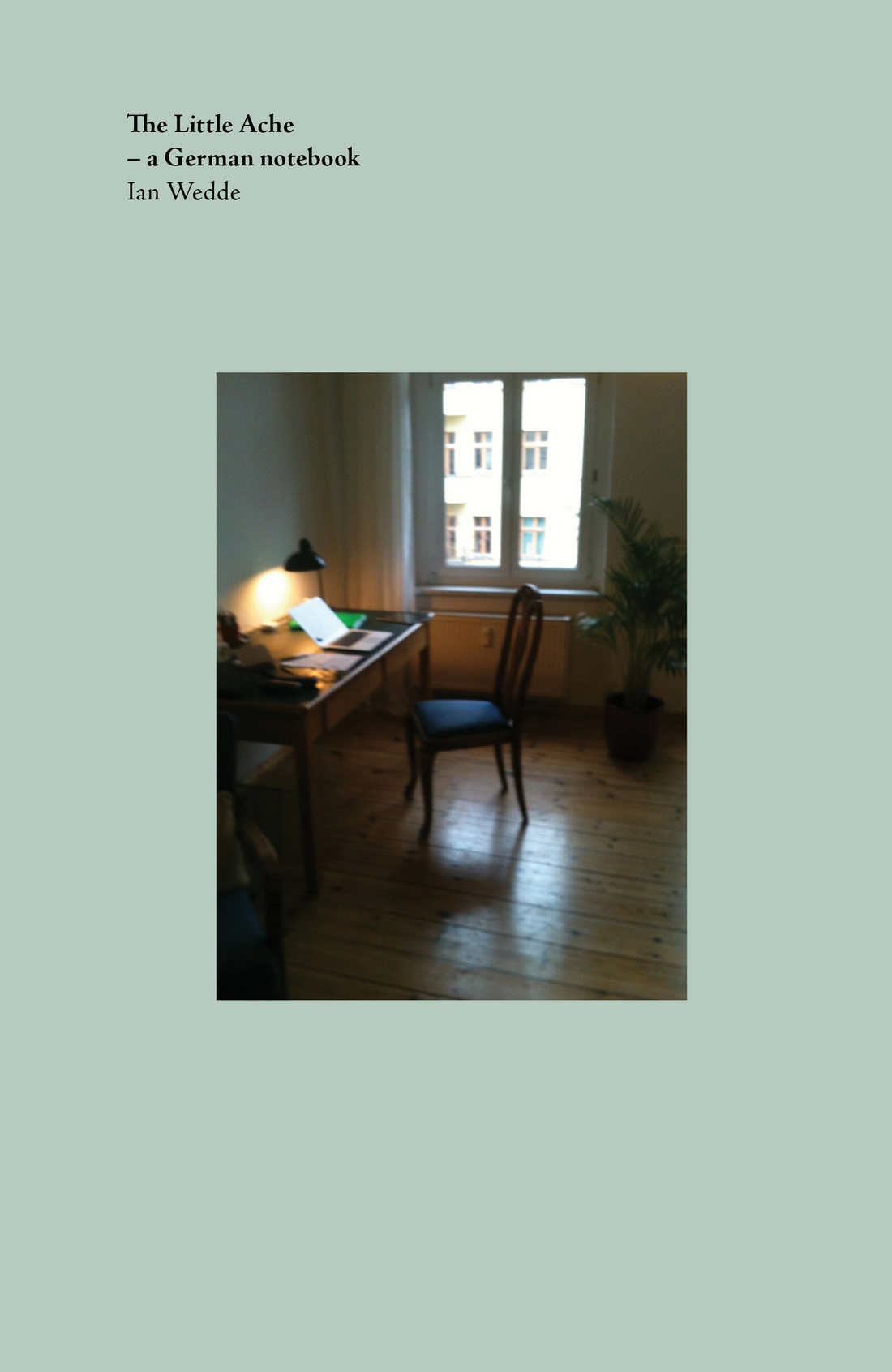
Ian Wedde’s latest poetry book was The Little Ache — A German notebook. Victoria University of Wellington Press, 2021. The poems were written while he was in Berlin researching his novel The Reed Warbler.
In last night’s dream I was a gridiron professional in L.A. and ‘in a relationship’ with no-nonsense Aussie actress Rachel Griffiths
whom I dislike as the gawky Sarah in Brothers and Sisters but adore as crazy Brenda in Six Feet Under. ‘Brenda’ and I
couldn’t persuade the puppy to romp on the bed with us. When I tried to crawl home through the wire mesh tunnel
that led from our place to the street torn up for gun emplacements, I ripped my best suit. The puppy was whining, ‘Brenda’ was in the window,
but I was snagged, there, in full view, the rip in my Boss making a noise like icebergs breaking loose.
Flowers falling
Tūī grawking and dial-toning in the Green Belt among the obliging Aussie eucalypts
whose red dirt nectar they relish more than the pale citrus, herbaceous local drop.
Was this a dream? Who cares. ‘And then I woke up’ is such a cop-out. Sipped flowers falling before us as we walked.
Wild turkey at the back of the driving range
It sits up nicely for you under unbelievable azure but keep your head down. Hang on to your turkey sandwich.
After dark they floodlight the range and you see red eyes down there at the back. Trajectories, they go up
and over, they sky then earth, a line that can’t be straight because it’s too full of meaning. A thoughtful pause.
I see where you’re coming from, but settle down, earthed and ready for impact.
Black
Ten minutes in The Warehouse is enough to make me want to kill myself. It’s the material inertia of New World aisles
that makes me want to end it. You’re doing well if you can even find the Modern Tretchikov in Moscow. Tusiata and I
walked for hours over a bridge and finally through a kind of art store. Our shoes were made of cardboard
and fell apart in the rain. There was a sculpture cemetery, and a tent for drinking beer and vodka. In the art warehouse
Malevic’s black square was barely displayed at all but my entire past rushed eagerly into it. In the Palazzo Rosso in Genoa
the opposite thing happened. The darkness at the back of Caravaggio’s Ecce Homo just kept redeeming it.
Film treatment
The klieg lights, the dark, dripping forest, the rank flanks
of horses, a sneery hound pissing on wet tents. The collapse
of public transport, the unhygienic orphanage, the barracks, the unpredictable
success of tour discounts. A lake in which a lake
is reflected. A mountain superimposed on another where
thoughts race along the boardwalk losing touch with their bodies.
Ian Wedde
Ian Wedde’s latest poetry book was The Little Ache — A German notebook. Victoria University of Wellington Press, 2021. The poems were written while he was in Berlin researching his novel The Reed Warbler.
Ian Wedde was born in 1946. He has published sixteen collections of poetry, most recently Selected Poems (2017). He was New Zealand’s Poet Laureate in 2011 and shared the New Zealand Book Award for poetry in 1978. The Little Ache — a German Notebook was begun while he had the Creative New Zealand Berlin Writer’s Residency 2013/2014 and often notes research done during that time, especially into his German great-grandmother Maria Josephine Catharina née Reepen who became the ghost that haunts the story of the character Josephina in Wedde’s novel The Reed Warbler.
Paula Green, from Cookhouse, Auckland University Press, 1997
My theme-season introductions seem like miniature self confessions on life and poetry. Crikey! I always have much to say about food and poetry because I love cooking and I love writing. My first book Cookhouse got scathing reviews either for being too domestic or forbeing too experimental. I walked around the supermarket on a Sunday morning reading the first review of my first book saying OMG OMG OMG. It was my first lesson as a writer: leave reviews with the person who wrote them. Just get on with what you love. A few weeks later I opened the Listener and there was a photograph of Cookhouse on the recipe page with a Marcella Hazan cookbook ( I loved her recipes!). Plus one of my poems, sitting on the page like a recipe. That was my second lesson as a writer. Your books and poetry find their way into surprising places and you will never know how your poetry touches people. Although sometimes you get an inkling: a stranger might walk up to you, or send an email or a card, and surprise you (in a good way!).
I can’t keep food out of my poetry and I am equally drawn to writers with similar intent. It is one reason I am such a fan of Nina Mingya Powle’s poetry. Her poems lead in multiple directions but the sensual hooks are often sparked by food. Ian Wedde is the same. I adore The Commonplace Odes. It has always mattered what food I put in my body, and it is a bit the same with with poetry. I want to cook a meal that tastes good and I want poetry that satisfies my reading tastebuds whether I am writing or reviewing. In fact don’t call me a reviewer please. And I am not actually very kind. I simply love reading poetry and sharing my engagements. Just as I love cooking a meal every night for my family.
The poems selected are not so much about food but revel in a presence of food to varying degrees. Grateful thanks to the publishers and poets who continue to support my season of themes.
The Poems
De-stringing beans
A mountain of runner beans
to top and tail and de-string.
She decides to do it for them: her sons
so they will be eaten this evening
sliced into green splinters
with pink seeds showing through.
Easier to sit than stand. Her best profile
towards the door when her son appears.
She wants to disguise how content she is.
The stringy edges, tops and tails, in a dish
the beans growing, like a mountain of shoes
later to be wrapped in tinfoil
roughly divided into two.
No one else in the family will eat them.
In an article it says they are underrated
almost despised as a vegetable
underestimated on two counts
or three: first the vigorous way
they climb, clamber to the sun
second they are rich in iron
and last and best: this contentment
so rarely found, except in
a painting of a woman pouring from a jug
someone bathing someone in a tub
this mountainous-seeming task
calming with each stroke of the knife.
Elizabeth Smither
little walnuts
served from across the seas
in a tin or a jar, fished from suitcases
presented
with grandmotherly dimples
little walnuts – xiao he tao
proudly, good for brain.
except neurons are firing
in staccato, half-
forgotten Mandarin.
they manage xie xie and dutifully
I eat them.
I forget why I ask for these –
the carnage of shells
scraps of brown meat
and a strange invasion staged
on my tongue – slow
and clumsy muscle.
I am quick to rise – you do not get to comment on what’s in my lunch box –
but just as quick to pick
the yolks of my too-dry lotus mooncakes –
discarded suns
of a world in hieroglyphs.
and when I have counted
waves of sleep – yi, er, san –
I don’t dream in the same vowels.
what can I bring back for you?
her smile like furls of steaming jasmine tea
amidst clamouring children
hawking their wants like roadside wares
or suitcase wheels clicking on concrete
destined for smog and skyscrapers.
I always ask for my little walnuts.
*Little walnut or xiao he tao is a particular kind of Chinese walnut with a distinct sweet-salty flavour.
Joy Tong
from A Clear Dawn: New Asian Voices from Aotearoa New Zealand, eds Paula Morris and Alison Wong, Auckland University Press, 2021
from A Clear Dawn: New Asian Voices from Aotearoa New Zealand, eds Paula Morris and Alison Wong, Auckland University Press, 2021
With Nectarines
to Claire Beynon
A cob loaf rests on a surface,
perhaps a table, an altar, a jetty,
that reaches over a shoreline toward dark water
and the approaching edge of night.
Out there an indigo quiet where the sky lowers to sea,
clouds shouldering weight of storm to come;
a hint of beach, airborne flicks of white,
where seabirds swoop for fish and scraps.
On this side of a sill,
the bread, and a bowl of tawny nectarines
occupy foreground that’s human with light,
with hearth-glow in the corner,
tended against incoming cold.
The bread is warm from the oven,
the fruit ripe, and the room that extends
from the canvas edge into my lived space
where the painting hangs, included as offering
to the sombre air,
to anyone who comes to this threshold, empty.
Carolyn McCurdie
Super Wine
The news is early or his clock is slow,
so he grabs his mug of tea and pops
a biscuit in his pocket,
the top pocket of a faded old coat.
It’s a wreck of a thing, this coat of his.
a shamefully limp and grubby article,
but he wears it through the news and Campbell Live
and on into the night,
and he wears it when he leaves his little flat
and slips up the lane and out into the park
and lights a cigarette
(his skinny nine-o’clocker
and the last of the day).
And he smells the smells of mown grass and woodsmoke,
and he walks across the park towards the lights,
the lights of the houses on the hill,
secular stars of silver and orange,
and he walks beneath the frosty stars themselves,
this unmarried, unmended man,
this unmarried, not-unhappy Earthling,
A Super Wine forgotten in his pocket.
Geoff Cochrane
from Pocket Edition, Victoria University Press, 2009
If you love me you’ll buy Bluff oysters and cook asparagus. Even though I don’t like either.
for Kirsten Holst, for feeding me many good things
and for Alison and Peter, for their Bluff oysters and asparagus
When I am no longer who I was
I can only hope that I will be loved by someone
so much that every day during Bluff oyster season
they will buy me a dozen Bluff oysters.
Even though they don’t like Bluff oysters
they will buy them for me
and every day I will exclaim
“I can’t even remember the last time I had Bluff oysters!”;
they will nod at the extreme length of time it has been.
When I am no longer who I was
and when Bluff oyster season is over
I can only hope that I will be loved by someone so much
they will cook me freshly picked asparagus every day.
Even though they don’t like asparagus
they will grow it for me and pick it for me
and lightly steam it
so that I can relish it served with hollandaise sauce
(although some days more lazily served with butter and lemon).
I will eat it with my fingers
and let the sauce (or butter) dribble down my chin;
no one will mind or tell me to be less messy
it will just be moments of edible joy.
In reality I don’t like Bluff oysters (or any oysters)
and I can’t stand asparagus (the taste and texture are disturbing);
I can only hope that maybe someone will love me enough
to buy and cook me the things that I love
even though they hate them, even though I won’t remember.
Paula Harris
the great pumpkin war
standing in the kitchen crying
beaten by a vegetable
thought by now it would be easier
people have suggested this (people i trust)
the myth of progress
you do something every day it gets easier
in reality each day the dirt accrues
it multiplies between cupboard doors
i am running out of resources
i am getting further & further into
the ten-year warranty on the fridge compressor
one day soon i will have to pick up the knife
& address the pumpkin in the room
bought so cheaply from the farmers’ market
now growing larger by the day
taking up all the bench space
i fear for the fruit bowl
my mother says to drop it from a height
she throws hers down the stone garden steps
my previous attempt resulted in
20 minutes lost to searching for an unscathed pumpkin
trying to break open a pumpkin at night
is like starting a winter war in russia
i am letting everything get out of control
i sleep knowing it is getting worse
i do not think i can win at this
i do not think i can carry on in any capacity
Rhys Feeney
from AUP New Poets 7, ed Anna Jackson, Auckland University Press, 2020
The Cheese Scone Recipe as Promised
What’s the secret, people ask,
why do your students return
year after year to your class?
Cheese scones, I say, crisp
on the outside, soft inside
like all good characters. First,
turn up the heat, 200 degrees
should do it. Next, sift two cups
of self-rising flour, holding the sieve
high, letting the flour fall like snow
in the air, then add a heaped half
teaspoon each of salt, mustard powder
and a good pinch of cayenne for a lick
of fire. Stir and rub in 30 grams
of butter. If in a hurry, as I usually am,
you can grate the butter or cheat
with the food processor,
but do not go all the way, stop
at the crumbly stage, add 75 grams
of grated cheese, then beat a large egg,
with about 75 mils of buttermilk,
(if you have none, add lemon juice to milk,
rest it for ten minutes). Breaking
the drought pour into the dry ingredients,
mixing first with a knife, then lightly
with your hands to bring the soft dough
together. If it seems too dry
add more buttermilk, but like
it’s a newborn and precious, go easy
with your handling, remembering
scones and poems need a light touch.
Cool hands, my mother said,
though mine have always been hot.
Roll the dough out in a rough circle,
not too thin, about 2.5 cm thick.
With students due any minute,
I usually take the lazy way, divide
it roughly into 8 triangles but you might
be wanting to impress your mother
or daughter-in-law, and have the time
and the aesthetic sense for fluted cutters.
Appearance improves the taste
so brush the tops with milk, sprinkle
on a little grated cheese, and a dusting
of cayenne. Bake on a high shelf
for about 15 minutes till golden
and irresistible. Making scones
is not dissimilar to crafting a poem,
you need to pay attention to detail,
measuring, mixing, letting in air,
but there the recipe ends.
What I haven’t talked of can not
like metaphor, be quantified, the secret is
to bring to the process, a little of you.
Diane Brown
the children open their
lunch boxes to each other
a ham sandwich
for a Fijian fried egg and three cassava sticks
a mini feta quiche
for a South Indian roti parcel stuffed
with cumin and okra
a tub of yogurt
for a Middle Eastern pouch of semolina
sautéed in ghee and cardomens
a celery stick
for a Tongan plantation ladyfinger banana
a juice box for
fresh Kiribati island toddy
the wooden decks approve
their slats on standby to suck evidence
of sharing and spit them into the crawl space
beneath the salivating joists
it’s the allergies
the adults
the food policies
and
the way fear feeds us all
Mere Taito
P r o p e r t i e s
You’ll need oil – For your forehead on Ash Wednesday, for the insides and outsides of your palms. For sore inner ears and lifeless hair. For removing the evil eye – that’s the most important. Though not one in the family knows the ritual, better to be with, than without.
Grapes and leaves – For your rice and pinenuts, for your grape jelly.
And ash – For the grape jelly – vine cinders to be precise. For holy crosses over the front doors of your houses or workplaces. For the bottoms of incense holders – hubris to clear it out.
Rose petals – For gravestones, but mostly for the preserve that fits into a spoon followed by icy water.
Water – From the priest, for drinking in the first month of the year and sprinkling in every room. For keeping in the fridge thereafter. For putting chamomile into – tea or warm compresses.
Garlic – For everything. For mashing up and applying with honey to sores. For rubbing on styes. For wrapping in bread and swallowing whole when feverish. For shooing away evil by saying the word alone – along with a spitting sound.
Vana Mansiadis
from Ithaca Island Bay Leaves: A Mythistorima, Seraph Press, 2009
1.2 To the cookbook
Turning east, I drove towards blue grey
Mountains down which cloud crawled
From summits which were already sky. High in it
A glare like grubby porcelain told me that morning
Was advanced. The nibbled winter paddocks were over-
Written in a language no one had ever taught me:
Glottal, almost choking, wet. Lines
Of leafless shelter-belt enwrapped the shorter
Rows of berryfruit trellises in need
Of pruning. My destination: an art gallery.
My mission: to speak about art and poetry.
It was going to be all over before I got there.
Quintus Horatius Flaccus, help me
In my hour of need, help me turn my back
on landscape that wants to be art, on poetry with feet
Of clay. The lovely world has everything I need,
It has my kids, my sweetheart, my friends, it has a new book
With mouth-watering risotto recipes in it,
The kind of plump rice you might have relished,
Horace, in the Sabine noon, yellowed with saffron.
‘The zen poet’ is another of you, he wrote a poem
About making stew in the desert which changed my life.
A good cookbook is as good as a book of poems
Any day, because it can’t be more pretentious
Than the produce you savour with friends as night falls.
Ian Wedde
from The Common Place Odes, Auckland University Press, 2001
Custard
When I was smaller than the family dog,
Dad would tell Mum
that he was taking me to kōhanga.
Then we’d go to the bakery
and get as many custard pies
as we could handle.
Park up by the river,
talk,
eat,
listen to the radio a while.
He’d light one up
as fat as the mighty brown trout,
captured and killed
and lull me to sleep
with a puku full of custard
in his red van
with all his windows up.
Now I am grown
and you ask me to explain something you said.
My eyes glaze
and all I can see is that
red van,
pastry flakes resting
in the corners of my sleeping mouth.
Ruby Solly
from Tōku Pāpā, Victoria University Press, 2021
The Poets
Diane Brown is a novelist, memoirist, and poet who runs Creative Writing Dunedin, teaching fiction, memoir and poetry. She is the Poetry Editor for ‘The Mix’ in the Otago Daily Times. Her latest book is a poetic novella, Every Now and Then I Have Another Child, Otago University Press 2020.
Geoff Cochrane is the author of 19 collections of poetry, mostly recently Chosen (2020), two novels, and Astonished Dice: Collected Short Stories (2014). In 2009 he was awarded the Janet Frame Prize for Poetry, in 2010 the inaugural Nigel Cox Unity Books Award, and in 2014 an Arts Foundation of New Zealand Laureate Award.
Rhys Feeney is a high school teacher in Te Whanganui-a-Tara. You can buy Rhys’ debut collection, “soyboy,” as part of AUP New Poets 7
Paula Harris lives in Palmerston North, where she writes and sleeps in a lot, because that’s what depression makes you do. She won the 2018 Janet B. McCabe Poetry Prize and the 2017 Lilian Ida Smith Award. Her writing has been published in various journals, including The Sun, Hobart, Passages North, New Ohio Review and Aotearotica. She is extremely fond of dark chocolate, shoes and hoarding fabric. website: www.paulaharris.co.nz | Twitter: @paulaoffkilter | Instagram: @paulaharris_poet | Facebook: @paulaharrispoet]
Vana Manasiadis is Greek-New Zealand poet and translator born in Te Whanganui-a-Tara and based in Tāmaki Makaurau after many years living in Kirihi Greece. She is 2021 Ursula Bethell Writer-in-Residence at Te Whare Wanaga o Waitaha Canterbury University. Her most recent book was The Grief Almanac: A Sequel.
Carolyn McCurdie is a Dunedin writer, mostly of poetry and fiction. Her poetry collection ‘Bones in the Octagon’ was published by Makaro Press in 2015.
Neema Singh is a poet from Christchurch of Gujarati Indian descent. Her work appears in Ko Aotearoa Tātou: We Are New Zealand(2020) and A Clear Dawn: New Asian Voices from Aotearoa New Zealand (2021) and she is currently working on her first collection of poetry, a series of poems unfolding the layers of culture, identity and history contained within ordinary moments. Neema is an experienced secondary school English teacher and holds a Master of Creative Writing from The University of Auckland.
Elizabeth Smither ‘s new collection of stories: ‘The Piano Girls’ will be published in May by Quentin Wilson Publishing.
Ruby Solly (Kāi Tahu, Waitaha, Kāti Māmoe) is a writer, musician and taonga pūoro practitioner living in Pōneke. She has been published in journals such as Landfall, Starling and Sport, among others. In 2020 she released her debut album, Pōneke, which looks at the soundscapes of Wellington’s past, present and future through the use of taonga pūoro, cello, and environmental sounds. She is currently completing a PhD in public health, focusing on the use of taonga pūoro in hauora Māori. Tōku Pāpā, published in Februrary 2021, is her first book.
Mere Taito is a poet living and working in Kirikiriroa.She is interested in the way poetry can be used to revitalise minority Indigenous languages like Fäeag Rotuạm ta.
Joy Tong picks wildflowers from neighbours’ fences, pets strangers’ dogs and chases stories in the streets. She’s a student, musician and writer from Tāmaki Makaurau and her other works can be found in Landfall, Mayhem and Starling, as well as A Clear Dawn, an anthology for NZ-Asian voices.
Ian Wedde was born in Blenheim, New Zealand, in 1946. He lives with his wife Donna Malane in Auckland. ‘To the cookbook’ is from a sequence called The Commonplace Odes, published as a book by Auckland University Press in 2001. He was New Zealand Poet Laureate in 2011.
In 2020 Poetry Shelf will host a monthly, theme-based festival of poems.
First up: trees. I chose trees because I live in a clearing in the midst of protected regenerating bush. It is a place of beauty and calm, no matter the wild West Coast weather. We look out onto the tail end of the Waitātakere Ranges knowing we work together as guardians of this land.
I chose trees because like so many other people the need to care for trees is strong – to see the fire-ravaged scenes in Australia is heartbreaking.
I love coming across trees in poems – I love the way they put down roots and anchor a poem in anecdote, life pulse, secrets, the sensual feast of bush and forests, political layers.
I could plot my life through the books I have read and loved, but I could also plot my life through my attachment to trees.
Let me Put in a Word for Trees
Let me put in a word for breathing.
Let me put in a word for trees.
Let me put in a word for breathing.
Dinah Hawken
from Water, Leaves, Stones (Victoria University Press, 1995)
After a long hard decade, Miranda asks for a poem about feijoas
Small hard green breasts budding on a young tree
that doesn’t want them, can’t think how to dance
if it has to put up with these;
yet over summer the fruits swell and plump:
frog barrel bodies without the jump or croak
limes in thick velvet opera coats
love grenades to throw like flirt bombs
for your crush to catch and softly clutch
before they release their sweet seductions
and when the congregation and the choir
in the Tongan church next door exalt in hymns
while their brass band soars and sforzandos in,
a fresh feijoa crop tumbles to the grass
as if the tree’s just flung down its bugle mutes
in a mid-life, high-kick, survival hallelujah.
Emma Neale
Heavy lifting
Once, I climbed a tree
too tall for climbing
and threw my voice out
into the world. I screamed.
I hollered. I snapped
innocent branches. I took the view
as a vivid but painful truth gifted
to me, but did not think to lay down
my own sight in recompense.
All I wanted was someone to say
they could hear me, but the tree said
that in order to be heard I must
first let silence do the heavy lifting
and clear my mind of any
questions and anxieties
such as contemplating whether
I am the favourite son. If I am not,
I am open to being a favourite uncle
or an ex-lover whose hands still cover
the former half’s eyes. I’ll probably never
have children of my own to disappoint
so I’ll settle for being famous instead
with my mouth forced open on TV like
a Venus fly-trap lip-synching for its life.
The first and the last of everything
are always connected by
the dotted line of choice.
If there is an order to such things,
then surely I should resist it.
Chris Tse
from He’s so MASC (Auckland University Press, 2018)
Reverse Ovid
Woman running across a field
with a baby in her arms . . .
She was once the last pine tree on Mars.
Bill Manhire
My mother as a tree
I like to think my mother may have been a tree
like Fred’s, the oak whose Elizabethan
damask skirts each year spring-clean
the hillside opposite, in front of the house
where Fred was born. Her royal foliage
clothes a peasant’s weathered fingers,
the same unfussed embrace.
Fred never sees her now,
he’s in a rest-home up the coast
and doesn’t get out much
and so, in lieu, she fosters me
from unconditional dawn
to dusk and through the night,
her feet in earth, her head
in air, water in the veins, and what
transpires between us is the breath
of life. In the morning birds
fly out of her hair, in the evening
they are her singing brain
that sings to me. My mother as a tree:
my house, my spouse, my dress
and nakedness, my birth, my death,
before and afterwards. I like
to think my tears may be her
watershed, not just for me.
Chris Price
from Beside Herself (Auckland University Press, 2016)
Objects 4
It’s the close of another year.
Stunned, I walk through the Gardens
feel them draw the numbness out of me.
This is another ‘I do this, I do that’ poem
I learnt in New York from O’Hara.
This is a New York poem set in a garden
styled in colonial civics on an island
that is not Manhattan.
I hurry to the hydrangea garden,
their shaded, moon-coloured faces
so much like my own. As a child I was posed
next to hydrangeas because the ones
next to an unremembered house
were particularly blue—
to match my eyes, presumably.
There are no hydrangeas in New York City.
I rush past the Australia garden but I stop
dead at the old aloes, their heavy leaves
so whale-like, gently swaying flukes
thick and fleshy, closing up the sky.
Some kids have carved their
initials and hearts in the smooth rind,
a hundred years against this forgotten afternoon.
I bend to the ground and sit as if to guard them
in the darkening sun.
The spread of rot constellates out of the kids’ marks
as if to say
look at the consequences,
look at me dying.
Nikki-Lee Birdsey
from Night As Day (Victoria University Press, 2019)
I Buried the Blood and Planted a Tree
Love is the thing that comes
when we suck on a teat and are fed.
Love is the food we can eat.
The food we can’t eat we give
to the ground
to the next day.
We pat the earth
like it is our own abdomen.
If I could have drunk a hot enough tea
to boil it out
I might have.
If I could have stood
on a big red button
and jumped once
to tell it to exit
like the highest note on the piano.
It was a sound I couldn’t feed.
I gave it to tomorrow.
I buried the blood and planted a tree
so she, unable to be fed, could feed.
Maeve Hughes
The sepia sky is not one for forgetting. Even fragmented, looking up at it from beneath a canopy. The flash of light through leaves more twitch than twinkle. Therapists and yoga teachers say It’s important to let yourself to be held by mother earth, to let yourself be. I used to feel relief in the arms of a tree, but now I feel unease. Is it my own chest trembling or the trees? Oxygen spinning from the leaves, boughs holding birds who were once such a chorus they almost drove Cook’s crew back to sea. Invisible roots bearing the weight of me, through the deep dark, where trees talk in voices I am too brief to hear.
Simone Kaho
Trees
Place is bottled lightning in a shop,
or in a chandelier’s glass tear-drop,
or in a glow-worm’s low watt grot,
or in street neon’s glottal stop —
wow-eh? wow-eh? wow-eh?
Place is the moulded face of a hill,
or lichen like beard on a window sill,
or the bare spaces that shadows fill,
or ancestors growing old and ill,
or descendants at the reading of a will,
who frown and examine their fingernails
before plunging off down the paper trails
of diary and letter and overdue bill.
Place is the home of family trees —
family trees to wrap round plots of soil,
tree roots to shrivel into umbilical cords,
tree branches to spill bones and skulls;
but even trees are just a spidery scrawl
against the shelf-life of a mountain wall.
Place is a brood perched on power-poles:
bellbirds with shadows of gargoyles,
korimako who clutch the power of one,
like an egg, to trill their familiar song.
Place is grandsons who sprawl
in the family tree with laughter;
place is the tree windfall,
gathered up in the lap of a daughter.
David Eggleton
from Rhyming Planet (Steele Roberts, 2001)
13
Te Mahuta Ngahere
the father of the forest
a livid monster among saplings.
A swollen aneurism grips his bole.
Below bearded epiphytes
a suppurating canker swarms with wasps.
Derisively lyrical
the tuis in his crazy, dreadlocked crown
pretend to be bulldozers.
Ian Wedde
from ‘Letter to Peter McLeavey – after Basho’, from Three Regrets and a Hymn to Beauty (Auckland University Press, 2005)
Last night I sat outside and looked at the moon. Up there, like it has been since the dawn of time.
Same one the cavemen looked at.
Sickle phase.
I know, scientifically, about the forces that hold it in place.
And suddenly I felt I knew too much.
The grass had been cut, while flowering.
The flowers were still there, they’d either sunk below the blades or reflowered.
I noticed grass flowers look like kowhai post-flowering. When the stamens hang long and white after the flower has fallen away.
The night was still. Cones on the street let me know men would come the next day in matching orange tunics and I should not park there.
The moon was still there.
The stillness and the quiet was misleading.
Everything had a perfect and terrible design that didn’t need me to know it.
I know the trees above the mangroves are called macrocarpas, some bird calls sweetly from the macrocarpa as the sun sets every evening. Orange, purple and pink from the verandah of my flat.
I don’t ever want to know that bird’s name.
Simone Kaho
Song from the fallen tree which served as a twelve year old’s altar to the wild gods
i am a hundred years more girleen since before you were a seed
i fell to mouldering in this darkleaf cathedral where you come
to bury the bones of brief chittering things and burn candles
in roothollows ah you young girleen life all aflickering past short
roots unplanted
i am all your church and ever the altar at which you girleen kneel
i all goldenarched around by sunbeam and sapling green
with my many rings i share with you rootlessness and in winter
you brush away my cloak of snow humming your warmblood
girleen beatsong to soften my ache of frost
while you ask knowing of what time is to the forest and you sing
up your low girleen voice to the horned and feathered kind which
do not walk the rustling hymn of season same as we all
then twice up here you come bringing anothergirl girleen
you open your arms to the sky saying this is your heart and
home yes this the forest that sings you by name and girleen
it is true we the trees know you but you never learned from us
the songs called shyness and slowly and the next time girleen you
bring your brighthaired friend you kiss her in the pricklebelly
shadow of the holly
where i feel you like a seed unhusked shiversway as she
branchsnap slams whipslap runs so when again you dewyoung
girleen come to me you come alone
ungrowing girleen and withering back your shoots as you
bitterbrittle freeze your sapling blood into something thinner
than lancewood leaf
which cracks you through to the heartwood solvent veinsap
dizzily diluting girleen you can barely make your mountainwalk
up to me
until for two snowmelts you do not return but even once your
starved arterial taproot has begun sucking in again greedy sunlight
and sugar to colour your suppling girleen bark back alive
you have disremembered every prayersong taught you by we the
trees and i rot in the forest you called your heart and girleen
you do not visit
Rebecca Hawkes
The Gum-Tree
Sitting on the warm steps with you
our legs and backs supported by timber
looking down to the still trunk of the gum-tree
we are neither inside ourselves
as in the dark wing of a house
nor outside ourselves, like sentries
at the iron gates – we are living
on the entire contour of our skins,
on the threshold, willing to settle
or leap into anywhere.
Here’s to this tree we are standing in.
Here’s to its blue-green shelter,
its soft bark,
the handy horizontal branch
we have our feet on
and the one supporting our shoulders.
Dinah Hawken
from Water, Leaves, Stones (Victoria University Press, 1995)
Nikki-Lee Birdsey was born in Piha. She holds an MFA from the University of Iowa Writers’ Workshop and a BA from New York University. She has been published widely in the US, UK, Canada, and New Zealand, and she is currently a PhD candidate at the International Institute of Modern Letters. Her first book Night as Day was published by VUP in 2019.
David Eggleton’s most recent poetry publication, Edgeland and other poems, was published by Otago University Press in 2018. He is the New Zealand Poet Laureate 2019 – 2021.
Dinah Hawken was born in Hawera in 1943 and now lives in Paekakariki. Her eighth collection of poetry, There is no harbour, was published by Victoria University Press in 2019.
Rebecca Hawkes is an erstwhile painter-poet and accidental corporate-ladder-ascender. Her chapbook Softcore coldsores was launched in AUP New Poets 5 in 2019 and she performs with the poetry troupe Show Ponies. She wrote this tree poem in her previous occupation as a teen and hopes it will survive repotting after all these years.
Maeve Hughes lives in a tall house in Wellington. She has studied Fine Arts and Creative Writing. Her first publication Horsepower won the 2018 Story Inc Prize for poetry and was launched in October last year.
Simone Kaho is a New Zealand / Tongan poet and a graduate of the International Institute of Modern Letters. She published her debut poetry collection, Lucky Punch, in 2016. Simone is noted for her poetry performance and writes for E-Tangata.co.nz.
Bill Manhire’s new book of poems will be published later this year. It might well be called Wow because he is so surprised by it.
Emma Neale is the author of 6 novels and 6 collections of poetry. She is the current editor of Landfall.
Chris Price is the author of three books of poetry and the hybrid ‘biographical dictionary’ Brief Lives. She convenes the poetry and creative nonfiction MA workshop at the International Institute of Modern Letters in Wellington. In May 2019 she and her guitarist partner Robbie Duncan will be among the guests at Featherston Booktown.
Chris Tse is the author of How to be Dead in a Year of Snakes and HE’S SO MASC. He is a regular contributor to Capital Magazine’s Re-Verse column and a book reviewer on Radio New Zealand. Chris is currently co-editing an anthology of LGBTQIA+ Aotearoa New Zealand writers.
Ian Wedde’sSelected Poems were published in 2017 – Te Mahuta Ngahere can be found there and we hope will survive in the bush. Wedde’s historical novel, The Reed Warbler, will be published by Victoria University Press in May, and a collection of essays 2014-2019 is in development.
Ian Wedde is an Auckland writer and curator with sixteen poetry collections, seven novels, two essay collections, a book of short stories, a memoir, a monograph on Bill Culbert and several art catalogues. His multiple honours include The Prime Minister’s Literary Award for Poetry, admission to The Order of NZ Merit and an Arts Foundation Laureate Award. His most recent poetry book, Selected Poems, appeared in 2017.
In ‘Enjoyment’, the preface to Selected Poems (2017), I ‘confess to restlessness and the enjoyment of subverting my own practice’, which is one way of saying I got bored with myself and switched tracks regularly over the years. In a selection covering fourteen collections these swerves look more abrupt than they were. One place where they converge is in ‘A hymn to beauty: days of a year’, a sequence of fifty-seven sections that sampled lines from songs, the day’s horoscope advice to Librans, a ‘today in history’ clip from the Evening Post, the birthday of someone famous, a quote from the shambolic literature of the Sublime, and a religious homily. It took up 22 pages in its original covers (Three Regrets and a Hymn to Beauty, AUP 2005) and I only stopped when a sensible little voice told me to—I was having too much fun. It took me out of an autoethnography groove, it allowed me to mess around with a complex word, beauty, without being trapped by aestheticising lyric conventions, and it construed narrative meanings that had nothing to do with my intentions. Fergus Barrowman first published the whole thing in Sport 32 (Summer 2004) for which I thank him. Here are three sections, the opening one and two more picked at random with my eyes shut.
Ian Wedde’s first (very small) book was published by Amphedesma Press in 1971 and in May this year his (fairly chunky) Selected Poems was published by Auckland University Press, with artwork by John Reynolds. A small book about the art of Judy Millar, Refer Judy Millar, is just out from Wunderblock in Berlin. His essay ‘How Not To Be At Home’ is in the anthology Home: New Writing just out from Massey University Press.
From Paula: For Poetry Shelf’s Winter Season, I invited 12 poets to pick one of their own poems that marks a shift in direction, that is outside the usual tracks of their poetry, that moves out of character, that nudges comfort zones of writing. It might be subject matter, style, form, approach, tone, effect, motivation, borrowings, revelation, invention, experimentation, exclusions, inclusions, melody …. anything!
This terrific series edited by Guy Somerset also includes Bill Manhire and Catherine Chidgey.
To celebrate Ian Wedde’s Selected Poems, we are invited to share a smidgeon of Ian’s reading life:
‘The first book to capture my imagination was … A toss up between May Gibbs’ Snugglepot and Cuddlepie (I was scared of the Banksia Men) and Rudyard Kipling’s Jungle Books (I was Mowgli!).’


 NZ Poetry Shelf