
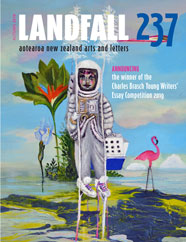
Landfall 237 edited by Emma Neale
Landfall 237 offers rich pickings for the poetry fans: familiar names (Peter Bland, David Eggleton, Elizabeth Smither, Ria Masae, Lynley Edmeades and Cilla McQueen) to emerging poets (Rebecca Hawkes, Claudia Jardine, essa may ranapiri) and those I am reading for the first time (Robynanne Milford, Jeremy Roberts, Catherine Trundle to name a few). The reading experience is kaleidoscopic, pulling you in different directions, towards both lightness and darkness, risk and comfort. And that is exactly what a literary journal can do. I was tempted to say should, but literary journals can do anything.
Landfall has a history of showcasing quirky artwork – and this issue is no exception. Sharon Singer’s sequence, “Everyday Calamities’ with its potent colour, surreal juxtapositions, strange and estranging narratives, and thematic bridges, is an addictive puzzle for heart and mind. I am circling humanity, the power of connection, the individual both tenacious and frail, the state of the planet. Paintings whirling and tipping you into moments that soothe, bewilder and provoke. I adore these.
I turned from these to Rachel O’Neill’s prose poem ‘The Supernatural Frame’ and get goosebumps:
You may look upon the painting through these special
foiled binoculars. We are at a safe distance. Afterwards you
may feel a chill or a fever linger for two days and a night,
accompanied by an infernal cough.
On the centennial of the birth of Ruth Dallas in Invercargill, I am also delighted to see John Geraets spotlight her poetry. Certain Dallas poems have always had a place in NZ literary anthologies (think ‘Milking Before Dawn’) but as readers we may less familiar with the wider expanse of her work. Like so many women poets of the twentieth century she is in the shadows. In his intro John suggests it is not clear how to include her ‘within more recent nexus based on gender, ethnicity, ecology, avant-gardism, faith or political affiliation’. He responds by assembling her words – culled from Landfall editor-contributor responses and her autobiography Curved Horizon – on the left-hand pages and his words on the right. He first sees in her poetry – compared with contemporary writing choices – predictability, regularity, un-excitement, regionalism; and then, by paying attention and refreshing his routes, he opens up poems to different movements. He moves in close to the poem. I love that. Much I could say on how we approach the women from the past! Expect 568 pages soon.
I absolutely love the poetry in this issue; it is both fresh and vital! I see neither formula nor dominating style but shifting stories, musicality, feeling, political bite, muted shades, bright tones.
Here are some highlights:
Joanna Preston’s poem ‘Allegrophobia’ carries you from birth to tardiness to spring in a layered on punctuality – a perfect little package.
Jasmine Gallagher’s ‘Be Still’ sent me to her bio because I want to read more by her. She is a doctoral student at the University of Otago and has previously been published in brief. Her poem is poetry as brocade – glinting for the eye and chiming for the ear.
Slattern: a
hoar frost:
a rime
Cold seed bed
Rot and slime
Another poet, Catherine Trundle, also sent me scavenging for more. She writes poetry, flash fiction and experimental ethnography. Her poem ‘The Caravan behind the Plum Tree’ is also an exquisite brocade.
This lush cusp of spring rides
pinkish, amoebic, wilding
the inside, every flesh ’n’ cranny
while the sunlight lunges in
through winter tidelines
of curtain rot
Tam Vosper’s ‘Ailurophilia’ was an equal hook for me. He is working on a PhD at Canterbury University that considers Allen Curnow and the poetics of place. Again this is brocade poetry: so rich in effect.
All Gallic pluck
and casual loft
you claim a suntrap,
slump sidewise down,
and unhinge your barbed yawn:
a shark to shoaling mice.
And I want to add Medb Charleton’s ‘I think I Saw You Dreaming’, Rebecca Hawkes’s ‘If I could breed your cultivar / I’d have you in my garden’ and Gail Ingram’s ‘The Kitchen’ to my list of brocade poetry. Glorious.
In contrast you have the spare deliciousness of Ariha Latham’s ‘Waitangi’. Another poet whose work I want to track down.
When I read Ria Masae’s “Jack Didn’t Build Here’ I can hear her performing its sharp mix of personal and politics – and it cuts into my skin. Six houses built. She carries us from the father’s house full of stories to David Lange’s Mangere home open to the locals: he ‘understood the pressures of fa’alavelave,/ cos he brown on the inside like that’. She bears us from the house her mum built with its’ celebration tables’ to the house Key built with its ‘security code gate’. She ends with a question (the house to be built?):
What house will Jacinda build?
Will it enable my daughters to build their own homes
of tangata whenua foundations and fa’a Samoa roofs
in this palagified City of Sales?
You can move from political bite to the glorious wit you often find in an Erik Kennedy poem. His ‘All Holidays Are Made-Up Holidays’ is no exception. Meet Cabinet Day – ‘we went along/ from house to house hanging little doors / around each other’s necks to hide our secrets’. Or the Feast of Holy Indifference. Genius!
Claire Orchard’s poem, ‘Breakages’, swivels on a set of shelves, on the objects that they hold, and in that satisfying movement speaks of so much more; the poem resembles a shelf of family history with peaks and troughs.
I enjoyed the way it had begun to display time
in the style of tottering, elderly people
I heard Joan Fleming talk about new poetry she was writing at the Poetry & Essay conference at Victoria University in 2017. The poems came out of her experience of camp life in Nyrripi and surrounding areas in Australia’s Central Desert. I was moved by her discussions of collaboration and consent, her attentiveness to the local. Two poems here – ‘Alterations’ and ‘Papunya is Gorgeous Dirty and I Second-guess my Purposes’ – come out of this experience. I can’t wait to see this in book form.
Finally a treat from Cilla McQueen. She has written ‘Poem for my Tokotoko’; it is personal, physical and abundant with the possibilities of poetry. Pure pleasure.
Sometimes I see you as an enchanter’s staff,
scattering poems like leaves to the west wind;
at others you’re practical, a trusty pole
by means of which, through quarrelling
undercurrents, I can ford turbulent water.
By means of which I put myself across.
This is such good issue – there are reviews and fiction I haven’t read yet, and the announcement of the Charles Brasch Young Writers’ Essay Competition 2019 – but on the poems only, it warrants a subscription. Yep – Landfall has its finger on the pulse of NZ poetry.
Landfall 237 page


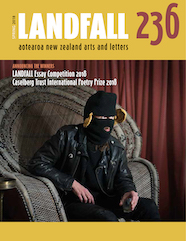
We have a wealth of literary journals (online and hard copy) at the moment that draw upon diverse communities and regions and that underline the fact poetry is currently piping hot in Aotearoa. Pick up a journal and you will find emerging voices, our poetry elders and everything in between – and that is as it should be. Loud quiet political personal inventive funny heartbreaking groundbreaking traditional mesmerising …. the list is endless when it comes to local poetry.
Landfall offers poetry, prose, reviews and artwork and comes out of Otago University Press with Emma Neale the current editor. It boosts its poetry review section by posting a bunch on line at the beginning of every month, and hosts the annual Landfall essay competition and the Caselberg Trust International Poetry Prize.
The latest issue is a hit with me on the poetry front because there is a pleasing diversity of voice and style, and a number of poems that have stuck to me like glue, and that I have shared with others.
But first the essays. The Landfall Essay competition is always on my annual must-read list. Emma selected the 2019 winning entries. In her introduction she talked about the way the best essays might be self-essays but also move beyond that to the gritty or glittery challenges of the world. I always think of an essay as a testing ground for ideas and at times a testing ground for how you convey those ideas which is why I love to read them. Essays can generate contagious feelings; but again, how that feeling is stitched into the writing gets tested. Emma’s introduction made me want to get back to an essay I have been working on for a year or so but, more importantly, read the winning entries.
Alice Miller’s winning essay, ‘The Great Ending’, closes in on the year 1918, on a false armistice and on Armistice Day. She juxtaposes events and anecdotes gleaned from newspaper cuttings and books and produces one of the best end paragraphs I have read in ages. A glorious read. I mused upon a future little handbook of essays that offer a selection of collaged years and a re-invigoration of history. Susan Wardell’s runner-up essay, ‘Shining Through the Skull’, is equally captivating. After reading Emma’s notes I was really keen to read the other placed essays.
Landfall has always promoted local poetry. Emma has selected an exquisitely contoured mix. On this occasion I find I am drawn to poems featuring various kinds of migration, movement and intimacies.
In Harry Rickett’s standout poem, ‘Pink Blanket’, the poet greets his 92-year-old mother and tries to tell her of his trip to India but she only (seemingly?) pays attention to her bared knee. This is the power of poetry – it takes you to a moment and makes you feel its intimacy. It felt like age as a form of migration.
I replace the blanket, try camels,
horses, donkeys, dogs, finally
an old photo of my long-dead father,
taken by her. ‘Do you know who
this is?’ She shakes her head.
She refolds the pink blanket,
exposes her bare left knee,
gives me a nose-crinkling grin.
Aiwa Pooamorn’s ‘A Thai-Chinese Stay-at-Home Mother gets Political’ gets both political, personal and utterly topical in a must-read kind of way. Home is both movement and necessary anchor.
I’m as Thai as Pad Thai noodles
invented to be the national dish
by military dictator Phibun
when actually it’s quite Chinese
all to create the myth
of a homogeneous monoculture
Thailand the land of smiles
pledge allegiance to
chaat (the Thai nation state)
satsana (the Buddhist religion)
phramahakesat (the demi-god King)
Siobhan Harvey’s ‘Someone Other than Yourself’ moves out from the sharp point of her migration from the UK, in a poem that completely unsettled me with its slender but potent admissions and wavery pronoun. The writing is sure-footed, the images clear, and the overall effect strange, intimate, puzzling. This is the kind of poem that adheres. I tried to select a piece to quote but the poem needs to stay together as if taking a bit out is a form of damage.
Landfall issue is rich in poetry that leaves its traces upon you in diverse ways: poems by essa may ranapiri, Tusiata Avia, Jodie Dalgleish, Elizabeth Kirkby-McLeod, Trevor Hayes, Helen Yong, Jane Arthur, Michael Mintrom, Jessica Le Bas, Richard Reeve do just that.
A bonus: In June 2017 a poem, ‘StreetNOISE’, attached to a building in Moray Place, closed down Dunedin’s central business district. The bomb squad was called, a court case ensure but charges were dropped. Justin Spiers offers seven images of the poet, artist and musician, L.$.D. Fascinating.
Plus David Eggleton’s picks for the Caselberg Trust prize, loads of fiction and reviews to get your reading teeth or heart into (so to speak).
Well worth a subscription I reckon.

‘Man Up’ from Tender Machines, Otago University Press, 2015
Emma Neale received the inaugural NZSA/Janet Frame Memorial Award, the Kathleen Grattan Award for an unpublished poetry manuscript (The Truth Garden), the University of Otago Burns Fellowship and the NZSA/Beatson Fellowship. Her poetry has been shortlisted for the Sarah Broom Poetry Award and the Bridport Poetry Prize, and her poetry collection, Tender Machines, was long-listed in the 2016 Ockham New Zealand Book Awards. Her novel, Billy Bird, was short-listed for the Acorn Prize in the 2017 Ockham New Zealand Book Awards and long-listed for the International Dublin Literary Award. She is the current editor of Landfall.
Otago University Press page
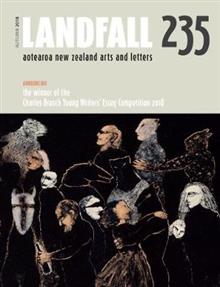
Landfall 235 launches Emma Neale as the new editor. The cover aptly features ‘The House Party’; Kathryn Madill’s monoprint is strange and seductive with sunken black space and textured skin. It is like a poem that tempts and then holds you in an intricate grip. There is a Madill sequence inside that is equally sumptuous, surprising, lyrical.
This is an addictive issue – think of it as a musical composition that carries you through diverse and distinctive reading effects across an arc from first poem to final story. I do hope more Pasifika, Māori and Asian poets send in submissions for the next issue to increase the diversity of voice.
The two visual sequences (by Madill and photogapher Russ Flatt) are stunning. Flatt’s photographs reconstruct memories from the ‘subconscious grief’ and experience of growing up gay in Auckland in 1970s and 1980s. Wow. This is the power of art to take you some place that transcends ideas and feeling but that is ideas and feeling.
Landfall 235 also includes the winner of the Charles Brasch Young Writers’ Competition, Aimee-Jane Anderson-O’Connor, fiction (including a keenly observed piece by Airini Beautrais) and reviews. It welcomes established elders such as Elizabeth Smither and Bernadette Hall and barely published authors such as Sarah Scott and James Tremlett.
Here are a few poetry highlights:
Tracey Slaughter has turned from her dark, edgy must-read fiction to poetry. She was recently shortlisted for the 2018 Peter Porter Poetry Prize and I can see why. Her poem, ‘the mine wife’, with short-line fluidity, fictional momentum building, spiky detail, gritty feeling, is all about voice. A vulnerable, risking, space clearing, ‘self’ admitting voice:
the hand is a useless
surface for showing
the love it takes
to clear a path. Under
layers you wait for me to sift
your face from its mask.
from ‘the mine wife’
Lynley Edmeades‘ list poem, ‘The Age of Reason’, kicks off from Jean Paul Sartre’s title to move from ‘longing’ to ‘baby’, scooping up Simone de Beauvoir on the way, and all the staccato thoughts that propel a micro portrait: because why because how because who. I adore this!
Because fear of death
Because a dog might do
Because antidepressants
Because déjà vu
Because the trees
Because the population
Because plastic
from ‘The Age of Reason’
‘A Love Letter to My Mother: A work in progress’ by Wen-Juenn Lee is layered and probing and direct. I am wanting to read the whole work:
She takes astronomy classes at night.
I do not ask her why she stargazes
what she looks for in the oily darkness
we go to a poetry reading on migrant women
I do not tell her
I remember her crying on the plane
from ‘A Love Letter to My Mother: A work in progress’
Nick Ascroft’s playful word shenanigans in ‘A Writer Wrongs’ are a delicious shift in key as rhyme binds writer, hater and waiter:
So my fish is pallid.
So there’s a little pebble in my freekeh salad.
Is it necessary a balladeer batters
out a ballad?
from ‘A Writer Wrongs’
I haven’t encountered Rachel Connor‘s poetry before. She is a medievalist and a postgraduate student in Otago University’s Department of English. I want to read more of her poetry! Her poem, ‘Home’, captivates with its quirky tropes and agile pivots upon ‘swan’:
A swan like a carved radish kickstarts its way across the water.
It should be easier
to temper my words and make iron gates of them,
to remember the names picked out in gold
that echo a memorial garden.
from ‘Home’
Tim Vosper offers my favourite ending in ‘The False Way to the Real’
When it comes time to kill the lamp
the leaf will turn into a shade.
from ‘The False Way to the Real’
I am fan of Sugar Magnolia Wilson’s poetry and have fingers crossed she gets a book out soon. ‘Betty as a Boy’ is lush with detail and movement:
And you, outside the upmarket grocer’s, camouflaged top, khaki pants
slashed with a silk of red, a backpack strung with things that clink,
disappearing into your androgyny— the inverse of a newly minted drag queen,
appearing like a flaming comet, burning to be noticed.
from ‘Betty as a Boy’
Here is another unfamiliar poet I want to see a collection from. Susan Wardell’s poem pulsates with glorious surprising life. I will quote a piece but I urge you to read the whole thing: place rich, lithely troped, visually sparking, enigmatic, humane. I am drawn to the voice, to the word hunger, to the portrait built.
They say
when meaning is gone, all that is left
is the grain
of the voice.
Well, hers sweeps the room like salt-flecked taffeta.
from ‘Grain of her Voice’
Writing journals, literary journals open up new avenues of reading and engagement. Landfall 235 is no exception. I have not finished, I have not yet read the reviews and all the fiction, but congratulations Emma Neale, you have taken the literary torch from David Eggleton, and the boost he gave, and turned your astute editorial eye to our advantage. I have new poets I am keen to track down. I have seen familiar poets with fresh eyes. Kind of like a poetry house party in my head.
Landfall page
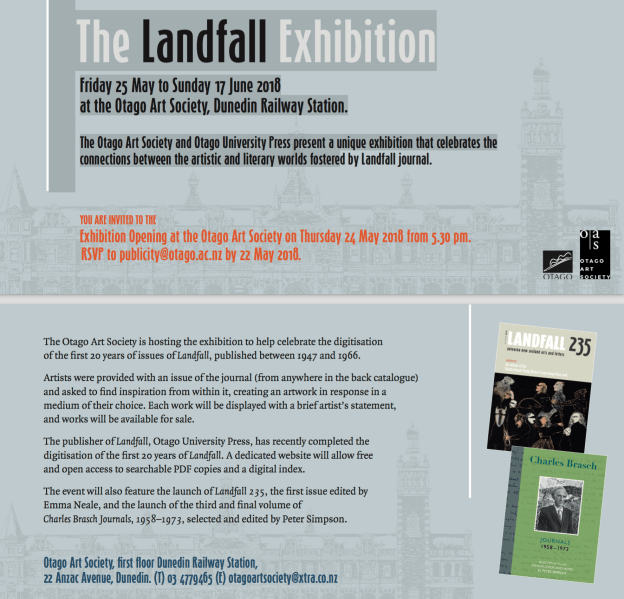
You can also go to the Landfall Exhibition if you live in Dunedin. Opening is Thursday May 25 at 5.30 pm.
My mother read aloud a lot of AA Milne, Beatrix Potter to me and my sister when we were small; I loved the Narnia books; and one novel that still stands out for me was a copy of The Last of the Great Whangdoodles, by Julie Andrews Edwards – it was a book bought for the plane flight to America when I was 8. There was something momentous about it being a hardback, being written by the person I thought of as Mary Poppins, and its imaginative fantasy world, with moments of ludicrous word play (the sweet tooth – a tooth with a tiny flower tattooed on it) totally transported me.
Full article here
Called
(2015)
It is October in Dunedin.
Rhododendrons fan out flamenco skirts;
magnolias, magnanimous with their moon-cool glow,
light the path south so the sun stirs us early;
although the river, the creek boulders,
the city’s cinched green belt, still hold the cold
like an ice store’s packed down snow.
The days shiver with filaments
of ua kōwhai: soft rain that dampens paths,
shakes loose carpets of white stamens, yellow flowers
bruised and trodden like flimsy, foil cornets.
School holidays send out falling, silvery arcs
of children’s sky-flung laughter; our bodies drink it in
as if love’s parched ground sore needs this watering.
Yet the radio stays hunched in the kitchen corner,
hard grey clot in the light’s fine arteries
muttering its tense bulletins
and as if they sense this late spring still harbours
frost’s white wreck, or some despotic harm abroad
seeps too near, our sons more than anything want
their old games: secret codes, invisible ink, velvet cloaks;
hide ’n’ seek in public gardens’ clefts and coves—
and again, again, can we tell them again
the chapters of how they first appeared
in the long, blurred myths we are entangled in;
kingfisher-blue wells of their eyes a-gleam
as if they know how much all adults withhold.
They want us to go back deeper, to when
we both were star-spill, sea-flume, spirits,
only belatedly woman, man, climbing up from a shore
feathered in sand black and soft as ash,
driven by some gravid magnetism towards each other
in case we changed to birds, lizards, trees,
or back to sea-salt borne by wind;
an urge clear as hunger coursing the cells’ deep helix
to complete this alteration, half bury and re-germinate
the fleet molecules of self, so we could run our mortal hands
the right, kind way along the children’s plush skins,
learn, pulse on pulse, their true, human names.
Yes, we must go back and back; as if to swear
even to this dread epoch’s wild, original innocence.
©Emma Neale
Emma Neale received the inaugural NZSA/Janet Frame Memorial Award, the Kathleen Grattan Award for an unpublished poetry manuscript (The Truth Garden), the University of Otago Burns Fellowship and the NZSA/Beatson Fellowship. Her poetry has been shortlisted for the Sarah Broom Poetry Award and the Bridport Poetry Prize, and her poetry collection, Tender Machines, was long-listed in the 2016 Ockham New Zealand Book Awards. Her novel, Billy Bird, was short-listed for the Acorn Prize in the 2017 Ockham New Zealand Book Awards and long-listed for the International Dublin Literary Award. She is the current editor of Landfall.

I have a swag of poetry books from 2017 that I have not yet got to – but over the next months I am flagging them through a suite of Summer Postcards.
How important is it that our poetry books get reviewed?
Poetry books get so little attention in the media these days. NZ Books still offers a handful of poetry reviews. Not sure about Takahe. There is Landfall-on-line steered by poet Emma Neale and the occasional attention in print media (Siobhan Harvey in The Herald). For members there is the quarterly NZ Poetry Society Review. There are a few reviews at The Spin Off or in The Listener. Poetry (USA) recently did a NZ cluster and you find some in the Poetry New Zealand Annual. Pantograph Punch has supported poetry, but until they can pay reviewers a decent amount, they are no longer doing reviews.
From The Pantograph Editors:
The Hardest Call
Because of these changes, we’ve made the difficult decision to hit pause on publishing reviews. It’s been one of the toughest decisions we’ve made.
During the existential crisis of 2017 (refer above) we came to the somewhat crushing realisation that in underpaying our writers (sometimes as low as $50 a review), we were contributing to a structure that systematically devalues those writers and privileges voices who can afford to write for low pay. In trying to support critical culture, we were simultaneously contributing to its decay.
It’s one of the hardest decisions because it feels so contradictory: we’re stopping doing one of the exact things we believe in the most.
We strongly believe in critical dialogue, and one of our areas of focus for 2018 is finding a way to bring reviewing back. We’re committed to creating a sustainable pathway for future critics, so one of the things we’ll be doing is creating a fund which will be dedicated to commissioning reviews. Our commitment is to be able to pay reviewers a minimum of $300 per review, and if you feel as strongly about this as we do, we invite you to donate to that fund here.
Pantograph Punch
You can read the full piece and contribute to the funding call here. They favour posting less (one a week) and building a climate of critical dialogue. This is exciting news. Bravo PP!
We are hungry for critical forums. Joan Fleming recently started a vital discussion on reviewing with her Facebook friends:
The Question of Claws
As I step into a new role at Cordite Poetry Review – that of NZ Commissioning Editor – I have been troubling my head about how critical to be of New Zealand poetry books that strike me as undeveloped. Particularly when I’ve admired a writer’s poems in journals, and am frustrated by their book; or am struck by the first few stunning poems of a collection, which then disappointingly levels out. It is tough to be honest in a poetry culture that is so intimately small. Often in our poetry reviewing, there is gentleness where I want rigour, and there is faint praise where I want productive disagreement. We are overly careful because we are reviewing friends and colleagues. We don’t want to offend. It is tricky. Do aesthetic battles push writers to better writing, or ought we to only support and encourage each other, trusting that we are all already pushing ourselves?
On the one hand, the stakes are so low: there is no money, there is no fame (except for the occasional meteoric anomaly!), and poetry is hardly a career. On the other hand, the stakes are painfully high. We are talking about our raw-edged souls on the page here. In a Facebook thread, I asked the question (provocatively worded, I suppose): “Should we be showing our claws more often?” For claws, read: Do I dare to write a thoughtful yet unfavourable review? I hope to think there is nothing in me that wants to tear down other writers because of agendas, grudges, or jealousies – but we all have our lenses and leanings, our sometimes-unconscious preferences and biases.
I, myself, am trying to thicken up my own dreadfully thin skin. A solution to this bind (and this is not an original thought – I think Ellie Catton suggested this way back) is to foster more trans-Tasman reviewing: New Zealand poets reviewing Australians, and Australians reviewing New Zealand books. At Cordite, we’re doing a little of this. We have lots of NZ books on our review list. I wonder if a New Zealand publication might take up this challenge? (Pantograph Punch: I’m looking at you!)
Joan Fleming
Last week I posted a piece on my Poetry-Shelf aims to see if it was worth keeping up the blog. Is it relevant? Does it matter that I do this? I want to post poems and do reviews, interviews, news, events, musings on local and international poetry. And at times involve other people (as I have done), but in the current drive for decent payment, how can this possibly work?
I strongly believe we need a go-to-place for NZ poetry that crosses borders of all kinds. I like the idea of a mix of reviews (long and short) so that a decent number of published books catch your attention. Ha! so there is a new James Brown out! Or Joan Fleming is reading from a new book at TimeOut (if only!).
To have a long review of your book where the reviewer has paid utmost attention is ideal. But to have no reviews and feel like your book has drifted into the ether is heartbreaking.
I posted this on Joan’s Facebook feed:
I review books on my blog that I love. My life is too short to absorb the toxic fallout of writing about books that I don’t love. I aim to celebrate and explore what a book of poetry might do.
I so often read negative reviews that incense me because the writers seems straitjacketed by a narrow reading and clear bias (I don’t like experimental poetry but here I am reviewing it kinda thing!). Or poets and reviewers who insist there are certain things a poem must do, and if it doesn’t, then it is a failure.
I am not afraid to put my claws out when an important book warrants it – as with the AUP literary omnibus. That attracted utter venom towards me on social media and affected me in all kinds of other ways – but I would still do it. My doctoral thesis (Italian) challenged the way the academy is driven to deconstruct and tear apart, rather than forge connections and produce different intellectual models of thought.
That said, in a world that continues to privilege the status of white men, we still need claws to unpick the ideas that shape us and that we so easily become immune to and accept.
Ellie Catton once used the word kindness in talking to students about writing. Our PM has used the word in view of governing a nation. I want to review out of kindness. That doesn’t mean I will say things I don’t mean when I talk about your poetry. It doesn’t mean I only say good things. It means I pay attention to the fact a human being has written it. It means I work hard to find path ways through a book that might present itself with shuttered windows on foreign pathways on a first reading.
Sometimes the bridge between the reader and a book fails. When I can’t cross that bridge, I am going to share a book where I can.
I believe we can have critical discussions and write out of state of kindness.
This may not be the majority point of view, but it is my view. I have almost finished a book that rescues some of the women from the past who have been misread, unread, muted and sidelined by men with their claws out because in their view the women were not writing poetry.
We, as women poets, have come a long way since our banishment to the shadows, but things are still not ideal. So I will continue to be part of the small (and it is SO very small) group of writers who go public on what they love (outside institutions, financial reward and so on, so beholden to nobody) because I want you (in the widest reach a pronoun is capable of) to fall in love with poetry and what a poem can do.
As I said at the Poetry & Essay conference in Wellington in December this is a matter of JOY!
 NZ Poetry Shelf