
We are well served by literary journals at the moment. Each delivers slightly different treats, biases, focuses but all offer high quality writing that resist any singular NZ model.
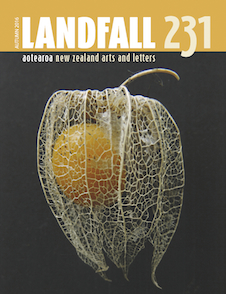
The latest Landfall (as you can see) has a stunning cover with its Peter Peryer photograph.
Inside: poetry (37 poets!), fiction, non-fiction, art and book reviews (including an excellent review of Anna Smaill’s The Chimes, one of my top fiction reads of the past year).
The poets range from the very familiar, whether young or old, to those new to me. And that is as it should be. David Eggleton is keeping the magazine fresh whilst giving vital space to our literary elders and maintaining a strong and welcome Pacific flavour.
A tasting plate of lines that got me (I seem to have been struck by mothers, fathers, surprising images, little twists):
from Brian Turner’s ‘Weekends’:
think of what a place could be
when it’s not what we possess
that counts most
but what we are possessed by
from CK Stead’s ‘One: Like a bird’ (for Kay):
You were beautiful, and I
sang, as I could in those days
all the way home—like a bird.
from Leilani Tamu’s ‘Researching Ali’i’:
I searched for you in boxes
the archivist muttered poison
from Rata Gordon’s ‘A Baby’:
I want to make a baby out of one peach and one prickle.
I want to use the kitchen sponge, sticky rice and a rubber band.
I want to use the coffee grinder.
from Siobhan Harvey’s ‘Spaceboy and the White Hole’:
he pictures matter barely visible, the light
of white holes as they transmit their secret
messages, sharp elegies, about letting go.
from Ruth Arnison’s ‘The Visit’:
Even from the road her house gave us the creeps.
Pale, communion wafer thin, and disapproving,
its severe windows three-quarter blinded.
from Heather McQuillan’s ‘In which I defend my father’s right to solitude’:
our father has a fine tooth way
of finding vulnerabilities
on the outward flanks
the wolf is always at his door
from Doc Drumheller’s ‘My Father’s Fingers’:
Days after my father died I felt a sense
of urgency to take care of his hot-house.
from Koenraad Kuiper’s ‘from Benedictine Sonnets’:
Mother always knitted particularly socks.
Knitting socks is a fine skill under the lamplight.
from Elizabeth Smither’s ‘Three “Willow” Pattern Bowls’:
My father thought I meant the plate
and wrapped one from the china cabinet
I carried it close to my heart
all the way back for a second reprimand.
from Bob Orr’s ‘Seven Haiku’:
I don’t care about
frogs
basho’s dead
from Will Leadbetter’s ‘Three Variations on “The Red Wheelbarrow” by William Carlos Williams’:
Nothing depends upon
the green wheelbarrow
Great winter reading!
This event prompted me to hunt for cheap fares to Wellington because it seemed like a rare and special poetry occasion. And it was! A sold-out event!
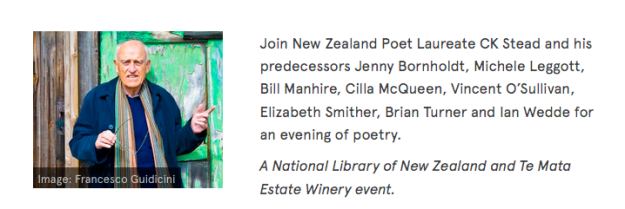
The National Library, as current administrator of the NZ Poet Laureate awards, hosted the evening as part of Wellington Writers Week. John Buck from Te Mata Wines instigated the Laureateship in 1997, with Bill Manhire taking the debut spot. John was there with wine to share. He still retains an involvement.
Fergus Barrowman from VUP was the MC. He made the important point that the award is ‘an activist portfolio not just an honour.’ The earliest debut publication by a Laureate was in 1964 while the most recent debut was 1988. Three generations of poets! Cilla McQueen and Michele Leggott calculated over 700 years of life/poetry experience across the ten laureates to date.
Bill Manhire (1997) spoke about what the Laureateship meant to him and the two ways it expanded his sense of what he might do as a poet, as a public figure. Firstly he began to write poems with some kind of public dimension. Secondly he explored the way the role centred on the promotion of poetry. He wanted to ‘talk it up.’ Both are options we can be thankful for. Bill’s poems that stand on a public stage are poems that embrace the knots and crests of humanity. I talked about the way ‘Hotel Emergencies’ does this on Summer Noelle in January.
Bill read ‘Erebus Voices’ and I sat there thinking this is a poem that belongs in the world and can be heard again. And again. And then again. Because it both moves and matters. Bill shows so adeptly the way poems can shift us to laughter, to wry grins at the surprise of it all, but also lead to far more unfathomable movements of the heart.
‘I am here beside my brother, terror./ I am the place of human error.’
I especially loved the way he started with the poem of a fellow poet. He ‘talked her poem up,’ and I fell in love with it all over again: Rachel Bush’s ‘The Strong Mothers.’
Hone Tuwhare was represented by his son Rob. We listened to Hone read ‘No Ordinary Sun,’ we listened to Rob read Hone and then Rob picked up his guitar and sang a Graham Brazier version of one of the poems. A version of friendship. Quiet, haunting, utterly melodic. This was love. Hairs standing on your arm on end from start to finish in the Tuwhare bracket.
‘Oh tree/ in the shadowless mountains/ the white plains and/ the drab sea floor/ your end is at last written.’
Elizabeth Smither read a cross section of poems that delighted the audience. But one as-yet-unpublished poem in particular stuck to me. Kate Camp, her mum and I – all went ‘wow.’ I adored the story of Elizabeth seeing her mother move through her house, the windows bright, unaware of the daughter driving by. By the time I got to congratulate her, dear Elizabeth had already signed her copy for Kate. How lovely! Like a bouquet of flowers. Elizabeth emailed the poem so I can read and write about it for my book.
‘It was all those unseen moments we do not see/ the best of a mother/ competent and gracious in her solitude’
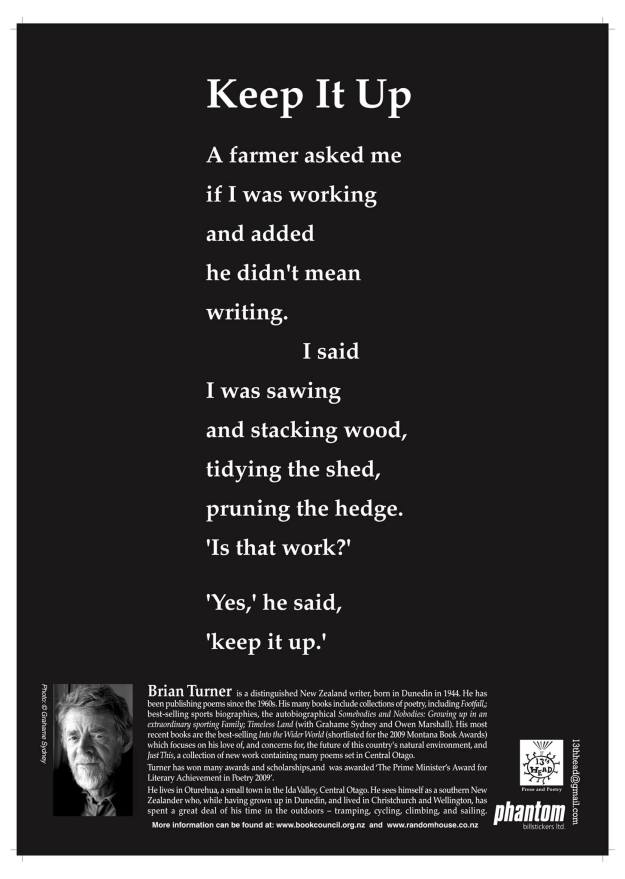
Brian Turner with his delicious wit said: ‘I’ve been called a political animal many times and it’s not always a compliment!’ And that is what makes his poems so enduring. The way he hits the right pitch of land and sky but with a deep love that is unafraid to match beauty with issues. He read a cluster of short poems where every word sang. Gee whizz this was good. Here are few lines I loved without the line breaks (sorry):
‘and the shadows are mauve birthmarks on the hills’
‘If the sky knew half of what we were doing down here it would be inconsolable and we would have nothing but rain’
‘where a river sings, a river always sang’
See what I mean!
Jenny Bornholdt
Jenny rued the way Wellington Writers Week has dropped ‘readers’ from the title. She said she would reclaim readers, in the perfect setting (the library), with a longish poem: ‘A long way from home.’ This was a highlight for me. The poem is all about illness and reading; the ability to read and a time when it flees. Here are some sample lines:
‘How as a child, books were the lens// through which I eyed the muddy track to adulthood’
‘For six weeks now I’ve been outside weather/ and of reading. Outside of myself.’
‘I have tried to read but nothing/ sticks. That anchor of my life has been raised and// I’m all at sea.’
Michele Leggott, like Bill, brings poetry to a a public arena through her tireless promotion and expansive love. Michele read an extract from a long work (‘The Fasciclies’) that bridges Taranaki and Lyttelton, the 1860s and the 1970s, and the connections between two women.
My notebook is full of Persian-like doodles of birds and shapes interspersed with notes but, as I listened to Michele, my pen stalled. I felt like I could hear Robin Hyde with her luminous detail and observations in the seams. For this was luminous writing. There is a bridge between reader and poem. Sometimes you cross it. Sometimes it seems impassable. I just wanted to cross the bridge and read the whole poem.
You can find the whole piece here.
Cilla McQueen read ‘Ripples’ a long poem that showcases her strengths as a writer. It is in her latest collection, The Radio Room (2010). Another highlight. Other poets make an appearance, Joanna and Hone. Moving. Uplifting in a way.
‘After the funeral service you leaned down towards me out of a cloud;/ “Kia mau!” you shouted into my mind.’
Cilla McQueen’s memoir is due next week from Otago University Press.
Ian Wedde also has a childhood memoir out, The Grass Catcher, which is on my must-read list. Ian’s poetry produces my ideal poetry trifecta of relations: music, ideas, heart. Oh! And singing its way through, a sense of story. He read from ‘The Life Guard.’ Ha! It’s all here. Listen to the start:
‘You have to start somewhere/ in those morose times,/ / a clearing in the forest say,/ filled with golden shafts of sunlight// and skirmishes’
Vincent O’Sullivan has a new book out from VUP, which I am about to review for a newspaper, so perfect to hear him read his poetic contours. He has the ability to refresh anything. To tilt tropes, to enhance the music of a line, to poke you with an idea, to make you feel. Once again I got caught up in the moment of listening and didn’t catch lines in my notebook.
Ck Stead is the current Poet Laureate. He began with a poem about Allen Curnow, who he felt would have been Laureate if he had lived within the Laureate time span. Karl had struggled over whether to read a top-hit kind of poem or read new things. I know that feeling and first thought I would only ever read a poem once in public when first published. That soon fell by the wayside.
It was a moment of audience empathy as Karl confessed he thought he would read it, then wouldn’t, then finally after hearing Bill, decided he would. And we were glad, indeed, as he read an elegy for his mother. Utterly moving.
Poetry is such a love for Karl. He made this clear when I was filming his ‘thank you’ speech for the Sarah Broom Poetry Award. And hearing him read on this occasion, lifted the poems off the pages where I have loved them, to a new life in the air/ear.
from ‘Elegy’ but without that scattered layout that makes much of white space (sorry):
‘She’s there somewhere/ the ferryman/ assures me.// He tells me/ she was reluctant to go/ but silent – // stood in the prow/ no tears/ and never looked back.’
Karl filled the room with the warmth of poetry. Music. Heart. Ideas. A perfect end.
The tokotoko table, with all the talking sticks carved especially for each poet, was like a quilt with stories. I wished someone had held up the mother tokotoko for all to see and told that story. And indeed held up each tokotoko, for each tokotoko has its own.
Karl will get his at the Matahiwi ceremony in April. I am honoured to be part of this occasion along with Gregory O’Brien and Chris Price.
A Circle of Laureates was a magnificent occasion. I bumped into Elizabeth Knox the next day and we were both enthusing about how good it was. Peter Ireland from the National Library had put in all the hard work! Kindly acknowledged on the night by Ian. Every poet held my attention. There is a big age range here, but to me, it is a way of honouring our poetry elders.
As a poet, I write with one foot in the past and one foot in the future.I want to know who I’m writing out of. This is my tradition. This is my innovation. This circle.
It reminded me of Selina Tusitala Marsh’s’s poem ‘A Circle of Stones in her debut collection where she honours the women she writes from, towards and beside.
Thank you to everyone who made this event possible. It was worth my spur-of-the-moment cheap flight, my accidental data blow out, my misbooking home that meant a new booking, the chance to hear the Lauris-Edmond finalists, and losing myself in Jessie Mackay in The Alexander Turnbull Library. Thirty-six hours of poetry. Heaven.
Thanks! Ten Poets Laureate to celebrate!


For the full programme see here but this is the poetry on offer.
I would love to go to the Laureate Circle but can’t make it at this stage (might just fly down on a whim!). I would really like to post pieces on any of the poetry events at the festival. Any takers?
Friday March 11th 7pm A Circle of Laureates
Friday March 11th 5pm Anis Mojgani and Marty Smith
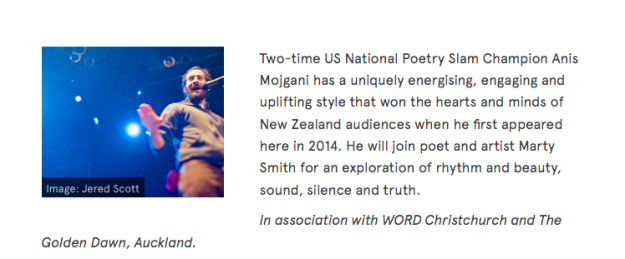
Thursday March 10th 1.45pm Anis Mojgani
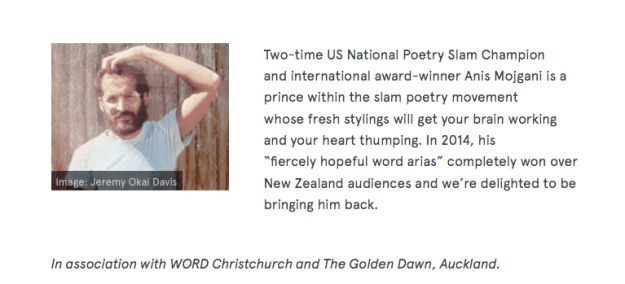
Sunday 13th March 2.30 pm Anis Mojgani with Mark Amery
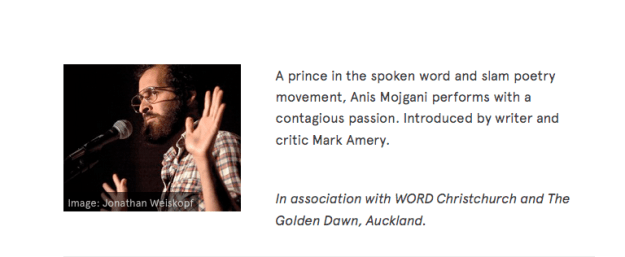
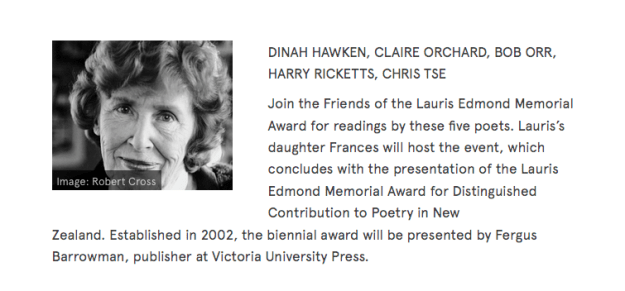
Saturday 12th March 3.30 pm Five Poets and a Prize
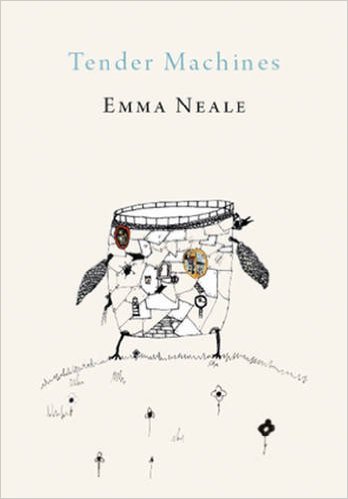
My pick is Emma Neale’s Tender Machines (OUP). Emma’s poetry is resonant on many levels and repays close reading. In her supple, expert language, she takes a loving look at the human condition in a collection which has depth, wisdom and insight.
Cilla McQueen
Mostly I read poetry and non-fiction, and a lot of the latter is to to do with environmental issues in an effort to understand and do something about the disgusting rate at which we’re destroying the place. Recently I read Michael McCarthy‘s The Moth Snowstorm, which Helen Macdonald termed ‘a deeply affecting memoir and a heartbreaking account of ecological impoverishment’. I concur. Much of what McCarthy writes about mirrors what’s happened and continues to here, in NZ, and elsewhere.
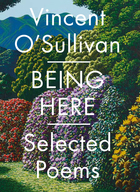
Three of the volumes of poetry that I’ve read and liked most in the past year are Robin Robertson‘s The Wrecking Light, Vincent O’Sullivan‘s Being Here, and Emma Neale‘s Tender Machines. Robertson doesn’t pussy-foot around, covers a lot of ground, can be caustic, blunt, wry and shattering. O’Sullivan ranges widely both in tone and content. Apart from the wry and sly ways he approaches things I like the ways in which he highlights human absurdities. As I hear him, it’s not as if we’re too much troubled by human absurdity, it’s that we’re not troubled enough. In Emma Neale’s Tender Machines she grapples with long-standing human predicaments, the difficulties we have personally keeping a lot of the ‘ongoing human symphony’ playing while trying to work out how to silence our dreadful ‘inner racket’.
I’d like to be able to buy and read far more NZ poetry than I do these days. Back in the 1960s, when I began trying to write poems, it was possible to be familiar with nearly all of the volumes of poems by NZ writers. Not now; the result is great gaps in one’s reading. Does it matter? I don’t know.
Brian Turner
At What Stage
Here’s a big question: at what stage
do we ask, not how to live, but for what?
It wasn’t something that troubled you
when you lived in an old wooden house
in North Dunedin in the 1950s, before
puberty thrummed and most of your ilk
walked or rode bikes to school or down
to the river mouth and the wharves to fish
for trevalli and mullet in their thousands.
To many Christ was still our Redeemer
and All Blacks the epitome of manhood
without appearing naked and tanned,
except for tight-fitting jocks, in days
when only academics went on sabbaticals.
Days before you witnessed both men
and women weep, and you’d yet discover
what greed undoes and acquisitions bury,
and you’d still to learn just how destructive
being so-called constructive can be. And
that innocence precedes despair
and what follows comes at you bitter as sleet:
full-frontal foreboding, then fear.
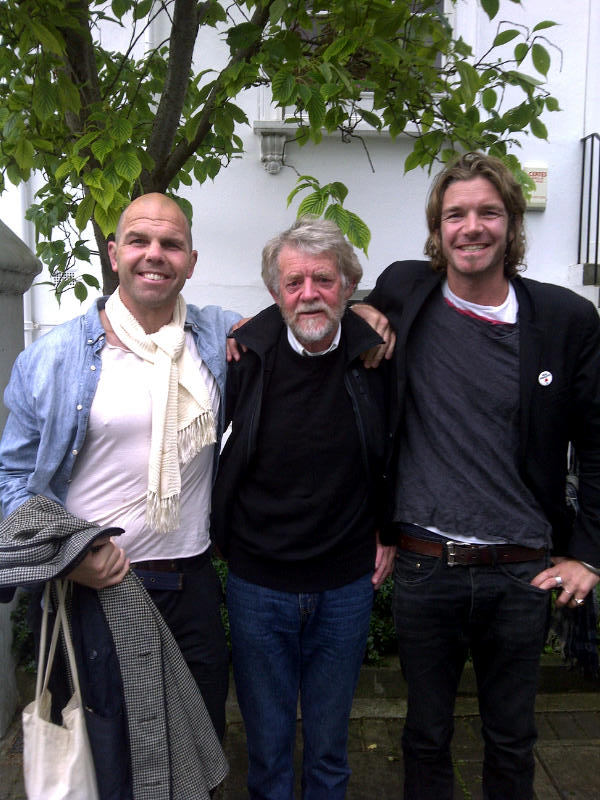
Author’s Bio: BRIAN TURNER is a well-known New Zealand writer and a member of one of his country’s most famous sporting families – his brothers, Glenn (cricket) and Greg (golf), were distinguished sports internationals. I mention this because I think it has given me closer contact with a wider range of New Zealanders and others elsewhere than I would have experienced otherwise. It has allowed me access to a wider world than many writers I know have enjoyed. As a result it has broadened my understanding of my country, my homeplace.
Turner is a former New Zealand hockey player (also captain of Otago and Wellington) and has published best-selling sports biographies (with Colin Meads, Josh Kronfeld, Anton Oliver and Glenn Turner). His many other books include the autobiographical Somebodies and Nobodies: Growing up in an extraordinary sporting Family; Timeless Land (with Grahame Sydney and Owen Marshall); and numerous collections of poetry, including Ladders of Rain (joint winner Commonwealth Poetry prize 1978), Beyond (winner NZ Book Awards for Poetry 1993), and Just This (winner NZ Post Book Award for Poetry 2010). He was the Te Mata Estate NZ Poet Laureate 2003-05.
In 1994-5 he held an Arts Council Scholarship in Letters. He was Robert Burns Fellow at the University of Otago in 1984 and Writer in Residence at the University of Canterbury in 1997. He was awarded the Lauris Edmond Memorial Award for Poetry in 2009 and ‘The New Zealand Prime Minister’s Award for Literary Achievement in Poetry 2009’. He received an Hon D Litt from the University of Otago in 2011. His most recent books are the best-selling Into the Wider World (shortlisted for the 2009 Montana Book Awards) which focuses on his love of and concerns for the future of this country’s natural environment, Just This, winner of the NZ Post Book Award for Poetry in 2010, and a further collection of poems, Inside Outside (2011). A major collection of new and previously published work, Elemental – Central Otago Poems (with photographs by Gilbert van Reenen) was published in August 2012.
Author’s note: Re ‘At What Stage’, hard to answer where poems come from. I’m a product of my roots and my reading. It’s in part ‘about’ where I come from, what life was like back then for me (1940s and 50s) and how much has changed and what I’ve made of it. It’s about our passage from who knows where to whatever follows. I have concluded that humankind has lost the plot, that we’re resolutely ‘shafting the future to serve the present’ (as George Monbiot put it), and that wilful blindness and delusion dominates our thinking everywhere. As Margaret Atwood pointed out we’re using up nature’s capital too fast and nature’s calling in her debt. A considerable proportion of the people who run NZ aren’t leaders, they are followers of that which is failing us and destroying much upon which all things depend. And so on and on…
Paula’s note: Brian has the ability, more than any poet I know, to catch the New Zealand landscape within the economy of a poem. As you read these offerings, a richness of place unfolds; through light and dark, through the changing seasons. The poem becomes a transcendental point of contemplation. Beauty draws closes. Yet there is so much more to Brian’s poetry than the spectacular lift of Southern landscapes. Place might be fodder for the eye, but there is also that ongoing concern with how we occupy place. How we protect it and how we damage it. Thus amidst the homages you find the political edge across the spectrum of his work that highlights all shades of greed, apathy and ignorance. I love the way this poem reflects the way our relations and engagement with the world makes subtle shifts in our passage from youth to adulthood. The humour. The bite. The underlying notion that some things matter very much indeed.
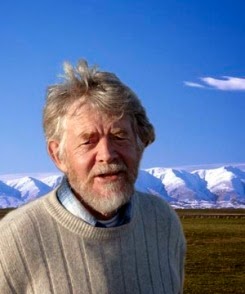
Otago poet Brian Turner has been awarded the $500 first prize for his poem ‘Mulching’, in the annual Caselberg Trust International Poetry Competition.
Second prize ($250) went to Dunedin-based writer Annelyse Gelman for her poem ‘Auden,’.
Poems by Mary Macpherson (Wellington), Lynley Edmeades (Dunedin) and Jessica le Bas (Nelson) were highly commended by this year’s competition judge, the distinguished poet Sue Wootton. Another entry from Brian Turner was also highly commended.
In her report, Ms Wootton said that each of the winning entries was ‘adeptly tuned, attentive to itself at every turn. What is said is inseparable from how it’s said.’ Over 200 entries were received for this year’s Caselberg Trust International Poetry Competition, from writers working in several different countries. Entries are judged ‘blind’, with the judge being completely unaware of the author’s identity until after the final decisions have been made.
The prize-winning poems and the judge’s report will be published in the May issue of Landfall, and together with the highly commended entries, will be posted on the Caselberg Trust web-site next month. Awards will be presented at a function at the University Book Shop in Dunedin, in April.
Past winners of the Caselberg competition include Mary McCallum from Wellington, and Tim Upperton from Palmerston North (who won two years in succession). Previous judges have been poets Bernadette Hall, James Brown and Gregory O’Brien.
The Caselberg Trust was established seven years ago to buy and renovate the former home of writer John Caselberg and his wife, the painter Anna Caselberg. The Caselberg house is now a residence for writers and artists of all descriptions, and the Trust runs residencies, workshops, exhibitions, and innovative arts events for the wider Dunedin community.
Robert West
Secretary Caselberg Trust
PO Box 71 Portobello Dunedin
 NZ Poetry Shelf