Tag Archives: Bill Manhire

Dinah Hawken to open WORDSONGS

I seem to have been a roving poetry reporter these past few weeks but time to shut the hatches and stay at home. This event will be good – I judge this on my experience of hearing Hannah sing Bill at the AWF a few years ago. Transcendental experience.

I urge you to check this poetry event out and would love a wee response from a poetry patron to post on the blog.


Screen Shot 2016-03-23 at 10.12.24 AM.png


Screen Shot 2016-03-22 at 6.28.24 PM.png


Tickets $20 from Eventfinder or Darcey’s Fruit Shop.  Limited door sales at $25.

QUERIES: Gilbert Haisman.  Tel 04 904 8428 or 022 0122 103. Email: thewordshop@paradise.net.nz

A Circle of Laureates, a galaxy of poetry

This event prompted me to hunt for cheap fares to Wellington because it seemed like a rare and special poetry occasion. And it was! A sold-out event!

The National Library, as current administrator of the NZ Poet Laureate awards, hosted the evening as part of Wellington Writers Week.  John Buck from Te Mata Wines instigated the Laureateship in 1997, with Bill Manhire taking the debut spot. John was there with wine to share. He still retains an involvement.

Fergus Barrowman from VUP was the MC. He made the important point that the award is ‘an activist portfolio not just an honour.’ The earliest debut publication by a Laureate was in 1964 while the most recent debut was 1988.  Three generations of poets! Cilla McQueen and Michele Leggott calculated over 700 years of life/poetry experience across the ten laureates to date.

Bill Manhire (1997) spoke about what the Laureateship meant to him and the two ways it expanded his sense of what he might do as a poet, as a public figure. Firstly he began to write poems with some kind of public dimension. Secondly he explored the way the role centred on the promotion of poetry. He wanted to ‘talk it up.’ Both are options we can be thankful for. Bill’s poems that stand on a public stage are poems that embrace the knots and crests of humanity. I talked about the way ‘Hotel Emergencies’ does this on Summer Noelle in January.

Bill read ‘Erebus Voices’ and I sat there thinking this is a poem that belongs in the world and can be heard again. And again. And then again. Because it both moves and matters. Bill shows so adeptly the way poems can shift us to laughter, to wry grins at the surprise of it all, but also lead to far more unfathomable movements of the heart.

‘I am here beside my brother, terror./ I am the place of human error.’

I especially loved the way he started with the poem of a fellow poet. He ‘talked her poem up,’ and I fell in love with it all over again: Rachel Bush’s ‘The Strong Mothers.’


Hone Tuwhare was represented by his son Rob. We listened to Hone read ‘No Ordinary Sun,’ we listened to Rob read Hone and then Rob picked up his guitar and sang a Graham Brazier version of one of the poems. A version of friendship. Quiet, haunting, utterly melodic. This was love. Hairs standing on your arm on end from start to finish in the Tuwhare bracket.

‘Oh tree/ in the shadowless mountains/ the white plains and/ the drab sea floor/ your end is at last written.’


Elizabeth Smither read a cross section of poems that delighted the audience. But one as-yet-unpublished poem in particular stuck to me. Kate Camp, her mum and I – all went ‘wow.’ I adored the story of Elizabeth seeing her mother move through her house, the windows bright, unaware of the daughter driving by. By the time I got to congratulate her, dear Elizabeth had already signed her copy for Kate. How lovely! Like a bouquet of flowers. Elizabeth emailed the poem so I can read and write about it for my book.

‘It was all those unseen moments we do not see/ the best of a mother/ competent and gracious in her solitude’


Brian Turner with his delicious wit said: ‘I’ve been called a political animal many times and it’s not always a compliment!’ And that is what makes his poems so enduring. The way he hits the right pitch of land and sky but with a deep love that is unafraid to match beauty with issues. He read a cluster of short poems where every word sang. Gee whizz this was good. Here are few lines I loved without the line breaks (sorry):

‘and the shadows are mauve birthmarks on the hills’

‘If the sky knew half of what we were doing down here it would be inconsolable and we would have nothing but rain’

‘where a river sings, a river always sang’

See what I mean!


Jenny Bornholdt

Jenny rued the way Wellington Writers Week has dropped ‘readers’ from the title. She said she would reclaim readers, in the perfect setting (the library), with a longish poem: ‘A long way from home.’ This was a highlight for me. The poem is all about illness and reading; the ability to read and a time when it flees. Here are some sample lines:

‘How as a child, books were the lens// through which I eyed the muddy track to adulthood’

‘For six weeks now I’ve been outside weather/ and of reading. Outside of myself.’

‘I have tried to read but nothing/ sticks. That anchor of my life has been raised and// I’m all at sea.’


Michele Leggott, like Bill, brings poetry to a a public arena through her tireless promotion and expansive love. Michele read an extract from a long work (‘The Fasciclies’) that bridges Taranaki and Lyttelton, the 1860s and the 1970s, and the connections between two women.

My notebook is full of Persian-like doodles of birds and shapes interspersed with notes but, as I listened to Michele, my pen stalled. I felt like I could hear Robin Hyde with her luminous detail and observations in the seams. For this was luminous writing. There is a bridge between reader and poem. Sometimes you cross it. Sometimes it seems impassable. I just wanted to cross the bridge and read the whole poem.

You can find the whole piece here.


Cilla McQueen read ‘Ripples’ a long poem that showcases her strengths as a writer. It is in her latest collection, The Radio Room (2010). Another highlight. Other poets make an appearance, Joanna and Hone. Moving. Uplifting in a way.

‘After the funeral service you leaned down towards me out of a cloud;/  “Kia mau!” you shouted into my mind.’

Cilla McQueen’s memoir is due next week from Otago University Press.


Ian Wedde also has a childhood memoir out, The Grass Catcher, which is on my must-read list. Ian’s poetry produces my ideal poetry trifecta of relations: music, ideas, heart. Oh! And singing its way through, a sense of story. He read from ‘The Life Guard.’ Ha! It’s all here. Listen to the start:

‘You have to start somewhere/ in those morose times,/ / a clearing in the forest say,/ filled with golden shafts of sunlight// and skirmishes’


Vincent O’Sullivan has a new book out from VUP, which I am about to review for a newspaper, so perfect to hear him read his poetic contours. He has the ability to refresh anything. To tilt tropes, to enhance the music of a line, to poke you with an idea, to make you feel. Once again I got caught up in the moment of listening and didn’t catch lines in my notebook.


Ck Stead is the current Poet Laureate. He began with a poem about Allen Curnow, who he felt would have been Laureate if he had lived within the Laureate time span. Karl had struggled over whether to read a top-hit kind of poem or read new things. I know that feeling and first thought I would only ever read a poem once in public when first published. That soon fell by the wayside.

It was a moment of audience empathy as Karl confessed he thought he would read it, then wouldn’t, then finally after hearing Bill, decided he would. And we were glad, indeed, as he read an elegy for his mother. Utterly moving.

Poetry is such a love for Karl. He made this clear when I was filming his ‘thank you’ speech for the Sarah Broom Poetry Award. And hearing him read on this occasion, lifted the poems off the pages where I have loved them, to a new life in the air/ear.

from ‘Elegy’ but without that scattered layout that makes much of white space (sorry):

‘She’s there somewhere/ the ferryman/ assures me.// He tells me/ she was reluctant to go/ but silent – // stood in the prow/ no tears/ and never looked back.’

Karl filled the room with the warmth of poetry. Music. Heart. Ideas. A perfect end.


The tokotoko table, with all the talking sticks carved especially for each poet, was like a quilt with stories. I wished someone had held up the mother tokotoko for all to see and told that story. And indeed held up each tokotoko, for each tokotoko has its own.

Karl will get his at the Matahiwi ceremony in April. I am honoured to be part of this occasion along with Gregory O’Brien and Chris Price.


A Circle of Laureates was a magnificent occasion. I bumped into Elizabeth Knox the next day and we were both enthusing about how good it was. Peter Ireland from the National Library had put in all the hard work! Kindly acknowledged on the night by Ian. Every poet held my attention. There is a big age range here, but to me, it is a way of honouring our poetry elders.

As a poet, I write with one foot in the past and one foot in the future.I want to know who I’m writing out of. This is my tradition. This is my innovation. This circle.

It reminded me of Selina Tusitala Marsh’s’s poem ‘A Circle of Stones in her debut collection where she honours the women she writes from, towards and beside.

Thank you to everyone who made this event possible. It was worth my spur-of-the-moment cheap flight, my accidental data blow out, my misbooking home that meant a new booking, the chance to hear the Lauris-Edmond finalists, and losing myself in Jessie Mackay in The Alexander Turnbull Library.  Thirty-six hours of poetry. Heaven.

Thanks! Ten Poets Laureate to celebrate!


Bill Manhire joins Paul Muldoon and Jackie Kay among others for First Light project

Wonderful! Grabbed a cheap seat to go to Circle of Laureates on Friday but this is definitely outside whims! Ah if only that backyard portal was on green light.

Screen Shot 2016-03-09 at 9.19.54 AM


‘Perhaps no art form captured the complexity and terror of the First World War more acutely than poetry. Drawing on their experiences, poets used their art to reflect on the war’s impact, from the horrors of the battlefield to the ways in which the conflict rendered a familiar world unrecognisable to those left living in it.

For Fierce Light, leading poets from countries that participated in the First World War, including Yrsa Daley-Ward, Jackie Kay, Bill Manhire, Paul Muldoon, Daljit Nagra and Jo Shapcott, are each creating new works that endeavour to understand the incomprehensible, exploring contemporary events while also contemplating the First World War. These works will be presented alongside a series of specially commissioned short films, each made in response to the new poems and the themes raised within them. Fierce Light launches with an exhibition and a special live event featuring the poets during the City of Literature programme at Norfolk & Norwich Festival, before the poems and films are presented on radio, at other literary festivals and online.’

Full page here

Poetry Highlights at Wellington’s Writer’s Week in March

For the full programme see here but this is the poetry on offer.


I would love to go to the Laureate Circle but can’t make it at this stage (might just fly down on a whim!). I would really like to post pieces on any of the poetry events at the festival. Any takers?


Friday March 11th 7pm  A Circle of Laureates

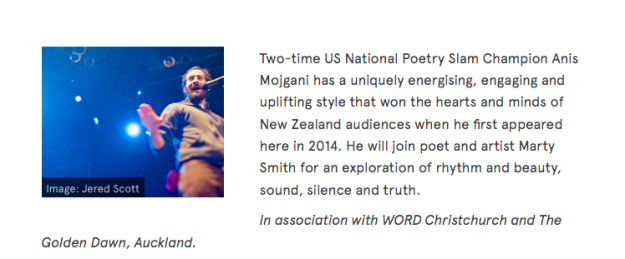
Screen shot 2016-01-30 at 9.48.49 AM


Friday March 11th 5pm   Anis Mojgani and Marty Smith

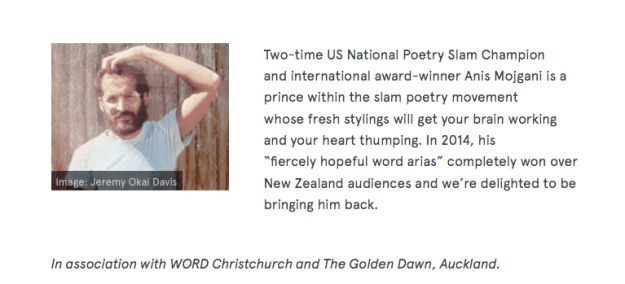
Screen shot 2016-01-30 at 9.55.17 AM


Thursday March 10th 1.45pm Anis Mojgani

Screen shot 2016-01-30 at 9.57.28 AM


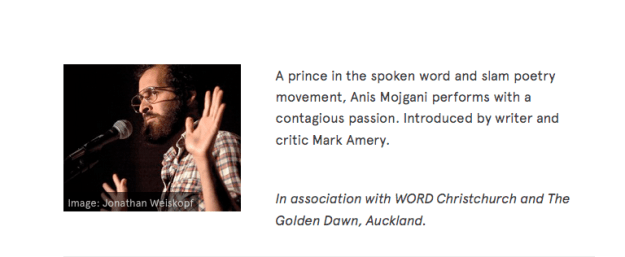
Sunday 13th March 2.30 pm  Anis Mojgani with Mark Amery

Screen shot 2016-01-30 at 9.59.20 AM


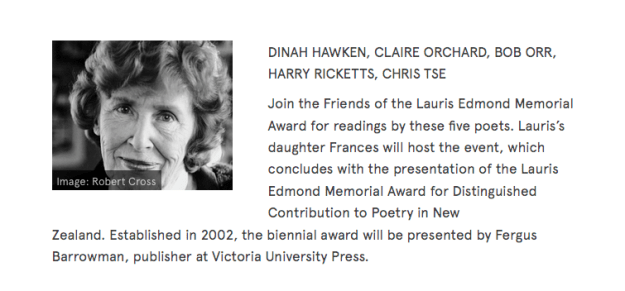
Saturday 12th March 3.30 pm Five Poets and a Prize


Screen shot 2016-01-30 at 10.00.52 AM

Poetry Shelf interviews Brent Kininmont: “Among other threads are those related to ‘drifting’ and ‘sleeping’”

Brent Kininmont 

Brent Kininmont is originally from Christchurch. Except for a year in Wellington, he has lived for the past 16 years in Tokyo. He worked as a journalist at The Japan Times and Reuters news agency, and now teaches intercultural communication. His poems have appeared in JAAM, Landfall, Poetry NZ, The Press, Snorkel, Sport, Takahe, Trout, Turbine, and Best New Zealand Poems 2009 and 2011. His debut collection, Thuds Underneath, was recently published by Victoria University Press.


This is a terrific debut, and I am hard pressed to think of a New Zealand collection quite like this. At times there is a fablesque, dreamlike quality that fleetingly pitches camp in the surreal (whiffs of early Gregory O’Brien), while at other times the real is luminous. The effect is surprising, inventive, original. What sorts of things do you want your poems to do?

In Thuds Underneath I tried to not include poems that couldn’t stand alone, but there is always a danger that a poem will underwhelm, particularly if it’s composed of short lines and compact stanzas, as quite a few of mine are. In a collection, then, I would like the seemingly disparate poems to speak to each other. By conversing, they can help to justify each other’s inclusion.

It would be marvelous if readers noticed the intentional echoes in the book, especially those spaced quite a few pages apart. A blatant example is a title appearing at the start that is repeated towards the end of the collection, as the title of a different poem. That echo is significant, to me at least. Still, I don’t really mind if subtle reverberations do go undetected – it should be enough for me to know they are there, and hopefully a slight bonus for anybody who does notice. Besides, I’m not the ideal reader of my own book; I seldom read collections of poetry cover to cover in one sitting, so I can miss things. I can’t really expect more from the reader than I can actually offer as a reader myself.


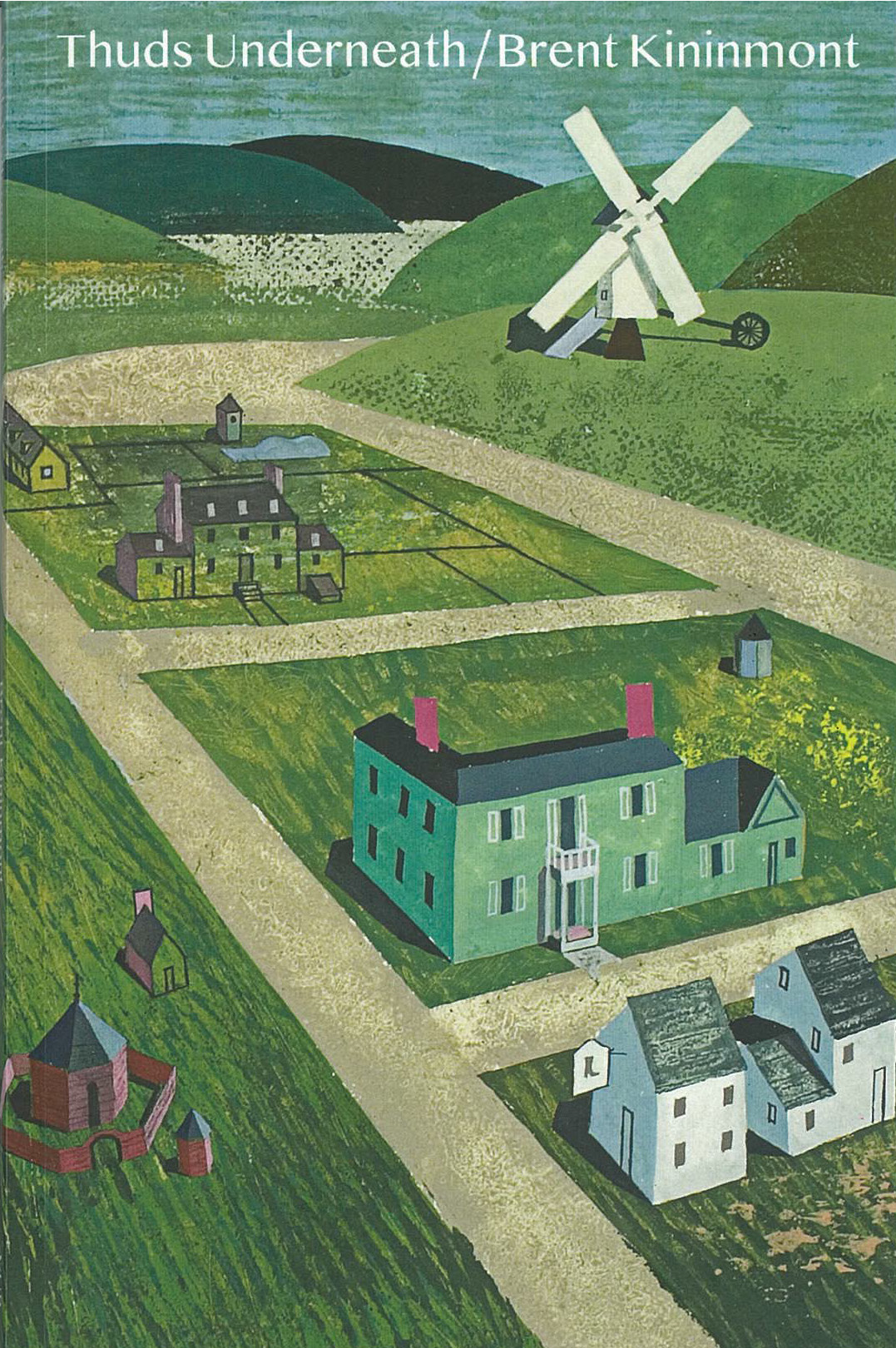
Thuds cover   Thuds cover


Right from the start the poems demonstrate a curious mind at work, as though the collection is a cabinet of fascinating things, anecdotes, observations. What feeds your curiosity as a poet?

The strands running through the collection suggest a preoccupation with transport, particularly aircraft, as well as temples and plains, and gaps of various kinds. How my daughter is schooled in Japan interests me ­­– when it’s not frustrating me; this crops up in the book’s final section. I’m also fascinated by the ancient Mediterranean, and that has found form in some of my poems. If I hadn’t ended up in Japan, which obviously has its own deep history of human occupation, I imagine pitching tent in Sicily or The Peloponnese. Recently I have been spending time with some of the key source texts from the classical world (Homer, Herodotus, etc.). Nothing may come of this in my future writing, though it would be nice if something did.


What I love about this debut is the way it offers such diverse and engaging reading routes. I also followed a vein of poetry of travel (not just via geography). The poems generate moments of stillness within the momentum of internal movement. And yes, the locations are global. How do the poems travel in your view?

There are routes I was conscious of while writing the book and others that revealed themselves during the long time spent arranging the poems. The collection is ordered into three locales: classical lands, the South Island, and Japan. I was quite alert to reversing the familiar narrative of leaving New Zealand then coming back; Thuds Underneath could be read as a coming home then departure again – the return is left open-ended. There is also a fairly standard transition from a sense of restlessness at the beginning to an embrace of some stability at the end (though somebody had to point that out to me). The arrival of a daughter seems to contrast with the passing of a mother; and a father keeps appearing, though he is somewhat detached. Among other threads are those related to ‘drifting’ and ‘sleeping’, and imposing structures with godlike attributes. It is those particular threads I was acknowledging with the two epigraphs I included at the beginning of the collection.


Does Japan have an effect upon how you write?

Probably the main effect is the objectivity that living there provides about my home culture and my own learned behavior. Differences seem magnified in a country like Japan, where the language is very dissimilar, but so are discussion styles, the nature of relationships, and the sense of formality. Silence also has a wider range of meanings, in verbal messages and on the written page. Japan, especially in the beginning, forced me to consider why I think and behave in certain ways, and that has likely seeped into how I write, though it is hard to cite specific examples. I have certainly embraced the opportunity that the physical distance from New Zealand has given me to step back and write about my upbringing and education, say, and their effects. Meanwhile, any sense of being culturally isolated from New Zealand is diminished quite a bit by yearly trips home and by the Internet, which allows me to plug into what is going on in local poetry.


One poem bears the epigraph, ‘after Maui and Manhire’. What New Zealand poets have influenced you?

Among the New Zealand books  tagged on my poetry shelves, those by Andrew Johnston and David Beach literally stick out. Beach’s first book of prose sonnets, the drolly titled Abandoned Novel, sparked my interest in the form. Although the sonnets I have written probably differ in style to his, they likely wouldn’t have appeared so prominently in my collection if I hadn’t admired his unique and witty perspectives. Beach’s work was one of my paths to the weighty James K. Baxter. And I got through The Iliad (even weightier) with help from his second collection, The End of Atlantic City, in which 24 sonnets are smart abridgments of the 24 books of Homer’s epic poem. After finishing each book, I would read the corresponding sonnet. It was my small reward for slogging through numerous, and not always engaging, battle scenes. (The fall of Troy in The Iliad niftily contrasts with another 24 sonnets in Beach’s collection, about the survival ­– or slow ‘fall’ ­– of the Wellington suburb of Te Aro.)

I first came across Beach’s work in 2007, the same year I was fortunate to meet regularly with Andrew Johnston, while I was doing the creative writing Masters at Victoria University. Andrew lives in Paris and was only back in New Zealand for that year (like me). Quite a few years earlier his debut, How to Talk, was the first book of poetry I ever bought, and he was the first poet I wanted to write like. His sharp, shorter poems had given me permission to keep trying to write stanzas trimmed of excess. In our regular talks, among many superb insights, he encouraged me to not fret about borrowing ideas from other poets ­– a revelation to me at the time. That he is also a former journalist who lives away from New Zealand could be another reason why I still rely on his poetry for occasional counsel.


Name three poetry books you have loved in the past year.

They would be among those I kept returning to while Thuds Underneath was coming together. Other than volumes by the two poets I mention above, these three stand out (plus two more):

Night Light, by Donald Justice

After the Dance, by Michele Amas

The Street of Clocks, by Thomas Lux

Milky Way Bar, by Bill Manhire

Bell Tongue, by Paola Bilbrough


With kind permission from Brent and VUP a poem from the new collection:


Hitch

after Maui and Manhire


It can be quite a stretch to haul

the north closer, given that great trench


in between. After lunch we

caught rides on a succession of


straights, a crooked thread line

of far peaks stitching our plains to sheets


of clouds. Only the closed mouth of

the evening vessel stalled us.


Now, among ponga overlooking

the sound, my torch shines on a slim


book she packed. It’s about our known

universe (her tutor said), how we all


live at its edge. In one poem

the word Coromandel really sticks out.


©Brent Kininmont 2015

Damien Wilkin’s launch speech for Bill Manhire’s short story collection: ‘I think of these stories as ludic on the outside but ferocious in their hidden centres.’

Great launch speech!

It’s not a bad way to approach this book – to listen for the tune as much anything. Because while it’s true that these beguiling, discomforting stories take many strange and sudden turns, I was struck all over again by how hummable they are, how they stick to the ear and the mind.’

Launch speech here

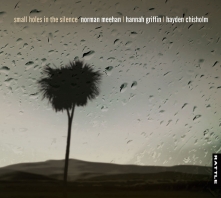
I have had this new CD on repeat: Small Holes in the Silence


Small_Holes_in_t_55beb4afb57d4_222x198      Small_Holes_in_t_55beb4afb57d4_222x198

Small Holes in the Silence Rattle VUP

The CD looks good with its striking cover but what matters is that this CD sounds spectacular. Norman Meehan on piano, Hannah Griffin on voice and Hayden Chisholm on saxophone have taken a number of New Zealand poems (terrific poems) and transformed them into song.

For example: Hone Tuwhare’s ‘Rain’, Bill Manhire’s ‘Ballad of the Hurting Girl,’ James K Baxter’s ‘High Country Weather,’ Alistair Campbell’s ‘Blue Rain,’ Eileen Duggan’s ‘Frost,’ David Mitchell’s ‘Yellow Room.’

Tricky stiff — translating poetry into song when the new score might muffle the internal music to such an extent the poetry suffers. How does word meet external melody?

In this case, the poem becomes something different, a wonderful different that almost needs a new word to signal its poetry/music status. Word becomes music and music becomes word. Like a yin yang kind of thing. Two sides of the one cloth.

I loved the enticing interplay between silence, chord, harmony, counterpoint, key, movement and word. The arcing melody of instrument and voice step out from a word or phrase. Lightly. Surprisingly. Beautifully.

And the voice. The glorious voice that makes hairs stand on end. Hannah takes a word and savours it in her mouth. The word itself becomes aural poem with its dips, lifts and extensions.

Ah. Poetry becomes melody, melody slips into the pores of your skin and when you return to the poem on the page there is this haunting refrain. The voice, the piano, the saxophone — secret aural undercurrents as you read.

Plus there is a great introduction by Bill Manhire. I especially agree with this: ‘The music doesn’t overpower the words; but neither does it defer to them.’


I highly recommend this!

A wee reminder: You are warmly invited to attend the launch of The Stories of Bill Manhire

62f6377b-1dcd-4d64-9e60-012cf0241973


You are warmly invited to attend the launch of

The Stories of Bill Manhire

on Thursday 12 November, 6pm–7.30pm
at Unity Books,
57 Willis St, Wellington.

The book will be launched by Damien Wilkins.
Bill will be available to sign copies.

$40, hardback.
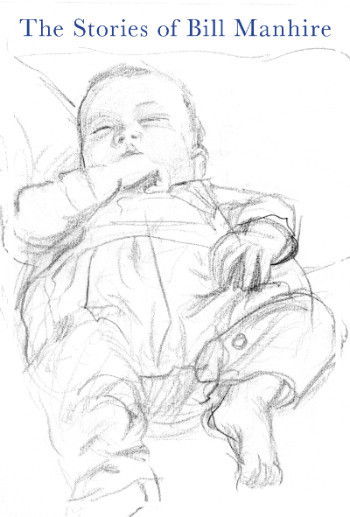
cover illustration, ‘Sleeping Baby’ by Peter Campbell

About The Stories of Bill Manhire
Sheep-shearing galas, Antarctic ponies, human clones, the Queen’s visit to Dunedin, a pounamu decoder, a childhood in the pubs of the South Island, the last days of Robert Louis Stevenson—this is Bill Manhire as backyard inventor, devising stories in which the fabulous and the everyday collide.

THE STORIES OF BILL MANHIRE collects the stories from The New Land: A Picture Book (1990) and those added to South Pacific (1994) and Songs of My Life (1996). In addition there are previously uncollected and unpublished stories, the choose-your-own-adventure novella The Brain of Katherine Mansfield (1988), and the memoir Under the Influence (2003).

Bill Manhire’s short stories to be launched at Unity Books

62f6377b-1dcd-4d64-9e60-012cf0241973


You are warmly invited to attend the launch of

The Stories of Bill Manhire

on Thursday 12 November, 6pm–7.30pm
at Unity Books,
57 Willis St, Wellington.

The book will be launched by Damien Wilkins.
Bill will be available to sign copies.

$40, hardback.
cover illustration, ‘Sleeping Baby’ by Peter Campbell


About The Stories of Bill Manhire
Sheep-shearing galas, Antarctic ponies, human clones, the Queen’s visit to Dunedin, a pounamu decoder, a childhood in the pubs of the South Island, the last days of Robert Louis Stevenson—this is Bill Manhire as backyard inventor, devising stories in which the fabulous and the everyday collide.

THE STORIES OF BILL MANHIRE collects the stories from The New Land: A Picture Book (1990) and those added to South Pacific (1994) and Songs of My Life (1996). In addition there are previously uncollected and unpublished stories, the choose-your-own-adventure novella The Brain of Katherine Mansfield (1988), and the memoir Under the Influence (2003).