Tag Archives: Bill Manhire

Three new books by three VUP authors get an art gallery outing

1e7088a3-8807-47c9-a7a6-98f7294cf027.jpg


We warmly invite you to a reading from three new books
by three celebrated VUP writers.

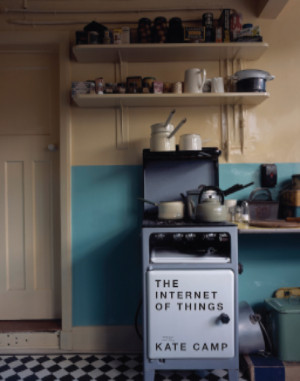
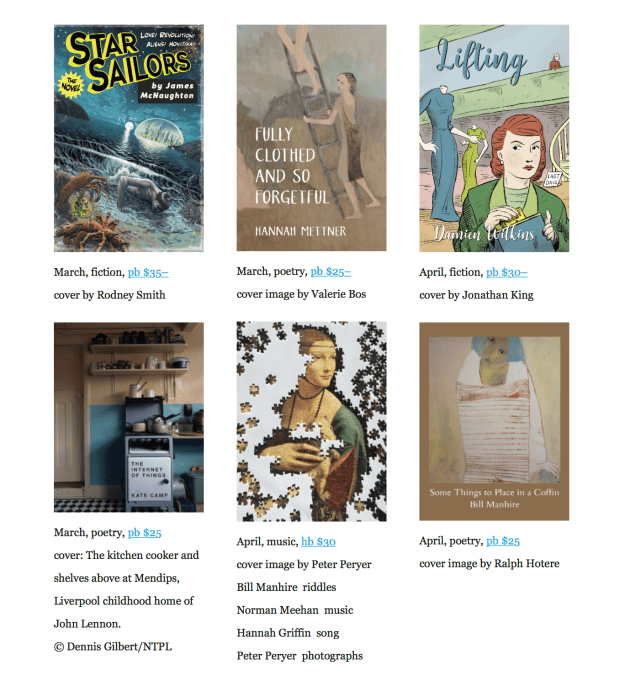
The internet of things, new poetry by Kate Camp
Some Things to Place in a Coffin, new poetry by Bill Manhire
Lifting, a new novel by Damien Wilkins

on Wednesday 12 April, 5.30pm–7.30pm
at Adam Art Gallery,
Gate 3, Victoria University, Kelburn Parade.

Refreshments will be served.

All three books will be for sale courtesy of Vic Books. Guests will also be able to purchase Tell Me My Name, a collaboration between Bill Manhire, composer Norman Meehan, vocalist Hannah Griffin, and photographer Peter Peryer.

All welcome.

Terrific interview on Radio National: Kim Hill with Bill Manhire and some new poems


Bill Manhire: collected riddles

From Saturday Morning, 10:35 am 4th March
Bill Manhire


Bill Manhire has two new books out this year – a collection of poetry called Some Things To Place in a Coffin and Tell Me My Name – a collection of riddles along with a CD of songs composed by Norman Meehan, sung by Hannah Griffin.

Bill Manhire founded the International Institute of Modern Letters, which is home to New Zealand’s leading creative writing program. He is now Emeritus Professor of English and Creative Writing at Victoria. In 1997 he was made New Zealand’s inaugural Poet Laureate, and in 2005 he was appointed a Companion of the New Zealand Order of Merit and in in the same year was named an Arts Foundation of New Zealand Laureate. He holds an honorary Doctorate of Literature from the University of Otago and is a Fellow of the Royal Society of New Zealand. He received the Prime Minister’s Award for poetry in 2007. In 2016 Victoria University Press published The Stories of Bill Manhire which collected new and published short fiction.

Entries open for Kathleen Grattan Poetry Award 2017


Friday, 24 February 2017

The judge of the 2017 Kathleen Grattan Poetry Award is prize-winning New Zealand poet and fiction writer Bill Manhire. Manhire has won several New Zealand Book Awards, a number of significant fellowships, and he was the 1997/1998 New Zealand Te Mata Estate Poet Laureate. He was also honoured with the 2007 Prime Minister’s Award for Literary Achievement.

This prestigious biennial poetry award from Landfall and the Kathleen Grattan Trust is for an original collection of poems, or one long poem, by a New Zealand or Pacific permanent resident or citizen.
Individual poems in the collection can have been previously published, but the collection as a whole should be unpublished.

Entries are accepted until 31 July 2017 and must be either received or postmarked by this date. The result will be announced in Landfall 234 (November 2017), and the winner receives $10,000 and a year’s subscription to Landfall. Otago University Press has the right to publish the winning collection.

For full entry details, and to learn more about Kathleen Grattan, please visit the Award Page.

bill manhire

Poetry Shelf The Summer Season: Poets pick poems – Tim Upperton picks Bill Manhire


Kevin


I don’t know where the dead go, Kevin.

The one far place I know

is inside the heavy radio. If I listen late at night,

there’s that dark, celestial glow,

heaviness of the cave, the hive.


Music. Someone warms his hands at the fire,

breaking off the arms of chairs,

breaking the brute bodies of beds, burning his comfort

surely to keep alive. Soon he can hardly see,

and so, quietly, he listens: then someone lifts him

and it’s some terrible breakfast show.


There are mothers and fathers, Kevin, whom we barely know.

They lift us. Eventually we all shall go

into the dark furniture of the radio.


©Bill Manhire, Lifted  Victoria University Press, 2005.


The eldest of my children published a poem in a recent issue of Sport about the two of us. The poem ends, “We don’t like Kevin but we both like ‘Kevin.'” I forget who Kevin was, but of all the poems of Bill Manhire’s that I admire, this one, “Kevin,” this secular prayer, is the one I admire most. It reminds me of Matthew Arnold’s “Dover Beach,” another secular prayer: what is there, when we all must die, and we have lost religious faith? Arnold finds an answer, of sorts, in personal relations: “Ah, love, let us be true / To one another!” Manhire finds it in human continuity, perhaps the poetic tradition he has inherited, which includes Arnold: “There are mothers and fathers, Kevin, whom we barely know.” The man “breaking off the arms of chairs, / breaking the brute bodies of beds, burning his comfort / surely to keep alive” is no doubt a metaphor, but I think of the great Russian poet, Marina Tsvetaeva, in the winter famine of 1918-1919, who did exactly this. This poem conveys harsh truths, unironically, sympathetically, and in its hopelessness – as in Arnold’s hopelessness – there is a glint of hope, or consolation. Perhaps the only afterlife is in “the dark furniture of the radio” – one of those stained oak radios of my childhood, its transistors humming, a vehicle for the voices of the living and the dead. “They lift us” – “lift” being a particularly resonant word for Manhire – in the way that hymns lifted previous generations. This is such a sad, desolate poem, but every time I read it, it cheers me.

Tim Upperton


Tim Upperton’s poems have been anthologised in The Best of Best New Zealand Poems (VUP) and Essential New Zealand Poems (Random House). His second book, The Night We Ate The Baby (Haunui Press), was a finalist in the Ockham New Zealand Book Awards in 2016.

Poetry Shelf The Summer Season: Poets pick poems – Bill Manhire picks Louise Wallace

DSCN7357.jpg

Four Seasons on Poetry Shelf aims to widen the scope of voices, selections, opinions, poetry tastes, sidetracks, reading options in 2017 on the blog. Each season will be different.


First up, The Summer Season where, over the course of two weeks, New Zealand poets pick a favourite New Zealand poem and offer a few comments.

I have spent the past year reading, writing and researching my way through poetry by New Zealand women for my book. Sometimes a poem feels like a foreign country, a sea in which I haven’t the foggiest idea how to swim, and I feel like I am treading water, hopelessly. But sometimes, upon return, when the light catches the poem aslant (thanks Cilla McQueen!), I find myself swimming and it is heaven. Sometimes it’s just a matter of changing stroke, of navigating the tidal flow with different eyes. Different ears.

Reading outside your comfort zone, reading into the unfamiliar along with the much loved, is an absolute joy.

Yep, poetry is an absolute joy.


To launch the season, I am posting a poem Bill Manhire is very fond of:

‘Poi Girls’ by Louise Wallace (Since June, Victoria University Press, 2009).

Bill also suggested including a link to Louise’s excellent short note on the Best New Zealand Poems site. However Louise has granted permission to post both the poem and the comment. Thank you!

The Poi Girls

Kahu, Mere, and Faith
stand on the grass
by the corner.
They lean
on the fence and watch you
walk past –
spinning, twirling their poi.
Pou
Pou
Pou
The Poi Girls
say with their poi,
with each hard slap
of their poi.

On your way home
they’re in the same spot,
Kahu, Mere, and Faith.
Their older brothers and cousins
are fixing the car, out
on Mere’s lawn.
The boys stop as you
walk by.
They lean their hands
on the car’s sides and look out
from under the hood.
What
you
want?
The Poi Girls
say with their poi.

You’re walking
down the dip
but you have left
your shoes at school.
The yellow seeds
stick to your feet,
and when you get up
the other side, The Poi Girls
are looking
at you.
Om
Om
Om–mee
The Poi Girls
say with their poi.
Piss off,
you tell them,
leave me alone.
You don’t need
their crap as well.

You stuff Pak ‘n Save bags
into white plastic
and tie
them up with string.
You walk past the corner
twirling and spinning,
Hey
you!
Bumheads!
you say with your Pak ‘n Save poi.
The Poi Girls chase you
down the street
but you are too little and fast
for them,
especially for Faith, the fat one,
the one with the lighter skin.

One day in the cloakroom
It’s just you and Thomas
and he tells you
you have beautiful eyes –
green and brown,
just like his girlfriend, Jade’s.
The Poi Girls burst in, twirling.
You
kissed
Thomas!
The Poi Girls
say with their poi,
your cheeks
pounding flush.

Your sister tells you
to run through the mud
and you say you will
and that you don’t even care.
So you run
and halfway you sink
to your waist
and down the dirt road
come The Poi Girls, slowing
to a stop.
Ha!
You
egg
The Poi Girls
say with their poi
and leave
with your sister
in tow, twirling.

It’s sunny but cold
that morning, on the way
to school.
Mere’s front lawn
is filled with cars,
and there are people in suits
and old koros with sticks
and The Poi Girls stand
out the front.
Mere doesn’t
look at you today,
so Kahu and Faith
glare twice as hard for her.
The Poi Girls’ poi
hang still
from their hands
and today
say nothing at all.

©Louise Wallace Since June, Victoria University Press, 2009.


Louise comments:  ‘ “The Poi Girls” is one of those rare poems that came to me almost fully-formed in the middle of the night. I scribbled it down then and there, and I wish this happened more often! I grew up in Gisborne and the essence of this poem comes from there. The poem is about childhood, curiosity and the nature of difference, but contains a certain menace too. Through the sound of the poi and its repetition I hoped to convey the weight and seriousness that events so often have when you experience them as a child.’


Best NZ Poems

Listen to the poem here.

nzepc launches its fourth Six Pack Sound

Poets Jenny Bornholdt, Janet Charman, Owen Connors, Andrew Johnston, Bill Manhire and Chris Price contribute dazzling audio recordings of recent work and comment on their Six Pack selections. They join a gallery of recorded performances by poets working in Aotearoa New Zealand and the Pacific region. Click, listen and browse Six Pack Sound’s growing sampler of remarkable poetic voices.

See here.

Screen Shot 2016-12-12 at 12.27.12 PM.png

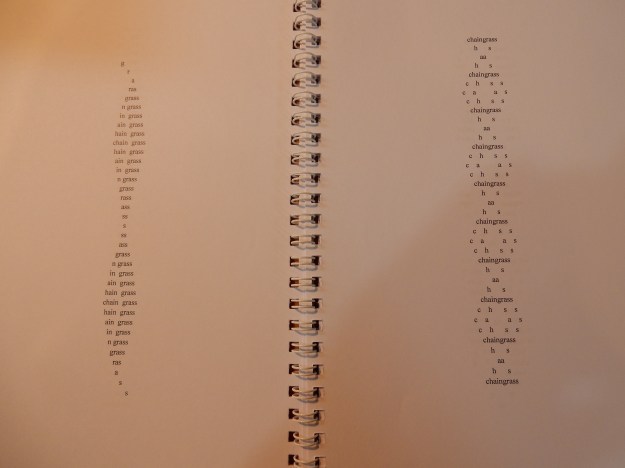
Catherine Vidler’s Chaingrass poems – skeletal like a leaf-haul in autumn


Catherine Vidler has used Bill Manhire’s poem ‘Falseweed’ as the starting point for a series of poems. I am hesitant to name this endeavour concrete poetry. I am not sure why. Perhaps because although the poems plant a visual imprint on the page, a tangible icon to lock eyes upon, the effect is more like a kinetic web, an ethereal tissue that evokes memory, anecdote, fleeting sensations. I have seen these poems referred to as visual poetry.


chaingrass_stale_objects_cover.JPG

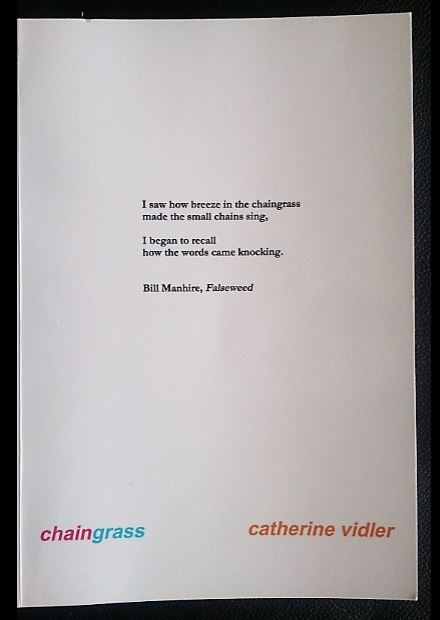
The cover of the paperback (SoD)


Bill’s lines haunt – a kind of causeway to daydreams. Catherine has set up camp on the causeway and in an almost stream-of-conscious way lets Bill’s words float and tumble and take shape. Sometimes I see the visual imprint but I can no longer read the words with my myopia. That doesn’t matter to me. I know the words are there. Sometimes they are lost in smudged grey blocks of once-were-words. I get the nostalgic kick of cross stitch – me at school in the sixties making thread patterns on linen like generations of women before me. I was never very good and found my mind wandering to patterns in the sky.

Then again it is like trying to catch a dandelion kiss and blow it to your grandmother. The tissue poems are like a map of a mind wandering from the poetic line. At times a molecular snapshot, at times the pattern of a choreographer, at times the movement of the wind. Accepting the book on these terms, my terms really, no page is static.

I am reminded of the utter of joy of abstract art. In Paris I sat in front of Gerhard Richter’s mound of yellow pollen for an hour, sitting and looking at the yellow. It began to move and hum – just as yellow on a canvas can move and hum – and lift you beyond colour, can sink and submerge you in colour. It’s not like I entered a Zen-like space – I instead entered a fullness, a richness of experience that braided physical images with deep feeling.


If you are going to read this book the verb ‘to read’ acquires new dimensions.


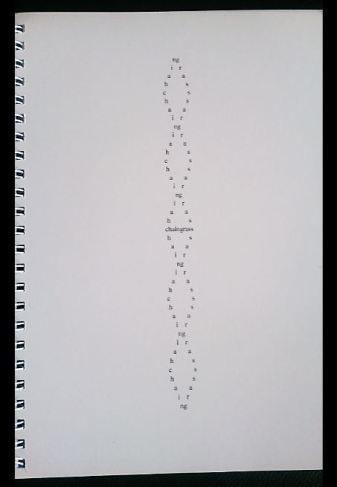
Catherine’s chaingrass poems also appear in a smaller chapbook. There is a sense (sensation) of leafing through the long grass because it is the long-grass poems that have made it here. Shuffle too and fro, your eye catches glints of wordchains and you are caught  in the long grass. The white space renders the word stamp elegant, skeletal like a leaf-haul in autumn; altogether beautiful and mesmerising. Yet there is change, transformation, a magnetic pull of letters to displace and connect the word fragments. The grass is memory. By this point the visual dance, almost molecular, shifts to a new key, and yes, it becomes music.


chaingrass_zimZalla_cover.JPG

The cover of the chapbook (zimZalla)


For the big, Stale Objects dePress book:

chaingrass, SOd press 2016

The book can be purchased online through Lulu here.


For the zimZalla book:

Chaingrass, zimZalla obect 039, 2016, zimzalla.co.uk

The book can be purchased online at zimZalla’s object page


Catherine Vidler‘s collection Furious Triangle was published by Puncher & Wattmann in 2011. She is the editor of trans-Tasman literary magazine Snorkel.

vidler-photo.JPG


from chaingrass the chapbook

DSCN7279.jpg

DSCN7278.jpg

Poetry critic Stephen Burt gives public masterclass in Wellington with Bill Manhire

image004.jpg

Contemporary poetry has plenty to offer new readers, and plenty more for those who already follow it. Yet its difficulty—and sheer variety—leaves many readers puzzled and overwhelmed. The critic, scholar and poet Stephen Burt sets out to help.

In Close Calls with Nonsense: How to Read New Poetry, Victoria University of Wellington’s International Institute of Modern Letters (IIML) presents a public masterclass on poetry. Steered by Victoria University Emeritus Professor Bill Manhire, Burt will guide the audience through a number of contemporary poems by writers from the United Kingdom, United States and New Zealand, illuminating their methods and unfolding their pleasures. This event aims to introduce both tentative and long-time poetry readers to the rewards of reading new poetry. Burt will also give a reading of their poems.

Burt is Professor of Poetry at Harvard University. Their influential reviews and books have made them one of the leading critics of their generation, and their enthusiasm for new writing has helped to establish the careers of younger poets, and helped audiences to appreciate their work.

Burt’s 1998 essay ‘The Elliptical Poets’ is widely credited with identifying a new school of poetry. The book that followed, Close Calls With Nonsense (2009), includes an essay on James K. Baxter among those on more recent poets.

In their new book, The Poem is You, Burt explores 60 American poems. Publisher’s Weekly wrote that: “Burt’s many ways of looking at a poem will inspire new students and accomplished poets, especially as many of his meditations circle the question of what poetry does or should do: making readers pay attention, ask questions, and experience new things.”

In 2012 a NY Times interview hailed Burt as ‘Poetry’s Cross-Dressing Kingmaker’. Burt identifies as transgender, and their poetry chapbook All-Season Stephanie (2015) explores coming of age as it might have happened for their female alter-ego. Burt prefers to use the gender-neutral pronoun ‘they’.

Close Calls With Nonsense is presented by the IIML in partnership with City Gallery Wellington. Admission is free, with all welcome. The gallery will be open prior to the event for visitors to view the exhibition Cindy Sherman (exhibition entry charges apply).

What: Close Calls With Nonsense, with Stephen Burt and Bill Manhire
When: 5.30–7pm, Monday 12 December
Where: City Gallery, Wellington

For more information contact Chris Price on chris.price@vuw.ac.nz.

A spiral-bound notebook of visual poems, created in response to the word ‘chaingrass’ from Bill Manhire’s poem ‘Falseweed’

chaingrassimage.jpg


A spiral-bound notebook of visual poems, created in response to the word‘chaingrass’ from Bill Manhire’s poem ‘Falseweed’, has just been released in the UK by zimZalla.

zimZalla is a publishing project which makes literary objects. It is administrated by poet and publisher Tom Jenks and operates out of Manchester.

The poems were made by Catherine Vidler and the book designed by Tom Jenks.

The notebook is preceded by two other ‘chaingrass’ collections which Catherine has made and which have been published this year. A large collection of poems and patterns was published by Stale Objects dePress in Sydney in September, and a PDF chapbook of the poems together with an interview with Catherine, was recently featured in the journal Jazz Cigarette in the United States.

an interview and poem

stale objects