On Poetry: Airini Beautrais relishes the fulfilment of intent

secretheart.9780864735416__29659.1347922938.140.215       westernline.9780864736499__89622.1349055507.140.215

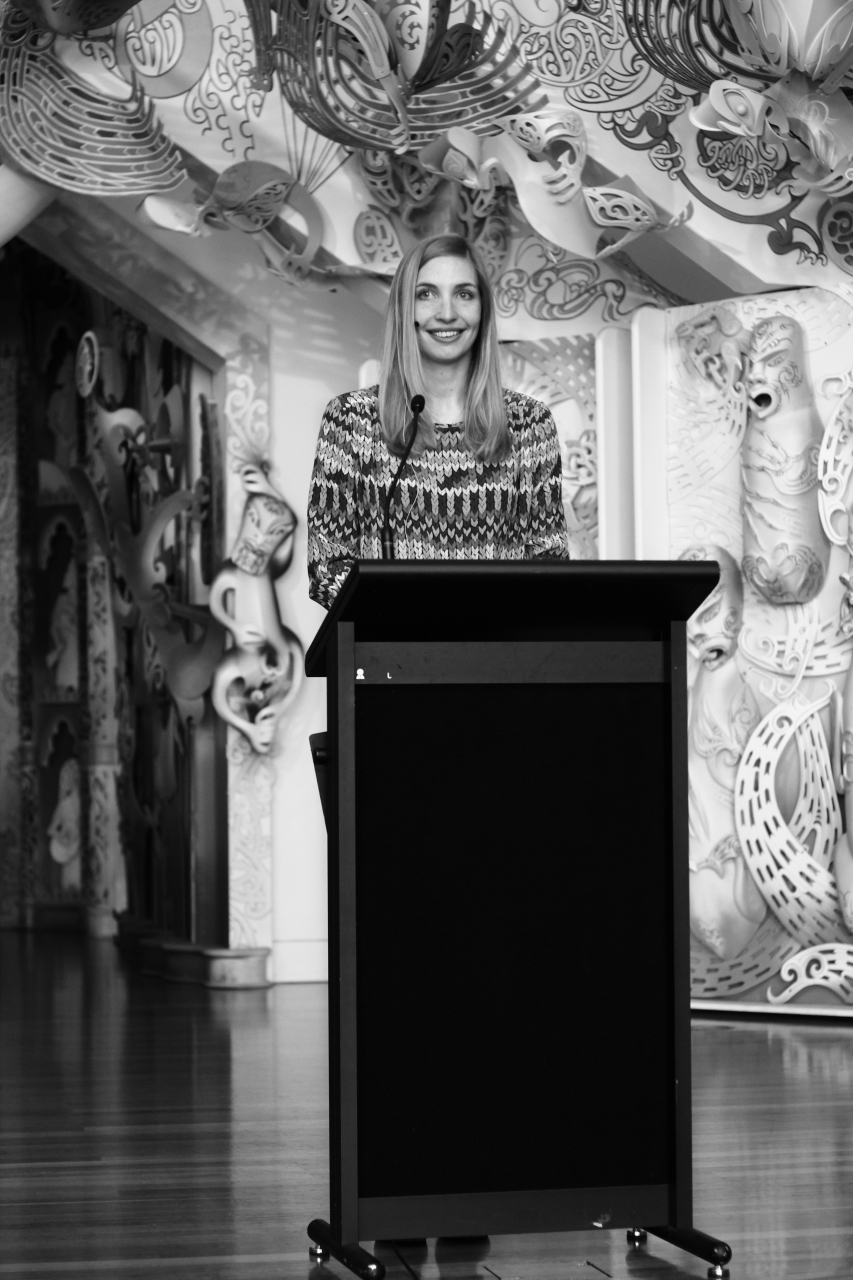
Airini Beautrais is currently enrolled in a PhD in Creative Writing at the International Institute of Modern Letters, where she is exploring Australia and New Zealand narrative poems. Airini has a background in ecological science and has worked as a secondary-school teacher. Her debut poetry collection, Secret Heart, was awarded Best First Book at the Montana Book Awards in 2007. Her second, standout collection, Western Line, filled me ‘with joy – through what words can do and through the avenues poetry makes available’ (my NZ Herald review).  The initial sequences of love and charm poems took miniature, imaginative leaps, trailed footprints in the everyday, relished musical lifts and were unafraid of humour. As I said in my review, there was no other New Zealand collection quite like it: daring, fresh, agile.

Airini has generously agreed to contribute to the ongoing series of small pieces ‘On Poetry.’

Here is a quote I came across recently:

“Poetry is the fulfilment of intent; what dwells in the mind is intent, what comes forth in words is poetry. Emotions move in the core of one’s being and take form in words. When speaking them does not suffice, then one sighs them or chants them; if sighing and chanting do not suffice, then one sings them; if singing them does not suffice, then unconsciously one taps them out with the hands, dances them, treads them and stamps them

Emotions come forth in sounds, and when the sounds fulfil patterns they are called musical tones. The musical tones of an age of peace are tranquil and incline to joy; their regulation is harmonious. The musical tones of an age of disorder are dissonant and incline to anger; their regulation is perverted. The musical tones of a kingdom in ruins are mournful and incline to nostalgia; their people are suffering. Therefore, to keep order in success or failure, to move Heaven and Earth, to touch the feelings of ghosts and spirits, nothing can approach poetry.”

This was written in the 1st century AD, in a preface to the Shih Ching anthology of Chinese poetry. It is attributed to a writer named Wei Hung. The translation above is by Dore Levy, and I found it in her book on Chinese narrative poetry.

The first thing that struck me about this passage was the statement “Poetry is the fulfilment of intent.” I had never thought of it like that, but the idea made sense. We do bring our intent forth in words – for better or worse. Intent is the beginning of the poem – but where might a poem end up? What work will it do? Moving heaven and earth, touching the feelings of spirits; these are no mean feats. Would we attempt such things?

Recently I have been thinking a lot about the work of poetry. Largely based on my own experience, I have a suspicion that as poets we have a tendency to make too many rules for ourselves, or to internalise the rules we interpret from what we read. Often these rules seem to involve the work poetry may or may not do. Such as: poetry may involve clever word-play. It may be obscure. It may be unintelligible. It may be funny. It may confess. It may not articulate an opinion. It may not teach. It may not preach, prophesy, challenge, condemn, tell, etc.

Maybe these are what have been my rules. I like to tell people I only have one rule in my poetry: Never write about cats (a rule I am of course prepared to break if the right occasion arises). But underneath are the bigger rules. In my work at the moment, I am staring them down, and it terrifies me. I am terrified of two things: If I break those rules, I will never be a poet. If I don’t break those rules, I will never be a poet.

I am not a chanter or a dancer. I write with a page, and silent reading, in mind. If I write anything that stamps, it will be in a metaphorical sense. But I do, in spite of my rules, have intentions. Are they honourable? I’m not sure. I feel that poetry needs a 1980’s bumper sticker: Poetry can do anything!

Victoria University Press page

Twenty-three love poems

Poetry With Airini on National Radio

On Tuesday Poems

Otago Daily Times review

NZ Books review

IIML student page

Bernadette Hall talks to Poetry Shelf: All I know is that I’m more in love with poetry, whatever it is, than ever

IMG_1396

Bernadette Hall is an award-winning poet, editor and teacher living at a beach north of Christchurch. She has published numerous collections of poetry, but is one of those poets who gives more to the community than just her marvelous poems. Bernadette co-founded the Hagley Writers’ Institute in Christchurch and has continued to mentor young writers. As editor she has placed two New Zealand women poets under a welcome spotlight. She edited Like Love Poems: Selected Poems of Joanna Margaret Paul (2006) and The Judas Tree: Poems by Lorna Staveley Anker (2013). Both are terrific additions to the local, poetry landscape.

With a new collection about to be launched by Victoria University Press on November 1st, it seemed the perfect time to interview Bernadette. I will post a review of Life & Customs at the beginning of November.

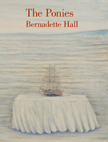
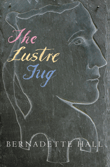
Bernadette’s poems are lyrical havens, where musical chords are words that chime and where rhythms shift in undercurrents of beat. As you read, your body unwittingly absorbs the music, the delicious flecks of assonance, alliteration and rhyme. Her poems lead you back out into the world, to the detail that makes the poet’s experience shine not just at a physical level but at a level where things less easily put into words take root (beauty, love, grief, despair, doubt, intuition, compassion, kindness, thought). She is not afraid to use similes and when she uses them they refresh the poem (‘The rain is like mice scrabbling in the ceiling’ and ‘It’s like walking into a room that’s full/ of McCahons, you know, the way the air changes’). Sometimes a poem is a home for anecdote (much came from her six-month residency in Ireland for The Lustre Jug). Sometimes it is a home for sights and sounds and information that the poet with her eyes and ears open to the world has gleaned (a little like a poet-magpie). If you haven’t yet discovered the luminous attractions of Bernadette’s poems, her collection The Lustre Jug (VUP, 2009) is the perfect place to start (find a hammock, add The Ponies (VUP, 2007) and The Merino Princess: Selected Poems (VUP, 2004) and you will be set!).
merinoprincess.9780864734921__44356.1347922881.140.215   ponies.9780864735522__14453.1347922920.140.215   lustrejug.9780864736086__91830.1347922534.140.215

The interview:

Dear Paula

Here’s a little something, a sort of reply to your questions.

I haven’t really got a lot to say about poetry at the moment. I think the teaching gene has finally been extinguished in me.  I’m not so sure about things that I used to be sure of a year or so ago.  I have to think that this is a healthy state of affairs.

All I know is that I’m more in love with poetry, whatever it is, than ever.

Bernie

My mother loved language.

Her conversation sparkled with word play and old sayings from Central Otago and from her Irish family. These sayings were rich and dangerous, they had everyone laughing. There was a sharp wit and scathing irony in them. If we complained about a petticoat that hung down a little or a spot that had turned up on our chins just before we went up town with our friends, she’d say ‘A blind man on a galloping horse wouldn’t see that.’ An expression of high praise from her sister, my aunt, was ‘Why you’re the girl your mother forgot to drown.’ Haha, it was outrageous and dangerous  and full of affection.  Heehee, saying one thing and meaning another, isn’t that supposed to be a definition of poetry?

My mother’s mother had a few words of the Irish. My two sisters and I have inherited an affection for what we call the Irish gift of charming, scurrilous repartee. ‘My arse to you and that’s behind me’ my grandmother would say, apparently.  But never to her grand-children.  My mother would quote her if we were playing up, digging our heels in.  ‘Oh, bum through the letterbox,’ she’d say. And that was that. It might have been an acknowledgement of being rendered speechless but it was also a declaration of authority. There were to be no more arguments or protestations. We’d have to laugh but we’d also have to do what we were told.  Even more so after my father died, felled by a heart attack, right in front of me, I’d just arrived home from school and I was sixteen.

To be grief-stricken. To speak to no-one in my family, not my mother or my sisters, for a year                 ( something I’d ‘forgotten’ until one of my sisters reminded me and then I was amazed that something in my own inexplicable private life as I had experienced it, had had an impact on someone else, that it had been visible when all that time I had thought I was invisible.)  To be so angry.

At Holy Name School in Dunedin ( site now of the Students Union, only a huge walnut tree remains)  I learnt language as mystery in the Latin Mass. I learnt musical rhythms in the repetitions of the Litany of the Saints many of whom had the most remarkable names, Cosmas and Chrosogynus for example.  Ora pro nobis, we’d chorus, ‘pray for us.’  And if two saints were invoked in the same breath, we’d use the plural orate pro nobis. Not one word of Maori passed our lips but plenty of the language of the Roman Empire, of civilisation and theological sureties.

We performed poems in a poetry choir conducted by Miss Molly Randall.  ‘I must go down to the sea again / to the lonely sea and the sky’ and ‘one of them two of them three of them four of them / seabirds on the shore.’ We copied out poems by Rupert Brooke, Scottish ballads (so marvellously tragic), Milton on his blindness and Elizabeth Barrett Browning on love.  Eileen Duggan was a Catholic so of course we learnt her poems. I loved especially her lines about the little silver consecration bell ringing in the untamed darkness of the New Zealand bush. Now it’s her doubting poems that I admire.

Belief and unbelief, the tension between them being a virtue, I have been told, in the poems I wrote in response to the sculptures by Llew Summers,  the Stations of the Cross, which remain sound but imprisoned in the destructed Catholic Cathedral of the Blessed Sacrament in Christchurch. Anthony Ritchie has written a symphony for full orchestra and solo soprano in which he uses words from these poems. The work will be premiered in Christchurch on February 22, 2014.

As a child, I wrote poems for my friend Annette. She set me a topic and paid me a penny and I gave her a poem.  On things like Dogs ( I was passionately in love with dogs, desperate to have one but I don’t think we could have afforded one) and Spring and The Circus.  I wrote a long essay on The Sea.  It delighted Mother St Joan and got me a straight A. But the real pleasure was in sitting at the little table in the window of the spare room, looking out at the poplars and the willows and the river, the Leith.  Being solitary and absorbed. Silent, lost to myself and fully alive. It wasn’t until I was in my mid-forties that the desire for this kind of internal ‘room of my own’ awoke in me again.

I always loved the sea. My dad and I were the bravest when it came to swimming. He’d float on his back, going up and down on the waves. I played tennis. I played the cello, in the King Edward Tech orchestra conducted by Mr Waldon Mills. Later on I was in the Otago University orchestra led by Bill Southgate. Music and Latin and freedom.  I climbed trees with my friend Nicki. I ran wild along the track to the Gardens, I spent hours puddling around in the Leith, catching cockabullies and tiny weedy lobsters. I planted flower seeds – I was born to do manual work, to be a gardener, digging, pruning, lugging, mulching, turning the compost heap, raking the little pebble paths that go for grass out here in the droughty Hurunui. I can remember my Dad’s mother, a little Northern Irish migrant, a farmer, a prohibitionist, running out onto the road in Leith Valley behind the milkman’s cart.  I helped her shovel up the horse’s droppings to feed the pansies in the garden.

I have spent a lifetime immersed in the language of poetry and plays as a high school teacher, specialising in English, Latin and Classical Studies. The poet, Iain Lonie, tried to teach me Greek. His poetry and he himself, transfigured by his love for Judith, were more successful in teaching me ‘to prize what is of value’ than anything else.  John Dickson’s presence, the way he reads his poems, the fact that like Geoff Cochrane, he makes poetry visible and desirable in his very being, the fact that in conversation with these two and with Joanna Margaret Paul, I felt/feel myself getting nourishment for that sometimes hidden part of my life, the way, by my given nature, I tend to hide what I treasure the most.

When I read essays by Adrienne Rich, Seamus Heaney and Nuala Ni Dhomnhaill, poems by Wallace Stevens and Michele Leggott, John Berryman and  Hone Tuwhare, I am often going around the same traps but each time I find something new, something that I need, something that changes the work I am doing at the time.

I admire the poems that Tusiata Avia is writing at the moment. ‘The beauty of the husband’ by Anne Carson and The Big Music by Kirsty Gunn.  Novels by John Coetzee, Nigel Cox and Janet Frame. The Bath Fugues by Brian Castro. I have just started on Jorge Luis Borges, better late than never.  Max Gate by Damien Wilkins and The Luminaries by Eleanor Catton are on my to be read list. Time and again I read Dia by Michele Leggott,  The Rocky Shore by Jenny Bornholdt and The Palm at the End of the Mind by Wallace Stevens.  This week I’m in love with some wonderful, edgy poems written by a student I’m currently mentoring, they make me laugh out loud. And with a few lines from Thomas Merton’s ‘Book of Hours’ – a book which was given to me as a rather surprising gift :

‘No matter how simple discourse may be

     it is never simple enough.

     No matter how simple thought may be,

     it is never simple enough.

     No matter how simple love may be,

     it is never simple enough.’

That’s how I want to write this week, with simplicitas. Next week it might be all about elaborations.

When I was a teenager I worked in the school holidays in Buntings Brush Factory, operating machines that made toilet brushes and hair-curlers. I was very happy working there.  The mix of people was a real eye-opener   For some of the workers, Buntings offered the safety and respect of a sheltered workshop.  On my last day in the December just before I turned eighteen, before I headed off to university in the following year because I didn’t want to work in a bank as the Career Adviser who visited our school had advised, a gentle older man called Bruce gave me a copy of Allen Curnow’s The Penguin Book of New Zealand Verse (1960) as a farewell present. I still have it. There’s a poem there that said everything I could have imagined at the time about love and sex and longing.

‘Beloved your love is poured to enchant all the land

         the great bull falls still the opossum turns from his chatter

         and the thin nervous cats pause and the strong oak-trees stand

         entranced and the gum’s restless bark-strip is stilled from its clatter.

from ‘Flow at Full Moon’ by R. A. K. Mason.

The poem spoke to me and for me. It was like a voice from another planet.

When I write a poem, I want to break through. To be completely lost. So that the words aren’t mine, so that the flow is automatic. It’s like flying if it’s going well and that’s just the first flush of it. That’s when the best, the strangest lines make their appearance. But the whole usually takes more time and patience, allowing everything and then letting it all settle and find itself.  The aim being to make something that’s truthful and brave and beautiful. I like to give myself a bit of a fright, to push out beyond what I’d thought was possible. Poetry is the ground on which I can let myself go.  I can throw myself away and hope in a mad kind of way that I’ll be found and how liberating is that.

Victoria University Press page

New Zealand Book Council page

New Zealand Electronic Poetry Centre page

Canterbury University Press page

Best NZ Poems edited by Bernadette Hall here

My review of The Lustre Jug in The NZ Herald

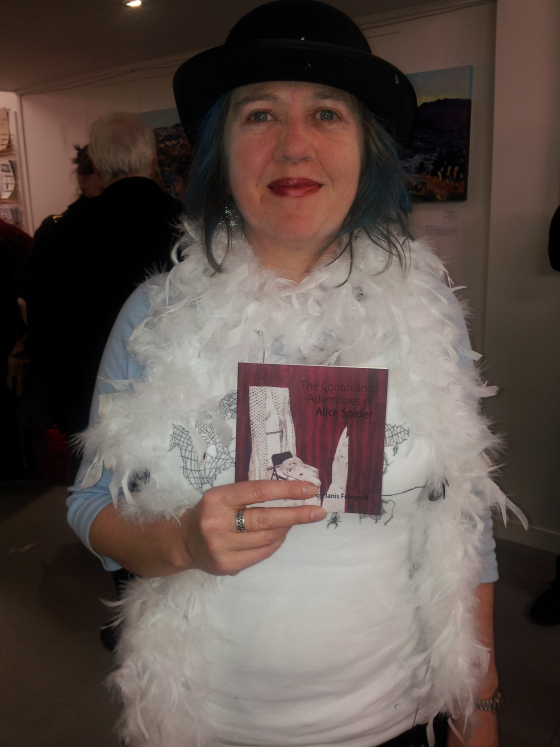
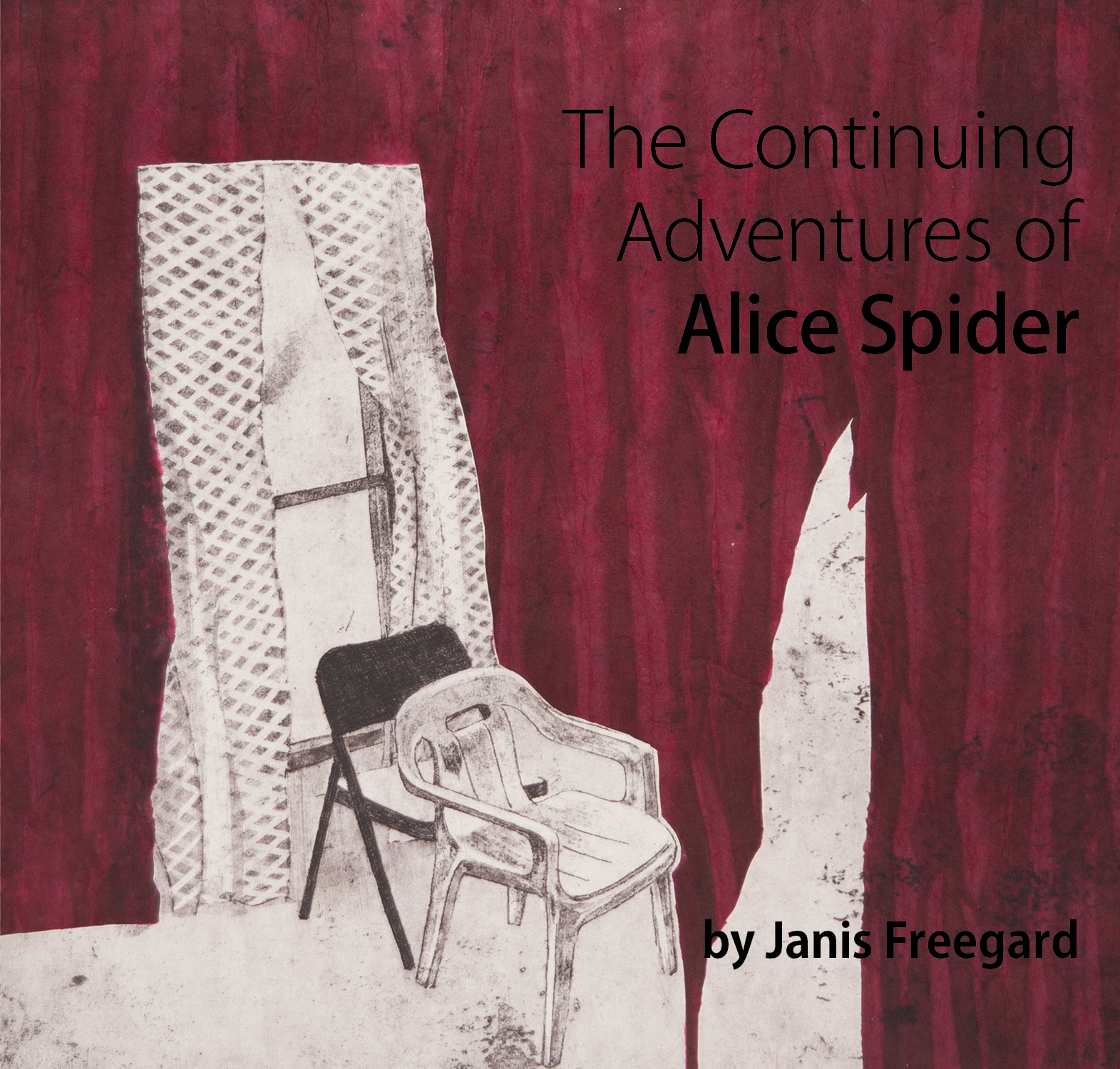
The Continuing Adventures of Alice Spider

  janis launch - mary macpherson

Janis Freegard was like a magpie in her debut collection with ‘her eye out for the shining anecdote and the gleaming fact.’ Kingdom Animalia: The Escapades of Linnaeus (Auckland University Press, 2011) was a dazzling arrival that was both inventive and assured. She borrowed six animal classes to explore contemporary life. See my NZ Herald review here. She initially appeared in AUP New Poets 3 (2008) with a shorter extract from the adventures of Alice.

Janis has a science background with degrees in Botany and Plant Ecology, so it is not surprising her new collection has ‘spider’ in the title: The Continuing Adventures of Alice Spider. It is a gorgeous little book, like a pocket edition that you can pop in your pocket and pull out at amoment’s notice. The poems were selected from a longer version of The Continuing Adventures of Alice Spider and the book is published by Anomalous Press in The States. The Press is devoted to ‘the diffusion of writing in the forms it can take.’ In a mini manifesto it states that ‘We’re searching for imaginary solutions in this exceptional universe. We’re thinking about you and that thing you wrote one time and how you showed it to us and we blushed.’

Alice Spider is ‘a spinner. A spinster.’ The book is like a handbook to Alice. The sequence of prose poems (or poetic prose) hold Alice to the light as though she is a prism that refracts and reflects in all her shifting, colourful glory.  She is an Alice of many sides as the titles suggest: ‘Alice the Camel,’ ‘Alice the Mermaid,’ ‘Alice the Dinosaur.’ That is one charm of the sequence; you have no idea what or who Alice will be next (there is a poem entitled, ‘Who is Alice?’).

The second charm of the collection is the way Janis tends Alice. It strikes me that the author (almost like a poetic narrator) is delighting in the protagonist’s multiplicity, her failings, her quirkiness and her audacity. There is an infectious tenderness at work in the pore of every poem as Alice becomes both self-absorbed and self-transformative.

The third charm is the way the world of Alice is a cousin (perhaps once removed) of the world of the surreal (there is a poem ‘Alice and the Surreal’). We enter a reality that relishes offbeat twinges, tics and spasms. In ‘Alice and the Babies,’ ‘Alice had never wanted children but now here she is, producing all these babies, suddenly, every week a new one, filling her house.’ Having had countless babies in the blink of an eye, Alice feeds them on pancakes and then, once they hit adulthood, makes them cereal-box hats and farewells them a year later. There is the inexplicable and the unfathomable but it is subsumed into the fabric of the everyday (along with cheekiness and change). Thus the cow is in the Post Office trying to register its car. Alice (or course!) buys stamps. This is a collection infused with humour, and that humour is the flint for the surreal.

Finally, the writing itself. The book is a treasure box of sentences; economical, wry, agile. You could easily employ spider-like tropes to talk about the writing: the way it deftly weaves detail to unsettle the everyday. The way the poems spin a fine web that shimmer and shine with the glaze of a storyteller. The way the book as a whole embraces the simplicity and the beauty of a spider’s web. There is repetition. There is a love of language: ‘It’s like. It’s a lot like. It’s like being in love. It’s that mirror you see yourself reflected in. This is me. It’s like. It’s a lot like. It’s like being. It’s like being in love.’

Most of all, though, there is Alice, and reading Alice is a rare treat.

‘It’s not an angel. It’s a woman with wings. Oh alright then, says Alice. You’d better come in.’

Janis Freegard Weblog

The book is selling for $20 in NZ and is available from Matchbox Studios in Wellington (http://matchboxstudios.co.nz/). Unity has also agreed to stock it. It is also available from Anomalous Press for $US10 + postage & packaging.  They also have e-book and audio versions and a fancy handmade letterpress version (the latter with a smaller selection of poems). http://anomalouspress.org/books/alice.php.

From the media release:

Alice made her way to the US via the Tuesday Poem online network run by New Zealand writer Mary McCallum.

Janis says, “I was paired with wonderful US poet Melissa Green for an end-of-year “Secret Santa” Tuesday poem swap – I posted one of Melissa’s poems on my blog and she kindly hosted Alice Spider.  Cat Parnell of Anomalous Press spotted Alice there and asked if I’d like to contribute to a new online journal she was involved with.  Alice appeared in an edition of Anomalous, after which the editors contacted me to say they were interested in publishing an Alice Spider chapbook”.

Of Alice, Janis says “In some respects she’s a kind of alter ego, a more reckless version of myself. I do let her borrow a few of my own experiences from time to time. Perhaps she’s also a spirit of wildness and freedom.  I know some people think of her as a spider, but to me, she’s human (well, as human as any fictitious character).

“There has always been a mix of realism and surrealism, humour and menace.  The earlier pieces contain more knives, blood and cigarettes; the later pieces tend to be a bit lighter, with zebras and hot air balloons.

“It feels very much as though Alice has gone off travelling without me.  It’s been a really exciting process and a great example of how the worldwide web (a very appropriate vehicle for someone called Alice Spider) can connect people across the planet and make things happen,” she says. 

alice_cover


TEN Essential Poetry Books for Spring Reading

I just applauded Lorde for standing up and saying boldly to the world: ‘I am a feminist.’ Brava!

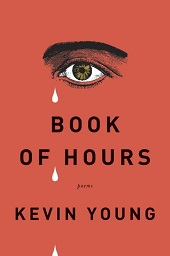
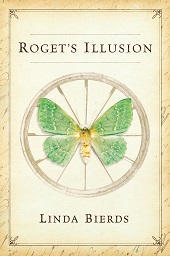
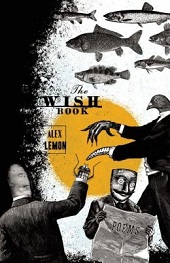
youngk   bierds   lemon

I thought I would post a link from a tweet by Don Share: Ten Essential Titles in Contemporary Poetry for Winter reading. Looks like some interesting books in this line up that I might chase up. But only one woman poet (Linda Bierds) – definitely want to read her book.

Got me wondering what I would post if I sampled ten essential NZ Poetry Books to read over summer. Hmmm. Looking forward to Bernadette Hall, Selina Tusitala Marsh, Louise Wallace currently reading and loving).

Meanwhile feel free to send me your TEN Essential Poetry Books for Spring Reading (or FIVE or TWO or ONE) and I will post them.

paulajoygreen@gmail.com

First Friday Poem by a Secondary School student: I am not a graceful person

Poetry Shelf aims to feature a poem by a secondary-school student on the last Friday of every month. I have received a bundle of poems from which to pick one to post. Many of the poems were full of emotion and were circling dark and difficult subject matter. The trick of writing a poem that will hook and then keep the attention of the reader is to explore how emotion can serve the poem rather than control the poem (a bit like rhyme really). Real detail, attention to the sound of the line, not giving everything away, laying down clues can help, playing with the form of a poem — this can help create a poem that moves rather than overwhelms.

‘I am not a graceful person’ by Emily Savage, aged 17, Year 12, Raglan Area School

The poem I picked does circle difficult subject matter, but it is surprising, mysterious, thoughtful, daring, fresh (remember this is not a formula for what makes it a good poem, but just happens to be what this poem does). I like the way the poet doesn’t spell everything out. I like the overlapping circles in the poem; the way graceless is transformed into gracefulness, the way night becomes day, the way difficulty becomes ease. The rhythm of the lines add to the mood; they puncture the dark of the night with their varying lengths. This is a poem I wanted to read again, and of all the poems I got sent it is the one that stuck in my head.

I am not a graceful person

I am not a graceful person
I am the Tuesday that never came. I am the 11:45pm siren from falling  out of dreams. I am the awkwardly disguised leap years and the numbing of your limbs.

But

You are beautiful as you speak, in fragment thoughts at
1am
2am
3am
you lift up all things that hit the ground one by one
4am
but mostly you are transparent, solid, rock, feelings (big, bold) although nothing to hold them together. You have all things needed to become something more, but you are everything less
5am
I am over the moon, but under the sun
and you are somewhere near the stars.
Which is okay because most things we see are dead or
will be sometime in the future. So having a grasp on something isn’t all that bad when you know everything/everyone
is dead.
so as it hit
6am (15 seconds)
I knew that your dead words- my gracefulness would= 7am. And by the sun is up,
so I knew we would be okay.

Turbine: Time to get your poem pens in action and send submissions to the online magazine

Turbine: Time to get your poem pens in action and send submissions to the online magazine produced by IIML at Victoria University.
What to submit

Only material that has not yet been published in New Zealand will be considered.

Prose: short essays or fiction pieces are preferable, to a maximum of 2,500 words (longer pieces may be considered at the editors’ discretion). Send only 2 pieces.

Poetry: Send only 5 poems.

Photographs or artworks with a literary theme may be considered.

As a non-profit publication, Turbine is unable to offer payment for contributions. For all accepted material, copyright will revert to the author upon publication.

The editors are unable to engage in correspondence regarding individual submissions.

When to submit

The reading period for the 2013 issue of Turbine will begin July 1, 2013. Please do not send submissions before this date.

Submissions for the next issue must be received by October 19, 2013.

We will send email notification of acceptance or rejection in early December, 2013. (Those submitting by post will only be notified if they provide a stamped, self-addressed envelope with their submission.)

For more information see Turbine guidelines here

Turbine issues here


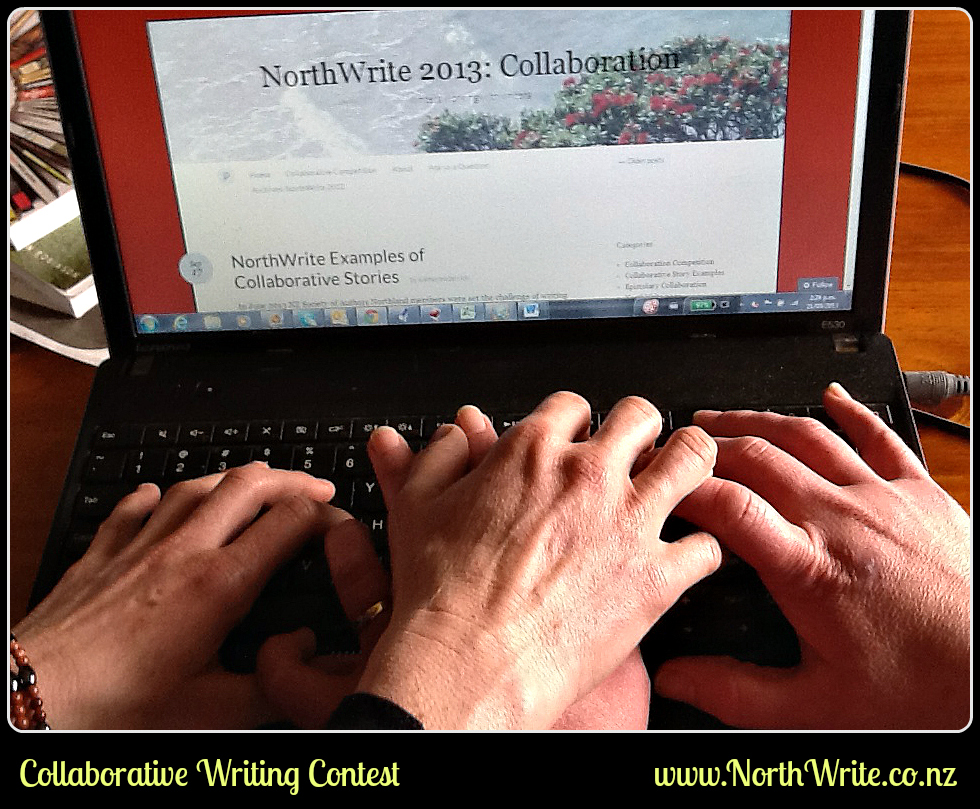
The NorthWrite2013 collaborative competition for short stories and poems is now open

Northwrite collaborative02

The NorthWrite2013 collaborative competition for short stories and/or poetry is now open for entries and closes at midnight (NZ time) 15 November 2013. Entries received after this time will not be considered. Judges are Michelle Elvy and Tim Jones, and there is a minimum prize pool of $500. There is an entry fee of $20 per entry which is equivalent to $10 per person since each entry must be a collaboration between two people.

Competition Rules:

 ·         The competition is open to all New Zealand citizens and residents, and each entry must be the combined work of two people.

  • Entries must be previously unpublished (this includes in print and online) and previously unplaced in any other competition.
  • Entries can be in story or poem form, or in a combination of the two as follows (word and line limits exclude the title):

o   Story: Either one story (maximum 750 words) written collaboratively, or two stories (total word count not to exceed 750 words) where one has been written as a response to the other.

o   Poem: Either one poem written collaboratively (maximum of 60 lines) or two poems (total number of lines not to exceed 60) where one has been written as a response to the other.

o   Combination: One poem (maximum 30 lines) and one story (maximum 325 words) where one has been written in response to the other.


The official full rules, regulations and submission details can be found here.


Word and World at Central City Library in Auckland with a stellar line-up

Friday 27th September, Central City Library, Level 2, Whare Wananga

Auckland Libraries and the NZ Electronic Poetry Centre (nzepc) present a poetry reading by Adam Aitken, Ali Alizadeh, Jen Crawford, Ya-Wen Ho, David Howard, Susan Schultz and Ann Vickery as part of the the Poetry as Social Action Symposium at the University of Auckland.

MC is Australian poet and critic Pam Brown.

Welcome glass of wine at 5.30 pm, readings start at 6pm.

Booking recommended 377 0209 or email karen.craig@aucklandcouncil.govt.nz

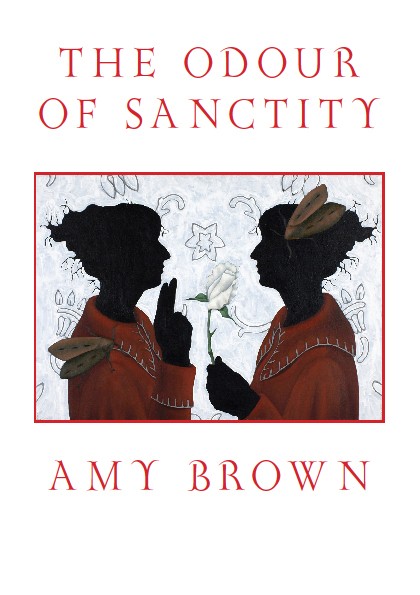
Amy Brown’s The Odour of Sanctity is an astonishing example of a contemporary epic poem

mbialostocki130904_change0046     OdourOfSanctityCover__56412_1362609647_1280_1280

Amy Brown‘s debut poetry collection, The Propaganda Poster Girl, was shortlisted for the Jessie MacKay Award for Best First Book in the 2009 Montana NZ Book Awards. It introduced a fresh new voice, and Amy went into my head compartment of poets to watch. Her second collection, The Odour of Sanctity, moves into different territory and forms part of her Doctoral submission on contemporary epic poetry. She is currently teaching at the University of Melbourne.

This new collection is challenging, intricate, assured. It takes the reader on a roller-coaster trip through the lives of saints, but these six saints are not what you might expect in a catalogue of sainthood. You have Jeff Mangum from the indie rock group Neutral Milk Hotel (nowish), Victorian poet Christina Rossetti (150 years earlier), memoirist and mystic Margery Kempe (four centuries before that), Saint Elizabeth of Hungary (1231), Saint baby Rumwold who spoke nonstop during his three-day life (662) and Saint Aurelius Augustine (300 years prior to that). This backward trawl through time nets some surprising results.

I am no scholar of Catholicism, but I am a student of poetry. The central ways in which this collection acquires an invigorating poetic force are through juxtaposition, (metonymical shivers), acute detail (anchorage in the real), shifting narrative voices, political under-and-overcurrents, and a vital heartbeat (providing little emotional kicks). Each candidate represents his or her own minefield of difficulty and strength, but the compounding effect of goodness and weakness is to be found in the gaps between the candidates.

The six cases fit into a structure of six parts and an envoi that might well echo the formal pattern of a sestina. Such a structure calls for semantic ripples, musical rhyme, and rebound at the level of feeling. And so it is, as the collection pivots and swivels on notions of good.

Jeff Mangum is making music to save himself, using his obsession with Anne Frank as fuel. He imagines unbearable loneliness. In Amy’s words, ‘Music is everything. God is nothing.’ Yet this drive to make music unwittingly unmakes him — leaves him stranded and unable  to participate in the world. Daringly, Amy selects the way Jeff might be awarded sainthood (even though he is alive) in his struggle to be good. She picks the way his music kickstarted a dead heart back to life as the miracle.

This might subvert the Catholic criteria for sainthood, but it also might be the point. Read this as a poetic narrative, but also read this as a challenge to orthodoxy. The word ‘odour’ lodged so tauntingly in the collection’s title underlines the way that this book is as much about stench as it is about sweetness. Goodness, miracles, humility, compassion, and faith can be located in the grit and grime, and everyday detail. The church itself has a history of goodness (compassion, forgiveness, charity) that can also be matched by a history of foul play (treatment of women, corrupt relations with political power, greed, abuse). In other words, Amy places ‘goodness’ under a critical spotlight. What is ‘goodness’ when it comes to ‘sainthood’? Is it a matter of piety, eating frugally, caring for others (and animals), compassion, sacrifice, humility, an erasure of ego and desire, chastity, a state of holiness and piety, an ability to perform miracles? It seems to me, a contemporary epic poem is the perfect place to reconfigure notions of good and sainthood (albeit in a secular fashion).

To read Amy’s six saints is to read them outside as well as within Catholic doctrine, along with the history of the Catholic faith at the level of ordinary lives and within the Church hierarchy. The life of Christina Rossetti, for example, raises the thorny issue of woman as saint. This woman writing is not simply an object of beauty (a muse), but a woman who struggles, creates, contemplates, resists and makes choices. There is the shadow-ladder of Neo-Platonic thought  that ascends to divine ideals (think beauty). In Christina’s narrative, the steps are both divine and actual. For the woman writing, ‘my voice is a bird,/ my words are weeds,/ poetry is a garden.’  And before, ‘my throat sings/ like a toad or a mallard;/ I groan of things/ that should be loved and changed/ and my mouth stings.’ The words are the ladder that embody grief along with feminist seeds (in this account). Thus Paradise ‘must be/ a place of mothers and sisters/ where there are no demands on one/ but to be cheerful and no reason/ to groan.’

The Odour of Sanctity offers much on an intellectual level along with the poetic veins that I signaled earlier, but it also takes grip of your heart as you enter the unbearable world of the candidates. There is the dissolution of Margery as she wants to be without stain, supplicant to God, to be bodiless and celibate. Yet she bears countless children and countless wounds from her husband. She stands in for female suffering, and as you hold her case close, the yearning for such erasure is both heart wrenching and unfathomable.

Amy has delivered a collection that takes hold of you on numerous, overlapping levels. To me, it is a collection that will provoke and prompt numerous arguments on what it is to be good and what it is to be a saint, whether male or female, dead or alive, religious or non religious. There is a sextet of voices at work (so beautifully crafted by Amy) and more (for example, the contemporary witnesses, God). It is in the rub of this voice against that voice, that the pathos, the grief, the pain and the sour smell of humanity unsettle the sweet potential of good.

The Odour of Sanctity is an astonishing example of a contemporary epic poem. There is a plainness of language that gives birth to a sumptuousness of effect. I am not interested in what the collection does not do, but in what Amy has chosen to get it to do. I loved it.

Amy Brown, The Odour of Sanctity  Victoria University Press 2013  $35