Rachel O’Neill’s One Human in Height: Sent me searching for a new word to signal the kind of writing that takes flight

OneHumaninHeight_RachelO'Neill

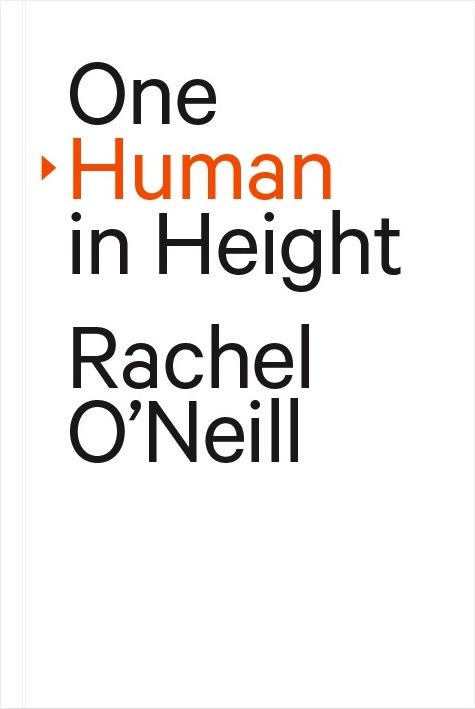
Rachel O’Neill, One Human in Height, Hue & Cry Press, 2013

Rachel O’Neill‘s debut poetry collection sent me searching for a new word to signal the kind of writing that takes flight within its pages. Yes, this is poetry that finds life in sentences, so you fall upon little prose poems (like embroidered pocket handkerchiefs on the page), but that seems barely adequate. Yes, these exquisite sentences have toes in the surreal, but again that falls short of the way each piece pivots upon an axis of the real. I think I have opted for poetry prisms.

OneHumanInHeight_cover   OneHumanInHeight_cover  OneHumanInHeight_cover

I was reminded of an extraordinary mix of things as I read: Anne Kennedy’s debut novel, 101 Traditional Smiles, Lyn Hejinian’s sentences, Fanny Howe’s sentences, Richard Brautigan, Gertrude Stein, Gregory O’Brien’s early poetic slants with magical drops, Gianni Celati’s Narratori delle pianure (for a start).

These poems are poetry prisms because they are shape-shifters (not on the page as they maintain the uniformity of squares and rectangles). They are kaleidescopic, anecdotal, twisty, askew, stream-of-consciousness-like, uncanny, colourful, incantatory, shiny. Each poem shifted in the light as I read, so the anecdotal world became less settled, more surprising, yet never loosing its anchorage in the real.

One of the first poems, ‘Waking early in the marigolds,’ is the perfect entry into the book. The poet takes an idea and then playfully jams with it in slightly off-beat ways (the poem is about waking up in surprising places — ‘I came into the world with nothing bar a capacity for waking in unexpected places.’). It is almost (oh, at a stretch!) a metaphor for how these poems work; as perhaps these poems awake in surprising places, a little to the left of right of expectation. I loved the ending, where the poet yearns to be lying in bed ‘with some authority despite being out of my depth.’

The collection’s subject matter seems to be driven by both real life and the imagination, by a poet who is mindful of the world about her, but who is willingly to filter that world through imaginative excursions. Thus, you get transported from behind the eyelids of a man to what you tell and don’t people to someone arriving at a family reunion by parachute to a compass that is dropped and multiplied 200 million times.

Rachel’s sentences have a pitch perfect economy (‘The sea’s pale back’) that generate musical tones. The quirkiness, the off-beatness, the flashes of the surreal, however, are not embedded in skewed syntax or word choices but in the anecdotal revelations (fictional or otherwise). For me, Rachel’s graceful language heightens the narrative twists and turns.

Endings can be the ruination of a poem, but Rachel has a light touch, a surprising touch. She concludes ‘My father’s memories’ with this: ‘He shunted past me muttering, “My father’s memories,” as if every year he bore them on that stretcher down to the water.’ Rachel’s beginnings are equally nimble and fresh: ‘She sits down at the kitchen table to wait out the remainder of April.’

This is a glorious debut. These poems show the way you can hold any occasion, object, person or place in your mind and, like a prism, watch it shimmer and shine with little stories that hook tufts of truth and fabrication, self and knowing, illusions and strange kinks, and everyday bric-a-brac. I am in love with this book.

Thanks to Hue & Cry I have a copy of this book to give to someone who likes or comments on this post.

On Poetry: Emma Neale pushes against the glass walls of form

Emma at Ross Creek

Photo credit: Graham Warman

Emma Neale has contributed this piece as part of an occasional series (On Poetry) from New Zealand writers. Emma is a Dunedin-based poet (four collections published), novelist (The Fosterling is a terrific read), teacher, mentor and anthologist. She has a PhD in English Literature from London’s University College, received the inaugural Janet Frame Memorial Award for Literature (2008), the Kathleen Grattan Award for Poetry (2011) and was the 2012 Robert Burns Fellow at the University of Otago. Her poetry is steered by a deft pen, a pen that embraces family as much ideas, and music as much tropes. She writes out of empathy for the world (both universal and particular) and her poems divert the intellect and hook the heart. Her poetry to date cannot be aligned solely with family preoccupations, but her family poems are some of the best I have read. This line from ‘No Time Like the Present’ could also be a cue to her poetry writing: ‘No present like time/ to follow thought’s curving rivers.’

thumb_160160226234240Sleeve thumb_160160226234240Million thumb_160160226234240TheTruthGarden web

On writing a villanelle

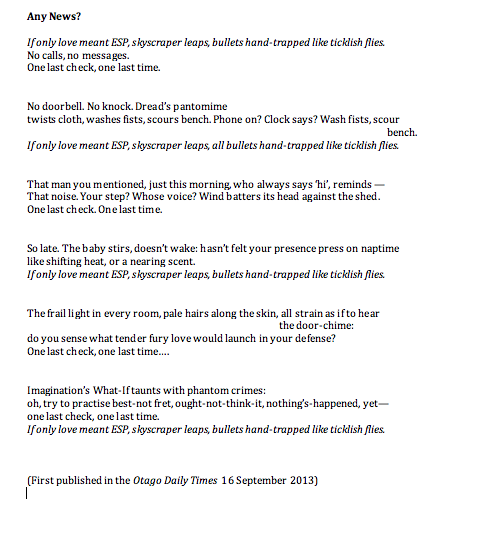
Screen shot 2013-11-04 at 3.10.16 PM

When I teach a second-year poetry workshop at the University of Otago, I try to set the students at least two exercises each semester that are new to me, too, to keep my teaching fresh, and to put myself back in the hot-seat: a writer is only as experienced as the new form they’re trying, and I think it’s important to remind myself just how daunting composing-to-deadline can be – not to mention the process of having a first draft read in public.

This year, one of the classic forms I set was the villanelle. I’ve read dozens, but had never tried to write one. The students turned up some good examples, ranging from comic commentaries on poetry itself (Nicola Thorstensen) to whimsically lovelorn (David Cooper). For many of them, it seemed as if writing within these strict constraints actually altered their work for the rest of the semester: it clarified and tautened even their attempts at free verse and/or concrete and in one case, digital, form. It was a prime example of the way form and structure actually give energy to the ideas and words, rather than binding them too tightly. As we might hear the drives of the wasp trapped in the jar more clearly than if the jar weren’t there: the force of the emotion or argument pushes hard against the glass walls of form.

When I started to tackle a villanelle, I initially wanted to write about a fictional character with OCD, based on a young girl I saw in a documentary years ago. I thought the repetitive structure would be useful to capture that stuckness, that inescapable treadmill of obsession. There’s only a skerrick of that in the poem still. It very quickly took on a real world anxiety, about a specific event, rather than being about a psychiatric disorder as such. (Although I’d like to try it again for that purpose.)

Initially I found it hard not to try to work in a kind of narrative progression: but soon saw that the stasis — even in the closure — would be a much better expression of anxiety than writing in a point of release, relief, uplift, psychological shift (even worst-fears-realised) would have been.

The technicalities of finding rhyme or half-rhyme gave the process an unexpected buoyancy: it’s like a kind of verbal orienteering, a happy, almost spatial problem solving. I knew I was meant to repeat two refrains and really wanted to stick with ‘one last check, one last time’ – only to belatedly realise that ‘time’ has a very limited range of potential rhymes. It also meant I had to cheat a little, and use assonance instead of perfect end rhyme, or even half rhyme, for the first and third lines… can we call assonance quarter rhyme?!

The title was a bugbear. I’ve already published a poem called ‘Traveller Overdue’ which is about separation, fear of loss, and a loved one at risk, although it’s in open form and uses mimetic typography — rather than refrains and rhyme — as its way of trying to embed presence into the white void of the page. ‘Overdue’ kept coming back, like an unpaid fine addressed to the wrong person, and I had to keep sending it away again. I tried about 8 different options: all yuck yuck yucketty yuck. Finally, hooray, when imagination’s account is in the red, along come the rich funds of Roget’s Thesaurus – and the phrase ‘Hold the Line’ seemed to arrive with a slap to the forehead. The reference to the phone line, the life line, the poetic line, all seemed perfect: but then I realised that friend and colleague Sarah Broom’s posthumous collection Gleam contained a sparse, moving lyric called ‘Holding the Line’. The loss of Sarah to poetry, and the publication of her collection, both seemed too recent for me to have a similar title, even as a tribute to her. I needed a title that would still evoke a sense of expectation, suspense: without falling either way. Although ‘Any News?’ loses the reflexivity of the other choice, perhaps the fact that it’s also more demotic helps to get that sense of visceral dread more, once you’re into the cyclical doubts of the poem.

I think when I try the form again, I’ll work harder at getting that separate aphoristic quality into the two refrains. When they repeat so often, it would seem logical to make them rich, complex, mysterious, perhaps, so that revisiting them is endlessly compelling. (Although monotony may sometimes be the mood the poet wants, of course, if the subject matter is about endurance.) There’s a much closer relationship to song than the sestina and pantoum, the other closed forms I’ve most enjoyed writing before. Even though I knew that intellectually, from reading other villanelles and reading about the villanelle, there is nothing like moving the mind around within the architecture of a poetic form for us to really know the possibilities of its psychological space and aesthetic effects.

Emma Neale’s blog

New Zealand Book Council page

University of Otago Press page

Steele Roberts page

New Zealand Electronic Poetry Centre page

Interview with Emma Neale published in The Listener, April 26-May 2 2008 Vol 213

Emma Neale’s Random House profile

Feature in Otago Daily Times

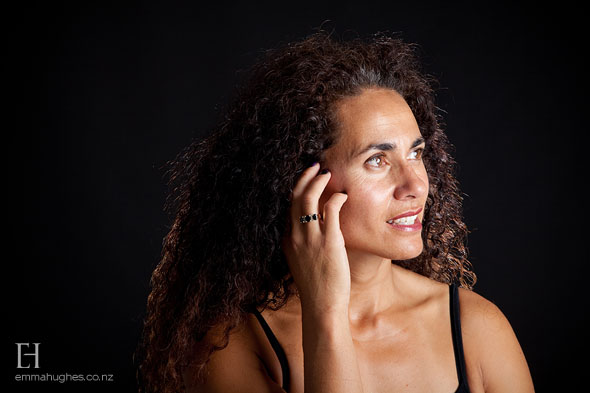
Selina Tusitala Marsh talks to Poetry Shelf (Part 1): It is my voice as woman, kickboxer, and Pacifican

105selina

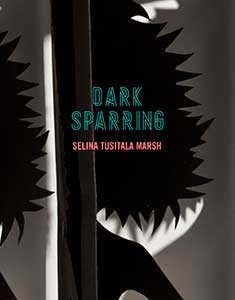
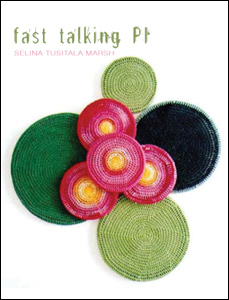
Selina Tusitala Marsh is of Samoan, Tuvaluan, English and French descent. The first Pacific Islander to graduate from the University of Auckland with a PhD in English, she now lectures in the Department. Her debut collection, Fast Talkin’ PI (Auckland University Press, 2009), won the Jessie MacKay Award for Best First Book of Poetry at the NZ Post Book Awards. Selina represented Tuvalu at the London Olympics Poetry Parnassus event. Her second collection, Dark Sparring (Auckland University Press, 2013), is to be launched in Auckland tonight. Selina is a strong role model for emerging poets and writers in our Pacific communities, through the poetry she pens, the courses she teaches, the ideas she circulates, the writers she mentors and the schools she visits.

cp-dark-sparring cp-fast-talking-pi

Selina’s first book has two lives — on the page and in performance. For some poets, one is a dilute form of the other, but with Selina the strength in one is the strength in the other. Her voice is, as her poetry underlines, a voice in a long line of women writing, and in particular Pacific-Island women writing. She acknowledges her literary forbears. Her voice is sweetened with musical honey, but it is also unafraid to bite as she questions her place in the world. The long poem, ‘Fast Talkin’ PI,’ has captured the ears and hearts of festival goers around the world as she pulls us into the thick of what it means to be human. This list of what a woman can be and do (in debt to Anne Waldman) is a song in the ear, an infectious beat and rhyme momentum and an act of liberation from straightened stereotypes —  and it gets under your skin. Selina has the courage to speak out, and her ideas are not veiled beneath hint and allusion, but as she speaks, you get the textured delights of poetry. Like several New Zealand women, Selina is showing that Performance Poetry (or Spoken Word Poetry) is a vital part of our poetry culture. It exists in a spectrum of subtly, passion, politics, heartbreak, musical chords, love, connections, word play, autobiography, body dance, tradition and experimentation.

In celebration of her new book, Selina kindly agreed to be interviewed by Poetry Shelf. I will post a review of Dark Sparring next week. The Photo Credit is Emma Hughes Photography. Thanks to Auckland University Press, I have giveaway copy of Selina’s new book for someone who likes or comments on this post or the review I will post next week.

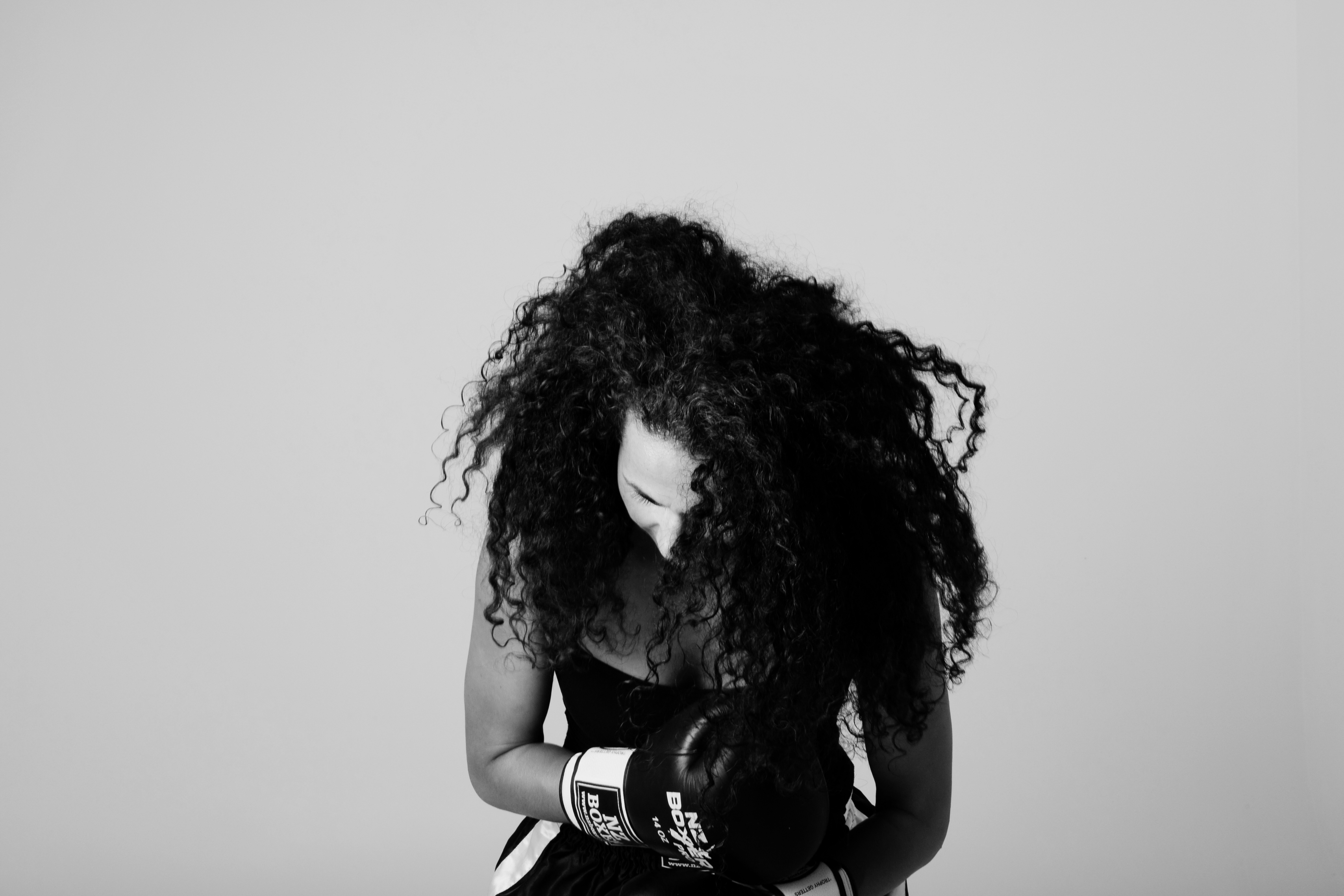
Selina KBox Image

The Interview:

Did your childhood shape you as a poet? What did you like to read? Did you write as a child? What else did you like to do?

I’ve never mentioned this before but when I was young my dad, who worked in a stainless steel factory, made us kids a stainless steel slide. My favourite past time was to lie, tummy down, on the slide and peer into the warped face staring back.  I’d also stare at the reflected warped sky, birds, trees, other people, but mostly this face that was mine and not mine.  Then I’d sing and chant to this other self. I think, without getting too psychoanalytical,  that those endless hours went some way to being conscious of me as other, and of my words as potentially independent of myself. Something that exists beyond my body and is emitted through another body that looks somewhat like me but isn’t me.  That duality continues through life.  I’m an incredibly social person and yet, need time alone, and enjoy deep one-to-one friendships.  I also used to while away entire Saturdays reading books in bed, pretending the backyard fence was a horse (and riding it), and got really good at Galaga at the corner takeaways.

Did university life (as a student) transform your poetry writing? Theoretical impulses, research discoveries, peers?

Undoubtedly yes.  Because it gave me books, books from all over the globe and introduced me to the world of post colonial theory where marginalised voices were recognised and given space to flourish. It gave me a lens with which to view the gaping absence of voices like mine – Pacific, political, raw, performative. In terms of being exposed to New Zealand poetry, it was Hone Tuwhare’s gutsy voice and concrete grindings of the line that got me excited, as well as Sam Hunt’s embodied lyricism and bardish behaviours!  These poets thrilled me because they made poetry relevant to my way of being.  Yet, I didn’t write in response to anyone else’s poetry, that is, it didn’t feel as if poetry with a capital ‘p’ belonged to me until I met the words of black American women poets like Maya Angelou and Audrey Lorde. And coming across the black feminist theory of bell hooks was also a game changer.  Suddenly the right to write and claim space was not only an option, it was a responsibility, not only to one’s perceived community, but one’s self.

When you started writing poems as a young adult, were there any poets in particular that you were drawn to (poems/poets as surrogate mentors)?

The earliest poem I can remember being enamoured with was ‘The Highwayman’.  It simply stunned me and I became obsessed with its drama, sacrifice, violence, and redemption, along with its haunting clip clopping rhythms.  I had an illustrated book of poems and its picture also haunted me.  All the other poems in the book were babyish in comparison.  This was adult and therefore, a real poem!

Your poems are as alive on the page as they are when you perform them. They draw upon a passionate engagement with life (there is heart at work), but they also have a political edge. Plus of course there is the vitality of sound — from repetition to rhythm to rhyme. What are key things for you when you write a poem?

I guess it begins with movement, like, something has to move me emotionally, intellectually, spiritually.  And then it has to fit right in my mouth, which doesn’t necessarily mean it must rhyme, but that the words must be able to mill about together on the tongue. Fitting in the mouth and on the tongue often means that the words dance with each other, shadowing each other’s rhythms.  Juxtapositions are important in order to disrupt expectation and widen the reading audience.  For example, what happens when Muay Thai kickboxing, a traditional Tuvalu dance, and grief move together in the same space, on the same page?  And then a poem has to move someone else.  The most gratifying response to a poem I’ve received lately was when I penned the long poem ‘Kickboxing Cancer’ on the walls of the old Waiheke Police Station holding cell (converted into the Waikare Maori Art Gallery).  It’s four walls became the four sides of a boxing ring.  Janine, the curator, told me about a couple of tourists who came to see the exhibition.  The husband couldn’t get his wife to leave.  For a good half hour she sat in the cell  reading and weeping. That’s gratifying.

What PI poets might not have come to our attention that you would recommend?

Grace Teuila Taylor launches her first collection, ‘Afakasi Speaks’, published by *, in Hawai’i. She is a stunning Niu poet able to bridge the page with the stage and back again. She co-founded the South Auckland Poets Collective, gives back to the community, is sensitive, strong and humble.  I love Grace and her work.  She really demonstrates how poetry can be an emancipatory vehicle in so many ways.

Do you think your writing has changed since your startling debut with Fast Talking PI? For example, how does your new collection link back to that? And then move away from it?

The signature poem in Dark Sparring is ‘Kickboxing Cancer’ and is a distant cousin to ‘Fast Talking PI’.  They both echo Anne Waldeman’s ‘Fast Speaking Woman’ – the bones are there in both.  End line repetition, its chant aesthetic, the reclaiming ‘I’ – it’s all related and ‘Kickboxing Cancer’ is a return to the woman- centred focus Waldeman began with.  Its Pacificness is less overt, which isn’t a bad thing.  It’s more implicit in the tone, mood, and empowering politics of the piece. Subtle references to Tangaroa (Maori God of the Sea) and Tagaloa (Samoan Supreme Being) are made but a Pacificness pervades the entire piece – it is the centre, not the margin – it is my voice as woman, kickboxer, and Pacifican!


Auckland University Press page

nzepc page

New Zealand Book Council page

Radio NZ interview

Best New Zealand Poems here

Blackmail Press page

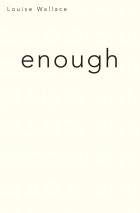
The winner of Lousie Wallace’s Enough, thanks to VUP

enough_front__19529.1371430013.140.215   enough_front__19529.1371430013.140.215   enough_front__19529.1371430013.140.215   enough_front__19529.1371430013.140.215

Thanks to Victoria University Press, Poetry Shelf has randomly selected Emma Neale to receive the giveaway copy of Lousie Wallace’s Enough.

For my review see here.

More giveaway copies of new NZ poetry books coming up in next few weeks as I post reviews.

A Poetry-Shelf Toast: Michele Leggott is a poet to be celebrated

cl-michele-leggott

Michele Leggott was awarded the Prime Minister’s Award for Poetry in 2013. She has published a substantial body of work including seven volumes of poetry. She edited Young Knowledge: The Poems of Robin Hyde. Michele is a Professor of English at The University of Auckland, she co-founded The New Zealand Electronic Poetry Centre, has mentored countless emerging poets, and was The National Library’s inaugural Poet Laureate (2008-9). Her poetry has accompanied her through the extraordinary challenges of losing her sight, an experience that has not diminished her commitment to New Zealand poetry in any way whatsoever. Her poetry is, as she attests, in debt to a long line of women writers; it engages with heart and intellect, along with eye and ear. There is difficulty, there is musicality, there is silence, there is autobiography, there is the real world, there is mythology, there is history, there is the world of writing, there are homages to others, there is acute and sweet lyricism, there is family, there is love, there is laughter, there is song, there is a shifting vocabulary, there are foreign words, there is experimentation, there is tradition, there is pain, there is sadness, there is joy, there is empathy, there is movement, there is poetry that haunts and there is poetry that holds you close so you lean in and listen.

Congratulations Michele on this well deserved honour.

To celebrate the PM’s Award for Poetry Michele answers twelve questions for The NZ Herald.

nzepc

New Zealand Book Council page

Auckland University Press

My review of Mirabile Dictu

Link

LisaSamuelsAntiM   LisaSamuelsAntiM

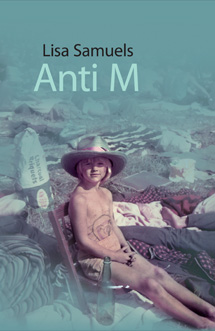
Lisa Samuels, Anti M, Chax Press, 2013

Lisa Samuels teaches Creative Writing, Literature and Theory at The University of Auckland. Born in Boston, she has also lived in the Middle East and Europe. She has a PhD from the University of Virginia and has published seven poetry collections and a recording of Tomorrowland with soundscapes (2012).

Lisa’s new book, Anti M, is presented as anti-memoir or omitted prose. Pick up the book, start reading, and you can use those labels as you will. For me, the writing wittingly or unwittingly navigates poetry as much as it does narrative, and yes, there is the governing rule of omission or erasure at work. You enter a realm of heightened or exaggerated selectiveness (bearing in mind an author is always selective), exclusion and perhaps even interference with memory. As you read questions arise, images surface and story and poetry produce electric connections. If the writer takes away, for example, what does she create?

Three terrific quotations provide gateways into the writing. I especially loved Bernard of Clairvaux (1140): ‘what keen edge can both clean my memory and keep it intact? Only the living and effective Word which is sharper than a two-edged sword …’

Holding the book, with that quotation ringing so beautifully in my ears, and flicking through the pages where the words float dreamlike, scattered, suspended, I am struck that the gap, the pause, the lure of silence will be a key part of my reading. Numerous other poets spring to mind: Michele Leggott, Susan Howe, Kathleen Fraser, Lisa Robertson, Lyn Hejinian, Gertrude Stein, the erasure art of Mary Ruefle.

Firstly, the gap or the pause. The opening lines of the book: ‘today we walk an outer ring/ around the borrowed house.’  A fitting entry into writing that is in so many ways (subversive or otherwise) an autobiographical passage. The ‘we,’ ambiguous at the outset, may be the poet, the reader, the narrator-I, Daisy, family. The book is divided into nine parts like nine concentric circles, but the passage is interrupted. There are syntactical  gaps, gaps of information or recollection. At times it is like a movie jump cut (‘the music makes people adult veil’), but for me it was as though I were listening to a story being told where the teller is reserved, circumspect or bumping up against pockets of amnesia. At times it is like poetry of the pause where an interruption (or withholding) in the narrative flow elbows room for the reader to stop and meditate (to fill in the narrative gap, to make personal connections, to tinker with the syntax, to sidetrack and daydream). For example: ‘The train robbery      in a balloon/ language before I could swear something fretted over.’ The omitted text also keeps altering the course of narration as though the circumspect narrator cannot maintain a single thread but keeps swerving from a single word or phrase to elsewhere. The gaps skew grammar, verb agreements go awry. Phrases are left dangling in mid air and questions  come to the surface. Is this a matter of concealment, shyness, artistry, craft, deferral, sidetracking? Is it a case where the writer re-enacts the inability of words to represent a life (a memoir) adequately? Would the book be better or worse (more comforting, more estranging) with the gaps filled in?

It might seem like this is a vertiginous book to read as you navigate cliffs and gullies, but it reminded me of standing in front of a patchy fresco in Italy. So much missing but somehow, in that prolonged moment of looking, you experience something coming together, gloriously, surprisingly. The reading isn’t disorienting, it doesn’t leave you bereft of anchor, it embeds you in a world that absorbs and moves. Lisa leaves gem-like clues to the writing that haunt and puzzle, such as ‘narrative order as/ the paint thinner of consciousness.’ Or ‘sometimes when one is unifying reality/ the patchwork humming outside the air/ communicates/ the bed contains.’ The word ‘patchwork’ leads to that Italian mosaic or patchy fresco, and signals the centuries-old ambition of unifying miniature pieces. What to do with these pieces? The word ‘humming’ leads us to the power of the musical note to work on the body and the heart. Another clue to the methodology of the writer: ‘a    little/assemble band/ which lyrics    blanked/ of independent words.’ And this, which suggests the process is not methodical but steered by intuition and gut feelings: ‘Tripping a little on the stairs of relation.’ ‘Relation’ makes a faint line to family connection but more importantly exposes an image of the making of story — in steps and stages with leaps and bounds and stumbles and falls (ah, the risk of reading and writing).

What is visible upon the page matters. You leapfrog the words. You manage the pauses. There is an attentiveness to sound (as there is with the other poets I listed), a sustained lyricism that might be intuitive or might be deliberately composed. There are shifting aural links, delicious and subtle shifts in sound that create harmonious chords. This is pleasurable — to read from ‘shock’ to ‘corral.’ There is sweet, compounding alliteration: ‘The shiny summer window sentences / stands to think.’ Or the way this ‘sound’ is caught in an aural fishnet with that ‘sound’: ‘swishing     looking with a     room/ the wall/ by day, and glistening.’ Phrases leap out at you and stick (whether musically or semantically): ‘People are the whole house.’ Words echo, again in semantic and musical ripples. For example, red. You move from red pills to red-like coals to red mouth to red dates.

Daisy is like a cypher, a puzzle. Is she the buried girl of the poet, the narrating-I? Or a white board to absorb memory in all its frailty and strength?

At intervals, there are luminous photographs that seem lifted from the past. Deep-set, colour images with a tangible sheen like lush memory pockets. They serve as a perfect metaphor for the writing. Lisa has served memory with a tangible sheen that attains poignancy, momentum, and audible lyricism. I can’t think of a single ‘anti’ word that suits my reading of this astonishing book. The final photograph (now black and white) is a baby on hands and knees looking at him or herself in a mirror. The surprise. The puzzlement. The mystery. The magic. The self discovery that is never complete, distorted yet vital.

In this book (however you choose to define it will depend upon your passage as a reader), the words are indeed keen. No cutting edge here though — instead a liveliness, an attentiveness to shades of change, a quickness. This luminous book represents the swoop and soar of memory through noise, silence, presence, absence, nostalgia, joy, interruption, love, longing, forgetting. The key undercurrent, and the one that keeps you attached to each line, is that this poet writes out of an unflagging and infectious love of words. For me, the gap (the omission, the white space, the ringing silence) transforms interrupted narrative into poetry.

Chax Press page

Rob McLennan’s interview

Spain Journey at ka mate ka ora

Shearsman Books page

epc at Buffalo page

nzepc Tapa Notebook page

Louise Wallace’s Enough: Wherever you look there is energy

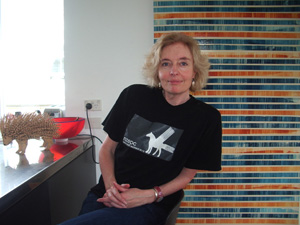
Louise Wallace (Rory Mearns 2013)

Louise Wallace’s debut poetry collection, Since June, was a delight. In my Herald review I saw it as ‘a satisfying mix of economy, elegance, strangeness, lightness, boldness and different personae.’  Louise was awarded the Briggs Prize in 2008 at The International Institute of Modern Letters. Since then her poems have been published in New Zealand (including The Best of Best New Zealand Poems), Australia and Germany. She has taught Creative Writing at Massey University and the Nelson Marlborough Institute of Technology for the past five years.

enough_front__19529.1371430013.140.215  enough_front__19529.1371430013.140.215  enough_front__19529.1371430013.140.215  enough_front__19529.1371430013.140.215

Victoria University Press has just released Louise’s second book of poems, Enough. This new collection reflects the geographical movement of the poet (she was raised in Gisborne, recently spent three years in Nelson and has returned to Wellington). It is a terrific follow-on in both scope and sensibility. Her poems have points of origin in diverse places — from the random-article function in Wikipedia (thus poems on Cooper County, Missouri, Breakfast Television, Whaling in the Faroe Islands to name a few) to Lynn Davidson’s lines in a collaborative artwork to Dorothy in Emily Perkin’s The Forrests. Such a vivacious mix of subject matter adds texture to poems that are light footed and sure. Again, Louise finds little kinks in reality, in experience and in anecdote to produce a collection that surprises and takes risks, but that also relishes large patches of calm and ordinariness.

The title itself stalls you. ‘Enough.’ Enough what. Enough how. The word twitches and trembles in its multiplicity of meaning, from the hand raised to stay stop, to the arms outstretched that signal plenty, to (as the title poem itself suggests) the fearsome possibility that nothing is ever enough. Placing that particular  title on the cover of the book, also whispers (oh so quietly) that to write poems is sometimes –provisionally and momentarily– enough (in the face of all other meanings). Perhaps reading and writing poetry can make the world, for an hour or an afternoon, more bearable.

I don’t see this collection as trying to fit or suit poetic trends. It is a collection written out of shifting movement, out of hurt and honesty and love. Alongside a mind inventing and imagining, this is a poet engaged with ‘the gestation of a second difficult book.’ The traces of living are hot spots. One poem, ‘Getting things done,’ is like a secret, narrative undercurrent throughout the book. The narrator moves, the narrator arrives, the narrator unpacks, the narrator gets things done. Having listed the visible signs of ‘doing’ the narrator climbs in a box with her cup of tea and ‘starts’: ‘She shuts the curtains on the outside world/ even though it’s very nice weather/ and there are sounds of children playing/ and then screaming and then she starts.’

This poem reverberated for me on so many levels. The little mantra ‘I will get things done‘ was followed by the isolated last line ‘she writes.’ The poem is testimony to the stamina required by women to maintain the domestic sphere and then to make space for themselves (to do, if not to be). Making the box is making room in the head, away from domestic routine, the clutter and the demands to a moment of stillness and quiet. Making the box is also making the poem. The poet can climb into the poem with her blocked ears and her inky pen. The acute register of the final line is in the way the two words echo and rebound in the cavity of history — in the way women have always had to make a box (a room, a space, a moment) from which and in which to write (Louise’s first collection poignantly acknowledged the women who had preceded her). This simple poem opens out into marvelousness.

Louise’s poems can sidestep out of doubt and anxiety with such poetic agility the dark feeling exposes something completely other – a quirky image, a surprising ending, humour, startling detail. In ‘In the end,’ the detail of the head being stoked opens a new view of the grandmother, and it is very moving.

You fall upon juxtapositions that add to the humour, anecdote or heart of the poem. In ‘A hand’ an old woman refuses the narrator’s help, so the latter imagines herself (bitterly at first) as an old woman and then laughs: ‘The round of my head/ against the car park grey.’ I love the way ‘grey’ is the miniature prefigurement of old age and grey hair. In ‘Well how would you be about it’ someone watches the meals on wheels being buried in the garden: ‘Her neighbour watches and reports back — / the no-good little tell-tale tit.’ Or the delicious leap from ‘a grisly stew’ of worry to a hat made of peacock’s feathers in ‘The feathered hat.’

The structure of Louise’s collection works beautifully, with its movement from prose poem to poem to little poem to bite-size poem and hither and thither. Wherever you look there is energy — whether in the plainness, the heart, the anecdotal swivels, the hesitations, the repetitions or the idiosyncratic detail. This is a poetry collection to savour.

Thanks to Victoria University Press I have a copy of Enough to give away to someone who comments on this post by Thursday 31st October.

Victoria University Press page

New Zealand Book Council page

Interview with Louise Wallace on Radio NZ

Review of Since June in the Otago Daily Times

Poems in Snorkel

Best New Zealand Poems page

An Interview: Anne Kennedy ‘everything was up for question, and so the thing was to keep on searching”

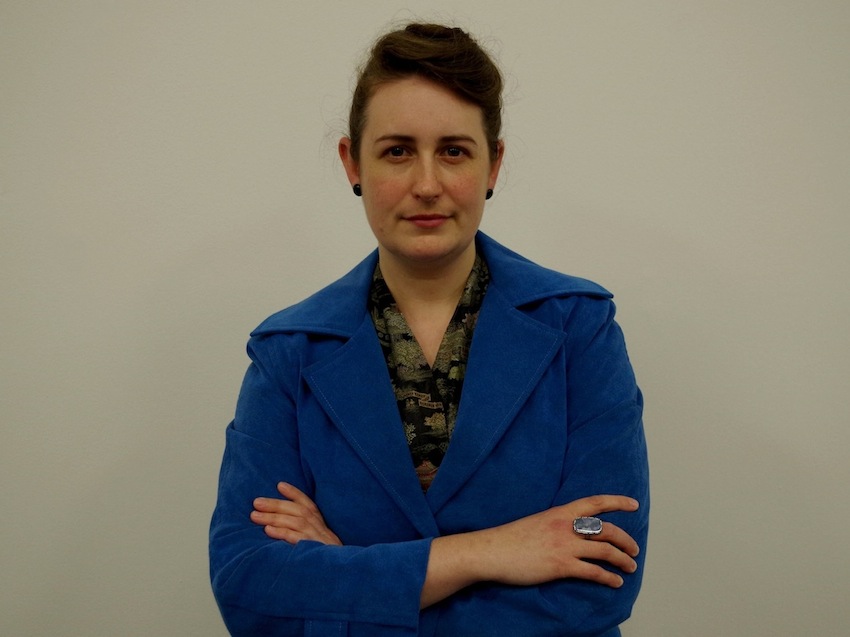
Anne Kennedy mugshot

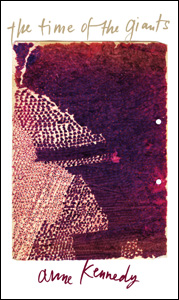
Anne Kennedy has many strings to her writing bow. She writes fiction, poetry and screenplays, and has gathered wide readership with her ability to draw upon a keen intellect, empathy, humour and a musical ear. This year she won the Poetry Category of The New Zealand Post Book Awards, with her collection The Darling North (Auckland University Press, 2012); a decision that delighted her poetry fans (Sarah Jane Barnett, who was also shortlisted, sung the praises of Anne’s poetry in a Listener interview). Anne’s debut collection, Sing-song (AUP, 2003)  won The Montana New Zealand Book Awards and her follow-up, The Time of the Giants (AUP, 2005), was short-listed. Very few New Zealand poets have received such sustained honours (perhaps Cilla McQueen?). This year also saw the release of her critically acclaimed novel, The Last Days of the National Costume. Anne has spent a number of years teaching fiction and screenwriting at the University of Hawai’i, as well as teaching part-time at Manukau Institute of Technology.
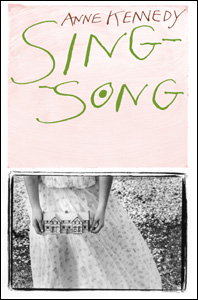
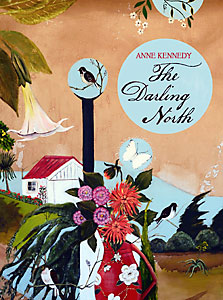
cp-sing-song cp-the-time-of-the-giants cp-the-darling-north

Anne’s poetry is a joy to read. While you might find traces of similarity, her poetry is unlike  that of any other New Zealand poet. Narrative energy is at the heart of her poems, poems that range from long to longer to book length. Her poems emerge from a life of reading and the reading of life. In ‘The Darling North’ poem there is a strong debt to Frederick E Manning’s Old New Zealand along with North by Seamus Heaney (she acknowledges these debts in her endnote), but the poem reaches deep into other experiences. There is a vivacity of detail, words that tremble and surprise on the line, a movement that is as much onwards as it is hesitation. Onwards, because you are in the sway and swerve of narrative motion, hesitation because the elasticity and surprise of words stalls you. Each line is a musical haven, where a note is struck and then counterbalanced or echoed or augmented:

I put my coat on over my nightdress and navigate

the trembling upper veranda, its nervous


kauri planks penned like wild horses under my feet

and I bounce down the foaming moonlit steps


to the garden, where a cat scallops, and hedgehog

snuffles obliquely into flax. It is cool.


Anne kindly agreed to an interview for Poetry Shelf:

Did your childhood shape you as a poet? What did you like to read? Did you write as a child? What else did you like to do?

To me, writing is partly about searching, and that’s what I was brought up to do. There were always books, and they were treasured (from Paradise Lost to A Town Like Alice), but I don’t know how anyone got time to read them because the house was busy with people, debate, drama. Looking back, we contended with philosophical gulfs on a daily basis: My parents came from different social classes, the Sixties happened, and in those days the Catholic schools peddled a sense of difference from mainstream society. (I don’t know if this was good or bad, but the artist needs to stand apart some of the time, if we are to believe Bourdieu). Overall, everything was up for question, and so the thing was to keep on searching.

One day, not long after I started school I, realized with a rush that if you could write, you could write a book. I threw a sickie (easy in our house), and wrote a tiny poem book (in Anne Carson’s ‘off hours’) in which every page ended in the sound ‘ee’. I was very proud of it and after that never stopped writing.

I don’t think we can underestimate how important literacy is, ‘in the first place’ (to quote Janet Frame), for creative writing. A while back, people were chuckling over John Key handing out Prime Minister’s awards for ‘literacy’ to three of our most eminent writers. No doubt he meant literature, but there’s some truth in the mistake. It all begins with being given the power to read and write well, yet more and more children miss out. I’m lucky that being taught early on meant the page represented freedom, only freedom. I’ve taught students who are intensely creative and great wordsmiths but struggle to translate that into writing because they’ve been failed by the education system.

Poetry on the page begins when you are five.

I was never without a novel (Rosemary Sutcliffe, C. S Lewis, Dodie Smith) , but when I was about seven I was given Peacock Pie, a collection of little story poems for children by Walter de la Mare, which I loved, and worse, copied. Later I was given an anthology for kids called This or That or Nothing, which was more confronting, with poems about nuclear bombs and suicide. It had an assortment of wonky fonts and a bright orange cover – very 1968. Poetry suddenly seemed subversive and shocking. I lived in that book for a year – and also copied it shamelessly. This is how people learn, I just didn’t know it then. (This is why your work with children’s poetry is so important, Paula.)

There was also the Bible, listened to at Mass. (‘Consider the lilies of the field, they toil not neither do they spin.’) I don’t remember anyone ever cracking open the text themself: it was always aural, and the rhythms and the far-fetched stories are still with me. That might seem contradictory to my point about literacy, but literature is the spoken written down.

You had developed a substantial reputation as a fiction writer (innovative, musical, poetic, complex, with strong relations with the real world, imagined worlds, and literary worlds), before you published poetry. What drew you to this different form?

I always wrote poetry. My first two fiction books are partly in poem form, but yes, I did leap over a kind of doorstep. My fiction seemed to be being read by a poetry audience which is strangely more accepting. Also I felt like my fiction was a failure, and I needed to stop!

I agree that your fiction is sumptuous and poetic (no way a failure!) and generates a reading experience that is quite breathtaking. Your poems are narrative driven — as a reader I get caught up in the arc and sidetracks of the narrative impulse, but there is so much more going on (as with your fiction). On so many occasions, musicality is the poem’s lifeblood, along with luminous and often surprising detail, light-footed and shifting syntax, and snatches of story that draw people and places close. What are key things for you when you write a poem?

One of the key things is a kind of key, or a tonal centre. As a reader, I find myself looking for a departure from a central idea or theme and a return to it – there’s a glorious tension in that. I’m drawn to modern and contemporary narrative poets like Anne Carson, Albert Wendt, W. S. Merwin, Williams Carlos Williams, T.S. Elliot, and also and especially Virgil, who daringly stray a long way from ‘home’, but inevitably return. When Vela travels away from his time, his people, his seriousness, even his story, coming back is all the better.

While I can admire a short poem that is a thing in itself but not a story, I couldn’t write one to save myself. There would be so much pressure on it! A poem only lives for me if it is part of a network, a litany.

On a line level, I love the element of surprise, but also plainness, because surprise is only interesting when it is set like a gem. Ian Wedde is very good at this.

Yes! I think it is the plainness that elbows room in the surprise and the surprise that makes little leaps in the plainness. You continue to write poetry, you continue to write fiction. Is this a supportive relationship? What is different about doing one rather than the other?

I wish I knew, and I’d stick to one or the other, probably fiction! Sometimes I try to work out the differences between the genres but can never get very far.

What poets have mattered to you over the past decades? Some may have mattered as a reader and others may have been crucial in your development as a writer.

            My brother, Philip, was the first adult poet I read. Most of what we still have of his was written in his teens. He died at 22. I’m working on a sequence grouped around one of his poems, which I find a very moving experience. It’s taking me a long time. (I hope I haven’t jinxed it by talking about it.)

There were poetry books in the house because of Philip: Hone Tuwhare, James K Baxter, Sam Hunt, who were so important for their New Zealand vernacular – and because they are incredibly good. But they’re all men, and as I got older I sought out women poets – Anne Sexton, Sylvia Plath, Maya Angelou, and imagist poets like H. D.

When I first read Gertrude Stein, it was like a wall crashing down. But another went up, a Steinish wall: I think I embarked on a years-long phase of not caring about the reader. I put it down to not caring enough about people. Emotional maturity is important in a writer.

All these poets I read as a reader and as a writer. I don’t separate the two.

Perhaps this emotional maturing strengths the presence of heart in the risks you take as a writer. What New Zealand poets are you drawn to now?

Some young poets I’ve noticed recently make you swell with the knowledge that this business is in good hands: Sarah Jane Barnett, Amy Brown, Ya-Wen Ho, Courtney Sina Meredith, Steven Toussaint, Ashleigh Young. And Ellie Catton’s The Luminaries is intensely poetic. I read it in the same way as I do a poem.

I agree with you on The Luminaries. A number of reviews have used the word ‘luminous.’ Poetically luminous, at the level of the sentence for a start. Do you think your poetry writing has changed since Sing-song was published in 2003?

I hope so. I hope I’ve got better, but you can never really know. As Flannery O’Connor says, ‘Mystery isn’t something that is gradually evaporating. It grows along with knowledge.’


You have spent the past decade living between New Zealand and Hawaii. Is a sense of home an important factor as you write?  I wonder if your writing is a way of laying down roots, both familial and literary. Or do you feel torn between places and thus restless as a writer?

            I laid down roots through writing a long time ago, and moved on from that. I think that’s quite a common pattern. But moving between countries, having two realities, has undoubtedly played into the collision of worlds that the imagination continues to be.

Do you think the poetry writing landscape in New Zealand is vastly different than that in Hawaii? Is ethnicity or race an issue?

Ah, this is all so complicated! Ethnicity is a hot issue in Hawai`i. People talk about it constantly, and are defined by it (‘that Chinese girl’ kind of thing), which is at once refreshing and difficult. And of course poetry lives in that world. One of the big recent movements is Pidgin poetry, which has such a gorgeous sound because it is essentially a spoken language. Two of my favourite Local poets who write in Pidgin are Lois Ann Yamanaka (who also writes novels), and Ann Inoshita: ‘Going come dark so my madda call me / fo go back inside da house’ (‘TV’). Indigenous Pacific poetry with a political drive is also strong in Hawai`i, with poets like Brandy McDougall, Craig Santos Perez, and Robert Sullivan, being part of the Pacific-wide picture. (See my piece on Hawai`i poetry in Ka Mate Ka Ora: http://www.nzepc.auckland.ac.nz/kmko/03/ka_mate03_kennedy.pdf)

On returning to Aotearoa, I remembered that ethnicity is like sex, you can’t talk about it publicly. And yet, this is a very racist country. Maori and Polynesian poetry, and in fact all non-white poetry, is largely ghettoized. I’ve been shocked to be involved in event after event that is entirely white. I’d forgotten that could even happen. So while it is considered tasteless to mention ethnicity, people happily exclude based on it.

I put this racism down to a reluctance to entertain different aesthetics. The kind of poetry I like is ABOUT being open to difference, to different codes, to different musics.

Pakeha writers have got to hope that when they are in the minority, which will happen eventually, the people in the majority remain open to the aesthetics of other.

What irks you in poetry?

The ‘isn’t-my-life-lovely’ poem.

What delights you?

Curious narrative. Hidden form. Tossed-offness. Humour. And the thing I didn’t know would delight me until I read it.


Name three NZ poetry books that you have loved.

It’s probably too nepotistic of me to mention Voice Carried My Family, by Robert Sullivan, so: Wild Dogs Under My Skirt, by Tusiata Avia; Thicket, by Anna Jackson; The Lifeguard, by Ian Wedde.

Name three overseas poetry books that you have loved.

I’ll limit myself to North America for now: Glass, Irony, and God, by Anne Carson; Povel, by Geraldine Kim; Rebellion is the Circle of a Lover’s Hands, by Martín Espada.

The constant mantra to be a better writer is to write, write, write and read read read. You also need to live! What activities enrich your writing life?

Being with family trumps everything.

But lots of other things. If you feed only off creative writing and its world, you might end up with the literary equivalent of mad cow disease.

Some poets argue that there are no rules in poetry and all rules are to be broken. Do you agree? Do you have cardinal rules?

Form is a kind of gravity. If there wasn’t any, everything would fly away. I enjoy formal constraints and the freedom to muck them up. For instance, in The Family Songbook John Newton’s handling of meter is spectacular, and yet the lines on the surface seem roughed up in best possible sense. That kind of controlled spokenness I can only dream of writing.

In the end, the elements of a poem are there for the greater good. I like Eavan Boland’s quite essentialist take on what images do in a poem: ‘Images are not ornaments; they are truths.’

Do you find social media an entertaining and useful tool or white noise?

How could we live without it now? It brings people together in new configurations. Also, the written word is lifeblood again. It was languishing for a while there.

You have dedicated significant time to teaching creative writing at The University of Hawaii and, in a more part time role, at Manukau Institute of Technology. What do you see as important in your role as mentor?

I think I’m there to open some conceptual doors. It took me a while to work out process. Teaching is like constructing a narrative – in what order should you introduce ideas so they make sense? I’ve spent a lot of time trying to get this right, usually using close readings of texts. It’s exhilarating to have a class share a text, to get it, enjoy it, learn from it. (I got some of that just from reading and talking to people, but you don’t get a degree from hanging out with friends!)

I was surprised to find that I like teaching students who will probably not end up as writers, it’s just something that will enrich their lives. But of course it is also incredibly exciting to work with someone who is dripping with talent.

Women writers have often managed a writing life along with domestic demands and have been denigrated for writing that embraces domestic concerns. Any thoughts on this? Is there still a case for feminist appraisals of writing and the institutions that both reproduce and critique it?

Poetry isn’t sealed off from daily life, so until women have equal pay, equal opportunity, and don’t have to live in fear, feminist principles must have a place in writing and criticism. Although women poets are published in greater numbers now in Aotearoa (it could hardly be fewer than when it was just Jan Kemp!), there’s still chauvinism, still old farts and not so old farts who view women’s domestic-themed poetry as ‘soft’.

The big names of poetry are still mostly men, and the theorists we revert to are men even though there’ve been generations of feminist theorists now.

When I was young, feminist poets and theorists were vital to my vision of myself as a writer. To my list above I could add Denise Levertov, Anna Akhmatova, Anne Waldman, and Hélène Cixous, Elaine Showalter, and Simone de Beauvoir. I don’t think I would be in print without them. I’m worried we may have stopped making consciously feminist poetry too soon. But Pasifika women seem to not have forgotten the struggle. Tusiata Avia, Selina Tusitala Marsh, Courtney Sina Meredith are inspiring a new generation of young women.

Finally if you were to be trapped (in a waiting room, on a mountain, inside on a rainy day) for hours what poetry book would you read?

As long as I can be trapped from November on, Bernadette Hall’s forthcoming book, Life & Customs.

Thank you, Paula.

Thank’s Anne. Bernadette’s book is due in November and is published by Victoria University Press. I will review it on Poetry Shelf.

Links:

Auckland University Press page

New Zealand Book Council page

Scottish Poetry Library introduction to Anne Kennedy

Anne Kennedy on the New Zealand Electronic Poetry Centre

Anne Kennedy’s author page at Allen and Unwin

Anne Kennedy on the New Zealand Electronic Text Centre

Anne Kennedy in Best New Zealand Poems 2005

Anne Kennedy’s bibliography in the Auckland University Library’s New Zealand Literature File

NZ on Screen page

Interview for Unity Books

Review of The Darling North in Metro

Review of The Darling North in Landfall

Review of The Darling North in NZ Books

Review of The Darling North in The Listener

Eleanor Catton Every now and then you get to read a novel that elevates you far beyond the bric-a-brac of everyday routine

BWpVIpJCQAAlo9p  BWpVIpJCQAAlo9p

Earlier this year I got a proof copy of Eleanor’s book to review for the Herald. It was, as my review attests, an extraordinary reading experience. It seemed to be a significant and vital contribution to the local literary landscape let alone the wider global setting. To sit glued to the TV this morning, with twitter alongside, to hear her announced as winner and to follow her speech (so composed, thoughtful, inspirational) was pinch-your-self-material. Even from this far, from out from the city and its hubbub of life, from bookshops and libraries and book chat, I wanted to leap for joy. This is a marvelous book, and its author inhabits this world with a rare mix of graciousness, humility, courage, outspokenness, daring, warmth and kindness. These qualities mark her as a person (as they did with Margaret Mahy), but they also mark her writing. In her speech, she contrasted the need to write for money and the need to write with other values in mind. Eleanor writes out of love — out of a love of writing and words, but equally importantly, out of a love of humanity, her close friends and family, and then beyond. Cheers!

_70501637_eleanorcatton_getty

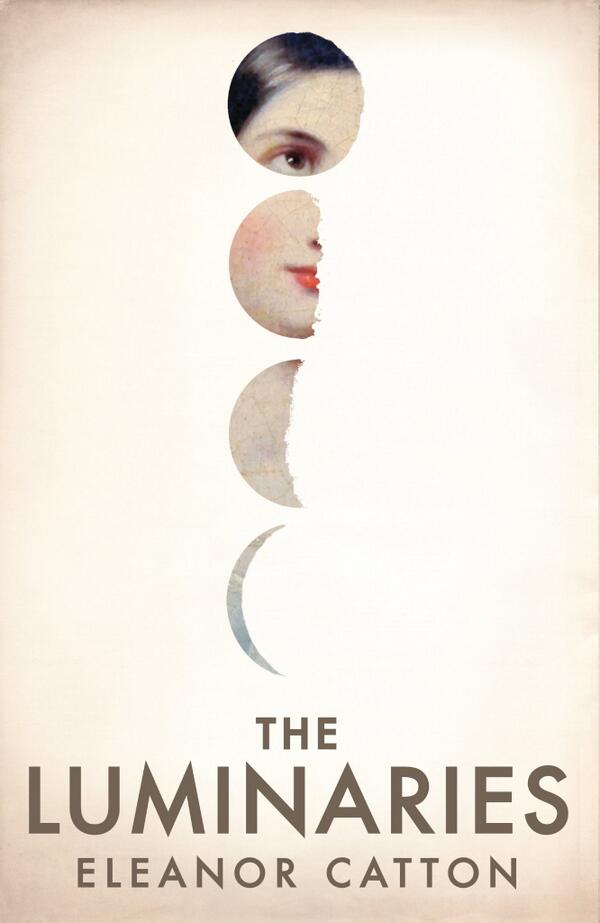
The Luminaries by Eleanor Catton
(Victoria University Press hardback $45/paperback $35)

Every now and then you get to read a novel that elevates you far beyond the bric-a-brac of everyday routine, takes you apart, reassembles you, and leaves you feeling as though you have been on holiday with a genius.

Eleanor Catton’s astonishing new novel, The Luminaries, does just that. It was no surprise to me, really, because her debut novel, The Rehearsal, was daring, fresh, beautifully crafted and award-winning. It has been translated into 12 languages.

Don’t let the hefty size put you off (more than 800 pages) because you enter the world of a novelist who, in her late 20s, writes with such wisdom, compassion, elegance and craft you don’t want to depart that world in a hurry.

See the rest of my Herald review here.